• 검색 결과가 없습니다.

RESULTS: Muscle activity within both groups after intervention using self-stretching or passive stretching exercise was significantly different (p < .05)(p < .01). Neck alignment of both groups was significantly different (p <

N/A
N/A
Protected

Academic year: 2021

Share "RESULTS: Muscle activity within both groups after intervention using self-stretching or passive stretching exercise was significantly different (p < .05)(p < .01). Neck alignment of both groups was significantly different (p < "

Copied!
9
0
0

로드 중.... (전체 텍스트 보기)

전체 글

(1)


| Abstract |

1)

PURPOSE: The purpose of this study was to provide clinical basic data to reduce pain and improve function by comparing neck muscle activity and neck alignment using self-stretching and passive stretching exercises for chronic neck pain caused by forward head posture.

METHODS: The subjects were divided into 15 subjects assigned to perform self-stretching exercise and 15 subjects assigned to perform passive stretching exercise. The intervention was conducted for a total of 4 weeks. The muscle activity in the neck was measured by surface electromyography (EMG) before intervention, and craniovertebral and cranial rotation angles were measured by X-ray. The 4-week intervention was conducted and the above items re-measured in the same manner and analyzed.

본 논문은 백승윤(2020)의 석사 학위 논문의 요약본임.

†Corresponding Author : Seung-Yun Baek

[email protected], https://orcid.org/0000-0002-0473-2562 This is an Open Access article distributed under the terms of the Creative Commons Attribution Non-Commercial License (http://creativecommons.org/licenses/by-nc/3.0) which permits unrestricted non-commercial use, distribution, and reproduction in any medium, provided the original work is properly cited.

RESULTS: Muscle activity within both groups after intervention using self-stretching or passive stretching exercise was significantly different (p < .05)(p < .01). Neck alignment of both groups was significantly different (p <

.001)(p < .01). Further, muscle activities of the upper trapezius and splenius capitis muscles showed significant differences (p<.05). Lastly, neck alignment showed statistically significant difference (p < .05).

CONCLUSION: Self-stretching exercise activated motor nerves as a posture correction exercise, thereby improving inhibition of muscle activity, muscle contraction delay, and pathological conditions of the muscle. For future research, interventions of self-stretching exercise will be needed for patients with chronic back pain accompanied by forward head posture, and various clinical studies on postural improvement of forward head posture by maintaining a normal muscle tone state are needed.

Key Words: Muscle activity, Neck alignment, Self- stretching exercise

Research Article Open Access

자가 신장운동이 전방머리자세를 동반한 만성 목통증 환자의 자세개선에 미치는 영향

강정일⋅정대근⋅박승규⋅양대중⋅김제호⋅문영준⋅백승윤

세한대학교 물리치료학과, 1 정다운요양병원

Effect of Self-Stretching Exercises on Postural Improvement in Patients with Chronic Neck Pain Caused by Forward Head Posture

Jeong-Il Kang, PT, PhD⋅Dae-Keun Jeong, PT, PhD⋅Seung-Kyu Park, PT, PhD⋅Dae-Jung Yang, PT, PhD⋅

Je-Ho Kim, PT, PhD⋅Young-Jun Moon, PT, PhD 1 ⋅Seung-Yun Baek, PT, MS Department of Physical Therapy, Sehan University, 1 Jungdaun Hospital

Received: March 2, 2020 / Revised: March 25, 2020 / Accepted: April 9, 2020

ⓒ 2020 J Korean Soc Phys Med

(2)

Ⅰ. 서 론

현대사회는 컴퓨터와 스마트폰의 사용시간이 증가 함에 따라 근골격계의 질환에 노출되어 있다 [1]. 특히 머리를 숙인자세로 장시간 동안 스마트폰을 사용하게 되면 목뼈의 앞굽음각이 소실되어 이에 따른 기능이상 을 동반한다[2].

목의 잘못된 자세는 목뼈에 가해지는 스트레스가 증가되어 목뼈 관절의 위치변화를 가져오고, 척추 중심 선 보다 머리가 전방으로 위치하게 되어 상부목뼈의 폄과 하부목뼈의 굽힘이 동반되는 전방머리자세가 나 타나게 된다[3]. 전방머리자세는 머리척추각은 감소되 고 머리회전각은 증가되는데[4], 일반적으로 머리척추 각이 50° 보다 작고 머리회전각이 145° 보다 크면 진단 을 내릴 수 있다[5]. 이처럼 목의 비정상적인 각도 변화 는 관절뿐만 아니라 목 주위 근육들에도 악영향을 미치 는데[6,7], 목의 안정화에 관여하는 깊은근육들은 근활 성도가 감소하게 되고 반대로 표면근육들은 과도한 근 활성도가 나타나는 근육의 불균형을 초래하게 된다 [8,9]. 이러한 목 주위 근육과 연부조직에 과도한 긴장은 근활성도 변화와 함께 근섬유사이의 혈관들과 말초신 경들이 동시에 압박되어 목통증이 동반될 수 있다[10].

목통증은 목의 움직임을 제한시킴으로써 근력과 지구 력 약화로 목의 기능부전이 나타나게 되는데 목통증이 3개월 이상 지속되면 만성목통증으로 진행되어 원활한 일상생활에 제약을 초래한다[11-13].

전방머리자세의 증상을 중재하기 위해서는 잘못된 습관의 개선과 바른자세에 대한 인식이 선행되어야 하 며, 이를 위한 물리치료적 중재방법으로는 맥켄지운동, 신장운동, 견인치료 등이 임상에서 적용되고 있다 [14-16]. 특히 맥켄지운동은 자가 신장운동방법 중 하나 로써 환자 스스로 긴장된 근육을 이완시킴으로 자세교 정이 되고, 목 정렬 개선에 효과적인 중재방법으로 제 시되고 있다[17,18].

전방머리자세는 표면근육들이 과도한 근활성도와 함께 바르지 못한 자세로 머리를 지지하기 때문에 일상 생활하는 동안 불편함을 호소하게 된다. 이러한 증상을 치료하기 위해서는 여러 선행연구들에서 다양한 중재

방법이 보고되었으나 어느 중재방법이 더 효율적인가 에 대한 논쟁은 지속되고 있다. 따라서 환자가 능동적 으로 중재하는 자가 신장운동과 치료사나 기계로 중재 하는 수동 신장운동을 4 주간 중재하여 전방머리자세 를 동반한 만성 목통증 환자의 근활성도와 목 정렬에 미치는 요인을 분석하여 기능회복에 관련된 효과 검증 및 이에 대한 임상적 기초자료를 제공하고자 한다.

Ⅱ. 연구방법

1. 연구대상

본 연구는 기관생명윤리위원회의 승인(SH-IRB 2019- 32) 을 받고 2019년 4월부터 7월까지 전라남도에 소재한 M 병원에서 외래 치료중인 25 ~ 45세 연령범위의 머리 척추각이 49° 이하이고 머리회전각은 145° 이상인 전방 머리자세를 동반한 만성 목통증 환자 30명의 성인 남성 을 대상으로 하였다. 본 연구의 대상은 신경외과 수술 을 받지 않은 자, 정신적, 인지적 문제가 없는 자, 오른손 이 우세손인 자로 본 연구의 목적을 이해하고 연구에 참여하기로 동의한 자를 대상자로 선정하였다.

2. 실험방법

1) 연구설계

전방머리자세를 동반한 만성 목통증 환자 30명을 임상 표본추출하여 자가 신장운동을 중재한 집단 15명 과 수동 신장운동을 중재한 집단 15명으로 무작위 배치 한 후 4주 간, 주 3회, 1일 1회, 1회 30분 간 중재를 시행하였다. 중재 전 목 주위 근활성도를 분석하기 위 해 표면근전도(MP 100, Biopac system, USA)로 목빗근, 앞목갈비근, 위등세모근, 머리널판근의 근활성도를 측 정하였고, 목 정렬을 분석하기 위해 X-ray로 머리척추 각과 머리회전각을 측정하였다. 그리고 4주 간 중재를 한 후, 이들 항목을 동일하게 재 측정하여 비교분석하 였다.

(1) 근활성도 측정

목 근육의 근활성도를 측정하기 위해 표면근전도의

(3)

4 채널을 사용하였으며, 근전도 신호 수집을 위한 표본 추출율(Sampling rate)은 1,000 ㎐로 하였고, 주파수 대 역 여과 필터(Notch filter)는 60 ㎐, 주파수 대역필터는 30 ∼450 ㎐ 설정하였다. 표면전극을 사용하여 목빗근 은 꼭지돌기와 복장뼈 위쪽패임의 중간지점에 전극을 부착하고 앞목갈비근은 근육 섬유가 평행하게 움직이 는 방향으로 목빗근의 빗장뼈 부분의 외측 경계에 부착 하였으며, 위등세모근은 제7번 목뼈 가시돌기와 어깨 뼈 봉우리 사이 중간지점의 근복(Muscle belly)에 근섬 유와 평행한 방향으로 2 ㎝ 간격으로 부착하고 머리널 판근은 제7번 목뼈와 같이 제4번 목뼈로 외측 약 2㎝

지점에 부착하고 실시하였으며, 신호획득 전에 능동적 으로 목의 관절 굽힘과 폄 운동을 실시하여 각 채널에서 입력되는 근활성도 신호가 이상이 없는지 확인하였다.

기준동작 측정은 의자에 편하게 앉은 자세에서 양팔을 몸통 옆에 놓게 하고 일정한 자세를 유지하게 하여 15초 동안 측정하고, 시작과 끝 5초를 뺀 5초 구간을 3회 분석한 후 실효치 진폭값의 평균을 기준동작의 수치값 으로 설정하였고, 특정동작은 의자에 앉은 자세로 몸 통, 골반, 다리가 일직선상이 되도록 정렬을 맞추고 어 깨관절의 90° 굽힘과 팔꿉관절 폄 상태로 양손에 2㎏

아령을 들고 15초 동안 유지하도록 한 후 각 근육에서 근전도 신호를 3회 반복하여 평균값을 적용하였으며 [19], 대상자들에게 피로를 방지하기 위해 측정 간 2분 의 휴식시간을 주었다. 이를 특정 동작 시 RMS의 평균 값 / 기준 동작 시 RMS의 평균값 × 100으로 %RVC (%reference voluntary contraction)값으로 적용하였다 [20](Fig. 1).

(2) 목 정렬 측정

대상자가 편안하게 선 자세에서 머리는 자연스럽게 유지하게 하고, 양팔은 이완하여 체간 옆에 놓고 어깨 와 팔 근육들을 최대한 이완시킨 상태에서 편안하고 자연스런 자세를 취하도록 한 후, X-ray (CXD-RD850D

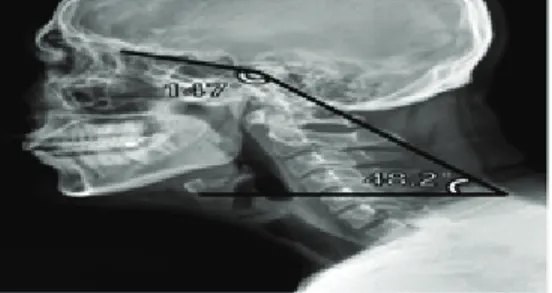
Ⅱ, Korea)로 측면 1 m 거리에서 촬영을 하였다. X-ray 촬영 후 각도 측정을 위해 Picture Archiving and Communications System(PACS, USA)를 사용하였고, 대 상자의 제 7목뼈와 귀구슬(Tragus), 그리고 눈의 외측 눈구석(Canthus)에 직선을 그어 머리척추각, 머리회전 각을 측정하였다. 일반적으로 전방머리자세를 가지고 있는 대상자는 머리척추각은 작은 각도와 머리회전각 은 큰 각도를 나타낸다[4](Fig. 2).

Items Self-Stretching Exercise Group (n = 15) Passive Stretching Exercise Group (n = 15)

M ± SD M ± SD p

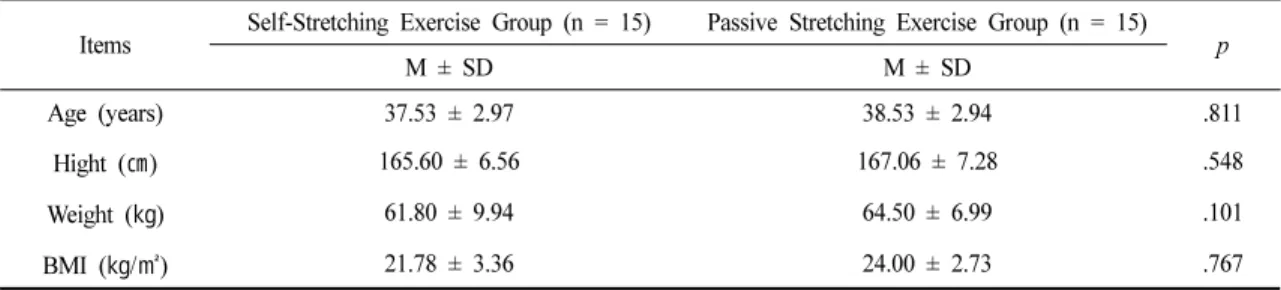
Age (years) 37.53 ± 2.97 38.53 ± 2.94 .811

Hight (㎝) 165.60 ± 6.56 167.06 ± 7.28 .548

Weight (㎏) 61.80 ± 9.94 64.50 ± 6.99 .101

BMI (㎏/㎡) 21.78 ± 3.36 24.00 ± 2.73 .767

Table 1. General Characteristic of Study Subjects

Fig. 1. Measurement of muscle activity according to %RVC value.

(4)

3. 중재방법

1) 자가 신장운동

본 연구의 자가 신장운동은 7가지 동작을 시행하였 다[21](Fig. 3).

2) 수동 신장운동

바로 누운 자세에서 견인치료기를 이용하여 간헐적 인 목 견인과 치료사가 도수로 목빗근, 앞목갈비근, 위

등세모근의 신장운동을 시행하였다[22-24](Fig. 3).

4. 자료분석

본 연구의 자료 처리는 Window용 SPSS 20.0을 이용 하여 연구대상자의 일반적 특성을 Shapiro-wilk로 정규 성 검정하였고, 집단 내 근활성도와 목 정렬의 변화비 교하기 위해 대응표본 t-검정(Paired t-test)를 사용하였 고, 집단 간 근활성도와 목 정렬의 변화비교를 위해 공분산분석(ANCOVA)를 사용하였다. 유의수준 α = .05 로 설정하였다.

Ⅲ. 연구결과

1. 자가 신장운동과 수동 신장운동의 집단 내 근활성도 변화 비교

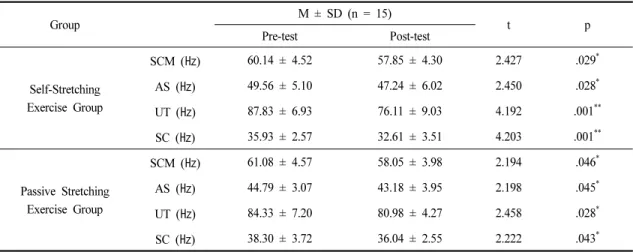
자가 신장운동의 집단 내 근활성도 변화 비교는 목빗 근, 앞목갈비근에서 근활성도가 유의하게 감소하였고 (p < .05), 위등세모근, 머리널판근에서도 근활성도가

Fig. 2. Craniovertebral angle, cranial rotation angle.

Fig. 3. Self-stretching exercise and passive stretching exercise.

(5)

유의하게 감소하였다(p < .01). 그리고 수동 신장운동의 집단 내 근활성도 변화 비교는 목빗근, 앞목갈비근, 위 등세모근, 머리널판근 모두에서 근활성도가 유의하게 감소하였다(p < .05)(Table 2).

2. 자가 신장운동과 수동 신장운동의 집단 간 근활성 도 변화 비교

자가 신장운동과 수동 신장운동의 집단 간 비교에서 는 자가 신장운동이 수동 신장운동 보다 위등세모근과 머리널판근의 근활성도가 유의하게 감소하였다(p <

.05)(Table 3).

3. 자가 신장운동과 수동 신장운동의 집단 내 목 정렬 변화 비교

자가 신장운동의 집단 내 목 정렬 변화 비교는 머리 척추각에서 유의하게 증가하였고(p < .001), 머리회전 각에서 유의하게 감소하였다(p < .001). 그리고 수동 신장운동의 집단 내 목 정렬 변화 비교는 머리척추각에 서 유의하게 증가하였고(p < .001), 머리회전각에서도 유의하게 감소하였다(p < .01)(Table 4).

4. 자가 신장운동과 수동 신장운동의 집단 간 목 정렬 변화 비교

자가 신장운동과 수동 신장운동의 집단 간 비교에서

Group M ± SD (n = 15)

t p

Pre-test Post-test

Self-Stretching Exercise Group

SCM (㎐) 60.14 ± 4.52 57.85 ± 4.30 2.427 .029

*

AS (㎐) 49.56 ± 5.10 47.24 ± 6.02 2.450 .028

*

UT (㎐) 87.83 ± 6.93 76.11 ± 9.03 4.192 .001

**

SC (㎐) 35.93 ± 2.57 32.61 ± 3.51 4.203 .001

**

Passive Stretching Exercise Group

SCM (㎐) 61.08 ± 4.57 58.05 ± 3.98 2.194 .046

*

AS (㎐) 44.79 ± 3.07 43.18 ± 3.95 2.198 .045

*

UT (㎐) 84.33 ± 7.20 80.98 ± 4.27 2.458 .028

*

SC (㎐) 38.30 ± 3.72 36.04 ± 2.55 2.222 .043

*

*p < .05, **p < .01

SCM, SternoCleidoMastoid ; AS, Anterior Scalene; UT, Upper Trapezius; SC, Splenius Capitis

Table 2. Comparison of Changes in the Neck Muscle Activity within the Self-Stretching Exercise Group and Passive Stretching Exercise Group

Items Self-Stretching Exercise Group (n = 15) Passive Stretching Exercise Group (n = 15)

F p

Pre-test Post-test Pre-test Post-test

SCM (㎐) 60.14 ± 4.52 57.85 ± 4.30 61.08 ± 4.57 58.05 ± 3.98 .007 .932

AS (㎐) 49.56 ± 5.10 47.24 ± 6.02 44.79 ± 3.07 43.18 ± 3.95 .071 .792

UT (㎐) 87.83 ± 6.93 76.11 ± 9.03 84.33 ± 7.20 80.98 ± 4.27 4.984 .034

*

SC (㎐) 35.93 ± 2.57 32.61 ± 3.51 38.30 ± 3.72 36.04 ± 2.55 5.199 .031

*

*

p < .05

SCM, SternoCleidoMastoid ; AS, Anterior Scalene; UT, Upper Trapezius; SC, Splenius Capitis Table 3. Comparison of Changes in Neck Muscle Activity between the Groups

(6)

는 자가 신장운동이 수동 신장운동 보다 머리척추각이 유의하게 증가하였고(p < .05), 머리회전각에서도 유의 하게 감소하였다(p < .05)(Table 5).

Ⅳ. 고 찰

일상생활에서 스마트폰이나 태블릿의 장기간 사용 은 목의 부담이 되어 구부정한 자세를 유발하며[25], 이러한 자세는 표면근육의 근활성도를 과도하게 증가 시킨다[26]. 따라서 바른 자세를 유지하기 위해서는 깊 은근육들을 활성화시키고, 표면근육들의 활성도를 감 소할 필요가 있다고 제시되고 있다[27].

자가 신장운동 방법 중 하나인 맥켄지운동은 목 주변 근육을 이완시키고 깊은근육 자극에 도움을 주어 목 주위 관절과 근육에 가해지는 스트레스를 감소시켜 자 세조절에 긍정적인 영향을 줄 수 있다[17,18]. 본 연구 결과 자가 신장운동과 수동 신장운동 모두 근활성도와 목 정렬에서 유의한 차이를 보였으며, 군 간 비교에서 는 자가 신장운동이 수동 신장운동 보다 통계학적으로

유의한 차이가 나타났다. 정모범[28]은 편타성 손상 환 자를 대상으로 맥켄지운동을 4주 간 중재하여 목의 근 활성도를 비교한 결과, 목빗근, 앞목갈비근의 근활성도 가 감소된다고 보고하였고, 김창현과 심재훈[15]은 전 방머리자세 환자 10명을 대상으로 수동 견인치료를 15 분 동안 중재하여 목의 근활성도를 비교한 결과, 목빗 근과 위등세모근의 근활성도가 감소됨을 보고하였으 며, 배원식 등[29]은 전방머리자세 20명을 대상으로 맥 켄지 운동군 10명과 어깨 안정화 운동군 10명으로 중재 한 후에 목의 근활성도를 비교한 결과, 자가 신장운동 군에서 위등세모근과 목널판근의 근활성도의 더 효과 적인 감소가 나타난다고 보고하였다. 그 이유는 자가 신장운동은 운동신경을 활성화시켜 근활성도의 억제, 근육의 병적상태가 개선되어 깊은근육의 근활성도는 증가하고 표면근육의 근활성도가 감소하는 성향을 보 여[30,31], 근육의 길이를 정상적으로 변화시키는 것으 로 판단된다.

Kim 등[32]은 전방머리자세 28명을 대상으로 맥켄 지운동과 근막이완술을 중재한 A 그룹 10명과 맥켄지

Group M ± SD (n = 15)

t P

Pre-test Post-test

Self-Stretching Exercise Group CVA 46.53 ± 1.25 53.07 ± 1.67 -12.682 .000

**

CRA 147.73 ± 1.62 143.17 ± 1.76 7.736 .000

**

Passive Stretching Exercise Group CVA 46.34 ± 1.35 51.80 ± .94 -15.043 .000

**

CRA 147.17 ± 2.89 144.84 ± 2.96 3.053 .009

*

*

p < .01,

**

p < .001

CVA, Craniovertebral Angle ; CRA, Cranial Rotation Angle

Table 4. Comparison of Changes in the CVA and CRA within the Self-Stretching Exercise Group and Passive Stretching Exercise Group

Items Self-Stretching Exercise Group (n = 15) Passive Stretching Exercise Group (n = 15)

F p

Pre-test Post-test Pre-test Post-test

CVA 46.53 ± 1.25 53.07 ± 1.67 46.34 ± 1.35 51.80 ± .94 6.119 .020

*

CRA 147.73 ± 1.62 143.17 ± 1.76 147.17 ± 2.89 144.84 ± 2.96 5.068 .033

*

*

p < .05

CVA, Craniovertebral Angle ; CRA, Cranial Rotation Angle

Table 5. Comparison of the Changes in CVA and CRA between the Groups
(7)

운동과 테이핑을 중재한 B 그룹 9명 그리고 맥켄지운동 과 근막이완술 그리고 테이핑을 중재한 C 그룹 9명으로 분류한 후에 4주 간 중재하여 머리척추각을 비교한 결 과, 모든 그룹에서 머리척추각이 증가함을 보고하였고, 오영택[3]은 전방머리자세 14명을 대상으로 맥켄지운 동군 7명과 스포츠마사지를 포함한 맥켄지운동군 7명 으로 분류한 후에 4주 간 중재하여 머리회전각을 비교 한 결과, 두 그룹 모두 머리회전각의 유의한 차이가 나타남을 보고하였으며, 박세연[23]은 전방머리자세 40명을 대상으로 메이틀랜드 정형도수물리치료군 20 명과 신장운동군 20명으로 분류한 후에 6주 간 중재하 여 머리회전각을 비교한 결과, 메이틀랜드 정형도수물 리치료군과 신장운동군 모두에서 머리척추각의 증가 와 머리회전각의 유의한 감소를 보고하였다. 그리고 최영준과 황룡[33]은 전방머리자세 32명을 대상으로 자세교육을 포함한 목뼈 및 등뼈 신장운동 및 근력강화 운동군 16명과 자세교육만 중재한 대조군 16명으로 분 류한 후에 10주 간 중재하여 머리척추각, 머리회전각을 비교한 결과, 목뼈 및 등뼈 신장운동 및 근력강화 운동 을 중재한 실험군이 자세교육만을 중재한 대조군에 비 해 머리척추각의 증가와 머리회전각이 유의하게 감소 함을 보고하였다. 그 이유로는 근육이 이완되면서 근원 섬유인 액틴과 미오신도 함께 늘어나 근육의 긴장을 감소시킴으로 반흔 조직을 제거하여 정상적인 근 길이 를 회복할 수 있고, 기계적 수용기에 적절한 자극으로 인해 목뼈의 앞굽음증 개선에 효과를 나타나기 때문이 다[34-37]. 이러한 선행연구들의 결과는 본 연구의 결과 를 뒷받침해 줄 수 있다. 따라서 본 연구의 자가 신장운 동은 긴장된 근육의 신장으로 운동신경을 자극하고 외 적인 모멘트 팔이 길어져 다른 근육들보다 근활성도에 민감하게 작용하는 머리널판근이 근활성도 감소함으 로써[38], 정상적인 근활성도 상태를 유지하여 목 정렬 개선에 더 효과적이라는 결과를 도출 할 수 있었다.

본 연구의 제한점으로는 일생생활이나 복용약물을 통제하지 못했기 때문에 연구 결과에 영향을 미칠 수 있다는 점과 연구 대상자들을 1개 의료기관 내로 하였 고, 25~45세의 연령범위로 하였기에 모든 연령대의 전 방머리자세를 동반한 만성 목통증 환자에 대한 일반화

하기에는 한계가 있다는 점이다.

Ⅴ. 결 론

자가 신장운동군과 수동 신장운동군 집단내에서는 모두 근활성도와 목 정렬에서 통계학적으로 유의한 차 이가 나타났지만, 자가 신장운동군이 수동 신장운동군 보다 위등세모근과 머리널판근의 근활성도 감소와 목 정렬 개선에 보다 효과적으로 작용 할 수 있었다. 향 후 전방머리자세를 동반한 만성 목통증 환자들의 자세 개선을 위해 자가 신장운동에 대한 중재가 필요할 것이 며, 전방머리자세의 자세개선에 대한 다양한 임상 연구 들이 필요할 것으로 판단된다.

Acknowledgements

본 논문은 2020년 세한대학교의 학술연구비에 의하 여 지원되었다.

References

[1] Kanchanomai S, Janwantanakul P, Pensri P, et al.

Prevalence of and factors associated with musculoskeletal symptoms in the spine attributed to computer use in undergraduate students. Work. 2012:43(4);497-506.

[2] Berolo S, Wells RP, Amick IIIBC. Musculoskeletal symptoms among mobile hand-held device users and their relationship to device use: a preliminary study in a Canadian university population. Ergonomics Research Society. 2011:42(2);371-8.

[3] Oh YT. Effect of McKenzie Stretch Exercise and Sports Massage on the Forward Head Postur. Archives of Orthopedic and Sports Physical Therapy. 2018:14(2);91-7.

[4] Shon MJ, Roh JS, Choi HS, et al. The Effect of Postural Training through Action Observation on Craniovertebral Angle and Cranial Rotation Angle of Forward Head Posture. Journal of Korean Physical Therapy Science.

2012:19(2);17-24.

(8)

[5] Chansirinukor W, Wilson D, Grimmer K, et al. (2001).

Effects of backpacks on students: measurement of cervical and shoulder posture. The Australian journal of physiotherapy. 2001:47(2);110-6.

[6] Sahrmann S. Diagnosis and treatment of movement impairment syndromes. Elsevier Health Sciences. 2001;

1-459.

[7] Neumann DA. Kinesiology of the musculoskeletal system-e-book: foundations for rehabilitation. Elsevier Health Sciences. 2013;1-725.

[8] Khayatzadeh S, Kalmanson OA, Schuit D, et al. Cervical spine muscle-tendon unit length differences between neutral and forward head postures: biomechanical study using human cadaveric specimens. Journal of the American Physical Therapy Association. 2017:97(7);756-66.

[9] Katherine H, Cheryl L. Effectiveness of an exercise programto improve forward head posture in normal adults:

A randomizedcontrolled 10-week trial. J Man Manip Ther.

2005:3(3);163-76.

[10] Nejati P, Lotfian S, Moezy A, et al. The study of correlation between forward head posture and neck pain in Iranian office workers. International journal of occupational medicine and environmental health. 2015:28(2);295-303.

[11] Cho WH, Lee WY, Choi HK, et al. An Investigation on the Biomechanical Effects of Turtle Neck Syndrome through EMG Analysis. Proceedings of the Korean Society of Precision Engineering Conference. 2008:(11);195-6.

[12] So YJ, Woo YK. Effects of Smartphone Use on Muscle Fatigue and Pain and, Cervical Range of Motion Among Subjects With and Without Neck Muscle Pain. Physical Therapy Korea. 2014:21(3);28-37.

[13] Jang JW. The effects of sling exercise and mckenzie exercise on forward head posture. Master’s degree.

Graduate School of Sahmyook University. 2017.

[14] Noh HJ, Shim JH, Jeon YJ. Effects of neck stabilization exercises on neck and shoulder muscle activation in adults with forward head posture. International Journal of Digital Content Technology and its Applications. 2013:7(12);

492-8.

[15] Kim CH, Shim JH. Comparison of the Effects of Cervical Mobilization Technique, Neuromuscular Release, and Cervical Traction on Cervical Alignment and Muscle Activity in People with Forward Head Posture. The Korean Academy of Neural Rehabilitation. 2016:6(2);9-18.

[16] Wickstrom BM, Oakley PA, Harrison DE, et al.

Non-surgical relief of cervical radiculopathy through reduction of forward head posture and restoration of cervical lordosis: a case report. Journal of physical therapy science. 2017:29(8);1472-4.

[17] Al-Obaidi SM, Al-Sayegh NA, Nakhi HB, et al.

Effectiveness of Mckenzie intervention in chronic low back pain: a comparison based on the centralization phenomenon utilizing selected bio-behavioral and physical measures. International journal of physical medicine &rehabilitation. 2013:1(128);2.

[18] Warude T, Shanmugam S. The effect of Mckenzie approach and Mulligan’s Mobilisation (SNAGS) in lumbar disc prolapse with unilateral radiculopathy.

International Journal of Science and Research. 2014:39 (4.89);38-93.

[19] Wegner S, Jull G, O’Leary S, et al. The effect of a scapular postural correction strategy on trapezius activity in patients with neck pain. Manual therapy. 2010:15(6);

562-6.

[20] Kim EK. The Effect of Bodyblade Training on Body Alignment of Neck and Shoulder, Muscle Activity, Stability, and Foot Pressure at Forward Head Posture.

Doctor's degree. Graduate School of Daegu University.

2015.

[21] Choi SY. The effect of cervical traction, cranial rhythmic impulse, McKenzie exercise program apply to episodic tension type headache patients on headache and cervical muscle tone. Master’s degree. Graduate School of Welfare Management at Namseoul University. 2016.

[22] Park JW, Park YK. Cervical Traction. The journal of

Korean Society of Physical Therapy. 1991:3(1);203-9.

(9)

[23] Park SY. The Effects of Maitland Orthopedic Manual Physical Therapy and Stretching on Neck Posture and Pain, Range of Motion of Forward Head Posture. Master’s degree. Graduate School of Yongin University. 2015.

[24] Byun SH, Han DW. The Effects of passive stretching exercise of the scalene muscles on forced vital capacity.

Journal of the korean society of physical medicine.

2016:11(1);35-43.

[25] Greig AM, Straker LM, Briggs AM, et al. Cervical erector spinae and upper trapezius muscle activity in children using different information technologies. Physiotherapy.

2005:91(2);119-26.

[26] Caneiro JP, O'Sullivan P, Burnett A, et al. The influence of different sitting postures on head/neck posture and muscle activity. Manual therapy. 2005:15(1);54-60.

[27] Cagnie B, O'leary S, Elliott J, et al. Pain-induced changes in the activity of the cervical extensor muscles evaluated by muscle functional magnetic resonance imaging. The Clinical journal of pain. 2011:27(5);392-7.

[28] Jeong MB. The effect of Sling or McKenzie exercise in cervical stabilization of whiplash injury on rear-end collision. Master’s degree. Graduate School of Honam University. 2016.

[29] Bae WS, Lee KC, Kim YH, et al. Comparison between McKenzie Stretch Exercise and Scapula Stability Exercise on Neck Muscle Activation in the Forward Head Posture.

Journal of the Korean Society of Integrative Medicine.

2016:4(1);13-20.

[30] Jang HJ, Kim HH, Chang HS, et al. The Effects of Combined Exercise Program for Patients with Chronic Neck Pain. Journal of the korean society of physical medicine. 2011:6(1);81-92.

[31] Lee SJ, Oh HH, Chae JS, et al. The Effect of Therapeutic Massage and Mckenzie Exercise on Pain and Range of

Motion in Chronic Neck Pain Patient: a Case Study.

Journal of Korean Physical Therapy Science. 2017:24(2);

61-70.

[32] Kim JY, Kim SJ, Shim JY, et al. Effects of McKenzie exercise, Kinesio taping, and myofascial release on the forward head posture. Journal of physical therapy science.

2018:30(8);1103-7.

[33] Choi YJ, Hwang R. Effect of Cervical and Thoracic Stretching and Strengthening Exercise Program on Forward Head Posture. The Journal of the Korea Contents Association. 2011:11(10);293-300.

[34] Han DH. Effect of Active Release Technique and Myofascial Release Technique on Pain, Neck disability index, Pressuere Pain threshold and Range of Motion in Patients with Chronic Neck Pain. Master’s degree.

Graduate School of Sahmyook University. 2018.

[35] Partanen JV, Ojala TA, Arokoski JP, et al. Myofascial syndrome and pain: a neurophysiological approach.

International Society for Pathophysiology. 2010:17(1);

19-28.

[36] Robb A, Pajaczkowski J. Immediate effect on pain thresholds using active release technique on adductor strains: pilot study. Journal of bodywork and movement therapies. 2011:15(1);57-62.

[37] Cho SH. The Effect of Myofascial Release Technique and Forward Head Posture Correction Exercise on Chronic Tension-Type Headache. Master’s degree. Graduate School of Pusan Catholic University. 2014.

[38] Oh HT. Effect of Support Spine of Neck Auto-Mobilization Training on Cervical Spine Alignment, Range of Motion and Muscle Activity in Adults with Forward Head Posture.

Doctor's degree. Graduate School of Daegu University.

2018.

수치

Fig. 1. Measurement of muscle activity according to %RVC value.
Fig. 3. Self-stretching exercise and passive stretching exercise.
Table 2. Comparison of Changes in the Neck Muscle Activity within the Self-Stretching Exercise Group and Passive  Stretching Exercise Group
Table 5. Comparison of the Changes in CVA and CRA between the Groups
참조

관련 문서

The purpose of this study is to evaluate the marginal and internal fit of coping made by CAD/CAM using different scanning methods.. Zirconia coping was made

Results after 4 weeks showed that both deep neck bending muscle exercise+general neck strengthening exercise group showed decreased pain and improved functional status

This study was to do a comparative analysis on kinematic differences and differences in muscle activity between the skilled and the unskilled in windsurfing

The purpose of this study was to investigate the lower extremity muscle strength and student health of male middle school students. Twenty middle school

The purpose of this study was to provide primary material in discussing methods to activate the treatment effects of diabetes and reduce the rate of

In the control group, lifestyle-related factors were significantly different only in blood glucose (p &lt;.01) and there was no significant difference in

The purpose and necessity of this study was to investigate the effects of lactic acid fatigue and body oxidation through myofascial relaxation exercise using small tools

Results: The results demonstrated a significant positive correlation between the muscle atrophy and the tendon tear.(p&lt;0.05) And there was statistically