Introduction
EMG can be performed with relative safety despite being painful for the patient. However, needle EMG does have the potential to cause adverse events, and an idiopathic or iatrogenic coagulation disorder is con- sidered a relative contraindication to needle EMG.
1,2Despite the possible risks, adverse events following needle EMG are often ignored since their frequency is extremely low. Due to its low cost and convenience compared with other examinations for assessment of nerve damage, needle EMG is still performed in cases with no absolute contraindication simply by weighing the benefits and risks.
We report the case of a female who was diagnosed with ACS by a hematoma that occurred after needle EMG on the lower extremity. We also report her subse- quent surgeries and a series of disputes, as well as the determination by the Korea Medical Dispute Mediation and Arbitration Agency.
CASE REPORT
ISSN 1229-6066 https://doi.org/10.18214/jkaem.2018.20.1.38 J Korean Assoc EMG Electrodiagn Med 20(1):38-41, 2018
J Korean Assoc
Electrodiagn Med EMG
Copyright © by Korean Association of EMG Electrodiagnostic Medicine
This is an Open Ac cess article distributed under the terms of the Creative Commons Attribution Non-Commercial License (http://creativecommons.org/licenses/by-nc/4.0) which permits unrestricted non-commercial use, distribution, and reproduction in any medium, provided the original work is properly cited.
Received December 18, 2017 Revised March 15, 2018 Accepted April 23, 2018
Corresponding Author: Ki Hun Hwang
Department of Physical Medicine and Rehabilitation, Dong Eui Hospital, 62 Yangjeong-ro, Busanjin-gu, Busan 47227, Korea
Tel: 82-51-867-5101, Fax: 82-51-867-5162, E-mail: [email protected]
근전도검사 이후에 발생한 전경골근의 혈종: 증례보고
문원식, 강인현, 최종경, 황기훈
동의의료원 재활의학과
A Case Report of Iatrogenic Hematoma on Anterior Tibialis Muscle after Electromyography
Won Sik Moon, In Hyun Kang, Jong Kyoung Choi, Ki Hun Hwang
Department of Physical Medicine and Rehabilitation, Dong Eui Hospital, Busan, Korea
Needle electromyography (EMG) is valid investigation routinely performed by physiatrists and neurologists, and quite safe when performed by an experienced examiner. Needle EMG is generally well tolerated and rarely thought to be associated with any significant side effects, other than mild pain, so practitioners usually overlook any potential complications.
However, needle EMG is an invasive procedure and under certain situations has the potential to be associated with bleeding complications such as hematoma or acute compartment syndrome (ACS). We report a case of ACS after EMG in the left lower extremity that led to a lawsuit. To prevent complications such as hematoma and ACS resulting from needle EMG, we should be familiar with the clinical features of ACS and perform immediate evaluation and treatment to improve patient prognosis.
Key Words: hematoma, electromyography, compartment syndrome
39
Won Sik Moon, et al. Iatrogenic Hematoma on Anterior Tibialis Muscle after Electromyography
Case Report
A 50-year-old female was admitted for hypoesthe- sia and pain in her left foot for 2~3 years. During her initial visit, she was using crutches and indicated that weakness in her left leg was severe, to the point where she would collapse after intermittent walking. She had a history of gout and Haglund’s deformity a few years earlier, for which she underwent surgeries for removal of typhi and bony prominence for each. In addition, she was taking psychiatric medication for insomnia and depression. She often took aspirin to control sudden episodes of pain, but had not taken any in the 2 weeks prior. Despite her complaints, actual muscle weakness and notable muscle atrophy in the left leg were not found on a manual muscle test. And her muscle tone and her patella and Achilles tendon reflexes were also normal. She had no specific findings on spinal magnet- ic resonance imaging (MRI) performed at another hos- pital. Laboratory studies revealed a hemoglobin level of 12.4 g/dl (normal, 12.0~14.3 g/dl), platelet count of 183 × 10
9per liter (normal, 169~365 × 10
9per liter), international normalized ratio of 1.01 (normal, 0.8~1.2), and an activated partial thromboplastin time of 38.4 s (normal, 27~45 s). We assumed her past history and current medical conditions were not related to her symptoms. Subsequently, EMG was performed for dif- ferentiation of lumbar radiculopathy, peripheral poly- neuropathy, and other disorders.
The deep peroneal and tibial motor nerve conduc- tion study and the superficial peroneal and sural sen- sory nerve conduction study showed normal latency, amplitude, conduction velocity, and normal findings were also seen in the late response. Needle EMG per- formed on the lumbar paraspinal muscles and left leg including the vastus medialis, anterior tibialis, peroneus longus, medial gastrocnemius muscles, with 26-gauge 50 mm monopolar needle electrode, showed no abnor- mal spontaneous activity and also normal motor unit action potentials were noted. About an hour after the test was completed, the patient complained of severe
left leg pain and hypoesthesia in the left foot. The pain was localized to the anterior tibialis muscle area where the needle EMG was performed. Swelling localized to the anterior tibialis muscle without any symptoms of infection such as fever, heat sensations revealed the possibility of a hemorrhage that formed a hematoma.
Presumably this, developed after the needle EMG, and other differential diagnoses such as cellulitis, deep vein thrombosis, arterial occlusion were ruled out.
Initial intracompartmental pressure (ICP) measured in the anterior tibialis muscle was 20 mmHg by the gold standard direct invasive measurement and the left dorsalis pedis artery was palpable. Therefore, the diagnostic criteria for ACS were not met at that point.
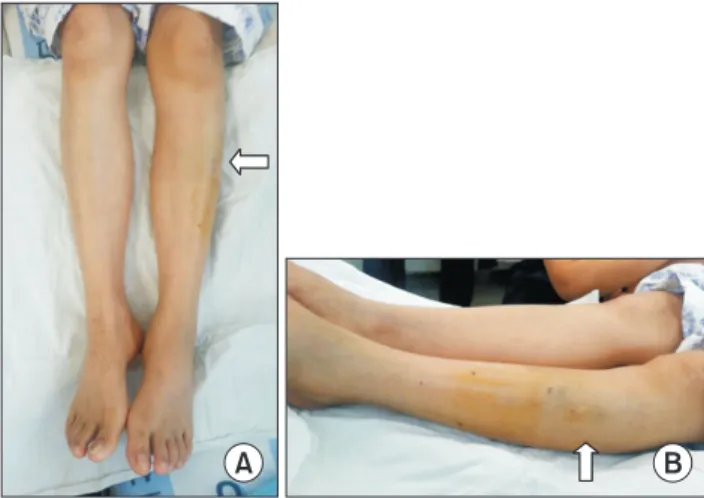
Initial treatment was performed using elastic bandage compression and ice packs, and progress was moni- tored, but the symptoms worsened, while swelling and ecchymosis were noted at the suspected lesion site (Fig. 1). MRI was performed on the left leg to confirm the problem immediately, approximately 7 hours had passed since the first symptoms occurred. An oval- shaped hematoma measuring 20 × 16 × 38 mm was found in the anterior tibialis muscle, but there was no evidence of compression on the anterior tibialis artery or vein or the deep peroneal nerve. In addition, injuries to the major arteries that can cause hematoma, such as
A B
Fig. 1. Swelling and ecchymosis are seen on left lower limb (arrow).
(A) Frontal aspects of lower extremity and (B) lateral aspect of lower extremity.
40
J Korean Assoc EMG Electrodiagn Med Vol. 20, No. 1, Jun. 2018
the peroneal or anterior tibial artery were not observed on MRI (Fig. 2). Approximately 12 hours after bleeding began, the pain and dysesthesia became more severe.
As a result, surgical treatment was deemed necessary and the department of orthopedic surgery was con- sulted to perform a fasciotomy and hematoma removal.
After surgery, the symptoms improved, but the surgi- cal fasciotomy wound was left open. Approximately 3 months of rehabilitation therapy was required as a re- sult of muscle weakness that developed after long-term bed rest for wound healing and suture removal. The patient was discharged when she was able to walk on her own with crutches and has now recovered to the point of being able to perform the tasks of daily living without assistive devices.
Discussion
A characteristic feature of intramuscular hematoma is edema, which is caused by interstitial fluid accumula- tion in the muscle due to the osmotic gradient created by blood pooling in a confined area. Pain, tenderness, and impaired muscle contraction and relaxation are also commonly present. Intramuscular hematoma may cause increased ICP and ACS.
ACS collectively refers to various symptoms that oc- cur when the tissue pressure within a closed muscle compartment exceeds the perfusion pressure to cause
muscle and nerve ischemia. ACS mainly occurs in the extremities, most often following trauma, such as a fracture.
3ACS can be diagnosed based on clinical fea- tures such as the 6 Ps: pressure, pain, paresthesias, paresis, pink skin, and presence of a distal pulse. And absence of these findings can be used to exclude the diagnosis of ACS.
4Without proper treatment ACS can lead to necrosis of intracompartmental muscle and nerves. Moreover, it can lead to a Volkmann contrac- ture in an extremity, while severe cases have the po- tential to cause renal failure and even death.
5Early di- agnosis and decompression are essential for successful treatment.
The current gold standard for diagnosis of ACS is in- vasive ICP measurement.
6ACS is suspected when ICP is ≥ 30 mmHg, while surgical treatment is considered when it reaches ≥ 40 mmHg. ICP measurement is a method in which a slit catheter or a similar needle is inserted in the muscle compartment to directly send measurements to a pressure transducer. As a second diagnostic tool, ultrasonography is a non-invasive mea- surement tool that can be useful in diagnosing ACS.
7It can be diagnosed by a variety of methods via ultra- so- nography. For example, measurement of pulsatile tis- sue motion using ultrasound has comparable diagnostic sensitivity and specificity to invasive measurements.
8Recording diastolic retrograde arterial flow via pulsed Doppler also correlates with the degree of pressure ap-
A B
Fig. 2. Transverse T1 weighted (A) and T2 weighted (B) left lower limb MRI scan demonstrates that hemorrhagic fluid collection in the intermuscular space at anterior tibialis muscle (20 x 16 x 38 mm).
41
Won Sik Moon, et al. Iatrogenic Hematoma on Anterior Tibialis Muscle after Electromyography
plied to the limb, suggesting that Doppler analysis of retrograde flow may be a useful tool for detecting and evaluating hemodynamics in potential ACS cases.
9A variety of possible complications may occur after needle EMG, and because it is an invasive procedure, the risk of bleeding cannot be eliminated. However, amongst cases in which complications do occur, bleed- ing is often resolved within just a few days, with mild sequelae in some cases.
To date, the literature reveals only a handful of case reports of symptomatic bleeding complications after EMG, especially ACS.
10Farrel et al. reported a case of ACS occurring after needle EMG performed on the legs.
11Even though bleeding complication prevalence is low, in those patients thought to be at an increased risk for bleeding, it is reasonable to ensure that examiners following guidelines to minimize the chance of com- plication. The American Association of Neuromuscular and Electrodiagnostic Medicine recommends that for patients who are taking anticoagulants, examination of the superficial muscles should be conducted first, fol- lowed by examination of the deep muscles, and that compression should be sustained after removing the needle.
2This patient filed a request for medical dispute me- diation in relation to this case. Consequently, the ap- propriateness of EMG and the need for written consent, as well as treatment in response to hematoma were reviewed by the Korea Medical Dispute Mediation and Arbitration Agency.
Even though we received confirmation that there were no inappropriate processes as we went through dispute mediation in this case, there were some com- pensations and remedies that could have helped to relieve the patient’s discomfort and minimize hospi- tal costs. First of all, electromyographers should have carefully evaluated the patient's medical and past his- tory, physical condition, and risk factors, while keeping in mind the potential onset of complications. Second,
when we consider the time required for MRI and sur- gery after ACS had occurred, it would have been better to consider ultrasonography as an ancillary image di- agnostic tool prior to MRI, so that we could have saved time and operated sooner.
References
1. Kimura J: Electrodiagnosis in diseases of nerve and muscle:
Principles and practice, 4th ed, Oxford University Press, 2013, pp227-248
2. American Association of Electrodiagnostic Medicine: Guide- lines in electrodiagnostic medicine: Risks in electrodiagnos- tic medicine. Muscle Nerve 1999: 8: S53-S69
3. Smith TO, Hunt NJ, Wood SJ: The physiotherapy manage- ment of muscle haematomas. Phys Ther Sport 2006: 7: 201- 209
4. Wiemann JM, Ueno T, Leek BT, Yost WT, Schwarz AK, Har- gens AR: Noninvasive measurements of intramuscular pres- sure using pulsed phase-locked loop ultrasound for detect- ing compartment syndromes: a preliminary report. J Orthop Trauma 2006: 20: 458-463
5. Mubarak SJ, Hargens AR: Acute Compartment Syndromes.
Surg Clin North Am 1983: 63: 539-555
6. Hislop M, Tierney P: Intra compartmental pressure testing:
results of an International survey of current clinical practice, highlighting the need for Standardized protocols. Br J Sports Med 2011: 45: 956-958
7. Gershuni DH, Gosink BB, Hargens AR: Ultrasound Evaluation of the Anterior Musculofascial Compartment of the Leg Fol- lowing Exercise. Clin Orthop Relat Res 1982: 167: 185-190 8. Lynch JE, Lynch JK, Cole SL, Carter JA, Hargens AR: Nonin-
vasive monitoring of elevated intramuscular pressure in a model compartment syndrome via quantitative fascial mo- tion. J Orthop Res 2009: 27: 489-494
9. McLoughlin S, McLoughlin MJ, Mateu F: Pulsed Doppler in simulated compartment syndrome: A pilot study to record hemodynamic compromise. Ochsner J 2013: 13: 500-506 10. Gertken JT, Patel AT, Boon AJ: Electromyography and anti-
coagulation. Phys Med Rehabil 2013: 5: 3-7
11. Farrel CM, Rubin DI, Haidukewych GJ: Acute Compartment Syndrome of the leg following diagnostic electromyography.
Muscle Nerve 2003: 27: 374-377