Validation of the Korean Version of Schedule of Fatigue and Anergia: General Physician Questionnaire
The Schedule of Fatigue and Anergy/General Physician (SOFA/GP) was developed to screen for prolonged fatigue in the primary care setting. We aimed to evaluate the reliability and validity of the Korean version of the SOFA/GP (SOFA/GP-K), which is adapted from the original English version. We performed translation and back translation, and after conducting a pilot study, we tested the final version of the questionnaire for its reliability and validity in a Korean primary care setting. Two hundred participants that visited a health examination center in a university hospital completed the survey between September and November 2012. A second survey was performed within 2 weeks of the primary survey to test for reliability. We evaluated concurrent validity between the SOFA/
GP-K score, the Fatigue Severity Scale (FSS), and Brief Fatigue Index (BFI) scores. The Spearman correlation coefficient between SOFA/GP-K and FSS was 0.71 and 0.61 between SOFA/GP-K and BFI. Internal consistency of SOFA/GP-K was observed (Cronbach’s
alpha = 0.82) and construct validity was confirmed by factor analysis. The Kappa scores for test-retest reliability for each survey item were between 0.28 and 0.64. The SOFA/GP-K is a valid and reliable questionnaire for screening fatigue in a primary care setting.
Keywords: Fatigue; Anergia; Korean; Primary Health Care; Validation; Scale Sarah Kim,1 Woo Kyung Bae,2
Ju Young Kim,1 Mijee Jang,3 Jeong Hyun Kim,4 and Hyun Hee Noh1
1Department of Family Medicine, and 2Health Promotion Center, Seoul National University Bundang Hospital, Seongnam; 3Department of Family Medicine, Seoul National University Hospital, Seoul; 4Department of Mental Health and Behavioral Medicine Services for Clinical Departments, Seoul National University Bundang Hospital, Seongnam, Korea
Received: 16 March 2015 Accepted: 9 November 2015 Address for Correspondence:
Woo Kyung Bae, MD
Department of Family Medicine, and Health Promotion Center, Seoul National University Bundang Hospital, 82 Gumi-ro 173-beon-gil, Bundang-gu, Seongnam 13620, Korea Tel: +82.31-787-7805, Fax: +82.31-787-4078 E-mail: [email protected]
Funding: This study was supported by grant N. 02-2012-055 from the Seoul National University Bundang Hospital Research Fund.
http://dx.doi.org/10.3346/jkms.2016.31.2.159 • J Korean Med Sci 2016; 31: 159-163
INTRODUCTION
Although fatigue is one of the most common symptoms experi- enced by many people, it is yet to be conceptualized or accu- rately diagnosed despite many attempts (1). In Korea, around 29.5% of patients visiting primary care units report significant fatigue (2). The high prevalence of prolonged fatigue states (PFS) is of renewed interest in psychiatry and general medicine as they challenge conventional etiological concepts and the current classification of common forms of anxiety, depression, and somatic distress syndromes (3).
PFS is assumed when fatigue lasts more than one month with or without comorbid conditions elucidating fatigue, whereas chronic fatigue syndrome can be diagnosed when fa- tigue lasts more than 6 months without physical or mental ill- ness as the main reason for fatigue. PFS have different charac- teristics than other common psychological and somatic forms of distress. The essential components of PFS are mental and physical fatigue, neurocognitive symptoms, and musculoskele- tal pain (4). States of prolonged fatigue negatively affect quality of life and adversely influences a person’s functioning conse- quently resulting in financial losses and social isolation (5).
Therefore, early detection and screening of PFS is crucial.
In recent years, an increasing number of scales have been developed attempting to measure the nature, severity, and im- pact of fatigue in a range of clinical populations such as the Brief Fatigue Index (BFI), Fatigue Severity Scale (FSS), Chalder Fatigue Scale, and many others (1,5). Each scale has varied in the purpose of measure and in response to the multi-dimen- sional nature of fatigue. Many of these questionnaires were translated into Korean and validated BFI (6) and FSS (7), how- ever, there are limitations to applying these questionnaires to primary care settings due to the fact that a great part of these questionnaires deals with fatigue in specific diseases. For in- stance, the FSS is a measurement of fatigue and was developed for patients with multiple sclerosis and systemic lupus erythe- matosus to facilitate research and treatment (6,8). The BFI has been validated with the general Korean population (9), and is more commonly used in cancer patients to assess for cancer related fatigue. In addition, BFI and FSS measure levels of acute fatigue within a short period of time (the past 24 hours and the past week, respectively), which supports the limitation for their use in detecting PFS.
Hadzi-Pavlovic et al. (4) developed and validated the Sched- ule of Fatigue and Anergia (SOFA) to identify cases of prolonged and disabling fatigue in community and general practice set- Medicine General & Social Medicine
tings. The Schedule of Fatigue and Anergia/General Physician in Korean (SOFA/GP-K) screen for PFS differ from conventional screening tools because it is simple and not limited to specific diseases. The goal of this study was to produce a simple instru- ment that is sensitive, reliable, and valid for use in future pri- mary clinics to accurately screen for PFS.
MATERIALS AND METHODS Participants and data collection
Between September and November 2012, two hundred partici- pants visiting a health examination center at a university hospi- tal in Korea for a routine health screening were enrolled. They were asked to complete a self-administered questionnaire fol- lowing brief instructions pertaining to the survey on the day of the hospital visit. The necessary sample size was obtained from a similar fatigue questionnaire validation study (10). The same survey was completed again after two weeks when the subjects visited the hospital for the results of their health screening tests.
To assess for stress, we used the validated Korean Brief Encoun- ter Psychosocial Instrument (BEPSI-K) (11). To be eligible, the subjects 1) had to be between 18 and 65 years of age, 2) had to understand and complete the questionnaires, 3) were not be taking psychiatric medications including sleeping pills and an- ti-anxiety agents, and 4) not under current treatment for malig- nancy or other acute diseases (abrupt onset with a short dura- tion, mainly, common cold and hepatitis).
Schedule of fatigue anergia/general physician
The SOFA questionnaire exists in two forms: SOFA/CFS for iden- tification of patients with chronic fatigue syndrome in special- ized clinics, and the SOFA/GP, a modified version for the iden- tification of fatigue syndromes in community and primary care settings. For our study, we created a Korean version of the latter questionnaire to be used in primary care settings in the com- munity and hospitals. The SOFA/GP consists of 10 question- naire items with anchor points ranging from 1 to 4 (1: none or little ~ 4: most of the time). A score of 1 is given for each ques- tion if the answer is ‘a good part of the time’ or ‘most of the time’.
A score of 0 is given if the answer is only true ‘some of the time’
or less. A total point cutoff of ≥ 3 points maximizes specificity (sensitivity 81%, specificity 100%) (4).
After acquiring permission from Dr. Hadzi-Pavlovic, cross- cultural adaptation of original questionnaire was performed based on recent guidelines (12). The SOFA/GP-K was devel- oped using the forward-backward translation process. In the translation process, the items were first translated into Korean by two translators whose native language was Korean and then back-translated into English by two other translators whose na- tive language was English, and who had not seen the original English version. Bilingual fluency was required of both transla-
tors to complete the translation. The back-translated English versions were compared with the original questionnaire. A committee of three people reviewed the translations and back translations to compare sources and developed the final ver- sion. The original developer of the survey confirmed the final version. Comprehensibility and appropriateness of language in the Korean cultural context were emphasized for the transla- tion and cross-cultural adaptation procedure. For example, it was noted that a proportion of Korean patients associated the phrase “poor concentration” with lack of or a loss of concentra- tion. Hence, the second item of the questionnaire “My concen- tration is poor” was translated to “Decreased concentration” in order to avoid ambiguity. A pilot study of 10 subjects was per- formed and based on feedback; the final version of the ques- tionnaire was developed (Appendix 1).
Brief fatigue inventory
The BFI, developed by Mendoza et al. (13), consists of 9 items using a numerical scale of 0 to 10 on a single page. The first 3 items ask patients to describe their fatigue now, at its usual lev- el, and at its worst level during the previous 24 hours, using ex- treme points from “no fatigue” to “fatigue as bad as you can imagine.” The next 6 items ask patients to describe how much fatigue has interfered with different aspects of their life during the previous 24 hours. The global score for the BFI is calculated as the mean value of these 9 items. The validity and reliability of the original scale were well established in English, as well as in Korean (6).
Fatigue severity scale
The FSS is one of the best known and most used fatigue scales.
It was developed by Krupp et al. for patients with multiple scle- rosis and systemic lupus erythematosus to facilitate research and treatments (8). The scale contains nine items that measure the severity of fatigue symptoms of subjects during the past week. Items are scored from 1 to 7 on a numeric visual analog scale (VAS). The total score is calculated by deriving an arith- metic mean. It has been validated on several medical disorders such as multiple sclerosis, systemic lupus erythematosus, spi- nal cord injury, stroke, cancer, and many others (8,14).
Statistical analysis
The reliability and validity of the SOFA/GP-K were evaluated.
The test-retest reliability was assessed with the kappa score and percent agreement for dichotomous variables. Internal consis- tency reliability was assessed using Cronbach’s alpha coefficient.
This coefficient ranges from 0 to 1, with higher values indicating good reliability. Construct validity was evaluated based on the factor analysis and the fit of the factor model was evaluated based on the results of the scree test, interpretability, and exami- nation of the residuals. Concurrent validity was evaluated by cal-
culating the Spearman correlation coefficients between SOFA/
GP-K and FSS and BFI. All statistical procedures were performed using the STATA statistical software program (version 12.0).
Ethics statement
The study was approved by the institutional review board of Seoul National University Bundang Hospital in Korea (IRB num- ber: B-1207/162-304). Each participant gave written consent af- ter being fully informed of the study.
RESULTS
Participant characteristics
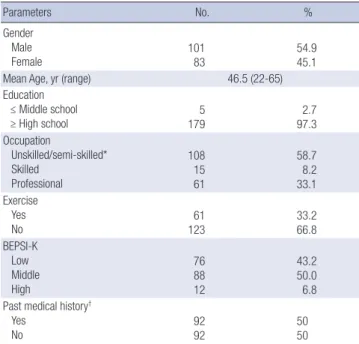
The participants were between 22 and 65 years old with a mean age of 46.5. Fifty percent of participants had a past medical his- tory; 45 with hypertension, diabetes, dyslipidemia, or cardio- vascular disease; 20 with chronic respiratory diseases including asthma; 8 with thyroid disease; 6 with chronic liver disease; and 14 with other diseases. Around thirty percent of participants ex- ercised more than 3 times per week. Occupation was divided into three categories, unskilled/semi-skilled (108 participants), skilled (15 participants), and professional (61 participants).
Among the 184 participants that were included in our study, 176 subjects completed the BEPSI-K and were classified into three categories depending on their scores; 76 with low intensi- ty, 88 with middle intensity, and 12 subjects with high intensity stress (Table 1).
Rate of missing data
There were 5 missing responses for SOFA/GP-K, with a missing rate of 0.25% of the total data points. There were 11 incomplete questionnaires for the other fatigue instruments including sur- veys on general information. Therefore, a total number of 184 participants were included for analysis.
Internal consistent reliability and Test-retest reliability The overall Cronbach’s alpha coefficient for the SOFA/GP-K was 0.82 (between 0.78 and 0.81 if any one of the ten items was deleted) (Table 2). The percent agreement between each survey items were between 55.07% and 81.16% with kappa scores of 0.28-0.64 (Table 3).
Construct validity
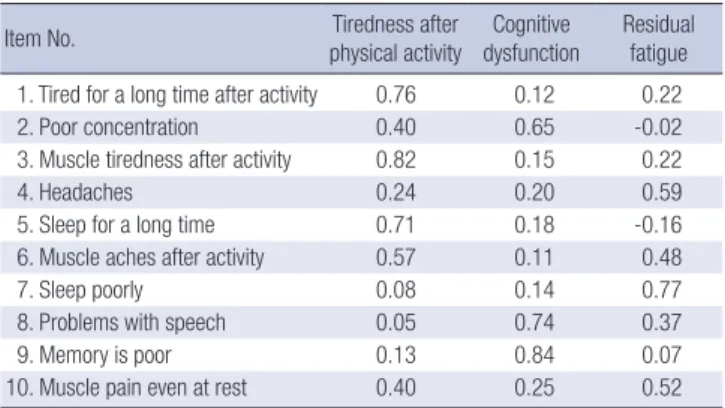
The screen test for the SOFA/GP-K suggested a three-factor so- lution. The eigenvalue was 3.89 for the first factor; tiredness af- ter physical activity, followed by 1.19 and 1.02 for the next two factors; cognitive dysfunction and residual fatigue (Table 4).
Concurrent validity
The concurrent validity of the SOFA/GP-K was demonstrated by calculating the correlations between the SOFA/GP-K and other fatigue instrument scores, the BFI and FSS (Table 5). The SOFA/GP-K was significantly correlated with the well validated
Table 1. Clinical characteristics of 184 subjects enrolled in the study
Parameters No. %
Gender Male Female
101
83
54.9 45.1
Mean Age, yr (range) 46.5 (22-65)
Education
≤ Middle school
≥ High school
5 179
2.7 97.3 Occupation
Unskilled/semi-skilled*
Skilled Professional
108
15 61
58.7
8.2 33.1 Exercise
Yes No
61 123
33.2 66.8 BEPSI-K
Low Middle High
76 88 12
43.2 50.0 6.8 Past medical history†
Yes No
92 92
50 50
*Including unemployed, housewife, service worker, and retired; †Including hyperten- sion, diabetes, dyslipidemia, stroke, chronic liver disease, thyroid disease, chronic re- spiratory disease, cardiovascular disease, degenerative/rheumatoid arthritis, asthma, allergy, endometriosis, gastritis, prostatitis, alopecia, arrhythmia, history of prostate cancer (surgically removed). BEPSI-K, Korean Brief Encounter Psychosocial Instrument.
Table 2. Internal consistency with Cronbach’s Alpha and Alpha coefficient if item deleted
Scales Coefficient (n = 184)
Alpha 0.82
Alpha if item deleted
1. Tired for a long time after activity 0.79
2. Poor concentration 0.80
3. Muscle tiredness after activity 0.78
4. Headaches 0.80
5. Sleep for a long time 0.81
6. Muscle aches after activity 0.79
7. Sleep poorly 0.81
8. Problems with speech 0.80
9. Poor memory 0.80
10. Muscle pain at rest 0.80
Table 3. Test-retest reliability coefficients (Kappa) for the SOFA/GP-K
Items Percent agreement (%) Kappa score
1. Tired for a long time after activity 62.3 0.37
2. Poor concentration 69.6 0.49
3. Muscle tiredness after activity 62.3 0.33
4. Headaches 79.0 0.64
5. Sleep for a long time 56.5 0.34
6. Muscle aches after activity 55.1 0.28
7. Sleep poorly 68.1 0.53
8. Problems with speech 70.3 0.50
9. Poor memory 71.0 0.48
10. Muscle pain at rest 81.2 0.51
SOFA/GP-K, Korean Schedule of Fatigue and Anergia/General Physician.
FSS and BFI. The correlation between SOFA/GP-K and FSS was (rho: 0.71, P < 0.001) and BFI was (rho: 0.61, P < 0.001).
DISCUSSION
It is hard to evaluate subjective symptoms such as fatigue when a commonly agreed upon definition is lacking. The usefulness of patient self-reports on subjective symptoms is widely ac- knowledged, thus a variety of self-report instruments have been developed and are currently in use. Although many of these scales are promising, as of yet there is no fatigue scale designed specifically to screen PFS. A valid and reliable instrument is needed to screen prolonged fatigue and to communicate in the same terms between patients and physicians. To do so, an ap- propriate validation of the psychometric instrument is essen- tial, even more so when the study is cross-cultural in nature.
Hence, a rigorous process of an initial pilot study, translation, back-translation, cross-cultural adaptation and validation was performed according to proposed guidelines by Guillemin et al.
(12). The present study is the first to evaluate the validity and reliability of the SOFA/GP in patients visiting primary care units in Korea. Test-retest reliability, internal consistency, and con- current validity of the questionnaire resulted in excellent validi- ty and fair to moderate reliability. The relatively low missing rate supports that the questionnaire is easy to administer.
The factor analysis gave a three-factor solution, somewhat similar to the results of the original article using latent class analysis. The first factor, related to tiredness after physical activ- ity consisted of 4 items. The second factor consisted of 3 items related to cognitive aspects. The third factor consisted of 3 items, related to neither physical activity nor cognitive function;
therefore, we classified them as residual fatigue. The Kappa scores of the test-retest reliabilities for each item are somewhat low, but still respectable (16). The internal consistency was high with a Cronbach’s alpha coefficient of 0.82, which shows that the scale is a coherent, additive instrument, in which the indi- vidual items have meaning.
SOFA/GP was originally developed to screen for prolonged
fatigue states, rather than well-developed chronic fatigue syn- drome. It differs from other fatigue evaluating scale in that it is not limited to specific diseases such as cancer, fibromyalgia, neurologic and musculoskeletal disorders, or psychological problems. The high cutoff score of the questionnaire maximizes the specificity for use in the community and primary care facili- ties. The scales also identify PFS as having quite different char- acteristics to other common psychological and somatic forms of distress. SOFA/GP differentiates conventional notions of anxiety and depression from PFS, thus recognizing that PFS is not merely somatic symptoms of anxiety and depression. An- other distinct advantage of this scale is that the questions are shorter and simpler, allowing subjects to easily complete the entire survey within 2 minutes. SOFA/GP-K uses a Likert scale when evaluating the severity for fatigue rather than the numeric VAS scale as used in FSS. Likert scales have been found to be easier to use and understand for both the researcher and the respondent and that coding as well as interpretation is easier when compared to VAS. It also takes less time to explain to the patients (17). Simplicity is an important advantage, because its main purpose is to assess fatigue. Therefore, it could be argued that a simpler scale, such as the SOFA scale in the form of Likert scale, may be more appropriate when assessing patients with fatigue through its ease of administration.
The current study is subject to several limitations. While pre- sumably healthy, the subjects in our study may differ from the community norms in that they may be more concerned about their health for one reason or another. Although more partici- pants in our study were experiencing stress to a moderate de- gree (50%) than compared to the low intensity of the general population (57%), the previous study was conducted through telephone interviews of the general population and the results may differ from patients visiting primary care units (11). In ad- dition, if fatigue, through FSS, is defined with a cutoff mean of 3.22 according to previous study (18), our study revealed 40.2%
(74/184) of subjects were fatigued. The prevalence of fatigue in Korea’s general population is 32.5% (2). However, 45 out of 184 participants (24.5%) of our study were diagnosed with meta- bolic diseases and cardiovascular diseases, which is similar to the rate in the general population. Therefore, we concluded that subjects visiting a routine health examination center could represent the general Korean population that visits the primary care units. Another possible limitation is that because SOFA/
Table 4. Extraction of factors via factor analysis
Item No. Tiredness after
physical activity Cognitive
dysfunction Residual fatigue 1. Tired for a long time after activity 0.76 0.12 0.22
2. Poor concentration 0.40 0.65 -0.02
3. Muscle tiredness after activity 0.82 0.15 0.22
4. Headaches 0.24 0.20 0.59
5. Sleep for a long time 0.71 0.18 -0.16
6. Muscle aches after activity 0.57 0.11 0.48
7. Sleep poorly 0.08 0.14 0.77
8. Problems with speech 0.05 0.74 0.37
9. Memory is poor 0.13 0.84 0.07
10. Muscle pain even at rest 0.40 0.25 0.52
Table 5. Test of validity of SOFA/GP-K
SOFA Correlation P value
FSS score 0.71 < 0.001
BFI score 0.61 < 0.001
The Spearman correlation coefficients between scores for SOFA/GP-K items and FSS and BFI. SOFA/GP-K, Korean Schedule of Fatigue and Anergia/General Physician; FSS, fatigue severity scale; BFI, brief fatigue inventory.
GP is a unidimensional measure of fatigue, it may provide lim- ited reliability and only the most perfunctory information about the patients’ experiences with fatigue. However, the SOFA/GP has good psychometric measures as a screening tool to assess fatigue.
In conclusion, our study has shown that the SOFA/GP-K is a reliable, valid self-rating instrument and is suitable for screen- ing for prolonged fatigue. This simple and easily administered measurement of fatigue is essential for studies of its prevalence, severity and for studies of effectiveness of fatigue management in Korea. In a clinical sense, the SOFA/GP-K may minimize bar- riers of communication between patients and physicians con- cerning fatigue in Korea. It may additionally provide important and necessary insight into further evaluation and treatment of fatigue. Further studies on the scale’s ability to act as an out- come measure with treatment may be necessary.
ACKNOWLEDGMENTS
We thank Dr. Dusan Hadzi-Pavlovic (University of New South Wales, Psychiarty) for his permission to translate the SOFA/GP into Korean. We also thank Hae Lim Kim and Anne Shin for their excellent translation. Finally, we would like to also thank the participants who cooperated willingly.
DISCLOSURE
All authors have no potential conflicts of interest to disclose.
AUTHOR CONTRIBUTION
Conception and design: Bae WK, Kim JY, Kim JH. Acquisition of data: Kim S, Jang M. Noh HH. Analysis and interpretation of data: Kim S, Bae WK. First writing of manuscript: Kim S, Jang M.
Revision of the manuscript: Kim S, Bae WK. Agree with the manuscript contents and conclusions: Kim S, Bae WK, Kim JY, Kim JH, Jang M, Noh HH.
ORCID
Woo Kyung Bae http://orcid.org/0000-0001-6729-4128 Sarah Kim http://orcid.org/0000-0002-2651-0338 Ju Young Kim http://orcid.org/0000-0001-6018-3337 Mijee Jang http://orcid.org/0000-0002-5511-545X Jeong Hyun Kim http://orcid.org/0000-0001-7923-0797 Hyun Hee Noh http://orcid.org/0000-0002-7413-6838
REFERENCES
1. Dittner AJ, Wessely SC, Brown RG. The assessment of fatigue: a practical guide for clinicians and researchers. J Psychosom Res 2004; 56: 157-70.
2. Kim CH, Shin HC, Won CW. Prevalence of chronic fatigue and chronic fatigue syndrome in Korea: community-based primary care study. J Ko- rean Med Sci 2005; 20: 529-34.
3. Hotopf M, Wessely S. Chronic fatigue syndrome--mapping the interior.
Psychol Med 1999; 29: 255-8.
4. Hadzi-Pavlovic D, Hickie IB, Wilson AJ, Davenport TA, Lloyd AR, Wake- field D. Screening for prolonged fatigue syndromes: validation of the SOFA scale. Soc Psychiatry Psychiatr Epidemiol 2000; 35: 471-9.
5. Elnicki DM, Shockcor WT, Brick JE, Beynon D. Evaluating the complaint of fatigue in primary care: diagnoses and outcomes. Am J Med 1992; 93:
303-6.
6. Yun YH, Wang XS, Lee JS, Roh JW, Lee CG, Lee WS, Lee KS, Bang SM, Mendoza TR, Cleeland CS. Validation study of the korean version of the brief fatigue inventory. J Pain Symptom Manage 2005; 29: 165-72.
7. Lee JH, Jeong HS, Lim SM, Cho HB, Ma JY, Ko E, Im JJ, Lee SH, Bae S, Lee YJ, et al. Reliability and validity of the fatigue severity scale among university student in South Korea. Korean J Biol Psychiatry 2013; 20: 6-11.
8. Krupp LB, LaRocca NG, Muir-Nash J, Steinberg AD. The fatigue severity scale. Application to patients with multiple sclerosis and systemic lupus erythematosus. Arch Neurol 1989; 46: 1121-3.
9. Yun YH, Lee MK, Chun HN, Lee YM, Park SM, Mendoza TR, Wang XS, Cleeland CS. Fatigue in the general Korean population: application and normative data of the Brief Fatigue Inventory. J Pain Symptom Manage 2008; 36: 259-67.
10. Cho HJ, Costa E, Menezes PR, Chalder T, Bhugra D, Wessely S. Cross- cultural validation of the Chalder Fatigue Questionnaire in Brazilian primary care. J Psychosom Res 2007; 62: 301-4.
11. Kim KN, Park JY, Shin TS, Jun KJ, Choi EY, Kim HJ, Lee SH, Yoo TW, Huh BY. Degree of stress and stress-related factors by the Korean version of the BEPSI. J Korean Acad Fam Med 1998; 19: 559-70.
12. Guillemin F, Bombardier C, Beaton D. Cross-cultural adaptation of health- related quality of life measures: literature review and proposed guide- lines. J Clin Epidemiol 1993; 46: 1417-32.
13. Mendoza TR, Wang XS, Cleeland CS, Morrissey M, Johnson BA, Wendt JK, Huber SL. The rapid assessment of fatigue severity in cancer patients:
use of the Brief Fatigue Inventory. Cancer 1999; 85: 1186-96.
14. Anton HA, Miller WC, Townson AF. Measuring fatigue in persons with spinal cord injury. Arch Phys Med Rehabil 2008; 89: 538-42.
15. Herlofson K, Larsen JP. Measuring fatigue in patients with Parkinson’s disease - the Fatigue Severity Scale. Eur J Neurol 2002; 9: 595-600.
16. Viera AJ, Garrett JM. Understanding interobserver agreement: the kappa statistic. Fam Med 2005; 37: 360-3.
17. Hasson D, Arnetz BB. Validation and findings comparing VAS vs. Likert scales for psychosocial measurements. Int Electron J Health Educ 2005; 8:
178-92.
18. Chung KI, Song CH. Clinical usefulness of Fatigue Severity Scale for pa- tients with fatigue, and anxiety or depression. Korean J Psychosom Med 2001; 9: 164-73
Appendix SOFA/GP-K
피로와 무기력에 관한 설문 (SOFA/GP)
지난 몇 주 동안 당신의 건강 상태를 가장 잘 반영하는 상황에 V 하시기 바랍니다.
전혀 그렇지 않다/
거의 그렇지 않다 가끔 그렇다 자주 그렇다 거의 항상 그렇다
1. 신체 활동을 하고 나면 오랫동안 피곤하다. □ 1 □ 2 □ 3 □ 4
2. 집중력이 부족하다. □ 1 □ 2 □ 3 □ 4
3. 신체 활동을 하고 나면 근육에 피로를 느낀다. □ 1 □ 2 □ 3 □ 4
4. 두통이 생긴다. □ 1 □ 2 □ 3 □ 4
5. 오랜 시간 동안 잠을 자야 한다. □ 1 □ 2 □ 3 □ 4
6. 신체활동을 하고 나면 근육에 통증을 느낀다. □ 1 □ 2 □ 3 □ 4
7. 깊은 잠을 못 잔다. □ 1 □ 2 □ 3 □ 4
8. 말하는데 어려움이 있다. (예: 단어가 잘 떠오르지 않는다) □ 1 □ 2 □ 3 □ 4
9. 기억력이 좋지 않다. □ 1 □ 2 □ 3 □ 4
10. 쉴 때 조차도 근육에 통증을 느낀다. □ 1 □ 2 □ 3 □ 4