Original Article: Food Science/Microbiology
Effect of Soybean Curd Residue Fermented by Monascus pilosus on the High fat Diet-Induced Obese Mice
Sang-Il Lee · Ye-Kyung Lee · Soon-Dong Kim · In-Ae Lee · Jongkeun Choi · Joo-Won Suh*
Monascus pilosus로 발효시킨 비지의 항비만 효과
이상일 · 이예경 · 김순동 · 이인애 · 최종근 · 서주원*
Received: 11 May 2013 / Accepted: 19 August 2013 / Published Online: 31 March 2014
© The Korean Society for Applied Biological Chemistry 2014
Abstract This study investigated anti-obesity and antioxidant effects of dietary non-fermented soybean crud residue (SCR) and fermented SCR by Monascus pilosus (FSCR) in high-fat induced- obese mice. SCR and FSCR were supplemented with high-fat diet at 2% (wt/wt) dose for 8 weeks. Both SCR and FSCR significantly lowered body weight, epididymal fat weight and weight gain rate compared to high-fat diet control (HC) group and FSCR group showed lowest weight gain rate. In addition, it was observed that serum and hepatic lipid profiles including triglyceride, total cholesterol, LDL-cholesterol and HDL-cholesterol were significantly improved by supplementing SCR or FSCR. Furthermore, SCR and FSCR administration showed increase of glutathione content and decrease of hepatic lipid peroxide content, serum amino- transferase activity, and hepatic xanthine oxidase activity. On the other hand, activities of reactive oxygen species scavenging enzyme such as superoxide dismutase, glutathione S-transferase and glutathione peroxidase in two test groups were higher than those of HC. Lastly, in comparison with SCR, FSCR was more effective in restoring obesity-related biomarkers to normal level in high-diet induced obese mice. In conclusion, the present study indicates that
FSCR could have not only anti-obese effects such as inhibition of abdominal fat accumulation, but also protective effects of cardiovascular disease such as atherosclerosis by decreasing serum and hepatic lipid contents. Furthermore, these results suggest that experimental diets in this study could alleviate hepatic damage caused by overproduction of reactive oxygen spices (ROS) due to obesity via inhibition of ROS generating activities and induction of ROS scavenging activities.
Keywords anti-obesity · lipid profiles · Monascus pilosus · reactive oxygen spices scavenging activity · soybean curd residue
서 론
경제성장과 국민 소득의 향상에 따른 식생활의 서구화로 인스턴 트 식품과 육류의 섭취량 및 음주량의 급증으로 인한 비만이나, 고지혈증, 동맥경화증 및 당뇨병과 같은 생활습관병의 발생율이 크게 증가하고 있어 국민의 건강과 관련하여 많은 문제점으로 지적되고 있다. 비만은 과잉의 에너지 섭취와 육체적 활동 감소 및 유전적 요인에 의해 체내에 지방이 과잉으로 축적되어 나타 나는 것으로 심혈관계 질환과 당뇨, 동맥경화 등과 같은 생활습 관병 뿐만 아니라 비알코올성 간염, 암, 치매 등의 원인으로 잘 알려져 있다(Grundy, 1998; Kopelman, 2000; Furukawa 등, 2004; Grundy, 2004; Carmiel-Haggai 등, 2005; Milagro 등, 2006; Després 등, 2008; Satoh 등, 2008). 비만을 포함한 생활 습관병의 효과적인 예방과 치료는 일반적으로 식이조절과 운동 등 생활습관의 개선과 약물요법을 병행해야 하는 것으로 잘 알 려져 있으며, 이의 예방과 관련된 의약품뿐만 아니라 다양한 건 강 기능식품이 개발·판매되고 있다(Yun, 2010). 그러나 현재까 S.-I. Lee
Department of Food, Nutrition and Culinary Arts, Keimyung College, Daegu 704-703, Republic of Korea
Y.-K. Lee · S.-D. Kim · I.-A. Lee · J.-W. Suh
Division of Bioscience and Bioinformatics, Myongji University, Yongin, Gyeonggi 449-728, Republic of Korea
J. Choi
Department of Cosmetic Science, Chungwoon University, Hongseong, Chungnam 350-701, Republic of Korea
*Corresponding author (J.-W. Suh: [email protected])
지 비만을 예방하거나 치료를 위한 대부분의 약물들은 식욕을 저하시키거나 영양물질의 흡수를 저해하는 등 단일 작용기전에 따른 효과를 나타내는 것으로 심각한 부작용 때문에 사용에 제 한을 받고 있어 다양한 작용기전에 의한 효과적이고 안전한 항 비만제의 개발이 요구되고 있다.
비지(soybean curd residue: SCR)는 우리나라 전통식품의 하 나로 대두에 물을 넣어 파쇄한 후 가열하여 두유를 얻고 남은 잔유물로 대부분이 대두의 껍질부분을 포함한 비수용성 물질로 구성되어 있어 소화성이 좋지 않아 가축의 사료로 이용되거나 폐기물로 버려지고 있다. 그러나 최근 SCR이 항비만(Matsumoto 등, 2007, Yun, 2010, Choi 등, 2011), 항고지혈(Matsumoto 등, 2007) 뿐만 아니라 SCR의 발효 산물에서 높은 항산화 및 면역활성(Shi 등, 2012) 효과가 있는 것으로 보고되고 있어 기 능성을 더욱 증진시키고자 하는 연구들이 많이 이루어지고 있다.
한편, Monascus속 곰팡이는 전통적으로 홍국의 제조에 이용 하고 있으며, cholesterol 생합성을 저해하는 monacolin K, mevinolin 및 novastatin과 같은 statin계 성분을 생성하는 것으 로 알려져 동맥경화의 예방에 사용되고 있다(Endo, 1980). 또, 이 미생물이 생성하는 색소성분은 항균 및 항암활성을 나타내 는 것으로 알려져 있고(Birch 등, 1962; Keisuke 등, 1992), Monacolin K 또한 항진균, 항당뇨, 항고혈압, 항콜레스테롤 및 항암 등의 효과가 보고되고 있으며(Kiyoshi 등, 1995; Yasukawa 등, 1996; Martinkova 등, 1999; Kang 등, 2008; Kim과 Rhyu, 2008), 최근 Lee 등(2011a)은 Monascus속 곰팡이의 균 체 추출물이 항 비만 효과를 나타내는 것으로 보고한 바 있다.
본 연구에서는 기능성 미생물로 잘 알려져 있는 M. pilosus로 발효시킨 비지를 첨가한 식이가 고지방식이 마우스의 체중과 지 질개선효과에 미치는 영향을 상호비교 관찰하여 항비만 기능성 식품의 개발에 대한 기초자료를 제시코자 한다.
재료 및 방법
재료 및 균주. 실험용 비지는 국내산 대두(Glycine max Taekwang) 를 이용하여 재래식 방법으로 두부를 만들고 있는 경상북도 경 산시 중앙동에 위치한 재래시장 내의 한 두부제조공장에서 두 부제조 후 곧 바로 채취한 비지(불린 대두에 물을 가하여 자동 화시킨 맷돌로 간 후 100oC에서 1시간 동안 끓이고 포대에 넣 어 여과하여 두부제조용의 두유를 얻고 남은 찌꺼기)를 젖은 상 태로 구입하여 장기간 동안 보관하면서 사용할 수 있도록 함과 동시에 생비지에 함유된 미생물의 번식을 막기 위하여 1 cm 내 외의 두께로 엷게 펴서 일광 하에서 통풍을 시키면서 3일간 건 조시킨 후 믹서기를 사용하여 50 mesh의 입도로 분쇄한 것을 발효용 재료로 사용하였다. 발효용 균주는 한국 종균협회에서 구입한 Monascus pilosus IFO 4480을 사용하였다.
발효비지 및 그 혼합물의 제조. M. pilosus를 이용한 발효비지 와 그 혼합물의 제조는 Fig. 1에서와 같이 행하였다. 생비지 (wet-SCR)를 일광 하에서 수분함량이 2% 내외가 되도록 2–3일 간 건조시킨 후 4oC에서 저장하였다. 발효는 저장중의 시료 100 g에 대하여 물 70 mL의 비율로 첨가하여 수분함량을 41.2%로 조절하였다. 그리고 polypropylene (PP) bag에 500 g씩 넣고 면 으로 된 air filter가 부착된 뚜껑을 닫아 121oC에서 90분간 살 균한 다음 20oC로 냉각하였다. 따로 액체 배양한 M. pilosus [BactoTM malt extract (Becton, Dickinson and Co, Sparks,
USA) 2%, glucose 2% 및 peptone 0.1% (w/v) 함유 액상배 지, 25oC에서 7일간 배양 후, 균수를 108 cfu/mL로 조정]를 시 료 무게의 10% (v/w)가 되도록 접종하고 25oC에서 15일간 고 체발효한 다음, 40oC에서 2일간 건조시키고 50 mesh 입도로 분 쇄하여 발효비지 (FSCR)를 제조하였다. 대조구로 사용한 비지 는 121oC에서 90분간 살균한 후 건조시킨 것을 사용하였다.
동물실험. 실험동물은 4주령의 평균체중 21−24 g의 ICR (Crljori:
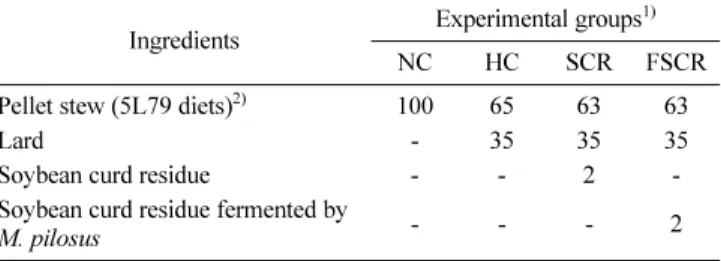
CD-1), SPF/VAF outbred mice (Orient Ltd., Korea)를 구입하여 기본사료(5L79 diets: PMI Nutrition, LLC, Brentwood, USA)로 1주일간 환경에 적응시킨 다음 실험에 사용하였다. 실험군별 식 이조성은 Table 1과 같으며, 기본사료만을 급여한 정상식이 대 조군(NC), 기본사료에 lard 35% 혼합한 사료를 급여한 고지방 식이 대조군(HC), 기본사료에 lard 35%와 건조비지(SCR) 2%
혼합한 사료를 급여한 군(SCR) 및 기본사료에 lard 35%와 M.
Fig. 1 Effects of SCR- and FSCR-supplemented high fat diet on the changes of net body weight gain of mouse. Values are means (n=6), and the values of the final week are mean ± standard deviations (n=5).
Different superscripts in the final day indicate significant differences (p <0.05).
Table 1 Experimental groups and ingredients of diets for high fat supplemented mouse (%)
Ingredients Experimental groups1)
NC HC SCR FSCR
Pellet stew (5L79 diets)2) 100 65 63 63
Lard - 35 35 35
Soybean curd residue - - 2 -
Soybean curd residue fermented by
M. pilosus - - - 2
1)Abbreviations: NC; normal control group, HC; high fat supplemented control group, SCR; soybean curd residue 2% supplemented high fat diet group, FSCR; soybean curd residue fermented by M. pilosus 2%
supplemented high fat diet group (FSCR).
2)The diets for animal experiments manufactured in PMI Nutrition, LLC, Brentwood, MO, USA. Guaranteed analysis: crude protein 18%, crude fat 5%, crude fiber 5%, ash 8%.
pilosus로 발효시키고 건조한 비지 2%를 혼합한 사료를 급여한 군(FSCR)의 4개 군(6마리/군)으로 나누어 8주간 사육하였다. 식 이는 Feeds Lab Co. (Korea)에 의뢰하여 제조였으며 4oC에서 보관하면서 매일 신선한 식이를 공급하였다. 실험동물은 stainless steel cage에 6마리씩 넣어 사육하였고, 온도 23±2oC, 습도 60±5%를 유지하였다. 명암주기는 12시간 간격으로 설정하였으 며, 실험식이와 음용수는 자유 섭취시켰다.
체중 및 식이효율의 측정. 실험기간 동안 매일 오전 10−11시에 체중과 식이섭취량을 측정하였으며, 식이효율(feed efficiency ratio, FER)은 1주간의 체중 증가량을 1주간의 식이섭취량으로 나눈 값으로 하였다.
혈청 ALT 활성 및 지질함량. 혈청 ALT (alanine aminotransferase) 활성도는 Reitman과 Freanke (1957)의 방법에 준하여 kit시약 (Asan Pham., Korea)을 사용하여 측정하였으며 Karmen (1955) 의 방법에 따라 혈청 1 mL당 분당 NADH의 흡광도를 0.001 감소시키는 Karmen unit로 나타내었다. 혈청중성지질(AM 157S- K, Asanpharm Co., Korea), 총콜레스테롤(AM 202-K, Asanpharm Co., Korea) 및 HDL-콜레스테롤 함량(AM 203-K, Asanpharm Co., Korea)은 kit 시약으로 측정하였으며, LDL-콜레스테롤 함 량은 Friedewald 등(1972)의 방법에 따라 계산하였다. Atherogenic index (AI)는 계산식[(total cholesterol HDL-cholesterol)/HDL- cholesterol]에 의하여 산출하였다.
효소활성 측정 시료 준비. 8주간 사육한 mouse에게 물만 주고 12시간 동안 금식시킨 후 ether 마취 하에서 하대정맥으로부터 채혈한 다음, 빙냉의 생리식염수로 간을 관류하고 장기를 적출 한 다음 수분을 제거하고 무게를 측정하였다. 적출한 간 조직 일 정량에 4배량의 0.25 M sucrose 용액을 가하여 마쇄한 균질액을 10,000×g (4oC)에서 30분간 원심 분리한 다음 postmitochondrial fraction을 취하여 효소 활성도 측정에 이용하였다. 채취한 혈액은 실온에서 응고시킨 다음 4oC, 2,500×g에서 10분간 원심분리 하여 혈청을 분리한 후 −70oC에 두면서 분석용 시료로 사용하였다.
간 조직 지질함량. Folch 등(1957)의 방법에 따라 chloroform과 methanol (2:1) 혼합액에 간 조직 마쇄액 일정량을 가해 혼합한 다음 방치하여 분리된 유기용매층 일정량을 취해 질소가스 존 재 하에서 휘발시킨 후 중성지방의 함량과 총콜레스테롤의 함량 을 kit 시약(AM 157S-K, AM 202-K, Asan Pharm Co. Ltd., Korea)으로 각각 측정하였다.
간 조직 GSH 및 LPO의 함량. 간 조직 환원형 glutathione (GSH)의 함량은 Ellman (1959)의 방법에 따라 일정량의 간 조 직 마쇄균질액에 5,5'-dithibis(2-nitrobenzoic acid)를 가하여 생 성되는 thiophenol의 흡광도를 측정하였으며 간 조직 g당 GSH µmole로 나타내었다. LPO (lipid peroxide)의 함량은 Ohkawa 등 (1979)의 방법에 따라 일정량의 간 조직 마쇄균질액에 thiobarbituric acid (TBA) 용액을 가하여 반응시킨 후 n-butanol을 가하여 이 행되는 TBA-reactive substance를 흡광도 532 nm에서 측정한 다음 분자흡광계수(ε=1.5×10⁵ M−1 cm−1)를 이용하여 함량을 산 출하였으며 간 조직 g당 malondialdehyde (MDA) nmole로 나 타내었다.
간 조직 XO, SOD, GST 및 GPX 활성. 간 조직 XO (xanthine oxidase)의 활성은 Stirpe와 Della Corte(1969)의 방법 에 따라 측정하였으며, 활성도는 분당 단백 1 mg이 기질인 xanthine으로부터 생성시킨 uric acid의 양을 nmole로 나타내었 다. SOD활성은 Martin 등(1987)의 방법에 따라 superoxide anion radical에 의해 hematoxylin으로부터 생성되는 hematin을
560 nm에서 측정하였으며 효소원을 가하지 않은 대조구의 흡광 도를 50% 억제하는 효소량을 1 unit로 하여 1 mg의 단백질이 hematoxylin의 자동산화를 억제하는 정도를 U (Unit)로 나타내 었다. GST 활성은 Habig 등(1974)의 방법에 따라 효소에 의해 기질인 1-chloro-2,4-dinitrobezene (CDNB)과 GSH이 반응하여 생성되는 thioether의 흡광도를 340 nm에서 측정한 다음 흡광계 수(ε=9.5 M−1 cm−1)를 이용하여 활성도를 계산하였으며 분당 단 백질 1 mg이 생성시킨 thioether의 µmole로 나타내었다. GPX 활성은 Paglia 등(1967)의 방법에 따라 1 mM EDTA 함유 50 mM phosphate buffer (pH 7.0) 용액 일정량에 1 mM sodium azide, 0.2 mM NADPH, 1 mM GSH, 1 unit glutathione reductase 및 일정량의 효소원과 기질인 0.25 mM hydrogen peroxide를 가해 25oC에서 반응시키는 동안에 생성된 oxidized glutathione 을 환원시키는데 소모된 NADPH를 340 nm에서 측정하고 분자 흡광계수(ε=6.22 mM−1 cm−1)를 이용하여 효소활성을 계산하였 다. 효소의 활성도는 1 mg의 단백질이 1분간 산화 시킨 NADPH의 함량을 nmole로 나타내었다.
단백질 측정. 간 조직의 단백질 함량은 Lowry 등(1951)의 방법 에 따라 bovine serum albumin을 표준용액으로 하여 측정하였다.
간 조직 검사. 8주간 사육한 mouse 간 조직을 절취하여 10%
neutral formalin에 고정시킨 다음, 알코올 탈수, 파라핀 포매하 여 microtome으로 4 µm 두께로 잘라 hematoxylin과 eosin으로 염색하여 광학현미경으로 관찰하였다.
통계 처리. 데이터는 실험동물 6마리에 대한 평균치와 표준편차 로 나타내었다. 유의성 검증은 SPSS ver. 14.0 (SPSS Inc., USA) software package program을 이용하여 Duncan’s multiple range test를 행하였다.
결과 및 고찰
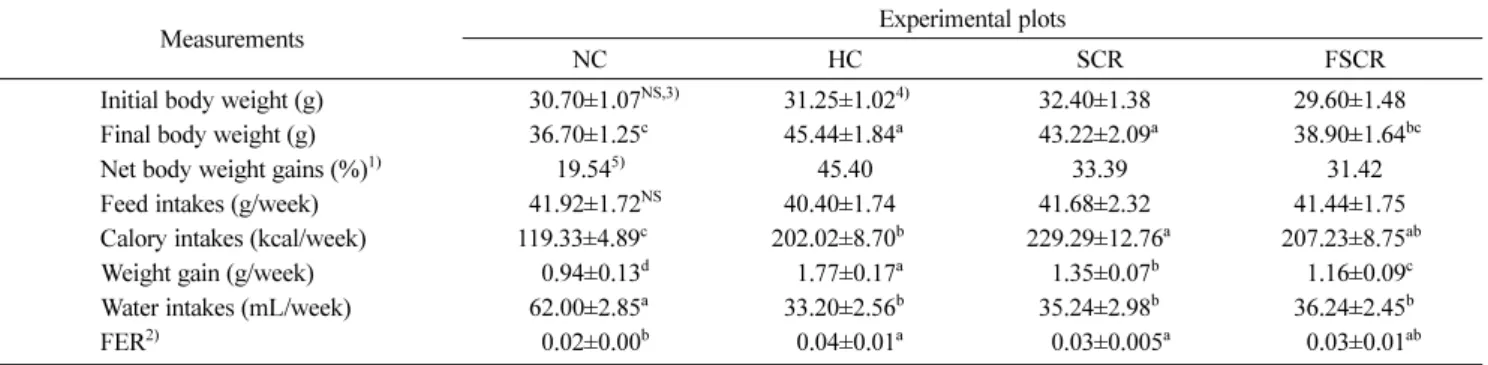
체중, 식이섭취량 및 식이효율. SCR 및 FSCR을 각각 2% 함 유하는 고지방식이가 mouse의 체중과 식이효율에 미치는 영향 을 관찰한 결과는 Table 2 및 Fig. 2와 같다. 주당 체중 증가 량은 HC군에서 NC군에 비해 88.29%의 현저한 증가를 보였으 며, SCR군과 FSCR군에서는 HC군에 비해 각각 26.45% 및 30.79%가 각각 감소하였다. 초기중량에 대한 체중증가율을 8주 동안 plot한 결과(Fig. 2), 고지방식이군(HC, SCR 및 FSCR)은 식이 초기부터 뚜렷한 체중증가를 보였으며 특히, FSCR군은 3 주 이후부터 7주째 까지는 SCR군에 비하여 유의적으로 낮은 경향을 나타내었다. 그러나 8주째의 초기체중에 대한 체중증가 율은 NC군 19.54%, HC군 45.40%, SCR군 33.39%, FSCR군 31.42%로 FSCR군에서의 체중감소율이 가장 낮았으나 SCR군 과의 유의차는 없었다. 식이섭취량은 모든 실험군 간에서 유사 하였으며, calory 섭취량과 식이효율(FER)은 NC군에 비해 모든 고지방 실험식이군에서 높았으나, FSCR군에서의 식이효율은 NC군과 유의적인 차이가 없었다. 이러한 결과는 본 실험에서 이용한 SCR이 체중 증가를 억제하는 효과가 있으나 M. pilosus 로 발효시킨 비지(FSCR)에서 그 효과가 큼을 암시하고 있다.
장기중량 및 부고환 주변지방의 함량. SCR 및 FSCR을 각각 2%씩 혼합한 고지방식이로 8주간 사육한 mouse의 체중에 대한 장기중량 %와 부고환주변지방의 함량을 조사한 결과는 Table 3 및 Fig. 2와 같다. 체중에 대한 간 중량(%)은 NC군에 비하 여 HC군에서 7.68%가 낮았으며, SCR군과 FSCR군에서는 NC
군과 유의적인 차이가 없었다. 신장의 중량은 NC군에 비해 HC 군에서 유의하게 낮았으며, SCR군에서는 HC군에 비해 유의하 게 높았고 FSCR군에서는 NC군과 유사한 값을 나타내었다. 고 환의 중량은 HC군과 SCR군이 NC군에 비하여 유의적으로 낮 은 반면 FSCR군에서는 NC군과 유사하였다. 한편, 부고환주변 조직의 중량은 NC군에 비하여 HC군에서 약 4.23배가 높았으며, SCR 및 FSCR군은 HC군에 비하여 각각 7.06% 및 22.30%가 낮았다(Fig. 2).
고지방 식이에서는 당대사의 불균형과 과잉으로 생성되는 glucose flux 및 비정상적인 RNA와 DNA의 합성으로 간을 비 롯한 장기들의 중량이 증가하는 것으로 알려져 있다(Wu 등, 2007). 일반적으로 고지방식이 mouse에서는 체중 당 간의 중량 이 감소하는 것으로 알려져 있다(Gregoire 등, 2002; Matsuzawa- Nagatan 등, 2008; Ha 와 Chae, 2010). 따라서 본 실험의 결 과는 특히 FSCR군에서 간 중량과 부고환 주변지방의 함량이
SCR군에 비하여 현저하게 낮은 현상을 고려할 때 FSCR이 복 부비만을 억제하는 효과가 있음을 암시하고 있다.
혈청 및 간 조직 지질 함량. SCR 및 FSCR을 각각 2%씩 혼 합한 고지방식이로 8주간 사육한 mouse의 혈청 및 간 조직 지 질 함량의 변동을 조사한 결과는 Table 4 및 Fig. 3과 같다.
Table 4에서 보는 바와 같이 혈청중성지질의 함량은 HC군이 NC군에 비하여 31.70%가 높았으나 SCR 및 FSCR군의 경우는 HC군에 비해 각각 35.56% 및 35.53%가 낮았으며, SCR군과 FSCR군 상호간에는 차이를 보이지 않으면서 다같이 NC군 이 하의 수준을 나타내었다. 총 cholesterol의 함량은 HC군이 NC 군에 비하여 71.62%가 높았으나, HC군에 비하여 SCR군은 12.99%가, FSCR군은 15.56%가 각각 낮았다. HC군의 혈청 HDL-cholesterol의 함량은 NC군에 비하여 19.91%가 낮았으나 SCR군에서는 HC군에 비하여 11.42%가 높았으며 특히, FSCR 군은 HC군에 비하여 38.49%가 높았다. LDL-cholesterol의 함 량은 NC군에 비하여 HC군에서 2.59배가 높았으나 SCR 및 FSCR군은 HC군에 비하여 각각 16.23% 및 26.85%가 낮았다.
한편, 동맥경화증지수(AI)는 NC군에 비해 HC군에서 2.90배가 높았으며, SCR 및 FSCR군의 경우는 HC군에 비하여 각각 26.95% 및 47.95%가 낮았다.
한편, 간 조직 total cholesterol의 함량은 HC군이 NC군에 비 해 2.05배가 높았으나 SCR 및 FSCR군에서는 HC군에 비하여 21.56% 및 27.52%가 낮았다(Fig. 3A). 그리고 간 조직 중성지 질의 함량은 total cholesterol과 유사하게 HC군이 NC군에 비하 여 2.11배가 높았으며, SCR 및 FSCR군은 HC군에 비하여 각 각 36.74% 및 44.35%가 낮았다(Fig. 3B).
Table 2 Effects of SCR- and FSCR-supplemented high fat diet on body weight gain and feed efficiency ratio of mouse
Measurements Experimental plots
NC HC SCR FSCR
Initial body weight (g) 030.70±1.07NS,3) 031.25±1.024) 032.40±1.38 029.60±1.48
Final body weight (g) 036.70±1.25c 045.44±1.84a 043.22±2.09a 038.90±1.64bc
Net body weight gains (%)1) 19.545) 45.40 33.39 31.42
Feed intakes (g/week) 041.92±1.72NS 040.40±1.74 041.68±2.32 041.44±1.75
Calory intakes (kcal/week) 119.33±4.89c 202.02±8.70b 229.29±12.76a 207.23±8.75ab
Weight gain (g/week) 000.94±0.13d 001.77±0.17a 001.35±0.07b 001.16±0.09c
Water intakes (mL/week) 062.00±2.85a 033.20±2.56b 035.24±2.98b 036.24±2.45b
FER2) 000.02±0.00b 000.04±0.01a 000.03±0.005a 000.03±0.01ab
1)Net body weight gain against initial body weight (%).
2)Feed efficiency ratio.
3)Not significant.
4)Values are mean ± standard deviations (n=6), different superscripts in the same row indicate significant differences (p <0.05).
Fig. 2 Effects of SCR- and FSCR-supplemented high fat diets on the content of fat around epididymal of mouse. Abbreviations: BW: body weight. Values are mean ± standard deviations (n=5), different superscripts in the figures indicates significant differences (p <0.05).
Table 3 Effects of SCR- and FSCR-supplemented high fat diets on organs weight of mouse
Organs Experimental plots
NC HC SCR FSCR
Liver 4.43±0.14a,1) 4.09±0.18b 4.52±0.21a 4.51±0.12a Kidney 1.97±0.12a 1.48±0.17c 1.70±0.09b 1.93±0.14ab Heart 0.58±0.04NS,2) 0.53±0.05 0.57±0.04 0.58±0.06 Testis 0.72±0.05a 0.57±0.04bc 0.57±0.02c 0.66±0.05ab
1)Values are mean ± standard deviations (n=6), different superscripts in the same row indicate significant differences (p <0.05).
2)Not significant.
고지방 식이에 의해 혈중 중성지질, total-cholesterol 및 LDL-cholesterol의 함량이 증가하며, HDL-cholesterol의 함량은 감소하는 것으로 이미 잘 알려져 있으며(Woo 등, 2008; Lee 등, 2011a), 이로 인한 조직 내 지질의 축적과 reactive oxygen spices (ROS)의 생성증가로 인한 과산화 지질(Vincent 등, 2001; Lee 등, 2011b)의 함량증가에 따라 비알코올성 간염 (Grundy, 2004; Carmiel-Haggai 등, 2005; Milagro 등, 2006) 뿐만 아니라 심혈관계 질환 및 당뇨병 등과 같은 대사성 질환 의 위험성이 증가하는 것으로 보고되고 있다(Furukawa 등, 2004; Després 등, 2008; Satoh 등, 2008). 본 실험에서 고지방 식이에 의해 증가하였던 혈중 및 간 조직 lipid profile들이 실 험식이를 급여하였을 때 저하되고 있어 비 알코올성 간염이나 동맥경화증 등과 같은 대사성질환의 예방과 경감에 기능성을 나 타낼 수 있다는 것을 암시하고 있으며 특히 M. pilosus로 발효 시킨 FSCR이 발효시키지 않은 SCR에 비하여 큰 것으로 확인 되었다.
따라서 이상의 실험결과는 콩의 부산물인 비지에서 항비만
효과와 더불어 고지혈증에 의한 지방간의 예방 및 경감 효과가 있으나 M. pilosus로 발효시킴으로서 그 효과가 현저하게 높아 지는 것으로 사료된다.
간 조직 GSH, LPO 함량 및 혈청 ALT 활성. SCR 및 FSCR을 각각 2%씩 혼합한 고지방식이로 8주간 사육한 mouse 의 간 조직 GSH와 LPO의 함량 및 혈청 ALT의 활성 변동을 조사한 결과는 Fig. 4 및 5와 같다. 간 조직의 GSH 함량은 NC군에 비하여 HC군이 29.54%의 유의한 감소를 보였으나 SCR 및 FSCR군은 HC군에 비하여 각각 23.95% 및 31.74%가 증가하였다(Fig. 4A). 그리고 LPO의 함량은 HC군이 NC군에 비하여 35.59%가 증가하였으나 SCR 및 FSCR군에서는 HC군 에 비하여 각각 17.89% 및 28.71%가 감소하여 FSCR군이 SCR군에 비하여 높은 감소율을 보였다(Fig. 4B).
한편, 혈청 ALT의 활성(Fig. 5)은 HC군이 NC군에 비하여 87.53%나 높은 값을 나타내었으나 SCR 및 FSCR군은 HC군에 비하여 각각 15.90% 및 39.50%의 낮은 수치를 보였으며 특히, FSCR군은 NC군 수준으로 회복되었다.
Fig. 4 Effects of SCR- and FSCR-supplemented high fat diets on the content of hepatic glutathione and lipid peroxide of mouse. Values are mean ± standard deviations (n=5), different superscripts in the figures indicates significant differences (p <0.05).
Fig. 3 Effects of SCR- and FSCR-supplemented high fat diets on the content of hepatic triglyceride and total cholesterol of mouse. Values are mean ± standard deviations (n=5), different superscripts in the figures indicates significant differences (p <0.05).
고지방식이 하에서는 간 조직의 GSH 함량은 감소하나 LPO 의 함량은 증가하는 것으로 보고되고 있다(Yao 등, 2011). 간 조직에서 GSH는 ROS에 의한 LPO의 생성을 억제 한다 (Wang 등, 2000). 간 조직의 GSH 함량이 감소하면 ROS에 의 해 생성되는 LPO 함량이 증가하는 것으로 알려져 있으며, LPO 의 함량은 생체막의 손상정도를 알 수 있는 지표로 활용되고 있다(Ohkawa 등, 1979). 체내의 각종 스트레스로 생성된 ROS 는 다가불포화지방산으로부터 LPO를 생성하며, 생성된 LPO는 분해되어 aldehydes, ketones, lactones 등을 생성하여 세포조직 의 손상과 노화를 촉진한다.
ALT는 간장과 심장에 다량 분포하며, 아미노산의 생합성에 관여하는 효소로 약물이나 스트레스 등으로 간 조직이 손상되 면 그 활성이 증가하게 됨으로 간 손상의 지표로 활용되고 있 다. 비만이 되면 간장에 지방이 축적되고 지방과산화물의 생성 으로 ROS가 생성되어 간 조직이 손상되면서 이들 효소의 활성 이 증가한다. 또한 간염이나 고혈당상태에서도 이들 효소의 활 성이 증가하며, 간장의 상대적 중량도 증가 한다(Reitman 과 Frankel, 1957). 혈중의 중성지질과 cholesterol의 대부분은 lipoprotein의 형태로 LDL을 형성하며 동맥경화증 발병과 비례 관계에 있다(Gordon 등, 1981). 지방대사는 주로 간에서 일어나
며 간에서 합성된 중성지질이 정상적으로 제거되지 않으면 간 에 축적되어 지방간을 유발 한다(Schaefer, 1995). 간은 콜레스 테롤 합성의 주요 장기로 유리형 콜레스테롤 또는 ester형 콜레 스테롤로서 지단백에 함유되어 순환계로 분비됨으로써 혈액 중 의 콜레스테롤 농도를 조절하는 역할을 한다(Yao 등, 1985). 한 편, 간으로 재 흡수된 콜레스테롤은 담즙산으로 산화되어 소장 으로 분비되고, 식이로부터 섭취된 콜레스테롤 및 지질과 결합 하여 재 흡수되는 과정을 거쳐 다시 간으로 회수되는 장간순환 (entro-hepatic circulation) 과정을 통하여 체내 콜레스테롤의 함 량을 조절한다.
본 실험의 고지방식이군에서 간의 콜레스테롤 농도가 유의적 으로 증가한 것은 고지방 식이가 혈중 중성지질을 상승시켜 간 에서 VLDL의 생성을 증가시키고, 이로부터 전환된 LDL이 증 가함으로써 이를 간에서 제거하는 과정에서 간 조직의 콜레스 테롤 농도가 높아진 것으로 생각되나 SCR군과 FSCR군에서는 GSH의 생성을 촉진함으로서 ROS의 생성을 억제하여 고지방식 이하에서도 간 조직의 손상을 예방하거나 치유하는 것으로 사 료되며 이러한 효과는 SCR군에 비하여 FSCR군에서 높은 것 으로 보인다.
간 조직 XO, SOD, GPX 및 GST 활성. SCR 및 FSCR을 각각 2%씩 혼합한 고지방식이로 8주간 사육한 mouse 간 조직 의 ROS 생성계 효소(XO) 및 ROS 소거계 효소(SOD, GPX 및 GST)의 활성 변동을 조사한 결과는 Fig. 6과 같다. ROS 생성계 효소의 일종인 XO의 활성(Fig. 6A)은 HC군이 NC군에 비해 2.52배가 높았으며, SCR 및 FSCR군의 경우 HC군에 비 하여 각각 28.21% 및 47.44%가 낮았다. 이와는 반대로 ROS 소거계 효소인 SOD의 활성(Fig. 6B)은 HC군이 NC군에 비하 여 43.63%가 낮았으며, SCR 및 FSCR군의 경우는 HC군에 비 하여 각각 12.07% 및 42.72%가 높았다. GPX의 활성(Fig. 6C) 도 HC군은 NC군에 비하여 36.83%가 낮았으며, SCR 및 FSCR군은 HC군에 비하여 각각 30.69% 및 32.94%가 높았다.
GST의 활성(Fig. 6D)은 HC군이 NC군에 비하여 33.86%가 낮 았으나 SCR 및 FSCR군은 HC군에 비하여 각각 37.95% 및 51.20%가 높아져 모두 NC군 수준으로 회복되었다.
XO는 체내에서 XOR (xanthine oxidoreductase)의 형태로 존 재하며 purine 체의 최종 대사과정에 관여하는 비특이적인 효 소이며(Stirpe와 Della Corte, 1969; Waud와 Rajagopalan, 1974; Park 등, 1997), 정상 생리상태에서는 NAD+를 전자수용 체로 이용하는 dehydrogenase로 작용하나 병리적 상태에서는 분 자상의 산소를 전자수용체로 이용하는 XO (xanthine oxidase)로 작용하며 superoxide 및 hydrogen peroxide와 같은 ROS를 생 Table 4 Effects of SCR- and FSCR-supplemented high fat diets on the content of serum lipid profiles of mouse
Measurements Experimental plots
NC HC SCR FSCR
Triglyceride (mg/dL) 087.36±2.94b,3) 115.06±6.15a 074.15±4.33c 074.18±4.42c
Total cholesterol (mg/dL) 136.20±7.22c 233.75±9.37a 203.38±8.26b 197.39±8.30b
HDL-cholesterol (mg/dL) 054.24±3.18b 043.44±3.12c 048.40±2.97c 060.16±2.85a
LDL-cholesterol (mg/dL)1) 064.49±3.22d 167.30±8.37a 140.15±7.01b 122.39±5.92c
AI2) 001.51±0.09d 004.38±0.26a 003.20±0.16b 002.28±0.11c
1)LDL-cholesterol=total cholesterol[(triglyceride/5)+HDL-cholesterol].
2)AI; altherogenic index=(total cholesterol HDL-cholesterol)/ HDL-cholesterol.
3)Values are mean ± standard deviations (n=5), different superscripts in the same row indicate significant differences (p <0.05).
Fig. 5 Effects of SCR- and FSCR-supplemented high fat diets on the serum ALT activities of mouse. Values are mean ± standard deviations (n=5), different superscripts in the figures indicates significant differences (p <0.05).
성한다(Stirpe와 Della Corte, 1969; Waud와 Rajagopalan, 1974; Hashim 등, 2005). 또한 XO는 고지방식이에 의해서도 그 활성이 증가하는 것으로 알려져 있다(Erdei 등, 2006). SOD 는 ROS 생성계에 의해 생성된 superoxide를 반응성이 낮은 hydrogen peroxide로의 전환에 관여하는 항산화효소(McCord와 Fridovich, 1969; Im 등, 1985; McCord 2008)로 알려져 있으 며, 고지방식이에 의해 활성이 저하되는 것으로 보고되고 있다 (Yao 등, 2011). GPX는 GSH를 이용하여 hydrogen peroxide (LPO) 뿐만 아니라 ROS에 의해 생성된 LPO를 무독화 시키는 효소로 고지방식 이하에서는 그 활성이 감소하는 것으로 알려 져 있다(Lee 등, 2011b). GST는 selenium 비의존성 항산화 효 소로 환원형 GSH를 이용하여 lipid hydroperoxide를 대응하는 lipid alcohol로 환원시킬 뿐만 아니라 약물이나 독소 및 발암성 물질 등과 같은 친전자성 물질과 환원형 GSH의 포합반응에 관 여하는 해독효소(Adams 등, 1983; Duvoix 등, 2003)로 고지방 식이에 의한 비만상태 하에서는 그 활성이 크게 감소한다 (Demori 등, 2006; Lee 등, 2010). GST는 체내에서 phase 반
응에 의해 생성된 electrophilic compounds를 GSH와 포합시켜 무독화시키는 phase 반응에 관여할 뿐만 아니라 항산화활성도 가지는 효소로 고지방식이 대조군인 HC군에서 감소된 활성이 고지방식이에 SCR 및 FSCR을 혼합하여 성장시킨 실험군에서 증가하는 것은 발효과정에서 Monascus속 미생물이 생성하는 색 소나 statin계의 성분들에 의한 효과라 생각되며, 이의 섭취는 acetaminophen 등과 같은 생체 내에서 조직손상이나 발암 등을 유발하는 것으로 알려져 있는 electrophilic compounds를 생성 하는 독성물질의 해독에 긍정적인 영향을 줄 것으로 생각된다 (Dahlin 등, 1984; James 등, 2003; Ajith 등, 2007). 본 실험 에서 고지방식이에 의한 ROS 생성계 효소인 XO의 활성 증가 와 ROS 소거계 효소들의 활성 감소에 따른 과잉의 ROS에 의 한 과산화지질의 함량 증가가 SCR에 비하여 FSCR에 의하여 더욱 효과적으로 회복되는 것으로 보아 oxidative stress에 의한 간 조직의 손상을 예방 혹은 경감시켜줄 것으로 생각된다.
간 조직의 광학 현미경 관찰. SCR 및 FSCR을 함유하는 고지 방식이로 8주간 사육한 마우스 간 조직을 검경한 결과는 Fig.
Fig. 6 Effects of SCR- and FSCR-supplemented high fat diets on the activities of hepatic XO (xanthine oxidase, uric acid nmole/mg of protein/min), SOD (superoxide dismutase, units/mg of protein), GPX (glutathione peroxidase, NADPH nmole/mg of protein/min) and GST (glutathione S- transferase, thioether µmole/mg of protein/min) of mouse. Values are mean ± standard deviations (n=5), different superscripts in the figures indicates significant differences (p <0.05).
7과 같다. 정상식이군(NC)에서는 중심정맥과 간 조직 세포, 세 포막 및 sinosoid가 정상적인 구조를 유지하고 있다. 그러나 고 지방식이 대조군인 HC군에서는 거의 모든 간 조직 세포가 소 지방구의 축적에 의해 확장되어 동양혈관이 폐쇄된 상태이며, 염증성 세포들이 부분적으로 침윤되어 있는 간 조직 손상이 나 타났다(arrow). 그러나 SCR을 혼합한 고지방식이군에서는 중심 정맥주위의 세포들 일부는 정상적으로 회복되는 현상이 관찰되 나 간 소엽의 간세포삭과 간 조직 세포 내에 소지방구가 상당 히 많이 관찰된다. 그러나 FSCR을 혼합한 고지방식이군은 고 지방식이로 손상된 동양혈관이나 염증성 세포들이 아주 적게 관 찰되며 고지방식이로 폐쇄된 동양혈관과 염증성 세포들이 정상 수준에는 미치지 못하나 상당히 많이 회복되는 경향을 나타내 었다.
이상의 결과, M. pilosus로 발효시킨 비지(FSCR)는 고지방식 이에 의한 비정상적인 생리상태 하에서 체중감소효과와 더불어 GSH의 함량과 항산화 효소들의 활성을 증가시켜 ROS에 의해 야기될 수 있는 조직의 산화적 손상을 감소시킴으로서 간 손상 예방 또는 경감효과를 나타내는 것으로 사료된다. 또한, 고지방 식이하에서 간 조직 XO의 활성억제와 GPX의 활성을 증가시 키는 효과를 나타내었다.
초 록
본 연구에서는 고지방식이로 비만을 유도한 마우스를 이용하여 비지 (SCR)와 Monascus pilosus로 발효비지의 항비만 및 항산 화 효능을 조사하였다. 마우스는 비지와 발효비지를 2% (wt/wt) 가 되도록 고지방식이에 첨가하여 8주간 사육하였다. 비지 및 발효비지 투여군은 고지방식이 대조군과 비교할 때 모두 유의 한 수준의 체중 감량, 체중 증가율, 부고환주변의 지방 함량이 낮았다. 8주째의 초기체중에 대한 체중증가율은 정상식이군 19.54%, 고지방식이군 45.40%, 비지군 33.39% 그리고 발효비
지군 31.42%로 발효비지군에서 가장 낮았다. 또한 혈청의 triglyceride, 총 콜레스테롤, LDL-콜레스테롤 함량 그리고 간 조 직의 trigrlyceride 함량도 고지방식이로 증가된 수준에서 크게 줄어들었다. 한편 비지와 발효비지의 급여는 glutathione 함량을 높이고, 지질의 과산화, 혈청의 aminotransferase 및 xanthine oxidase의 활성을 낮추는 것으로 나타났다. 반면, superoxide dismutase, glutathione S-transferase, glutathione peroxidase의 활성은 비지 및 발효비지군 모두에서 고지방식이군에 비하여 높 았다. 마지막으로, 비지군과 비교할 때 발효비지군은 고지방식 이로 비만을 유도한 마우스에서 비정상적인 비만 관련 생화학 적 지표들을 좀 더 효과적으로 정상식이군의 지표들로 회복시 켜주는 것을 확인할 수 있었다. 이상의 결과, 고지방 식이로 인 한 체중 증가와 복부지방의 축적 및 고지혈증과 간 조직의 지 방 축적현상이 M. pilosus로 발효시킨 비지의 2% 식이로 항비 만 효과와 동시에 혈액 및 간 조직 지방의 함량을 저하시켜 고 지혈증으로 인해 야기될 수 있는 심혈관계 질환을 예방할 수 있을 것으로 생각된다. 또한 활성산소 생성계의 활성 억제와 활 성산소 소거계 활성 증가를 유도함으로서 비만 상태에서 나타 날 수 있는 과잉의 활성산소에 의한 간 조직 손상을 예방 혹은 경감시켜줄 수 있을 것으로 사료된다.
Keywords 발효 비지, 항비만, 항산화, 활성산소, Monascus pilosus
감사의 글 본 연구는 농촌진흥청 차세대 바이오그린21사업(과제번호:
PJ009582)의 지원에 의해 이루어진 연구이며, 연구비 지원에 감사드립니다.
References
Adams JD, Lauerberg BH, and Mitchell JR (1983) Plasma glutathione and glutathione disulfide in rat: Regulation and response to oxidative stress. J Pharmacol Exp Ther 227, 749–54.
Ajith TA, Hema U, and Aswathy MS (2007) Zingiber officinale Roscoe prevents acetaminophen-induced acute hepatotoxicity by enhancing hepatic antioxidant status. Food Chem Toxicol 45, 2267–72.
Birch AJ, Cassera A, Fitton D, Holker JSE, Smith H, Tompson GA et al.
(1962) Studies in relation to biosynthesis. Rotiorin, monascin and rubropunctatin. J Chem Soc 11, 3583–7.
Carmiel-Haggai M, Cederbaum AI, and Nieto N (2005) A high-fat diet leads to the progression of non-alcoholic fatty liver disease in obese rats.
FASEB J 19, 136–8.
Choi MS, Kim JI, Jeong JB, Lee SB, Jeong JN, Jeong HJ et al. (2011) Suppressive effects of by-product extracts from soybean on adipocyte differentiation and expression of obesity-related genes in 3T3-L1 adipocytes. J Life Sci 21, 358–67.
Dahlin DC, Miwa GT, Lu AY, and Nelson SD (1984) N-acetyl p- benzoquinimine. A cytochrome P450 mediated oxidation product of acetaminophen. Proc Natl Acad Sci USA 81, 1327–31.
Demori I, Voci A, Fugassa E, and Burlando B (2006) Combined effects of high-fat diet and ethanol induce oxidative stress in rat liver. Alcohol 40 185–91.
Després JP, Lemieux I, Bergeron J, Pibarot P, Mathieu P, Larose E et al.
(2008) Abdominal obesity and the metabolic syndrome: contribution to global cardio metabolic risk. Arterioscler Thromb Vasc Biol 28, 1039–49.
Duvoix A, Morceau F, Delhalle S, Schmitz M, Schnekenburger M, Galteau M-M et al. (2003) Induction of apoptosis by curcumin: mediation by glutathione S-transferase P1-1. Biochem Pharmacol 66, 1475–83.
Ellman GL (1959) Tissue sulfhydryl group. Arch Biochem Biophys 82, 70–7.
Endo A (1980) Monacolin K, a new hypocholesterolemic agent that specifically inhibits 3-hydroxy-3-methylglutaryl coenzyme A reductase.
Fig. 7 Light microscopic photographs of liver tissue (bar: 25 µm) of mouse fed with SCR- and FSCR-supplemented high fat diets (HE stain).
The hepatocytes in HC group are distended by accumulation of multiple fat droplets and sinusoids are occluded (arrow). Abbreviations: Table 1 and Fig. 1.
J Antibiot (Tokyo) 33, 334–6.
Erdei N, Toth A, Pasztor ET, Papp Z, Edes I, Koller A et al. (2006) High-fat diet-induced reduction in nitric oxide-dependent arteriolar dilation in rats: role of xanthine oxidase-derived superoxide anion. Am J Physiol Heart Circ Physiol 291, H2107–15.
Folch J and Less M (1957) A simple method for the isolation and purification of total lipids from animal tissues. J Biol Chem 226, 497–509.
Friedewald WT, Levy RI, and Fredrickson DS (1972) Estimation of the concentration of low-density lipoprotein cholesterol in plasma, without use of the preparative ultracentrifuge. Clin Chem 18, 499–502.
Furukawa S, Fujita T, Shimabukuro M, Iwaki M, YamadaY, Nakajima Y et al.
(2004) Increased oxidative stress in obesity and its impact on metabolic syndrome. J Clin Investig 114, 1752–61.
Gordon T, Kannel WB, Castelli WP, Thomase R, and Dawber TR (1981) Lipoprotein, cardiovascular disease, and death. Arth Internal Medicine 141, 1128–31.
Gregoire FM, Zhang Q, Smith SJ, Tong C, Ross D, Lopez H et al. (2002) Diet-induced obesity and hepatic gene expression alterations in C57BL/
6J and ICAM-1-deficient mice. Am J Physiol Endocrinol Metab 282, E703–13.
Grundy SM (1998) Multi-factorial causation of obesity. Implications for prevention. Am J Clin Nutr 67, 563S–72S.
Grundy SM (2004) Metabolic complications of obesity. Obesity, Metabolic Syndrome, and Cardiovascular Disease. J Clin Endo Metab 89(6), 2595–
600.
Ha SK and Chae C (2010) Inducible nitric oxide distribution in the fatty liver of a mouse with high fat diet-induced obesity. Exp Anim 59(5), 595–604.
Habig WH, Pabst MJ, and Jacoby WB (1974) Glutathione Stransferase. The first enzymatic step in mercapuric acid formation. J Biol Chem 249, 7130–9.
Hashim MS, Lincy S, Remya V, Teena M, and Anila L (2005) Effect of polyphenolic compounds from Coriandrum sativum on H2O2-induced oxidative stress in human lymphocytes. Food Chem 92, 653–60.
Im MJ, Manson PN, Bulkley GB, and Hoopes JE (1985) Effects of superoxide dismutase and allopurinol in survival of acute island skin flaps. Ann Surgery 201, 357–9.
James LP, Mayeux PR, and Hinson JA (2003) Acetaminophen induced hepatotoxicity. Drug Metab Dispos 31, 1499–506.
Kang MR, Kim JY, Hyun YJ, Kim HJ, Yeo HY, Song YD et al. (2008) The effect of red-yeast-rice supplement on serum lipid profile and glucose control in subjects with impaired fasting glucose or impaired glucose tolerance. Korean J Nutr 41, 31–40.
Karmen A (1955) A note on the spectrophotometric assay of glutamicoxaloacetic transaminase in human blood serum. J Clin Invest 34, 131–3.
Keisuke T, Tomio I, Nobukazu T, Hiroshi O, Shirou A, Shouichi T et al.
(1992) Effect of mycelial weight on hypotensive activity of Beni-koji in spontaneously hypertensive rats. Nippon Shokuhin Kogyo Gakkashi 39, 790–6.
Kim EY and Rhyu MR (2008) Antimicrobial activities of Monacus Koji extracts. Korean J Food Sci Technol 40, 76–81.
Kiyoshi I, Yoshio M, Keisuke T, Nobukazu T, Sjpiocjo T, Sjorpi A et al.
(1995) Effect of beni-koji extracts on blood pressure in primary hypertensive volunteers. Jpn J Nutr 53, 263–71.
Kopelman PG (2000) Obesity as a medical problem. Nature 404, 635–43.
Lee J, Jeong JY, Cho YS, Park SK, Kim KJ, Kim MJ et al. (2010) Effect of young Phragmites communis leaves powder on lipid metabolism and erythrocyte antioxidant enzyme activities in high-fat diet fed mice. J Korean Soc Food Sci Nutr 39, 677–83.
Lee SI, Kim JW, Lee YK, Yang SH, Lee IA, Suh JW et al. (2011a) Anti- obesity effect of Monascus pilosus mycelial extract in high fat diet induced obese rats. J Appl Biol Chem 54, 197–205.
Lee SI, Kim JW, Lee YK, Yang SH, Lee IA, Suh JW et al. (2011b) Protective effect of Monascus pilosus mycelial extract on hepatic damage in high- fat diet induced-obese rats. J Appl Biol Chem 54, 206–13.
Lowry OH, Rosebrough NJ, Farr AL, and Randall RL (1951) Protein measurement by folin phenol reagent. J Biol Chem 193, 265–75.
Martin JP, Dailey JM, and Sugarmanand E (1987) Negative and positive assays of superoxide dismutase based on hematoxylin autoxidation. Arch
Biochem Biophys 255, 329–36.
Martinkova L, Patakova-Juzlova P, Krent V, Kucerova Z, Havlicek V, Olsovsky P et al. (1999) Biological activities of oligoketide pigments of Monascus purpreus. Food Addit Contam 16, 15–24.
Matsumoto K, Watanabe Y, and Yokoyama SI (2007) Okara, soybean residue, prevents obesity in a diet-induced murine obesity model. Biosci Biotechnol Biochem 71, 720–7.
Matsuzawa-Nagata N, Takamura T, Ando H, Nakamura S, Kurita S, Misu H et al. (2008) Increased oxidative stress precedes the onset of high-fat diet-induced insulin resistance and obesity. Metabolism 57(8), 1071–77.
McCord JM (2008) Superoxide dismutase, lipid peroxidation, and bell-shaped dose response curves. Dose-Response 6, 223–38.
McCord JM and Fridovich I (1969) Superoxide Dismutase: an Enzymic Function for Erythrocuprein (Hemocuprein). J Biol Chem 244, 6049–55.
Milagro FI, Campión J, and Martínez AJ (2006) Weight gain induced by high-fat feeding involves increased liver oxidative stress. Obesity 14, 1118–23.
Ohkawa H, Ohishi N, and Yagi K (1979) Assay for lipid peroxides in animal tissues by thiobarbituric acid reaction. Anal Biochem 95, 248–54.
Paglia ED and Valentine WN (1967) Studies on the quantitative and qualitative characterization of erythrocyte glutathione peroxidase. J Lab Clin Med 70, 158–69.
Park GY, Lee SJ, and Lim JG (1997) Effects of green tea catechin on cytochrome p450, xanthine oxidase activities in liver and liver damage in streptozveocin induced diabetic rats. J. Korean Soc Food Sci Nutr 26, 901–7.
Reitman S and Frankel S (1957) A colorimetric method for the determination of serum glutamic oxalacetic and glutamic pyruvic transaminases. Am J Clin Pathol 28, 56–63.
Satoh N, Wada H, Ono K, Yamakage H, Yamada K, Nakano T et al. (2008) Small dense LDL-cholesterol relative to LDL-cholesterol is a strong independent determinant of hypoadiponectinemia in metabolic syndrome. Circ J 72, 932–9.
Schaefer EJ (1995) Lipoproteins, nutriton, aging and atherosclerosis. Am J Clin Nutr 61, 726–40.
Shi M, Yang Y, Guan D, Zhang Y, and Zhang Z (2012) Bioactivity of the crude polysaccharides from fermented soybean curd residue by Flammulina velutipes. Carbohydrate Polymers 89: 1268–76.
Stirpe F and Della Corte E (1969) The regulation of rat liver xanthine oxidase.
Conversion in vitro of the enzyme activity from dehydrogenase (type D) to oxidase (type O). J Biol Chem 244: 3855–63.
Vincent HK, Powers SK, Dirks AJ, and Scarpace P (2001) Mechanism for obesity induced increase in myocardial lipid peroxidation. Int J Obes 25:
378–88.
Wang RS, Nakajima T, and Honma T (2000) Different change patterns of the isozymes of cytochrome P450 and glutathione S-transferase in chemically induced liver damage in rat. Ind Health 37: 440–8.
Waud WR and Rajagopalan KV (1974) Purification and properties of the NAD+-dependent (type D) and O2-dependent (type O) forms of rat liver xanthine dehydrogenase. Arch Biochem Biophys 172, 354–64.
Woo MN, Bok SH, Lee MK, Kim HJ, Jeon SM, Do GM et al. (2008) Anti- obesity hypolipidemic effects of a proprietary herb fiber combination (S
& S PWH) in rats fed high-fat diets. J Med Food 11, 169–78.
Wu YG, Xia LL, Lin H, Zhou D, Qian H, and Lin ST (2007) Prevention of early liver injury by breviscapine in streptozotocin-induced diabetic rats.
Planta Med 73, 433–8.
Yao J, Zhi M, and Chen M (2011) Effect of silybin on high-fat-induced fatty liver in rats. Braz J Med Biol Res 44, 652–9.
Yao T, Sato M, Kobayashi Y, and Wasa T (1985) Amperometric assays of total and free cholesterol in serum by the combined use of immobilized cholesterol esterases and cholesterol oxidant reactors and peroxidase electrode in a flow injection system. Anal Biochem 149, 387–91.
Yasukawa K, Takahashi M, Yamanouchi S, and Takido M (1996) Inhibitory effect of oral administration of Monascus pigment on tumor promotion in two-stage carcinogenesis in mouse skin. Oncol 53, 247–9.
Yun JW (2010) Possible anti-obesity therapeutics from nature. A review.
Phytochem 71, 1625–41.