Epidemiology and Erythromycin Resistance of Streptococcus pyogenes in the Last 20 Years
Sunjoo Kim
Department of Laboratory Medicine, Gyeongsang National University School of Medicine, Gyeongsang Institute of Health Sciences, Jinju, Korea
Serological methods for the epidemiological study of Streptococcus pyogenes, such as T-, or M-typing, were replaced by emm typing in the 2000s. The fre- quency of emm types may differ according to geo- graphical area and study period. Erythromycin resist- ance rates and the prevalence of erythromycin-re- sistant phenotypes in several countries are surveyed, and common emm genotypes associated with eryth- romycin resistance are described for each country.
There is no correlation between erythromycin resist- ance and macrolide use in Korea. S. pyogenes is thought to cause severe illness, such as strepto- coccal toxic shock syndrome (STSS) and necrotizing fasciitis. The mortality rate of STSS is about 50%,
and there have been several hundred victims of STSS in Japan in the last 2 decades. The resistance rate to macrolides peaked at 50% in 2002, and cur- rently, <10% of strains exhibit macrolide resistance in Korea. However, the erythromycin resistance rate recently exceeded 90% in China. Considering in- creases of travel between neighboring countries, a vigilant survey to monitor these highly virulent and antibiotic-resistant strains is necessary. (Korean J Clin Microbiol 2011;14:119-125)
Key Words: Streptococcus pyogenes, Group A strep- tococci, emm, Epidemiology, Erythromy- cin resistance
Received 29 July, 2011, Revised 21 October, 2011 Accepted 21 October, 2011
Correspondence: Sunjoo Kim, Department Laboratory Medicine, Gyeong- sang National University Hospital, 90 Chilam-ding, Jinju 660-702, Korea. (Tel) 82-55-750-8239, (Fax) 82-55-762-2696, (E-mail) sjkim [email protected]
119 INTRODUCTION
Streptococcus pyogenes, also known as group A streptococci (GAS), is a major pathogen that causes acute bacterial phar- yngitis, often resulting in nonsuppurative sequelae, such as rheu- matic fever (RF) and post-streptococcal glomerulonephritis (PSGN). While these secondary sequelae were a global threat in the early 20th century, improvement of personal hygiene, better nutrition and the invention of penicillin have made these seque- lae rare in developed countries. However, these diseases are still major public health problems in the developing world. More- over, several outbreaks of RF were reported in the USA during the 1980s [1]. Strains M1, M3, and M18 were more frequently isolated from patients with severe invasive infections as well as strains M3 and M18 from patients with RF than from normal controls [2]. The mucoid type, M3, was a major cause of the resurgence of RF [1]. The most striking diseases caused by GAS are necrotizing fasciitis and streptococcal toxic shock syn-
drome (STSS), or toxic shock-like syndrome, which was de- scribed in the early 1990s in the developed world. The mortality rate of STSS has reached 50%, which is 10 times higher than that of toxic shock syndrome caused by Staphylococcus aureus [3]. During the past few decades in Japan, there have been sev- eral hundreds of victims of STSS caused by group A, C, or G streptococci [4]. Although STSS cases are rarely reported in Korea, an increased awareness and understanding of this disease should be emphasized. A clinical trial testing a vaccine against the 26–valent serotype of GAS is currently underway [5]. GAS infects only human beings, making it difficult to determine the mechanisms of RF or PSGN, which are currently unknown.
Many virulence factors, such as streptococcal pyrogenic exotox- in A (SPE A), have been suggested as a cause of STSS; how- ever, this linkage has not been established, and there are still unknown mechanisms to be discovered [3,4]. Considering the high mortality rate of STSS and the proximity of Korea to Japan, outbreaks of this fatal illness should be closely monitored. The clinical course of STSS is so rapid that some- times a diagnosis will be incomplete or missed altogether, which is a major problem because most cases of STSS require urgent surgical debridement as part of the treatment regimen [3].
CARRIER STUDY
A carrier of GAS is defined as a person who has a throat cul- ture positive for GAS but who does not have a sore throat or immunologic response [6]. Carriers may transfer GAS to close contacts, such as classmates or friends and family members. The carrier study is useful to enhance our understanding of the epi- demiology of GAS and to conduct a survey of antibiotic resist- ance in the community. A study demonstrated an association be- tween an increased carriage rate of an invasive streptococcal clone among school children and the outbreak of invasive strep- tococcal disease [7]. As GAS is common in elementary school children, most carrier studies have been performed using this group. Throat culture results can be completed in a short period of time, even for a large-scale study. Serotypes or the antibiotic resistance of GAS identified in carriers may overlap with those isolated from true infections in the same area. The carrier rate of GAS ranged from 8% to 18% among elementary school chil- dren in Korea [8].
EPIDEMIOLOGICAL STUDY
1. Serotyping
There are several antigens on the cell wall surface of GAS.
The T, OF, and M antigens were commonly used for epidemio- logical purposes until the 1990s. The T typing test is based on slide agglutination with anti-T sera, which is commercially available. Although the T typing test is convenient to perform, it often causes cross-reactions that resulted in vague interpreta- tions. Certain M proteins do not induce anti-M sera in the rab- bit, and these were named opacity factors (OF) because they turned the horse serum opaque. Therefore, the OF antigen is equivalent to M protein such that OF4 is the same as M4. OF antibodies to M4, M2, M75, and M48 were the most common in the USA [9], while antibodies to M4, M28, M22 were more common in Korean children [10]. Instead of rabbit anti-M sera, human sera were used for OF typing in a 96-well microplate opacity method [9]. The M protein is the most important viru- lence factor of GAS, as it inhibits GAS phagocytosis by neutro- phils. Anti-M sera made from rabbit immunizations are difficult to produce and preserve. There have been more than 80 differ- ent M proteins discovered. M typing is based on double im- munodiffusion on an agarose gel and shows unambiguous results. There are approximately 10 WHO Collaborating Centers for Reference and Research for Streptococci, worldwide. The
author sent GAS isolates from Korean carriers to one of these WHO reference centers located in Minnesota in the early 1990s.
The M typing results showed a variable distribution of M types by region in Korea. M78 was the most common type in Inje (48%), while M12 was more common in Nonsan, Seoul, and Jinju (24-48%) [8].
2. emm genotyping
M typing, once considered the gold standard for the epi- demiologic study of GAS, was replaced by emm genotyping in the 2000s. The emm genotyping method uses PCR and sequenc- ing and is currently available in many laboratories [11]. The emm gene encodes the M protein, and this gene has a heteroge- neous sequence at 5’ terminus. Although the emm gene is paral- lel to the M protein, there are more than 230 different emm genes reported. The emm genotyping method has been used to show a dynamic change in the distribution of emm gene variants within the same regions across time. The emm genotyping in Jinju has shown that the most common emm genotype, emm12, has recently become rare in that region. The prevalence of emm12 declined from 34% in 2002 to 7% in 2004, over the pe- riod of only two years [12]. Moreover, previously non-existent emm type, emm44/61 appeared most frequently in 2004 (28%).
The emm78 type, not detected in the past, was most frequent in 2006 (17%). These results indicate that an influx and expansion of new emm types can occur within a community. In another study conducted in Korea, the most prevalent genotypes were emm12 and emm4 among 615 isolates taken from acute phar- yngitis cases from 1998-2003 [13]. An epidemiologic study of invasive S. pyogenes isolates from Italy also showed a dynamic change of emm types. The emm89 epidemic clone decreased from 24% in 1994-1996 to 2% in 2003-2005. The emm12 type became rather common with an increase from 1% to 12% dur- ing the same time period [14].
ANTIBIOTIC RESISTANCE
1. Treatment regimens
Antibiotic treatment is necessary to reduce unwanted sequelae and to prevent the spreading of these bugs to the other people.
However, the use of antibiotics should be restricted to cases of bacterial pharyngitis, and should not be used for cases of viral pharyngitis. Overuse or misuse of antibiotics is a social concern and should be discouraged, as these practices may increase the selective pressure on the bugs resulting in an increase in anti-
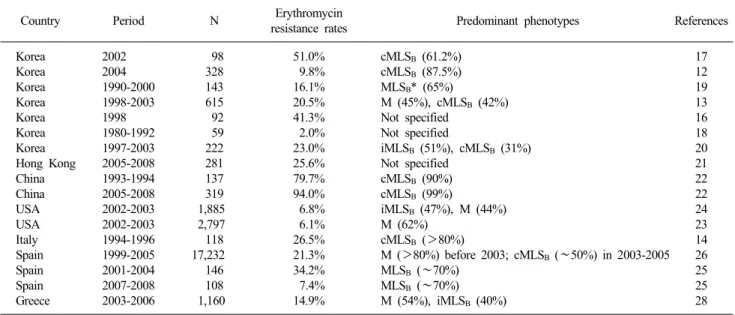
Table 1. Erythromycin resistance rates and predominant phenotypes of Streptococcus pyogenes in the last 20 years
Country Period N Erythromycin
resistance rates Predominant phenotypes References
Korea Korea Korea Korea Korea Korea Korea Hong Kong China China USA USA Italy Spain Spain Spain Greece
2002 2004 1990-2000 1998-2003 1998 1980-1992 1997-2003 2005-2008 1993-1994 2005-2008 2002-2003 2002-2003 1994-1996 1999-2005 2001-2004 2007-2008 2003-2006
98 328 143 615 92 59 222 281 137 319 1,885 2,797 118 17,232 146 108 1,160
51.0%
9.8%
16.1%
20.5%
41.3%
2.0%
23.0%
25.6%
79.7%
94.0%
6.8%
6.1%
26.5%
21.3%
34.2%
7.4%
14.9%
cMLSB (61.2%) cMLSB (87.5%) MLSB* (65%)
M (45%), cMLSB (42%) Not specified
Not specified
iMLSB (51%), cMLSB (31%) Not specified
cMLSB (90%) cMLSB (99%)
iMLSB (47%), M (44%) M (62%)
cMLSB (>80%)
M (>80%) before 2003; cMLSB (∼50%) in 2003-2005 MLSB (∼70%)
MLSB (∼70%) M (54%), iMLSB (40%)
17 12 19 13 16 18 20 21 22 22 24 23 14 26 25 25 28
*MLSB includes both constitutive and inducible type.
biotic resistance. Although penicillin is the drug of choice to eradicate GAS in the throat, oral penicillin V is no longer avail- able in Korea. Moreover, Korean physicians are hesitant to use injectable penicillin due to the risk of shock allergy. Although other oral penicillins or cephalosporins are safe and easy to take, they are not very effective against intracellular organisms.
GAS is located in both extra-cellular and intra-cellular compartments. Macrolides are adequate alternative drugs that ef- fectively kill intracellular organisms, and these can be used for patients who are allergic to penicillin. Macrolides are also effec- tive against other etiological agents that cause respiratory tract infections, such as chlamydia and mycoplasma [15]. Long-act- ing macrolides, such as azithromycin or clarithromycin, have been increasinggly used to treat infections, and these are more likely to induce resistance than erythromycin.
2. Mechanism of macrolide resistance
The macrolides, lincosamides and streptogramin B, also called MLSB, have similar structures and antibacterial spectra.
Erythromycin and clindamycin are class drugs of the macrolides and lincosamides, respectively. The double disk synergy (DDS) of erythromycin and clindamycin is used to classify GAS phe- notypes into cMLSB (constitutive resistance), iMLSB (inducible resistance), and M. The cMLSB phenotype is resistant to both erythromycin and clindamycin and its minimal inhibitory con- centration (MIC) is very high (>64 μg/mL). It shows a charac- teristic ‘D’ shape by DDS in iMLSB. Clindamycin is regarded
as resistant in iMLSB because resistance is induced within 2-3 days of usage. With a microdilution test, an iMLSB phenotype may be missed. In the case of the M phenotype, clindamycin is susceptible and the MIC of erythromycin is low (4-8 μg/mL).
These phenotypes rely upon the macrolide resistance genes:
cMLSB with erm(B), iMLSB with erm(A) (previously known as erm(TR)), and M with mef(A). Most of the macrolide-resistant GAS strains contain only one resistance gene. The antibiotic mechanism of MLSB phenotype is the methylation of 23S rRNA, whereas the M phenotype is caused by efflux. Resistance due to other mechanisms, e.g., 23S rRNA mutation, is rare.
3. Macrolide resistance rates and phenotype distribution
It is worthwhile to compare the trend of macrolide resistance and its phenotypic distribution by country (Table 1). The emer- gence of erythromycin resistance (41.3%) was encountered in Seoul, Korea beginning in 1998 [16]. An even higher peak of erythromycin resistance (51%) was observed in Jinju, Korea in 2002 [17]; however, this peak dropped sharply to 9.8% in the same area in just over 2 years [12]. The cMLSB phenotype was predominant in both of these two studies. The erythromycin re- sistance rate of GAS strains collected between 1980 and 1992 was 2% [18]. GAS strains isolated between 1990 and 2000 showed resistance rates of 16.1% and 9.8% to erythromycin and clindamycin, respectively in Wonju, Korea [19]. In that report, erythromycin resistance was first observed in 1994. Although the number of isolates tested was low (23 strains), phenotypic
distribution showed 9, 6, and 8 strains each for the cMLSB, iMLSB, and M phenotypes, respectively [19]. Erythromycin re- sistance was observed in 23% of clinical isolates collected be- tween 1997 and 2003 in Seoul [20]. Among the 51 eryth- romycin-resistant strains, the cMLSB phenotype accounted for 31%, the iMLSB phenotype for 51%; and the M phenotype for 18% [20]. Another large-scale study in Korea showed that the M (45%) and cMLSB (42%) phenotypes were rather common among 126 erythromycin-resistant strains in 1998-2003 [13].
The overall rate of erythromycin resistance was 25.6% in 281 strains isolated between 2005 and 2008 in Hong Kong [21].
Surprisingly, in China, rates of erythromycin and clindamycin resistance were 79.7% and 75.4%, respectively, in 1993-1994, and these rates increased to 94% and 96.9%, respectively, be- tween 2005 and 2008 [22]. The resistance rate to erythromycin was 6.1% among 2,797 isolates in the USA collected between 2002 and 2003 [23]. In this study, they collected pharyngeal iso- lates from different locations and at different times, and as a re- sult, they observed variable rates by site (3.0-8.7%) and by month (<2% to >10%). Over 60% of the macrolide-resistant isolates presented with the M phenotype in this study [23].
Another study in the USA during the same time period showed that resistance rates to erythromycin and clindamycin were 6.8%
and 0.5%, respectively, among 1,885 isolates [24]. The macro- lide-resistance phenotype distribution of strains in this study was as follows: cMLSB was 9%, iMLSB was 47%, and the M pheno- type was present in 44% of resistant strains. Among the 129 er- ythromycin-resistant strains, three predominant emm types were observed: emm75, emm12, and emm58 [24]. In a long-term study conducted in Spain from 1993 to 2008 [25], the eryth- romycin resistance trend coincidently overlapped with ours.
Erythromycin resistance rates progressively increased from 0%
in 1993-1994 to 34.2% in 2001-2004, and then they fell to 7.4%
in 2007-2008. Among the 66 erythromycin-resistant isolates studied, the cMLSB, iMLSB, and M phenotypes were 50%, 10.7%, and 39.4%, respectively [25]. Another well-designed study in Spain demonstrated that the erythromycin resistance rate was 21.3% among 17,232 isolates between 1999 and 2005 and most of erythromycin-resistant isolates had the M pheno- type prior to 2003 [26]. However, by 2004-2005, 50% of iso- lates presented with the MLSB phenotype, suggesting a higher MIC more recently. The cMLSB, iMLSB and M phenotype rates were 18%, 31% and 50%, respectively, among 167 eryth- romycin-resistant strains in Italy [27]. Among 1,160 clinical iso- lates collected between 2003 and 2006, the rates of resistance
to erythromycin and clindamycin were 14.9% and 1.4%, re- spectively, in Greece [28], suggesting that most of these isolates were of the M phenotype.
4. Antimicrobial consumption and antimicrobial resistance
It is well known that erythromycin resistance of GAS in Japan used to be very high (over 60%) in the 1970s, with a sub- stantial decrease in erythromycin resistance since the 1980s [29,30]. The reduction of macrolide usage is postulated as a ma- jor reason for the decrease in erythromycin resistance in Japan.
Scientists in Finland demonstrated a close association between erythromycin resistance of GAS and the consumption of this drug [31]. The incomparably high resistance rate (>95%) to macrolides in China in the late 2000s is a worrisome trend [21], as well, particularly because most of these strains had the cMLSB phenotype. As these highly resistant strains are inter- changeable between neighboring countries, a vigilant survey should be conducted to monitor these strains.
The resistance rate of erythromycin, class drug of the macro- lides, showed a peak (51%) in 2002, which dropped dramati- cally to 10% in 2004 in Jinju [12], and is currently less than 10%. However, the author has found that the consumption of macrolides, especially new macrolides, such as azithromycin, roxythromycin, and clarithromycin, has recently increased [32].
The author has suggested that the change of distribution of emm genotypes may affect the resistance rate more so than reducing the use of antibiotics in Korea [32]. A Spanish group observed a similar phenomenon: the frequency of erythromycin-resistant GAS was altered by the emergence of epidemic clones suscep- tible to erythromycin [33], and these arose without changes in the use of macrolides.
5. emm genotype and antimicrobial resistance
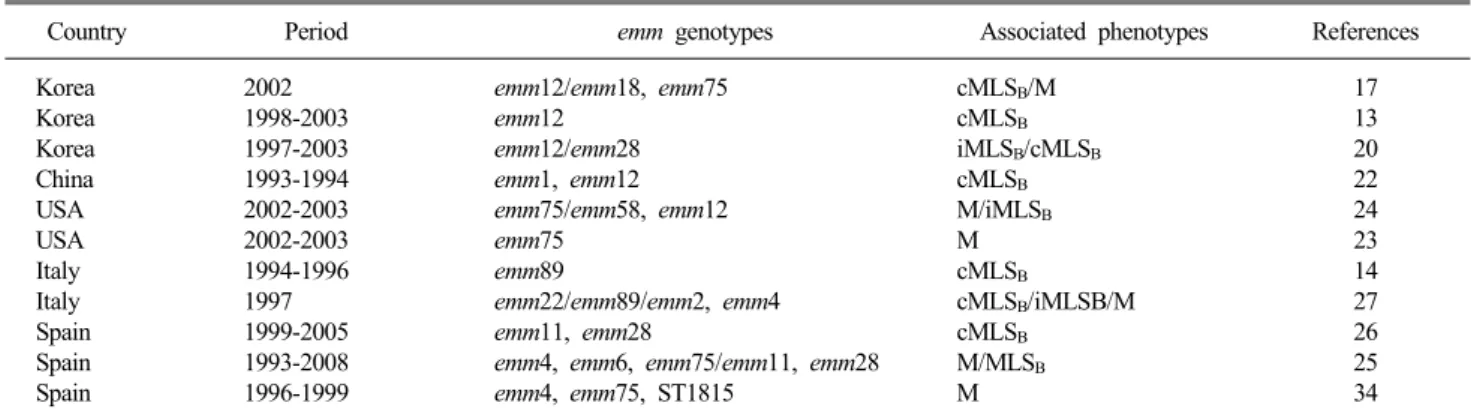
There is a discrepancy in the association between emm geno- type and erythromycin resistance reported by country (Table 2).
The author reported strong associations between emm12 and cMLSB, and emm18 and emm75 with M phenotype in 2002 [17]. While all iMLSB strains harbored the emm12 genotype, nine of 16 cMLSB had the emm28 type observed in Seoul [20].
There was a strong positive association between emm12 and the erm(B) gene in Korea, where 87.7% of the emm12 genotype contained the erm(B) gene [13]. The emm12 genotype seemed to be the most resistant genotype in Korea [13,17,32]. The emm75 genotype seemed to be associated with M phenotype [17,23-25].
Table 2. Association of emm genotypes and erythromycin-resistant phenotypes of Streptococcus pyogenes
Country Period emm genotypes Associated phenotypes References
Korea Korea Korea China USA USA Italy Italy Spain Spain Spain
2002 1998-2003 1997-2003 1993-1994 2002-2003 2002-2003 1994-1996 1997 1999-2005 1993-2008 1996-1999
emm12/emm18, emm75 emm12
emm12/emm28 emm1, emm12 emm75/emm58, emm12 emm75
emm89
emm22/emm89/emm2, emm4 emm11, emm28
emm4, emm6, emm75/emm11, emm28 emm4, emm75, ST1815
cMLSB/M cMLSB
iMLSB/cMLSB
cMLSB
M/iMLSB
M cMLSB
cMLSB/iMLSB/M cMLSB
M/MLSB
M
17 13 20 22 24 23 14 27 26 25 34
The most common emm genotypes representing erythromycin resistance were emm22 (85.7%) in Hong Kong [21], emm1 (86.2%) and emm12 (91.8%) in China [22], and emm77 (17.9%) and emm4 (16.8%) in Greece [28]. Almost all strains harboring the emm22 gene had the cMLSB phenotype, and more than 80%
of the emm89 and emm4 positive strains presented with the iMLSB and M phenotypes, respectively, in Italy [27]. Among the M phenotype isolates, the most frequent genotypes (88.5%) were emm4, emm6, and emm75, while emm11, emm28, and emm25 accounted for 72.5% of MLSB phenotype isolates in Spain over a period from 1993-2008 [25]. Another study sup- ported the relationship between emm types and the MLSB phe- notype reported in Spain. In that study, the most prevalent geno- types were emm11 and emm28 in isolates collected from 1999 to 2005, and these had the MLSB phenotype [26]. In the other study in Spain, emm4, ST1815, and emm75 had been predom- inantly observed in erythromycin-resistant strains from 1996- 1999 [34]; however, the emm12 genotype was common both in erythromycin-resistant and susceptible strains. The finding of di- verse emm types representing erythromycin resistance that varies by country indicates that the M protein does not play a role in the passage of resistance gene clusters (e.g., transposon) through the cell wall. Clonal expansion of resistant strains in a given re- gion is more likely the cause, rather than susceptibility of cer- tain M proteins to resistance genes. However, more studies should be conducted to elucidate the mechanism of macrolide resistance. That no penicillin-resistant GAS strains have been identified, worldwide [35], despite the fact that a very high re- sistance rate to penicillin occurs in Streptococcus pneumoniae, has yet to be fully elucidated.
CONCLUSION
S. pyogenes, or GAS, may cause severe illnesses, such as STSS or necrotizing fasciitis. The mortality rate for STSS is currently 50%. There have been several hundred victims of STSS in Japan. Acute pharyngitis is a very common infection of the upper respiratory tract. Although no strains with resist- ance to penicillin have been discovered, the macrolides have been the most common treatment used to eradicate this bug.
GAS resistance to erythromycin peaked in 2002, but this resist- ance is currently very low in Korea; however, the macrolide re- sistance rate exceeded 90% recently in China. Considering the increasing numbers of travelers between neighboring countries, a vigilant survey to monitor these highly virulent and anti- biotic-resistant strains is necessary.
REFERENCES
1. Markowitz M and Kaplan EL. Reappearance of rheumatic fever.
Adv Pediatr 1989;36:39-65.
2. Johnson DR, Stevens DL, Kaplan EL. Epidemiologic analysis of group A streptococcal serotypes associated with severe systemic infections, rheumatic fever, or uncomplicated pharyngitis. J Infect Dis 1992;166:374-82.
3. Stevens DL. Streptococcal toxic shock syndrome. Clin Microbiol Infect 2002;8:133-6.
4. Nakashima K, Ichiyama S, Iinuma Y, Hasegawa Y, Ohta M, Ooe K, et al. A clinical and bacteriologic investigation of invasive streptococcal infections in Japan on the basis of serotypes, toxin production, and genomic DNA fingerprints. Clin Infect Dis 1997;25:260-6.
5. McNeil SA, Halperin SA, Langley JM, Smith B, Warren A, Sharratt GP, et al. Safety and immunogenicity of 26-valent group a streptococcus vaccine in healthy adult volunteers. Clin Infect Dis 2005;41:1114-22.
6. Gerber MA. Treatment failures and carriers: perception or problems? Pediatr Infect Dis J 1994;13:576-9.
7. Cockerill FR 3rd, MacDonald KL, Thompson RL, Roberson F,
Kohner PC, Besser-Wiek J, et al. An outbreak of invasive group A streptococcal disease associated with high carriage rates of the invasive clone among school-aged children. JAMA 1997;277:
38-43.
8. Kim SJ. Bacteriologic characteristics and serotypings of Strepto- coccus pyogenes isolated from throats of school children. Yonsei Med J 2000;41:56-60.
9. Johnson DR and Kaplan EL. Microtechnique for serum opacity factor characterization of group A streptococci adaptable to the use of human sera. J Clin Microbiol 1988;26:2025-30.
10. Kim S and Lee NY. Epidemiological usefulness of anti-opacity factor antibody screening in schoolchildren. J Clin Microbiol 2001;39:1316-8.
11. Beall B, Facklam R, Thompson T. Sequencing emm-specific PCR products for routine and accurate typing of group A streptococci.
J Clin Microbiol 1996;34:953-8.
12. Koh EH, Maeng KY, Kim S, Jeong HJ, Lee NY. A decrease in erythromycin resistance rate of Streptococcus pyogenes in 2004 in Jinju. Korean J Clin Microbiol 2006;9:51-7.
13. Yi YH, Choi JH, Lee HK, Lee KJ, Bae SM, Yu JY, et al.
Characterization of erythromycin resistance of Streptococcus pyogenes isolated from pharyngitis patients in Korea. Jpn J Infect Dis 2006;59:192-4.
14. Creti R, Imperi M, Baldassarri L, Pataracchia M, Recchia S, Alfarone G, et al. emm Types, virulence factors, and antibiotic resistance of invasive Streptococcus pyogenes isolates from Italy:
What has changed in 11 years? J Clin Microbiol 2007;45:2249-56.
15. Choi EH. Emergence of macrolide resistance and clinical use of macrolide antimicrobials in children. Korean J Pediatr 2008;51:
1031-7.
16. Cha S, Lee H, Lee K, Hwang K, Bae S, Lee Y. The emergence of erythromycin-resistant Streptococcus pyogenes in Seoul, Korea.
J Infect Chemother 2001;7:81-6.
17. Kim S and Lee NY. Epidemiology and antibiotic resistance of group A streptococci isolated from healthy schoolchildren in Korea. J Antimicrob Chemother 2004;54:447-50.
18. Chong YS, Lee KW, Kown OH, Park HS. Antimicrobial susceptibility of Streptococcus pyogenes and Streptococcus agalac- tiae. J Korean Soc Chemother 1994;12:111-5.
19. Uh Y, Jang IH, Hwang GY, Lee MK, Yoon KJ, Kim HY. Antimi- crobial susceptibility patterns and macrolide resistance genes of beta-hemolytic streptococci in Korea. Antimicrob Agents Chemo- ther 2004;48:2716-8.
20. Bae SY, Kim JS, Kwon JA, Yoon SY, Lim CS, Lee KN, et al.
Phenotypes and genotypes of macrolide-resistant Streptococcus pyogenes isolated in Seoul, Korea. J Med Microbiol 2007;56:
229-35.
21. Chan JC, Chu YW, Chu MY, Cheung TK, Lo JY. Epidemiological analysis of Streptococcus pyogenes infections in Hong Kong.
Pathology 2009;41:681-6.
22. Feng L, Lin H, Ma Y, Yang Y, Zheng Y, Fu Z, et al. Macrolide- resistant Streptococcus pyogenes from Chinese pediatric patients in association with Tn916 transposons family over a 16-year period.
Diagn Microbiol Infect Dis 2010;67:369-75.
23. Green MD, Beall B, Marcon MJ, Allen CH, Bradley JS, Dashefsky B, et al. Multicentre surveillance of the prevalence and molecular
epidemiology of macrolide resistance among pharyngeal isolates of group A streptococci in the USA. J Antimicrob Chemother 2006;
57:1240-3.
24. Richter SS, Heilmann KP, Beekmann SE, Miller NJ, Miller AL, Rice CL, et al. Macrolide-resistant Streptococcus pyogenes in the United States, 2002-2003. Clin Infect Dis 2005;41:599-608.
25. Ardanuy C, Domenech A, Rolo D, Calatayud L, Tubau F, Ayats J, et al. Molecular characterization of macrolide- and multidrug- resistant Streptococcus pyogenes isolated from adult patients in Barcelona, Spain (1993-2008). J Antimicrob Chemother 2010;65:
634-43.
26. Pérez-Trallero E, Montes M, Orden B, Tamayo E, García-Arenzana JM, Marimón JM. Phenotypic and genotypic characterization of Streptococcus pyogenes isolates displaying the MLSB phenotype of macrolide resistance in Spain, 1999 to 2005. Antimicrob Agents Chemother 2007;51:1228-33.
27. Zampaloni C, Cappelletti P, Prenna M, Vitali LA, Ripa S. emm Gene distribution among erythromycin-resistant and -susceptible Italian isolates of Streptococcus pyogenes. J Clin Microbiol 2003;
41:1307-10.
28. Michos AG, Bakoula CG, Braoudaki M, Koutouzi FI, Roma ES, Pangalis A, et al. Macrolide resistance in Streptococcus pyogenes:
prevalence, resistance determinants, and emm types. Diagn Micro- biol Infect Dis 2009;64:295-9.
29. Fujita K, Murono K, Yoshikawa M, Murai T. Decline of erythromycin resistance of group A streptococci in Japan. Pediatr Infect Dis J 1994;13:1075-8.
30. Bass JW, Weisse ME, Plymyer MR, Murphy S, Eberly BJ. Decline of erythromycin resistance of group A beta-hemolytic streptococci in Japan. Comparison with worldwide reports. Arch Pediatr Adolesc Med 1994;148:67-71.
31. Bergman M, Huikko S, Pihlajamäki M, Laippala P, Palva E, Huovinen P, et al; Finnish Study Group for Antimicrobial Resistance (FiRe Network). Effect of macrolide consumption on erythromycin resistance in Streptococcus pyogenes in Finland in 1997-2001. Clin Infect Dis 2004;38:1251-6.
32. Koh E and Kim S. Decline in erythromycin resistance in group A streptococci from acute pharyngitis due to changes in the emm genotypes rather than restriction of antibiotic use. Korean J Lab Med 2010;30:485-90.
33. Oliver MA, García-Delafuente C, Cano ME, Pérez-Hernández F, Martínez-Martínez L, Albertí S. Rapid decrease in the prevalence of macrolide-resistant group A streptococci due to the appearance of two epidemic clones in Cantabria (Spain). J Antimicrob Chemother 2007;60:450-2.
34. Albertí S, García-Rey C, Domínguez MA, Aguilar L, Cercenado E, Gobernado M, et al; Spanish Surviellance Group for Respiratory Pathogens. Survey of emm gene sequences from pharyngeal Streptococcus pyogenes isolates collected in Spain and their relationship with erythromycin susceptibility. J Clin Microbiol 2003;41:2385-90.
35. Horn DL, Zabriskie JB, Austrian R, Cleary PP, Ferretti JJ, Fischetti VA, et al. Why have group A streptococci remained susceptible to penicillin? Report on a symposium. Clin Infect Dis 1998;26:
1341-5.
=국문초록=
최근 20년간
Streptococcus pyogenes
의 역학 및 Erythromycin 내성경상대학교 의학전문대학원 진단검사의학교실, 건강과학연구원 김 선 주
Streptococcus pyogenes의 역학조사를 위해서 사용되었던 혈청학적 방법은 2000년 이후에 emm 유전자형 검사에 의해 대 치되고 있다. 유전자형 분포는 지역이나 연구시기에 따라 다양하게 보고되었다. 이 논문에서는 여러 나라에서 보고된 erythromycin (EM) 내성률과 내성 표현형에 대해 기술하였다. 또한 EM 내성과 emm 유전자형의 연관성에 대해서도 살펴 보았다. 한국에서는 macrolide계 항균제의 사용량과 EM 내성률과는 무관하였다. S. pyogenes는 독성쇼크증후군이나 괴사 성 근막염과 같은 치명적인 질환을 일으킨다. S. pyogenes에 의한 독성쇼크증후군은 치사율이 50%에 이르며, 일본에서는 이 질환으로 수 백 명이 사망하였다. 한국에서는 2002년 EM 내성률이 50%로서 정점을 보인 후, 현재는 10% 미만으로 매우 낮게 유지되고 있다. 하지만 최근 중국에서는 EM 내성률이 90% 이상으로 보고되고 있다. 근접한 이웃 국가 간에 여행자가 급증하고 있음을 감안하면, 매우 치명률이 높고, 항균제 내성률이 높은 이 균의 유입을 잘 관찰해야 할 것이다.
[대한임상미생물학회지 2011;14:119-125]
교신저자 : 김선주, 660-702, 경남 진주시 칠암동 90번지 경상대학교병원 진단검사의학과
Tel: 055-750-8239, Fax: 055-762-2696 E-mail: [email protected]