Copyrights © 2016 The Korean Society of Radiology
214
Case Report
pISSN 1738-2637 / eISSN 2288-2928 J Korean Soc Radiol 2016;75(3):214-217 http://dx.doi.org/10.3348/jksr.2016.75.3.214
INTRODUCTION
An intercoronary communication is a direct communication between the two main coronary arteries and it can develop in the absence of an obstructive lesion (1, 2). Its true prevalence in the general population is not known, but the documented coro- nary angiographic incidence is 0.002% in 126595 patients and 0.02% in 9726 patients (1, 3). It can be distinguished from col- lateral arteries by its angiographic features, and it does not re- flect an underlying coronary disease (2). Here, we present a case of intercoronary communication between the right coronary ar- tery (RCA) and the left circumflex coronary artery (LCX) found incidentally in a 48-year-old man. The initial diagnosis was made using electrocardiogram (ECG)-gated multidetector
computed tomography (MDCT).
CASE REPORT
A 48-year-old man presented to the hospital with chest tight- ness and acute exertional chest pain. His symptoms had devel- oped 5 days earlier. There was no history of trauma, hyperten- sion, diabetes, or surgery. He did not have any connective tissue disorder or any other systemic anomaly, and there was no nota- ble family history of disease. The physical examination was nor- mal, with an arterial blood pressure of 130/90 mm Hg. A 12- lead ECG showed a normal sinus rhythm with a heart rate of 65 beats/min. Chest radiography revealed a normal-sized heart contour with no lung infiltration. Transthoracic echocardiogra-
Communication between the Right and Circumflex Coronary Arteries Discovered Incidentally by Multidetector Computed Tomography
다중검출 컴퓨터단층촬영으로 우연히 발견된 우측 관상동맥과 좌측 회선 관상동맥의 연결
Se Hwan Kwon, MD
1*, Eui Jong Kim, MD
1, Jong Shin Woo, MD
2, Soo-Joong Kim, MD
2, Hyo-Chul Youn, MD
3, Joo Hyeong Oh, MD
1Departments of 1Radiology, 2Cardiology, 3Cardiothoracic Surgery, College of Medicine, Kyung Hee University, Seoul, Korea
Intercoronary communication is a rare congenital coronary anomaly. We present a case of a 48-year-old man with an incidentally discovered communication between the right and circumflex coronary arteries, who was admitted with chest tightness and exertional dyspnea. The initial diagnosis was made using electrocardiogram- gated multidetector computed tomography.
Index terms Coronary Circulation Coronary Vessel Anomalies
Multidetector Computed Tomography Humans
Male
Received June 9, 2016 Revised June 27, 2016 Accepted July 3, 2016
*Corresponding author: Se Hwan Kwon, MD Department of Radiology, College of Medicine, Kyung Hee University, Kyung Hee University Hospital, 23 Kyungheedae-ro, Dongdaemun-gu,
Seoul 02447, Korea.
Tel. 82-2-958-8622 Fax. 82-2-968-0787 E-mail: [email protected]
This is an Open Access article distributed under the terms of the Creative Commons Attribution Non-Commercial License (http://creativecommons.org/licenses/by-nc/3.0) which permits unrestricted non-commercial use, distri- bution, and reproduction in any medium, provided the original work is properly cited.
215
Se Hwan Kwon, et al
jksronline.org J Korean Soc Radiol 2016;75(3):214-217 phy showed normal-sized cardiac chambers and normal left ven- tricular systolic function.
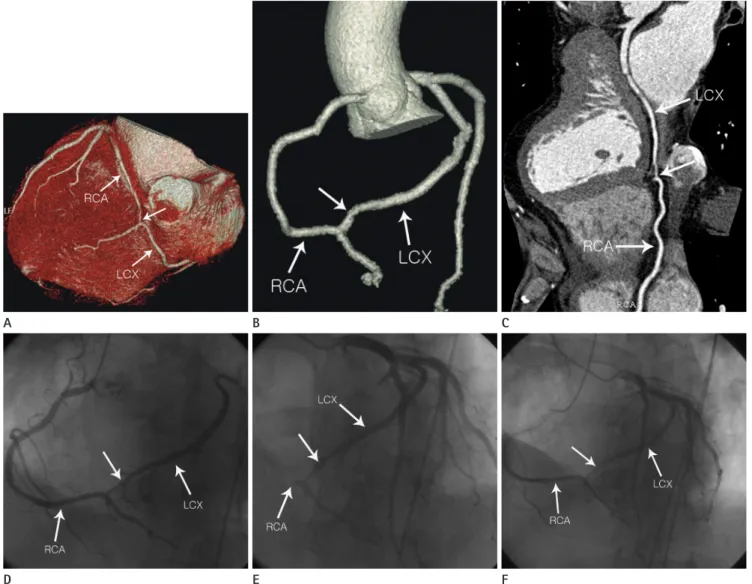
Cardiac CT performed using a 128-slice MDCT scanner (In- genuity Core 128; Philips Medical Systems, Best, the Nether- lands) showed no significant coronary artery stenosis, pulmo- nary thromboembolism and aortic dissection. However, an intercoronary communication between the posterolateral branch of the RCA and the distal LCX was noted (Fig. 1A-C, Supple- mentary Movie 1 in the online-only Data Supplement). Coro- nary angiography revealed no significant luminal narrowing or occlusion of the coronary arteries. However, selective and si- multaneous injection into the right and left coronary ostia con-
firmed the interarterial continuity between the RCA and LCX (Fig. 1D-F, Supplementary Movie 2 in the online-only Data Supplement). Selective injection into the left coronary artery showed retrograde filling of the RCA from the distal LCX, while right coronary injection filled the RCA and LCX. Retrograde filling did not involve the collaterals, but it was rather due to a bidirectional intercoronary communication. The patient was reassured that his coronary arteries were normal. Medical treat- ment (aspirin 100 mg/day, metoprolol 50 mg/day, and isosor- bide mononitrate 40 mg/day) alone controlled his symptoms, and he was discharged in good condition.
Fig. 1. Communication between the right and circumflex coronary arteries discovered incidentally by multidetector computed tomography.
Three dimensional volume rendered images (A, B), and curved multiplanar reformatted image (C) showing the posterolateral branch of the right coronary artery (RCA) communicating (arrow) with the distal left circumflex coronary artery (LCX). Coronary angiography with selective (D, E) and simultaneous injection (F) into the right and left coronary arteries showing the connection (arrow) between the posterolateral branch of the RCA and the distal LCX. There is no significant coronary artery stenosis.
A B C
D E F
216
Communication between the Right and Circumflex Coronary Arteries
jksronline.org
J Korean Soc Radiol 2016;75(3):214-217
DISCUSSION
Intercoronary arterial communication or “coronary arcade” is a rare variant of the coronary circulation (1, 2). It is distinguished from the coronary collaterals seen in patients with occlusive coronary artery disease based on the angiographic features and histological structure (4). In the presence of occlusive coronary artery disease, collaterals dilate progressively in an attempt to mitigate the severity of myocardial ischemia and necrosis. In comparison, intercoronary communications are single, extra- mural, straight or gently curved, and larger in diameter (> 1 mm) than collaterals. They also appear to be histologically different:
collaterals that develop in the presence of obstructive coronary artery disease are composed of endothelium supported by poor- ly organized collagen, muscle, and elastic fibers, whereas inter- coronary communications are similar to an epicardial vessel with a well-defined muscle layer (4, 5). Rare cases of intercoronary communication in the absence of obstructive coronary artery disease have been reported (1-6). In the past, intercoronary com- munications were usually diagnosed postmortem or by cardiac catheterization. Conventional coronary angiography is the gold standard for assessing coronary arteries. However, recent ad- vances in cardiac MDCT enable non-invasive diagnosis of this condition and other coronary anomalies (7, 8). In our patient, ECG-gated, cardiac MDCT was performed for triple rule-out (acute coronary syndrome, pulmonary thromboembolism, and aortic dissection) and an intercoronary communication between the posterolateral branch of the RCA and the distal LCX was discovered incidentally by MDCT.
The functional significance of intercoronary communications is unclear. They may have a protective role if occlusive coronary lesions develop in any of the involved vessels. However, Don- aldson and Isner (5) reported a case with > 95% narrowing of the RCA, in which the left anterior descending artery–posterior descending artery (PDA) continuity did not prevent extensive transmural infarction in the distribution of the PDA; hence, the theoretical protective role is questionable. Furthermore, myo- cardial ischemia can result from a coronary steal by the unidi- rectional intercoronary communication (2, 6). Kim et al. (4) and Takatsu et al. (9) reported cases of intercoronary communica- tions with vasospastic angina. Although the relation between in- tercoronary communication and coronary artery spasm is not
clear, consideration of coronary vasospasm can be useful if in- tercoronary communication without significant coronary steno- sis is found in patients with chest pain. Fortunately, our patient did not have combined significant coronary artery stenosis or any other disease; medical treatment (aspirin, metoprolol, and isosorbide mononitrate) controlled his symptoms. Further studies are needed to evaluate the potential role of intercoronary com- munication and to establish a standard management protocol.
In summary, we report a case of intercoronary communica- tion between the RCA and LCX found incidentally in a 48-year- old man who was initially diagnosed using ECG-gated MDCT.
SUPPLEMENTARY MOVIE LEGENDS
Communication between the right and circumflex coronary arteries discovered incidentally by MDCT.
Movie 1. Maximum intensity projection cardiac MDCT axial images during mid-diastole.
Movie 2. Coronary angiographic images in the left anterior oblique caudal view with simultaneous injection of contrast ma- terial into both coronary ostia.
Supplementary Materials
The online-only Data Supplement is available with this article at http://dx.doi.org/10.3348/jksr.2016.75.3.214.
REfERENCES
1. Yamanaka O, Hobbs RE. Coronary artery anomalies in 126,595 patients undergoing coronary arteriography. Cathet Cardio- vasc Diagn 1990;21:28-40
2. Gur M, Yilmaz R, Demirbag R. Unidirectional communication between the circumflex and right coronary arteries: a very rare coronary anomaly and cause of ischemia. Int J Cardio- vasc Imaging 2006;22:339-342
3. Carangal VP, Dehmer GJ. Intercoronary communication be- tween the circumflex and right coronary arteries. Clin Car- diol 2000;23:125-126
4. Kim SH, Kim DH, Choi WG, Woo SI, Choi IS, Kwan J, et al.
Intercoronary Communication between the Circumflex and Right Coronary Arteries Coexisted with Coronary Vasospasm.
Korean Circ J 2013;43:488-490
217
Se Hwan Kwon, et al
jksronline.org J Korean Soc Radiol 2016;75(3):214-217 5. Donaldson RF, Isner JM. Intercoronary continuity: an ana-
tomic basis for bidirectional coronary blood flow distinct from coronary collaterals. Am J Cardiol 1984;53:351-352 6. Sengül C, Ozveren O, Oduncu V, Deg˘ertekin M. Unidirectional
intercoronary communication: a very rare coronary anomaly and cause of ischemia. Turk Kardiyol Dern Ars 2011;39:344 7. Kim YJ, Yong HS, Kim SM, Kim JA, Yang DH, Hong YJ, et al.
Korean guidelines for the appropriate use of cardiac CT.
Korean J Radiol 2015;16:251-285
8. Kim YJ, Yong HS, Kim SM, Kim JA, Yang DH, Hong YJ.
Guideline for appropriate use of cardiac CT in heart disease.
J Korean Soc Radiol 2014;70:93-109
9. Takatsu F, Osugi J, Sugiishi M, Suzuki A, Nagaya T. Intercoro- nary and intracoronary communications in four cases of va- sospastic angina. Cathet Cardiovasc Diagn 1989;16:103-108
다중검출 컴퓨터단층촬영으로 우연히 발견된 우측 관상동맥과 좌측 회선 관상동맥의 연결
권세환
1* · 김의종
1· 우종신
2· 김수중
2· 윤효철
3· 오주형
1관상동맥 사이의 연결은 드문 선천성 관상동맥 이상이다. 저자들은 흉부 불편감과 운동시 호흡곤란을 주소로 내원한 48세 남자 환자에서 심전도 동기화 다중검출 컴퓨터단층촬영으로 우측 관상동맥과 좌측 회선 관상동맥의 연결을 우연히 발견 하여 보고한다.
경희대학교 의과대학 1영상의학과, 2심장내과, 3흉부외과