성인 천식과 우울증과의 관계에 관한 연구
김여진1, 김정은2, 이주석1
성균관대학교 의과대학 삼성창원병원 1소아청소년과, 2내과
Association between asthma and depression in Korean adults
Yeo Jin Kim1, Jeoung Eun Kim2, Ju Suk Lee1
Departments of 1Pediatrics and 2Internal Medicine, Samsung Changwon Hospital, Sungkyunkwan University School of Medicine, Changwon, Korea
Purpose: Asthma is one of the most common allergic diseases in which depression is an important comorbidity. However, little is known about the prevalence of depression in Korean adult asthmatics. This study was performed to evaluate the association be- tween asthma and depression and to investigate the clinical characteristics of Korean adult asthmatics with depression.
Methods: Data were acquired from 18,066 men and women, aged older than 19 years who participated in the Fifth Korea National Health and Nutrition Examination Surveys, which was conducted from 2010 to 2012. The presence of asthma was based on self-re- ported physician diagnosis of asthma in the Health Interview Surveys.
Results: The prevalence of asthma was 3.2%, and that of depression was 4.2%. In univariate analysis, adults with asthma were old age, marital status, unemployment, low education, low monthly family income, low number of household members, obesity (P< 0.05) were significantly associated with asthma, but sex, residence area, and smoking status were not associated with asthma.
The prevalence of hypertension and depression were higher in asthmatics (P< 0.05), while diabetes mellitus was not associated with asthma. After adjustment for age, marital status, number of household members, monthly family income, body mass index, hypertension, unemployment, low educated status, and depression were associated with the higher prevalence of asthma (P< 0.01). Depression was associated with female sex, unemployment, while it was not associated with lung function in asthmatics.
Conclusion: The results of this study show that depression may be an important risk factor for asthma in Korean adults. Further studies are needed to explore mechanisms responsible for the association between depression and asthma. (Allergy Asthma Respir Dis 2015;3:173-179)
Keywords: Asthma, Depression, Respiratory function tests
서 론
천식은 가장 흔한 만성 호흡기 질환의 하나로 전세계적으로 유 병률 증가를 보이며1,2) 국내에서도 지속적인 증가 추세를 보인다.3,4) 천식의 유병률이 증가하는 이유로는 생활 습관의 변화, 대기오염, 위생가설 등이 제안되고 있으며5-7) 최근에는 천식과 정서적인 문제 와의 연관성에 대한 보고도 이루어지고 있다.8) 이 중 우울증과의 연관성에 대해서는 천식 환자에서 일반인보다 우울증의 빈도가 높 고 우울증이 천식 조절에 악영향을 미치는 것으로 알려져 있다.9,10) 천식과 우울증의 관계에 대한 최근 국내보고에 의하면 우울증을 동반한 성인 천식 환자에서 우울증을 동반하지 않은 경우에 비해 짧은 유병 기간을 가지고 천식 증상이 잘 조절되지 않는다고 보고
하였다.11) 그러나 천식 환자들의 우울증 유병률에 대한 국내 연구 는 없어 이에 본 저자들은 천식 환자에서 정상인에 비해 우울증 유 병률이 높은지를 알아보고자 하였고 또한 우울증을 동반한 천식 환자에서 우울증을 동반하지 않은 경우에 비해 나이, 성별, 흡연, 체질량지수 등의 임상적 인자와 폐기능검사 수치의 차이가 있는지 를 알아보고자 후향적 단면연구를 실시하였다.
대상 및 방법
1. 연구 대상
본 연구는 5차 국민건강영양조사(Korea National Health and Nutrition Examination Surveys)의 자료를 이용하여 실시하였다. 국
Allergy Asthma Respir Dis 3(3):173-179, May 2015 http://dx.doi.org/10.4168/aard.2015.3.3.173 ORIGINAL ARTICLE
Correspondence to: Ju Suk Lee
Department of Pediatrics, Samsung Changwon Hospital, Sungkyunkwan University School of Medicine, 158 Paryong-ro, Masanhoewon-gu, Changwon 630-723, Korea
Tel: +82-55-290-6045, Fax: +82-55-290-6044, E-mail: [email protected] Received: January 16, 2015 Revised: March 28, 2015 Accepted: March 30, 2015
© 2015 The Korean Academy of Pediatric Allergy and Respiratory Disease The Korean Academy of Asthma, Allergy and Clinical Immunology This is an Open Access article distributed under the terms of the Creative Commons Attribution Non-Commercial License
민건강영양조사의 세부적인 조사 내용과 방법은 질병관리본부 연 구윤리심의위원회(Institutional Review Board)의 승인을 받아 수 행되고 있다. 5차 국민건강영양조사는 2010년부터 2012년까지 3년 동안의 조사이며 총 25,534명이 참여하였다. 본 연구는 25,534명 중 19세 이상의 성인을 대상으로 실시하였으며 18세 이하 5,935명을 제 외하였다. 19,599명 중에서 천식의 유무를 응답하지 않은 1,533명은 연구에서 제외하여 18,066명을 대상으로 연구를 실시하였다.
2. 연구 방법
본 연구는 5차 국민건강영양조사를 이용하여 실시한 인구 기반 후향적 설문 조사연구이며 국민건강영양조사 자료는 국민건강영 양조사 홈페이지(https://knhanes.cdc.go.kr/knhanes)에서 제공받 았다. 연구에 사용되었던 각 변수의 정의는 체질량지수의 경우
<23, 23–25, >25 kg/m2을 기준으로 세 군으로 나누었고 이는 정 상, 과체중, 비만을 의미한다. 결혼 상태는 결혼 생활을 유지하고 있 는 경우, 사별 또는 이혼 후 독신인 경우, 결혼한 적 없는 경우로 나 누었고 직업군은 현재 직업에 종사하고 있는 경우와, 무직으로 나 누었다. 흡연의 경우는 흡연을 한번도 하지 않았던 군, 이전에 흡연 을 하였지만 현재 금연을 한군, 현재도 흡연을 하고 있는 군으로 나 누었으며 금연군은 금연 시행 후 흡연을 한번도 하지 않은 군으로 정의하였고 간헐적 흡연이 있었던 군은 흡연군으로 분류하였다. 거 주지역은 도시와 농촌으로 나누었으며 시, 동은 도시로 읍, 면은 농 촌으로 분류하였다. 한달 가족 수입은 5차 국민건강영양조사에서 분류한 4분위수를 이용하였고 교육 수준은 중학교 졸업 미만, 중 학교 졸업, 고등학교 졸업, 대학 졸업 이상으로 나누었다. 당뇨, 고혈 압, 천식과 우울증의 유무는 평생 의사에 의해 진단받은 적 있는 경 우로 한정하였다.
3. 통계 분석
자료 분석은 PASW Statistics ver. 18.0 (SPSS Inc., Chicago, IL, USA) 프로그램을 사용하였고 2군에서 빈도 비교는 chi-square를 사용하였고 천식과 우울증과의 연관성을 알아보기 위해 logistic regression analysis를 사용하였으며 P 값이 0.05 미만인 경우를 통 계적으로 의미 있다고 판단하였다.
결 과
1. 대상자들의 특징
총 18,066명의 연구 대상자들 중 천식으로 진단된 경우는 587명 (3.2%)이었고 우울증으로 진단된 경우는 758명(4.2%)이었다. 교육 수준은 고졸 이상인 경우(63.3%)가 많았으며 가족 구성원의 수는 2–4인 가정인 경우(79.8%)가 대부분을 차지하였다. 도시지역 거주 자의 빈도(79.2%)가 높았으며 대상자들의 현재 흡연율은 20.3%였
Table 1. Demographic characteristics of subjects (n= 18,066)
Characteristic No. (%)
Sex
Male 7,632 (42.3)
Female 10,434 (57.8)
Age (yr)
19–30 2,359 (13.1)
31–40 3,448 (19.1)
41–50 3,156 (17.5)
51–60 3,434 (19.0)
61–70 3,082 (17.1)
> 70 2,587 (14.3)
Marital status, n= 18,065
Married 13,394 (74.1)
Single (separated or divorced) 2,183 (12.1)
Never-married 2,488 (13.8)
Employment status, n= 17,821
Employed 10,480 (58.8)
Unemployed 7,341 (41.2)
Education, n= 17,860
< Middle school 4,606 (25.8)
Middle school 1,948 (10.9)
High school 5,939 (33.3)
> High school 5,367 (30.0)
Monthly family income (quartile), n= 17,856
1 3,538 (19.8)
2 4,597 (25.7)
3 4,841 (27.1)
4 4,880 (27.3)
No. of household members
1 1,368 (7.6)
2 4,741 (26.2)
3 4,461 (24.7)
4 5,040 (27.9)
> 5 2,456 (13.6)
Residence area
Urban 14,315 (79.2)
Rural 3,751 (20.8)
Smoking status
Current 3,673 (20.3)
Ex-smoker 3,632 (20.1)
None 10,761 (59.6)
Body mass index (kg/m2), n= 17,961
< 23 8,074 (45.0)
23–25 4,187 (23.3)
> 25 5,700 (31.7)
Hypertension
Yes 4,117 (22.8)
No 13,949 (77.2)
Diabetes mellitus
Yes 1,506 (8.3)
No 16,560 (91.7)
(Continued to the next page)
고 고혈압의 빈도는 22.8%였다. 당뇨병의 빈도는 8.3%였으며 체질량 지수 25 kg/m2 이상의 비만을 나타내는 경우는 31.7%였다(Table 1).
2. 천식 환자의 사회경제학적 특성.
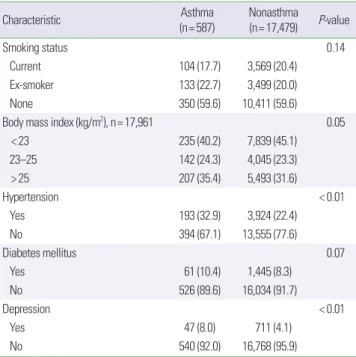
본 연구 대상자들에서 천식으로 진단된 경우에 평균 연령이 높 았고(56.2±17.9 years vs. 50.4±16.5 years, P<0.01) 또한 연령이 높을수록 천식으로 진단되는 빈도가 높은 경향을 보였으며 천식 으로 진단되는 경우에 사별 혹은 이혼으로 독신인 경우가 많았다 (P<0.01). 천식인 경우에 무직인 경우와 중학교 졸업 이하의 학력 을 가진 경우가 많았고 소득 수준이 낮은 경우와 2인 이하의 가족 인 경우에 천식의 빈도가 높았다(P<0.01). 비만, 고혈압 있는 경우 에 천식의 동반 빈도가 높았으나 당뇨, 거주지, 흡연 유무에 따른 차 이는 없었다. 천식이 있는 경우에 우울증의 동반 빈도는 8.0%로 천 식이 없는 경우에 비해 유의하게 높았다(8.0% vs. 4.1%, P<0.01) (Table 2).
각 연령별로 나누어 분석한 결과 천식과 가족 구성원 수, 고혈압, 비만, 당뇨, 거주지, 흡연 유무와 유의한 관계는 없었으나 성별, 소 득 수준, 교육 수준, 결혼, 직업, 우울증과는 유의한 상관관계를 보 이는 연령군도 있었다. 성별의 경우에 20대 남성에서 천식 빈도가 높았고(3.8% vs. 2.0%, P= 0.01) 60대 여성에서 천식 빈도가 높았다 (2.4% vs. 3.4%, P= 0.02). 다른 연령층에서는 40대 이후에 여성에서 남성보다 천식 유병률이 높은 경향을 보이나 유의한 차이는 없었 다. 결혼의 경우에는 20대 미혼의 경우에 기혼자에 비해 천식 유병 률이 높았고(2.5% vs. 0.2%, P= 0.03) 70대 이상의 경우에서는 기혼
Characteristic Asthma
(n= 587) Nonasthma (n= 17,479) P-value
Smoking status 0.14
Current 104 (17.7) 3,569 (20.4)
Ex-smoker 133 (22.7) 3,499 (20.0)
None 350 (59.6) 10,411 (59.6)
Body mass index (kg/m2), n= 17,961 0.05
< 23 235 (40.2) 7,839 (45.1)
23–25 142 (24.3) 4,045 (23.3)
> 25 207 (35.4) 5,493 (31.6)
Hypertension < 0.01
Yes 193 (32.9) 3,924 (22.4)
No 394 (67.1) 13,555 (77.6)
Diabetes mellitus 0.07
Yes 61 (10.4) 1,445 (8.3)
No 526 (89.6) 16,034 (91.7)
Depression < 0.01
Yes 47 (8.0) 711 (4.1)
No 540 (92.0) 16,768 (95.9)
Values are presented as number (%).
Table 2. Demographic characteristics according to the presence of asthma (n= 18,066)
Characteristic Asthma
(n= 587)
Nonasthma (n= 17,479) P-value
Sex 0.16
Male 231 (39.4) 7401 (42.3)
Female 356 (60.6) 10,078 (57.7)
Age (yr) < 0.01
19–30 65 (11.1) 2,294 (13.1)
31–40 78 (13.3) 3,370 (19.3)
41–50 63 (10.7) 3,093 (17.7)
51–60 95 (16.2) 3,339 (19.1)
61–70 130 (22.1) 2,952 (16.9)
> 70 156 (26.6) 2,431 (13.9)
Marital status, n= 18,065 < 0.01
Married 385 (65.6) 13,009 (74.4)
Single (separated or divorced) 129 (22.0) 2,054 (11.8)
Never-married 73 (12.4) 2,415 (13.8)
Employment status, n= 17,821 < 0.01
Employed 258 (44.3) 10,222 (59.3)
Unemployed 324 (55.7) 7,017 (40.7)
Education, n= 17,860 < 0.01
< Middle school 245 (42.0) 4,361 (25.2)
Middle school 70 (12.0) 1,878 (10.9)
High school 155 (26.6) 5,784 (33.5)
> High school 113 (19.4) 5,254 (30.4)
Monthly family income (quartile),
n= 17,856 < 0.01
1 191 (33.0) 3,347 (19.4)
2 139 (24.0) 4,458 (25.8)
3 124 (21.4) 4,717 (27.4)
4 125 (21.6) 4,755 (27.5)
No. of household members < 0.01
1 70 (11.9) 1,298 (7.4)
2 189 (32.2) 4,552 (26.0)
3 140 (23.9) 4,321 (24.7)
4 124 (21.1) 4,916 (28.1)
> 5 64 (10.9) 2,392 (13.7)
Residence area 0.47
Urban 458 (78.0) 13,857 (79.3)
Rural 129 (22.0) 3,622 (20.7)
(Continued to the next)
Characteristic No. (%)
Depression
Yes 758 (4.2)
No 17,308 (95.8)
Asthma
Yes 587 (3.2)
No 17,479 (96.8)
Table 1. Continued Table 2. Continued
Table 4. Demographic characteristics of asthma with and without depression (n= 587)
Characteristic
Asthma Depressed
(n= 47) Nondepressed (n= 540) P-value
Sex < 0.01
Male 9 (3.9) 222 (41.1)
Female 38 (96.1) 318 (58.9)
Age (yr) 0.12
19–30 2 (4.3) 63 (11.7)
31–40 7 (14.9) 71 (13.1)
41–50 6 (12.8) 57 (10.6)
51–60 7 (14.9) 88 (16.3)
61–70 17 (36.2) 113 (20.9)
> 70 8 (17.0) 148 (27.4)
Marital status 0.32
Married 31 (66.0) 354 (65.6)
Single (separated or
divorced) 13 (27.7) 116 (21.5)
Never-married 3 (6.4) 70 (13.0)
Employment status, n=582 < 0.01
Employed 10 (21.7) 248 (46.3)
Unemployed 36 (78.3) 288 (53.7)
Education, n= 583 0.65
< Middle school 21 (45.7) 224 (41.7)
Middle school 7 (15.2) 63 (11.7)
High school 12 (26.1) 143 (26.6)
> High school 6 (13.0) 107 (19.9)
Monthly family income (quartile), n=579 0.26
1 18 (40.9) 173 (32.3)
2 13 (29.5) 126 (23.6)
3 5 (11.4) 119 (22.2)
4 8 (18.2) 117 (21.9)
No. of household members 0.22
1 7 (14.9) 63 (11.7)
2 15 (31.9) 174 (32.3)
3 14 (29.8) 126 (23.3)
4 4 (8.5) 120 (22.2)
> 5 7 (14.9) 57 (10.6)
Residence area 0.94
Urban 37 (78.7) 421 (78.0)
Rural 10 (21.3) 119 (22.0)
Smoking status 0.65
Current 31 (66.0) 319 (59.1)
Ex-smoker 7 (14.9) 97 (18.0)
None 9 (19.1) 124 (23.0)
Body mass index (kg/m2), n= 584 0.69
< 23 20 (42.6) 215 (40.0)
23–25 9 (19.1) 133 (24.8)
> 25 18 (38.3) 189 (35.2)
Values are presented as number (%).
인 경우에 사별 혹은 이혼, 미혼인 경우에 비해 천식 유병률이 높았 다(2.1% vs. 0.7 vs. 0.4%, P= 0.01). 직업 유무에 있어서는 40대 이후 부터 무직인 경우에 천식 유병률이 유의하게 높았다(P<0.05). 소 득의 경우에는 50대(P<0.01), 60대(P<0.01)에서 소득 수준이 낮 은 경우에 천식 유병률이 높았다. 교육 수준의 경우에는 40대 (P<0.01), 60대(P= 0.02)에서 교육 수준이 낮은 경우에 천식 유병 률이 높았다. 우울증의 경우에는 30대(7.4% vs. 2.1%, P<0.01), 40 Table 3. Adjusted odds ratio (OR) and their 95% confidence intervals (CIs) for the prevalence of asthma
Characteristic Adjusted* OR 95% CI P-value
Age (yr) 0.24
19–30 0.788 0.465–1.335 0.38
31–40 0.781 0.520–1.173 0.23
41–50 0.646 0.438–0.952 0.28
51–60 0.698 0.510–0.957 0.26
61–70 0.839 0.649–1.085 0.18
> 70 Reference
Marital status, n= 18,065 0.04
Married 0.763 0.547–1.149 0.20
Single 1.050 0.655–1.684 0.84
Never-married Reference
Employment status, n= 17,821 < 0.01
Unemployed 1.429 1.192–1.712
Education < 0.01
< Middle school Reference
Middle school 0.884 0.662–1.182 0.41
High school 0.685 0.521–0.901 < 0.01
> High school 0.583 0.422–0.806 < 0.01
No. of household members 0.51
1 Reference
2 1.130 0.804–1.588 0.48
3 1.239 0.865–1.776 0.24
4 1.081 0.739–1.581 0.69
> 5 0.962 0.642–1.443 0.85
Monthly family income (quartile) 0.21
1 Reference
2 0.785 0.613–1.007 0.06
3 0.779 0.592–1.025 0.08
4 0.844 0.636–1.120 0.24
Body mass index (kg/m2) 0.15
< 23 Reference
23–25 1.168 0.940–1.452 0.16
> 25 1.203 0.985–1.469 0.07
Hypertension
Yes 1.075 0.872–1.325 0.50
Depression
Yes 1.577 1.140–2.182 < 0.01
*Adjusted for age, marital status, occupation, education, number of household members, monthly family income, body mass index, hypertension, depression.
게 측정되었으나 통계적 유의성은 없었다. 본 연구에서 60세 이상 의 고령연령의 천식 환자에서 우울증의 동반 빈도가 다소 높았으나 통계적 유의성은 발견하지 못하였고 70대 이상에서는 우울증의 동 반 빈도가 낮게 측정되었다. 국민건강영양조사 보고에서는 우울 증상 경험률이 고령일수록 증가하였는데24) 이러한 차이는 우울증 진단의 차이에 기인한다고 생각된다. 본 연구에서는 우울증을 의 사 진단에 의한 경우로 한정하였고 국민건강영양조사에서는 우울 증상 자가보고를 사용하였는데 전체 국민건강영양조사 연구참여 자에서 의사의 진단에 의한 우울증의 빈도는 70대 이후 감소 추세 를 보인다.
천식 환자에서 우울증을 동반하는 경우에 여성의 빈도가 높고25) 연령이 증가할수록 우울증의 빈도가 높다고 보고하고 있다.26,27) 본 연구에서도 우울증을 동반한 천식 환자에서 여성의 빈도가 높았으 며 통계적 유의성은 없었으나 60세 이상의 고령인 경우 빈도가 높 은 경향을 보였다.
이전 국내 보고에서11) 천식 환자에서 연령이 증가할수록, 소득 수준이 낮을수록 우울증 동반 빈도가 높고 성별, 비만, 교육 수준, 무직, 흡연에 따른 우울증 동반 빈도는 차이가 없다고 보고하였다.
본 연구 결과와 다른 국내 연구와11) 차이가 발생하는 이유로는 연 구 대상자 선정의 차이에 의해 발생한다고 생각된다. 본 연구에서 대상자는 국민건강영양조사의 참여자를 대상으로 하였고 천식 유 무를 의사에 의해 진단받은 과거력에 대한 설문 결과에 의해 결정 하였으나 이전 국내 보고의11) 경우에는 병원을 내원하는 천식 환자 중 일부를 대상자로 선정하였고 천식을 Global Initiative for Na- tional Asthma 권고안에 기반을 두어 진단하였다.
우울증이 천식 조절에 영향을 준다고 알려져 있으나28) 우울증이 천식 환자의 폐기능에 미치는 영향에 대해서는 우울증을 동반한 천식 환자에서 폐기능이 감소되었다는 보고와29,30) 우울증이 천식 환자의 폐기능에 영향을 주지 않는다는 보고가 있다.31) 우울증을 동반한 천식 환자에서 낮게 측정된 폐기능은 우울증으로 인한 천 식약물 순응도 저하에 의해 발생할 수 있어 조절 상태에 있는 천식 환자에서 우울증이 폐기능에 미치는 영향에 대한 향후 연구가 필 요하다. 본 연구에서 우울증이 천식 환자의 폐기능에 미치는 영향 은 없었고 이는 이전 국내 연구 결과와 동일하다.11)
천식과 우울증의 연관성이 천식과 우울증의 직접적인 관계에 의 한 것인지 만성 질환과 우울증과의 연관성에 의한 것인지는 아직 완전히 밝혀지고 있지 않지만 만성 간염 환자보다 천식 환자에서 우울증의 빈도가 높다고 보고되어 천식과 우울증 사이에 어느 정 도 관계가 있으리라 생각된다.32) 천식과 우울증과의 연관성에 대한 가설로는 몇 가지가 제안되고 있는데 첫 번째로 천식이 우울증을 일으킨다는 가설이다. 이러한 기전을 설명하는 데는 크게 두 가지 가설이 있다. 일반적으로 천식이 우울증과 같은 기분 장애보다 먼 저 발생하는데 천식 환자에서 호흡 장애와 같은 공포체험이 심리 Table 5. Lung function of asthma with and without depression (n= 587)
Characteristic Asthma
P-value Depressed (n= 26) Nondepressed (n= 263)
FVC (L) 2.82± 0.88 3.10± 0.84 0.11
FEV1 (% predicted) 83.9± 20.0 80.4± 20.1 0.40
FEV1/FVC (%) 0.72± 0.11 0.69± 0.13 0.27
FEF25%-75% (L/sec) 2.39± 2.02 2.77± 1.95 0.35
PEFR (L/sec) 5.22± 1.97 5.47± 1.94 0.53
Values are presented as mean± standard deviation.
FVC, functional vital capacity; FEV1, forced expiratory volume in one second; FEF25%-75%, forced expiratory flow during 25%–75%; PEFR, peak expiratory flow rate.
대(5.7% vs. 1.9%, P= 0.02), 60대(9.3% vs. 3.9%, P<0.01) 천식 환자 에서 우울증의 동반 빈도가 높았고 나머지 연령층에서도 통계적 유의성은 없었으나 천식 환자에서 우울증의 동반 빈도가 높았다.
다변량 분석 후 무직(odds ratio [OR], 1.429; 95% confidence in- terval [CI], 1.192–1.712), 저학력(P <0.01), 우울증이 있는 경우 (OR, 1.577; 95% CI, 1.140–2.182)에 유의하게 천식의 빈도가 높았 다(Table 3).
3. 우울증이 천식 환자에 미치는 영향
천식 환자에서 우울증이 동반된 경우에 여성인 경우(96.1% vs.
89.3%, P<0.01)가 많았고 무직인 경우(78.3% vs. 53.7%, P<0.01)가 많았다. 우울증의 동반 유무와 나이, 결혼 상태, 교육 수준, 가구당 수입, 가구당 가족 수, 거주지역, 흡연, 비만, 폐기능 사이에 유의한 관계는 없었다(Tables 4, 5).
고 찰
일반인에 비해 천식 환자에서 우울증의 빈도가 높다는 결과는 인종과 문화가 다른 여러 연구에서 공통적으로 보고되고 있다.12-16) 국내 천식 유병률은 2.0%–5.8%로 보고되고 있고17) 우울증의 유병 률은 3.7%–17.7%로 보고되고 있으며18-20) 본 연구에서 천식 유병률 은 3.2%였고 우울증의 유병률은 4.2%였다. 천식 환자에서 우울증 의 동반 빈도는 미국 성인을 대상으로 한 연구에서 7.5%로 보고하 였고14) 본 연구에서는 8%의 동반 빈도를 보여 정상인에 비해 천식 환자에서 우울증의 동반 빈도가 높았다.
본 연구에서 우울증이 동반된 천식 환자의 경우에 무직, 여성의 빈도가 유의하게 높았고 나이, 결혼 상태, 교육 수준, 가구당 수입, 가구당 가족 수, 거주지역, 흡연, 비만과 유의한 관계는 없었다. 우 울증은 고령, 여성, 무직, 독신, 교육 수준이 낮은 경우, 저소득층, 도 심 거주, 흡연, 비만의 경우에 빈도가 높다고 알려져 있으며21-23) 본 연구에서도 우울증을 동반한 천식 환자에서 무직, 여성의 빈도가 유의하게 높았다. 독신, 교육 수준이 낮은 경우, 저소득층, 흡연, 비 만의 경우에 본 연구에서 천식 환자의 우울증 동반 빈도가 다소 높
적 긴장 상태를 야기시켜 이후 우울증과 같은 기분 장애를 일으킬 수 있다는 인식 가설과33) 천식에 의한 저산소증, 과이산화탄소혈증 증세가 중추신경계의 과잉반응을 일으켜 이후 우울증을 야기한 다는 생물학적 가설이 있다.34) 그러나 저산소증, 과이산화탄소혈증 을 겪지 않은 잘 조절되고 있는 경증 천식 환자에서도 우울증이 발 생하기 때문에 최근에는 생물학적 가설에 대해서는 널리 받아들여 지지 않고 있다.
두 번째 가설은 우울증이 천식을 발생시킨다는 가설로 우울증 과 같은 기분 장애로 인해 발생한 장기간의 긴장 상태가 시상하부- 뇌하수체-부신 축의 하향조절과 부신피질, 부신 호르몬 수용체의 하향조절을 발생시키고 이로 인한 호르몬 불균형 상태가 천식을 발생을 일으킨다고 제안하고 있다.35-37) 즉, 흡입항원에 대한 알레르 기 면역반응이 긴장 상태에 의해 증폭되며 이는 향후 천식으로 발 생한다.38)
세 번째 가설은 천식과 우울증이 아직 밝혀지지 않은 동일 면역 기전에 의해 발생한다는 가설로 tumor necrosis factor-α, interleu- kin (IL) 1, IL-4, IL-6가 두 질환 모두에서 증가되어 있어 동일기전 에 의해 발생한다고 제안하고 있으나 이에 대한 연구가 부족하다.39) 본 연구의 단점은 첫째 후향적 단면연구로 천식과 우울증 사이 의 인과관계를 밝히기 어렵고 둘째 설문조사 연구이므로 대상자 선정에서 선택 삐뚤림, 연구 참여자의 기억에 의하므로 회상 삐뚤 림이 발생할 수 있다. 또한 천식, 우울증 등의 진단이 정확한 진단 기준 없이 의사의 주관에 의해 이루어질 수 있어 이 또한 본 연구의 단점으로 생각된다. 마지막으로 질병 유병률에 있어 확률표본 추 출을 고려하지 않았으므로 전국민을 대표하는 결과로서 한계점을 지닌다. 그럼에도 불구하고 본 연구의 장점은 대규모 설문조사 내 용을 이용한 연구이며 검사에 있어서 동일한 방법으로 표준화가 시행되었다. 또한 대규모 국내 자료를 이용하여 정상인과 천식 환 자에서 우울증의 유병률 차이에 대한 첫 보고에 의의가 있다.
천식과 같은 아토피 질환과 우울증과의 관계에 대해서는 임상의 학에서 많은 관심이 있으나 국내에서 이에 대한 연구는 부족하다.
본 논문에서 천식이 있는 경우에 우울증의 동반 빈도가 높았고 우 울증을 동반한 천식 환자의 경우에 있어서 여성, 무직의 빈도가 높 았다. 이러한 결과가 인종, 사회적 특성에 기반한 것인지 또는 연구 상의 오류에 의한 것인지에 대해서는 향후 다른 추가 연구가 필요 하다. 본 논문 내용을 기반으로 할 때 저자들은 성인 천식 환자에서 여성인 경우, 무직인 경우에는 우울증의 동반 유무를 확인하는 과 정이 필요하며 이러한 동반 질환을 적절히 치료함으로써 환자의 천 식 치료에도 어느 정도 도움이 되리라 생각된다.
REFERENCES
1. Asher MI, Montefort S, Bjorksten B, Lai CK, Strachan DP, Weiland SK, et
al. Worldwide time trends in the prevalence of symptoms of asthma, al- lergic rhinoconjunctivitis, and eczema in childhood: ISAAC phases one and three repeat multicountry cross-sectional surveys. Lancet 2006;368:
733-43.
2. Eder W, Ege MJ, von Mutius E. The asthma epidemic. N Engl J Med 2006;
355:2226-35.
3. Kim H, Oh SY, Kang MH, Kim KN, Kim Y, Chang N. Association between kimchi intake and asthma in Korean adults: the fourth and fifth Korea Na- tional Health and Nutrition Examination Survey (2007-2011). J Med Food 2014;17:172-8.
4. Kim SY, Jung JY, Park MS, Kang YA, Kim EY, Kim SK, et al. Increased prevalence of self-reported asthma among Korean adults: an analysis of KNHANES I and IV data. Lung 2013;191:281-8.
5. Brown EM, Arrieta MC, Finlay BB. A fresh look at the hygiene hypothe- sis: how intestinal microbial exposure drives immune effector responses in atopic disease. Semin Immunol 2013;25:378-87.
6. Delfino RJ. Epidemiologic evidence for asthma and exposure to air tox- ics: linkages between occupational, indoor, and community air pollution research. Environ Health Perspect 2002;110 Suppl 4:573-89.
7. Pearce N, Douwes J. Lifestyle changes and childhood asthma. Indian J Pe- diatr 2013;80 Suppl 1:S95-9.
8. Goodwin RD, Jacobi F, Thefeld W. Mental disorders and asthma in the community. Arch Gen Psychiatry 2003;60:1125-30.
9. Lu Y, Mak KK, van Bever HP, Ng TP, Mak A, Ho RC. Prevalence of anxi- ety and depressive symptoms in adolescents with asthma: a meta-analysis and meta-regression. Pediatr Allergy Immunol 2012;23:707-15.
10. Cluley S, Cochrane GM. Psychological disorder in asthma is associated with poor control and poor adherence to inhaled steroids. Respir Med 2001;95:37-9.
11. Choi GS, Shin YS, Kim JH, Choi SY, Lee SK, Nam YH, et al. Prevalence and risk factors for depression in Korean adult patients with asthma: is there a difference between elderly and non-elderly patients? J Korean Med Sci 2014;29:1626-31.
12. Kunik ME, Roundy K, Veazey C, Souchek J, Richardson P, Wray NP, et al. Surprisingly high prevalence of anxiety and depression in chronic breathing disorders. Chest 2005;127:1205-11.
13. Loerbroks A, Apfelbacher CJ, Bosch JA, Sturmer T. Depressive symptoms, social support, and risk of adult asthma in a population-based cohort study. Psychosom Med 2010;72:309-15.
14. Oraka E, King ME, Callahan DB. Asthma and serious psychological dis- tress: prevalence and risk factors among US adults, 2001-2007. Chest 2010;137:609-16.
15. Hasler G, Gergen PJ, Kleinbaum DG, Ajdacic V, Gamma A, Eich D, et al.
Asthma and panic in young adults: a 20-year prospective community study. Am J Respir Crit Care Med 2005;171:1224-30.
16. Scott KM, Von Korff M, Ormel J, Zhang MY, Bruffaerts R, Alonso J, et al.
Mental disorders among adults with asthma: results from the World Men- tal Health Survey. Gen Hosp Psychiatry 2007;29:123-33.
17. Song WJ, Kang MG, Chang YS, Cho SH. Epidemiology of adult asthma in Asia: toward a better understanding. Asia Pac Allergy 2014;4:75-85.
18. Kim KW, Kim SH, Shin JH, Choi BY, Nam JH, Park SC. Psychosocial, physical, and autonomic correlates of depression in Korean adults: results from a county-based depression screening study. Psychiatry Investig 2014;
11:402-11.
19. Kim TS, Jeong SH, Kim JB, Lee MS, Kim JM, Yim HW, et al. The clinical research center for depression study: baseline characteristics of a Korean long-term hospital-based observational collaborative prospective cohort study. Psychiatry Investig 2011;8:1-8.
20. Park RJ, Moon JD. Coffee and depression in Korea: the fifth Korean Na-
tional Health and Nutrition Examination Survey. Eur J Clin Nutr 2015;
69:501-4.
21. Brumpton BM, Leivseth L, Romundstad PR, Langhammer A, Chen Y, Camargo CA Jr, et al. The joint association of anxiety, depression and obesity with incident asthma in adults: the HUNT study. Int J Epidemiol 2013;42:1455-63.
22. Sengupta P, Benjamin AI. Prevalence of depression and associated risk factors among the elderly in urban and rural field practice areas of a ter- tiary care institution in Ludhiana. Indian J Public Health 2015;59:3-8.
23. Weyerer S, Eifflaender-Gorfer S, Kohler L, Jessen F, Maier W, Fuchs A, et al. Prevalence and risk factors for depression in non-demented primary care attenders aged 75 years and older. J Affect Disord 2008;111:153-63.
24. Ministry of Health & Welfare; Korea Centers for Disease Control and Pre- vention. Korea Health Statistics 2012: Korea National Health and Nutrition Examination Survey (KNHANES V-3). Cheongwon: Ministry of Health
& Welfare, Korea Centers for Disease Control and Prevention; 2013.
25. Di Marco F, Santus P, Centanni S. Anxiety and depression in asthma. Curr Opin Pulm Med 2011;17:39-44.
26. Ng TP, Chiam PC, Kua EH. Mental disorders and asthma in the elderly:
a population-based study. Int J Geriatr Psychiatry 2007;22:668-74.
27. Wong SY, Woo J, Lynn HS, Leung J, Tang YN, Leung PC. Risk of depres- sion in patients with chronic respiratory diseases: results from two large cohort studies in Chinese elderly from Hong Kong. Int J Geriatr Psychia- try 2006;21:233-8.
28. Kapadia SG, Wei C, Bartlett SJ, Lang J, Wise RA, Dixon AE, et al. Obesity and symptoms of depression contribute independently to the poor asth- ma control of obesity. Respir Med 2014;108:1100-7.
29. Krommydas GC, Gourgoulianis KI, Angelopoulos NV, Kotrotsiou E, Raft- opoulos V, Molyvdas PA. Depression and pulmonary function in outpa-
tients with asthma. Respir Med 2004;98:220-4.
30. Ritz T, Steptoe A. Emotion and pulmonary function in asthma: reactivity in the field and relationship with laboratory induction of emotion. Psy- chosom Med 2000;62:808-15.
31. Rimington LD, Davies DH, Lowe D, Pearson MG. Relationship between anxiety, depression, and morbidity in adult asthma patients. Thorax 2001;
56:266-71.
32. Centanni S, Di Marco F, Castagna F, Boveri B, Casanova F, Piazzini A.
Psychological issues in the treatment of asthmatic patients. Respir Med 2000;94:742-9.
33. Zaubler TS, Katon W. Panic disorder and medical comorbidity: a review of the medical and psychiatric literature. Bull Menninger Clin 1996;60(2 Suppl A):A12-38.
34. Roy-Byrne P, Stein MB. Inspiring panic. Arch Gen Psychiatry 2001;58:
123-4.
35. Cookson H, Granell R, Joinson C, Ben-Shlomo Y, Henderson AJ. Moth- ers' anxiety during pregnancy is associated with asthma in their children.
J Allergy Clin Immunol 2009;123:847-53.e11.
36. Dreger LC, Kozyrskyj AL, HayGlass KT, Becker AB, MacNeil BJ. Lower cortisol levels in children with asthma exposed to recurrent maternal dis- tress from birth. J Allergy Clin Immunol 2010;125:116-22.
37. Wright RJ, Rodriguez M, Cohen S. Review of psychosocial stress and asthma: an integrated biopsychosocial approach. Thorax 1998;53:1066-74.
38. Liu LY, Coe CL, Swenson CA, Kelly EA, Kita H, Busse WW. School exam- inations enhance airway inflammation to antigen challenge. Am J Respir Crit Care Med 2002;165:1062-7.
39. Jiang M, Qin P, Yang X. Comorbidity between depression and asthma via immune-inflammatory pathways: a meta-analysis. J Affect Disord 2014;
166:22-9.