D I A B E T E S & M E T A B O L I S M J O U R N A L
This is an Open Access article distributed under the terms of the Creative Commons Attribution Non-Commercial License (https://creativecommons.org/licenses/by-nc/4.0/) which permits unrestricted non-commercial use, distribution, and reproduction in any medium, provided the original work is properly cited.
Switching to Once-Daily Insulin Degludec/Insulin Aspart from Basal Insulin Improves Postprandial Glycemia in Patients with Type 2 Diabetes Mellitus:
Randomized Controlled Trial
Kyu Yong Cho1,2, Akinobu Nakamura1, Chiho Oba-Yamamoto1, Kazuhisa Tsuchida1, Shingo Yanagiya1, Naoki Manda3, Yoshio Kurihara4, Shin Aoki5, Tatsuya Atsumi1, Hideaki Miyoshi1,6
1Department of Rheumatology, Endocrinology and Nephrology, Faculty of Medicine and Graduate School of Medicine, Hokkaido University, Sapporo,
2Clinical Research and Medical Innovation Center, Hokkaido University Hospital, Sapporo,
3Manda Memorial Hospital, Sapporo,
4Kurihara Clinic, Sapporo,
5Aoki Clinic, Sapporo,
6Division of Diabetes and Obesity, Faculty of Medicine and Graduate School of Medicine, Hokkaido University, Sapporo, Japan
Background: To explore the efficacy and safety of switching from once-daily basal insulin therapy to once-daily pre-meal injec- tion insulin degludec/insulin aspart (IDegAsp) with respect to the glycemic control of participants with type 2 diabetes mellitus (T2DM).
Methods: In this multicenter, open-label, prospective, randomized, parallel-group comparison trial, participants on basal insulin therapy were switched to IDegAsp (IDegAsp group; n=30) or continued basal insulin (Basal group; n=29). The primary end- point was the superiority of IDegAsp in causing changes in the daily blood glucose profile, especially post-prandial blood glucose concentration after 12 weeks.
Results: Blood glucose concentrations after dinner and before bedtime were lower in the IDegAsp group, and the improvement in blood glucose before bedtime was significantly greater in the IDegAsp group than in the Basal group at 12 weeks (−1.7±3.0 mmol/L vs. 0.3±2.1 mmol/L, P<0.05). Intriguingly, glycemic control after breakfast was not improved by IDegAsp injection before break- fast, in contrast to the favorable effect of injection before dinner on blood glucose after dinner. Glycosylated hemoglobin signifi- cantly decreased only in the IDegAsp group (58 to 55 mmol/mol, P<0.05). Changes in daily insulin dose, body mass, and record- ed adverse effects, including hypoglycemia, were comparable between groups.
Conclusion: IDegAsp was more effective than basal insulin at reducing blood glucose after dinner and before bedtime, but did not increase the incidence of hypoglycemia. Switching from basal insulin to IDegAsp does not increase the burden on the patient and positively impacts glycemic control in patients with T2DM.
Keywords: Diabetes mellitus, type 2; Hypoglycemia; Insulin degludec; Insulin degludec, insulin aspart drug combination; Ran- domized controlled trial
Corresponding author: Hideaki Miyoshi https://orcid.org/0000-0002-3131-0832 Division of Diabetes and Obesity, Faculty of Medicine and Graduate School of Medicine, Hokkaido University, N15 W7, Kita-ku, Sapporo 060-8638, Japan
E-mail: [email protected]
INTRODUCTION
Type 2 diabetes mellitus (T2DM) is characterized by increas-
ing insulin resistance and a gradual decline in β-cell function that in many instances eventually necessitates treatment with exogenous insulin injection to maintain glycemic control [1,2].
https://doi.org/10.4093/dmj.2019.0093 pISSN 2233-6079 · eISSN 2233-6087
However, due to fear of hypoglycemia, weight gain, the practi- cal difficulties associated with the use of injection devices, and the requirement to titrate insulin dose, it is challenging for pa- tients and physicians to initiate or intensify insulin therapy [3].
Once-daily basal insulin injection is an optimal initiating method with a relatively low frequency of hypoglycemic events, and is widely used worldwide [4]. It is also an ideal method because the frequency of injections required is low and the algorithm used to titrate the dose is relatively simple.
The consensus statement by the American Diabetes Associa- tion and the European Association for the Study of Diabetes recommends once-daily basal insulin injection therapy as the first step in the introduction of insulin for the treatment of T2DM [5]. This approach mimics physiologic insulin secretion by adding insulin boluses in a sequential manner (evolving from basal insulin injection to basal-plus-one bolus to basal- plus-two boluses to basal-bolus therapy), but the increase in the frequency of injections adds an additional burden for pa- tients.
A variety of studies, including systematic reviews and meta- analyses of trials comparing basal insulin therapy and twice a day premixed insulin therapy, have concluded that there is a higher risk of hypoglycemia with premixed insulin while the final glycosylated hemoglobin (HbA1c) is lower [6]. The prod- ucts in the early phases of premixed insulins, including Neutral Protamine Hagedorn (NPH) or Neutral Protamine Lispro (NPL) are shorter-acting than basal insulin analogues; there- fore, they do not effectively mimic physiologic basal insulin se- cretion, which can be approximated by basal insulin analogues in the higher extent. Moreover, resuspension is required before the injection of the early premixed insulin products, ensuring accurate and repeatable dosing from an insulin cartridge would be difficult [7].
Insulin degludec/insulin aspart (IDegAsp) is a new combi- nation insulin consisting of 70% long-acting basal insulin de- gludec (IDeg) and 30% rapid-acting prandial insulin aspart (IAsp), in which each component maintains its independent characteristics and there is no interaction between them [8,9].
Accordingly, IDegAsp is convenient for “step-up” therapy (i.e., changing to basal-plus-one bolus therapy from basal insulin therapy) without the need for an increase in injection frequen- cy. IDeg, as the basal component of IDegAsp, has a longer du- ration of action and flatter profile than those of the early prod- ucts of basal insulins, such as NPH, NPL, glargine, and de- temir, resulting in fewer hypoglycemic episodes and less day-
to-day variability [10,11]. Use of IDegAsp has been reported to be associated with lower fasting blood glucose and frequency of hypoglycemia than other premixed insulin preparations [12]. Moreover, once-daily IDegAsp showed a significantly greater effect on reducing HbA1c in a phase 3 study, compared with once-daily insulin glargine (IGlr), without inducing more frequent hypoglycemia [13]. However, there have been few studies of the efficacy or safety of switching to IDegAsp in par- ticipants with T2DM that were being treated with basal insulin analogues. It would thus be useful to determine whether once- daily IDegAsp injection therapy can improve glycemic control, especially postprandial hyperglycemia, if participants are changed from once-daily long-acting basal insulin injection therapy in a clinical setting. To investigate the efficacy and safety of the switching to IDegAsp, we carried out a prospec- tive, randomized, parallel-group comparison trial.
METHODS
Trial population
The inclusion criteria were as follows: Japanese adults with T2DM; aged 20 to 80 years; HbA1c 46 to 75 mmol/mol (6.0%
to 9.0%); who had been treated with basal insulin (IDeg or IGlr) for ≥12 weeks before enrollment. Subjects who had a known or suspected allergy to trial products, unstable diabetic retinopa- thy, severe liver dysfunction or renal failure, and women who were pregnant or lactating, were excluded. Subjects with low in- sulin secretion (fasting plasma C-peptide ≤0.5 ng/mL) were also excluded. All informed consent was obtained from the subjects.
Trial design and procedures
A 12-week, multicenter, open-label, prospective, randomized, parallel-group comparison, treat-to-target study was conduct- ed at nine sites in Hokkaido, Japan. Screening commenced in January 2017 and recruitment was completed by November 2017. The protocol for this research project has been approved by a suitably constituted Ethics Committee of the institution and it conforms to the provisions of the Declaration of Helsin- ki (as revised in Fortaleza, Brazil, October 2013), Committee of Hokkaido University Hospital (approval No. 016-0228). The study was registered with the University Hospital Medical In- formation Network (UMIN) Center (UMIN000025199) be- fore enrollment.
Participants were assigned randomly (1:1) to continue ad-
ministering once-daily basal insulin (Basal group) or to switch from once-daily basal insulin to once-daily IDegAsp (IDegAsp group). Randomization and allocation of participants were undertaken by a specialized center independent of the medical institutions involved. Participants were allocated such that body mass index, HbA1c, and the identity of the basal insulin used (IDeg or IGlr) did not differ between the groups. Al- though the initial dose of IDegAsp used was the same as for the basal insulin, it could be reduced at the discretion of the physician when there was a risk of hypoglycemia. IDeg or IGlr continued to be administered at the same time as before the study commenced, whereas IDegAsp was administered just before the largest meal of the day, in accordance with the man- ufacturer’s instructions. The insulin titration method was as follows: the initial dosage of IDegAsp was identical to the pre- vious basal insulin dosage or was slightly increased to contain an identical amount of the degludec component. Then, it was titrated based on self-measured blood glucose (SMBG) mea- surements made before breakfast, to achieve a target blood glucose level of 5.5 to 7.2 mmol/L. Concomitant medications were continued at the same dose from enrollment until the end of the study. However, when the risk of hypoglycemia was sus- pected to be high, the dose of any concomitant medication could be reduced at the discretion of the physician. Four in- stances of seven-point SMBG profiles (measurements made before and 2 hours after the start of breakfast, lunch, and din- ner, and prior to bedtime) were carried out at before (two times) and during the treatment period of the study (two times); the average of the SMBG profiles at each period was used for the evaluation. A hypoglycaemic event was counted if blood glucose was confirmed to be <3.9 mmol/L by SMBG measurement or if assistance was required.
Endpoints and assessments
The primary endpoint was the superiority of daily blood glu- cose profile using seven-point SMBG measurement, particu- larly that in the postprandial blood glucose concentration in the IDegAsp group. Secondary endpoints were change from baseline in HbA1c, body mass, insulin dose, and other clinical parameters at 12 weeks, as well as the occurrence of adverse ef- fects, including hypoglycemic events.
Statistical analyses
The sample size of this study was calculated using data from the phase 3 trial of IDegAsp [13], in which the efficacy of once-
daily IDegAsp was compared with that of once-daily IGlr in insulin-naïve participants with T2DM. It was determined that 28 participants (30 participants, including a 10% drop-out esti- mate) were required in each group to detect a significant differ- ence, with 80% power and a statistical significance level of 5%, using the assumption that switching from IDeg or IGlr to IDe- gAsp would improve postprandial blood glucose by a mean 3.2 mmol/L, with a standard deviation (SD) of 4.1 mmol/L.
Data are reported as mean±SD, median (range), or number (%). Differences in baseline characteristics between the two groups were evaluated using the unpaired t-test or the Mann- Whitney U test for continuous variables, and the chi-square test or Fisher’s exact test for categorical variables. The Kol- mogorov-Smirnov test was used to test for the normality of continuous variables. The relationship between continuous variables was evaluated using Spearman rank-order correla- tion analysis. Data were analyzed using JMP Pro v14.0.0 (SAS Institute, Cary, NC, USA). A value of P<0.05 was considered to represent statistical significance.
RESULTS
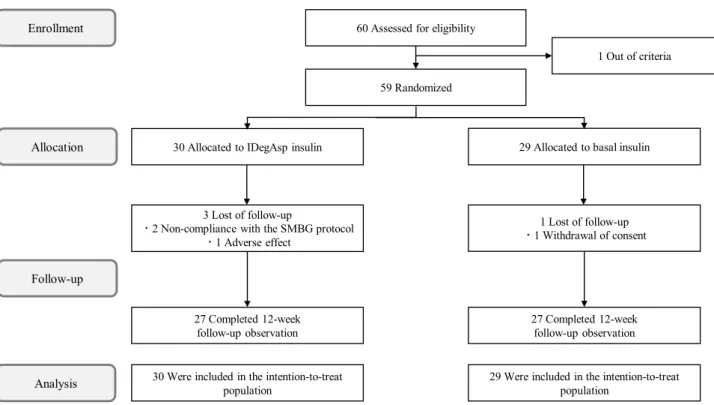
A total of 60 participants were initially enrolled in the study, but one was subsequently excluded according to the entry cri- teria. Each participant was randomly assigned to either the IDegAsp group (n=30) or the Basal group (n=29) (Fig. 1).
Four participants withdrew from the study prior to its comple- tion. The reasons for non-completion were withdrawal of con- sent (n=1), non-compliance with the SMBG protocol (n=2), and the adverse effect of hot flushes (n=1). No major differ- ences in baseline characteristics were identified between the groups (Table 1). There were 34 participants (57.6%) over the age of 65. In the IDegAsp group, there were 14 participants (46.7%) administering IDeg and 16 (53.3%) administering IGlr at baseline, and the Basal group contained 12 participants (41.4%) using IDeg and 17 (58.6%) using IGlr. There were no significant differences in the baseline characteristics of the two groups.
Regarding the primary endpoint of blood glucose concentra- tion measured using SMBG, the changes in total increase of post- prandial blood glucose during the study were –0.8±3.1 mmol/L in the IDegAsp group and 0.1±3.1 mmol/L in the Basal group;
these values were significantly different between groups (P=
0.04). In particular, blood glucose significantly decreased in the IDegAsp group, both after dinner (from 11.2±2.5 to 9.5±
60 Assessed for eligibility
59 Randomized
29 Allocated to basal insulin
3 Lost of follow-up
・2 Non-compliance with the SMBG protocol
・1 Adverse effect
27 Completed 12-week
follow-up observation 27 Completed 12-week
follow-up observation Enrollment
Allocation
Follow-up
Analysis
Figure1
1 Out of criteria
1 Lost of follow-up
・1 Withdrawal of consent 30 Allocated to IDegAsp insulin
30 Were included in the intention-to-treat
population 29 Were included in the intention-to-treat
population
Fig. 1. Study protocol flow diagram. IDegAsp, insulin degludec/insulin aspart; SMBG, self-measured blood glucose.
2.6 mmol/L, P<0.05) and at bedtime (from 10.1±2.4 to 8.4±
2.1 mmol/L, P<0.01) (Table 2). Moreover, the reduction in blood glucose before bedtime in the IDegAsp group was sig- nificantly greater than that in the Basal group (P=0.02) (Fig.
2). The proportion of participants achieving their glycaemic target before breakfast was similar between the groups (53.3%
in the IDegAsp group and 51.7% in the Basal group). Injection timing was evenly allocated between the groups at baseline (Table 1). In the IDegAsp group, the participants changed their injection timing to just before their main meal (breakfast, lunch, or dinner), following the instructions (n=9 [30.0%], n=3 [10.0%], and n=18 [60.0%], respectively). There were im- provements in glycaemic control after dinner (11.2±2.5 to 9.5±
1.8 mmol/L) and at bedtime (10.1±2.4 to 8.4±2.1 mmol/L) in the subgroup who injected IDegAsp before dinner (n=18). In- triguingly, no improvement in glycemia was detected after breakfast in the subgroup who injected IDegAsp before break- fast (10.3±2.3 to 9.8±5.1 mmol/L, n=9) (Table 3). In the IDe- gAsp group, 10 participants (55.6%) in the “before dinner in- jection” subgroup and four participants (44.4%) in the “before breakfast injection” subgroup achieved fasting blood glucose levels within the target range. The change of IDegAsp dose was from 13.5 to 13.7 units in the “before dinner injection” sub-
group, whereas it was from 10.8 to 11.1 units in the “before breakfast injection” subgroup. The changes in HbA1c in IDe- gAsp group were 63 mmol/mol (7.6%±0.6%) to 59 mmol/mol (7.2%±0.6%) in before dinner subgroup and 58 mmol/mol (7.5%±0.7%) to 55 mmol/mol (7.3%±0.6%) in before break- fast subgroup. There were no significant differences between two subgroups although the decreasing tendency was observed in before dinner subgroup (P=0.07). There was no difference in blood glucose between participants who had previously used IDeg or IGlr as their basal insulin preparation (data not shown). The change in daily insulin dose was comparable be- tween the groups (IDegAsp, 11.9±6.4 to 13.7±8.9 units; Basal, 13.0±5.4 to 13.7±6.9 units; P=0.94) (Table 3).
The HbA1c of the IDegAsp group significantly decreased from 58 mmol/mol (7.5%±0.6%) to 55 mmol/mol (7.3%±
0.6%) (P<0.05), but there was no significant difference in the change in HbA1c between the groups (P=0.11) (Table 4).
There were no significant differences in the changes in body mass, blood pressure, liver function, renal function, or lipid concentrations between baseline and 12 weeks, or between the two groups.
There were no severe adverse events during the study period.
Twenty-four hypoglycemic episodes were recorded in the IDe-
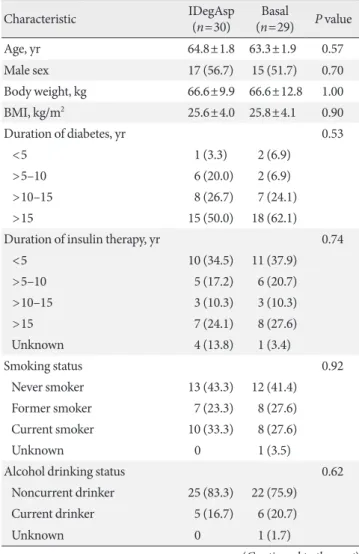
Table 1. Differences in clinical characteristics between the IDegAsp group and the Basal group
Characteristic IDegAsp
(n=30) Basal
(n=29) P value
Age, yr 64.8±1.8 63.3±1.9 0.57
Male sex 17 (56.7) 15 (51.7) 0.70
Body weight, kg 66.6±9.9 66.6±12.8 1.00
BMI, kg/m2 25.6±4.0 25.8±4.1 0.90
Duration of diabetes, yr 0.53
<5 1 (3.3) 2 (6.9)
>5–10 6 (20.0) 2 (6.9)
>10–15 8 (26.7) 7 (24.1)
>15 15 (50.0) 18 (62.1)
Duration of insulin therapy, yr 0.74
<5 10 (34.5) 11 (37.9)
>5–10 5 (17.2) 6 (20.7)
>10–15 3 (10.3) 3 (10.3)
>15 7 (24.1) 8 (27.6)
Unknown 4 (13.8) 1 (3.4)
Smoking status 0.92
Never smoker 13 (43.3) 12 (41.4)
Former smoker 7 (23.3) 8 (27.6)
Current smoker 10 (33.3) 8 (27.6)
Unknown 0 1 (3.5)
Alcohol drinking status 0.62
Noncurrent drinker 25 (83.3) 22 (75.9) Current drinker 5 (16.7) 6 (20.7)
Unknown 0 1 (1.7)
Table 1. Continued
Characteristic IDegAsp
(n=30) Basal
(n=29) P value Diabetic retinopathy 10 (33.3) 8 (27.6) 0.78 Diabetic nephropathy 12 (40.0) 6 (20.7) 0.16
Hypertension 20 (66.7) 20 (69.0) 1.00
Dyslipidemia 26 (86.7) 19 (65.5) 0.07
Antidiabetic medicine
Insulin 0.75
Degludec 14 (46.7) 12 (41.4)
Glargine 16 (53.3) 17 (58.6)
Insulin dose, unit/day 12.0±6.4 13.0±5.4 0.48
Injection timing 0.79
Breakfast 15 (50.0) 13 (44.8)
Lunch 1 (3.3) 2 (6.9)
Dinner/Bedtime 14 (46.7) 14 (48.3)
Biguanide 22 (73.3) 16 (55.2) 0.18
Thiazolidinedione 3 (10.0) 3 (10.3) 1.00
Sulphonylurea 5 (16.7) 5 (17.2) 1.00
Glinide 10 (33.3) 7 (24.1) 0.56
DPP-4 inhibitor 19 (63.3) 21 (72.4) 0.58
α-Glucosidase inhibitor 7 (23.3) 7 (24.1) 1.00
SGLT2 inhibitor 9 (30.3) 8 (27.9) 1.00
GLP-1 receptor agonist 5 (16.7) 3 (10.3) 0.71 Values are presented as mean±standard deviation or number (%).
IDegAsp, insulin degludec/insulin aspart; BMI, body mass index;
DPP-4, dipeptidyl peptidase-4; SGLT2, sodium-glucose cotransport- er-2; GLP-1, glucagon-like peptide-1.
(Continued to the next)
Table 2. Comparison of the change in daily blood glucose concentrations
Variable IDegAsp group (n=30) Basal group (n=29)
P value
Baseline At 12 weeks Baseline At 12 weeks
Blood glucose, mmol/L
Total postprandiala –0.8±3.1 0.1±3.1 0.04
Before breakfast 6.8±0.3 6.9±1.5 7.5±0.3 7.4±1.7 0.27
After breakfast 9.5±2.5 10.2±2.8 10.6±2.3 10.5±2.2 0.63
Before lunch 7.5±2.0 8.0±2.5 8.2±2.1 8.1±2.4 0.88
After lunch 10.4±2.1 10.5±2.4 10.3±2.3 10.3±2.6 0.78
Before dinner 7.7±2.8 8.1±2.8 8.2±2.5 8.5±2.4 0.58
After dinner 11.2±2.5 9.5±2.6b 10.6±2.4 10.4±2.4 0.19
Bedtime 10.1±2.4 8.4±2.1c 9.6±2.7 9.9±2.8 0.02
Values are presented as mean±standard deviation. P values compare the IDegAsp and the Basal groups.
IDegAsp, insulin degludec/insulin aspart.
aThe change in total increase of postprandial blood glucose, bP<0.05, cP<0.01 between the two groups in the change during the study.
gAsp group and 26 in the Basal group during the 12 weeks of the trial (difference between groups, P=0.82). Few adverse events occurred in either group (Supplementary Table 1). One
participant, who felt hot flushes, feared the development of hy- poglycemia and dropped out of the study. However, it was not determined whether this was a hypoglycemic symptom, be- Table 3. Changes in daily blood glucose concentrations in patients of the IDegAsp group who injected either before breakfast (n=9) or dinner (n=18)
The timing of IDegAsp injection Before breakfast (n=9) Before dinner (n=18)
Baseline At 12 weeks P value Baseline At 12 weeks P value
Blood glucose, mmol/L
Before breakfast 7.2±1.0 7.7±1.3 0.20 6.7±1.1 6.9±1.5 0.74
After breakfast 10.3±2.3 9.8±5.1 0.74 9.5±2.5 10.2±2.4 0.40
Before lunch 9.2±2.6 10.0±3.3 0.12 7.5±2.0 8.0±1.5 0.84
After lunch 10.4±2.5 11.4±3.2 0.36 10.4±2.1 10.5±2.0 0.39
Before dinner 9.8±3.8 9.9±4.0 0.96 7.6±2.8 8.1±1.5 0.28
After dinner 11.2±3.7 10.3±3.8 0.58 11.2±2.5 9.5±1.8a <0.01
Bedtime 9.8± 3.4 9.2±3.0 0.56 10.1±2.4 8.4±2.1a <0.01
Insulin dose, unit 10.8±4.6 11.1±5.4 0.85 13.5±6.4 13.7±6.6 0.43
Patients achieved the targetb 4 (44.4) 4 (44.4) 1.00 12 (66.7) 10 (55.6) 0.50
HbA1c, % 7.5±0.7 7.3±0.6 0.23 7.6±0.6 7.2±0.6 0.07
Values are presented as mean±standard deviation or number (%).
IDegAsp, insulin degludec/insulin aspart; HbA1c, glycosylated hemoglobin.
aP<0.05 between baseline and the end of the study, bThe number of patients who achieved fasting blood glucose levels within the target range (5.5 to 7.2 mmol/L).
0.0 5.0 10.0 15.0
Blood glucose, mmol/L
● IDegAsp group ■ Basal insulin group
Breakfast Lunch Dinner Bedtime
Figure 2
a
Fig. 2. Blood glucose concentrations at the end of the study. Seven-point self-monitoring of blood glucose was undertaken by participants in the insulin degludec/insulin aspart (IDegAsp) and Basal groups during the study periods. Data are mean±standard deviation. P values indicate comparisons between the IDegAsp and Basal groups. Unpaired t-test. aP<0.05.
15
10
5
0
Blood glucose (mmol/L)
cause SMBG was not being carried out at that time. Other ad- verse effects were similarly mild and resolved with appropriate support, such that no other participants dropped out of the tri- al. No participants had infections, dehydration, ketoacidosis, or cardiovascular events.
DISCUSSION
This randomized controlled trial in a real-world clinical setting demonstrated that switching from once-daily basal insulin to once-daily IDegAsp comprises a useful step-up treatment mo- dality that improves glycaemic control without the require- ment for an increased insulin dose or with a greater risk of hy- poglycemia. Seven-point SMBG revealed that trial participants
administering once-daily basal insulin had relatively high blood glucose after dinner, and that IDegAsp significantly im- proved this. The relative contribution of the postprandial blood glucose level to HbA1c score is larger than that of the fasting blood glucose level at lower HbA1c [14], and a signifi- cant improvement in HbA1c only occurred in the IDegAsp group, in which the mean HbA1c level was <7.5%. Thus, this improvement was likely the result of the reduction in post- prandial blood glucose level caused by the rapid-acting IAsp component of IDegAsp.
Although there have been several comparison studies regard- ing the use of IDegAsp and IGlr in insulin-naive participants for the initiation of once-daily insulin [13,15,16], there have only been two studies regarding the potential benefits of switch- Table 4. Comparison of the effects of insulin type on other parameters
Variable IDegAsp group (n=30) Basal group (n=29)
P value
Baseline At 12 weeks Baseline At 12 weeks
Body weight, kg 66.6±9.9 68.3±10.3 66.6±12.8 66.9±13.3 0.66
BMI, kg/m2 25.6±4.0 26.0±4.0 25.8±4.1 25.9±4.2 0.90
SBP, mm Hg 129.2±14.6 129.0±17.6 126.6±13.5 129.5±20.6 0.93
DBP, mm Hg 74.3±7.9 72.9±12.7 71.1±8.6 73.5±10.5 0.87
HbA1c, % 7.5±0.6 7.3±0.6a 7.6±0.6 7.6±0.7 0.11
C-peptide, ng/mL 2.4 (1.9–4.4) 1.8 (1.2–8.5) 1.9 (1.5–3.0) 2.9 (1.2–3.3) 0.74
AST, U/L 25.1±10.8 23.3±7.6 24.0±8.6 22.7±7.4 0.78
ALT, U/L 26.6±19.2 24.4±16.9 25.8±12.7 25.8±12.8 0.73
γ-GTP, U/L 28.5 (16.0–41.0) 28.5 (11.0–36.3) 22.0 (19.0–38.0) 29.0 (12.0–40.0) 0.67
Creatinine, μmol/L 75.4±25.5 76.0±5.5 75.4±25.5 75.7±5.4 0.96
ACR, mg/g creatinine 11.8 (5.2–85.5) 22.5 (6.5–97.0) 9.5 (4.1–27.9) 11.2 (8.0–32.8) 0.30
UA, μmol/L 302.9±84.0 309.9± 81.9 340.7±80.0 340.7±82.7 0.16
TG, mmol/L 1.5±0.6 1.6±0.8 1.6±0.7 1.7±0.7 0.95
TC, mmol/L 4.2±0.6 4.7±0.9 4.6±0.7 4.7±0.9 0.06
HDL-C, mmol/L 1.5±0.3 1.4±0.4 1.3±0.3 1.4±0.3 0.50
Insulin dose, unit/day 11.9±6.4 13.7±8.9 13.0±5.4 13.7±6.9 0.94
Injection timing <0.01b
Breakfast 15 (50.0) 9 (30.0) 13 (44.8) 13 (44.8)
Lunch 1 (3.3) 3 (10.0) 2 (6.9) 2 (6.9)
Dinner and bedtime 14 (46.7) 18 (60.0) 14 (48.2) 14 (48.2)
Values are presented as mean±standard deviation, median (25%–75% confidence interval), or number (%). P values refer to differences be- tween the IDegAsp and Basal insulin groups.
IDegAsp, insulin degludec/insulin aspart; BMI, body mass index; SBP, systolic blood pressure; DBP, diastolic blood pressure; HbA1c, glycosylat- ed hemoglobin; AST, aspartate aminotransferase; ALT, alanine aminotransferase; γ-GTP, γ-glutamyl transpeptidase; ACR, albumin/creatinine ratio; UA, uric acid; TG, triglyceride; TC, total cholesterol; HDL-C, high density lipoprotein cholesterol.
aP<0.05 between baseline and the end of the study, bP<0.01 between the two groups in the change during the study.
ing from basal insulin to IDegAsp [17,18]. One of these report- ed that IDegAsp (n=10) was more effective than basal insulin at reducing postprandial plasma glucose, measured following a 2-hour meal test, after 4 weeks of administration [17]. Consis- tent with our findings, there was a significant improvement in post-meal plasma glucose concentration after switching from basal insulin analogues to IDegAsp. A noteworthy aspect of the present study was the low frequency of hypoglycemia, because of the gentle insulin dose adjustment in order to ensure safety;
this is most important in real-world clinical settings. From this perspective, the present study differed from previous phase 3 trials or studies using intensive insulin titration protocols, which caused high frequencies (almost half of the participants) of hypoglycemia and serious adverse events [13].
In the present study, injection of IDegAsp before breakfast did not significantly improve blood glucose at any time point, in- cluding after breakfast. Although one of the possible explana- tions is the small sample size of the subgroup (n=9), the mean improvement in this subgroup was smaller than that in the sub- group that administered IDegAsp before dinner (−0.5 mmol/L vs. −2.5 mmol/L, respectively). There were similar findings in phase 3 studies of once-daily IDegAsp versus IGlr in Japanese and western participants with T2DM, in which postprandial blood glucose decreased when IDegAsp was administered be- fore dinner, but not before breakfast [13,18]. In addition, an- other study of once-daily IDegAsp injection, in which the par- ticipants injected IDegAsp before breakfast (n=266, 52 weeks), demonstrated no improvement in postprandial blood glucose after breakfast. Moreover, there was significantly more hypo- glycemia in the morning in the IDegAsp group than in the IGr group [15]. Taken together, these results highlight the impor- tance of the timing of IDegAsp administration. IDegAsp injec- tion before dinner seems to be more effective at improving postprandial blood glucose than the injection of this mixture before breakfast. A possible mechanism was identified in the previous study, which demonstrated more stable nocturnal gly- cemia and less hypoglycemia in European participants with in- sulin naive T2DM administering IDegAsp than in those ad- ministering IGlar. Plasma glucose concentration in the morn- ing is influenced by many factors that are unrelated to the insu- lin absorption profile, such as meals, variation in meal times, and exercise patterns. At night, glycemia is minimally affected by these factors, meaning that there is a stronger influence of insulin type on the blood glucose profile [16]. Although IDe- gAsp once-daily before breakfast was effective in a prior study,
it was determined with a 2-hour meal test and the dose of IDe- gAsp was increased by >60% for only 4 weeks in that study [17].
There were several limitations in the current trial. It was a randomized controlled trial, but used an open-label design, which might have generated some reporting bias. The injection timing of IDegAsp exhibited variation because it was adminis- tered immediately prior to the largest meal of the day, in accor- dance with the manufacturer’s instructions. The sample num- ber at each meal was not uniform because of the instruction.
At the end of this study, nearly half of the participants achieved fasting glucose levels in the target range. Although insulin dose was titrated to achieve a target fasting blood glucose level of 5.5 to 7.2 mmol/L before breakfast in this study, it could be re- duced at the discretion of the physician when there was a risk of hypoglycemia. Because this study was performed in a stan- dard clinical setting and included relatively older patients (mean age, 64.8 years), the physicians might have been reluc- tant to risk the onset of hypoglycemia. If strict titration were adopted in younger people, more improvement might be de- tected in glycemic control. In this study, there were fewer hy- poglycaemic events, but uncounted undetected hypoglycemia might exist. The peak of postprandial blood glucose was not al- ways at 2 hours after meals. Because postprandial hyperglyce- mia and asymptomatic hypoglycemia were not easy to detect by SMBG [19], and were more effectively detected by continu- ous glucose monitoring (CGM), further trials using CGM in real-world clinical settings should be planned in the future.
Our findings show that IDegAsp reduces hyperglycemia af- ter dinner and at bedtime without increasing the frequency of hypoglycaemic episodes or causing other adverse effects, when injected before dinner. Switching from once-daily basal insulin to once daily IDegAsp before the main meal of the day can be regarded as a positive step in the management of participants with inadequately controlled T2DM.
SUPPLEMENTARY MATERIALS
Supplementary materials related to this article can be found online at https://doi.org/10.4093/dmj.2019.0093.
CONFLICTS OF INTEREST
Akinobu Nakamura, Naoki Manda, Yoshio Kurihara, Tatsuya Atsumi, and Hideaki Miyoshi have received honoraria for lec-
tures and received research funding from some organizations as described below. There was no financial support for this study.
Akinobu Nakamura has received research funding from Mitsubishi Tanabe Pharma Co., Ono Pharmaceutical Co. Ltd.;
Naoki Manda has received honoraria for lectures from Ono Pharmaceutical Co. Ltd.; Yoshio Kurihara has received hono- raria for lectures from Astellas Pharma Inc., AstraZeneca, Mit- subishi Tanabe Pharma Co. Ltd., MSD, Ono Pharmaceutical Co. Ltd., Sanofi, Shionogi & Co. Ltd., Taisho Toyama Pharma- ceutical Co. Ltd., and Takeda Pharmaceutical Co. Ltd.; Tatsuya Atsumi has received honoraria for lectures from Mitsubishi Tanabe Pharma Co. Chugai Pharmaceutical Co. Ltd., Astellas Pharma Inc., Takeda Pharmaceutical Co. Ltd., Pfizer Inc., Ab- bVie Inc., Eisai Co. Ltd., Daiichi Sankyo Co. Ltd., Bristol-My- ers Squibb Co., UCB Japan Co. Ltd., Eli Lilly Japan K.K., and has received research funding from Astellas Pharma Inc., Takeda Pharmaceutical Co. Ltd., Mitsubishi Tanabe Pharma Co., Chugai Pharmaceutical Co. Ltd., Daiichi Sankyo Co. Ltd., Otsuka Pharmaceutical Co. Ltd., Pfizer Inc., and Alexion Inc.
Hideaki Miyoshi has received honoraria for lectures from As- tellas Pharma Inc., Dainippon Pharma Co., Eli Lilly, Mitsubishi Tanabe Pharma Co., MSD, Novartis Pharma, Novo Nordisk Pharma, Kowa Pharmaceutical Co. Ltd., Nippon Boehringer Ingelheim Co., Ono Pharmaceutical Co. Ltd., and Sanofi, and has received research funding from Astellas Pharma Inc., Dai- ichi Sankyo, Dainippon Pharma Co., Eli Lilly, Mitsubishi Ta- nabe Pharma Co., Novo Nordisk Pharma, Kowa Pharmaceuti- cal Co., Abbott Japan Co., Nippon Boehringer Ingelheim Co., Ono Pharmaceutical Co. Ltd., and Taisho Toyama Pharmaceu- tical Co., Ltd.
The other authors declare no conflict of interest.
AUTHOR CONTRIBUTIONS
Conception or design: K.Y.C., K.T., H.M.
Acquisition, analysis, or interpretation of data: K.Y.C., A.N., C.O.Y., K.T., S.Y., N.M., Y.K., S.A., H.M.
Drafting the work or revising: K.Y.C., A.N., T.A., H.M.
Final approval of the manuscript: K.Y.C., T.A., H.M.
ORCID
Kyu Yong Cho https://orcid.org/0000-0002-3131-0832 Hideaki Miyoshi https://orcid.org/0000-0002-5909-3243
ACKNOWLEDGMENTS
The authors thank the participants, their families, and all the investigators involved in this study. We thank Mark Cleasby, PhD, from Edanz Group (www.edanzediting.com/ac) for edit- ing a draft of this manuscript.
REFERENCES
1. Butler PC, Meier JJ, Butler AE, Bhushan A. The replication of beta cells in normal physiology, in disease and for therapy. Nat Clin Pract Endocrinol Metab 2007;3:758-68.
2. Inzucchi SE, Bergenstal RM, Buse JB, Diamant M, Ferrannini E, Nauck M, Peters AL, Tsapas A, Wender R, Matthews DR.
Management of hyperglycemia in type 2 diabetes, 2015: a pa- tient-centered approach: update to a position statement of the American Diabetes Association and the European Association for the Study of Diabetes. Diabetes Care 2015;38:140-9.
3. Ishii H, Iwamoto Y, Tajima N. An exploration of barriers to in- sulin initiation for physicians in Japan: findings from the Dia- betes Attitudes, Wishes And Needs (DAWN) JAPAN study.
PLoS One 2012;7:e36361.
4. Holman RR, Thorne KI, Farmer AJ, Davies MJ, Keenan JF, Paul S, Levy JC; 4-T Study Group. Addition of biphasic, prandial, or basal insulin to oral therapy in type 2 diabetes. N Engl J Med 2007;357:1716-30.
5. Nathan DM, Buse JB, Davidson MB, Ferrannini E, Holman RR, Sherwin R, Zinman B; American Diabetes Association; Euro- pean Association for Study of Diabetes. Medical management of hyperglycemia in type 2 diabetes: a consensus algorithm for the initiation and adjustment of therapy: a consensus statement of the American Diabetes Association and the European Asso- ciation for the Study of Diabetes. Diabetes Care 2009;32:193- 203.
6. Pontiroli AE, Miele L, Morabito A. Metabolic control and risk of hypoglycaemia during the first year of intensive insulin treatment in type 2 diabetes: systematic review and meta-anal- ysis. Diabetes Obes Metab 2012;14:433-46.
7. Jehle PM, Micheler C, Jehle DR, Breitig D, Boehm BO. Inade- quate suspension of neutral protamine Hagendorn (NPH) in- sulin in pens. Lancet 1999;354:1604-7.
8. Haahr H, Fita EG, Heise T. A review of insulin degludec/insulin aspart: pharmacokinetic and pharmacodynamic properties and their implications in clinical use. Clin Pharmacokinet 2017;
56:339-54.
9. Niskanen L, Leiter LA, Franek E, Weng J, Damci T, Munoz- Torres M, Donnet JP, Endahl L, Skjoth TV, Vaag A. Compari- son of a soluble co-formulation of insulin degludec/insulin as- part vs biphasic insulin aspart 30 in type 2 diabetes: a ran- domised trial. Eur J Endocrinol 2012;167:287-94.
10. Wysham C, Bhargava A, Chaykin L, de la Rosa R, Handelsman Y, Troelsen LN, Kvist K, Norwood P. Effect of insulin degludec vs insulin glargine U100 on hypoglycemia in patients with type 2 diabetes: the SWITCH 2 randomized clinical trial. JAMA 2017;318:45-56.
11. Heise T, Norskov M, Nosek L, Kaplan K, Famulla S, Haahr HL.
Insulin degludec: lower day-to-day and within-day variability in pharmacodynamic response compared with insulin glargine 300 U/mL in type 1 diabetes. Diabetes Obes Metab 2017;19:
1032-9.
12. Fulcher GR, Christiansen JS, Bantwal G, Polaszewska-Muszyn- ska M, Mersebach H, Andersen TH, Niskanen LK; BOOST:
Intensify Premix I Investigators. Comparison of insulin de- gludec/insulin aspart and biphasic insulin aspart 30 in uncon- trolled, insulin-treated type 2 diabetes: a phase 3a, randomized, treat-to-target trial. Diabetes Care 2014;37:2084-90.
13. Onishi Y, Ono Y, Rabol R, Endahl L, Nakamura S. Superior glycaemic control with once-daily insulin degludec/insulin as- part versus insulin glargine in Japanese adults with type 2 dia- betes inadequately controlled with oral drugs: a randomized, controlled phase 3 trial. Diabetes Obes Metab 2013;15:826-32.
14. Monnier L, Lapinski H, Colette C. Contributions of fasting and postprandial plasma glucose increments to the overall diurnal
hyperglycemia of type 2 diabetic patients: variations with in- creasing levels of HbA(1c). Diabetes Care 2003;26:881-5.
15. Kumar A, Franek E, Wise J, Niemeyer M, Mersebach H, Simo R. Efficacy and safety of once-daily insulin degludec/insulin aspart versus insulin glargine (U100) for 52 weeks in insulin- naive patients with type 2 diabetes: a randomized controlled trial. PLoS One 2016;11:e0163350.
16. Liebl A, Davidson J, Mersebach H, Dykiel P, Tack CJ, Heise T.
A novel insulin combination of insulin degludec and insulin aspart achieves a more stable overnight glucose profile than in- sulin glargine: results from continuous glucose monitoring in a proof-of-concept trial. J Diabetes Sci Technol 2013;7:1328-36.
17. Nagai Y, Nishine A, Hashimoto E, Nakayama T, Sasaki Y, Mu- rakami M, Ishii S, Kato H, Tanaka Y. Efficacy and safety of switching from basal insulin to once-daily insulin degludec/in- sulin aspart in Japanese patients with inadequately controlled type 2 diabetes: a 4-week, randomized, open-label, treat-to-tar- get study. J Diabetes Investig 2017;9:567-72.
18. Kumar S, Jang HC, Demirag NG, Skjoth TV, Endahl L, Bode B.
Efficacy and safety of once-daily insulin degludec/insulin as- part compared with once-daily insulin glargine in participants with type 2 diabetes: a randomized, treat-to-target study. Dia- bet Med 2017;34:180-8.
19. Levy JC, Davies MJ, Holman RR; 4-T Study Group. Continuous glucose monitoring detected hypoglycaemia in the Treating to Target in Type 2 Diabetes Trial (4-T). Diabetes Res Clin Pract 2017;131:161-8.