Endocrinol Metab 2014;29:226-232
http://dx.doi.org/10.3803/EnM.2014.29.3.226 pISSN 2093-596X · eISSN 2093-5978
Review Article
Can Robotic Thyroidectomy Be Performed Safely in Thyroid Carcinoma Patients?
Young Jun Chai1,2, Kyu Eun Lee2,3, Yeo-Kyu Youn2,3
1Department of Surgery, Boramae Medical Center, Seoul National University College of Medicine; 2Cancer Research Institute, Seoul National University College of Medicine; 3Department of Surgery, Seoul National University Hospital, Seoul National University College of Medicine, Seoul, Korea
Since the adoption of the Da Vinci robotic system for remote access thyroid surgery, robotic thyroidectomy (RT) has become a popular surgical option for patients who want to avoid neck scars. Surgeons in South Korea pioneered this surgical technique and have reported successful outcomes. Although many studies have reported that RT is a feasible and safe therapeutic alternative, concerns over the surgical and oncological safety of RT remain. This article reviews the advantages and disadvantages of RT and compares the surgical safety and oncological completeness of RT with conventional open thyroidectomy.
Keywords: Thyroid neoplasms; Robotic thyroidectomy; Robot-assisted thyroidectomy; Transaxillary thyroidectomy; Bilateral axillo-breast approach
INTRODUCTION
Thyroid carcinoma is the most common endocrine malignancy [1]. Although the treatment of choice has been conventional open thyroidectomy (OT), this method inevitably results in neck scars due to the anatomical location of the thyroid gland.
To avoid cosmetically undesirable outcomes, various remote approaches have been utilized for patients with low risk of re- currence, the two most common techniques being the transax- illary approach (TAA) and bilateral axillo-breast approach (BABA).
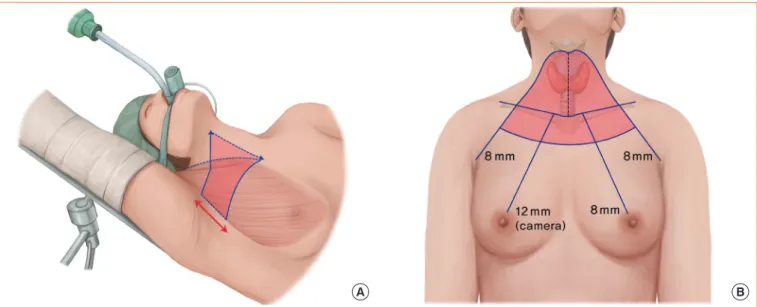
In the TAA, the patient’s lesion-side arm is raised over the head, and a 5- to 6-cm vertical skin incision is made in the ax- illa. Surgical instruments are inserted through a subcutaneous skin flap running from the axilla to the anterior neck, with sur- gery continuing from the lateral side (Fig. 1) [2]. In contrast,
BABA uses two 0.8-cm-sized axillar incisions and two cir- cumareolar incisions, measuring 0.8-cm on the left and 1.2-cm on the right side. The 1.2-cm circumareolar incision is used as a camera port and can be moved to the left side if the surgeon prefers [3]. Both the TAA and BABA techniques were origi- nally developed for endoscopic surgery, but they have been generally replaced by robotic surgery since the adoption of the Da Vinci robotic system in 2007. Robotic surgery has advan- tages over endoscopic surgery, including superior field of view, ergonomic improvement, and learning curve [4,5]. The merits of the robotic system, including high-definition three- dimensional imaging, high degree of freedom of motion, and a tremor filtering system, have increased the popularity of ro- botic thyroidectomy (RT).
Despite many studies reporting that RT is effective and safe in patients with thyroid cancer, not all thyroid surgeons advo-
Corresponding author: Kyu Eun Lee
Department of Surgery, Seoul National University Hospital, Seoul National University College of Medicine, 101 Daehak-ro, Jongno-gu, Seoul 110-744, Korea
Tel: +82-2-2072-2081, Fax: +82-2-766-3975, E-mail: [email protected]
Copyright © 2014 Korean Endocrine Society
This is an Open Access article distributed under the terms of the Creative Com- mons Attribution Non-Commercial License (http://creativecommons.org/
licenses/by-nc/3.0/) which permits unrestricted non-commercial use, distribu- tion, and reproduction in any medium, provided the original work is properly cited.
cate RT. RT has several disadvantages, including being costly, technically demanding, and requiring advanced training [6].
To date, however, no randomized controlled study has com- pared RT with OT. This review of previously published stud- ies compares the outcomes of RT with those of OT.
COSMETIC OUTCOMES OF ROBOTIC THYROIDECTOMY
The most important motivation for patients to choose RT is the absence of neck scarring. For example, a prospective ques- tionnaire study of 41 patients who underwent RT and 43 pa- tients who underwent OT evaluated cosmetic satisfaction 3 months postoperatively [7]. In a second study, cosmetic satis- faction was assessed after 1 day, 1 week, and 1 or 3 months in 75 patients who underwent RT and 226 who underwent OT [8]. In both studies, cosmetic satisfaction was greater in the RT than in the OT group at all recorded time points. Cosmetic satisfaction in patients who underwent modified radical neck dissection (MRND) was also higher in the RT than in the OT group [9]. Thus, the cosmetic benefits of RT seem to be estab- lished.
POSTOPERATIVE PAIN AFTER ROBOTIC THYROIDECTOMY
Since RT requires the formation of a larger skin flap than OT, concerns have arisen that postoperative neck and chest pain may be greater after RT. Contrary to this assumption, levels of
pain were similar after RT and OT. For example, a question- naire evaluation of patients 24 hours after thyroidectomy found no significant difference in pain after RT and OT [7].
Another study evaluating pain on a visual analogue scale 30 minutes, 4 hours, and 1, 2, 3, and 10 days after RT or OT found no difference in analgesic use, with the pain score being lower in the RT group than in the OT group at 1 and 2 days af- ter surgery [10]. An evaluation of neck and chest pain found that neck pain was similar in the RT and OT groups, although anterior chest pain was significantly greater in the RT group [8]. However, chest pain score in the RT group was lower than neck pain score in both groups.
SURGICAL SAFETY
Recurrent laryngeal nerve injury
Table 1 shows the incidence of transient and permanent recur- rent laryngeal nerve injury (RLNI) who underwent robotic or OT. Most of the studies defined transient RLNI as hoarseness or vocal cord palsy persisting less than 6 months. Six studies comparing RT with OT found similar rates of transient/perma- nent RLNI [7,8,11-14]. The incidence of transient RLNI in pa- tients who underwent RT varied from 0% to 20%, with most studies reporting a rate less than 15%. Permanent RLNI was observed in only 0.2% to 0.3% of the patients [4,15-18], a rate comparable to that of open surgery [19].
Hypoparathyroidism
Although the definition of hypoparathyroidism differs among Fig. 1. Patient position and flap dissection area (red color) of transaxillary approach (A) and bilateral axillo-breast approach (B).
A B
studies, it is generally based on parathyroid hormone, calcium level, or on hypocalcemic symptoms (Table 2). In most stud- ies, a diagnosis of permanent hypoparathyroidism required the condition to last more than 6 months. In six studies comparing RT and OT [7,8,11,13,14,17], the incidence of permanent hy- poparathyroidism was similar in the two groups, although one study [17] reported a higher rate of transient hypocalcemia in the RT group.
Other complications
Other rare complications are described in Table 3. Unique complications associated only with RT included brachial inju- ry and skin flap perforation, although their incidence was only 0.1% in the study with the largest patient population [18].
Bleeding is considered a major complication of both RT and OT, but hematomas requiring reoperation were uncommon in the RT group [4,8,12,18].
Sensory changes
Since RT requires the formation of a larger skin flap than OT, RT may be accompanied by sensory changes in the corre- sponding skin area. For example, an evaluation of cutaneous light-pressure thresholds in patients who underwent BABA RT found sensory changes in the anterior chest area; however, these became normalized 3 months after surgery [20]. Similar results were observed in patients who undewent TAA RT. Two studies prospectively comparing sensory changes in patients who underwent TAA RT and OT found that sensory changes in the anterior neck area were similar or more common in the OT group, whereas sensory changes in the anterior chest were more common in the RT group. Anterior chest discomfort in the RT group became comparable with that in the OT group 1.5 years after surgery [21]. Sensory changes, therefore, were considered fairly minor.
Table 1. Incidence of Transient and Permanent Recurrent Laryngeal Nerve Injury First author Affiliate Approach No. of
patient (RT vs. OT)
No. of TT
(RT vs. OT) Evaluation
Incidence of
transient RLNI P value
Incidence of
permanent RLNI P value
RT OT RT OT
Lee et al. [7]
(2010) Ajou
University TAA 41 vs. 43 26 vs. 26 Laryngoscopy 1 (2.4) 0 (0.0) 0.308 0 (0.0) 0 (0.0) 1.000 Kim et al. [11]
(2011) Sungkyunkwan
University BABA 69 vs. 138 69 vs. 138 Laryngoscopy 1 (1.4) 1 (0.7) 0.626 0 (0.0) 0 (0.0) 1.000 Tae et al. [8]
(2012) Hanyang
University TAA 75 vs. 226 29 vs. 204 Laryngoscopy 6 (8.0) 7 (3.1) 0.097 0 (0.0) 1 (0.4) 1.000 Landry et al.
[12] (2012) M.D. Anderson
Cancer Center TAA 25 vs. 25 0 vs. 0 Not mentioned 5 (20.0) 4 (16.0) 1.000 0 (0.0) 1 (4.0) 1.000 Yoo et al. [15]
(2012) Catholic University
of Korea TAA 46 30 Laryngoscopy 0 (0.0) - - 0 (0.0) - -
Kim et al. [16]
(2012) Korea
University BABA 93 72 Not mentioned 3 (3.2) - - 0 (0.0) - -
Lee et al. [4]
(2013) Seoul National
University BABA 1,026 872 Laryngoscopy 124/872
(14.2) - - 2/872
(0.2) - -
Noureldineet al.
[13] (2013) Tulane
University TAA 24 vs. 35 14 vs. 25 Laryngoscopy 1 (4.1) 2 (5.7) 0.760 0 (0.0) 0 (0.0) 1.000 Yi et al. [17]
(2013) Ulsan
University TAA 98 vs. 423 98 (100) vs.
423 (100) Not mentioned - - - 1 (1.0) 2 (0.5) 0.466
Kim et al. [14]
(2014) Chung-Ang
University BABA 123 vs. 392 100 vs. 364 Laryngoscopy 6 (4.9) 24 (6.1) 0.607 0 (0.0) 1 (0.3) 1.000 Ban et al. [18]
(2014) Yonsei
University TAA 3,000 1,090 Not mentioned 37 (1.2) - - 8 (0.3) - -
Data are expressed as number (%)
RT, robotic thyroidectomy; OT, open thyroidectomy; TT, total thyroidectomy; RLNI, recurrent laryngeal nerve injury; TAA, transaxillary approach;
BABA, bilateral axillo-breast approach.
SURGICAL COMPLETENESS
Among the clinical parameters used to evaluate surgical com- pleteness after thyroidectomy are the number of retrieved lymph nodes, stimulated thyroglobulin (sTg) concentration, and raidioactive iodine uptake (RAI) on whole body scans (WBS).
Lymph node retrieval
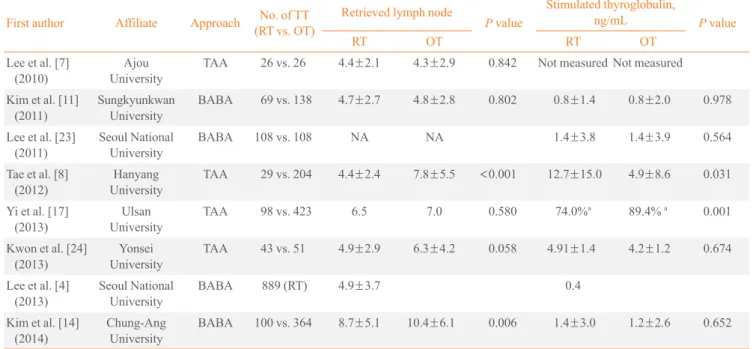
Since papillary thyroid carcinomas metastasize via the sur- rounding lymph nodes, central lymph node dissection is rou- tinely performed in most centers in order to assure oncological safety. In most studies, the numbers of retrieved central lymph nodes were comparable during RT and OT (Table 4). In two studies [8,14], however, the absolute number of retrieved lymph nodes was lower in patients undergoing RT than OT (4.4±2.4 and 8.7±5.1, respectively), although the absolute numbers of the former were similar to those in other studies.
Stimulated thyroglobulin level
sTg level is measured before RAI treatment after elevating
thyroid stimulating hormone (TSH) either by thyroid hormone withdrawal or by injection of recombinant human TSH (Thy- rogen, Genzyme, Cambridge, MA, USA). Elevated sTg after total thyroidectomy suggests the presence of remnant thyroid tissue; therefore, low sTg is a good indicator of complete thy- roid removal. Table 4 shows the results of sTg at the first RAI treatment after RT or OT. While four studies (three BABA, one TAA) reported similar sTg levels in these two groups [11,14,22,23], the other two studies (both TAA) reported that sTg was significantly higher in the RT than in the OT group [8,17]. However, in these two studies, sTg levels turned out to be similar after stage subclassification [17] or after the first RAI treatment [8].
Whole body scan
Remnant thyroid tissue can also be measured by thyroid up- take count ratio on WBS. For example, in one study, RAI up- take in the thyroid bed was higher in the RT than in the OT group when assessed by WBS [23]. The higher uptake in the RT group may have been due to the characteristics of TAA, in Table 2. Incidence of Transient and Permanent Hypoparathyroidism
First author Affiliate Approach No. of patient(RT vs. OT) No. of TT (RT vs. OT)
Definition of transient hypoparathyroidism
Transient hypoparathyroidism Permanent hypoparathyroidism
RT OT P value RT OT P value
Lee et al. [7]
(2010) Ajou
University TAA 41 vs. 43 26 vs. 26 Not defined 5/26 (19.2) 4/26
(15.3) 0.758 0
(0.0) 0
(0.0) 1.000 Kim et al. [11]
(2011) Sungkyunkwan
University BABA 69 vs. 138 69 vs. 138 PTH normalized
within 6 mo 23/69 (33.3) 38/138
(27.5) 0.583 1/69
(1.4) 4/138 (2.9) 0.352 Tae et al. [8]
(2012) Hanyang
University TAA 75 vs. 226 29 vs. 204 PTH normalized within 6 mo 8/29
(27.5) 112/226
(49.5) <0.001 0/29
(0.0) 4/204 (2.8) 0.575 Yoo et al. [15]
(2012) Catholic University
of Korea TAA 46 30 PTH <5 pg/mL
within 6 mo 5
(16.7) 0
(0.0) Kim et al. [16]
(2012) Korea
University BABA 93 72 Not defined 17/72
(23.6) 0/72
(0.0) Lee et al. [4]
(2013) Seoul National
University BABA 1,026 872 PTH normalized
within 6 mo 341/872
(39.1) 13/872
(1.5) Noureldine et al.
[13] (2013) Tulane
University TAA 24 vs. 35 14 vs. 25 PTH normalized
within 3 mo 2/14 (14.3) 4/25
(16.0) 0.902 0
(0.0) 0
(0.0) 1.000 Yi et al. [17]
(2013) Ulsan
University TAA 98 vs. 423 98 vs. 423 Not defined 52/98
(53.1) 182/423
(43.0) 0.046 3/98
(3.1) 3/423 (0.7) 0.084 Kim et al. [14]
(2014) Chung-Ang
University BABA 123 vs. 392 100 vs. 364 Serum calcium
<4.0 mEq/L 29/100 (29.0) 80/364
(22.0) 0.161 0
(0.0) 0
(0.0) 1.000 Ban et al. [18]
(2014) Yonsei
University TAA 3,000 1,090 Requires
calcium less than 6 mo
408/1,090
(37.4) 12/1,090
(1.1) Values are expressed as number (%).
RT, robotic thyroidectomy; OT, open thyroidectomy; TT, total thyroidectomy; TAA, transaxillary approach; BABA, bilateral axillo-breast approach;
PTH, parathyroid hormone.
Table 3. Complications of Robotic Thyroidectomy
First author Affiliate Approach No. of patient No. of TT Tracheal
injury Brachial
plexus injury Hematoma Seroma Chyle leakage Lee et al. [7]
(2010) Ajou
University TAA 41 26 NA NA 0 (0.0) 2 (4.9) NA
Kim et al. [11]
(2011) Sungkyunkwan
University BABA 69 69 NA NA NA 1 (1.4) 1 (1.4)
Tae et al. [8]
(2012) Hanyang
University TAA 75 29 NA NA 2 (2.6) 6 (8.0) NA
Landry et al. [12]
(2012) M.D. Anderson
Cancer Center TAA 25 0 NA 2 (8.0) 3 (12.0) 3 (12.0) NA
Yoo et al. [15]
(2012) Catholic University
of Korea TAA 46 30 NA NA NA NA 1 (0.2)
Kim et al. [16]
(2012) Korea
University BABA 93 72 NA NA 0 (0.0) 0 (0.0) NA
Lee et al. [4]
(2013) Seoul National
University BABA 1,026 872 NA NA 4 (0.4) NA NA
Yi et al. [17]
(2013) Ulsan
University TAA 98 98 NA NA 0 (0.0) NA 0 (0.0)
Kim et al. [14]
(2014) Chung-Ang
University BABA 123 100 NA NA 0 (0.0) NA NA
Ban et al. [18]
(2014) Yonsei
University TAA 3,000 1,090 6 (0.2) 4 (0.1) 11 (0.4) 52 (1.7) 11 (0.4)
Values are expressed as number (%).
TT, total thyroidectomy; TAA, transaxillary approach; NA, not available; BABA, bilateral axillo-breast approach.
Table 4. Surgical Completeness of Robotic Thyroidectomy First author Affiliate Approach No. of TT
(RT vs. OT)
Retrieved lymph node
P value
Stimulated thyroglobulin,
ng/mL P value
RT OT RT OT
Lee et al. [7]
(2010) Ajou
University TAA 26 vs. 26 4.4±2.1 4.3±2.9 0.842 Not measured Not measured Kim et al. [11]
(2011) Sungkyunkwan
University BABA 69 vs. 138 4.7±2.7 4.8±2.8 0.802 0.8±1.4 0.8±2.0 0.978
Lee et al. [23]
(2011) Seoul National
University BABA 108 vs. 108 NA NA 1.4±3.8 1.4±3.9 0.564
Tae et al. [8]
(2012) Hanyang
University TAA 29 vs. 204 4.4±2.4 7.8±5.5 <0.001 12.7±15.0 4.9±8.6 0.031
Yi et al. [17]
(2013) Ulsan
University TAA 98 vs. 423 6.5 7.0 0.580 74.0%a 89.4% a 0.001
Kwon et al. [24]
(2013) Yonsei
University TAA 43 vs. 51 4.9±2.9 6.3±4.2 0.058 4.91±1.4 4.2±1.2 0.674
Lee et al. [4]
(2013) Seoul National
University BABA 889 (RT) 4.9±3.7 0.4
Kim et al. [14]
(2014) Chung-Ang
University BABA 100 vs. 364 8.7±5.1 10.4±6.1 0.006 1.4±3.0 1.2±2.6 0.652
Values are expressed as number (%).
TT, total thyroidectomy; RT, robotic thyroidectomy; OT, open thyroidectomy; TAA, transaxillary approach; BABS, bilateral axillo-breast approach;
NA, not available.
aPercentage of the patients who had <2 ng/mL of stimulated thyroglobulin at the first radioactive iodine treatment.
which removal of the contralateral thyroid gland is made diffi- cult by the unilateral approach. However, RAI uptake was similar in the RT and OT groups at the second WBS after the first RAI treatment. In contrast, when BABA RT and OT were compared after propensity score matching to minimize selec- tion bias, RAI uptake was similar at the first WBS in the two groups [22].
ROBOTIC THYROIDECTOMY IN CERTAIN DISEASES
Robotic thyroidectomy in Graves disease
Graves disease has been regarded as a contraindication for en- doscopic thyroidectomy or RT because bleeding control is hampered by the narrow operative view, hypervascularity, and the large-sized thyroid gland. However, recent technical ad- vances and accumulated experience have enabled RT in pa- tients with Graves disease. Kwon et al. [24] reported successful RT in 30 patients with Graves disease, with a tolerable compli- cation rate. In the study, one patient experienced permanent hy- poparathyroidism, but none had major complications such as bleeding, open conversion, or permanent RLNI. The other ret- rospective study comparing RT and OT in Graves’ disease pa- tients [25], in which those with smaller-sized thyroid under- went RT, found no significant between-group differences in operation time, blood loss, or complication rate. RT might be performed safely in selected Graves’ disease patients.
Robotic modified radical neck dissection in thyroid carcinoma patients
Robotic surgery has also been utilized for MRND [26]. Since extensive incision scars are inevitable in patients undergoing traditional MRND, robotic MRND may be a good alternative to avoid scarring. Both TAA and BABA have shown outcomes similar to open conventional MRND. For example, a similar number of lateral lymph nodes was retrieved following BABA robotic and open MRND, without causing hypocalcemia, RLNI, or bleeding [27]. In addition, a comparison of patients undergoing TAA or open MRND reported similar complica- tion, surgical completeness, and recurrence rates [9].
CONCLUSIONS
RT offers better cosmetic satisfaction to patients than OT, and RT is as safe and effective as OT in thyroid cancer patients, with similar complication rates. RT also showed similar onco-
logic safety as OT, as assessed by lymph node harvest, com- plete removal of thyroid tissue, and RAI success rates. RT is a good alternative surgical modality for patients who wish to avoid neck scars.
CONFLICTS OF INTEREST
No potential conflict of interest relevant to this article was re- ported.
REFERENCES
1. Xing M. BRAF mutation in thyroid cancer. Endocr Relat Cancer 2005;12:245-62.
2. Kang SW, Jeong JJ, Nam KH, Chang HS, Chung WY, Park CS. Robot-assisted endoscopic thyroidectomy for thyroid malignancies using a gasless transaxillary ap- proach. J Am Coll Surg 2009;209:e1-7.
3. Lee KE, Choi JY, Youn YK. Bilateral axillo-breast ap- proach robotic thyroidectomy. Surg Laparosc Endosc Per- cutan Tech 2011;21:230-6.
4. Lee KE, Kim E, Koo do H, Choi JY, Kim KH, Youn YK.
Robotic thyroidectomy by bilateral axillo-breast approach:
review of 1,026 cases and surgical completeness. Surg En- dosc 2013;27:2955-62.
5. Kang SW, Jeong JJ, Yun JS, Sung TY, Lee SC, Lee YS, Nam KH, Chang HS, Chung WY, Park CS. Robot-assisted endoscopic surgery for thyroid cancer: experience with the first 100 patients. Surg Endosc 2009;23:2399-406.
6. Inabnet WB 3rd. Robotic thyroidectomy: must we drive a luxury sedan to arrive at our destination safely? Thyroid 2012;22:988-90.
7. Lee J, Nah KY, Kim RM, Ahn YH, Soh EY, Chung WY.
Differences in postoperative outcomes, function, and cosme- sis: open versus robotic thyroidectomy. Surg Endosc 2010;
24:3186-94.
8. Tae K, Ji YB, Cho SH, Lee SH, Kim DS, Kim TW. Early surgical outcomes of robotic thyroidectomy by a gasless unilateral axillo-breast or axillary approach for papillary thyroid carcinoma: 2 years’ experience. Head Neck 2012;34:
617-25.
9. Lee J, Kwon IS, Bae EH, Chung WY. Comparative analy- sis of oncological outcomes and quality of life after robotic versus conventional open thyroidectomy with modified radical neck dissection in patients with papillary thyroid carcinoma and lateral neck node metastases. J Clin Endo-
crinol Metab 2013;98:2701-8.
10. Ryu HR, Lee J, Park JH, Kang SW, Jeong JJ, Hong JY, Chung WY. A comparison of postoperative pain after con- ventional open thyroidectomy and transaxillary single-in- cision robotic thyroidectomy: a prospective study. Ann Surg Oncol 2013;20:2279-84.
11. Kim WW, Kim JS, Hur SM, Kim SH, Lee SK, Choi JH, Kim S, Lee JE, Kim JH, Nam SJ, Yang JH, Choe JH. Is ro- botic surgery superior to endoscopic and open surgeries in thyroid cancer? World J Surg 2011;35:779-84.
12. Landry CS, Grubbs EG, Warneke CL, Ormond M, Chua C, Lee JE, Perrier ND. Robot-assisted transaxillary thyroid surgery in the United States: is it comparable to open thy- roid lobectomy? Ann Surg Oncol 2012;19:1269-74.
13. Noureldine SI, Jackson NR, Tufano RP, Kandil E. A com- parative North American experience of robotic thyroidec- tomy in a thyroid cancer population. Langenbecks Arch Surg 2013;398:1069-74.
14. Kim BS, Kang KH, Kang H, Park SJ. Central neck dissec- tion using a bilateral axillo-breast approach for robotic thyroidectomy: comparison with conventional open proce- dure after propensity score matching. Surg Laparosc En- dosc Percutan Tech 2014;24:67-72.
15. Yoo H, Chae BJ, Park HS, Kim KH, Kim SH, Song BJ, Jung SS, Bae JS. Comparison of surgical outcomes between endoscopic and robotic thyroidectomy. J Surg Oncol 2012;
105:705-8.
16. Kim HY, d’Ajello F, Woo SU, Son GS, Lee JB, Bae JW.
Robotic thyroid surgery using bilateral axillo-breast ap- proach: personal initial experience over two years. Miner- va Chir 2012;67:39-48.
17. Yi O, Yoon JH, Lee YM, Sung TY, Chung KW, Kim TY, Kim WB, Shong YK, Ryu JS, Hong SJ. Technical and on- cologic safety of robotic thyroid surgery. Ann Surg Oncol 2013;20:1927-33.
18. Ban EJ, Yoo JY, Kim WW, Son HY, Park S, Lee SH, Lee CR, Kang SW, Jeong JJ, Nam KH, Chung WY, Park CS.
Surgical complications after robotic thyroidectomy for thyroid carcinoma: a single center experience with 3,000 patients. Surg Endosc. Epub 2014 Mar 20. DOI: http://dx.
doi.org/ 10.1007/s00464-014-3502-1.
19. Barczynski M, Konturek A, Pragacz K, Papier A, Stopa M, Nowak W. Intraoperative nerve monitoring can reduce prevalence of recurrent laryngeal nerve injury in thyroid re- operations: results of a retrospective cohort study. World J Surg 2014;38:599-606.
20. Kim SJ, Lee KE, Myong JP, Koo do H, Lee J, Youn YK.
Prospective study of sensation in anterior chest areas before and after a bilateral axillo-breast approach for endoscopic/
robotic thyroid surgery. World J Surg 2013;37:1147-53.
21. Song CM, Ji YB, Bang HS, Park CW, Kim H, Tae K.
Long-term sensory disturbance and discomfort after robot- ic thyroidectomy. World J Surg 2014;38:1743-8.
22. Lee KE, Koo do H, Im HJ, Park SK, Choi JY, Paeng JC, Chung JK, Oh SK, Youn YK. Surgical completeness of bi- lateral axillo-breast approach robotic thyroidectomy: com- parison with conventional open thyroidectomy after pro- pensity score matching. Surgery 2011;150:1266-74.
23. Lee S, Lee CR, Lee SC, Park S, Kim HY, Son H, Kang SW, Jeong JJ, Nam KH, Chung WY, Park CS, Cho A. Surgical completeness of robotic thyroidectomy: a prospective com- parison with conventional open thyroidectomy in papillary thyroid carcinoma patients. Surg Endosc 2014;28:1068-75.
24. Kwon H, Koo do H, Choi JY, Kim E, Lee KE, Youn YK.
Bilateral axillo-breast approach robotic thyroidectomy for Graves’ disease: an initial experience in a single institute.
World J Surg 2013;37:1576-81.
25. Noureldine SI, Yao L, Wavekar RR, Mohamed S, Kandil E.
Thyroidectomy for Graves’ disease: a feasibility study of the robotic transaxillary approach. ORL J Otorhinolaryn- gol Relat Spec 2013;75:350-6.
26. Kang SW, Lee SH, Ryu HR, Lee KY, Jeong JJ, Nam KH, Chung WY, Park CS. Initial experience with robot-assisted modified radical neck dissection for the management of thyroid carcinoma with lateral neck node metastasis. Sur- gery 2010;148:1214-21.
27. Seup Kim B, Kang KH, Park SJ. Robotic modified radical neck dissection by bilateral axillary breast approach for pap- illary thyroid carcinoma with lateral neck metastasis. Head Neck. Epub 2013 Nov 8. DOI: http://dx.doi.org/10.1002/
hed.23545.