24 Copyright © 2013 The Korean Brain Tumor Society and The Korean Society for Neuro-Oncology
INTRODUCTION
Little is known about pain in patients undergoing neurosur- gical procedures. It has been previously pointed out that post- operative pain after neurosurgery was modest and less worry- ing than during other surgical procedures [1]. There are relatively few studies in which the incidence and severity of pain have ac- tually been assessed in patients undergoing neurosurgical pro- cedures [2,3].
Risk factors for postoperative pain have been extensively in- vestigated and include female sex, preoperative pain severity, younger age, surgical procedure, expected incision size, and psychological profile [4,5]. Recent studies have reported that postoperative pain following craniotomy is a persistent con- cern, and that new analgesic strategies are needed [6-8].
Pain Assessment in Brain Tumor Patients after Elective Craniotomy
Young Deok Kim, Jae Hyun Park, Seung-Ho Yang, Il Sup Kim, Jae Taek Hong, Jae Hoon Sung, Byung Chul Son, Sang Won Lee
Department of Neurosurgery, St. Vincent’s Hospital, The Catholic University of Korea, Suwon, Korea
Received January 18, 2013 Revised March 20, 2013 Accepted April 5, 2013 Correspondence Seung-Ho Yang
Department of Neurosurgery, St. Vincent’s Hospital, The Catholic University of Korea, 93 Jungbu-daero, Paldal-gu, Suwon 442-723, Korea Tel: +82-31-249-8304 Fax: +82-31-245-5208 E-mail: [email protected]
Objective This study was performed to assess the postoperative pain of brain tumor patients who underwent elective craniotomy and to evaluate the factors associated with pain intensity.
Methods From January 2010 to December 2011, 47 patients with newly diagnosed brain tu- mors who underwent craniotomy were enrolled. The postoperative pain status was assessed daily un- til discharge using the visual analogue scale (VAS).
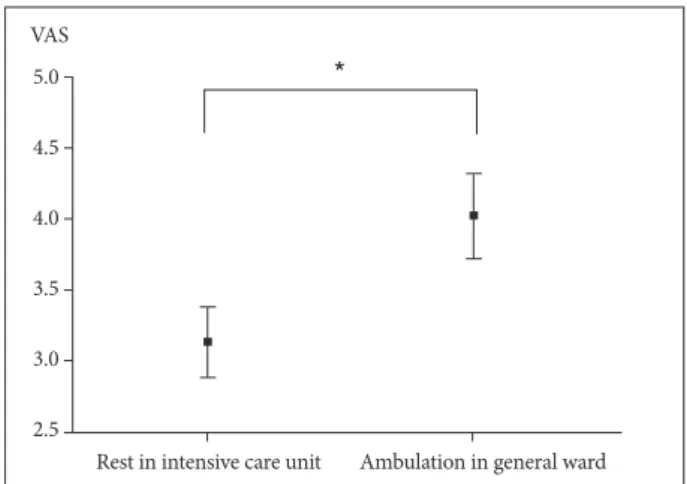
Results The study participants comprised of 22 males and 25 females with ages ranging from 18-76 years (median age, 50 years). Patients were divided into two groups: the painful group included patients who had a VAS score of more than 3 during their hospital stay after the craniotomy, and the tolerable group included patients who had a VAS score of 1 to 3 during their hospital stay. There were no differences between the two groups in terms of age, sex, location of surgery, history of diabetes, hypertension and smoking, body mass index, and hospital stay. Univariate analysis revealed that oper- ating time, length of wound, head fixation, and perioperative administration of opioid were not associ- ated with the intensity of postoperative pain. Daily assessment of VAS revealed the two peaks of pain on the operation day and the 4th postoperative day. The intensity of pain during the ambulation period was higher than that during intensive care unit (ICU) stay.
Conclusion Pain following elective craniotomy for brain tumor removal is insufficiently managed, especially after discharge from the ICU. More attention needs to be paid to patients’ pain throughout the hospital stay.
Key Words Brain neoplasm; Postoperative pain; Craniotomy; Visual analogue scale;
Pain management; Analgesia.
The primary purpose of brain tumor surgery is the precise diagnosis and total resection of the tumor if necessary. It is widely believed that patients do not experience intense pain following intracranial surgery due to the fact that surgical treat- ment of the brain parenchyma is not painful. However, it is common practice to infiltrate the scalp with lidocaine plus epi- nephrine to reduce postoperative pain after craniotomy [9].
A reasonable goal is to achieve relief of the patients’ symp- toms such as headache and neurologic deficits as well as post- operative pain following brain tumor surgery.
The incidence and severity of pain have rarely been assessed in Korean patients. We conducted an observational study of pain intensity and its’ associated factors in Korean brain tu- mor patients undergoing elective craniotomy at a single insti- tution.
Brain Tumor Res Treat 2013;1:24-27 / Print ISSN 2288-2405 / Online ISSN 2288-2413
ORIGINAL ARTICLE
YD Kim et al.
25
MATERIALS AND METHODS
The inclusion criteria for the study were patients with newly diagnosed brain tumors, normal mental function, good per- formance, and oriented status who underwent elective crani- otomy. The exclusion criteria were patients with psychologi- cal or severe medical diseases, those who had undergone previous brain surgery such as craniotomy for vascular disease, transsphenoidal approach, burr hole surgery, or reoperation for brain tumors. Patients with newly developed neurological deficits after craniotomy were excluded in order to strictly eval- uate pain status. Patients who were not able to estimate the amount of pain because of decreased awareness were also ex- cluded. Finally, patients with postoperative wound problems were excluded.
Between January 2010 and December 2011, 47 patients were enrolled according to the above criteria. We serially as- sessed postoperative pain in patients who underwent elective craniotomy for the treatment of various brain tumors. To mea- sure the extent of pain, we used a visual analog scale (VAS), in which the score can range from 0 (no pain) to 10 (worst pain imaginable). Pain was categorized as 1-3 (mild pain), 4-6 (moderate pain), and 7-10 (severe pain) according to VAS as- sessment. In the operating room, scalp infiltrations with 1%
lidocaine and 1 : 100,000 epinephrine were performed before the scalp incision. Perioperative opioid administration was left to the anesthesiologists’ discretion in the recovery room.
Postoperative analgesia was managed as follows: all patients received 75 mg intramuscular diclofenac sodium or 30 mg in- travenous ketorolac tromethamine during 1 to 3 days after sur- gery. Acetaminophen and tramadol were orally administered afterword. Opioid was given for selected patients, when nec- essary.
The duration of the operation, the site of the surgery, the length of the wound, head fixation, surgical position, medi- cal/social history, body mass index (BMI), and intensive care unit (ICU) stay were collected from each patient’s medical records, and we searched for clinical factors associated with postoperative pain.
Statistical analysis
All statistical analyses were performed using SPSS (version 16.0, SPSS Inc., Chicago, IL, USA). Exploratory analyses of the demographic and medical data were performed by calcu- lating the means and standard deviations for the continuous outcomes. Chi-square tests and independent 2-sample t-test were used to assess statistical differences between groups. Lo- gistic regression analysis was used for univariate analysis for variables associated with postoperative pain scores. Statistical si- gnificance was accepted at a probability value of less than 0.05.
RESULTS
The study participants comprised of 22 males and 25 fe- males with ages ranging from 18-76 years (mean age, 50.1 years). Patients’ tumors included 21 meningiomas, 10 glio- mas, 6 metastatic brain tumors, 4 acoustic neuromas, 3 heman- giomblastomas, and 3 granulomas. The median operating time was 358 minutes (range, 160-733). The median length of the surgical wound was 15.3 cm (range, 7-30).
Pain scores of 4 or greater are associated with moderate to severe pain [10]. We divided the patients into two groups (pain- ful group versus tolerable group). The painful group included patients who had a VAS score of more than 3 during their hospital stay after the craniotomy. The tolerable group in- cluded patients who had a VAS score of 1 to 3 during their hospital stay. The characteristics of the two groups are sum- marized in Table 1. There were no differences between the two groups in terms of age, sex, location of surgery, history of di- abetes, hypertension and smoking, BMI, or hospital stay. Uni- variate analysis revealed that age, sex, location, operating time, length of wound, head fixation, and perioperative adminis- tration of opioid were not associated with the intensity of po- stoperative pain.
Daily assessment of VAS revealed the two peaks of postop- erative pain on the operation day and the 4th postoperative day (Fig. 1). VAS of the operation day and 4th postoperative day was not statistically different from that of the other days.
However, VAS of the operation day and 4th postoperative day was higher than that of the 8th postoperative day (p-val- ue 0.009 and 0.016, respectively). Postoperative pain during ICU stay (except for operation day) was compared with that during the ambulation periods on the general wards. The in- tensity of pain during the ambulation period was higher than Table 1. Clinical characteristics of brain tumor patients who un- derwent elective craniotomy
Parameters Painful group (N=28)
Tolerable group (N=19) p-value Age (yrs) 49.6±14.9 50.7±16.4 0.442
Sex (M : F) 10 : 18 12 : 7 0.060
Location 0.875
Supratentorial 19 12
Infratentorial 6 4
Skull base 3 3
Diabetes 3 1 0.464
Hypertension 8 6 0.538
Smoking 3 7 0.246
BMI 28.4±3.8 21.9±2.5 0.224
Hospital stay (days) 14.6±2.8 14.8±2.6 0.771 Data are presented as mean±standard deviation. BMI: body mass index
26 Brain Tumor Res Treat 2013;1:24-27 Postoperative Pain in Brain Tumor Patients
that during ICU stay (p-value 0.009) (Fig. 2).
DISCUSSION
This study showed that brain tumor patients undergoing craniotomy had severe pain during the ambulation period rather than during the ICU stay. Most studies have only ad- dressed the perioperative period, which averaged from the day of operation to 1 or 2 days postoperatively [11]. In West- ern studies, the reported prevalence of moderate to severe pain during the first 24 postoperative hours has ranged from 41 to 84% [12,13]. It has been found that pain is common for the first 2 days after a major elective intracranial surgery, with approximately two-thirds of patients reporting moder- ate to severe pain at some point during their hospitalization [14]. At our institution, patients with brain tumors are hospi- talized for approximately 14 days. Therefore, we were able to serially assess the postoperative pain up to 14 days. On the 4th
postoperative day, most patients begin to attempt to ambulate actively in the general wards. During this period, clinicians pay more attention to the neurological status of and wound care for patients rather than the subjective pain of neurologically and medically stable patients. According to the review of ran- domized double-blinded trials, scalp infiltrations with local anesthetic agents provide adequate analgesia in the first few postoperative hours, and cyclo-oxygenase type 2 inhibitors and morphine may cause a reduction in pain scores in the 24-hour study [15,16]. In our study, most patients received acetaminophen (usually, 900-1,950 mg) postoperatively. Al- ternatively, administration of muscle relaxants or anti-depres- sants is preferred for patients complaining of pain or discom- fort during acetaminophen usage. There is a need for further study on pain management in the ambulation period follow- ing craniotomy.
We suggest that the postoperative pain of brain tumor pa- tients undergoing craniotomy is an important and often ne- glected clinical problem that deserves greater attention from neurosurgeons in order to provide better and more appropri- ate treatment. Previous studies have revealed that age, sex, ex- pected incision size, and surgical procedure have been shown to affect postoperative pain intensity [4,17]. In the current study, we found no significant differences in these previously known factors between the painful group and tolerable group. It has been reported that women seem to experience greater intensity of pain after orthopedic surgery [18]. Simi- larly, our study showed a trend toward greater pain reported by women, but it was not statistically significant.
One large retrospective study found that craniotomy was associated with less pain and analgesic consumption than sur- gery of the facial bones or the lumbar spine [1]. Interestingly, patients who underwent infratentorial procedures reported more severe pain compared to those who underwent supra- tentorial procedures. The amount of postoperative pain after intracranial surgery may depend on the extent of muscle damage associated with the operative approach [19]. Because surgical approaches to the posterior fossa often involve con- siderable muscle dissection, infratentorial procedures cause more pain compared to supratentorial procedures. Opioids have had a limited role in the analgesic management of pa- tients who have undergone major intracranial surgery because of a presumed lack of need and a concern that opioids will affect the postoperative neurological examination [20,21].
Excessive administration of painkillers before the end of sur- gery may delay neurologic effect and may also exacerbate pain and alter the level of consciousness [22]. Perioperative opioid administration was left to the anesthesiologists’ dis- cretion at our institution. Therefore, it is important to take into consideration both the patients’ comfort as well as the
Op day VAS
POD 1 POD 2 POD 3 POD 4 POD 5 POD 6 POD 7 POD 8 4
3.5 3 2.5 2 1.5 1 0.5 0
Fig. 1. Sequential changes of visual analog scales (VAS) after brain tumor surgery.
Fig. 2. Higher visual analog scales (VAS) scores during am- bulation in the general ward (4.02±0.3) than at rest in the ICU (3.13±0.25). Data are presented as mean±SE. *p<0.05. ICU:
intensive care unit.
Ambulation in general ward VAS
5.0 4.5 4.0 3.5 3.0 2.5
*
Rest in intensive care unit
YD Kim et al.
27 neurological objectives in managing postoperative pain after
brain tumor surgery.
In this study, pain with movement in the general ward was aggravated compared with at rest in the ICU. The pain of brain tumor patients after ICU discharge is often inadequately treat- ed. Pain following elective craniotomy for brain tumor remov- al is insufficiently managed, especially after discharge from the ICU. Thorough attention need to be paid to patients’ pain throughout the entire hospital stay, especially just after dis- charge from the ICU.
Conflicts of Interest
The authors have no financial conflicts of interest.
REFERENCES
1. Dunbar PJ, Visco E, Lam AM. Craniotomy procedures are associated with less analgesic requirements than other surgical procedures. Anes- th Analg 1999;88:335-40.
2. Kalkman CJ, Visser K, Moen J, Bonsel GJ, Grobbee DE, Moons KG.
Preoperative prediction of severe postoperative pain. Pain 2003;105:
415-23.
3. Thomas T, Robinson C, Champion D, McKell M, Pell M. Prediction and assessment of the severity of post-operative pain and of satisfac- tion with management. Pain 1998;75:177-85.
4. Morin C, Lund JP, Villarroel T, Clokie CM, Feine JS. Differences be- tween the sexes in post-surgical pain. Pain 2000;85:79-85.
5. Scott LE, Clum GA, Peoples JB. Preoperative predictors of postopera- tive pain. Pain 1983;15:283-93.
6. Rahimi SY, Vender JR, Macomson SD, French A, Smith JR, Alleyne CH Jr. Postoperative pain management after craniotomy: evaluation and cost analysis. Neurosurgery 2006;59:852-7; discussion 857.
7. Roberts GC. Post-craniotomy analgesia: current practices in British neurosurgical centres--a survey of post-craniotomy analgesic practic- es. Eur J Anaesthesiol 2005;22:328-32.
8. Thibault M, Girard F, Moumdjian R, Chouinard P, Boudreault D, Ruel M. Craniotomy site influences postoperative pain following neurosur- gical procedures: a retrospective study. Can J Anaesth 2007;54:544-8.
9. Law-Koune JD, Szekely B, Fermanian C, Peuch C, Liu N, Fischler M.
Scalp infiltration with bupivacaine plus epinephrine or plain ropiva- caine reduces postoperative pain after supratentorial craniotomy. J Neurosurg Anesthesiol 2005;17:139-43.
10. Jensen MP, Smith DG, Ehde DM, Robinsin LR. Pain site and the ef- fects of amputation pain: further clarification of the meaning of mild, moderate, and severe pain. Pain 2001;91:317-22.
11. Klimek M, Ubben JF, Ammann J, Borner U, Klein J, Verbrugge SJ.
Pain in neurosurgically treated patients: a prospective observational study. J Neurosurg 2006;104:350-9.
12. De Benedittis G, Lorenzetti A, Migliore M, Spagnoli D, Tiberio F, Vil- lani RM. Postoperative pain in neurosurgery: a pilot study in brain surgery. Neurosurgery 1996;38:466-9; discussion 469-70.
13. Quiney N, Cooper R, Stoneham M, Walters F. Pain after craniotomy.
A time for reappraisal? Br J Neurosurg 1996;10:295-9.
14. Gottschalk A, Berkow LC, Stevens RD, et al. Prospective evaluation of pain and analgesic use following major elective intracranial surgery. J Neurosurg 2007;106:210-6.
15. Hansen MS, Brennum J, Moltke FB, Dahl JB. Pain treatment after cra- niotomy: where is the (procedure-specific) evidence? A qualitative systematic review. Eur J Anaesthesiol 2011;28:821-9.
16. Saringcarinkul A, Boonsri S. Effect of scalp infiltration on postopera- tive pain relief in elective supratentorial craniotomy with 0.5% bupiva- caine with adrenaline 1:400,000. J Med Assoc Thai 2008;91:1518-23.
17. Block AR, Ohnmeiss DD, Guyer RD, Rashbaum RF, Hochschuler SH.
The use of presurgical psychological screening to predict the outcome of spine surgery. Spine J 2001;1:274-82.
18. Taenzer AH, Clark C, Curry CS. Gender affects report of pain and function after arthroscopic anterior cruciate ligament reconstruction.
Anesthesiology 2000;93:670-5.
19. Talke PO, Gelb AW. Postcraniotomy pain remains a real headache! Eur J Anaesthesiol 2005;22:325-7.
20. Stoneham MD, Walters FJ. Post-operative analgesia for craniotomy patients: current attitudes among neuroanaesthetists. Eur J Anaesthe- siol 1995;12:571-5.
21. Verchère E, Grenier B, Mesli A, Siao D, Sesay M, Maurette P. Postoper- ative pain management after supratentorial craniotomy. J Neurosurg Anesthesiol 2002;14:96-101.
22. Guignard B, Bossard AE, Coste C, et al. Acute opioid tolerance: intra- operative remifentanil increases postoperative pain and morphine re- quirement. Anesthesiology 2000;93:409-17.