• 검색 결과가 없습니다.

Optimization of efficient protocorm-like body (PLB) formation of Phalaenopsis and Dendrobium hybrids

N/A
N/A
Protected

Academic year: 2021

Share "Optimization of efficient protocorm-like body (PLB) formation of Phalaenopsis and Dendrobium hybrids"

Copied!
5
0
0

로드 중.... (전체 텍스트 보기)

전체 글

(1)

http://dx.doi.org/10.14518/crals.2014.32.4.032 Print ISSN 2287-271X

Original Article

Optimization of efficient protocorm-like body (PLB) formation of Phalaenopsis and Dendrobium hybrids

Khaing Wah Soe

1

, Khin Thida Myint

1

, Aung Htay Naing

2

, and Chang Kil Kim

2

*

1

Department of Horticulture, Yezin Agricultural University, Yezin, Myanmar

2

Department of Horticultural Science, Kyungpook National University, Daegu 702-701, Korea

Received: August 28 2014 / Accepted: September 12 2014

Abstract Optimization of the protocorm-like body (PLB) formation of Phalaenopsis and Dendrobium hybrids was performed by determining the effects of plant growth regulators (PGRs) and different parts and division sizes of the PLB. For both genera, the base part was the best for the proliferation of PLBs, yielding the highest number of PLBs on a PGR-free medium for Phalaenopsis and medium containing 0.1 μM NAA and 10.0μM BAP for Dendrobium. As regards the division size, four-division sections resulted in a higher PLB formation efficiency for Phalaenopsis, while two-division sections produced a higher PLB formation efficiency for Dendrobium. It is expected that these findings will be applicable to efficient PLB formation of other Phalaenopsis and Dendrobium orchids.

Keywords: Explant types, Orchids, Plant growth regulators (PGRs), Protocorm-like-body (PLB)

Introduction

With the global marketing of Phalaenopsis and Dendrobium, the orchid industry is now a substantial contributor to the economies of many ASEAN countries (Hew, 1994; Laws, 1995). Over 75%

of all the orchids sold in the U.S. belong to the Phalaenopsis species, which replaced Cattlyea in the 1980s as the most popular

orchid (Griesbach, 2002).

Phalaenopsis and Dendrobium are traditionally propagated by the cutting or division of offshoots, however, these methods slow the rate of multiplication and arrest the growth of the mother plant, making them ineffective for large scale production. Thus, in vitro propagation methods have been widely used for commercial production.

Many studies on the in vitro propagation of orchids have already been reported using various explants, such as stem nodes (Griesbach, 1983), leaf tissues/segments (Park et al., 2002), and root tip cultures (Park et al., 2003). Yet, in vitro multiplication using these methods is unfortunately very difficult and the rate of multiplication is also low. Thus, for the mass propagation of orchids, propagation using protocorms has been studied by Yam et al. (1991) and Chen et al. (2000). As a result, the production of PLBs from protocorms or PLBs and regeneration have been shown to be efficient (Chen and Chang, 2000; Chen and Chang, 2004; Naing et al., 2011). However, this requires precise cultural conditions, including the media composition and growth regulators (Chen et al., 2000; Chen and Chang, 2004). The horizontal sectioning of PLBs to produce next-cycle PLBs has also been demonstrated in the case of Phalaenopsis (Tanaka et al., 1984; Tanaka, 1987), along with high-frequency multiplication using similar techniques in the case of Phalaenopsis gigantea (Murdad et al., 2006).

Accordingly, this study attempted to optimize the precise media composition for the efficient in vitro propagation of Phalaenopsis and Dendrobium hybrids using different parts and division sizes of PLBs.

Materials and Methods

Plant materials

PLBs of Phalaenopsis and Dendrobium hybrids provided by Mingalardon Orchid Farm in Yangon, Myanmar, were used as the source of the explants.

*Corresponding author: Chang-Kil Kim Tel: 82-53-950-5728; Fax: 82-53-950-5722 E-mail: [email protected]

This is an Open Access article distributed under the terms of the Creative Commons Attribution Non-Commercial License (http://creativecommons.

org/licenses/by-nc/3.0/) which permits unrestricted non-commercial use, distribution, and reproduction in any medium, provided the original work is properly cited.

© 2014 Institute of Agricultural Science and Technology, Kyungpook

National University

(2)

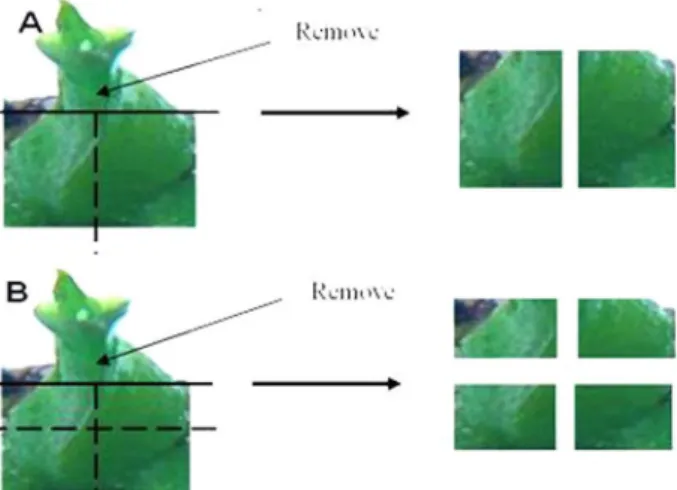
PLB formation from intact or different parts of PLB Intact or transversally divided parts of PLBs (tip, middle, and basal portions) shown in Figure 1A were cultured on an MS medium supplemented with 15% (v/v) CW and different concentrations of α-naphthaleneacetic acid (NAA , 0, or 0.1 μM) in combination with 6-benzylaminopurine (BAP, 0, 0.5 or 10.0 μM).

PLB formation from different division sizes of intact PLB For this experiment, the tips of the protocorms were trimmed off and the rest of the PLBs evenly sectioned into two-division sections (2-3 mm in length, 1-1.5 mm in width) or four-division sections (1-1.5 mm in length and width) using a surgical blade under aseptic conditions, as shown in Figure 1B. These explants were then cultured in the same media composition as described above.

Culture conditions

The pH of the medium was adjusted to 5.8 before gelling with a 7.0 g/L agar. All the media were autoclaved at 121

o

C and 105 kPa pressure for 15 minutes. The culture vessels were 100ml bottles that included 20 ml of the medium and were closed using cotton plugs. After culturing, the culture vessels were incubated in a culture room at 25±2

o

C under a 16-hour photoperiod using cool white fluorescent lamps with approximately 25 μmol

−1

m

−2

s

−1

.

Experimental design and statistical analysis

The experiments were arranged using a Randomized Complete Block Design (RCB) with two factors. Five explants were used per treatment with seven replicates. The PLB formation frequency and mean number of PLBs per explant were recorded after 8 weeks of culture. The collected data were statistically analyzed using DMRT

Results and Discussion

PLB formation from intact or different parts of PLBs When intact or different parts of the PLBs (tip, middle, and basal parts) were cultured on the media supplemented with different combinations of NAA and BAP, protuberances were observed for both orchid genera after 2 weeks of culturing, and the formation Figure 1A. Different initial materials: non-divided protocorm (intact) and

divided protocorm.

Figure 1B. Different sizes of divided protocorm: two-division sections (A) and four-division sections (B).

Table 1. Effects of Different parts of PLBs and PGRs on frequency of PLB formation and mean number of PLBs per explants of Phalaenopsis hybrid and Dendrobium hybrid

PGRs ( µM)

Esplant part

Phalaenopsis hybrid Dendrobium hybrid

NAA BA PLBs formation

%

Mean no of PLBs per explant

PLLBs formation

%

Mean no of PLBs per explant

0 0 NDP 00.0 00.0 06.7 02.5

Tip 20.0 02.8 10.0 01.2

Middle 40.0 11.7 08.0 12.7

Base 44.0 13.3 51.4 11.0

0.1 5.0 NDP 00.0 00.0 08.0 12.1

Tip 08.0 00.7 42.8 15.5

Middle 20.0 03.0 45.0 09.0

Base 32.0 11.0 53.3 17.3

0.1 10.0 NDP 00.0 00.0 20.0 03.2

Tip 00.0 00.0 14.3 03.5

Middle 00.0 00.0 55.0 13.3

Base 00.0 00.0 57.1 18.7

(3)

of PLBs was subsequently observed after 6 weeks of culturing.

In both genera, the basal parts resulted in a higher percentage of PLB formation than the other parts (Table 1). However, the in vitro response to PLB formation by the two genera varied distinctly according to the different PLB parts and PGR concentrations used. No PLB formation was recorded from the intact PLBs of Phalaenopsis, whereas the intact PLBs of Dendrobium did respond. Moreover, for Phalaenopsis, although the basal part was found to be the best for PLB formation with most treatments, no response was observed when cultured on the medium containing 0.1 μM NAA and 10.0 μM BAP. In contrast, for Dendrobium, the basal part resulted in similar percentages with all treatments. In addition, for Phalaenopsis, PLB formation favored the PGR-free medium over the media containing PGRs, whereas, for Dendrobium, the media containing PGRs resulted in higher PLB formation.

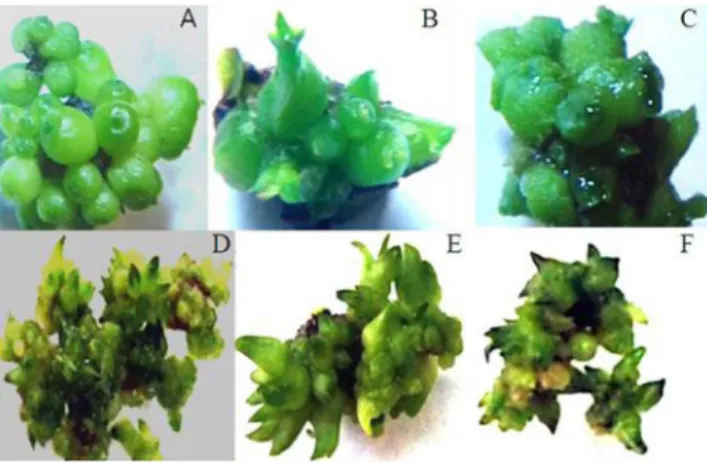
Similar to PLB formation, for both genera, the basal part was found to have a more inductive effect on the number of PLBs than the other parts, although a higher number of PLBs per explant was generally obtained from Dendrobium. Notwithstanding, the highest number of PLBs per explant (11.6) was recorded from the basal part of Phalaenopsis cultured on a PGR-free medium (Figure 2A). Thus, among the tested media, the PGR-free medium showed a better response than the media with added PGRs. For Phalaenopsis, the middle part was found to have a more inductive effect on the number of PLBs per explant than the tip part, while the intact PLBs did not respond at all. In contrast, for Debderobium, the inductive effect of the protocorm parts on the number of PLBs varied distinctly according to the PGR concentration, although the number of PLBs induced by the basal part showed superiority with most treatments. Furthermore, for the basal part, the medium containing 0.1 μM NAA and 10.0 μM BAP was found to encourage an increase in the number of PLBs

per explant (18.7) (Figure 1D).

Therefore, the findings of this experiment provide a valuable message for PLB propagation from different parts of orchid PLBs.

Dividing the PLBs resulted in more PLB formation than using intact PLBs. This was related to the wounds and the results of activating quiescent cells near the cut surface (Imaseki, 1985;

Murdad et al., 2006). Murdad et al. (2006) also reported that this activation includes the initiation of cell proliferation and biochemical changes within the quiescent unwounded cells near the wound. Increased endogenous hormone production in certain plant organs after wounding may also have been one of the factors involved in PLB formation (Rosenstock et al., 1978). Among the protocorm parts used, the tip parts developed fewer PLBs than the basal or middle parts, and the site of PLB formation was not seemingly confined to the location of the apical meristem (Begum et al., 1994). Histological observation has also revealed that regenerated PLBs are generally formed from the epidermal layer of the posterior region of the protocorm (Chen and Chang, 2004).

Thus, since the basal part consists of large parenchymatous cells and functions as a storage organ (Batygina et al., 2003), the basal part can be assumed as the most suitable for use as an explant.

In the case of Phalaenopsis, the maximum PLB formation was observed on a PGR-free medium. Chen and Chang (2004) also reported that NAA inhibited direct embryo formation from protocorms of Phalaenopsis amabilis var. formosa Shinmadzu.

Therefore, it can be assumed that an NAA-added medium can inhibit PLB formation in some species of Phalaenopsis. Moreover, the type of explant may also be a factor, since the amount of PGR added to the culture medium can differ depending on the explant type, i.e., shoot, leaf, stem, or root. For Phalaenopsis and Doritaenopsis, Tokuhara and Mii (1993) reported that the highest frequency of PLB formation was obtained from shoot tips on a medium supplemented with 0.1 mg /L NAA and 20 mg / L BA.

Meanwhile, in the case of root explants, the highest frequency of PLB formation was reported to occur on a medium supplemented with 2.3 μM TDZ (Park et al., 2003). Leaf and stem explants have also been reported to require a PGR-supplemented medium to induce PLBs (Murthy and Pyati, 2001; Tee et al., 2010; Luo et al., 2008; Tanaka, 1992). In contrast, protocorm explants have been shown to produce the maximum PLB formation on a culture medium without PGR (Murdad et al., 2006). Thus, the PLB propagation results of Phalaenopsis in the current study were similar to the previous findings of Murdad et al. (2006).

Conversely, for Dendrobium, the 0.1 μM NAA+10.0 μM BAP added medium resulted in the maximum PLB formation. Tee et al.

(2010) previously reported that BAP was the most efficient for PLB formation from shoot tip cultures of Dendrobium, plus the production of PLBs was very high in the presence of NAA. The in vitro response to PGRs has also been found to be different between Phalaenopsis and Dendrobium hybrids, seemingly due to the content of endogenous substances depending on the genotype.

Figure 2. Proliferation of PLBs from protocorm of Phalaenopsis and

Dendrobium hybrids: proliferated PLBs on basal part of protocorm (A),

2-division size (B), and 4-division size (C) of divided protocorms

cultured on PGR-free medium in Phalaenopsis and cultured on 0.1 µM

NAA + 10.0 µM BAP supplemented medium in Dendrobium (D, E, and F).

(4)

Thus, the type and level of PGR necessary in an in vitro culture apparently depend on the species, genotype and explant size (Kane, 1996).

For the efficient regeneration of Phalaenopsis protocorms, it was very encouraging that the MS medium without PGR worked well in this study. However, in the case of Dendrobium, the medium containing (0.1 μM NAA+5.0 μM BAP) and (0.1 μM NAA+10.0 μM BAP) was required to obtain the maximum PLB formation. Therefore, each genotype needs a specific PGR regime even when using the same kind of explant.

In brief, based on the findings in this study, further experimentation is needed to identify suitable culturing methods, such as liquid cultures, shaking cultures, and explant orientation, for more efficient regeneration protocols.

PLB formation from different division sizes of PLB

The effects of the different sizes of the explants and PGRs on the frequency of PLB formation by the Phalaenopsis and Dendrobium hybrids are shown in Table 2. The highest PLB formation frequency (36%) resulted from the four-division sections of Phalaenopsis on the PGR-free medium, while the two- division sections of Dendrobium showed the highest PLB formation (36.7%) when cultured on the medium with 0.1 μM NAA and 10.0 μM BAP. Although the number of PLBs per explant did not differ significantly between the two genera for the different sizes of the divided protocorms, the maximum number of PLBs induced per explant did vary. For Phalaenopsis the number of PLBs (8.0) per explant was higher from the four-division sections than from the two-division sections on the PGR-free medium (Figure 2B and C), whereas, for Dendrobium, the number of PLBs (15.3) per explant was higher from the two-division sections than from the four-division sections on the 0.1 μM NAA and 10.0 μM BAP-added medium (Figure 2E and F).

Thus, based on the results of this experiment, dividing the protocorms into four-division sections produces the maximum PLB formation in the case of Phalaenopsis, whereas two-division sections produce the maximum PLB formation in the case of Dendrobium. These differences in the regeneration capability of the two orchid genera would seem to be influenced by the

genotype. Tanaka (1992) also reported that the regeneration capability in terms of PLB formation could even differ within one genus. It is a routine pathway that protocorms or PLBs are divided into small sections and inoculated on a medium. One small section of a protocorm or a PLB can then induce many PLBs after 6-8 weeks of culture. In this way, PLB propagation can be expanded to a commercial level. Therefore, sectioning a protocorm is an important factor in propagation, as each section plays a vital role in the multiplication of PLBs.

In this study, for Phalaenopsis, the medium without PGR obtained the maximum survival percent and PLB formation for both sizes of explant. However, for Dendrobium, 0.1 μM NAA and 10.0 μM BAP needed to be added to obtain the highest PLB formation frequency and number of PLBs per explant. Plus, these findings confirmed the results of the first experiment, i.e., that PLB proliferation is related to the genotype and PGR requirements.

In conclusion, for maximum regeneration capability, this study found that a divided protocorm was more efficient than a non- divided protocorm for both Phalaenopsis and Dendrobium hybrids. More specifically, the basal part of the protocorm was most efficient as an explant for PLB formation. However, it is recommended that both the basal and middle parts are used to obtain satisfactory results in PLB propagation. When dividing the protocorm, in the case of Phalaenopsis, a higher percentage of PLB formation and the maximum number of PLBs per explant were observed from four-division sections, whereas, in the case of Dendrobium, the same results were obtained from two-division sections. For both orchid genera, a PGR-free medium produced satisfactory results for PLB formation, although for Dendrobium, the addition of 0.1 μM NAA and 10.0 μM BAP showed the best results. Yet, while the PGR level can differ depending on the genotype or species, protocorm sectioning can be used for any orchid. Therefore, this finding will be applicable to other Phalaenopsis and Dendrobium orchids.

References

Batygina TB, Bragina EA, Vasilyeva VE (2003) The reproductive system Table 2. Effects of different sizes of explants and PGRs on frequency of PLB formation and mean number of PLBs per explants of Phalaenopsis hybrid and Dendrobium hybrid

PGRs ( µM)

Esplant size

Phalaenopsis hybrid Dendrobium hybrid

NAA BA PLBs formation

%

Mean no of PLBs per explant

PLLBs formation

%

Mean no of PLBs per explant

0 0 Two-Division 20.0 3.7 26.7 08.0

Four-division 36.0 8.0 00.0 00.0

0.1 5.0 Two-Division 6.7 2.0 30.0 12.3

Four-Division 0.0 0.0 24.0 06.7

0.1 10.0 Two-Division 0.0 0.0 36.7 15.3

Four-Division 0.0 0.0 20.0 11.7

(5)

and germination in orchids. Acta biol Cracov Bot 45: 21-34.

Begum AA, Tamaki M, Kako S (1994) Formation of protocorm-like bodies (PLB) and shoot development through in vitro culture of outer tissue of Cymbidium PLB. J Japan Soc Hort Sci 63: 663-673.

Chen JT, Chang WC (2000) Plant regeneration via embryo and shoot formation from flower-stalk explants of Oncidium Sweet sugar. Plant Cell Tiss Org 62: 95-100.

Chen YC, Chang C, Chang WC (2000) A reliable protocol for plant regeneration from callus culture of Phalaenopsis. In Vitro Cell Dev Biol-Plant 36: 420-423.

Chen JT, Chang WC (2004) Induction of repetitive embryogenesis from seed-derived protocorms of Phalaenopsis amabilis var. formosa Shimadzu. In vitro Cell Dev Biol

-

Plant 40: 290-293.

Griesbach RJ (1983) The use of indoleacetylamino acids in the in vitro propagation of Phalaenopsis orchids. Sci Hort 19: 363-366.

Hew CS (1994) Orchid cut-flower production in ASEAN countries.

In:Arditti, Joseph Arditti (ed.). Orchid Biology: Reviews and Perspectives. Wiley, J. and Son Inc. New York, pp. 363-401.

Imaseki H (1985) Hormonal control of wound induced responses. In Pharis, R. P., Reid, D. N. (eds), Hormonal Regulation of Development Springer, Berlin, Heidelberg, New York, pp. 485-512.

Kane ME (1996) Propagation from preexisting meristems. In: Plant tissue culture concepts and laboratory exercises. CRC Press. Inc. pp. 61-71.

Laws SN (1995) Cut orchids in the world market. Floracult Int 5: 12-15.

Luo JP, Wang Y, Zha XQ, Huang L (2008) Micropropagation of Dendrobium densiflorum Lindl. ex Wall. through protocorm-like bodies: effects of plant growth regulators and lanthanoids. Plant Cell Tiss Organ Cult 93: 333-340.

Murdad R, Hwa KS, Seng CK, Latip, MA, Aziz ZA, Ripin R (2006) High frequency multiplication of Phalaenopsis gigartea using trimmed

bases protocorms technique. Sci Hortic 111: 73-79.

Murthy HN, Pyati AN (2001) Micropropagation of Aerides maculosum Lindl. (Orchidaceae). In Vitro Cell Dev Biol-Plant 37: 223-226.

Park SY, Murthy HN, Paek KY (2002) Rapid propagation of Phalaenopsis from floral stalk-derived leaves. In Vitro Cell Dev Biol-Plant 38: 168- 172.

Park SY, Murthy HN, Paek KY (2003) Protocorm-like body induction and subsequent plant regeneration from root tip cultures of Doritaenopsis.

Plant Sci 164: 919-923.

Rosenstock G, Kabl G (1978) Phytohormones and regulation of cellular processes in aging storage tissues. In Biochemistry of Wounded Plant Tissues, Gunter, K., ed., Walter De Gruyter, Berlin, New York. pp.

623-671.

Tanaka M (1992) Micropropagation of Phalaenopsis spp. Biotechnol Agric For 20: 246-268.

Tee CS, Wong CQ, Lam XL, Maziah M (2010) A preliminary study of protocorm-like-body (PLB) induction using leaf explants of Vanda and Dendrobium orchids. AsPac J Mol Biol Biotechnol 18: 189-191.

Tanaka M (1987) Studies on the clonal propagation of Phalaenopsis through in vitro culture. Mem Fac Agric Kagawa Univ 49: 1-85.

Tanaka M, Nishimura M, Goi M (1984) Studies on the clonal propagation of monopodial orchids through tissue culture. (6) Differences in PLB formation capacity of Phalaenopsis leaf segments in culture. Abstr Jpn Soc Hort Sci Autumn Meet 53: 366-367.

Tokuhara K, Mii M (1993) Micropropagation of Phlaenopsis and Doritaenopsis by culturing shoot tips of flower stalk buds. Plant Cell Rep 13: 7-11.

Yam TW, Ernst R, Arditti J, Ichihashi S (1991) The effects of complex

additives and 4-dimethylamino pyridine on the proliferation of

Phlaenopsis protocorms. Lindleyana 6: 24-26.

수치

Table 1. Effects of Different parts of PLBs and PGRs on frequency of PLB formation and mean number of PLBs per explants of Phalaenopsis hybrid and Dendrobium hybrid
Figure 2. Proliferation of PLBs from protocorm of Phalaenopsis and Dendrobium hybrids: proliferated PLBs on basal part of protocorm (A), 2-division size (B), and 4-division size (C) of divided protocorms cultured on PGR-free medium in Phalaenopsis and cult

참조

관련 문서

The meeting was attended by Assistant Foreign Minister for GCC Affairs, Ambassador, Nasser Al-Muzayyen, and Deputy Assistant Foreign Minister for the Office of the

“ Sheikh Nasser has a written message from HH the Amir, Sheikh Sabah Al-Ahmad Al-Jaber Al-Sabah to the Chinese President, Chi Gen Beng related to enhancing mutual

On his part, CEO of Express Roads Authority, Saud Al-Naqqi said that the heavy rains of the previous day led to clogging parts of the express

Kuwait will celebrate on Sunday the fourth anniversary of the UN honoring and proclamation of His Highness the Amir, Sheikh Sabah Al-Ahmad Al-Jaber Al-Sabah as

• 이명의 치료에 대한 매커니즘과 디지털 음향 기술에 대한 상업적으로의 급속한 발전으로 인해 치료 옵션은 증가했 지만, 선택 가이드 라인은 거의 없음.. •

The proposal of the cell theory as the birth of contemporary cell biology Microscopic studies of plant tissues by Schleiden and of animal tissues by Microscopic studies of

Since every classical or virtual knot is equivalent to the unknot via a sequence of the extended Reidmeister moves together with the forbidden moves, illustrated in Section 2,

웹 표준을 지원하는 플랫폼에서 큰 수정없이 실행 가능함 패키징을 통해 다양한 기기를 위한 앱을 작성할 수 있음 네이티브 앱과