Original Article
Comparison of concurrent chemoradiotherapy with cisplatin plus 5-fluorouracil versus cisplatin plus paclitaxel
in patients with locally advanced cervical carcinoma
Eui-Sok Sol1, Tae Sung Lee1, Suk Bong Koh1, Hun Kyu Oh2, Gi Won Ye3, Youn Seok Choi1
Departments of 1Obstetrics and Gynecology, 2Pathology, 3Radiation Oncology, School of Medicine, Catholic University of Daegu, Daegu, Korea
Objective: The aim of this study was to compare survival outcomes and toxicities between concurrent radiotherapy with cisplatin plus 5-fluorouracil and that with cisplatin plus paclitaxel in patients with locally advanced cervical carcinoma.
Methods: We retrospectively reviewed data from 93 locally advanced cervical carcinoma patients (stage IB to IVA) who had been treated by concurrent radiotherapy with cisplatin plus 5-fluorouracil (CF, n=45) vs. cisplatin plus paclitaxel (CP, n=48) as primary therapy. Toxicities and survival outcomes were compared.
Results: In the CP group, there were higher frequencies of severe (grade 3 or 4) leukopenia (79.2%, as compared to 11.1% in the CF group), severe neutropenia (77.1%, as compared to 8.9% in the CF group) and severe peripheral neuropathy (12.5%, as compared to 2.2% in the CF group). In the CF group, there were higher frequencies of severe nausea (33.3%, as compared to 14.6% in the CP group) and severe hyponatremia (11.1%, as compared to 0% in the CP group). Five-year DFS of the CF and CP groups was 67.4% and 79.1%, respectively (p=NS). Five year OS of the CF and CP groups was 79.6% and 80.9%, respectively (p=NS).
Conclusion: Concurrent radiotherapy with cisplatin plus paclitaxel showed increased leukopenia, neutropenia and peripheral neuropathy, but less gastrointestinal toxicity (nausea) than that with cisplatin plus 5-fluorouracil. Survival outcome between these two groups was not statistically different in this study. Large prospective randomized controlled studies will be needed to confirm this result.
Key Words: Cervical cancer, Chemoradiotherapy, Cisplatin, 5-fluorouracil, Paclitaxel
Received December 27, 2008, Revised February 7, 2009, Accepted February 13, 2009
Address reprint requests to Youn Seok Choi
Department of Obstetrics and Gynecology, School of Medicine, Catholic University of Daegu, 3056-6, Daemyung 4-dong, Nam-gu, Daegu 705-718, Korea
Tel: 82-53-650-4087, Fax: 82-53-650-4078 E-mail: [email protected]
INTRODUCTION
Since the National Cancer Institute (NCI) released a clinical announcement regarding concurrent chemoradiation in 1999,1 chemoradiotherapy with cisplatin-containing agents became a new standard therapy for locally advanced cervical cancer. The five randomized trials which lead to the NCI clin- ical announcement used four different cisplatin-containing regimens with radiotherapy.2-6 In the five trials, different doses, cycles, and combinations of cisplatin based chemo- therapy used. All these cisplatin based regimens with radia- tion showed survival benefit over radiation alone. Based on
these randomized trials, it is evident that cisplatin-containing chemoradiation has a survival benefit over radiation alone.
However, several questions regarding chemoradiation remain unanswered by these randomized trials. One of these ques- tions is what will be the best ideal chemoradiation regimen.
The roles of chemotherapy during chemoradiation are to eradicate micrometastases and sensitize tumor cells to radiation.4 For this purpose, chemotherapeutic agents should have anti-cancer activity against cervical cancer cells and be- have as a radiosensitizer. The rationales of using paclitaxel in combination with cisplatin in concurrent chemoradiation are that 1) paclitaxel acts as a radiosensitizer in vitro,7,8 2) a phase I study with cisplatin plus paclitaxel has proved excellent overall response in patients with locally advanced cervical cancer,9 and 3) cisplatin plus paclitaxel have activity against metastatic and recurrent cervical cancer.10
Recently, several studies which used cisplatin plus paclitaxel with concurrent radiation have been reported.9,11-13 These were phase I and/or II studies which focused on evaluating toxicities and response rates in a limited number of enrolled patients. These studies have demonstrated that cisplatin plus
paclitaxel concurrently used with radiation show encouraging response rate and good tolerability. In the studies, dose limit- ing side effects were hematologic toxicities and diarrhea.
However, to the best of our knowledge, there have been no head-to-head comparison studies in concurrent chemo- radiotherapy between cisplatin plus paclitaxel and cisplatin plus 5-fluorouracil (5-FU). Therefore, this study aims at com- paring survival outcomes and toxicities between cisplatin plus 5-FU and cisplatin plus paclitaxel used in concurrent che- moradiotherapy in patients with locally advanced cervical carcinoma.
MATERIALS AND METHODS 1. Patients
One hundred sixty five patients with histologically proven cervical carcinoma underwent primary concurrent chemo- radiation at the Daegu Catholic Medical Center in Daegu, Korea between 2000 and 2007. Among the patients, the medi- cal records of one hundred fifty nine patients were available for evaluation. One hundred twelve patients were treated with cisplatin plus 5-fluorouracil (n=52) or cisplatin plus pa- clitaxel (n=60). The other 47 patients underwent chemo- radiation with weekly cisplatin regimen, and most patients (40) were diagnosed and treated after 2005.
This retrospective study included patients with the follow- ing criteria: 1) histologically proven cervical carcinoma, 2) Stage IB to IVA disease, 3) concurrent chemoradiation with cisplatin plus 5-fluorouracil or cisplatin plus paclitaxel, 4) for the purpose of cure, 5) squamous cell carcinoma, adenocar- cinoma or adenosquamous histology, 6) no para-aortic lymph node metastasis in the magnetic resonance imaging (MRI) findings, and 7) no previous treatment history. The stage of disease was determined clinically according to the FIGO stag- ing system. Stage IB and IIA patients in this study were those with lymph node metastasis by MRI, bulky tumor (over 4 cm in diameter), or suspected deep stromal invasion, who were anticipated to require postoperative chemoradiation. With these inclusion criteria, 93 patients (45 in cisplatin plus 5-flu- orouracil group [CF group], 48 in cisplatin plus paclitaxel group [CP group]) were included in this study.
2. Treatment
All patients received pelvic with/without extended field ra- diation and concurrent cisplatin based chemotherapy. The pelvis was treated by external beam radiotherapy with a linear accelerator using photon beam energy of 6/15 MV within a standard four-field box technique, followed by high dose rate brachytherapy. The energy of 6 MV was used selectively only in anteroposterior and posteroanterior teletherapy for the pa- tients whose pelvic anteroposterior diameters were less than 20 cm before 2005, but these patients were treated with 15 MV in both lateral teletherapy. Patients with Stage IB and IIA cervical carcinoma received a dose of 4,500-5,040 centigrays
(cGy) as external beam in 25-28 fractions over 5.0-5.5 weeks.
Patients with Stage IIB to IVA cervical carcinoma received a dose of 5,040-5,400 cGy as external beam radiotherapy given in 28-30 fractions over 6 weeks. This was followed by six courses of high dose intracavitary brachytherapy, after ex- ternal beam radiotherapy was completed. A dose of 3,000 cGy in 6 fractions was given over 3 weeks.
Two cycles of chemotherapy during external beam radio- therapy were given and consisted of cisplatin (75 mg/m2) with 5-FU (4,000 mg/m2), or cisplatin (75 mg/m2) with pacli- taxel (135 mg/m2). There were no specific criteria choosing cisplatin plus 5-FU or paclitaxel, except the patient’s personal economic reasons because of the higher cost of paclitaxel.
Chemotherapy started at the commencement of radiotherapy (day 1) and was given at 3 week intervals. Chemotherapy with cisplatin and 5-fluorouracil consisted of an intravenous in- fusion of 75 mg/m2 of cisplatin (day 1), followed by an intra- venous infusion of 4,000 mg/m2 of 5-fluorouracil over a 96-hour period (days 2-5). One liter of normal saline was giv- en both before and after cisplatin, and mannitol was used to increase urine output (day 1). Premedication included ondan- setron and dexamethasone to reduce nausea and vomiting.
Chemotherapy with cisplatin plus paclitaxel consisted of an intravenous infusion of 135 mg/m2 of paclitaxel (day 1), fol- lowed by an intravenous infusion of 75 mg/m2 of cisplatin (day 2). After concurrent chemoradiation, an additional two cycles of chemotherapy (3rd cycle: day 63-70, 4th cycle: day 84-91) were given as adjuvant chemotherapy in some patients. There were no specific criteria for adjuvant chemo- therapy, but we had used adjuvant chemotherapy before 2005.
If patients had grade 3 or 4 leukopenia or neutropenia, gran- ulocyte macrophage colony stimulating factor (GM-CSF) was used. Dose reduction was indicated when patients had severe hematologic or non-hematologic toxicities. Chemotherapy was stopped when severe toxicities were persistent after dose reduction, when patients had poor performance status, or when patients refused it.
3. Evaluation of toxicities and follow up
Patients were evaluated at the beginning of treatment and then weekly for side effects. A complete blood count and a bio- chemistry profile were also performed. Complete blood cell counts were obtained at days 10 to 14 of each chemotherapy cycle for evaluation of nadir white blood cell (WBC), neu- trophil, hemoglobin (Hb), and platelet. At days 10 to 14 of each chemotherapy cycle, we obtained a questionnaire from patients regarding nausea, vomiting, diarrhea, tingling sensa- tion, fatigue, general condition and etc. The lowest nadir com- plete blood counts (CBC) level and the worst toxicity of each category of non-hematologic toxicity during treatment were used for analysis of toxicity. The toxicity of chemoradiation was determined according to the ‘common terminology cri- teria for adverse events v3.0 by NCI’.
To evaluate the clinical response, we checked physical ex-
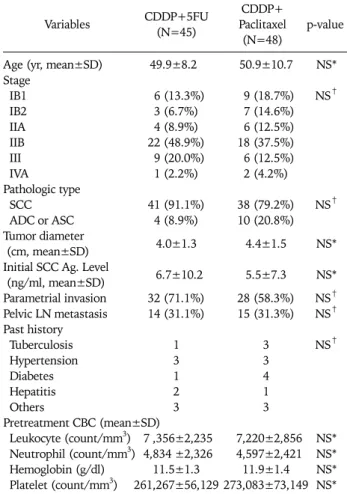
Table 1. Characteristics of patients
Variables CDDP+5FU
(N=45)
CDDP+
Paclitaxel (N=48)
p-value
Age (yr, mean±SD) 49.9±8.2 50.9±10.7 NS*
Stage
IB1 6 (13.3%) 9 (18.7%) NS†
IB2 3 (6.7%) 7 (14.6%)
IIA 4 (8.9%) 6 (12.5%)
IIB 22 (48.9%) 18 (37.5%)
III 9 (20.0%) 6 (12.5%)
IVA 1 (2.2%) 2 (4.2%)
Pathologic type
SCC 41 (91.1%) 38 (79.2%) NS†
ADC or ASC 4 (8.9%) 10 (20.8%)
Tumor diameter 4.0±1.3 4.4±1.5 NS*
(cm, mean±SD)
Initial SCC Ag. Level 6.7±10.2 5.5±7.3 NS*
(ng/ml, mean±SD)
Parametrial invasion 32 (71.1%) 28 (58.3%) NS† Pelvic LN metastasis 14 (31.1%) 15 (31.3%) NS† Past history
Tuberculosis 1 3 NS†
Hypertension 3 3
Diabetes 1 4
Hepatitis 2 1
Others 3 3
Pretreatment CBC (mean±SD)
Leukocyte (count/mm3) 7 ,356±2,235 7,220±2,856 NS*
Neutrophil (count/mm3) 4,834 ±2,326 4,597±2,421 NS*
Hemoglobin (g/dl) 11.5±1.3 11.9±1.4 NS*
Platelet (count/mm3) 261,267±56,129 273,083±73,149 NS*
CDDP: cisplatin, 5FU: 5-fluorouracil, SD: standard deviation, NS:
no statistically significant difference, SCC: squamous cell carcino- ma, ADC: adenocarcinoma, ASC: adenosquamous carcinoma, LN:
lymph node, CBC: complete blood count
*independent samples t-test, †chi- square test amination, Pap smear and imaging studies after 3 months
from the end of radiation. After treatment, we followed up pa- tients at 3 month intervals for the first 2 years, and then at 4-6 month intervals for additional 3 years, and once a year the- reafter.
4. Determination of lymph node metastasis
As we did not apply surgical staging in patients with cervical cancer, lymph node metastasis was evaluated by MRI. The cri- teria of lymph node metastasis by MRI were lymph nodes that were over 1 cm in the short axis diameter and were enhanced with gadolinium in T1 weighted enhanced magnetic reso- nance imaging.
5. Study end point
Primary end point was the comparison of survival outcome according to chemotherapy regimens. Overall survival (OS) was defined as the time from the date of diagnosis to death from cervical cancer. Patients who survived beyond the time of analysis were censored at the time of their last follow-up date. Disease free survival (DFS) was defined as the time from date of diagnosis to the recurrence of cancer in any sites. The evaluations of hematologic and non-hematologic toxicities were the secondary end points of this study.
6. Statistical analysis
Comparisons of variables between the groups were based on the chi-square test and t-test. The OS and DFS were estimated by the life-table method of Kaplan- Meier. Differences in sur- vival rates were assessed by the log-rank test. p-values were the result of two-sided tests and p-value<0.05 was consid- ered statistically significant. Statistical analysis was done us- ing SPSS ver. 13 (SPSS Inc., Chicago, IL, USA).
RESULTS 1. Characteristics of patients
Ninety three patients met with the previously described in- clusion criteria. Forty five patients were treated with cisplatin plus 5-FU (CF group), and 48 patients were treated with cis- platin plus paclitaxel (CP group). The mean ages for patients of the CF and CP groups were 49.9±8.2 years (mean± stand- ard deviation) and 50.9±10.7 years, respectively. FIGO stage distributions of the two groups were not statistically differ- ent, and pathologic types, tumor diameters determined by MRI, and pretreatment squamous cell carcinoma (SCC) anti- gen levels were also not different as shown in the Table 1.
Because we did not perform surgical staging of the cervical cancer, we checked possible lymph node metastasis by MRI, as described above. The frequencies of pelvic lymph node metastasis of both groups were not statistically different. The frequencies of parametrial invasion determined by physical examination were not statistically different. The pretreatment levels of WBC, neutrophil, Hb, and platelet were similar in
both groups (Table 1). All patients were Gynecologic Oncolo- gy Group performance status of 0 or 1 before beginning of the treatment.
2. Chemotherapy
The majority of patients completed their scheduled chemo- therapy during external beam radiotherapy, but three patients received only one cycle of chemotherapy due to either severe toxicities or poor performance status. Seventy one patients re- ceived one or two additional cycles of chemotherapy after ra- diotherapy (Table 2). The patients of both groups received similar total cycles of chemotherapy (CF vs. CP group:
3.3±0.9 vs. 3.1±0.9 cycles, p=NS). All patients received at least one cycle of chemotherapy. There were 10 patients in the CF group, and 27 patients in the CP group who required dose reduction during chemotherapy due to severe toxicities (p=0.001). Eleven patients in the CF group and 12 patients in the CP group stopped their scheduled chemotherapy due to
Table 2. The number of received cycles of chemotherapy No.
of cycles CDDP+5FU
(N=45) CDDP+Paclitaxel
(N=48) p-value
1 1 2
2 8 11 NS*
3 11 14
4 25 21
Mean of received cycles of chemotherapy (mean±SD)
3.3±0.9 3.1±0.9 NS†
CDDP: cisplatin, 5FU: 5-fluorouracil, SD: standard deviation, NS:
no statistically significant difference
*chi-square test, †independent samples t-test
Table 3. Worst hematologic toxicities during treatment CDDP+5FU
(N=45)
CDDP+Paclitaxel
(N=48) p-value
Hematologic toxicity evaluated by the worst nadir values (mean±SD)
WBC 2,971±1,065 1,619±925 <0.001*
ANC 1,971±900 717±823 <0.001*
Hb 9.5±1.1 9.5±0.9 NS*
Platelet 159,089±49,032 156,521±56,930 NS*
Hematologic toxicity evaluated by grade of the worst nadir values (no.) Leukopenia
Grade 1 5 1
Grade 2 22 7 <0.001†
Grade 3 5 29
Grade 4 0 9
Neutropenia
Grade 1 3 1
Grade 2 10 6 <0.001†
Grade 3 2 10
Grade 4 2 27
Anemia
Grade 1 4 12
Grade 2 31 26 NS†
Grade 3 3 3
Grade 4 0 0
Thrombocytopenia
Grade 1 21 19
Grade 2 0 2 NS†
Grade 3 0 1
Grade 4 0 0
Some of patients had more than adverse effect. Grades of toxicities were evaluated by ‘Common terminology criteria for adverse events version 3.0 by National Cancer Institute’
CDDP: cisplatin, 5FU: 5-fluorouracil, SD: standard deviation, NS:
no statistically significant difference
*independent samples t-test, †chi-square test
Table 4. Worst non-hematologic toxicities during treatment CDDP+5FU
(N=45) CDDP+Paclitaxel
(N=48) p-value*
G1 G2 G3 G4 G1 G2 G3 G4 Gastrointestinal
Nausea 7 15 15 0 10 22 7 0 0.033†
Vomiting 13 13 3 0 15 8 0 0 NS
Diarrhea 13 4 10 0 9 14 9 0 NS
Hypersensitivity 0 1 0 0 0 10 2 0 0.006
Peripheral 1 7 1 0 4 14 6 0 0.018
neuropathy
Alopecia 9 3 0 0 2 9 0 0 0.022
Hyponatremia 2 0 4 1 3 0 0 0 0.024‡
Hypokalemia 8 0 1 0 4 2 1 0 NS
Hepatotoxicity 6 1 1 0 11 4 2 0 NS
Renal toxicity 0 1 0 0 1 0 0 0 NS
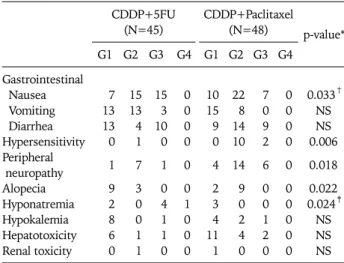
Some of patients had more than one adverse effect. Grades of tox- icities were evaluated by ‘Common terminology criteria for adverse events version 3.0 by National Cancer Institute’
CDDP: cisplatin, 5FU: 5-fluorouracil, NS: no statistically significant difference
*chi-square test, †statistically significant difference over grade 3 tox- icity, ‡CDDP+5FU group showed more grade 3 or 4 hyponatremia
severe toxicities or poor performance status (p=NS). Two pa- tients in the CF group and 3 patients in CP group refused che- motherapy during treatment.
3. Hematologic toxicities
Although both groups had similar values of pretreatment CBC, the means of nadir leukocyte (CF vs. CP group: 2,971±
1,065 vs. 1,619±25) and neutrophil (1,971±900 vs. 717±
823) counts were significantly lower in the CP group, as com- pared to the CF group. The frequency of grade 3 or 4 leukope- nia in the CP group (79.2%) was significantly higher than the CF group (11.1%). The frequency of grade 3 or 4 neutropenia in the CP group (77.1%) was also significantly higher than the CF group (8.9%). The frequencies of anemia or thrombocyto- penia were not statistically different between these two groups (Table 3).
4. Non-hematologic toxicities
With regard to gastrointestinal toxicity, grade 3 nausea was more common in the CF group (CF vs. CP group: 33.3% vs.
14.6%, p=0.033). The frequencies of vomiting, anorexia, di- arrhea, gastritis, and colitis were similar between these groups. The frequencies of grade 2 alopecia, peripheral neuro- pathy, and hypersensitivity were higher in the CP group, as shown in Table 4. The frequency of hyponatremia (Grade 3 or 4) was higher in the CF group, but that of hypokalemia was similar in these groups. Hepatotoxicity or renal toxicity was not different (Table 4). There was one patient in the CF group who had premature ventricular contractions during chemo- therapy, and there were two patients in the CP group who had radiation colitis after treatment.
5. Treatment outcome
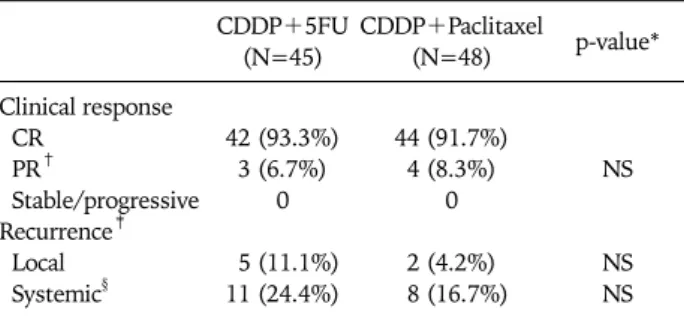
Eighty six patients (92.5%) demonstrated complete clinical response to chemoradiation, whereas 7 patients (7.5%) dem- onstrated partial response to treatment. Response rates of both groups were not statistically different (complete re-
CDDP+5FU (N=45)
CDDP+Paclitaxel
(N=48) p-value*
Clinical response CR
PR†
Stable/progressive Recurrence‡ Local Systemic§
42 (93.3%) 3 (6.7%)
0
5 (11.1%) 11 (24.4%)
44 (91.7%) 4 (8.3%)
0
2 (4.2%) 8 (16.7%)
NS
NS NS CDDP: cisplatin, 5FU: 5-fluorouracil, CR: complete response, PR:
partial response, NS: no statistically significant difference
*chi-square test, †Two patients of CDDP+5FU group and three pa- tients of CDDP+Paclitaxel group underwent adjuvant hysterectomy,
‡A total of 24 patients had recurrent disease, 2 of them had local and systemic recurrence together at the time of diagnosis of recurrence,
§Systemic recurrence included paraaortic lymph node metastasis and other systemic metastases
Table 5. Clinical response and type of recurrence
Fig. 1. (A) Kaplan-Meier estimates of disease free survival among patients undergoing chemoradiotherapy with cisplatin plus 5-fluorouracil (n=45) or plus paclitaxel (n=48). (B) Kaplan-Meier estimates of overall survival among patients undergoing chemoradiotherapy with cispla- tin plus 5-fluorouracil (n=45) or plus paclitaxel (n=48).
sponse rates in the CF and CP groups: 93.3% and 91.7%). Five patients showing partial response underwent adjuvant hys- terectomy after chemoradiation (2 patients in the CF group and 3 patients in the CP group). After a median follow up of 47.3 (2.1-88.4) months, 24 patients developed recurrent dis- ease, 16 patients died from their disease and one patient died of a cause other than cervical cancer (sepsis due to gastric ul- cer perforation). Patterns of recurrence in both groups were not statistically different (local and pelvic recurrence rates of the CF and CP groups: 11.1% and 4.2%, systemic recurrence rates of the CF and CP groups: 24.4% and 16.7%). Two pa- tients had both local and systemic recurrent lesions at the time of diagnosis of recurrence (Table 5). Five-year DFS of the CF and CP groups were 67.4% and 79.1%, respectively (p=NS), and 5 year OS of the CF and CP groups were 79.6%
and 80.9%, respectively (p=NS) (Fig. 1).
DISCUSSION
In this study, we observed that concurrent radiation with cis- platin plus paclitaxel resulted in more severe leukopenia and neutropenia, but less gastrointestinal toxicity than that with cisplatin plus 5-FU in patients with locally advanced cervical carcinoma. In particular, 77.1% patients of the cisplatin plus paclitaxel group experienced at least one event of grade 3 or 4 neutropenia during chemotherapy, which was the dose limit- ing side effect in this study. It is notable that the dosage of cis- platin and 5-FU was determined based upon the a previous randomized trial.4 The total number of chemotherapy cycles was also determined in accordance with a previous report.5 In general, the usual dosage of paclitaxel is 135-175 mg/m2 every 3 weeks. Considering toxicity which might be caused by the combination therapy of cisplatin and radiation, a dosage of 135 mg/m2 every 3 weeks was used in this study as the initial dose of paclitaxel. The frequencies of leukopenia and neu- tropenia of the cisplatin plus paclitaxel regimen were higher than previously reported.11,12 For example, in a phase I/II study of the Gynecologic Oncology Group using cisplatin (40 mg/m2/wk) and paclitaxel (40 mg/m2/wk) for 6 cycles, 17.7% and 11.5% of the total administered cycles show grade 3 or 4 leukopenia and grade 3 or 4 neutropenia, respectively.11 In another phase II trial with cisplatin (75 mg/m2) plus pacli- taxel (175 mg/m2) every 3 weeks for four cycles, 25% and 16%
patients display grade 3 or 4 leukopenia and grade 3 or 4 neu- tropenia, respectively.12 The reason why our study shows a higher frequency of leukopenia and neutropenia might be ex- plained by a dosage effect, i.e., 4 cycles of paclitaxel (135 mg/m2) combined with cisplatin and radiation in this study might be too much for Asian women. This is in accordance with a Japanese study which reported that the grades of hema- tological toxicity are significantly greater in weekly cisplatin
treatment groups at 40 mg/m2 (conventional dose in chemo- radiation) than at 30 mg/m2.14 However, we observed no dif- ference in the frequencies of anemia and thrombocytopenia between the cisplatin plus paclitaxel and cisplatin plus 5-FU regimens. This is also in agreement with previous reports.11,12
With regard to gastrointestinal toxicity, patients with the cisplatin plus 5-FU regimen experienced nausea more com- monly than those with the cisplatin plus paclitaxel regimen.
However, both regimens showed a similar degree of vomiting and diarrhea. Generally, 5-FU is known to result in severe gas- trointestinal toxicity than paclitaxel.15 In other non-hemato- logic toxicities, hypersensitivity, such as urticaria or itching was more common in patients with the cisplatin plus paclitax- el regimen, although it was mild to moderate, such as urticaria or itching. Both cisplatin and paclitaxel are known to cause peripheral neuropathy. Accordingly, neuropathy was more commonly observed in patients with the cisplatin plus pacli- taxel regimen. In contrast, there was no severe renal toxicity in both regimens, probably due to the routine use of massive hydration and mannitol when cisplatin was administered. The cisplatin plus 5-FU regimen showed a higher frequency of grade 3 or 4 hyponatremia, as opposed to the cisplatin plus pa- clitaxel regimen. This might be due to longer IV infusion time per each cycle and/or poor oral intake resulting from nausea in patients with the cisplatin plus 5-FU regimen. However, grade 2 alopecia was more commonly observed in the cisplatin plus paclitaxel regimen, whereas grade 3 or 4 alopecia was not detected in both regimens. This might be explained by the fact that paclitaxel is a stronger inducer of alopecia than 5-FU.15
In this study, we did not observe any statistically significant difference in disease free and overall survivals between cispla- tin plus 5-FU and cisplatin plus paclitaxel. There was over 10% difference in disease free survival between the two groups, but which did not reach statistical significance. If there is any survival difference between these two regimens, large prospective randomized controlled trials might be nec- essary to demonstrate such a difference. Given a similar sur- vival outcome, less toxic chemotherapy is considered to be a better choice. For this purpose, the dosage of paclitaxel might be reduced, no additional chemotherapy after radiation might be employed, or paclitaxel might be excluded from the regi- mens of chemoradiation (i.e., cisplatin alone). This is based upon our observation that paclitaxel at a dose of 135 mg/m2 for four cycles causes severe toxicity without any overall sur- vival benefits. In particular, severe neutropenia can be lethal unless rapid recovery is not achieved. More importantly, pa- clitaxel is far more costly than 5-FU, such that the use of pacli- taxel appears to be not cost-effective. A recent study also dem- onstrated that a regimen of weekly cisplatin alone in chemo- radiation significantly improves treatment compliance and re- duces acute hematologic toxicity, while not affecting response and survival rates.16 Since 2005, we have utilized more fre- quently a weekly regimen of cisplatin (40 mg/m2 each cycle) for 6 weeks with concurrent radiation in patients than cispla-
tin combination regimen (CF or CP).
In conclusion, chemoradiation with cisplatin plus paclitaxel showed a more severe form of leukopenia, neutropenia, alope- cia, hypersensitivity and peripheral neuropathy, but less gas- trointestinal side effect, in particular nausea than that with cisplatin plus 5-FU in patients with locally advanced cervical carcinoma. However, there was no difference in survival out- come between these 2 regimens. Limitations of our present study include a retrospective study, a non-randomized con- trolled trial, and a study with a small sample size. Therefore, large prospective randomized controlled studies are needed to confirm this result.
REFERENCES
1. National Cancer Institute. Concurrent chemoradiation for cer- vical cancer. Clinical announcement, Washington, D.C., February 22, 1999.
2. Rose PG, Bundy BN, Watkins EB, Thigpen JT, Deppe G, Maiman MA, et al. Concurrent cisplatin-based radiotherapy and chemotherapy for locally advanced cervical cancer. N Engl J Med 1999; 340: 1144-53.
3. Keys HM, Bundy BN, Stehman FB, Muderspach LI, Chafe WE, Suggs CL 3rd, et al. Cisplatin, radiation, and adjuvant hyster- ectomy compared with radiation and adjuvant hysterectomy for bulky stage IB cervical carcinoma. N Engl J Med 1999; 340:
1154-61.
4. Morris M, Eifel PJ, Lu J, Grigsby PW, Levenback C, Stevens RE, et al. Pelvic radiation with concurrent chemotherapy compared with pelvic and para-aortic radiation for high-risk cervical cancer. N Engl J Med 1999; 340: 1137-43.
5. Peters WA 3rd, Liu PY, Barrett RJ 2nd, Stock RJ, Monk BJ, Berek JS, et al. Concurrent chemotherapy and pelvic radiation therapy compared with pelvic radiation therapy alone as ad- juvant therapy after radical surgery in high-risk early-stage can- cer of the cervix. J Clin Oncol 2000; 18: 1606-13.
6. Whitney CW, Sause W, Bundy BN, Malfetano JH, Hannigan EV, Fowler WC Jr, et al. Randomized comparison of fluorouracil plus cisplatin versus hydroxyurea as an adjunct to radiation therapy in stage IIB-IVA carcinoma of the cervix with negative para-aortic lymph nodes: a Gynecologic Oncology Group and Southwest Oncology Group study. J Clin Oncol 1999; 17:
1339-48.
7. Geard CR, Jones JM. Radiation and taxol effects on synchron- ized human cervical carcinoma cells. Int J Radiat Oncol Biol Phys 1994; 29: 565-9.
8. Rodriguez M, Sevin BU, Perras J, Nguyen HN, Pham C, Steren AJ, et al. Paclitaxel: a radiation sensitizer of human cervical cancer cells. Gynecol Oncol 1995; 57: 165-9.
9. Pignata S, Frezza P, Tramontana S, Perrone F, Tambaro R, Casella G, et al. Phase I study with weekly cisplatin-paclitaxel and concurrent radiotherapy in patients with carcinoma of the cervix uteri. Ann Oncol 2000; 11: 455-9.
10. Papadimitriou CA, Sarris K, Moulopoulos LA, Fountzilas G, Anagnostopoulos A, Voulgaris Z, et al. Phase II trial of paclitax- el and cisplatin in metastatic and recurrent carcinoma of the uterine cervix. J Clin Oncol 1999; 17: 761-6.
11. DiSilvestro PA, Walker JL, Morrison A, Rose PG, Homesley H, Warshal D, et al. Radiation therapy with concomitant paclitaxel and cisplatin chemotherapy in cervical carcinoma limited to the pelvis: a phase I/II study of the Gynecologic Oncology Group.
Gynecol Oncol 2006; 103: 1038-42.
12. Miglietta L, Franzone P, Centurioni MG, Boni L, Tacchini L, Cosso M, et al. A phase II trial with cisplatin-paclitaxel cyto- toxic treatment and concurrent external and endocavitary radi- ation therapy in locally advanced or recurrent cervical cancer.
Oncology 2006; 70: 19-24.
13. Petera J, Odrazka K, Frgala T, Spacek J. External beam radio- therapy and high-dose brachytherapy combined with cisplatin and paclitaxel in patients with advanced cervical carcinoma.
Gynecol Oncol 2005; 99: 334-8.
14. Ikushima H, Osaki K, Furutani S, Yamashita K, Kawanaka T,
Kishida Y, et al. Chemoradiation therapy for cervical cancer:
toxicity of concurrent weekly cisplatin. Radiat Med 2006; 24:
115-21.
15. Gutheil J, Kearns C. Antimetabolites. In: Perry MC, editor. The chemotherapy source book. 2nd ed. Baltimore: Williams &
Wilkins; 1996. p. 323-5.
16. Kim YS, Shin SS, Nam JH, Kim YT, Kim YM, Kim JH, et al.
Prospective randomized comparison of monthly fluorouracil and cisplatin versus weekly cisplatin concurrent with pelvic ra- diotherapy and high-dose rate brachytherapy for locally ad- vanced cervical cancer. Gynecol Oncol 2008; 108: 195-200.