
Vol. 22, No. 4 pp. 594-600, 2021
Extensional Buckling Analysis of Asymmetric
Curved Beams Using DQM
Ki-Jun Kang
Department of Mechanical Engineering, Hoseo University
미분구적법(DQM)을 사용한 비대칭 곡선 보의 신장 좌굴해석
호서대학교 공과대학 기계공학부강기준
Abstract Curved beam structures are generally used as components in structures such as railroad bridges and vehicles. The stability analysis of curved beams has been studied by a large number of researchers.
Due to the complexities of structural components, it is difficult to obtain an analytical solution for any boundary conditions. In order to overcome these difficulties, the differential quadrature method (DQM) has been applied for a large number of cases. In this study, DQM was used to solve the complicated partial differential equations for buckling analysis of curved beams. The governing differential equation was deduced and solved for beams subjected to uniformly distributed radial loads. Critical loads were calculated with various opening angles, boundary conditions, and parameters. The results of the DQM were compared with exact solutions for available cases, and the DQM gave outstanding accuracy even when only a small number of grid points was used. Critical loads were also calculated for the in-plane inextensional buckling of the asymmetric curved beams, and two theories were compared. The study of a beam with extensibility of the arch axis shows that the effects on the critical loads are significant.
요 약 곡선 보는 철교 그리고 자동차와 갈은 구조물의 구성으로 널리 사용되어왔다. 많은 연구자들의 관심분야인 이러 한 구조물의 안정성 거동 해석분야는 괄목할 만한 성과가 있어 왔다. 곡선 보 구조물의 기하학적 구조 및 물성치가 탄성 및 강성에 미치는 영향을 분석하기 위하여 정역학적 동역학적 해석이 필요하다. 그러나 구조물의 복잡성 때문에 어떠한 경계조건에서도 엄밀해를 얻기가 매우 어렵다. 전통적으로 미분방정식의 해법은 유한차분법 혹은 유한요소법으로 해결 해왔으나 이러한 방법들은 때론 복잡한 비선형 구조물에는 과도한 컴퓨터 용량사용과 복잡한 알고리즘 프로그램을 요구 한다. 이러한 어려움을 해결하기 위해 미분구적법(DQM)이 여러 분야에 사용되어왔다. 본 연구에서는 복잡한 편미분 방 정식의 해를 구하기 위하여 미분구적법이 사용되었다. 중면 신장을 고려한 등분포 하중 하에서 선형으로 변하는 비대칭 곡선 보의 내평면 신장 좌굴의 지배방정식을 유도하였고, DQM을 이용하여 지배방정식의 해를 구하였다. 다양한 열림 각, 경계 조건, 그리고 파라미터에 의한 임계하중을 계산하였다. DQM 결과는 비교 가능한 엄밀해와 비교하였고 DQM 은 적은 격자점을 사용하고도 정확성을 보여주었다. 예를 들어 열림 각이 인 비 신장 고정단 곡선 보의 경우, 엄밀 해의 임계하중 값은 8.0이고 DQM의 임계하중 값은 7.98로, 오차가 0.3% 미만 이었다. 곡선 보의 내평면 비 신장 임계 하중도 계산하였고, 두 이론을 상호 비교 분석하였다. 아크축의 중면 신장을 고려한 연구는 곡선 보의 임계하중에 중대한 영향을 미치는 것을 보여준다.
Keywords : Asymmetric Curved Beam, Critical Load, DQM, Extensional Buckling, Radial Load
*Corresponding Author : Ki-Jun Kang(Hoseo Univ.) email: [email protected]
Received January 25, 2021 Revised March 17, 2021
1. Introduction
Due to their importance in various fields of engineering, the stability analysis of curved beams has been the subject fields of a number of investigations.
Ojalvo et al.[1] presented the elastic stability of arch segments with a push and a pull along the segments. Vlasov[2] obtained analytic-form solutions, in which cross sectional areas are allowed to warp along the arch axis, subject to bending moments and uniform radial loads.
Papangelis and Trahair[3] showed a theoretical study of the out-of-plane buckling of doubly symmetric arches to verify the predictions of Timoshenko and Gere[4] in uniform compression and of Vlasov[2] in uniform bending for arches.
Recently, Kang and Kim[5] investigated the in-plane buckling behavior of curved beams using the differential quadrature method, and Kang[6] also studied the in-plane extensional vibration behavior of curved beams using the differential quadrature method, respectively.
Solutions of the applicable differential equations have commonly been solved by the finite difference method(FDM) or the finite element method(FEM). These methods sometimes require a number of computing time as the number of gird points becomes relatively big with conditions of the complex geometry and the complex loading. In order to overcome these difficulties, the differential quadrature method(DQM) introduced by Bellman and Casti[7], which is a more efficient method for solving the differential equation, has been applied for a large number of cases.
In the present study, the DQM is applied for the in-plane extensional and inextensional buckling of the curved beam with linearly varying cross sectional areas under the uniformly distributed radial loads. The critical loads are analyzed for the curved beam.
2. Theoretical Analysis
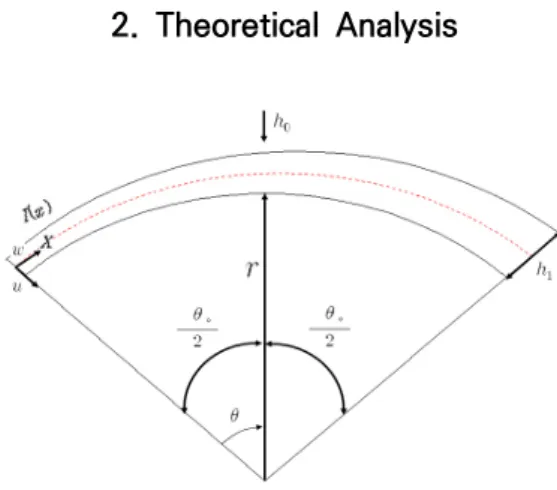
Fig. 1. Coordinates for a curved beam
Fig. 2. Forces on a curved beam
Fig. 1 shows the coordinate systems for a beam. The curved beam axis is specified by the angle . Here, is the height of the cross-section area at the middle, is the radius,
is the radial displacement, is the tangential displacement, and is the opening angle.
The equilibrium conditions of a curved beam not considering the shear deformation, shown in Fig. 2, give[8]
(1)
(2)
(3)
where M, and are the normal force, the shear force, the moment, and the mass per unit length, respectively. From the theory of a curved beam, the normal force and the bending moment are given
(4)
(5)
where is the cross-section area, is the moment of inertia of the area, and is the Young's modulus.
The substitution of Eqs. (4) and (5) into Eqs. (1) and (2) using Eq. (3) presents the following differential equations[9]
″′ ″ ′″ ″′ ″′
′ (6)
′′ ″ ″ ″′
′′
″ ′ (7) in which the prime and the dot show differentiation with respect to and . Assume the followings
(8) where and are the normal functions of and , and is .
Introducing , the dimensionless distance coordinate, defined as
(9)
Consider the curved beam having a rectangular cross section shown in Fig. 1. Here, and
are the varying cross-section area associated with the height at the middle of the beam and the function of the cross-section variation law, respectively. The variation law studied by Auciello and De Rosa[10], in which
the cross-section varies linearly, is
,
(10) where is the ratio of the heights.
Using Eqs. (8), (9), and (10), the Eqs. (6) and (7) can be presented
″
′
″
′
″
″′
″′
′
(11)
′
′
″
″
″′
′
′
″
′
(12) where is the radius of gyration,
, and is the length of the axis, . Each prime presents differentiation with respect to .
On the basis of Timoshenko and Gere[4], the buckling equations can be derived from the equation by replace the inertial terms.
→ (13)
→
(14)
→
(15)
It is noted that is the slope, and is the strain of a beam during bending.
Substituting Eqs. (13), (14), and (15) into Eqs.
(11) and (12) shows
″
′
″
′
″
″′
″′
′
″
′
(16)
′
′
″
″
″′
′
′
″
′
′
″
(17) Eqs. (16) and (17) are the differential equations of the in-plane extensional buckling of the asymmetric curved beams by uniformly distributed radial loads.
For the inextensional buckling of the asymmetric curved beams, the condition is starting with no extension of the center line of the axis. This condition requires that and be
(18)
Using Eq. (18) and eliminating in Eqs. (16) and (17), one can rewrite the equation
′
″
″′
″′
′
″
″
′
″′
′
″
(19)
Eq. (19) is the differential equation of the inextensional buckling of the asymmetric curved beams by uniformly distributed radial loads.
The boundary conditions of the beams for both ends clamped-clamped and both ends simply-simply supported are, respectively,
′ at X=0 and 1 (20)
at X=0 and 1 (21)
3. Application
The DQM is used for the extensional buckling of the asymmetric curved beam.
Applying the DQM to Eqs. (16) and (17), gives
″
′
(22)
′
′
(23)
where , and are the weighting
coefficients for the first, the second, the third, and the fourth order derivatives, respectively.
The boundary conditions for both ends clamped-clamped, given by Eq. (20), can be shown in differential quadrature
at
at
at
at
at δ
at δ (24)
Here, is a very little distance from the boundary ends of the beam. In their study on the application of the differential quadrature method to the static analysis of the straight beam, Jang et
al.[11] proposed the to the boundary points of grid points at a small distance from the ends of the beam.
The boundary conditions for both ends simply-simply supported, given by Eq. (21), can be shown in differential quadrature
at
at
at
at
at δ
at δ (25)
Those equations with proper boundary conditions can be solved for the critical loads of the asymmetric curved beam.
4. Numerical Results and Comparisons
The critical loads of the in-plane extensional and inextensional buckling for the asymmetric curved beams with linearly varying cross section under the uniformly distributed radial loads are solved by the DQM. The values are calculated for the various slenderness ratio
, ratio of the heights , opening angles, and boundary conditions. All results are computed with =13 and × [6], and the range of is from 30 to 200 suggested by Veletsos et al.[12].
Tables 1 and 2 show the critical loads
of extensional buckling for the beam in the case of fixed-fixed ends with
=0.2 and 0.4. Tables 3 and 4 present the critical loads of extensional buckling in the case of simply-simply supported ends with =0.2 and 0.4. In Table 5,
the critical loads of inextensional and extensional buckling for the beam in the cases of fixed-fixed ends with =200 are presented.
Table 6 shows that the critical loads by the DQM are compared with the critical loads by Timoshenko and Gere[4] for the inextensional buckling of uniform curved beams.
From Tables 1~4, the critical loads of extensional buckling of the beam with both ends fixed-fixed are much higher than those of the beam with both ends simply-simply supported.
In general, the critical loads are increased by decreasing the opening angles and the slenderness ratio except for some small opening angles. However, the slenderness ratio dose not significantly affect the critical load. As the ratios of heights are increased, the critical loads are decreased. The ratios of heights also have not much influence on the critical loads. The critical loads in cases of the simply support boundary conditions are importantly affected by the ratios of heights more than those in cases of the fixed boundary conditions.
From Table 5 for the case of =200, there is no big difference between the values of critical loads of the inextensional buckling and the critical loads of the extensional buckling when the beam has the uniform cross-sectional area ( ). However, for the non-uniform beam, the values of critical loads of both inextensional and extensional buckling show some difference which can have influence on the buckling behavior. The values of the critical loads of the extensional buckling are higher than those of the inextensional buckling, and the buckling behaviors are more affected by the simply supported boundary conditions than by the fixed boundary conditions for the non-uniform beams.
The buckling behavior is more affected by the opening angles and the boundary conditions than by the ratios of height and slenderness. The
critical loads are also more affected by the ratios of height than by the slenderness ratio.
Table 6 shows that the solutions by the DQM requiring only thirteen grid points agree excellent with the exact solutions by Timoshenko and Gere[4].
30 50 100 200
45 128.9 128.6 128.5 128.8
90 33.41 33.31 33.28 33.31
135 15.82 15.74 15.71 15.64
180 9.705 9.624 9.592 9.565
225 6.975 6.884 6.825 6.808
Table 1. The critical loads of extensional buckling for the asymmetric curved beams with fixed-fixed end boundary conditions and =0.2.
30 50 100 200
45 115.8 114.8 113.8 113.3
90 29.6 29.3 29.26 29.19
135 13.83 13.72 13.69 13.58
180 8.340 8.268 8.231 8.193
225 5.870 5.805 5.769 5.668
Table 2. The critical loads of extensional buckling for the asymmetric curved beams with fixed-fixed end boundary conditions and =0.4.
30 50 100 200
45 64.52 64.44 64.52 65.70
90 16.80 16.77 16.81 16.98
135 7.986 7.928 7.890 7.655
180 4.904 4.346 4.850 4.845
225 3.478 3.426 3.405 3.320
Table 3. The critical loads of extensional buckling for the asymmetric curved beams with simply-simply supported end boundary conditions and =0.2.
30 50 100 200
45 61.80 61.03 60.26 59.67
90 15.77 15.63 15.48 15.38
135 7.357 7.298 7.245 7.040
180 4.401 4.346 4.281 4.228
225 3.028 2.979 2.905 2.719
Table 4. The critical loads of extensional buckling for the asymmetric curved beams with simply-simply supported end boundary conditions and =0.4.
0.0 0.5 0.0 0.5
inextensibility extensibility
45 130.6 86.67 132.6 93.77
90 32.38 21.51 34.46 24.14
135 14.33 9.534 16.36 11.18
180 7.984 5,318 1.0 6.722
225 5.178 3.493 7.182 4.604
Table 5. The critical loads of inextensional and extensional buckling for the asymmetric curved beams with fixed-fixed end boundary conditions with =200.
Timoshenko and Gere[4] DQM
30 294 293
60 73.3 73.2
90 32.4 32.3
120 18.1 18.2
180 8.0 7.98
Table 6. The critical loads of inextensional buckling for the uniform curved beams with fixed-fixed end boundary conditions.
5. Conclusions
The governing differential equations of the in-plane extensional and inextensional buckling of the curved beam with linearly varying cross section subjected to uniformly distributed radial loads are derived. The differential quadrature
method(DQM) is used for analyzing the buckling behavior and calculating the critical loads of the beam.
The present approach gives the followings:
1) The results, previous not presented, are showed with the various boundary conditions, opening angles, ratio of heights, or slenderness ratios.
2) The effects of midsurface extension can affect the critical loads of the curved beam significantly. Therefore, the research for the extensional buckling analysis of the beam is import for the beam stability.
3) The DQM shows the solutions which agree excellent with the exact solutions requiring only a few number of grid points (thirteen points used for this study).
4) The DQM may also be extended to the curved beams of other profiles.
5) For a thick beam, the beam theory including the effects of the rotary inertia and the shear deformation gives a better results to the practical beam behavior. Therefore, the shear deformable theory for asymmetric curved beams having a thick cross-section area should be considered for the next research.
References
[1] M. Ojalvo, E. Demuts and F. Tokarz, "Out-of-Plane Buckling of Curved Members", Journal of the Structural Division, ASCE, Vol.95, pp.2305-2318, 1969.
[2] V. Z. Vlasov, Thin Walled Elastic Beams, 2nd Edition, English Translation, National Science Foundation, Washington, D.C., 1961.
[3] J. P. Papangelis and N. S. Trahair, "Flexural-Torsional Buckling of Arches", Journal of the Structural Engineering, ASCE, Vol.113, pp.889-906, 1987.
[4] S. P. Timoshenko and J. M. Gere, Theory of Elastic Stability, 2nd Edition, McGraw-Hill, New York, 1961.
[5] K. Kang and Y. Kim, "In-Plane Buckling Analysis of Curved Beams Using DQM", Journal of the Korea Academia-Industrial cooperation Society, Vol.13, pp.
2858-2864, 2012.
DOI: http://dx.doi.org/10.5762/KAIS.2012.13.7.2858
[6] K. Kang, "In-Plane Extensional Vibration Analysis of Curved Beams under Uniformly Distributed Radial Loads Using DQM", Journal of the Korea Academia- Industrial cooperation Society, Vol.19, pp.265-274, 2018.
DOI: https://doi.org/10.5762/KAIS.2018.19.7.265 [7] R. E. Bellman and J. Casti, "Differential Quadrature
and Long-Term Integration", Journal of Mathematical Analysis and Applications, Vol.34, pp.235-238, 1971.
[8] S. S. Rao and V. Sundararajan, "In-Plane Flexural Vibration of Circular Rings", Journal of Applied Mechanics,ASME, Vol.36, pp.620-625, 1969.
DOI: https://doi.org/10.1115/1.3564726
[9] K. kang, "In-Plane Vibration Analysis of Asymmetric Curved Beams with Linearly Varying Cross-Section Using DQM", Journal of the Korea Academia-Industrial cooperation Society, Vol.20, pp.612-620, 2019.
DOI: https://doi.org/10.5762/KAIS.2019.20.5.612 [10] N. M. Auciello, M. A. De Rosa, "Free Vibrations of
Circular Arche", Journal of Sound and Vibration, Vol.176, pp.443-458, 1994.
DOI: https://doi.org/10.1006/jsvi.1994.1388 [11] S. K. Jang, C. W. Bert and A. G. Striz, "Application of
Differential Quadrature to Static Analysis of Structural Components", Journal for Numerical Methods in Engineering, Vol.28, pp.561-577, 1989.
DOI: https://doi.org/10.1002/nme.1620280306 [12] A. S. Veletsos, W. J. Austin, C. A. L. Pereira, and S. J.
Wung, "Free In-plane Vibration of Circular Arches", Journal of the Engineering Mechanics Division, Vol.98, pp.311-329, 1972.
Ki-Jun Kang [Regular Member]
• Feb. 1984 : Chungnam National University, Dept. of Mechanical Engineering (B.S),
• Dec. 1989 : San Jose State University, Dept. of Mechanical Engineering (M.S)
• Dec. 1995 : University of Oklahoma, Dept. of Mechanical Engineering (Ph.D)
• Mar. 1997 ~ the present : Dept. of Mechanical Engineering, Hoseo University, Professor
<Areas studied>
Structural and Numerical Analysis, Buckling, Vibration
![Table 6 shows that the critical loads by the DQM are compared with the critical loads by Timoshenko and Gere[4] for the inextensional buckling of uniform curved beams](https://thumb-ap.123doks.com/thumbv2/123dokinfo/5332145.174439/5.799.92.386.237.480/table-critical-compared-critical-timoshenko-inextensional-buckling-uniform.webp)
