배송로봇의 보도 주행 허용을 위한 위험성 평가 모델을 활용한
안전 요구사항 개발에 관한 연구
류요엘1*, 백남정2, 전진우1, 조규선3
1한국로봇산업진흥원, 2숭실대학교 안전보건융합공학과, 3호서대학교 안전행정공학과
A Study on the Development of Safety Requirements Using a Risk
Assessment Model for Permitting Delivery Robots to Run on
Pedestrian Roads
Joel Ryu1*, Nam-jeong Baeck2, Jin-Woo Jun1, Guy-Sun Cho3
1Korea Institute for Robot Industry Advancement
2Department of Safety and Health Convergence Engineering, Soongsil University
3Department of Safety and Public Administration, Hoseo University
요 약 자율주행을 기반으로 음식을 실외 배송하는 로봇은 보도를 이용하고자 한다. 그러나 국내 현행법상 보도에는 보행자, 유모차, 휠체어 및 의료용 스쿠터만 통행할 수 있다. 따라서 현재 일부 국내기업은 규제샌드박스 제도를 통해 현행법을 적용 받지 않고 특례로 시범 운영 중이다. 배송로봇의 규제 개선을 위해선 제품 안전기준이 명확히 마련되어야 하나, 안전 요구사항 조차 없는 실정이다. 해외의 경우 제조사가 제조물책임법 하에 책임과 권한으로 배송로봇 서비스가 상용화는 되고 있어, 제품 안전기준이나 표준을 참고하기에는 제한적이다. 또한, 배송로봇은 복잡한 도심환경에서 성인, 노약자를 포함해 가로수, 자전거, 킥보드 등을 회피해야해 사고 우려가 높다. 본 연구에서는 첫 단계로 배송로봇 위험성 평가를 통해 안전 요구사항을 정의하고자 하였다. 위험성 평가를 실시한 결과 로봇의 동작, 자율주행 등과 관련한 안전 요구사항을 16건 도출하였다. 이를 국제표준 구성을 기준으로 10개의 세부 절로 정리하여 제안하였다. 또한, 제품 안전 요구사항 외에 교통 법규 및 안전문화 차원으로 규제되어야 하는 4개 안전요구사항 항목을 제시하였다. 본 연구 결과를 통해 배송로봇의 안전한 활용을 위한 규제 마련과 시장 성장에 기여하기를 기대한다.
Abstract Robots that autonomously drive and deliver food have the option of using the sidewalks.
However, only pedestrians, strollers, wheelchairs, and medical scooters are allowed on sidewalks as per the regulation. Therefore, some companies are piloting tests in the regulatory sandbox systems.
However, the relevant product safety criteria must be prepared to improve the regulations, and there exist no safety requirements formulated at present. In overseas, delivery robots are commercialized with greater responsibility and authority under the Product Liability Laws, so the robots are forced to follow the safety criteria. In addition, the risk of using delivery robots anywhere is high, and they must avoid trees, bicycles, etc., in an urban environment. In this study, we define safety requirements for delivery robot usage through a risk assessment As a result of the risk assessment, 16 safety requirements related to the robot operation and autonomous driving were derived. Based on the composition of the international standard, it was proposed to organize these requirements into ten detailed clauses. In addition to the product safety requirements, four safety requirements must be regulated in the traffic laws or safety culture. It is expected that this study will contribute to the establishment of regulations for safety and increase the market for delivery robots.
Keywords : Delivery Robot, Product Safety, Risk Assessment, Safety Requirement
*Corresponding Author : Joel Ryu(Korea Institute for Robot Industry Advancement) email: [email protected]
Received May 31, 2021 Revised July 8, 2021 Accepted September 3, 2021 Published September 30, 2021
1. 서론
1.1 연구배경 및 목적배송로봇 시장은 2021년 212 백만 달러에서 2026년 까지 연평균 35.1% 성장할 것으로 전망되고 있다[1]. 미 국의 배송로봇 선도기업인 Starship Technology는 2021년 초까지 100만 건의 배달을 완료 했다고 밝혔다 [2]. 미국 정부는 지난 2017년에 배송로봇의 도로이용을 위한 규제를 마련하였다. 조금 뒤늦게 우리나라는 2020 년에 ‘로봇산업 선제적 규제혁신 로드맵’을 마련하였고 이 내용 중, 배송로봇에 대한 규제 정비 방안을 마련하고 2025년까지 해소해 나갈 것이라 밝혔다[3].
배송로봇은 보행자와 같이 인도, 횡단보도를 이용해야 하기 때문에 “안전“에 대한 우려가 성장의 큰 걸림돌이 되는 것으로 평가된다. 2018년 미국 UC Berkeley 캠퍼 스 내에서 자율주행하던 배송로봇이 자체 화재가 발생해 전소한 사건이 있었고[4], 2020년 영국에서 배송 중이던 로봇이 운하에 빠진 사건이 있었다[5]. 경미하게는 배송 로봇이 휠체어 이용자의 진로를 방해하는 수준의 사건들 이 있기도 했지만[6], 위 사례에서 보듯 제품 자체의 결 함이 대인 사고로 연계될 가능성도 있기 때문에 안전성 확보에 대한 긴장을 늦추기 어려운 상황이다. 또한, 자체 안전성 확보를 위해 실증 테스트를 진행하고 있는 국내 배송로봇 기업들이 공통적으로 호소하는 사항은 안전에 대한 평가 체계 정립이다. 개인서비스로봇 안전 관련 국 제표준인 ISO 13482를 참고 할 수 있으나[7], 일반 가이 드 표준이기 때문에 배송로봇의 특성을 추가적으로 고려 한 해석 적용이 필요하고, 앞서 시장 실증을 진행하고 있 는 미국 조차도 제조물 책임법과 책임보험 가입 등 자율 적 관리 수준으로만 운영되고 있어 참고하기에는 제한적 이기 때문이다.
따라서, 본 고에서는 배송로봇이 주로 활용되는 기본 적 환경을 고려한 가운데 국제표준 기반의 위험성 평가 를 통해 배송로봇의 제품 안전성 확보에 필요한 요구사 항(requirement)을 탐색하고자 한다. 본 연구의 결과가 고성장이 예상되는 물류, 배송로봇 시장에 필요한 추가 적 안전 기술개발과 도로이용을 위한 법률 및 규정 제개 정에 기여하는 것을 목적으로 하고자 한다.
1.2 선행연구 및 연구방법
배송로봇 관련 선행연구를 조사한 결과 안전 보다 자 율주행 알고리즘 개발 연구가 주로 진행된 것으로 확인
되었다[8]. 일부 연구는 배송로봇은 라스트마일의 물류시 스템 관점으로 배송 효율분석 연구내용이 있었다[9,10].
배송로봇은 시장초기로 제품 설계와 비즈니스 모델 개발 의 연구가 주를 이룬 것으로 판단되었다. 배송로봇 제품 안전 관점의 연구는 규제 관리 차원의 연구가 있었다 [11]. 연구결과로 제품안전은 기존 제조물책임법을 인용 해 세부적인 안전 요구사항 개발에 참조하기에 어려움이 있었다.
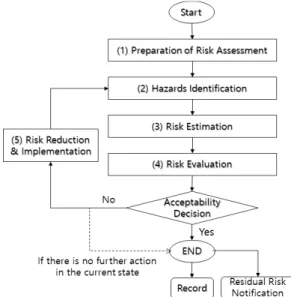
본 연구는 선행연구 탐색으로서 국내외 규제 분석과 관련 안전표준에 대해서 고찰하고자 한다. 해외 사례로 는 배송로봇 활용이 가장 활발한 미국의 규제내용을 분 석하였다. 서비스로봇 안전표준으로 제정된 ISO 13482 표준을 살펴봄으로써 배송로봇에 참고할 수 있는 안전요 구사항과 적용 부합성이 떨어지는 요구사항을 구분 분석 하였다. 고찰한 선행연구 내용을 토대로 ISO 12100에 의거한 위험성 평가(Risk Assessment)를 시행하였는데 Fig. 1은 표준이 요구하는 절차이다[12].
Fig. 1. Process of Risk Assessment
보다 배송로봇 특성에 부합한 안전 요구사항을 도출하 기 위해 RIA TR R15.306 표준을 접목하여 위험성 평가 모델을 설계하였다[13]. 위험성 평가 절차에 따라 평가팀 을 구성해 실시하였다. 위험성 평가팀은 로봇의 설계 및 특성을 검토하기 위한 로봇 전문가, ISO 12100 표준적 용을 위한 기계안전 전문가, ISO 13482 표준적용을 위 한 로봇안전 전문가, 로봇운용 알고리즘 및 통신 관련 전 문가로 구성하였다.
도출된 위험성 평가 결과를 바탕으로 배송로봇에 특화 된 새로운 안전 요구사항을 정리, 제시하였다.
2. 국내외 배송로봇 규제 현황
2.1 한국의 규제 현황국내에서 배송로봇 규제는 도로교통법과 자동차관리 법을 적용받고 있다. 배송로봇은 도로교통법을 적요할 경우 ‘차’에 해당되어 인도와 횡단보도에서 주행할 수 없 으며, 자동차관리법을 적용할 경우 자동차로 볼 수 없는 딜레마가 발생하고 있다. 따라서, 현 제도 하에서 배송로 봇은 관련 서비스를 제공할 수 없기 때문에 규제샌드박 스 제도에 따른 조건부 실증특례 형태로만 운영이 가능 한 상황이다. 국내 규제샌드박스 제도는 산업융합 촉진 법 등으로 운영되고 있으며, 이를 적용한 실증특례 2건 이 시범 운영 중이다.
실증특례를 위한 조건부 기술기준은 Table 1과 같다 [14]. 기술기준은 ‘제품에 대한 안전’, ‘주행에 대한 안 전’, ‘그 외 일반적인 안전 요구사항’으로 구성되어 있다.
제품 기준은 실외 기준이 아닌 실내 수준으로 안전성 검 증을 요구하고 있다. 주행조건으로는 명확한 실증코스 지정, 충분한 보도 폭 확보, 불량노면에 대한 노면 재포 장, 현장요원 운전자 지정 등이다. 그 외 일반사항으로 사고보고 및 책임보험 가입을 이행해야 한다.
Safety Requirements
Product ➀ Verification of standards for ensuring pedestrian safety (indoor safety test)
Driving
➀ Designate a clear demonstration course ➁ Ensuring sufficient sidewalk width
➂ Repaving the road surface for defective road surfaces and maintenance of areas with high sidewalk jaws
➃ Designation of field personnel driver General ➀ Report in case of safety accidents and
compensation for damages, etc.
➁ Liability insurance subscription
Table 1. Requirements for special demonstration of domestic regulatory sandbox system
2.2 미국의 규제 현황
미국은 Washington D.C 의회에서 2016년 3월 미국 내 최초로 배송로봇 시범운영을 조건부로 허용하였다 [15]. 이후 2017년 2월에 Virginia 의회가 배송로봇 관
련 법안을 제정하였다[16]. 이어서, 13개 주 및 특별구에 서 법안이 통과되었고, 6개 주에서 입법 진행하면서 배 송로봇 시장이 태동하기 시작했다.
미국의 배송로봇 관련 법을 국내의 제품, 주행, 일반 안전 사항 기준으로 정리한 내용은 Table 2와 같다. 제 품안전 기준은 주행속도, 제품 및 화물 허용중량, 승인된 야간등 및 반사경 장착, 사업주 정보 및 고유식별 번호 표기, 제동 시스템, 배터리 조건을 이행해야 한다. 주행 조건으로는 보행자 통행을 우선적으로 보장하고, 교통 신호를 준수해야 한다. 또한, 교차로나 횡단보도를 건너 는 경우 목적 외에 도로 진입이 금지한다. 위험 물질 등 을 운송하거나 범죄에 이용할 수 없도록 하고 있다. 일반 요구사항으로 책임보험 가입과 고유 식별 번호 등록을 이행해야 한다.
Safety Requirements
Product
➀ Travel speed
➁ Product allowable weight ➂ cargo allowable weight
➃ Equipped with approved night lights and reflectors
➄ Display owner's information and unique identification number information on the product
➅ Braking system
➆ The battery regulatory conditions must be fulfilled.
Driving
➀ Pedestrians' right to pass is guaranteed first for driving conditions.
➁ Observe all traffic control signals
➂ If you cross an intersection or crosswalk, you are prohibited from entering the road except for the purpose.
General
➀ No transport of hazardous materials and waste or use for crime
➁ Liability insurance subscription
➂ Registration of unique identification number Table 2. Requirements related to PDD in the US.
2.3 국제표준
배송로봇은 서비스 로봇으로 분류되며, 서비스 로봇 관련 국제표준은 ISO TC299, IEC TC61 기술위원회에 서 논의하고 있다. 배송로봇에 참조할 수 있는 ISO 국제 표준은 3종이 제정되었으며, IEC는 현재 개발 중이다.
배송로봇은 표준체계에 따라 기계류로 분류되며, ISO 12100 표준의 접근 방법으로 개발된 ISO 13482 표준을 참고할 수 있다. 또, 시험환경 구성 방법으로 참고할 수 있는 표준으로 ISO 18646-1, ISO 18646-2가 있다 [17,18].
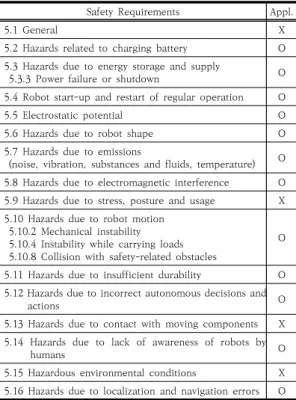
Table 3은 ISO 13482 국제표준의 안전 요구사항을 배송로봇 관점에서 적용가능 여부를 각 항목별로 분석한 결과이다. 동 표준 5장의 안전 요구사항 관련 16개 절 중 4개 절은 배송로봇과 연관성이 없었고, 12개 절은 일부 하위 절에서 참고가 가능하였다.
Safety Requirements Appl.
5.1 General X
5.2 Hazards related to charging battery O 5.3 Hazards due to energy storage and supply
5.3.3 Power failure or shutdown O
5.4 Robot start-up and restart of regular operation O
5.5 Electrostatic potential O
5.6 Hazards due to robot shape O
5.7 Hazards due to emissions
(noise, vibration, substances and fluids, temperature) O 5.8 Hazards due to electromagnetic interference O 5.9 Hazards due to stress, posture and usage X 5.10 Hazards due to robot motion
5.10.2 Mechanical instability 5.10.4 Instability while carrying loads 5.10.8 Collision with safety-related obstacles
O
5.11 Hazards due to insufficient durability O 5.12 Hazards due to incorrect autonomous decisions and
actions O
5.13 Hazards due to contact with moving components X 5.14 Hazards due to lack of awareness of robots by
humans O
5.15 Hazardous environmental conditions X 5.16 Hazards due to localization and navigation errors O Table 3. Applicability of the safety requirements
items of the ISO 13482 standard for delivery robot
3. 배송로봇 위험성 평가 실시
3.1 위험성 평가 모델 설계본 논문의 위험성 평가 모델은 안전 요구사항을 식별 하기 위한 사전 단계로 위험요인 파악, 위험성 추정, 위 험성 결정 과정을 거쳐 제품, 주행, 공통 안전 요구사항 으로 분류하는 모델로 Fig. 1과 같이 설계하였다. 이는 기계류 위험성 평가방법 관련 국제표준인 ISO 12100 틀 을 활용하고, 세부적인 위험성 추정 기준과 결정 방법은 미국표준 RIA TR R15.306을 연계해 참조해 모델의 유 효성과 재현성을 확보하였다.
Fig. 1. Risk assessment procedure model for delivery robot
첫째, 위험요인 파악(Hazard Identification)은 ISO 12100 표준에서 제시하는 방법에 따라 기계 전체 수명 주기 동안의 인적자용, 기계의 상태, 의도하지 않은 사용 자의 행동 및 오용을 고려하여 유형별, 상황별, 사건별로 평가하도록 하였다.
둘째, 위험성 추정(Risk Estimation) 기준은 로봇의 위험성 추정 방법으로 특화된 미국표준 RIA TR R15.306의 방법을 위험성 추정 관련 선행 연구들을 참 조하여 보완하였다[19,20]. Fig. 2는 위험성 추정 트리 모형으로 먼저 상해의 심각성 정도를 기준 정보에 따라 세단계로 추정하고, 다음으로 해당 위험의 노출 빈도 정 도를 세단계로 추정한다. 마지막으로, 해당 위험 회피 가 능성 정도를 세단계로 추정한다.
Fig. 2. The Identification Model of Safety-Requirements 셋째, 위험성 결정(Risk Evaluation) 기준은 RIA TR R15.306 표준 방법을 따랐다. 심각성, 노출정도, 회피 가능성을 순차적으로 평가한 결과에 따라 위험성의 수준
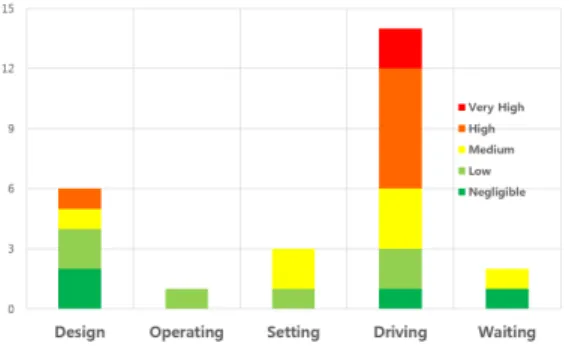
Fig. 3. the distribution of risk evaluation results 을 5단계(무시할 수준, 낮음, 중간, 높음, 매우높음)로 결 정할 수 있도록 구분했고, 이 중 ‘중간’, ‘높음’과 ‘매우 높음’은 안전 요구사항으로 선택하는 것으로 하였다.
마지막으로 위험성 결정으로 안전 요구사항으로 채택 된 사항은 위험요인이 가지는 특성에 따라 앞서 국내외 제도 사항에서 분석하였던 3가지 기준인 ‘제품 안전’,
‘주행 안전’, ‘일반 안전’ 요구사항으로 구분하였다. 세가 지 안전 요구사항으로 분류하는 상세 기준은 다음과 같 다. 먼저 제품 안전 요구사항은 제품 설계적인 측면이나, 제품 자체 검증이 필요한 경우이며, 주행 안전 요구사항 은 자동차 교통법규와 유사한 방식의 규제에 해당하는 경우이다. 일반 안전 요구사항은 사업자 및 사용자의 도 덕적 의무, 사회적 계도 등으로 안전을 확보할 수 있는 사항이다.
3.2 위험성 평가 결과
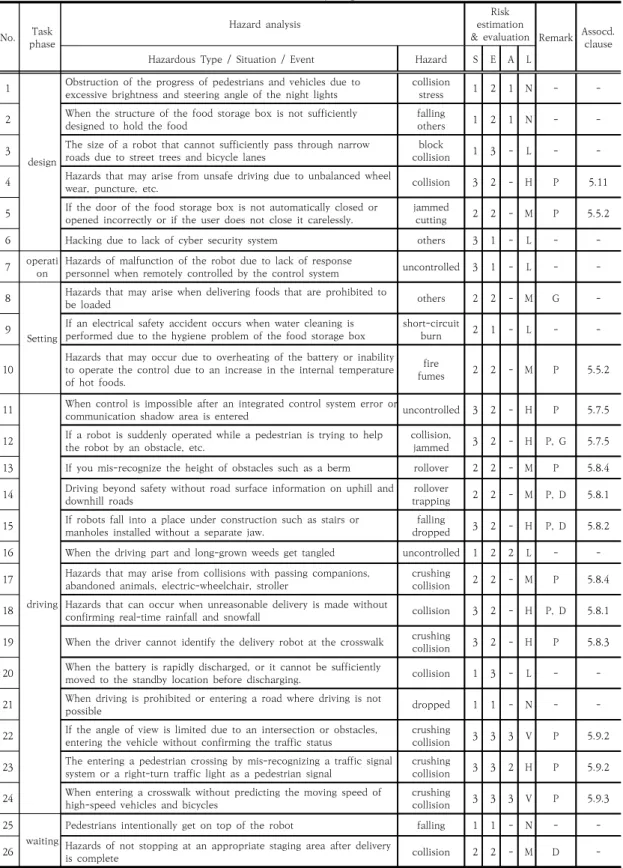
전문가 평가팀이 위험성 평가 모델에 따라 도출된 결 과는 Table 4와 같다. 위험요인 식별은 제품 수명 주기 중 ISO 12100에서 공통적으로 적용되는 부분을 제외하 고 실제 서비스 전주기를 고려하여 제품 설계(Design), 관리자의 운영(Operation), 서비스 이용 사업주가 배달 을 준비 작업(Setting), 배달을 위해 이동하는 작업 (Driving), 배달 후 대기하는 작업(Waiting)으로 구분하 였다. 각각의 단계에 따라 위험성 평가를 실한 결과 위험 요인은 총 26건이 식별되었다. 이 중 주행단계가 14건, 설계단계가 6건 순으로 많았고, 그 다음으로 준비(3건), 대기(2건), 운영(1건) 순이었다. 위험성 추정 및 결정을 실시한 결과, 매우높음(2건), 높음(7건), 중간(7건), 낮음 (6건), 무시할 수준(4건)으로 나타났다. 설계, 운영, 준비, 주행, 대기 단계별로 위험성 결정 결과 분포는 Fig. 3과 같다. 위험성 결정 기준에 따라 중간 이상의 위험요인이 16건으로, 이는 추가적인 안전 요구사항 마련이 필요한
사항으로 확인되었다. 이를 안전 요구사항의 분류로 살 펴보면 중복적 안전 요구사항으로 연결되는 항목을 모두 포함할 때, 제품안전(14건), 주행안전(4건), 일반안전(2 건)으로 나타났다.
4. 제품 안전 요구사항의 검토
4.1 유형별 검토안전 요구사항 식별 모델 활용을 Table 4에서 제품 안전 요구사항으로 분류된 14건을 유형별로 구조화 하였 다. Table 4에서 4번 위험요인과 관련하여 주행 및 진동 내구성, 타이어 소재 등에 대한 안전 요구사항이 필요한 것으로 판단되었다. 5번, 10번 위험요인은 음식물 보관 함 내부 구조설계 기준으로 추가적인 안전성 검증 기준 제시가 필요한 것으로 판단된다. 11번, 12번 위험요인은 오류 및 통신문제, 배터리 문제 상황에서 적절한 대처를 할 수 있는지에 대한 요구사항 추가가 필요한 것으로 사 료된다. 13번, 14번, 15번, 17번, 18번, 19번 위험요인 은 주행 환경과 관련되었다. 해당 내용은 실제 주행환경 을 모사한 시험환경을 구성하고 시험 데이터를 확보가 가능하도록 요구사항을 추가 개발할 필요가 있다. 22번, 23번, 24번은 자율주행 기술과 관련한 위험요인이다. 자 율주행 성능을 검증하기 위해 어린이, 노인, 등 피식별인 과, 자동차, 자전거, 휠체어, 유모차, 전동 킥보드 등의 피식별체를 시험환경을 구성하여 테스트해야 한다. 마지 막으로 실제 시험과 S/W 무결성 검증 등을 적용을 하는 내용이 포함된 안전 요구사항도 필요한 것으로 사료된다.
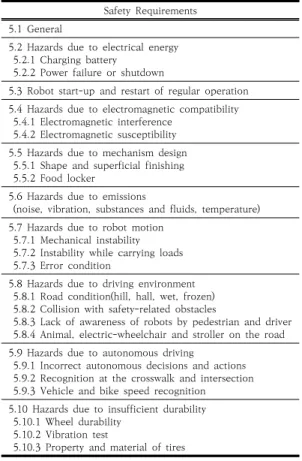
4.2 배송로봇 안전 요구사항의 표준화 제안 안전 요구사항 유형별로 구조화된 내용을 이를 ISO 13482 표준의 안전 요구사항을 준용하여 보완 제시한 결과는 Table 5와 같다. 5장의 제품안전 요구사항은 기 존 16개 절에서 10개 절로 정리하였다. 먼저, ISO 13482 표준에서 참고할 수 있는 항목은 유지했으며, 전 자파 적합성 관련 기존 5.5절, 5.8절은 5.4절로 통합하 였다. 5.5절은 기구설계 요구사항으로 기존 5.6절과 함 께 음식 보관함 관련 설계 요구사항을 추가해 정리하였 다. 5.7절은 오류 상황에서 로봇의 동작에 대해 검증이 필요한 5.7.3절을 추가하였다. 배송로봇 특성에 주안점 을 두고 로봇 주행 환경과 가까운 기존 5.10.8절은 5.8 절로 옮겼다. 이와 더불어 5.8절은 다양한 노면 조건 및
Table 4. The results of the identification model of safety-requirements No. Task
phase
Hazard analysis Risk
estimation
& evaluation Remark Assocd.clause
Hazardous Type / Situation / Event Hazard S E A L
1
design
Obstruction of the progress of pedestrians and vehicles due to
excessive brightness and steering angle of the night lights collision
stress 1 2 1 N - -
2 When the structure of the food storage box is not sufficiently
designed to hold the food falling
others 1 2 1 N - -
3 The size of a robot that cannot sufficiently pass through narrow
roads due to street trees and bicycle lanes block
collision 1 3 - L - -
4 Hazards that may arise from unsafe driving due to unbalanced wheel
wear, puncture, etc. collision 3 2 - H P 5.11
5 If the door of the food storage box is not automatically closed or
opened incorrectly or if the user does not close it carelessly. jammed
cutting 2 2 - M P 5.5.2
6 Hacking due to lack of cyber security system others 3 1 - L - -
7 operati
on Hazards of malfunction of the robot due to lack of response
personnel when remotely controlled by the control system uncontrolled 3 1 - L - - 8
Setting
Hazards that may arise when delivering foods that are prohibited to
be loaded others 2 2 - M G -
9 If an electrical safety accident occurs when water cleaning is
performed due to the hygiene problem of the food storage box short-circuit
burn 2 1 - L - -
10 Hazards that may occur due to overheating of the battery or inability to operate the control due to an increase in the internal temperature of hot foods.
fumesfire 2 2 - M P 5.5.2
11
driving
When control is impossible after an integrated control system error or
communication shadow area is entered uncontrolled 3 2 - H P 5.7.5
12 If a robot is suddenly operated while a pedestrian is trying to help
the robot by an obstacle, etc. collision,
jammed 3 2 - H P, G 5.7.5
13 If you mis-recognize the height of obstacles such as a berm rollover 2 2 - M P 5.8.4 14 Driving beyond safety without road surface information on uphill and
downhill roads rollover
trapping 2 2 - M P, D 5.8.1
15 If robots fall into a place under construction such as stairs or
manholes installed without a separate jaw. falling
dropped 3 2 - H P, D 5.8.2
16 When the driving part and long-grown weeds get tangled uncontrolled 1 2 2 L - - 17 Hazards that may arise from collisions with passing companions,
abandoned animals, electric-wheelchair, stroller crushing
collision 2 2 - M P 5.8.4
18 Hazards that can occur when unreasonable delivery is made without
confirming real-time rainfall and snowfall collision 3 2 - H P, D 5.8.1
19 When the driver cannot identify the delivery robot at the crosswalk crushing
collision 3 2 - H P 5.8.3
20 When the battery is rapidly discharged, or it cannot be sufficiently
moved to the standby location before discharging. collision 1 3 - L - -
21 When driving is prohibited or entering a road where driving is not
possible dropped 1 1 - N - -
22 If the angle of view is limited due to an intersection or obstacles,
entering the vehicle without confirming the traffic status crushing
collision 3 3 3 V P 5.9.2
23 The entering a pedestrian crossing by mis-recognizing a traffic signal
system or a right-turn traffic light as a pedestrian signal crushing
collision 3 3 2 H P 5.9.2
24 When entering a crosswalk without predicting the moving speed of
high-speed vehicles and bicycles crushing
collision 3 3 3 V P 5.9.3
25 waiting
Pedestrians intentionally get on top of the robot falling 1 1 - N - -
26 Hazards of not stopping at an appropriate staging area after delivery
is complete collision 2 2 - M D -
환경, 장애물, 보행자 등을 반영하였다. 배송로봇의 자율 주행 관련 5.9절은 기존 5.16절을 보다 구체화 시켜 횡 단보도나 교차로에서 영상 인식 수준이나 동적 장애물 인식 수준을 평가하는 요구사항을 반영하였다. 5.11절은 내구성에 대한 요구사항을 세부적으로 나눠 제시하였다.
Safety Requirements 5.1 General
5.2 Hazards due to electrical energy 5.2.1 Charging battery
5.2.2 Power failure or shutdown
5.3 Robot start-up and restart of regular operation 5.4 Hazards due to electromagnetic compatibility 5.4.1 Electromagnetic interference
5.4.2 Electromagnetic susceptibility 5.5 Hazards due to mechanism design 5.5.1 Shape and superficial finishing 5.5.2 Food locker
5.6 Hazards due to emissions
(noise, vibration, substances and fluids, temperature) 5.7 Hazards due to robot motion
5.7.1 Mechanical instability 5.7.2 Instability while carrying loads 5.7.3 Error condition
5.8 Hazards due to driving environment 5.8.1 Road condition(hill, hall, wet, frozen) 5.8.2 Collision with safety-related obstacles
5.8.3 Lack of awareness of robots by pedestrian and driver 5.8.4 Animal, electric-wheelchair and stroller on the road 5.9 Hazards due to autonomous driving
5.9.1 Incorrect autonomous decisions and actions 5.9.2 Recognition at the crosswalk and intersection 5.9.3 Vehicle and bike speed recognition 5.10 Hazards due to insufficient durability 5.10.1 Wheel durability
5.10.2 Vibration test
5.10.3 Property and material of tires
Table 5. Product safety requirements for delivery robot
5. 결론
본 연구는 배송로봇에 적합한 위험성 평가 모델을 설 계하고 배송로봇 서비스 전주기에 따라 위험성 평가를 실시하여 위험요인을 식별했다. 식별된 위험요인을 위험 성 결정 과정을 거쳐 안전 요구사항이 필요한 항목으로 정리하였다. ISO 13482 5장의 제품안전 요구사항을 기 존 16개 절에서 10개 절로 요약 정리할 수 있었다. 본 연구의 주요 결론은 아래와 같다.
(1) 배송로봇의 제품 안전 요구사항을 분석한 결과 크 게는 로봇동작, 주행환경, 자율주행기술, 내구성을
중심으로 세밀한 평가가 필요한 것으로 확인되었 다. 평가방법과 검증기준을 추가적으로 연구할 필 요가 있다.
(2) 배송로봇 서비스 전주기를 고려하여 위험요인을 식별한 결과 총 26건이 식별되었고, 이 중 주행단 계 관련이 14건, 설계단계 관련이 6건이었다. 위 험성 결정 기준에 따라 “중간” 이상의 위험요인이 16건으로, 중복된 경우를 포함하여 안전 요구항 목으로 분류하면 제품안전 관련 14건, 주행안전 관련 4건을 확인할 수 있었다.
(3) 위험성 결정 기준에 따라 중간 이상의 위험요인 중 일부 항목이 중복인 것으로 확인되었다. 이는 제품 안전 요구사항 검증만으로는 안전성 확보가 제한 될 수 있음을 의미하며, 교통 법규나 사회적 책임 과 의무 차원으로 관리해야할 것으로 판단된다.
(4) 본 연구에서 위험성 결정 결과 위험수준이 낮음으 로 평가된 위험요인도 제품의 기계적 한계 수준에 따라 위험성 결정 결과가 상이할 수 있어 참고는 필요할 것으로 판단된다.
References
[1] M&M, Delivery Robots Market worth $957 million by 2026, M&M, 2021.
[2] Starship technologies, Autonomous robots for industry 4.0, Starship technologies, Available From:
https://www.starship.xyz/kit/ (accessed Sep. 2, 2021) [3] "2021 Robot Industry Preemptive Regulatory
Innovation Roadmap", Ministry of Trade Industry Energy, Korea, 2020
[4] BBC, Kiwibot delivery robot catches fire after 'human error', BBC, 2018, Available From:
https://www.bbc.com/news/technology-46593190 (accessed Sep. 2, 2021)
[5] BBC, Milton Keynes delivery robot takes plunge into canal, BBC, 2020, Available From:
https://www.bbc.com/news/uk-england-beds-bucks- herts-53678376 (accessed Sep. 2, 2021)
[6] Freightwaves, Socializing the autonomous robot , Freightwaves, 2019, Available From:
https://www.freightwaves.com/news/socializing-the-a utonomous-robot (accessed Sep. 2, 2021)
[7] ISO 13482 : Robots and robotic devices — Safety requirements for personal care robots, 1st edition, ISO, 2014.
[8] S. Choi, “Logistics and Delivery Robots in the 4th
Industrial Revolution”, Electronics and Telecommunications Trends, Vol. 34, No. 4, pp.98-107, 2019.
DOI: https://doi.org/10.22648/ETRI.2019.J.340410 [9] D. Simoni, E. Kutanoglu, G. Claudel, “Optimization
and analysis of a robot assisted last mile delivery system”, Transportation Research, Vol. 142, No.
102049, pp.1-18 2020.
DOI: https://doi.org/10.1016/j.tre.2020.102049 [10] D. Jennings, M. Figliozzi, “Study of Sidewalk
Autonomous Delivery Robots and Their Potential Impacts on Freight Efficiency and Travel”, Transportation Research Record, Vol. 2673, No. 6 pp.317-326, 2019.
DOI: https://doi.org/10.1177/0361198119849398 [11] T. Hoffmann, G. Prause, “On the Regulatory
Framework for Last Mile delivvery robots”, Machines, Vol. 6, No. 33, pp.1-16, 2018.
DOI: https://doi.org/10.3390/machines6030033 [12] RIA TR R15.306, Task-Based Risk Assessment
Methodology, Robotic Industries Association, 2016 [13] ISO 12100 : Safety of machinery - General principles
for design - Risk assessment and risk reduction, 1st edition, ISO, 2010
[14] MOTIE Notice 2019-711, Notification of approval of special regulatory exceptions for ‘industrial convergence regulatory sandbox’, MOTIE, 2019 [15] Publication chapter 15C. Personal delivery device
pilot program, 2016, Council of the District of Columbia, Available From:
https://code.dccouncil.us/dc/council/code/sections/5 0-1552.html (accessed Sep. 2, 2021)
[16] Publication 46.2-908.1. Electric personal assistive mobility devices, electrically powered toy vehicles, electric power-assisted bicycles, and motorized skateboards or scooters, 2017, virginia general assembly, Available From:
https://law.lis.virginia.gov/vacode/title46.2/chapter8/
section46.2-908.1/ (accessed Sep. 2, 2021)
[17] ISO 18646-1 : Robotics - Performance criteria and related test methods for service robots - Part 1:
Locomotion for wheeled robots, 1st edition, ISO, 2016.
[18] ISO 18646-2 : Robotics - Performance criteria and related test methods for service robots - Part 2:
Navigation, 1st edition, ISO, 2019.
[19] Nicholas J. Bahr, System safety engineering and risk assessment : a practical approach 2nd, p.436, Taylor
& Francis Group, 2014, pp.353-359.
[20] G. Cho, “Improvement for the Safety on the Automobile -Parts Assembly Process using Collaborative Robot through Risk Assessment”, Journal of the Korea Academia-Industrial cooperation Society, Vol. 21, No.
8, pp.342-347, 2020.
DOI: https://doi.org/10.5762/KAIS.2020.21.8.342
류 요 엘(Joel Ryu) [정회원]
• 2013년 2월 ~ 현재 : 한국로봇산 업진흥원 책임연구원
• 2020년 3월 ~ 현재 : 숭실대학교 대학원 안전보건융합공학과 (박사 과정)
<관심분야>
로봇안전, 산업안전, 위험성평가, 안전보건경영시스템
백 남 정(Nam-Jeong Baeck) [정회원]
• 2018년 2월 : 숭실대학교 대학원 기업재난관리학과(경영학석사)
• 2020년 4월 ~ 현재 : 테크파이 대 표이사
• 2020년 9월 ~ 현재 : 대한의료데 이터협회 상임이사
• 2021년 6월 ~ 현재 : 가상자산거 래소 비블록 AML보고책임자
<관심분야>
사이버보안, 정보보호, 자금세탁방지
전 진 우(Jin-Woo Jun) [정회원]
• 2020년 2월 : 숭실대학교 대학원 안전보건융합공학과 (공학박사)
• 2001년 4월 ~ 2009년 8월 : 산업 기술연구회(NST) 평가팀장
• 2010년 7월 ~ 현재 : 한국로봇산 업진흥원 정책기획실장
• 2021년 3월 ~ 현재 : 숭실대학교 안전융합대학원 겸임교수
<관심분야>
기술정책, 위험성평가, 로봇안전, 로봇표준
조 규 선(Guy-Sun Cho) [정회원]
• 2020년 8월 : 숭실대학교 대학원 안전보건융합공학과 (공학박사)
• 1992년 1월 ~ 2018년 2월 : 한국 산업안전보건공단 부장
• 2018년 3월 ~ 현재 : 호서대학교 안전행정공학과 교수
<관심분야>
공정안전, 안전보건경영시스템, 로봇안전, 위험성평가