https://doi.org/10.4174/astr.2018.95.6.319 Annals of Surgical Treatment and Research
Single-incision laparoscopic ileostomy is a safe and feasible method of fecal diversion for anastomotic leakage following laparoscopic low anterior resection
Duk Yeon Hwang1, Gyeo Ra Lee1, Ji Hoon Kim1, Yoon Suk Lee2
1Department of Surgery, Incheon St. Mary’s Hospital, College of Medicine, The Catholic University of Korea, Incheon, Korea
2Department of Surgery, Seoul St. Mary’s Hospital, College of Medicine, The Catholic University of Korea, Seoul, Korea
INTRODUCTION
Surgical techniques are continuously being advanced to improve long-term and short-term surgical outcomes and to improve patients’ quality of life. One such advance is the introduction of minimally invasive surgery. These refer to surgical techniques that have the same effects as conventional surgical techniques but with minimal harm on the patients.
Laparoscopic surgeries are one of the typical minimally invasive surgeries. Since the first report of laparoscopic ileostomy by Khoo et al. [1], laparoscopy has become popular among surgeons for many types of enterostomies. Compared to the conventional enterostomy, laparoscopic enterostomy is associated with lower postoperative pain, shorter hospital stay, and faster recovery of intestinal functions [2,3].
Recently, single-incision laparoscopy has been used
Received February 2, 2018, Revised June 9, 2018, Accepted June 12, 2018
Corresponding Author: Yoon Suk Lee
Department of Surgery, Seoul St. Mary’s Hospital, College of Medicine, The Catholic University of Korea, 222 Banpo-daero, Seocho-gu, Seoul 06591, Korea
Tel: +82-2-2258-6095, Fax: +82-2-595-2282 E-mail: [email protected]
ORCID code: https://orcid.org/0000-0002-1849-2774
Copyright ⓒ 2018, the Korean Surgical Society
cc Annals of Surgical Treatment and Research is an Open Access Journal. All articles are distributed under the terms of the Creative Commons Attribution Non- Commercial License (http://creativecommons.org/licenses/by-nc/4.0/) which permits unrestricted non-commercial use, distribution, and reproduction in any medium, provided the original work is properly cited.
Purpose: Currently, many operations are performed using the single-incision laparoscopic method. Although there have been recent reports on single-incision laparoscopic ileostomy, none have compared this method to conventional laparoscopic ileostomy. This study aimed to assess the safety and feasibility of single-incision laparoscopic ileostomy for anastomotic leakage following laparoscopic low anterior resections.
Methods: From April 2012 to April 2017, 38 patients underwent laparoscopic ileostomy (single-incision; 19 patients referred to as group A, conventional laparoscopy; 19 patients referred to as group B) for anastomotic leakage following laparoscopic low anterior resection. We analyzed surgical and clinical outcomes between the 2 groups. Patients in whom a protective ileostomy was carried out during the initial laparoscopic low anterior resection were excluded from this study.
Results: No significant differences were observed between the 2 groups in terms of patient demographics and initial operation details. Incisional surgical site infections occurred less in group A than in group B (2 of 19 vs. 9 of 19, P = 0.029).
The median ileostomy operation time, amount of intraoperative bleeding, parastomal hernia ratio, hospital stay duration after ileostomy, postoperative pain score were not significantly different between the 2 groups.
Conclusion: Single-incision laparoscopic ileostomy is safe and feasible method of fecal diversion for anastomotic leakage following laparoscopic low anterior resection.
[Ann Surg Treat Res 2018;95(6):319-323]
Key Words: Ileostomy, Laparoscopy, Anastomotic leak, Minimally invasive surgical procedures
for several types of abdominal surgeries. Single-incision laparoscopy involves fewer incisions than conventional laparoscopic surgeries, yielding aesthetically superior outcomes as well as benefits of less postoperative pain, lower bleeding, less risk for surgical site infection (SSI), and lower incidence of incisional hernia [4-6]. Although there have been several reports of nonscarring single-incision laparoscopic enterostomy [7,8], none of the previous studies compared it with the conventional laparoscopic enterostomy. In this study, we compared and analyzed single-incision laparoscopic loop ileostomy and conventional laparoscopic loop ileostomy in patients who had developed anastomotic leakage after undergoing laparoscopic low anterior resection.
METHODS
Study design
From April 2012 to April 2017, 38 patients underwent laparoscopic ileostomy (single incision; 19 patients referred to as group A, conventional laparoscopy; 19 patients referred to as group B) for anastomotic leakage following laparoscopic low anterior resection at Incheon St. Mary’s Hospital, The Catholic University of Korea. All patients in whom a protective ileostomy was carried out during the initial laparoscopic low anterior resection were excluded from this investigation. Anastomotic leakage was diagnosed based on clinical symptoms such as high fever and abdominal pain, physical examination findings such as an abnormal digital rectal examination result and peritonitis, fecal leakage to the drainage tube, and abdominal computed tomography. Only patients with anastomotic leakage requiring surgery were defined as patients with anastomotic leakage.
This study was approved by the Institutional Review Board of Incheon St. Mary’s hospital (OC17RESI0107), which also waived the requirement for informed consent due to the retrospective nature of the study. In addition, our study was conducted in accordance with the Helsinki Declaration.
Surgical technique
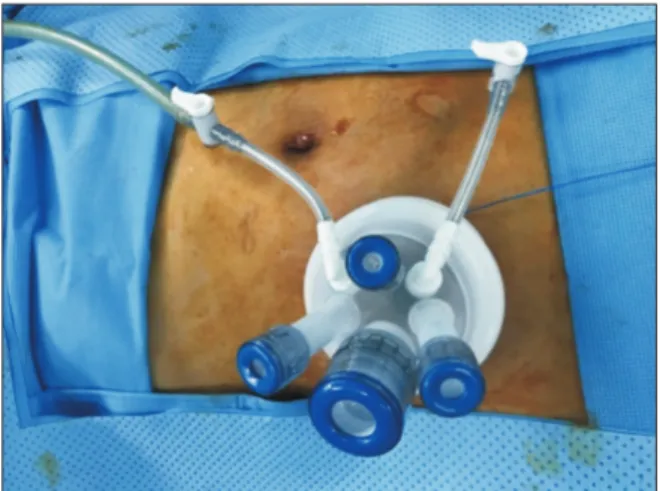
Single-incision laparoscopic loop ileostomy is performed under general anesthesia with the patients in the supine position. The stoma site was preoperatively marked by the ostomy care nurses. A circumlunar incision was made at the ileostomy site and was extended down to the anterior rectus sheath, which was divided in cruciate fashion. The rectus abdominis muscle fibers were then reflected laterally, and the posterior sheath was incised, allowing entry to the peritoneal cavity. This stoma site was then used as a point of laparoscopic access, a single-incision laparoscopic port (Lap single, Sejong Medical, Paju, Korea) was introduced, and pneumoperitoneum was established (Fig. 1). Conventional laparoscopic loop ileostomy was made by a 3-port technique. A 12-mm camera
port was placed in the transumbilical site. The 12-mm operative port was placed in the previously selected right-lower-quadrant stoma site and a 5-mm cannula was placed in the suprapubic midline. The cecum was identified, and the ileum was followed by use of a Babcock clamp through the right-lower-quadrant 12- mm ports and a bowel grasper in the 5-mm midline port. After a proper site of the distal ileum was selected that would reach the abdominal wall without tension, the 12-mm cannula was removed. The defect in the anterior rectus sheath created by the 12-mm trocar was extended in a cruciate fashion. Similar to the method described for single-incision laparoscopic ileostomy, entry to the peritoneal cavity was established, and selected ileum was cautiously brought to the abdominal wall.
The abdomen was insufflated again, and proximal and distal portions were verified according to anatomic orientation. The remaining cannulas were all removed, and the port sites closed.
Leakage management
All patients in this study received massive laparoscopic saline irrigation to help prevent sepsis and abscess formation.
Furthermore, in some patients who showed evidence of macroscopic anastomotic dehiscence on laparoscopic exploration, transanal suturing was attempted to repair the defect.
Parastomal hernia
We reviewed the ileostomy repair operation notes to assess whether parastomal hernias were present or not. For patients who did not have an ileostomy repair, outpatient clinic charts were reviewed to assess if parastomal hernia had existed.
Incisional SSI
The presence of superficial and deep incisional SSI was investigated. Signs and symptoms associated with the incisional
Fig. 1. A photograph showing a singleincision laparoscopic ileostomy.
SSI included redness, swelling, warmth, fever, pain, and pus formation.
Statistical analyses
The data were analyzed using IBM SPSS Statistics ver.
19.0 (IBM Co., Armonk, NY, USA). Continuous variables, such as age and tumor location were presented as mean ± standard deviation, and operation time was presented as the median number of minutes with the range included for each operation. Categorical variables, such as sex, parastomal hernia development, and SSI ratios were expressed as frequencies.
A Student t-test was used to compare continuous variables, whereas categorical variables were compared using the Fisher exact test, as appropriate. A P-value of ≤0.05 was considered significant.
RESULTS
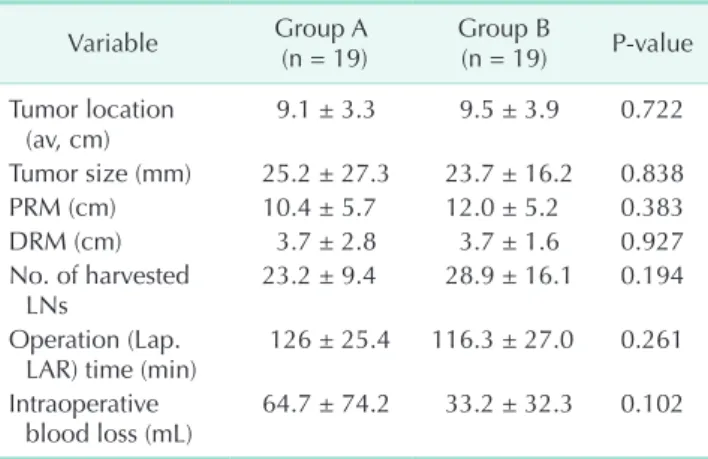
The demographic features of groups A and B are shown in Table 1. No significant differences were observed between the 2 groups in terms of patient age, sex, body mass index, and American Society of Anesthesiologists physical status classification. Moreover, no significant differences were observed between 2 groups regarding the initial operation details (Table 2). Operative and clinical outcomes of both ileostomy procedure types are shown in Table 3. The incisional SSI occurred less in group A than in group B (2 of 19 vs. 9 of 19, P = 0.029). Median ileostomy operation time, intraoperative bleeding, and postoperative discharge day were not significantly different between the 2 groups. Parastomal hernias occurred in 4 patients from group A and 5 patients from group B. The postoperative pain score was similar between the 2 groups.
DISCUSSION
Remarkable advances have been made in the field of rectal cancer surgery over the past several decades. With increased understanding of mesenteric spread of rectal cancer and the
establishment of total mesorectal excision as the standard surgical technique for midlower rectal cancer, local relapse has substantially been reduced. Further, the reduced autonomic nerve injury within the pelvic cavity has maximized the preservation of urinary and sexual functions after surgery [9-11].
In addition, advances in surgical techniques and instruments, such as stapler instruments, have increased the proportion of cases in which the anal sphincter is preserved. Nevertheless, complications and mortality after rectal cancer surgery continue to remain as important problems [12]. In particular, anastomotic leakage is the most dangerous and serious complication that occurs in approximately 3%–21% of patients undergoing rectal surgery. It is an important determinant of postoperative mortality, has grave effects such as increasing local relapse and lowering survival rates, and has detrimental effects on long-
Table 1. Patient demographics
Variable Group A
(n = 19) Group B
(n = 19) Pvalue
Age (yr) 62.8 ± 13.6 55.7 ± 9.1 0.095
Sex, male:female 16:3 16:3 >0.999
Body mass index (kg/m2) 23.3 ± 3.9 22.9 ± 2.2 0.689
ASA PS classification >0.999
I–II 18 18
III 1 1
Values are presented as mean ± standard deviation or number.
Group A, singleincision; group B, conventional laparoscopy;
ASA PS, American Society of Anesthesiologists physical status.
Table 2. Initial operation details
Variable Group A
(n = 19) Group B
(n = 19) Pvalue Tumor location
(av, cm) 9.1 ± 3.3 9.5 ± 3.9 0.722
Tumor size (mm) 25.2 ± 27.3 23.7 ± 16.2 0.838
PRM (cm) 10.4 ± 5.7 12.0 ± 5.2 0.383
DRM (cm) 3.7 ± 2.8 3.7 ± 1.6 0.927
No. of harvested
LNs 23.2 ± 9.4 28.9 ± 16.1 0.194
Operation (Lap.
LAR) time (min) 126 ± 25.4 116.3 ± 27.0 0.261 Intraoperative
blood loss (mL) 64.7 ± 74.2 33.2 ± 32.3 0.102 Values are presented as mean ± standard deviation.
Group A, singleincision; group B, conventional laparoscopy;
PRM, proximal resection margin; DRM, distal resection margin;
LN, lymph node; Lap. LAR, laparoscopic low anterior resection.
Table 3. Operative and clinical outcomes of ileostomies
Variable Group A
(n = 19) Group B
(n = 19) Pvalue Operation time (min) 65 (20–85) 70 (25–160) 0.163 Intraoperative
bleeding (mL) 52.9 ± 39.8 96.8 ± 105.9 0.104 Postoperative pain
score (POD#1, NRS) 2.7 ± 0.5 2.7 ± 0.7 0.959 Parastomal hernia
(ratio) 4/19 (21.0) 5/19 (26.3) >0.999 Hospital stay after
ileostomy 12.7 ± 7.7 12.0 ± 6.0 0.762
Incisional SSI (ratio) 2/19 (10.5) 9/19 (47.3) 0.029 Values are presented as median (range), mean ± standard deviation, or number (%).
Group A, singleincision; group B, conventional laparoscopy;
POD, postoperative day; NRS, numeric rating scale; SSI, surgical site infection.
term prognosis in patients with rectal cancer [13-16].
Rahbari et al. [17] classified anastomotic leakage into grades A, B, and C according to clinical manifestations and reported that protective ileostomy is essential to provide fecal diversion when anastomotic leakage occurs. In particular, for patients with anastomotic leakage who have severe sepsis peritonitis symptoms, or whose abdominal CT reveals wide dispersion of leakage, immediate intra-abdominal irrigation and aggressive surgical treatment such as ileostomy are the standard treatments [18,19].
In this study, rate of incisional SSI was less in the single incision laparoscopic ileostomy group than in the conventional laparoscopic ileostomy group. The patients who had anastomotic leakage are more susceptible to SSI. We think that using single port, or reducing number of port incision could reduce the SSI.
We recognize that our study is limited by its retrospective study design and small sample size of 38 patients with short-
term follow up at a single institution. Therefore, additional studies in multiple centers with long-term follow-up are required to fully evaluate the safety and feasibility of single- incision laparoscopic ileostomies.
In conclusion, we showed how a single-incision laparoscopic ileostomy can be implemented as a safe and feasible technique following leakage from laparoscopic low anterior resection.
Moreover, the procedure can be applied to many other bypass surgical interventions such as those used for cancer obstruction, intestinal perforation and fistulas. In particular, for patients who are at risk for morbidity and mortality, a single-incision laparoscopic ileostomy can offer many advantages as it is a minimally invasive surgical technique [20-22].
CONFLICTS OF INTEREST
No potential conflict of interest relevant to this article was reported.
REFERENCES
1. Khoo RE, Montrey J, Cohen MM. Laparo- scopic loop ileostomy for tem porary fecal diversion. Dis Colon Rectum 1993;36:966- 8.
2. Hollyoak MA, Lumley J, Stitz RW. Lapa- ro scopic stoma formation for faecal diversion. Br J Surg 1998;85:226-8.
3. Young CJ, Eyers AA, Solomon MJ. De- functioning of the anorectum: histor ical controlled study of laparoscopic vs. open procedures. Dis Colon Rectum 1998;41:
190-4.
4. Ahmed K, Wang TT, Patel VM, Nagpal K, Clark J, Ali M, et al. The role of single- incision laparoscopic surgery in abdom- inal and pelvic surgery: a syste matic review. Surg Endosc 2011;25:378-96.
5. Lim SW, Kim HR, Kim YJ. Single incision laparoscopic colectomy for colorectal cancer: comparison with conventional lapa ro scopic colectomy. Ann Surg Treat Res 2014;87:131-8.
6. Waters JA, Guzman MJ, Fajardo AD, Selzer DJ, Wiebke EA, Robb BW, et al. Single-port laparoscopic right hemicolectomy: a safe alternative to conventional laparoscopy.
Dis Colon Rectum 2010;53:1467-72.
7. Zaghiyan KN, Murrell Z, Fleshner PR.
Scarless single-incision laparoscopic loop ileostomy: a novel technique. Dis Colon Rectum 2011;54:1542-6.
8. Nguyen HM, Causey MW, Steele SR, Maykel JA. Single-port laparoscopic divert- ing sigmoid colostomy. Dis Colon Rectum 2011;54:1585-8.
9. Heald RJ, Husband EM, Ryall RD. The mesorectum in rectal cancer surgery--the clue to pelvic recurrence? Br J Surg 1982;
69:613-6.
10. Quirke P, Durdey P, Dixon MF, Williams NS. Local recurrence of rectal adeno- carcinoma due to inadequate sur gical resection. Histopathological study of lateral tumour spread and surgical ex- cision. Lancet 1986;2:996-9.
11. Wibe A, Eriksen MT, Syse A, Myrvold HE, Soreide O; Norwegian Rectal Cancer Group. Total mesorectal excision for rectal cancer--what can be achieved by a national audit? Colorectal Dis 2003;5:471- 7.
12. Bokey EL, Chapuis PH, Hughes WJ, Koorey SG, Hinder JM, Edwards R. Morbidity, mortality and survival following resection
for carcinoma of the rectum at Concord Hospital. Aust N Z J Surg 1990;60:253-9.
13. Karanjia ND, Corder AP, Bearn P, Heald RJ. Leakage from stapled low anastomosis after total mesorectal excision for carci- noma of the rectum. Br J Surg 1994;81:
1224-6.
14. Nesbakken A, Nygaard K, Lunde OC.
Outcome and late functional results after anastomotic leakage following mesorectal excision for rectal cancer. Br J Surg 2001;
88:400-4.
15. Memon AA, Marks CG. Stapled anasto- moses in colorectal surgery: a pro spective study. Eur J Surg 1996;162:805-10.
16. Matthiessen P, Hallbook O, Andersson M, Rutegard J, Sjodahl R. Risk factors for anastomotic leakage after anterior resection of the rectum. Colorectal Dis 2004;6:462-9.
17. Rahbari NN, Weitz J, Hohenberger W, Heald RJ, Moran B, Ulrich A, et al. Defin- ition and grading of anastomotic leakage following anterior resection of the rectum: a proposal by the International Study Group of Rectal Cancer. Surgery 2010;147:339-51.
18. Hyman NH. Managing anastomotic leaks from intestinal anastomoses. Surgeon 2009;7:31-5.
19. Zhu QL, Feng B, Lu AG, Wang ML, Hu WG, Li JW, et al. Laparoscopic low anterior resection for rectal carcinoma:
complications and management in 132 consecutive patients. World J Gastro-
enterol 2010;16:4605-10.
20. Williams JZ, Barbul A. Nutrition and wound healing. Surg Clin North Am 2003;
83:571-96.
21. Troppmann C, Pierce JL, Gandhi MM, Gallay BJ, McVicar JP, Perez RV. Higher surgical wound complication rates with sirolimus immunosuppression after kid-
ney transplantation: a matched-pair pilot study. Transplantation 2003;76:426-9.
22. Scappaticci FA, Fehrenbacher L, Cart- wright T, Hainsworth JD, Heim W, Berlin J, et al. Surgical wound healing com pli- cations in metastatic colorectal can cer patients treated with bevacizumab. J Surg Oncol 2005;91:173-80.