Received July 30, 2014, Revised May 20, 2015, Accepted for publication May 26, 2015
Corresponding author: Kwang Hoon Lee, Department of Dermatology and Cutaneous Biology Research Institute, Yonsei University College of Medicine, 50-1 Yonsei-ro, Seodaemun-gu, Seoul 03722, Korea. Tel:
82-2-2228-2080, Fax: 82-2-393-9157, E-mail: [email protected] This is an Open Access article distributed under the terms of the Creative Commons Attribution Non-Commercial License (http://creativecommons.
org/licenses/by-nc/4.0) which permits unrestricted non-commercial use, distribution, and reproduction in any medium, provided the original work is properly cited.
Copyright © The Korean Dermatological Association and The Korean Society for Investigative Dermatology
Ann Dermatol Vol. 28, No. 2, 2016 http://dx.doi.org/10.5021/ad.2016.28.2.159
ORIGINAL ARTICLE
Clinical Efficacy and Safety of Naltrexone Combination Therapy in Older Patients with Severe Pruritus
Jungsoo Lee, Jung U Shin, Seongmin Noh, Chang Ook Park, Kwang Hoon Lee
Department of Dermatology and Cutaneous Biology Research Institute, Yonsei University College of Medicine, Seoul, Korea
Background: Severe pruritus is a challenging condition, and it is more difficult to deal with in older patients due to their limitations in taking oral medication because of underlying diseases, possible interaction with concurrent medications, and poor general condition. Objective: We evaluated the ef- ficacy and safety of naltrexone (ReviaⓇ), an opioid antago- nist, in elderly patients with severe pruritus that was not easi- ly controlled with conventional antipruritics. Methods:
Eighteen patients were enrolled, with a mean age of 73 years.
They additionally received 50 mg of naltrexone per day for an average of 2 months. Results: Using the visual analogue scale, 13 (72.2%) of 18 patients showed a “much improved”
condition, reporting more than a 50% decrease in pruritus intensity. Sixteen (88.9%) showed symptomatic improve- ment, and only 2 (11.1%) had persistent pruritus. Five pa- tients reported side effects including insomnia, fatigue, con- stipation, and anorexia. However, reactions were either lim- ited to the first 2 weeks or well managed. Conclusion:
Naltrexone could be an effective and safe alternative treat- ment option to control severe pruritus in older patients. (Ann Dermatol 28(2) 159∼163, 2016)
-Keywords-
Elderly, Naltrexone, Pruritus
INTRODUCTION
Pruritus is a challenging symptom associated with various skin disorders. The consequent loss of sleep, physical dis- figurement and skin lesions can even result in impairment of health-related quality of life. Skin senescence associated with skin dryness during old age causes long-term pruritus.
Severe pruritus remains a difficult condition to control de- spite development in many treatment modalities. In addi- tion, older patients have many limitations in using oral medication due to their underlying diseases and the possi- ble interactions with the medications that they are already taking.
One of the main mediators that produce the itching sensa- tion is histamine, which is induced by many other media- tors, thus increasing histamine-induced pruritus. However, often, an antihistamine agent cannot effectively suppress all types of pruritus because some neuropeptides, pro- teases, and cytokines induce pruritus through a hista- mine-independent pathway.
The role of opiate receptors in the perception of pruritus is emphasized by the observation that opiate antagonists suppress pruritus of a different origin by modifying the neuronal sensation of itching1.
This study was designed to evaluate the efficacy and safety of naltrexone in the treatment of severe pruritus resistant to antihistamine agents in older patients.
MATERIALS AND METHODS
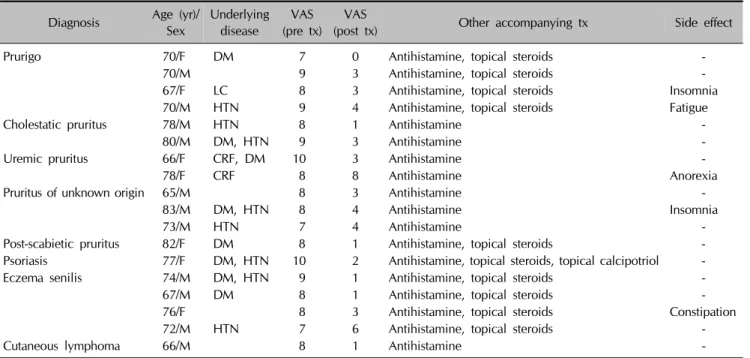
Sixteen patients with antihistamine-resistant severe pruritus were enrolled (Table 1) in this observational study.
Informed consent was obtained from all patients, and the protocols were approved by the institutional review board (IRB No. 4-2011-0423). To study the safety and efficacy in older people, only patients 65 years and older with severe
Table 1. Characteristics of patients who received naltrexone combination therapy for 2 months
Diagnosis Age (yr)/
Sex
Underlying disease
VAS (pre tx)
VAS
(post tx) Other accompanying tx Side effect
Prurigo 70/F DM 7 0 Antihistamine, topical steroids -
70/M 9 3 Antihistamine, topical steroids -
67/F LC 8 3 Antihistamine, topical steroids Insomnia
70/M HTN 9 4 Antihistamine, topical steroids Fatigue
Cholestatic pruritus 78/M HTN 8 1 Antihistamine -
80/M DM, HTN 9 3 Antihistamine -
Uremic pruritus 66/F CRF, DM 10 3 Antihistamine -
78/F CRF 8 8 Antihistamine Anorexia
Pruritus of unknown origin 65/M 8 3 Antihistamine -
83/M DM, HTN 8 4 Antihistamine Insomnia
73/M HTN 7 4 Antihistamine -
Post-scabietic pruritus 82/F DM 8 1 Antihistamine, topical steroids -
Psoriasis 77/F DM, HTN 10 2 Antihistamine, topical steroids, topical calcipotriol -
Eczema senilis 74/M DM, HTN 9 1 Antihistamine, topical steroids -
67/M DM 8 1 Antihistamine, topical steroids -
76/F 8 3 Antihistamine, topical steroids Constipation
72/M HTN 7 6 Antihistamine, topical steroids -
Cutaneous lymphoma 66/M 8 1 Antihistamine -
VAS: visual analogue scale, tx: treatment, F: female, M: male, DM: diabetes mellitus, LC: liver cirrhosis, HTN: hypertension, CRF: chronic renal failure, -: not detected.
Fig. 1. Antipruritic effect of naltrexone according to the improvement of visual analoge scale (VAS) score was observed in sixteen patients (p<0.05).
pruritus (a visual analogue scale [VAS] score 7 or higher) could sign up for the study. In addition, as naltrexone is not the first-line treatment option for pruritus, patients with a symptom that has not been easily controlled with con- ventional antipruritic medications were selected for this study. The mean age of the patients was 73 years (range, 65 to 83 years), and the men-to-women ratio was 6:4.
Patients received 50 mg of naltrexone per day (ReviaⓇ; Bristol-Myers Squibb, Mulgrave, VIC, Australia) for approx- imately 2 months (average, 66.5 days), and were instructed to continue their previous therapies including systemic corticosteroids, phototherapies, extra antipruritics, topical corticosteroids, and emollients. Most of the patients were given naltrexone with antihistamines and topical agents.
All the patients had persistent itching sensation, either gen- eralized or localized, caused by prurigo nodularis, choles- tatic pruritus due to cholestatic liver disease, uremic pruri- tus, eczema senilis, and cutaneous lymphoma. Some of the patients had pruritus of unknown origin. Baseline labo- ratory tests were performed on the first visit, including complete blood cell count and routine chemistry with liver function test. Efficacy was assessed with a VAS ranging from 0 (no pruritus) to 10 (the most intensive pruritus they can imagine)2 and scored at the beginning, after 2 weeks, and at the end of the 2-month naltrexone treatment.
Additional evaluation was performed to check adverse drug effects. Statistical analysis was conducted through a paired t-test by using IBM Statistical Package for the Social
Sciences Statistics ver. 21 (IBM Co., Armonk, NY, USA).
RESULTS
According to the VAS scores, 13 (72.2%) of 18 patients re- ported a “much improved” condition, experiencing more than 50% reduction in pruritus intensity (Table 1, Fig. 1).
Among them, 6 (33.3%) reported an almost complete elimination of pruritus, with a VAS score of 0 or 1. Sixteen (88.9%) of 18 patients showed symptomatic improve- ment, and only 2 (11.1%) had persistent pruritus. The ini-
tial mean VAS score was 8.28±0.89, and at the end of the second week, the mean VAS score significantly decreased to 3.72±1.49 (p<0.05). Finally, at the end of 2 months, the mean VAS score was again significantly lower (2.83±1.98), compared with both the initial VAS score and the VAS score at the end of the second week (p
<0.05). In terms of disease entities of pruritic skin dis- orders, patients with prurigo nodularis, cholestatic pruritus due to liver disease, uremic pruritus, xerotic eczema, ec- zema senilis, cutaneous lymphoma, and pruritus of un- known origin appeared to respond well to naltrexone.
However, there was no statistically significant difference in drug efficacy related to the cause of pruritus (p=0.507).
The first relief from pruritus was observed within 2 weeks, and the therapeutic effect was maintained during the study in all the patients who responded to naltrexone. In 14 (77.8%) patients, the first relief from pruritus was observed within a week. Five patients had side effects including in- somnia (two patients), fatigue, constipation, and anorexia.
Except for constipation, adverse reactions were restricted to the first 2 weeks, and constipation was well managed by laxatives. No patient exhibited any elevation in liver enzyme in the blood test or experienced deterioration of their underlying diseases.
DISCUSSION
Antihistamines are widely used to control pruritus, and they have been considered as the only antipruritic therapy that is available for various types of pruritus3. They are al- so generally safe for older patients, without causing con- siderable drug interactions. Many elderly patients benefit from antihistamines because they are usually already tak- ing many other medications due to their underlying diseases. Yet, there are many pruritic conditions that can- not be controlled by antihistamines alone. In addition, his- tamine is not the sole cause of itching.
We used naltrexone (ReviaⓇ) as a second-line treatment option for older patients with severe pruritus that could not be controlled by other means. The result showed that naltrexone relieves pruritus from various skin diseases and even itchiness associated with an internal disease, without significant side effects in older patients. The symptom was significantly improved after 2 weeks of naltrexone treatment. The decrease in the VAS score at the end of 2 months was less prominent when compared with the VAS score reduction in the first two weeks. And yet it was also statistically significant. In addition, the overall decline in the VAS score in terms of significant pruritus improvement was observed at the end of the study (p<0.05). Side ef- fects including insomnia, tiredness, and anorexia were
limited to the first 2 weeks only, and constipation was managed with laxatives, revealing the safety of using nal- trexone in older patients. Throughout the rest of the 2-month naltrexone treatment, no additional side effects were reported. Nausea is one of the most common ad- verse effects of naltrexone, and there was a report show- ing that younger patients are more likely to experience nausea4. Interestingly, none of our older patients had nausea. In our study with older patients, adverse reactions were reported in 5 (27.8%) patients. Other literature re- ported 11.1% to 38.5% of subjects with heterogeneous age and side effects reported throughout the treatment pe- riod5-7. In comparison with current literatures, naltrexone did not show a significantly higher frequency of side ef- fects in patients who are older than 65 years.
It has already been reported that endogenous or exogenous opioids can induce or intensify pruritus8-10. There is a gen- eral agreement on the fact that opioids induce an analgesic effect often in combination with pruritus evocation.
However, a recent study showed that a long-lasting mor- phine-induced itch via μ-opioid receptor (MOR1) and morphine-induced analgesia occur independently, where- as short-acting morphine-induced scratching was provoked via isoform D of MOR1, and they are located on different sets of neurons8. The mode of action in the provocation of itch differs between central and peripheral applications9-11. Opioid agonists themselves do not cause local itching upon injection or intradermal application. The antipruritic effect of MOR1 antagonists showed a central effect, and the κ-opioid receptor agonists revealed an effect on the spinal cord level. Opioid peptides have been implicated as mediators of cholestatic pruritus or pruritus of chronic kidney disease12,13, and upregulation of MOR1 in atopic dermatitis has been reported as well14.
Several randomized controlled trials have reported sig- nificant improvement in pruritus by using naltrexone in cholestatic pruritus, chronic urticaria, and atopic dermati- tis5,15-18, and a comparative study showed the efficacy of naltrexone in uremic pruritus6. The mean age of patients ranged from 45.3 to 62.6 years, and the study of Malekzad et al.5 had the most heterogeneous patient age, ranging from 24 to 85 years.
The antipruritic effect of naltrexone, a MOR1 antagonist, can be explained by a neuronal mechanism13. Administration of MOR1 antagonists inhibits pruritus by reversing the ef- fect of opioids. Both pain-transmitting and pruritoceptive dorsal horn neurons run parallel to each other in the dorsal horn of the spinal cord, connected by opioid-sensitive interneurons. Usually, opioids act on pain-transmitting neurons and interneurons, producing neuronal inactivity and analgesia. Thus, the inhibition of interneurons on the
pruriceptive neurons is repealed, clinically stimulating the itching sensation. Naltrexone inhibits the activation of MOR1 and suppresses itching.
Naltrexone is a synthetic congener of oxymorphone that blocks the effects of opioids twice as much as naloxone.
Naltrexone displaces endorphins at the μ- and κ-re- ceptors and exhibits minimal pharmacological activity.
Additionally, naltrexone has great oral bioavailability and shows linear increase in the area under plasma concen- tration-time curve19. It is only contraindicated in patients with acute hepatitis, liver failure, and severe liver in- sufficiency and should not be used in children, pregnant, or breast-feeding women13. Moreover, it must not be given to persons with drug addiction or to patients who are tak- ing opioid analgesics and opioid-containing medications.
Naltrexone does not have abuse potential because it does not cause physical dependence. In addition, it appears to have a favorable risk-to-benefit ratio and is usually well tolerated. Common side effects of naltrexone include with- drawal-like reactions; gastrointestinal effects including nau- sea, vomiting, and diarrhea; cardiovascular effects includ- ing dizziness; and neurologic effects including fatigue and headache7,15,16,19-21. However, they are generally limited to the first 2 weeks of treatment. As the effect of the drug usu- ally manifests within 2 weeks, naltrexone could be chal- lenged for the first 2 weeks and maintained on patients who respond to the medication.
The limitation of this study is the relatively small number of patients without an additional double-blind placebo group. Nevertheless, as it has already been proven that naltrexone could be an effective second-line option to treat pruritus, and as there has been no study on its use on older patients, we focused on the safety of using naltrex- one for 2 months as well as on its efficacy in elderly patients.
In addition, old people tend to have more severe and long-standing pruritus than younger subjects due to con- current xerosis and skin barrier impairment secondary to skin aging, making them harder to treat. The fact that older patients are vulnerable to pruritus emphasizes the value of efficacy of naltrexone in this study.
In conclusion, naltrexone should be considered a safe and effective alternative treatment for older patients with se- vere pruritus.
REFERENCES
1. Kremer AE, Feramisco J, Reeh PW, Beuers U, Oude Elferink RP. Receptors, cells and circuits involved in pruritus of systemic disorders. Biochim Biophys Acta 2014;1842:869-892.
2. Reich A, Heisig M, Phan NQ, Taneda K, Takamori K,
Takeuchi S, et al. Visual analogue scale: evaluation of the instrument for the assessment of pruritus. Acta Derm Venereol 2012;92:497-501.
3. Grundmann S, Ständer S. Chronic pruritus: clinics and treatment. Ann Dermatol 2011;23:1-11.
4. Oncken C, Van Kirk J, Kranzler HR. Adverse effects of oral naltrexone: analysis of data from two clinical trials.
Psychopharmacology (Berl) 2001;154:397-402.
5. Malekzad F, Arbabi M, Mohtasham N, Toosi P, Jaberian M, Mohajer M, et al. Efficacy of oral naltrexone on pruritus in atopic eczema: a double-blind, placebo-controlled study. J Eur Acad Dermatol Venereol 2009;23:948-950.
6. Legroux-Crespel E, Clèdes J, Misery L. A comparative study on the effects of naltrexone and loratadine on uremic pruritus. Dermatology 2004;208:326-330.
7. Metze D, Reimann S, Beissert S, Luger T. Efficacy and safety of naltrexone, an oral opiate receptor antagonist, in the treatment of pruritus in internal and dermatological diseases. J Am Acad Dermatol 1999;41:533-539.
8. Liu XY, Liu ZC, Sun YG, Ross M, Kim S, Tsai FF, et al.
Unidirectional cross-activation of GRPR by MOR1D uncouples itch and analgesia induced by opioids. Cell 2011;147:447-458.
9. Ständer S, Steinhoff M, Schmelz M, Weisshaar E, Metze D, Luger T. Neurophysiology of pruritus: cutaneous elicitation of itch. Arch Dermatol 2003;139:1463-1470.
10. Blunk JA, Schmelz M, Zeck S, Skov P, Likar R, Koppert W.
Opioid-induced mast cell activation and vascular responses is not mediated by mu-opioid receptors: an in vivo microdialysis study in human skin. Anesth Analg 2004;98:
364-370, table of contents.
11. Andrew D, Craig AD. Spinothalamic lamina I neurons selectively sensitive to histamine: a central neural pathway for itch. Nat Neurosci 2001;4:72-77.
12. Imam MH, Gossard AA, Sinakos E, Lindor KD. Pathogenesis and management of pruritus in cholestatic liver disease. J Gastroenterol Hepatol 2012;27:1150-1158.
13. Phan NQ, Bernhard JD, Luger TA, Ständer S. Antipruritic treatment with systemic μ-opioid receptor antagonists: a review. J Am Acad Dermatol 2010;63:680-688.
14. Bigliardi-Qi M, Lipp B, Sumanovski LT, Buechner SA, Bigliardi PL. Changes of epidermal mu-opiate receptor expression and nerve endings in chronic atopic dermatitis.
Dermatology 2005;210:91-99.
15. Bergasa NV, Alling DW, Talbot TL, Swain MG, Yurdaydin C, Turner ML, et al. Effects of naloxone infusions in patients with the pruritus of cholestasis. A double-blind, randomized, controlled trial. Ann Intern Med 1995;123:161-167.
16. Monroe EW. Efficacy and safety of nalmefene in patients with severe pruritus caused by chronic urticaria and atopic dermatitis. J Am Acad Dermatol 1989;21:135-136.
17. Summerfield JA. Naloxone modulates the perception of itch in man. Br J Clin Pharmacol 1980;10:180-183.
18. Wolfhagen FH, Sternieri E, Hop WC, Vitale G, Bertolotti M, Van Buuren HR. Oral naltrexone treatment for cholestatic pruritus: a double-blind, placebo-controlled study. Gastroen- terology 1997;113:1264-1269.
19. Heyer G, Groene D, Martus P. Efficacy of naltrexone on acetylcholine-induced alloknesis in atopic eczema. Exp Dermatol 2002;11:448-455.
20. Dixon R, Gentile J, Hsu HB, Hsiao J, Howes J, Garg D, et al. Nalmefene: safety and kinetics after single and multiple
oral doses of a new opioid antagonist. J Clin Pharmacol 1987;27:233-239.
21. Sullivan JR, Watson A. Naltrexone: a case report of pruritus from an antipruritic. Australas J Dermatol 1997;38:196-198.