ABSTRACT
Background: The association of N-terminal pro-B type natriuretic peptide (NT-proBNP) and plasma renin activity (PRA) for the prognosis of the patients with acute heart failure (HF) has not been fully investigated. This study aimed to determine the association between NT-proBNP and PRA and to investigate the incremental value of PRA to NT-proBNP for predicting long term prognosis in patients with acute HF.
Methods: Three hundred and ninety-six patients (mean age, 64.7 ± 15.9 years; 46.5% female) presenting with acute HF were enrolled between December 2004 and July 2013. Patients with newly diagnosed HF as well as patients with acute exacerbated chronic HF were included. The prognosis was assessed with the composite event of all-cause mortality and readmission for HF during a 2-year follow-up period.
Results: The etiology of HF was ischemic in 116 (29.3%) patients. In a Cox proportional hazards model, log-transformed PRA (hazard ratio [HR], 1.205; P = 0.007) was an independent predictor of the composite outcome of all-cause mortality and readmission for HF in addition to age (HR, 1.032; P = 0.001), white blood cell (WBC) count (HR, 1.103;
P < 0.001), and left ventricular ejection fraction (LVEF) (HR, 0.978; P = 0.013). Adding PRA to age, sex, LVEF, and NT-proBNP significantly improved the prediction for the composite outcome of all-cause mortality and readmission for HF, as shown by the net reclassification improvement (0.47; P < 0.001) and integrated discrimination improvement (0.10; P < 0.001).
Conclusion: PRA could provide incremental predictive value to NT-proBNP for predicting long term prognosis in patients with acute HF.
Keywords: Renin; Heart Failure; Natriuretic Peptides; Prognosis
INTRODUCTION
N-terminal pro-B type natriuretic peptide (NT-proBNP) is a well-known prognostic biomarker in heart failure (HF).1-3 NT-pro BNP is a marker of ventricular overload and myocyte stress; however, it has a known limitation of being affected by age, renal function, atrial fibrillation, etc.4 Accordingly, a multimarker prognostic stratification strategy for patients with HF would be desirable. The activation of the renin-angiotensin-aldosterone
Original Article
Received: May 28, 2020 Accepted: Aug 20, 2020 Address for Correspondence:
Dong Heon Yang, MD
Department of Internal Medicine, Kyungpook National University Hospital, 130 Dongdeok-ro, Jung-gu, Daegu 41944, Republic of Korea.
E-mail: [email protected]
© 2020 The Korean Academy of Medical Sciences.
This is an Open Access article distributed under the terms of the Creative Commons Attribution Non-Commercial License (https://
creativecommons.org/licenses/by-nc/4.0/) which permits unrestricted non-commercial use, distribution, and reproduction in any medium, provided the original work is properly cited.
ORCID iDs Bo Eun Park
https://orcid.org/0000-0002-5245-9863 Dong Heon Yang
https://orcid.org/0000-0002-1646-6126 Hyeon Jeong Kim
https://orcid.org/0000-0002-3496-3142 Yoon Jung Park
https://orcid.org/0000-0001-5132-226X Hong Nyun Kim
https://orcid.org/0000-0002-9903-1848 Se Yong Jang
https://orcid.org/0000-0002-4981-879X Myung Hwan Bae
https://orcid.org/0000-0001-7677-4895 Jang Hoon Lee
https://orcid.org/0000-0002-7101-0236 Hun Sik Park
https://orcid.org/0000-0001-7138-1494
Bo Eun Park ,1 Dong Heon Yang ,1,2,3 Hyeon Jeong Kim ,1 Yoon Jung Park ,1 Hong Nyun Kim ,3 Se Yong Jang ,1,2,3 Myung Hwan Bae ,1,2 Jang Hoon Lee ,1,2 Hun Sik Park ,1,2 Yongkeun Cho ,1,2 and Shung Chull Chae 1,2
1Department of Internal Medicine, Kyungpook National University Hospital, Daegu, Korea
2Department of Internal Medicine, School of Medicine, Kyungpook National University, Daegu, Korea
3Cardiology Center, Kyungpook National University Chilgok Hospital, Daegu, Korea
Incremental Predictive Value of
Plasma Renin Activity as a Prognostic Biomarker in Patients with Heart Failure
Cardiovascular Disorders
Yongkeun Cho
https://orcid.org/0000-0001-9455-0190 Shung Chull Chae
https://orcid.org/0000-0002-9871-6976 Disclosure
The authors have no potential conflicts of interest to disclose.
Author Contributions
Conceptualization: Park BE, Park HS, Yang DH. Data curation: Kim HJ, Yang DH. Formal analysis: Kim HJ, Park YJ, Kim HN, Yang DH.
Methodology: Park BE, Park YJ. Resources:
Chae SC. Software: Kim HN, Jang SY.
Supervision: Lee JH. Validation: Bae MH, Lee JH. Visualization: Cho Y. Writing - origina draft:
Park BE, Jang SY. Writing - review & editing:
Park BE, Yang DH.
system (RAAS) results in a series of complex enzymatic reactions that culminate in the generation of angiotensin II, the main effector molecule of the system, central to multiple causal pathways in hypertension, HF, and atherosclerosis.5 Plasma renin activity (PRA) has been suggested to be a surrogate of RAS activation and a marker of increased cardiovascular risk.6-11 However, in patients with HF, the association of PRA and NT-proBNP has not been fully investigated. This study aimed to determine the association between PRA and NT- proBNP and to investigate the incremental value of PRA to NT-proBNP for predicting long term prognosis in patients with acute HF.
METHODS
Study populations
This was a retrospective single-center study including 546 patients from December 2004 to July 2013. Patients with newly diagnosed HF and those with acute exacerbations of chronic HF were included. The diagnosis of HF was determined by the history, symptoms, physical examination, pulmonary congestion on chest X-ray, and instrumental findings for the assessment of structural myocardial involvement. Cardiac morphology and function were assessed by 2-dimensional Doppler echocardiography. The inclusion criterion was patients over 18 years of age. The exclusion criterion was patients in whom PRA and NT-proBNP were not measured simultaneously. The prognosis was assessed using composite events of all- cause mortality and readmission for HF. During the follow-up period, data were obtained by reviewing medical records and telephone interviews with patients or with their relatives.
Blood sampling and assays
Plasma NT-proBNP levels were measured by the SIEMENS diagnostic assay (Dimension VISTA 1500; Siemens, München, Germany). PRA levels were measured using the radioimmunoassay Angiotensin I RIA KIT (IM3518; Beckman Coulter, Prague, Czech Republic). Coefficients of variations were 11.3% and 20.9% for intra-assay and inter-assay variation, respectively. Blood samples were drawn at 8.00 am after an overnight fast, according to a standardized experimental protocol.12
Statistical analysis
Data are expressed as mean ± standard deviation (SD) for continuous variables and percentages (%) for categorical variables. Student's t-test was used to compare continuous variables while Pearson's χ2 test was used for categorical variables. Univariate analyses were performed to determine the clinical predictors of cardiac death. The Cox proportional hazards model was used to determine independent predictors of cardiac death during the follow-up period.
Variables with P values of < 0.05 on univariate analysis were selected and entered into the multivariate Cox proportional hazards analyses to estimate the hazard ratios (HRs) and 95% confidence intervals (CIs) of adverse events during follow-up periods. The optimal cut points for PRA and NT-proBNP were quantified using receiver operating characteristic (ROC) curves. The cumulative incidence rates of the composite outcome of all-cause mortality and readmission for HF during follow-up periods according to the cutoff values for PRA and NT- proBNP were estimated by using the Kaplan-Meier method and compared by using the log-rank test. The increased discriminative value after the addition of log-transformed NT-proBNP and/or log-transformed PRA to clinically relevant variables was estimated using 3 measures (the Harrell's C index, net reclassification improvement [NRI], and integrated discrimination improvement [IDI]). The Harrell's C index (C-statistic) is defined as the proportion of
usable patient pairs, in which the prediction and outcomes are concordant.13 We estimated ROC curves and compared the areas under the ROC curves (C-statistics with 95% CI) in corresponding logistic models.14 The NRI and IDI were calculated by analyzing the differences in individual estimated probabilities for the prognosis after the addition of log-transformed NT-proBNP and/or log-transformed PRA to a model containing clinically relevant variables.15 Given that no prior risk categories exist for the composite outcome of all-cause mortality and readmission for HF, we calculated the category-free NRI.15 For all analyses, a two-sided p-value of < 0.05 was considered statistically significant. Statistical analysis was performed using the software R (version 4.0.2; R Foundation for Statistical Computing, Vienna, Austria) statistical.
Ethics statement
The Institutional Review Board of the Kyungpook National University Hospital approved this study (approval No. KNUIH 2020-04-022). The need for informed consent was waived by the board.
RESULTS
Baseline characteristics
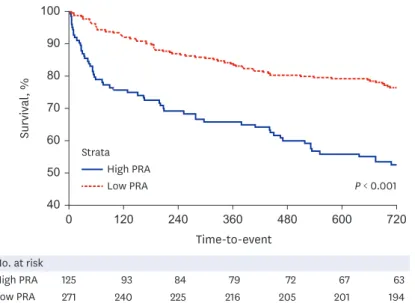
The baseline characteristics of the study subjects are shown in Table 1. The mean age ± SD was 64.7 ± 15.9 years, and 212 (53.5%) were male. The etiology of HF was ischemic in 116 (29.3%) patients, 148 patients had idiopathic HF, 46 had tachycardia-induced cardiomyopathy, 25 had valvular heart disease, 17 had hypertension-related HF, 15 had stress-induced cardiomyopathy, 14 had hypertrophic cardiomyopathy, 7 had restrictive cardiomyopathy, 6 had myocarditis, and 2 had unknown cause HF.
During the 2-year follow-up period, 119 (30.1%) composite events and 96 (24.2%) deaths were observed.
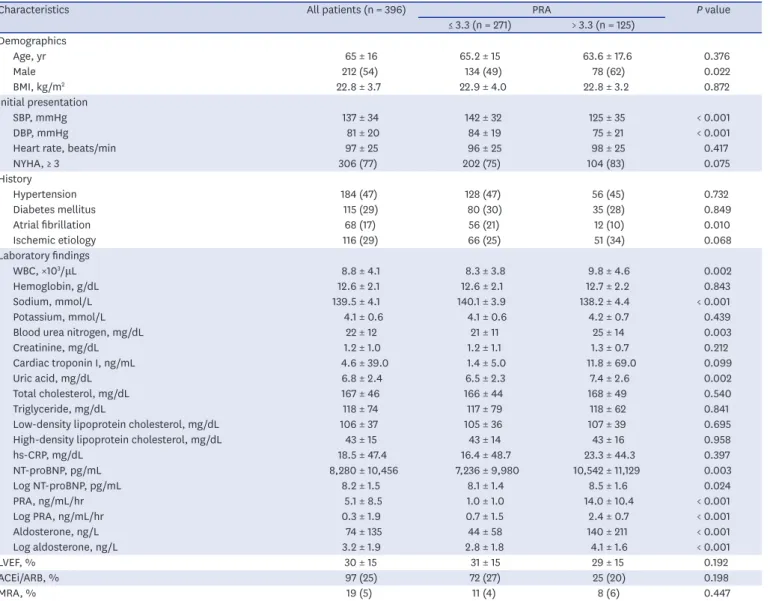
Association between PRA levels and the prognosis of the patients with acute HF On ROC analysis, the cutoff value of 3.3 ng/mL/hr for PRA best predicted composite outcome of all-cause mortality and readmission for HF (area under the ROC curve 0.650; sensitivity 50%, specificity 73%). As shown in the Kaplan-Meier analysis, patients with PRA > 3.3 ng/
mL/hr had a higher rate of the composite outcome of all-cause mortality and readmission for HF in two years (n = 61 in the low PRA group vs. n = 58 in the high PRA group) (Fig. 1).
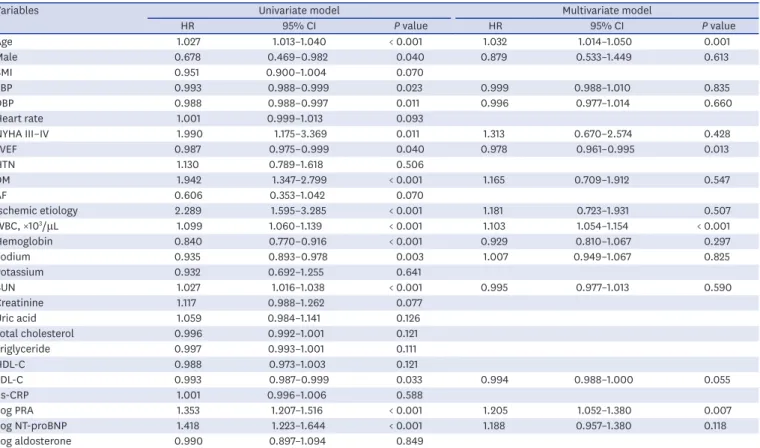
All-cause mortality for 2 years was confirmed by 48 events (17.7%) out of 271 in the Low PRA group and 48 events (38.4%) out of the 125 High PRA. On ROC analysis, the optimal cutoff value for log-transformed NT-proBNP was 5,190 pg/L for cardiac death (area under the ROC curve 0.668; sensitivity 64%, specificity 66%). As shown in Fig. 2, patients with an elevation of both biomarkers showed the highest risk of the composite outcome of all-cause mortality and readmission for HF; those with either high PRA or NT-proBNP showed an intermediate outcome, while the subset with both markers below the ROC cutoff values presented the lowest rate of composite outcome (log-rank P < 0.001). In addition, in-hospital death was confirmed in 12 patients (4.4%) in the low PRA group and 26 patients (20.8%) in the high PRA group, respectively. The Kaplan-Meier survival analysis revealed significant differences between the PRA levels of both groups (log-rank P < 0.001). In the univariate model, age, sex, systolic blood pressure, diastolic blood pressure, New York Heart Association Class III to IV, left ventricular ejection fraction (LVEF), diabetes mellitus, ischemic etiology, white blood cell (WBC) count, hemoglobin level, sodium level, blood urea nitrogen, low-density lipoproteins, log-transformed PRA, and log-transformed NT-proBNP were significant association with
composite outcome. In the multivariate model, age, LVEF, WBC, and log-transformed PRA were independent predictors for the composite outcome.
Incremental predictive value of the PRA
The incremental predictive values of log-transformed PRA in the Cox proportional hazards model are shown in Table 2. The PRA added incremental value to the combination of age, sex, LVEF, and log-transformed NT-proBNP in predicting the composite outcome of all- cause mortality and readmission for HF. The reclassification of patients with or without composite outcome at the time of 2-year follow-up is presented in Table 3. The addition of log-transformed NT-proBNP to age, sex, and LVEF yielded an NRI of 0.31 (P < 0.003) and 0.03 of IDI (P < 0.001). The addition of PRA to WBC count, age, and log-transformed NT- proBNP also significantly improved the reclassification (0.47; P < 0.001) and the integrated discrimination (0.10; P < 0.001) of subjects compared to the previous model.
Table 1. Clinical characteristics of patients according to PRA value ≤ 3.3 or > 3.3 ng/mL/hr cutoff values
Characteristics All patients (n = 396) PRA P value
≤ 3.3 (n = 271) > 3.3 (n = 125) Demographics
Age, yr 65 ± 16 65.2 ± 15 63.6 ± 17.6 0.376
Male 212 (54) 134 (49) 78 (62) 0.022
BMI, kg/m2 22.8 ± 3.7 22.9 ± 4.0 22.8 ± 3.2 0.872
Initial presentation
SBP, mmHg 137 ± 34 142 ± 32 125 ± 35 < 0.001
DBP, mmHg 81 ± 20 84 ± 19 75 ± 21 < 0.001
Heart rate, beats/min 97 ± 25 96 ± 25 98 ± 25 0.417
NYHA, ≥ 3 306 (77) 202 (75) 104 (83) 0.075
History
Hypertension 184 (47) 128 (47) 56 (45) 0.732
Diabetes mellitus 115 (29) 80 (30) 35 (28) 0.849
Atrial fibrillation 68 (17) 56 (21) 12 (10) 0.010
Ischemic etiology 116 (29) 66 (25) 51 (34) 0.068
Laboratory findings
WBC, ×103/μL 8.8 ± 4.1 8.3 ± 3.8 9.8 ± 4.6 0.002
Hemoglobin, g/dL 12.6 ± 2.1 12.6 ± 2.1 12.7 ± 2.2 0.843
Sodium, mmol/L 139.5 ± 4.1 140.1 ± 3.9 138.2 ± 4.4 < 0.001
Potassium, mmol/L 4.1 ± 0.6 4.1 ± 0.6 4.2 ± 0.7 0.439
Blood urea nitrogen, mg/dL 22 ± 12 21 ± 11 25 ± 14 0.003
Creatinine, mg/dL 1.2 ± 1.0 1.2 ± 1.1 1.3 ± 0.7 0.212
Cardiac troponin I, ng/mL 4.6 ± 39.0 1.4 ± 5.0 11.8 ± 69.0 0.099
Uric acid, mg/dL 6.8 ± 2.4 6.5 ± 2.3 7.4 ± 2.6 0.002
Total cholesterol, mg/dL 167 ± 46 166 ± 44 168 ± 49 0.540
Triglyceride, mg/dL 118 ± 74 117 ± 79 118 ± 62 0.841
Low-density lipoprotein cholesterol, mg/dL 106 ± 37 105 ± 36 107 ± 39 0.695
High-density lipoprotein cholesterol, mg/dL 43 ± 15 43 ± 14 43 ± 16 0.958
hs-CRP, mg/dL 18.5 ± 47.4 16.4 ± 48.7 23.3 ± 44.3 0.397
NT-proBNP, pg/mL 8,280 ± 10,456 7,236 ± 9,980 10,542 ± 11,129 0.003
Log NT-proBNP, pg/mL 8.2 ± 1.5 8.1 ± 1.4 8.5 ± 1.6 0.024
PRA, ng/mL/hr 5.1 ± 8.5 1.0 ± 1.0 14.0 ± 10.4 < 0.001
Log PRA, ng/mL/hr 0.3 ± 1.9 0.7 ± 1.5 2.4 ± 0.7 < 0.001
Aldosterone, ng/L 74 ± 135 44 ± 58 140 ± 211 < 0.001
Log aldosterone, ng/L 3.2 ± 1.9 2.8 ± 1.8 4.1 ± 1.6 < 0.001
LVEF, % 30 ± 15 31 ± 15 29 ± 15 0.192
ACEi/ARB, % 97 (25) 72 (27) 25 (20) 0.198
MRA, % 19 (5) 11 (4) 8 (6) 0.447
Data are presented as mean ± standard deviation or number (%).
PRA = plasma renin activity, BMI = body mass index, SBP = systolic blood pressure, DBP = diastolic blood pressure, NYHA = New York Heart Association Functional Classification, WBC = white blood cell, hs-CRP = high-sensitivity C-reactive protein, NT-proBNP = N-terminal pro-B type natriuretic peptide, LVEF = left ventricular ejection fraction, ACEi = angiotensin-converting enzyme inhibitor, ARB = angiotensin receptor blocker, MRA = mineralocorticoid receptor antagonist.
DISCUSSION
In the present study, the main findings were that the baseline PRA level at admission was an independent prognosticator for the composite outcome of all-cause mortality and readmission for HF in patients with acute HF. Moreover, PRA had a predictive value incremental to the combination of NT-proBNP and clinically relevant risk factors.
High PRA Strata
Low PRA 40 0
50 60 70 100
Time-to-event
Survival, %
90 80
720 600
360 480
240 120
High PRA No. at risk
63 67
79 72
84 93
125
Low PRA 271 240 225 216 205 201 194
P < 0.001
Fig. 1. Kaplan-Meier survival curves for composite outcome of all-cause mortality and readmission for heart failure in 2 subsets identified according to the cutoff values of 3.3 ng/mL/hr for PRA.; log-ank P < 0.001.
PRA = plasma renin activity.
High NT-proBNP, high PRA Strata
High NT-proBNP, low PRA Low NT-proBNP, high PRA Low NT-proBNP, low PRA 0
40 30 50 60 70 100
Time-to-event
Survival, %
90 80
720 600
360 480
240 120
P < 0.001
No. at risk
30 33
40 37
42 48
67
61 65
74 67
78 89
103
33 34
39 35
42 45
58
133 136
142 138
147 151
168 High NT-proBNP, high PRA High NT-proBNP, low PRA Low NT-proBNP, high PRA Low NT-proBNP, low PRA
Fig. 2. Kaplan-Meier survival curves for cardiac death in 4 subsets identified according to the cutoff values of 3.3 ng/mL/hr for PRA and 5,190 pg/L for log NT-proBNP (log-rank P < 0.001).
PRA = plasma renin activity, NT-proBNP = N-terminal pro-B type natriuretic peptide.
The activation of neurohormonal axes, in particular of the RAAS as a maladaptive response to cardiac dysfunction, plays a key role in the evolution and outcome of HF.16-19 High circulating concentrations of PRA and natriuretic peptides have been found in patients with HF.20,21 However, few data are available on the relative independent contribution of PRA and NT- proBNP to predict outcome in HF when compared directly in the same patient population.
Our results are consistent with previous studies, showing that PRA is a strong prognosticator in patients with HF. In addition, PRA and NT-proBNP together, appear to provide additive prognostic information.
The domain of cardiac biomarkers is rapidly expanding and novel markers are emerging fast. Unfortunately, only few do reach a level of clinical significance and are chosen for Table 2. Univariate and multivariate models for the composite outcome of all-cause mortality and readmission for heart failure using Cox-proportional hazards regression
Variables Univariate model Multivariate model
HR 95% CI P value HR 95% CI P value
Age 1.027 1.013–1.040 < 0.001 1.032 1.014–1.050 0.001
Male 0.678 0.469–0.982 0.040 0.879 0.533–1.449 0.613
BMI 0.951 0.900–1.004 0.070
SBP 0.993 0.988–0.999 0.023 0.999 0.988–1.010 0.835
DBP 0.988 0.988–0.997 0.011 0.996 0.977–1.014 0.660
Heart rate 1.001 0.999–1.013 0.093
NYHA III–IV 1.990 1.175–3.369 0.011 1.313 0.670–2.574 0.428
LVEF 0.987 0.975–0.999 0.040 0.978 0.961–0.995 0.013
HTN 1.130 0.789–1.618 0.506
DM 1.942 1.347–2.799 < 0.001 1.165 0.709–1.912 0.547
AF 0.606 0.353–1.042 0.070
Ischemic etiology 2.289 1.595–3.285 < 0.001 1.181 0.723–1.931 0.507
WBC, ×103/μL 1.099 1.060–1.139 < 0.001 1.103 1.054–1.154 < 0.001
Hemoglobin 0.840 0.770–0.916 < 0.001 0.929 0.810–1.067 0.297
Sodium 0.935 0.893–0.978 0.003 1.007 0.949–1.067 0.825
Potassium 0.932 0.692–1.255 0.641
BUN 1.027 1.016–1.038 < 0.001 0.995 0.977–1.013 0.590
Creatinine 1.117 0.988–1.262 0.077
Uric acid 1.059 0.984–1.141 0.126
Total cholesterol 0.996 0.992–1.001 0.121
Triglyceride 0.997 0.993–1.001 0.111
HDL-C 0.988 0.973–1.003 0.121
LDL-C 0.993 0.987–0.999 0.033 0.994 0.988–1.000 0.055
hs-CRP 1.001 0.996–1.006 0.588
Log PRA 1.353 1.207–1.516 < 0.001 1.205 1.052–1.380 0.007
Log NT-proBNP 1.418 1.223–1.644 < 0.001 1.188 0.957–1.380 0.118
Log aldosterone 0.990 0.897–1.094 0.849
HR = hazard ratio, CI = confidence interval, BMI = body mass index, SBP = systolic blood pressure, DBP = diastolic blood pressure, NYHA = New York Heart Association Functional Classification, LVEF = left ventricular ejection fraction, HTN = hypertension, DM = diabetes mellitus, AF = atrial fibrillation, WBC = white blood cell, BUN = blood urea nitrogen, HDL-C = high-density lipoprotein cholesterol, LDL-C = low-density lipoprotein cholesterol, hs-CRP = high-sensitivity C-reactive protein, PRA = plasma renin activity, NT-proBNP = N-terminal pro-B type natriuretic peptide.
Table 3. Discrimination of multivariate logistic regression models in predicting all-cause mortality and readmission for heart failure
Variables Discrimination
C-index P value NRI P value IDI P value
Model 1 0.664 (Reference) Reference Reference
Model 2 0.710 0.022 0.31 < 0.003 0.03 < 0.001
Model 3 0.751 < 0.001 0.47 < 0.001 0.10 < 0.001
Model 2 0.710 (Reference) Reference Reference
Model 3 0.751 0.037 0.31 < 0.005 0.06 < 0.001
Model 1 = age + sex + left ventricular ejection fraction; Model 2 = Model 1 + log NT-proBNP; Model 3 = Model 2 + log PRA.
NRI = net reclassification improvement, IDI = integrated discrimination improvement.
use in clinical practice. In the present study, PRA showed favorable results for predicting the composite outcome of all-cause mortality and readmission for HF in patients with HF. Therefore, PRA might be a useful prognostic biologic marker in patients with HF.
Recent studies have shown that baseline PRA levels are highly associated with 30-day HF rehospitalization or death in patients with acute HF.22 Moreover, there has been a study that showed that high PRA levels are significantly related to mortality and rehospitalization when patients with acute HF are treated after optimal medical treatment.23,24
Our study had several limitations. First, the retrospective analysis of prospectively collected data is a major limitation of this study. Therefore, we cannot completely exclude the possibility of residual confounding factors, and our results should be interpreted with caution. Second, because of the limited sample size, the patients in our study might not be representative of the entire population of HF. Third, PRA was measured only at baseline, so the effect of discharge medication on the relationship between PRA and mortality could not be further investigated.
The previous medical history of study subjects may affect PRA levels. However, there were no differences between low and high PRA groups in patients taking angiotensin-converting enzyme inhibitor (ACEi)/angiotensin receptor blocker (ARB) or mineralocorticoid receptor antagonist (MRA) with baseline anti-hypertensive medication (Table 1). Moreover, taking ACEi/ARB or MRA before hospitalization did not affect the prognosis of patients in univariate analysis. A plausible explanation may be that the study population was targeted at patients with acute decompensated HF, and the RAAS system can be overactivated regardless of medication.
In conclusion, our results suggest that PRA is an independent prognosticator in patients with HF and has a predictive value incremental to the combination of NT-proBNP. Further studies are required in a larger population to confirm the association between PRA and NT-proBNP for the prognosis in patients with acute HF.
REFERENCES
1. Emdin M, Vittorini S, Passino C, Clerico A. Old and new biomarkers of heart failure. Eur J Heart Fail 2009;11(4):331-5.
PUBMED | CROSSREF
2. Khanam SS, Choi E, Son JW, Lee JW, Youn YJ, Yoon J, et al. Validation of the MAGGIC (Meta-Analysis Global Group in Chronic Heart Failure) heart failure risk score and the effect of adding natriuretic peptide for predicting mortality after discharge in hospitalized patients with heart failure. PLoS One 2018;13(11):e0206380.
PUBMED | CROSSREF
3. Lee JH, Kim MS, Kim EJ, Park DG, Cho HJ, Yoo BS, et al. KSHF guidelines for the management of acute heart failure: Part I. Definition, epidemiology and diagnosis of acute heart failure. Korean Circ J 2019;49(1):1-21.
PUBMED | CROSSREF
4. Braunwald E. Biomarkers in heart failure. N Engl J Med 2008;358(20):2148-59.
PUBMED | CROSSREF
5. Schmieder RE, Hilgers KF, Schlaich MP, Schmidt BM. Renin-angiotensin system and cardiovascular risk.
Lancet 2007;369(9568):1208-19.
PUBMED | CROSSREF
6. Laragh JH. The renin system and future trends in management of high blood pressure. Clin Exp Hypertens 1980;2(3-4):525-52.
PUBMED | CROSSREF
7. Laragh JH, Sealey JE. Abnormal sodium metabolism and plasma renin activity (renal renin secretion) and the vasoconstriction volume hypothesis: implications for pathogenesis and treatment of hypertension and its vascular consequences (heart attack, stroke). Clin Chem 1991;37(10 Pt 2):1820-7.
PUBMED | CROSSREF
8. Brunner HR, Gavras H, Laragh JH. Specific inhibition of the renin-angiotensin system: a key to understanding blood pressure regulation. Prog Cardiovasc Dis 1974;17(2):87-98.
PUBMED | CROSSREF
9. Brunner HR, Laragh JH, Baer L, Newton MA, Goodwin FT, Krakoff LR, et al. Essential hypertension:
renin and aldosterone, heart attack and stroke. N Engl J Med 1972;286(9):441-9.
PUBMED | CROSSREF
10. Brunner HR, Sealey JE, Laragh JH. Renin as a risk factor in essential hypertension: more evidence. Am J Med 1973;55(3):295-302.
PUBMED | CROSSREF
11. Jang SY, Chae SC, Bae MH, Lee JH, Yang DH, Park HS, et al. Effect of renin-angiotensin system blockade in patients with severe renal insufficiency and heart failure. Int J Cardiol 2018;266:180-6.
PUBMED | CROSSREF
12. Latini R, Masson S, Anand I, Salio M, Hester A, Judd D, et al. The comparative prognostic value of plasma neurohormones at baseline in patients with heart failure enrolled in Val-HeFT. Eur Heart J 2004;25(4):292-9.
PUBMED | CROSSREF
13. Harrell FE Jr, Lee KL, Mark DB. Multivariable prognostic models: issues in developing models, evaluating assumptions and adequacy, and measuring and reducing errors. Stat Med 1996;15(4):361-87.
PUBMED | CROSSREF
14. DeLong ER, DeLong DM, Clarke-Pearson DL. Comparing the areas under two or more correlated receiver operating characteristic curves: a nonparametric approach. Biometrics 1988;44(3):837-45.
PUBMED | CROSSREF
15. Pencina MJ, D'Agostino RB Sr, D'Agostino RB Jr, Vasan RS. Evaluating the added predictive ability of a new marker: from area under the ROC curve to reclassification and beyond. Stat Med 2008;27(2):157-72.
PUBMED | CROSSREF
16. Swedberg K, Eneroth P, Kjekshus J, Wilhelmsen L; CONSENSUS Trial Study Group. Hormones regulating cardiovascular function in patients with severe congestive heart failure and their relation to mortality.
Circulation 1990;82(5):1730-6.
PUBMED | CROSSREF
17. Packer M. Pathophysiology of chronic heart failure. Lancet 1992;340(8811):88-92.
PUBMED | CROSSREF
18. Francis GS, Cohn JN, Johnson G, Rector TS, Goldman S, Simon A. Plasma norepinephrine, plasma renin activity, and congestive heart failure. Relations to survival and the effects of therapy in V-HeFT II. The V-HeFT VA Cooperative Studies Group. Circulation 1993;87(6 Suppl):VI40-8.
PUBMED
19. Benedict CR, Johnstone DE, Weiner DH, Bourassa MG, Bittner V, Kay R, et al. Relation of neurohumoral activation to clinical variables and degree of ventricular dysfunction: a report from the Registry of Studies of Left Ventricular Dysfunction. J Am Coll Cardiol 1994;23(6):1410-20.
PUBMED | CROSSREF
20. Levine TB, Francis GS, Goldsmith SR, Simon AB, Cohn JN. Activity of the sympathetic nervous system and renin-angiotensin system assessed by plasma hormone levels and their relation to hemodynamic abnormalities in congestive heart failure. Am J Cardiol 1982;49(7):1659-66.
PUBMED | CROSSREF
21. Mukoyama M, Nakao K, Hosoda K, Suga S, Saito Y, Ogawa Y, et al. Brain natriuretic peptide as a novel cardiac hormone in humans. Evidence for an exquisite dual natriuretic peptide system, atrial natriuretic peptide and brain natriuretic peptide. J Clin Invest 1991;87(4):1402-12.
PUBMED | CROSSREF
22. Rachwan RJ, Butler J, Collins SP, Cotter G, Davison BA, Senger S, et al. Is plasma renin activity associated with worse outcomes in acute heart failure? A secondary analysis from the BLAST-AHF trial. Eur J Heart Fail 2019;21(12):1561-70.
PUBMED | CROSSREF
23. Nijst P, Verbrugge FH, Martens P, Bertrand PB, Dupont M, Francis GS, et al. Plasma renin activity in patients with heart failure and reduced ejection fraction on optimal medical therapy. J Renin Angiotensin Aldosterone Syst 2017;18(3):1470320317729919.
PUBMED | CROSSREF
24. Ueda T, Kawakami R, Nishida T, Onoue K, Soeda T, Okayama S, et al. Plasma renin activity is a strong and independent prognostic indicator in patients with acute decompensated heart failure treated with renin- angiotensin system inhibitors. Circ J 2015;79(6):1307-14.
PUBMED | CROSSREF