미세조류 옥외 배양시스템을 이용한 바이오디젤 생산 및 도시하수 영양 염류 제거
강시온1,2, 김병혁1, 오희목1,2, 김희식1,2*
1한국생명공학연구원환경바이오연구센터
2과학기술연합대학원대학교청정화학및생물학과
Received : January 3, 2013 / Revised : February 8, 2013 / Accepted : February 12, 2013
서 론
20세기들어산업혁명과운송수단의발달로인하여인류 는급속한발달을이루었고이는화석연료의이용으로가능 할수있었다. 하지만화석연료는제한된매장지역과매장량 으로인하여여러차례세계경제위기를야기하는등의문 제점이지적되었다[25]. 또한무분별한화석연료의사용은 막대한온실가스를발생시켰으며, 지구온난화와같은환경
문제를야기했다[23]. 이에대응하고자교토의정서와같은
국가적차원의기후변화협약을통해온실가스를감축하려는 노력들이시도되었다. 미국의경우, 코펜하겐협약에서 2020년
까지온실가스배출을 1990년대비 3% 감축을합의하였으며
[8], 2050년까지 단계적으로 온실가스 배출을 감축하여
2005년기준 17% 수준으로감축하는목표를법으로규정하
고있다[13, 16]. 우리나라도기후협약에따라온실가스배출
을 2020년까지 2005년대비 4% 감축해야하며, 2020년전 망치대비 30%를감축하는목표를법으로규정하고있다[13, 24].
지구온난화에대한근본적인해결책은기존의화석연료를 줄이고, 발생된온실가스를저감하거나, 온실가스를배출하 지않는에너지원을사용하는것이며, 선진국들은화석연료 를대체할수있는대체에너지개발에박차를가하고있다. 미국은대체에너지에대한막대한재정적지원과세제혜택 을시행하고있으며, 2035년까지전기사용량의 80%를대체 에너지로전환하기로하였다[7, 13]. 특히 2017년까지휘발 유소비량을 20% 감축하고바이오디젤과같은바이오연료의 Production of Biodiesel and Nutrient Removal of Municipal Wastewater using a Small Scale Raceway Pond. Kang, Zion1,2, Byung-Hyuk Kim1, Hee-Mock Oh1,2, and Hee-Sik Kim1,2*. 1Environmental Biotechnology Research Center, Korea Research Institute of Bioscience and Biotechnology, Daejeon 305-806, Korea, 2Green Chemistry and Environmental Biotech- nology, University of Science and Technology (UST), Daejeon 303-333, Korea
A concerted effort to develop alternative forms of energy is underway due to fossil fuel shortages and its deleterious effects.
Recently, bioenergy from microalgae has gained prominence and the use of municipal wastewater as a low cost alternative for a nutrient source has significant advantages. In this study, we have employed municipal wastewater directly after primary treat- ment (primary settling basin) in a small scale raceway pond (SSRP) for microalgal growth. Indigenous microalgae in the waste- water were encouraged to grow in the SSRP under optimal conditions. The mean removal efficiencies of TN, TP, and NH3-N after 6 days were 77.77%, 63.55%, and 89.02%, respectively. The average lipid content of the microalgae was 19.51% of dry cell weight, and linolenate and linoleate (18:n) were the predominant fatty acids. The 18S rRNA gene analysis and microscopic observations of the indigenous microalgae community revealed the presence of Chlorella vulgaris and Scenedesmus obliquus as the dominant microalgae. These results indicate that untreated municipal wastewater, serving as an excellent nitrogen and phosphate source for microalgal growth, could be treated using microalgae in open raceway ponds. Moreover, microalgal bio- mass could be further profitable by the extraction of biodiesel.
Keywords: Microalgae, biodiesel, wastewater treatment, small scale raceway pond (SSRP)
*Corresponding author
Tel: +82-42-860-4326, Fax: +82-42-879-8103 E-mail: [email protected]
© 2013, The Korean Society for Microbiology and Biotechnology
사용을 2020년까지 4배이상늘리도록법안을개정하였다[16].
이러한전세계적흐름에맞추어바이오에탄올·디젤생산을 위해콩이나옥수수, 사탕수수, 미세조류등을이용하는연 구가활발히진행되고있다. 바이오연료생산을위한바이오 매스획득은농작물을이용할경우많은재배면적이필요하 고식량공급과경쟁하게되어세계곡물가격에큰영향을 미치는등의문제점이지적되고있다[5, 17, 25].
이에반해, 미세조류를이용한바이오디젤생산은단위면 적당생산량이뛰어나며세계곡물시장에영향을주지않 는이점을가지고있어, 농작물유래바이오연료가가지고
있는한계점을극복할수있을것으로기대되고있다[5, 17,
25]. 또한미세조류의광합성작용을통한이산화탄소고정
능력이있으므로온실가스감축에도기여할수있으며[5, 14,
25, 30], 바이오디젤을생산하고남은미세조류부산물은가
축사료로이용할수있는장점을가지고있다[1, 27, 29].
하지만미세조류배양에는질소와인과같은영양염류의 첨가와많은양의물이필요하며, 이는미세조류를이용한 바이오디젤생산비용을높이는요인이되고있다[30]. 이에 반해, 미세조류배양액으로유기성폐수를이용한다면바이 오매스획득을위한미세조류배양비용을줄일수있으며, 동시에폐수처리효과도기대해볼수있다[6, 29].
따라서본연구는유기성폐수를이용한미세조류배양의 효율적인미세조류바이오매스획득가능성과생산된바이 오매스의바이오디젤전환가능성을알아보고자유기성폐 수옥외배양시스템(Small Scale Raceway Pond, SSRP)을 적용하였다. 또한미세조류의성장을통해도시에서발생되
는유기성폐수의영양염류제거능을탐색하고, SSRP에서
성장하는미세조류의군집을분자생물학적방법을통해분 석하였다.
재료 및 방법
옥외 배양 시스템
하수종말처리장에유입되는유기성폐수를이용해미세조 류배양을하기위해 SSRP를설치하였다. SSRP의깊이는 약 30 cm, 용적 60 L이며, 폭기는 paddle wheel을이용하여 유속 30 cm/sec로운전하였다. 광원은태양광을이용하였으 며자연적인변화에의해 light/dark cycle (L/D cycle)을주었 고, HRT (hydraulic retention time)는 6일로반연속식으로 운전하였으며, 실험에사용한유기성폐수는대전시하수종 말처리장의유입수(1차침전지를거쳐포기조에들어가기전) 를 이용하였다. 유기성 폐수의 평균 성상(2011년 1월~ 2012년 5월)은 BOD (biological oxygen demand, mg/L):
167.85±31.01, COD-Mn (chemical oxygen demand, mg/
L): 111.90±24.28, TSS (total suspended solids, mg/L):
169.39±40.24, TN (total nitrogen, mg/L): 40.30±2.52, TP (total phosphorus, mg/L): 4.36±0.42를나타냈다. SSRP 에접종한토착미세조류는 1차침전지내벽에서식하는미
세조류를획득하여 SSRP에접종하였다. 접종한토착미세
조류를우점시키기위해, 유기성폐수의배출없이 6일간운 전하였으며, 6일후접종한 토착미세조류가우점하기시 작하였다. 우점된토착미세조류는대부분녹조류의형태
를나타냈다. 본 SSRP는대전하수종말처리장에서실험하
였다.
수질분석방법
SSRP의배양액을 2일마다채취하여 0.45 µm 마이크로 여과지로 여과한 후 잔류 TN, TP,NH3-N를측정하였다. TN, TP, 및 NH3-N는 Standard method를이용하여분석하 였다[2].
미세조류 성장 측정
미세조류의성장은건조중량및 chlorophyll-a로측정하였 다. 건조중량은 SSRP 배양액 10 ml을 0.45 µm 마이크로여 과지에거른후 105oC에서 24시간동안건조하여측정하였 다. Chlorophyll-a는 90% 아세톤을이용하는수질오염공정 시험법에따라측정하였다[2].
DNA 추출 방법 및 PCR 조건
SSRP의미세조류군집을분석하기위하여, 분자·생물학 적 기법인 Denaturing Gradient Gel Electrophoresis (DGGE)를이용하였다. SSRP 운전 20일째의배양액 1.5 ml 로부터 FastDNA Spin kit for Soil (Bio101, USA)을이용 하여 total DNA를추출하였으며, 시료로부터얻은 DNA를 주형으로 PCR 반응을수행하였다. 18S rRNA 유전자를증 폭하고자 SR-4F GC (5'-CGC CCG CCG CGC GCG GCG GGC GGG GCG GGG GCA CGG GGG GAG CCG CGG TAA TTC CAG CT-3')와 SR-7R (5'-TCC TTG GGC AAA TGC TTT CGC-3')을각각사용하였고[22], 이 primer를이 용하여 50 µl 안에 1× PCR buffer, 20 mM MgCl2, 40 mM dNTP mixture, 각 primer (1 µM), template DNA와 0.5 U Taq polymerase를첨가하여 PCR을수행하였다[20, 21].
반응조건은 94oC에서 5 min 동안 DNA를 pre-denaturation 시켜, 94oC에서 45 sec denaturation, 60oC에서 45 sec annealing, 72oC에서 45 sec extension하고 72oC에서 7 min 동안 final extension을수행하였다. Annealing 온도는초기 에는 60oC에서 시작해서 1 cycle 당 0.5oC 감소하게 20 cycles 수행하였고, 그후 50oC에서 15 cycles을수행하여 touch-down PCR을완료하였고, 2차 PCR의산물을이용하 여 DGGE를수행하였다[21].
DGGE 조건
PCR 산물은 DcodeTM System (Bio-Rad, USA)을이용하 여 DGGE를 수행하였다[21]. Denaturing gradient gel은 10% polyacrylamide (37.5:1 = acrylamide:bisacrylamide) 에 urea와 formamide 변성제를 40-70%까지농도구배가형 성되도록첨가하여제작하였으며, 제작된 DGGE gel에 PCR 증폭산물을 30 µl씩 loading하여 1× TAE buffer (40 mM Tris, 20 mM acetic acid, 1 mM EDTA, pH 8.0)에서 60oC,
115 V로 19시간 동안 전기영동하였다. 전기영동이 끝난
DGGE gel은 ethidium bromide (1:10,000)에서염색한후, UV로확인하였다[21].
염기서열분석
DGGE gel 상에서다른위치에존재하는 DNA 단편들을
회수하기위하여각각의 band를선택한후, 잘라내어 3차멸 균수 50 µl를첨가하고 4oC에서하룻밤동안방치하여상등 액을취하였다. Band에서회수한 DNA를주형으로 PCR에 사용한 primer를이용하여재증폭을수행했으며, PCR 산물 은 아가로스젤에서 전기영동하여 DNA recovery kit (QIAGEN, Germany)로정제한후 cloning 하였다. Cloning 은 T-Blunt vector (Solgent, Daejeon, Korea)를이용하였고, manufacturer’s protocol을따라수행하여 18S rRNA 유전 자의 염기서열을 결정하였다. 결정된 염기서열은 NCBI (www.ncbi.nlm.nih.gov)의 GenBank database를이용하여 BLAST search를통해분석하였다.
Lipid 추출 방법
미세조류의세포내지질함량은 Bligh & Dyer의방법을변 형한방법으로분석하였다. 미세조류시료에 Chloroform : methanol (2:1 v/v)를 넣어 교반 후, 증류수를 첨가하여 Chloroform : methanol : water의비율이 1 : 1 : 0.9가되게
조절하여분리된 chloroform 층을건조시켜지질함량을측
정하였다[3, 14].
FAME 분석방법
지방산메틸 에스터 (Fatty acid methyl esters, FAME) 조성 분석을 위해 Gas Ghromatograph (Shimadzu GC- 2010, Japan)를통하여분석하였다. 미세조류시료 50 mg과 1ml의 KOH-CH3OH를 test tube에 75oC에서 10분, 5%
HCl과 methanol을넣어 75oC에서 10분간반응시켰다. 그뒤, hexane과 (CH3)3COCH3을넣어반응시킨후증류수를첨가
하여 FAME가포함되어있는 층을 분리하였다. 지방산은
Gas chromatography (GC-2010, Shimadzu, Japan)를 통 하여 분석하였다[14]. GC detector는 flame ionized detector (FID)를사용하였으며 Rtx-wax capillary column (30 m ×
0.25 mm × 0.25µm) (RESTEK, USA)을사용하였다. Injector 와 detector는 300oC로설정하였으며, column 온도는 170oC 로 1분후, 5oC/min의속도로승온하여 250oC에서 12분동 안유지하였고, 총분석시간을 29분으로설정하였다.
결과 및 고찰
미세조류 배양을 통한 도시하수 수질정화
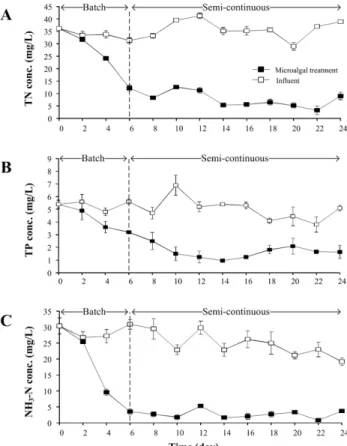
본연구에사용된 1차침전지방류수의 TN은평균 35.35
±1.00 mg/L이며, SSRP를이용하여처리된처리수의 TN은 운전 6일을시점으로평균 7.92 ± 1.04 mg/L으로나타났다
(Fig. 1A). 같은기간에활성슬러지공법에의해처리된최
종방류수의 TN은평균 13.01 ppm이며, 이는미세조류를이 용한유기성폐수처리가활성슬러지공법보다높은 TN 제 거효율을가지고있으며 TN의도시하수방류수수질기준 인 20 mg/L 이하로 TN을제거할수있는우수한능력을가 지고있음을확인할수있었다.
또한 실험에 사용된 1차 침전지 방류수의 TP는 평균
Fig. 1. The removal of total nitrogen (A), total phosphorus (B), and NH3-N (C).
Closed square; SSRP using municipal wastewater, open square;
influent. First 6 days; SSRP was batch operation, after 6 days;
semi-continuous operation.
5.10±0.40 mg/L이며, SSRP를이용하여미세조류를배양 한처리수의 TP는 운전 6일을 시점으로 평균 1.79±0.39 mg/L으로나타났다(Fig. 1B). 같은기간에활성슬러지공법 에의해 처리된최종 방류수의 TP는 평균 0.29 ppm이며, SSRP를이용한 TP제거효율이활성슬러지공법의 TP 제거 효율에미치지못함을알수있었다. 하지만도시하수의방 류수수질기준인 2 mg/L에만족하는수질정화수치를나타
냄으로써 SSRP는인제거에도탁월한결과를나타낸다고
판단될수있다. 또한 HRT 6일로운전시, TP & TN이방류 수수질기준이하로유지되는것을확인하였다.
또한유기성폐수의 NH3-N는평균 25.77±2.11 mg/L이 며, SSRP를이용하여미세조류를배양한배양액의 NH3-N 는운전 6일을시점으로평균 2.74±0.48 mg/L으로(Fig. 1C) 평균 89.02%의높은제거효율을보였다. SSRP를통한미
세조류의유기성폐수의처리시 NH3-N의제거능력이매우 우수함을입증한결과로판단된다. NH3-N는미생물의생장 에있어중요한물질인데, 미생물들이바로체내합성으로이 용이가능한형태의질소로알려져있기때문이다. 미생물들 이성장하면서 NH3-N의농도가먼저감소한뒤에 NO3-N의 농도가감소하게되는데, 이는 nitrate reductase의합성이 암모니아에의해후전사단계에서억제되기때문인것으로 알려지고있다[10, 19, 26, 28]. 즉, NH3-N와 NO3-N가함께 존재하면 NO3-N보다 NH3-N가먼저감소된후, NO3-N의농 도가감소하게된다.
미세조류 군집분석
SSRP를이용한미세조류배양으로유기성폐수를정화하
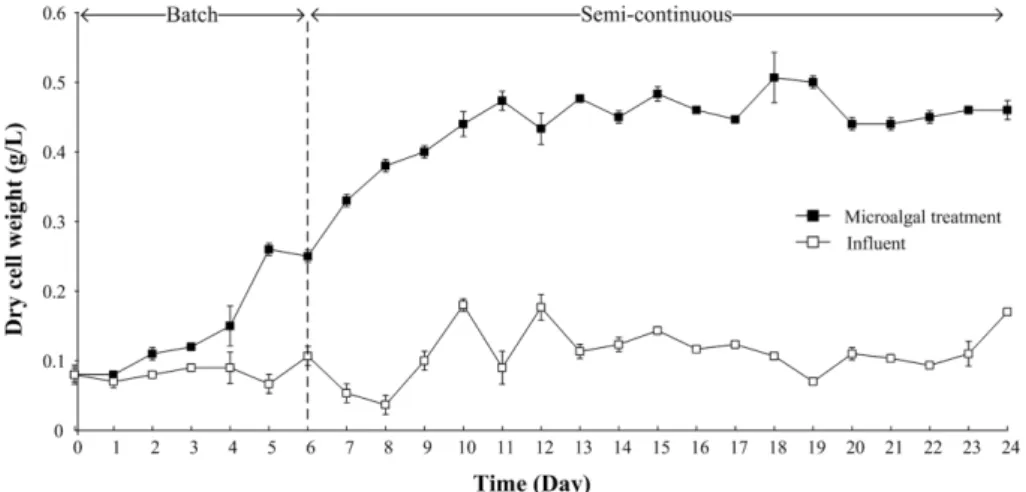
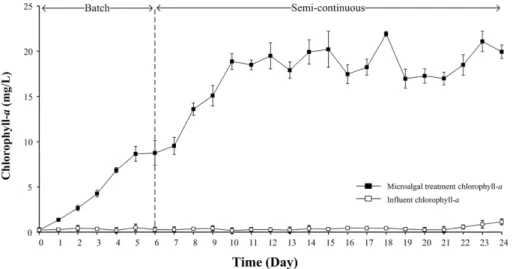
는미생물군집은구형의녹조류인 Chlorella와 2개, 4개혹 은 8개등의 세포들이 배열되어군체를 이루는 녹조류인 Scenedesmus가우점했다(Fig. 2). 우점한미세조류의시간 에따른성장을확인하기위해건조중량과 chlorophyll-a를 측정하였다. 유입되는유기성폐수의건조중량은평균 0.10 ± 0.01 g/L이며, SSRP내의건조중량은운전 6일을시점으로 평균 0.44 ± 0.01 g/L로유지되었으며, 바이오매스생산량은 0.07 g/L/day로나타남을확인하였다(Fig. 3). 또한유입되는 유기성 폐수의 chlorophyll-a는 평균 0.39±0.23 mg/L이며, SSRP는운전 6일을시점으로평균 16.11 ± 0.70 mg/L로유 지되는것을확인하였다(Fig. 4). SSRP 내의미세조류의건 조중량과 chlorophyll-a의측정결과를통해미세조류들이우 점·유지되는것을확인할수있었다.
SSRP 운전 24일의배양액으로부터 DNA를추출하여, 미 생물군집다양성을분석하는데유용한기법인 DGGE를통
해미생물군집의다양성을조사해본결과, Fig. 5와같이
DGGE gel 상에서다양한 bands를확인할수있었다. 또한
Fig. 3. Dry cell weight according to the operating time of the SSRP using municipal wastewater.
Closed square; DCW by SSRP using municipal wastewater, open square; DCW of influent.
Fig. 2. Photographs of dominant microalgae cells visualized under a light microscope × 1000 in the SSRP using municipal wastewater.
Scenedesmus (A) is oval shape and Chlorella (B) is a circle. Scale bars: 10 µm.
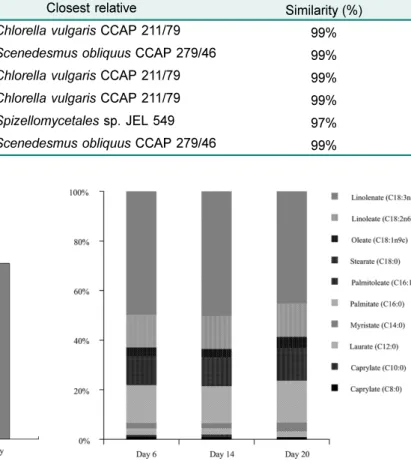
DGGE profile상의각 bands로부터회수한 DNA의염기서 열을결정한뒤, NCBI의 GenBank를이용하여상동성을비 교하였다. 진핵생물 18S rRNA 유전자 6개 bands에대한염 기서열을결정하였고, Table 1과같이분석되었다.
18S rRNA 유전자에대한 6개의 bands를분석한결과, 2가지속의녹조류와한가지의진균으로분석되었다. DGGE band e1, e3, e4는 Chlorella vulgaris로분석되었고, DGGE bands e2, e6는 Scenedesmus obliquus로분석되었다. 그리 고 DGGE band e5은 Spizellomycetales sp.의 fungi로분석 되었다. C. vulgaris는담수녹조류로서고농도이산화탄소에 대한내성을가지고있으며적응력이뛰어난것으로보고되 었다[31]. 또한유기성산업폐수내의고농도 NH3-N에대한 내성이우수하며폐수내의 NH3-N, NO3-N, P의제거효율 이높은것으로보고되었다[9, 30]. 그리고다른 Chlorella에 비하여성장속도가빠르며이산화탄소저감능력이높다고 보고되었다[11]. S. obliquus 역시유기성폐수내의 NH3-N,
NO3-N, P을제거하는데높은효율을나타낸다고알려져있
으며[9, 18], 산업폐수의중금속을제거하는데이용할수있
고, 높은지질함량을포함하여바이오디젤생산연구에이용 되고있다[4, 17].
미세조류 바이오매스의 지질함량 및 지방산 조성
SSRP 운전 6일, 14일, 그리고 20일의배양액에서미세조 류를수확하여미세조류내의지질함량을분석한결과, 각 각 21.97%, 18.58%, 17.98%로나타났으며, 지질생산량은 14.31 mg/L/day로나타남을확인하였다(Fig. 6). 14일, 20일 의지질함량보다 6일의지질함량이비교적높은것은초기
6일간배양액의배출없이 SSRP를운전하여배양액내의질
소고갈상태에근접하였기때문으로판단된다. 일반적으로 Fig. 4. Chlorophyll-a according to the operating time of the SSRP using municipal wastewater.
Closed square; Chlorophyll-a by SSRP using municipal wastewater, open square; Chlorophyll-a of influent.
Fig. 5. DGGE profiles based on 18S rRNA gene generated from SSRP.
DGGE condition: 10% polyacrylamide (37.5:1 = acrylamide:
bisacrylamide), urea, formamide 40-70%, 60oC, 115 V, 19 h running.
미세조류는질소가고갈된상태에서체내지질축적을증가 시키는것으로알려져있다[15, 17]. HRT 6일로 SSRP 운전 시질소가고갈되는조건은아니지만, 지질함량을증가시키 기위해서는 HRT를좀더길게운전하는것이유리하다는 것을알수있었다.
SSRP 운전 6일, 14일, 그리고 20일의배양액에서미세조
류를수확하여미세조류내의지질을 FAME로전환하여지
방산조성을분석하였으며, Fig. 7과같은조성을나타내었 다. SSRP에서우점하는미세조류들의 FAME는주로 C18:n 인 Linolenate (C18:3n3), Linoleate (C18:2n6c)와 C16:n인 Palmitate (C16:0)로이루어져있음을확인하였다. 일반적으 로 Chlorella sp.의 FAME 조성은 16:0, 18:2, 18:3이많고, Scenedesmus obliquus의 FAME 조성은 16:0, 18:2가많은 부분을차지한다고알려져있다[12]. SSRP에서배양된미세 조류의 FAME 분석 결과를 볼 때, Chlorella vulgaris와 Scenedesmus obliquus가우점하는것을나타낸현미경사 진(Fig. 2)과 DGGE의결과(Table 1)가일치하는것을확인 할수있었다.
본연구는유기성폐수를이용한효율적인미세조류바이
오매스획득가능성과미세조류배양을통한유기성하·폐 수의수질정화가능성을탐색하였다. 또한, 유기성하·폐수 를정화하는미세조류의군집과미세조류바이오매스의바 이오디젤전환능을분석하였다. 도시에서발생하는유기성 폐수를이용하여 SSRP에서미세조류배양후잔류 TN, TP, NH3-N를분석한결과, SSRP를통한유기성폐수의영양염 류의처리능이우수함을확인하였다. SSRP 시스템에서배
양액으로사용된뒤에방류되는배출수의 TN, TP 농도는도
시하수방류수수질기준(TN: 20 mg/L, TP: 2 mg/L)을충족 시키는수준으로나타났다. 이는미세조류바이오매스수확 후에배양액을재처리하는과정이불필요함을의미한다. HRT 6일에서 8일로변경시, 바이오매스생산량은증가하나 COD 값역시증가하는것으로나타났다(결과 미제시). 따라서 HRT를증가시키는것은수질정화측면에서는비효율적임을 확인하였다. 또한, 배양액에서유기성폐수내의질소, 인들 을섭취하여영양염류제거에기여하는미세조류를동정한 결과 C. vulgaris와 S. obliquus가우점함을확인하였고, C.
vulgaris와 S. obliquus 유래의지질을분석하여바이오디젤 전환가능성을확인하였다. 이를통해미세조류바이오매스 Table 1. Identity of the bands obtained from 18S rRNA gene DGGE profile of SSRP.
Band no. Accession no. Closest relative Similarity (%)
e1 FR865683 Chlorella vulgaris CCAP 211/79 99%
e2 FR865738 Scenedesmus obliquus CCAP 279/46 99%
e3 FR865683 Chlorella vulgaris CCAP 211/79 99%
e4 FR865683 Chlorella vulgaris CCAP 211/79 99%
e5 GQ499385 Spizellomycetales sp. JEL 549 97%
e6 FR865738 Scenedesmus obliquus CCAP 279/46 99%
Fig. 6. Lipid contents of microalgae of SSRP after the incu- bation days.
Fig. 7. Fatty Acid Methyl Ester (FAME) composition of microalgae of SSRP after the incubation days.
생산단가의절감뿐만아니라미세조류배양을통한영양염 류의제거와하수처리공법에서호기성처리로인한과도한 발전비용의절감과바이오매스를이용한바이오디젤전환 가능성을확인하였다. 향후 scale up 연구를통하여유기성 폐수를이용한미세조류배양이경제적인바이오매스생산 과바이오디젤생산및효율적인질소와인제거시스템으 로응용될수있을것으로판단된다.
요 약
화석연료의매장량한계와해로운영향으로인하여이를 대신할대체에너지연구가요구되고있다. 최근, 미세조류를 통한바이오에너지생산이주목을받고있으며, 도시하수를 영양원으로이용하여미세조류를배양하는것은생산비용을 낮추는좋은대안이될수있다. 본연구에서는옥외수질정 화배양시스템(Small Scale Raceway Pond; SSRP)을이용 하여적용했다. 실험에사용한도시하수는하수종말처리장 의 1차침전지를거친유입수를이용하였으며, 토착미세조 류를 SSRP에서배양하였다. 체류시간 6일운전후 TN, TP, NH3-N의평균제거효율은 77.77%, 63.55%, 89.02%로각 각나타났다. 또한미세조류내의지질함량은평균 19.51%
로나타났으며, FAME는주로 18:n인 linolenate, linoleate 로이루어져있음을확인하였다. 18S rRNA 유전자분석과 현미경관찰을통하여녹조류인 Chlorella와 Scenedesmus 가우점하는것을확인하였다. 이러한결과를통하여도시하 수는미세조류배양에필요한질소와인을제공할수있으 며, 미세조류를이용한 SSRP를통하여정화될수있는가능 성을확인하였다. 또한미세조류배양을통해얻어진바이오 매스는바이오디젤전환을통하여상업화될수있는가능성 을확인하였다.
Acknowledgements
This work was supported by the Advanced Biomass R&D Center (ABC) of Global Frontier Project funded by the Ministry of Educa- tion, Science and Technology (ABC-2011-0031351), the Energy Efficiency & Resources of the Korea Institute of Energy Technology Evaluation and Planning (KETEP) grant funded by the Korea gov- ernment Ministry of Knowledge Economy (No. 2012T100201665), and grant from the KRIBB (Korea Research Institute of Bioscience and Biotechnology) Research Initiative Program (www.kribb.re.kr).
References
1. Aaronson, S. and Z. Dubinsky. 1982. Mass production of microalgae. Cell. Mol. Life Sci. 38: 36-40.
2. APHA. 1998. Standard methods for the examination of water
and wastewater. APHA, Washington, DC. 20th ed.
3. Bligh, E. G. and W. J. Dyer. 1959. A rapid method of total lipid extraction and purification. Can. J. Biochem. Phys. 37: 911- 9117.
4. Cain, J. R., D. C. Paschal, and C. M. Hayden. 1980. Toxicity and bioaccumulation of cadmium in the colonial green alga Scenedesmus obliquus. Arch. Environ. Contam. Toxicol. 9: 9- 16.
5. Chisti, Y. 2007. Biodiesel from microalgae. Biotechnol. Adv.
25: 294-306.
6. Craggs, R. J., P. J. McAuley, and V. J. Smith. 1997. Wastewa- ter nutrient removal by marine microalgae grown on a corru- gated raceway. Water Res. 31: 1701-1707.
7. Galbraith, K. 2009. Obama signs stimulus packed with clean energy provisions. The New York Times.
8. Garber, K. 2009. Top 5 Issues at the Copenhagen Climate Conference. US News.
9. González, L. E., R. O. Cañizares, and S. Baena. 1997. Effi- ciency of ammonia and phosphorus removal from a colom- bian agroindustrial wastewater by the microalgae Chlorella vulgaris and Scenedesmus dimorphus. Bioresour. Technol.
60: 259-262.
10. Guerrero, M. G., J. M. Vega, and M. Losada. 1981. The assimilatory nitrate-reducing system and its regulation. Ann.
Rev. Plant Physiol. 32: 169-204.
11. Jeong, M. L., J. M. Gillis, and J. -Y. Hwang. 2003. Carbon dioxide mitigation by microalgal photosynthesis. Bull. Korean Chem. Soc. 24: 1763-1766.
12. Knothe, G. 2011. A technical evaluation of biodiesel from veg- etable oils vs. algae. Will algae-derived biodiesel perform?
Green Chem. 13: 3048-3065.
13. Lee, E. K. 2012. Change of energy related legislation system in Korea and USA. Korean Environ. Law Assoc. 34: 117-157.
14. Lee, J. Y., C. Yoo, S. Y. Jun, C. Y. Ahn, and H. M. Oh. 2010.
Comparison of several methods for effective lipid extraction from microalgae. Bioresour. Technol. 101: S75-S77.
15. Li, Y., M. Horsman, B. Wang, N. Wu, and C. Q. Lan. 2008.
Effects of nitrogen sources on cell growth and lipid accumula- tion of green alga Neochloris oleoabundans. Appl. Microbiol.
Biotechnol. 81: 629-636.
16. Liang, F. -Y., M. Ryvak, S. Sayeed, and N. Zhao. 2012. The role of natural gas as a primary fuel in the near future, includ- ing comparisons of acquisition, transmission and waste han- dling costs of as with competitive alternatives. Chem. Cent. J.
6 (Suppl 1): S4.
17. Mandal, S. and N. Mallick. 2009. Microalga Scenedesmus obliquus as a potential source for biodiesel production. Appl.
Microbiol. Biotechnol. 84: 281-291.
18. Martínez, M. E., S. Sánchez, J. M. Jiménez, F. E. Yousfi, and L. Muñoz. 2000. Nitrogen and phosphorus removal from urban wastewater by the microalga Scenedesmus obliquus.
Bioresour. Technol. 73: 263-272.
19. Morris, I. and P. J. Syrett. 1963. The development of nitrate
reductase in Chlorella and its repression by ammonium. Arch.
Microbiol. 47: 32-41.
20. Muyzer, G. 1999. DGGE/TGGE a method for identifying genes from natural ecosystems. Curr. Opin. Microbiol. 2: 317- 322.
21. Muyzer, G., E. C. D. Waal, and A. G. Uitierlinden. 1993. Profil- ing of complex microbial populations by denaturing gradient gel electrophoresis analysis of polymerase chain reaction- amplified genes coding for 16S rRNA. Appl. Environ. Micro- biol. 59: 695-700.
22. Nakayama, T., S. Watanabe, K. Mitsui, H. Uchida, and I.
Inouye. 1996. The phylogenetic relationship between the Chlamydomonadales and Chlorococcales inferred from 18S rDNA sequence data. Phycol. Res. 44: 47-55.
23. Oh, S. H., J. G. Han, N. Y. Kim, C. J. Sub, Y. T. Bin, L. S.
Young, and L. H. Youg. 2009. Cell growth and lipid production from fed-batch cultivation of Chlorella minutissima according to culture condition. KSBB J. 24: 377-382.
24. Park, S. H. and J. K. Koh. 2012. Greenhouse Gas Emission Allocation for Provinces in Korea. J. Korean Regional Sci.
Assoc. 28: 39-57.
25. Pittman, J. K., A. P. Dean, and O. Osundeko. 2011. The potential of sustainable algal biofuel production using waste- water resources. Bioresour. Technol. 102: 17-25.
26. Smith, F. W. and J. F. Thompson. 1971. Regulation of nitrate reductase in Chlorella vulgaris. Plant Physiol. 48: 224-227.
27. Soeder, C. J. 1980. Mass production of microalgae: Results and Prospects. Hydrobiologia 72: 197-209.
28. Syrett, P. J. and I. Morris. 1963. The inhibition of nitrateassim- ilation by ammonium in Chlorella. Biochimica et Biophysica Acta 67: 566-575.
29. Wilkiea, A. C. and W. W. Mulbry. 2002. Recovery of dairy manure nutrients by benthic fresh water algae. Bioresour.
Technol. 84: 81-91.
30. Yun, Y. S., S. B. Lee, J. M. Park, C. I. Lee, and J. W. Yang.
1997. Carbon dioxide fixation by algal cultivation using waste- water nutrients. J. Chem. Tech. Biotechnol. 69: 451-455.
31. Yun, Y. S., J. M. Park, and J. W. Yang. 1996. Enhancement of CO2 tolerance of Chlorella vulgaris by gradual increase of CO2 concentration. Biotechnology Techniques 10: 713-716.