경락경혈학회지 Vol.29, No.1, pp.17 22, 2012∼ Korean Journal of Acupuncture
- 17 -
In-Soo Jang , Chang-Sop Yang , Sei-Young Kang , Seung-Ho Sun Seung-Ho Lee , Hyug-Yong Choi , Hyung-Sik Seo
Dept. of Internal Medicine, College of Korean Medicine, Woosuk University Dept. of Internal Medicine, College of Korean Medicine, Sangji University College of Korean Medicine, Woosuk University, Hamsoa Pharmaceutical Company
Dept. of Ophthalmology, Otolaryngology and Dermatology, School of Korean Medicine, Pusan National University Abstract
Objectives : The purpose of this study is to discuss the diagnostic classification of the traditional medicine for pilosis, and the hair removal treatments in traditional medicine and its clinical application.
Backgrounds : In recent years, appearance and beauty have become main interest that have positioned in the medical area. In clinical Korean medicine, a variety of methods such as moxibustion, superficial bleeding, multiple microneedling, facial meridian massage, herbal medicine facial pack, laser acupuncture, and intense pulsed light (IPL) have been applied.
Methods and Results : Pilosis, a condition of abnormal hair growth, is stated for the first time in the publication, [Pathogenesis and Manifestations of All Diseases] by Chao Yuan-fang in 610 A.D. It shows that pilosis has been recognised as a disease for ages in Asia.
Reviewing several publications, we found multiple approaches to pilosis were already existed in korean medicine. They include internal medicinal classification and its’ medications. Acupuncture treatments also focused on regulation of radical causes and superficial removal of abnormal hairs.
Specific treatments includes body and ear acupuncture, ear acupressure, hypodermic acupuncture, hypodermic acupuncture injection, laser acupuncture treatment. Physical and chemical methods of hair removal were widely invented.
we resulted that significant scientific approaches to pilosis are under way in the korean medical field, and found a variety of medical treatments such as herbal medicines and dermatological methods.
Conclusions : Hair removal treatments for pilosis in traditional medicine has a long history.
Combined with advanced modern technology it can achieve greater advance in cosmetology.
Key words : Pilosis, Hair removal, Acupuncture, Laser, Korean Traditional medicine
赓
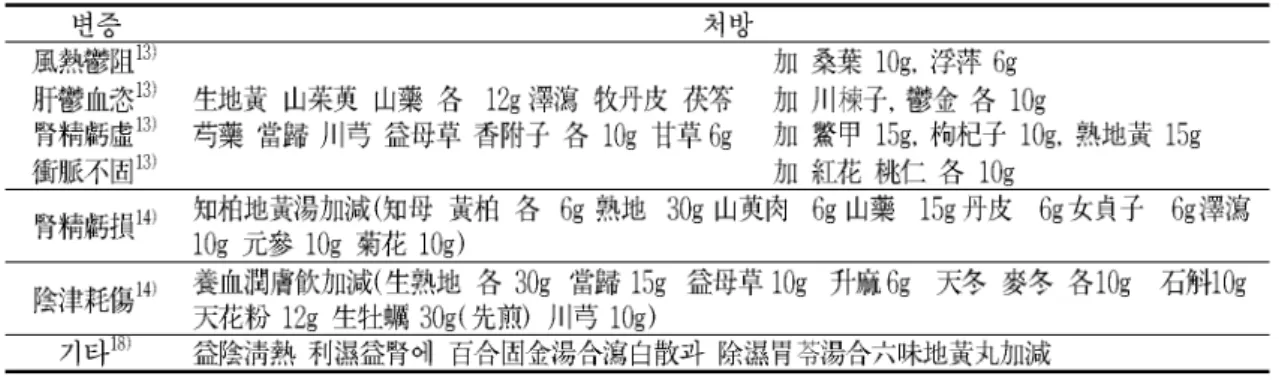
- 19 - Table 1. Classification of Pilosis and treatment medicines.
Table 2. Classification of Pilosis and acupoints.
Table 3. Other treatments for pilosis.
- 21 -