THE KOREAN JOURNAL OF HEMATOLOGY O R I G I N A L A R T I C L E
Improved outcome in childhood ALL with intensive consolidation and hematopoietic stem cell transplant
Jeong A Park
1, Thad Ghim
2, Keun Wook Bae
3, Kyung Nam Koh
3, Ho Joon Im
3, Jong Jin Seo
31Department of Pediatric, Inje University Haeundae Baik Hospital, Inje University College of Medicine, Busan, Korea, 2Department of Pediatrics, Hematology and Oncology, Emory University School of Medicine, Atlanta, GA, USA, 3Department of Pediatrics, Asan Medical Center, University of Ulsan College of Medicine, Seoul, Korea
p-ISSN 1738-7949 / e-ISSN 2092-9129 DOI: 10.5045/kjh.2010.45.2.109 Korean J Hematol 2010;45:109-14.
Received on March 12, 2010 Revised on June 16, 2010 Accepted on June 23, 2010
Background
Despite advances in chemotherapy, the prognosis of relapsed acute lymphoblastic leuke- mia (ALL) remains poor. Few studies on relapsed ALL have reported the importance of intensive consolidation followed with or without allogeneic hematopoietic stem cell transplantation (HSCT).
Methods
We evaluated the post-relapse outcomes in 47 Korean children with a first marrow relapse, and analyzed the prognostic factors.
Results
A second complete remission (CR) was achieved in 40 patients (85.1%), and at the time of this study, second CR was maintained in 12 of these patients. The estimated 3-yr event-free survival (EFS) rate after the first marrow relapse was 29.8±6.7%, and the overall survival (OS) rate was 45.3±7.5%. We found that second remission, consolidation of pe- diatric oncology group chemotherapy regimen (POG 9411), and HSCT significantly af- fected the outcome of the disease after relapse (P<0.001; P=0.004; P=0.05).
Conclusion
The results of our study revealed that an intensified POG 9411 consolidation chemo- therapy regimen followed by HSCT can improve the outcome of patients with relapsed ALL.
Key Words Acute lymphoblastic leukemia, Relapse, Intensive consolidation, Hemato- poietic stem cell transplantation
*This study was supported by a grant of The National R&D Program for Cancer Control, Ministry of Health & Welfare, Republic of Korea (Grant No. 0520290-3).
Correspondence to Jong Jin Seo, M.D., Ph.D.
Department of Pediatrics, Asan Medical Center, University of Ulsan College of Medicine, 388-1, Pungnap-2dong, Songpa-gu, Seoul 138-736, Korea Tel: +82-2-3010-3383 Fax: +82-2-473-3725 E-mail: [email protected]
Ⓒ 2010 Korean Society of Hematology
INTRODUCTION
Although the cure rate of childhood acute lymphoblastic leukemia (ALL) has remarkably improved with advances in chemotherapy, relapse still occurs in about 30% of the cases, with many patients showing relapse in the bone mar- row (BM) [1, 2]. Although second remission can be achieved after intensive reinduction chemotherapy in a majority of patients, many patients relapse again and experience a dismal outcome [3]. Hematopoietic stem cell transplantation (HSCT) is frequently performed to improve the outcome in patients with relapsed ALL. In this study, we evaluated the post-re- lapse outcomes of ALL in 47 Korean children with a first marrow relapse, and then analyzed the prognostic factors affecting the outcome, with the special focus on consolidation therapy and HSCT.
MATERIALS AND METHODS
1. Patients and treatment
Forty-seven patients (age, >1 yr) with an initial diagnosis of first BM relapse and without L3 morphology were included in this study between 1991 and 2006. Depending on the treatment period and the physicians, patients were treated with various ALL protocols adapted from the Children’s Cancer Group (CCG) [4-9] or the Pediatric Oncology Group (POG9411) (Table 1). In addition, 4 patients were treated according to the protocol of the Korean multicenter trial ALL0603 (Table 2). Allogeneic HSCT has been incorporated into intensive, multiagent chemotherapy regimens for the treatment of patients with relapsed ALL since 1999, and in this study, 10 patients underwent HSCT. Four patients received an allogeneic stem cell transplant from a human
Table 1. POG 9411 treatment schedule.
Induction
Prednisone 40 mg/m2/day PO in 3 divided doses for 28 days Vincristine 1.5 mg/m2(max 2 mg) IV weekly x 4
Doxorubicin 30 mg/m2/day IV at day 1 and 2
E. coli L-asparaginasea) 10,000 IU/m2 IM at days 1, 3, 5, 8, 10, 12, 15, 17, 19, 22, 24, and 26
Triple intrathecal therapy: methotrexate/hydrocortisone/cytarabine at days 1, 8, and 22
Consolidation I
Ifosfamide 2.8 g/m2 IV daily for 5 days Etoposide 100 mg/m2 IV daily for 5 days Consolidation II
Cytarabine 1 g/m2 IV daily for 4 days Idarubicinb) 5 mg/m2 IV daily for 4 days Course I
Etoposide 100 mg/m2 IV daily for 3 days Ifosfamide 3.4 g/m2 IV daily for 3 days Course II
6-thioguanine 75 mg/m2/day PO for 14 days
Methotrexate 25 mg/m2/dose PO q 6 hours x 4 doses at day 1 and 8
Triple intrathecal therapy on day 1 Course III
Cytarabine 1 g/m2 IV daily for 3 days Idarubicinc) 5 mg/m2 IV daily for 3 days Course IV
Vincristine 2 mg/m2 (max 2 mg) IV at days 1 and 8
Dexamethasone 8 mg/m2/day PO in 3 divided doses for 14 days E. coli L-asparaginase1 10,000 IU/m2 IM at days 1, 3, 5, 8, 10, 12,
15, 17
a)We substituted PEG to E-coli L-asparaginase due to Korean medical insurance problem. If cumulative dose of anthracylines ≥ 450 mg/m2, b)substitute PEG 2,500 IU/m2/day IM at day 1 and 8 or E-coli L-asparaginase 10,000 IU/m2 IM days 1, 3, 5, 8, 10, 12, 15 and 17, or c)discontinue idarubicin.
Table 2. ALL 0603 Induction for marrow relapsed ALL.
Prednisone 60 mg/m2 orally at days 1-28, then taper over 2 weeks
Idarubicin 10 mg/m2 IV at days 1, 8, 15, and 22 (give if ANC >500/μL, platelet >50,000/
μL at days 15,and 22)
Vincristine 1.5 mg/m2 (max 2 mg) IV at days 1, 8, 15, and 22
E.coli L-asparaginase 6,000 IU/m2 IM x 9 doses
Intrathecal therapy Hydrocortisone/cytarabine at days 1, 8, and 29
Abbreviation: ANC, absolute neutrophil count.
Table 3. Clinical characteristics of patients.
Characteristics No. of
patients %
Total 47
Sex Male 33 68.8
Female 14 29.2
NCI risk classification
at diagnosis Standard risk 28 58.8
High risk 19 39.6
Age at relapse Mean (years) 7.4
Range 1.5-16.4
<10 years 36 76.6
≥10 years 11 23.4
Relapse time Early 37 77.1
Late 10 20.8
Immunophenotype B lineage 41 85.4
T lineage 6 12.5
Karyotype at relapse Normal 14 29.8
Hypodiploidy 2 4.3
Hyperdiploidy 9 19.1
t(9:22) 3 6.4
t(4:11) 2 4.3
t(1:19) 1 2.1
Others 6 12.8
Unknown 10 21.3
Abbreviation: NCI, national cancer institute.
leukocyte antigen (HLA)-identical sibling donor, and 5 pa- tients received a stem cell transplant from an unrelated donor;
1 patient received a stem cell transplant from an HLA-hap- loidentical related donor. All patients except the patient who received the haploidentical transplant were conditioned with total body irradiation and cyclophosphamide. The pa- tient who received the haploidentical transplant was con- ditioned with a busulfan plus cyclophosphamide regimen.
2. Prognostic factors for treatment outcome
The clinical characteristics we examined were: age, sex, immunophenotype of leukemic blasts, the National Cancer Institute (NCI)’s risk classification (standard risk, 1-9 yr of age and WBC count of <50,000/μL vs. high risk: others) at initial presentation [10], early (<36 mo from initial diag- nosis) vs. late (≥36 mo from initial diagnosis) relapse, and treatment after relapse. We compared the second remission rates of different induction protocols. We compared the POG9411 consolidation regimen with other post-remission chemotherapies, and analyzed the effect of intensified con- solidation on survival after the second remission. In addition,
we analyzed that HSCT could affect the outcome of relapsed ALL patients.
3. Statistics
Complete remission (CR) was defined as less than 5%
blasts in BM aspirates, and hematologic recovery was defined as an absolute neutrophil count of over 1,000/μL and a platelet count greater than 100,000/μL. Univariate analyses of the association between CR rates and induction chemotherapies were performed using the chi-squared test. EFS was defined as the time from the first relapse to the next subsequent event (relapse, second malignancy, follow-up loss, or death from any cause). OS was defined as the time interval between the first relapse and death. EFS and OS curves were estimated using Kaplan-Meier analysis. Univariate Cox regression anal- ysis was performed for each potential predictor of outcome.
Fig. 1. Treatment overview and outcomes for patients with marrow-relapse ALL.
Table 4. Chemotherapies for marrow relapsed patients.
No. of patients
Induction protocol
CCG106 10
POG9411 9
ALL0603 4
CCG105 6
CCG106B 6
CCG104 3
CCG1884 4
Miscellaneous 5
Consolidation protocol
POG9411 13
CCG106 9
CCG106B 6
CCG105 4
CCG1884 4
CCG104 3
POG9160 3
Capizzi II 1
Miscellaneous 3
None 1
Relative hazard ratios (HR) with 95% confidence interval (CI) were determined for each factor while controlling the others. P-value was considered to be significant at <0.05.
All statistical analyses were performed using SPSS, version 13.0 (SPSS Inc, Chicago, IL).
RESULTS
1. Patient characteristics
Forty-seven patients, 33 men and 14 women, were ana- lyzed as of May 2010. Clinical characteristics of patients are shown in Table 3. The follow-up period after relapse ranged from 43 mo to 20 yr (median, 145.7 mo). The mean age at relapse was 7.4±0.6 yr, with a range of 1.5-16.4 yr.
The mean time from initial diagnosis to relapse was 17.5±3.2 mo. Forty-one patients had B cell immunophenotype, and 6 patients had T cell immunophenotype. According to the NCI risk classification, 28 patients were standard risk, and 19 patients were high risk. Thirty-seven relapses occurred within 36 mo from initial diagnosis (early relapse), while 10 patients relapsed after more than 36 mo from initial diag- nosis (late relapse).
2. Treatment outcome and prognostic factors
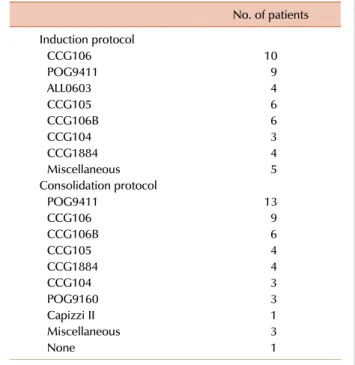
The overall treatment and outcome data are summarized in Fig. 1 and Table 4. Forty patients (85.1%) succeeded in attaining second remission, and 7 patients showed persistence (M2 or M3 marrow at day 29 of induction). There was no
significant difference in remission induction rates among ALL0603, POG9411, and other induction chemotherapies of the past (100% vs. 88.9% vs. 82.4%, P=0.6). After achieving second remission, the type of consolidation chemotherapy
Fig. 2. Event-free survival rates and overall survival rates of patients with marrow-relapse ALL. Event-free survival rates differed due to the achievement of second remission (A), consolidation chemotherapy after remission (B), and allogeneic hematopoeitic stem call transplantation (HSCT) (C). Overall survival rates were significantly affected by the achievement of second remission (D).
seemed to influence the outcome. Of the 40 patients who attained second remission, 12 patients (7 early relapses and 5 late relapses) were treated with a POG9411 consolidation regimen. After the second cycle of POG9411 consolidation, 7 patients (6 early relapses and 1 late relapse) underwent HSCT, and 5 patients continued on chemotherapy only.
Seven of the 12 patients treated with POG9411 remained in a continuous second remission at the time of this study.
On the other hand, of the 28 patients (25 early relapses and 3 late relapses) who received other consolidation regi- mens, only 3 underwent HSCT, and just 5 remained re- lapse-free to date. The EFS rate of the POG9411 consolidation group was significantly superior to that of the others (53.8±
13.8% vs. 14.7±6.1%, P=0.004) (Fig. 2).
The 3-yr EFS rate of marrow relapsed patients was 29.8±
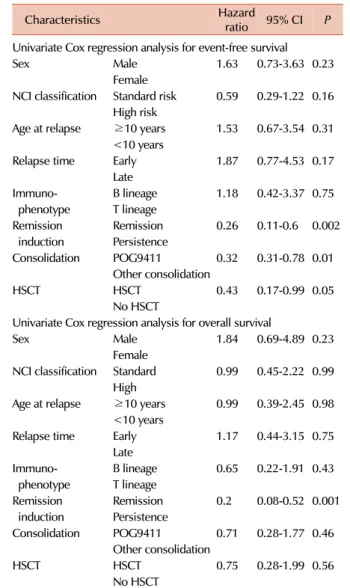
6.7%, and the 3-yr OS rate was 45.3±7.5%. Univariate analy- ses of EFS (Table 5) revealed that a second remission, POG9411 consolidation, and use of HSCT were significant prognostic factors (Fig. 2). Univariate analyses of OS (Table 5) revealed that achievement of a second remission sig- nificantly affected outcome (Fig. 1D). In the early-relapsed
group, EFS rates were significantly altered by HSCT (46.7%
vs. 13.7%, HR 0.034, 95% CI 0.16-0.93, P=0.034). However, HSCT was performed in only 1 late-relapsed patient, so the benefit of HSCT for late-relapsed patients was not clear (HR 0.45, 95% CI 0.05-4.05, P=0.48). Multivariate analysis con- curred with the results of the univariate analysis. However, only a second remission and POG9411 consolidation could significantly improve EFS rates (HR 0.17, 95% CI 0.06-0.47, P=0.001; HR 0.42, 95% CI 0.17-0.97, P=0.03), and just the attainment of remission could affect the OS (HR 0.12, 95%
CI 0.03-0.39, P<0.001).
DISCUSSION
Even with the improvement of chemotherapy, the prog- nosis of relapsed ALL remained poor. The poor prognosis was attributed to lower remission re-induction rates and a short duration of the second remission [8, 9]. Previous studies have reported that survival after relapse varies sig- nificantly depending on the time of relapse, sex, NCI risk
Table 5. Prognostic factors after marrow relapse.
Characteristics Hazard
ratio 95% CI P Univariate Cox regression analysis for event-free survival
Sex Male 1.63 0.73-3.63 0.23
Female
NCI classification Standard risk 0.59 0.29-1.22 0.16 High risk
Age at relapse ≥10 years 1.53 0.67-3.54 0.31
<10 years
Relapse time Early 1.87 0.77-4.53 0.17 Late
Immuno- B lineage 1.18 0.42-3.37 0.75
phenotype T lineage
Remission Remission 0.26 0.11-0.6 0.002 induction Persistence
Consolidation POG9411 0.32 0.31-0.78 0.01
Other consolidation
HSCT HSCT 0.43 0.17-0.99 0.05
No HSCT
Univariate Cox regression analysis for overall survival
Sex Male 1.84 0.69-4.89 0.23
Female
NCI classification Standard 0.99 0.45-2.22 0.99 High
Age at relapse ≥10 years 0.99 0.39-2.45 0.98
<10 years
Relapse time Early 1.17 0.44-3.15 0.75 Late
Immuno- B lineage 0.65 0.22-1.91 0.43
phenotype T lineage
Remission Remission 0.2 0.08-0.52 0.001 induction Persistence
Consolidation POG9411 0.71 0.28-1.77 0.46
Other consolidation
HSCT HSCT 0.75 0.28-1.99 0.56
No HSCT
Abbreviations: CI, confidence interval; NCI, national cancer in- stitute; HSCT, hematopoietic stem cell transplantation.
classification at initial diagnosis, and the treatment after relapse [11-14]. Our study was limited by the relatively small number of patients. Nonetheless, our study suggested that intensive consolidation, such as POG9411, and allogeneic HSCT were crucial and could improve outcome.
Prior experiences have shown that the most important factor affecting outcome was the time to relapse [14-16].
Although there was not enough statistical significance in our study, early-relapsed patients had a shorter second CR duration and lower OS rates than those of late-relapsed patients. In addition, some studies reported that an initial WBC less than 50,000/μL, and age younger than 10 yr at initial diagnosis predicted a more favorable outcome after relapse [14, 17], while our study failed to show any statistical significance of NCI risk classification on post-relapse outcome.
Attainment of second remission (M1 marrow at day 29 of re-induction) was a significant prognostic factor for EFS
and OS. It was an initial step toward a successful outcome, and patients who failed to go into remission within 4 weeks had a poorer prognosis. In our study, POG9411 consolidation therapy significantly increased the EFS rate after second remission. The POG9411 protocol was designed to deliver very intensive chemotherapy consisting of a modified stand- ard reinduction combination followed by 2 intensive con- solidation courses, followed by 4 courses of non-cross re- sistant drug combinations for continuation therapy. It ap- peared that POG9411 consolidation helped achieve a greater reduction of leukemia. A recent study of CCG1961 indicated that longer post-induction intensification failed to prolong EFS, while an early aggressive post-induction intensification resulted in better EFS and OS for patients with newly diag- nosed high-risk ALL [18]. Many studies have reported that the presence of minimal residual disease (MRD) prior to allogeneic transplantation is predictive of subsequent treat- ment failure [19, 20]. Superior outcome was observed if patients received the transplant with less malignant cell bur- den and lower MRD [21]. The end-induction MRD levels are strongly dependent on the intensity of the therapeutic regimens [22]. The POG9411 regimen may more effectively reduce the MRD as compared to other consolidations in this report.
In addition, HSCT significantly improved EFS rate for marrow-relapsed patients. In recent years, HSCT has been increasingly utilized in the management of relapsed leuke- mia. Previously published retrospective studies showed that the marrow-relapsed patients that received allogeneic HSCT, especially from HLA-matched sibling donors, showed a sig- nificantly better outcome than the patients that received chemotherapy alone [23-26]. However, benefits of HSCT in late BM relapse seemed less evident and the late-relapsed patients had a considerably better chance of cure by chemo- therapy alone [12, 26]. Our study also demonstrated that HSCT was more beneficial for EFS in early-relapsed patients, while there was no clear advantage of HSCT for EFS in late-relapsed patients.
This study showed that POG9411 intensive consolidation therapy followed by allogeneic HSCT conferred a better sur- vival rate in children with ALL with BM relapse. However, this retrospective study was limited by a relatively small number of patients and multiple heterogeneous treatment regimens. Since these patients were treated over a 20-yr period, the advancement in therapies and supportive care over time may have improved the treatment outcome. There- fore, a prospective multicenter trial involving a larger num- ber of patients treated with a uniform regimen is clearly required for ALL with BM relapse. We believe that the use of an intensive consolidation regimen comprising non- cross resistant drug combinations followed by HSCT should be an integral part of therapeutic strategy in designing a new protocol for the treatment of marrow-relapse ALL in children.
REFERENCES
1. Chessells JM. Treatment of childhood acute lymphoblastic leu- kaemia: present issues and future prospects. Blood Rev 1992;
6:193-203.
2. Rivera GK, Raimondi SC, Hancock ML, et al. Improved outcome in childhood acute lymphoblastic leukaemia with reinforced ear- ly treatment and rotational combination chemotherapy. Lancet 1991;337:61-6.
3. Chessells JM. Relapsed lymphoblastic leukaemia in children: a continuing challenge. Br J Haematol 1998;102:423-38.
4. Uckun FM, Nachman JB, Sather HN, et al. Poor treatment out- come of Philadelphia chromosome-positive pediatric acute lym- phoblastic leukemia despite intensive chemotherapy. Leuk Lymphoma 1999;33:101-6.
5. Hutchinson RJ, Gaynon PS, Sather H, et al. Intensification of ther- apy for children with lower-risk acute lymphoblastic leukemia:
long-term follow-up of patients treated on Children's Cancer Group Trial 1881. J Clin Oncol 2003;21:1790-7.
6. Heath JA, Steinherz PG, Altman A, et al. Human granulocyte col- ony-stimulating factor in children with high-risk acute lympho- blastic leukemia: a Children's Cancer Group Study. J Clin Oncol 2003;21:1612-7.
7. Gaynon PS, Steinherz PG, Bleyer WA, et al. Intensive therapy for children with acute lymphoblastic leukaemia and unfavourable presenting features. Early conclusions of study CCG-106 by the Childrens Cancer Study Group. Lancet 1988;2:921-4.
8. Gaynon PS, Harris RE, Altman AJ, et al. Bone marrow trans- plantation versus prolonged intensive chemotherapy for children with acute lymphoblastic leukemia and an initial bone marrow relapse within 12 months of the completion of primary therapy:
Children's Oncology Group study CCG-1941. J Clin Oncol 2006;24:3150-6.
9. Feig SA, Harris RE, Sather HN. Bone marrow transplantation ver- sus chemotherapy for maintenance of second remission of child- hood acute lymphoblastic leukemia: a study of the Children's Cancer Group (CCG-1884). Med Pediatr Oncol 1997;29:534-40.
10. Smith M, Arthur D, Camitta B, et al. Uniform approach to risk clas- sification and treatment assignment for children with acute lym- phoblastic leukemia. J Clin Oncol 1996;14:18-24.
11. Wheeler K, Richards S, Bailey C, Chessells J. Comparison of bone marrow transplant and chemotherapy for relapsed childhood acute lymphoblastic leukaemia: the MRC UKALL X experience.
Medical Research Council Working Party on Childhood Leukaemia. Br J Haematol 1998;101:94-103.
12. Borgmann A, von Stackelberg A, Hartmann R, et al. Unrelated do- nor stem cell transplantation compared with chemotherapy for children with acute lymphoblastic leukemia in a second re- mission: a matched-pair analysis. Blood 2003;101:3835-9.
13. Chessells JM, Veys P, Kempski H, et al. Long-term follow-up of relapsed childhood acute lymphoblastic leukaemia. Br J Haematol 2003;123:396-405.
14. Nguyen K, Devidas M, Cheng SC, et al. Factors influencing surviv-
al after relapse from acute lymphoblastic leukemia: a Children's Oncology Group study. Leukemia 2008;22:2142-50.
15. Henze G, Fengler R, Hartmann R, Niethammer D, Schellong G, Riehm H. BFM group treatment results in relapsed childhood acute lymphoblastic leukemia. Haematol Blood Transfus 1990;
33:619-26.
16. Buchanan GR, Rivera GK, Pollock BH, et al. Alternating drug pairs with or without periodic reinduction in children with acute lym- phoblastic leukemia in second bone marrow remission: a Pediatric Oncology Group Study. Cancer 2000;88:1166-74.
17. Malempati S, Gaynon PS, Sather H, La MK, Stork LC. Outcome after relapse among children with standard-risk acute lympho- blastic leukemia: Children's Oncology Group study CCG-1952. J Clin Oncol 2007;25:5800-7.
18. Seibel NL, Steinherz PG, Sather HN, et al. Early postinduction in- tensification therapy improves survival for children and adoles- cents with high-risk acute lymphoblastic leukemia: a report from the Children's Oncology Group. Blood 2008;111:2548-55.
19. Paganin M, Zecca M, Fabbri G, et al. Minimal residual disease is an important predictive factor of outcome in children with re- lapsed 'high-risk' acute lymphoblastic leukemia. Leukemia 2008;
22:2193-200.
20. Mehta PA, Davies SM. Pre-transplant minimal residual disease in children with acute lymphoblastic leukemia. Pediatr Blood Cancer 2007;48:1-2.
21. Krejci O, van der Velden VH, Bader P, et al. Level of minimal re- sidual disease prior to haematopoietic stem cell transplantation predicts prognosis in paediatric patients with acute lymphoblastic leukaemia: a report of the Pre-BMT MRD Study Group. Bone Marrow Transplant 2003;32:849-51.
22. zur Stadt U, Harms DO, Schlüter S, et al. MRD at the end of in- duction therapy in childhood acute lymphoblastic leukemia: out- come prediction strongly depends on the therapeutic regimen.
Leukemia 2001;15:283-5.
23. Matsuzaki A, Nagatoshi Y, Inada H, et al. Prognostic factors for relapsed childhood acute lymphoblastic leukemia: impact of allo- geneic stem cell transplantation--a report from the Kyushu- Yamaguchi Children's Cancer Study Group. Pediatr Blood Cancer 2005;45:111-20.
24. Boulad F, Steinherz P, Reyes B, et al. Allogeneic bone marrow transplantation versus chemotherapy for the treatment of child- hood acute lymphoblastic leukemia in second remission: a sin- gle-institution study. J Clin Oncol 1999;17:197-207.
25. Barrett AJ, Horowitz MM, Pollock BH, et al. Bone marrow trans- plants from HLA-identical siblings as compared with chemo- therapy for children with acute lymphoblastic leukemia in a sec- ond remission. N Engl J Med 1994;331:1253-8.
26. Eapen M, Raetz E, Zhang MJ, et al. Outcomes after HLA-matched sibling transplantation or chemotherapy in children with B-pre- cursor acute lymphoblastic leukemia in a second remission: a col- laborative study of the Children's Oncology Group and the Center for International Blood and Marrow Transplant Research. Blood 2006;107:4961-7.