Effect of abutment shade, ceramic thickness, and coping type on the final shade of zirconia all-ceramic restorations: in vitro study of color masking ability
Seon-Hee Oh1, Seok-Gyu Kim2*
1Department of Prosthodontics, Graduate School of Clinical Dental Science, The Catholic University of Korea, Seoul, Republic of Korea
2Department of Prosthodontics, Samsung Medical Center, College of Medicine, Sungkyunkwan University, Seoul, Republic of Korea
PURPOSE. The aim of the study was to evaluate the effect of abutment shade, ceramic thickness, and coping type on the final shade of zirconia all-ceramic restorations. MATERIALS AND METHODS. Three different types of disk-shaped zirconia coping specimens (Lava, Cercon, Zirkonzahn: ø10 mm × 0.4 mm) were fabricated and veneered with IPS e.max Press Ceram (shade A2), for total thicknesses of 1 and 1.5 mm. A total of sixty zirconia restoration specimens were divided into six groups based on their coping types and thicknesses. The abutment specimens (ø10 mm × 7 mm) were prepared with gold alloy, base metal (nickel-chromium) alloy, and four different shades (A1, A2, A3, A4) of composite resins. The average L*, a*, b* values of the zirconia specimens on the six abutment specimens were measured with a dental colorimeter, and the statistical significance in the effects of three variables was analyzed by using repeated measures analysis of variance (α=.05).The average shade difference (∆E) values of the zirconia specimens between the A2 composite resin abutment and other abutments were also evaluated. RESULTS. The effects of zirconia specimen thickness (P<.001), abutment shade (P<.001), and type of zirconia copings (P<.003) on the final shade of the zirconia restorations were significant.
The average ∆E value of Lava specimens (1 mm) between the A2 composite resin and gold alloy abutments was higher (close to the acceptability threshold of 5.5 ∆E) than those between the A2 composite resin and other abutments. CONCLUSION. This in-vitro study demonstrated that abutment shade, ceramic thickness, and coping type affected the resulting shade of zirconia restorations. [J Adv Prosthodont 2015;7:368-74]
KEY WORDS: Abutment; Zirconia; Restoration
INTRODUCTION
The effort of imitating the beauty of natural teeth in the
esthetic dentistry led to the development of ceramic cop- ings which had similar translucency and strength to natural teeth. The translucency of coping was recognized as one of the key factors determining the optical characteristics of all-ceramic restorations. The color of ceramic restorations can be expressed according to the CIE L*a*b* system. L*
represents lightness, a* represents redness on the positive axis and greenness on the negative axis, and b* represents yellowness on the positive axis, and blueness on the nega- tive axis.
The use of zirconia restorations with adequate translu- cency and high fracture strength is increasing. The fracture strength of zirconia restorations was reported to be twice that of alumina restorations.1-3 Relatively thin zirconia cop- ing allowed a sufficient amount of veneering porcelain, making the restoration more translucent.
Corresponding author:
Seok-Gyu Kim
Department of Prosthodontics, Samsung Medical Center, College of Medicine, Sungkyunkwan University, 20, Itaewon-ro 55-gil, Yongsan-gu, Seoul 04348, Republic of Korea
Tel. 82 2 792 6114: e-mail, [email protected]
Received April 10, 2015 / Last Revision July 21, 2015 / Accepted September 23, 2015
© 2015 The Korean Academy of Prosthodontics
This is an Open Access article distributed under the terms of the Creative Commons Attribution Non-Commercial License (http://creativecommons.
org/licenses/by-nc/3.0) which permits unrestricted non-commercial use, distribution, and reproduction in any medium, provided the original work is properly cited.
Recent studies reported that the thickness of the coping and veneering porcelain influenced the final shade of all- ceramic crowns.4-6 Repeated sintering was also found to influence the shade of all-ceramic crowns.4 Leucite- reinforced ceramic crowns had a greater thickness effect on a* and b* values, and Spinell ceramic crowns on L* and b*
values.5 All-ceramic crowns with low translucency had a less thickness effect, while those with high translucency had a greater thickness effect on their shades.6
Heffernan et al.7,8 compared the translucency of various all-ceramic crowns. In their study, In-Ceram Spinell, IPS Empress, and IPS Empress 2 showed the highest translu- cency, with Procera having an intermediate value, and In-Ceram Alumina and In-Ceram Zirconia the lowest trans- lucency. Zirconia crowns have lower translucency than Spinell or Empress crowns, but they may mask the dark shade of a metal post or a stained abutment due to their low translucency.
Because zirconia crowns have been widely used in ante- rior areas, their esthetic characteristics including translucen- cy were investigated using various methods.7-16 Zirconia crowns became more translucent as they became thinner, although the effect was weaker than that of glass ceramic.9 Zirconia crowns were less translucent than glass ceramic ones with the same thickness because the dense oxide ceramic structure of zirconia allowed more absorption and reflection rather than transmission of light.10,11 The translu- cency of zirconia crowns depended on the coloring and manufacturing methods of the coping, as well as the veneering technique.10-12 Color pigmentation of zirconia coping reduced its translucency, while pressed veneering made zirconia crowns more translucent than layered veneering.10,12
Two methods, which were absolute and relative translu- cency measuring methods, have been used for studying the translucency of all-ceramic crowns. The absolute translu- cency was measured by a spectrophotometer or a spectrora- diometer, which detected the whole light transmitted through the ceramic crown. The relative translucency mea- suring method was used to compare the relative translucen- cy of various all-ceramic crowns by the contrast ratio or translucency parameter that was measured on a black and white background.6-16 Some zirconia crowns with high translucency were proven to have light-scattering character- istics similar to human dentin in recent studies, but they showed higher L* and lower a*, b* values than dentin.14
There have been some recent studies on the shade- masking ability of highly translucent lithium disilicate glass ceramics,17-19 but similar studies on zirconia crowns were not common. The purpose of the present study was to evaluate the effects of abutment shade, ceramic thickness, and coping type on the final shade of three different types of zirconia crowns, and also to evaluate the masking ability of zirconia crowns with different thicknesses and abutment shades. The null hypothesis was that there were no signifi- cant differences in the average L*, a*, b* values of zirconia specimens with different abutment shades, ceramic thick- nesses, and coping types.
MATERIALS AND METHODS
Disk-shaped zirconia copings with uniform dimensions (Ø 10 mm × 0.4 mm) were prepared from three different zir- conia systems: Lava (3M ESPE, St. Paul, MN, USA), Cercon (Degudent GmbH, Hanau, Germany), and Zirkonzahn (Zirkonzahn GmbH, Gais, Italy). The zirconia copings went through milling, cleaning, and drying as pre-sintered zirconium oxide. They were then sintered according to the manufacturer’s instructions and ground using 1000 grit sandpaper. Each zirconia system had twenty coping speci- mens.
IPS e.max Press Ceram powder (A2 shade, Ivoclar Vivadent, Schaan, Liechtenstein) was built up and sintered on the prepared zirconia copings to total thicknesses of 1 mm (0.4 mm coping + 0.1 mm liner + 0.3 mm dentin por- celain + 0.2 mm enamel porcelain)and 1.5 mm (0.4 mm coping + 0.1 mm liner + 0.7 mm dentin porcelain + 0.3 mm enamel porcelain), as measured with an electronic cali- per (Model-DC515, Lutron Electronic Enterprise Co., Ltd., Taipei, Taiwan). After the exact thicknesses were achieved, the zirconia specimens were glazed. The whole fabrication procedure was performed by one dental laboratory techni- cian. Each zirconia specimen was cleaned in an ultrasonic cleaner for 5 minutes and dried. Zirconia restoration speci- mens were divided into six groups (Lava 1 mm (L1), Lava 1.5 mm (L1.5), Cercon 1 mm (C1), Cercon 1.5 mm (C1.5), Zirkonzahn 1 mm (Z1), and Zirkonzahn 1.5 mm (Z1.5)) according to their thickness and coping type. Each group had ten specimens.
The abutment specimens were made of gold alloy (type III; Pontor MPF, Cendres+Métaux SA, Biel/Bienne, Switzerland), base metal alloy (Nickel-chromium; Argeloy
Table 1. Translucency parameter (TP) values of six abutment and six zirconia specimens
Abutment BM (2.12) G (0.86) A1 (0.5) A2 (1.42) A3 (0.68) A4 (0.66)
Zirconia L1 (12.19) L1.5 (8.18) C1 (10.19) C1.5 (7.03) Z1 (9.91) Z1.5 (7.8)
BM = base metal alloy, G = gold alloy, A1-4 = A 1 to A4 shade of composite resin, L1 = Lava 1 mm, L1.5 = Lava 1.5 mm, C1 = Cercon 1 mm, C1.5 = Cercon 1.5 mm, Z1 = Zirkonzahn 1 mm, and Z1.5 = Zirkonzahn 1.5 mm.
N.P. Special, the Argen Cor., San Diego, CA, USA), and composite resin (A1, A2, A3, A4 shades, Herculite Precis Enamel, Kerr, Orange, CA, USA). A silicone putty (Extrude XP Putty, Kerr, Orange, CA, USA) mold with disk-shaped holes (ø10 mm × 3 mm) was prepared and applied in the holes with petroleum jelly. Cold curing orthodontic acrylic resin (Ortho-Jet, Lang Dental, Wheeling, IL, USA) powder and liquid were mixed and poured in the holes of the putty mold. The fully polymerized acrylic resin disks were then separated from the silicone putty mold, invested, and cast into type III gold alloy and nickel-chromium alloy. The disk-shaped cast alloy specimens were trimmed and pol- ished to 3 mm-thickness. Composite resin was filled in the holes of the transparent plastic mold(ø10 mm × 7 mm) applied with petroleum jelly and light-cured (A pilot study for evaluating the thickness of the resin abutment sufficient to mask the background shade was performed, and the minimum thickness was found to be 7 mm). The cured res- in specimens were separated from the mold, and ground to 7 mm-thickness with 1000 grit sandpaper. The abutment specimens were divided into six groups (BM (base metal alloy), G (type III gold alloy), A1, A2, A3, and A4 (compos- ite resins)) based on the materials used.
The CIE L*a*b* values of six abutment specimens were measured with a dental colorimeter (ShadeEye NCC, Shofu Inc., Kyoto, Japan) when the abutment specimens were placed on a black background (L = 8.6, a = 1.3, b = 0.5) and a white background (L = 91.1, a = 2.6, b = -7.1).
Translucency parameter (TP) values representing the trans- lucency of six abutments were obtained by applying the fol- lowing equation.9 The TP values of six ceramic specimens with different thicknesses and coping types were also obtained (Table 1). TP values below 2 were considered to represent the material with translucency low enough to completely mask the black background.10 The color mea- surement by the dental colorimeter used D65 as a light source under the standard lighting system (Super Light-VI, BoTeck, GunPo, Korea). The dental colorimeter was cali- brated, and measurements were made using an elastic touch probe placed perpendicular to the specimens on a 45 degree plate (45/0-degree geometry).
TP = ((L*B - L*W)² + (a*B - a*W)² + (b*B - b*W)²)1/2 L*: brightness, a*: redness to greenness, b*: yellowness to blueness, B: black background, W: white background
Six groups of the zirconia specimens were matched with six groups of the abutment specimens for the final shade evaluation. Each zirconia specimen was stabilized on each abutment specimen with translucent Choice try-in paste (Bisco Inc., Schaumburg, IL, USA). The color of the zirconia specimens on the abutments was measured three times in the ‘analyze mode’ using a dental colorimeter (ShadeEye NCC, Shofu Inc., Kyoto, Japan). The L*, a*, and b* values of each combination were obtained and averaged.
In addition, the shade-masking ability of the zirconia
specimens measured on the different shades of abutments was evaluated. The shade difference values (∆E) of the zir- conia specimens between the A2 shade and other shades of the abutments were obtained by the following equation.
Based on previous studies, any shade difference values (∆E) that were less than 2.6 were regarded as clinically shade- matched (not-perceptible), and any ∆E values greater than 5.5 were regarded as clinically unacceptable.20-23
∆E = ((∆L*)² + (∆a*)² + (∆b*)²)½
L*: brightness, a*: redness to greenness, b*: yellowness to blueness
∆L* = L1* - L2*, ∆a* = a1* - a2*, ∆b* = b1* - b2*
Repeated measures analysis of variance (α = .05) was used to evaluate the statistical significance of the effects of the ceramic thickness, abutment shade, and types of coping on the final shade of the zirconia specimens. SAS for Windows (9.3, SAS Institute Inc., Cary, NC, USA) was used for the statistical analysis.
RESULTS
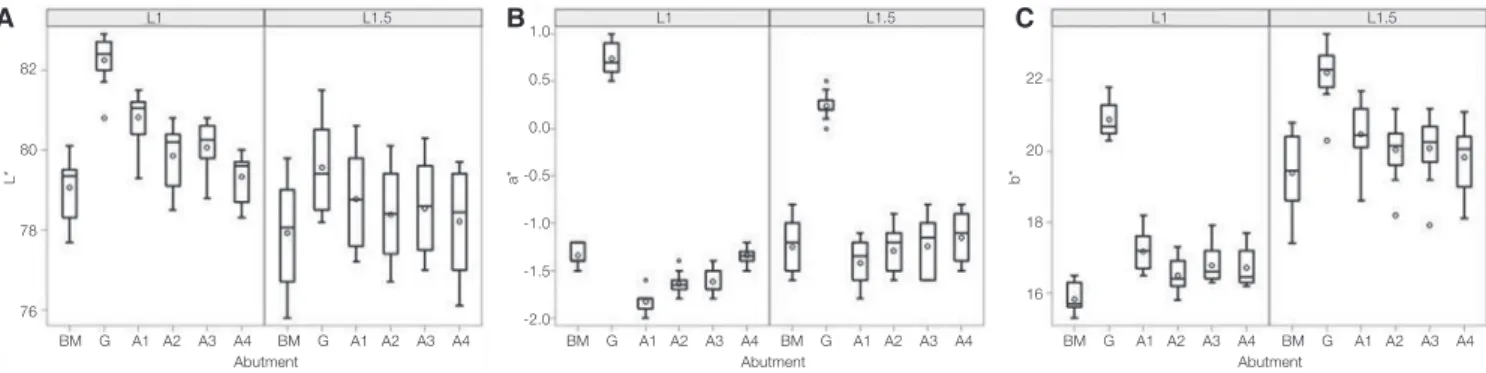
The average L*, a*, b* values of the zirconia specimens on the abutments are shown in Fig. 1, Fig. 2, and Fig. 3. When the ceramic thickness increased from 1 to 1.5 mm, the L*
value decreased, and the a* and b* values increased. The gold abutment (G) showed the highest L*, a*, b* values, and the base metal abutment (BM) had the lowest L*, b*
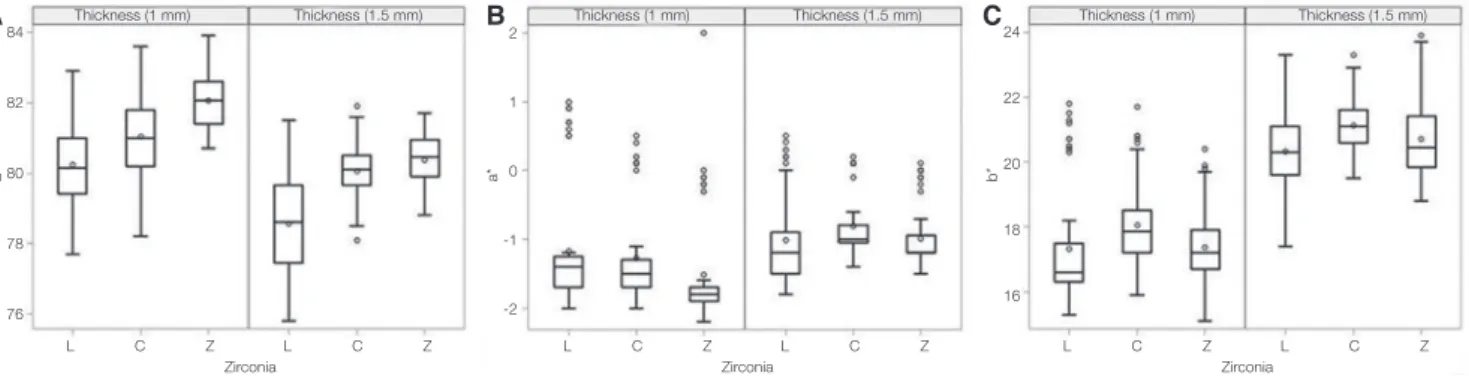
values. The average L*, a*, b* values of three types of the zirconia specimens with 1 and 1.5 mm thicknesses are com- pared in Fig. 4. The a* and b* values showed little differ- ence among the zirconia specimens, but the lowest L* value was observed in the Lava specimens. According to the results from the repeated measures analysis of variance, there were significant effects of the ceramic thicknesses (P
< .001), abutment shades (P < .001), and types of zirconia coping (P < .003) on the final shade of the zirconia restora- tions.
In a clinical case, zirconia crowns can be placed on adja- cent abutments with different shades. The type and thick- ness of the zirconia crowns should be determined to mask the abutment shade differences. In this study, the gold abutment (G) showed the highest L*, a*, and b* values, and other abutments showed lower values with only minute dif- ferences among themselves. It was necessary to determine whether these differences were within the acceptable range of the human eye. The shade differences (∆E) of the zirco- nia specimens between the A2 resin (control: the same shade as the ceramic specimens) and other shades of abut- ments were compared in Fig. 5 and Fig. 6. For the 1 mm- thick zirconia specimens, the ∆E value between the gold alloy and A2 resin abutments was the greatest (> 2.6).
Other abutments showed minor differences (∆E) from the A2 resin abutment, and the values were 1 or less. Lava
Fig. 1. Mean L*a*b* values of Lava (L) zirconia specimens on different shades of abutment specimens. (A) Mean L*
values, (B) Mean a* values, (C) Mean b* values.
Abbreviations; L1: Lava 1 mm, L1.5: Lava1.5 mm, BM: base metal alloy, G: gold alloy, A1-A4: A1-A4 shades of composite resin, L*: lightness, a*: redness(+).greenness(-), b*: yellowness(+)/blueness(-).
L1 L1.5 L1 L1.5 L1 L1.5
82
80
78
76
L*
1.0 0.5 0.0 -0.5 -1.0 -1.5 -2.0
a* b*
22
20
18
16
BM G A1 A2 A3 A4 BM G A1 A2 A3 A4 Abutment
BM G A1 A2 A3 A4 BM G A1 A2 A3 A4 Abutment
BM G A1 A2 A3 A4 BM G A1 A2 A3 A4 Abutment
A B C
Fig. 2. Mean L*a*b* values of Cercon (C) zirconia specimens on different shades of abutment specimens. (A) Mean L*
values, (B) Mean a* values, (C) Mean b* values.
Abbreviations; C1: Cercon 1 mm, C1.5: Cercon 1.5 mm, BM; base metal alloy, G: gold alloy, A1- A4: A1-A4 shades of compsite resin, L*: lightness, a*: redness(+).greenness(-), b*: yellowness(+)/blueness(-).
C1 C1.5 C1 C1.5 C1 C1.5
83 82 81 80 79 78
L*
0.5 0.0 -0.5 -1.0 -1.5 -2.0
a* b*
22
20
18
16 BM G A1 A2 A3 A4 BM G A1 A2 A3 A4
Abutment
BM G A1 A2 A3 A4 BM G A1 A2 A3 A4 Abutment
BM G A1 A2 A3 A4 BM G A1 A2 A3 A4 Abutment
A B C
Fig. 3. Mean L*a*b* values of Zirkonzahn (Z) zirconia specimens on different shades of abutment specimens. (A) Mean L* values, (B) Mean a * values, (C) Mean b* values.
Abbreviations; Z1: Zirkonzahn 1 mm, Z1.5: Zirkonzahn 1.5 mm, BM: base metal alloy, G: gold alloy, A1-A4: A1-A4 shades of composite resin, L*: lightness, a*: redness(+)/greenness(-), b*: yellowness(+)/blueness(-).
Z1 Z1.5 Z1 Z1.5 Z1 Z1.5
84 83 82 81 80 79
L*
2
1
0
-1
-2
a* b*
24
22
20
18
16
BM G A1 A2 A3 A4 BM G A1 A2 A3 A4 Abutment
BM G A1 A2 A3 A4 BM G A1 A2 A3 A4 Abutment
BM G A1 A2 A3 A4 BM G A1 A2 A3 A4 Abutment
A B C
showed the highest ∆E value (5.5) between the A2 resin and gold alloy abutments, and Zirkonzahn showed the low- est. The 1.5 mm-thick ceramic specimens had overall lower
∆E values (< 2.6 except Lava between A2 and gold) than the 1 mm-thick ones.
DISCUSSION
The null hypothesis in the present study was rejected based on the results showing significant differences in L*, a*, b*
values related to abutment shade, ceramic thickness and coping type. The influence of the abutment shade on the final color of the all-ceramic crowns was significant, affect- ing the L*, a*, and b* values, as shown in Fig. 1, Fig. 2, and Fig. 3. The zirconia specimens, when measured on the gold
alloy abutments, showed the highest L*, a*, and b* values, regardless of the ceramic thickness or coping type. This result was in agreement with the previous study. Shimada et al.24 found in their colorimeter study that the all-ceramic crowns placed on gold alloy abutments showed significantly higher L*, a*, and b* values than those on composite or sil- ver-palladium alloy abutments. They used IPS Empress 2 for ceramic specimens. In contrast, Azer et al.25 found that the final shade of the IPS Empress crowns was not affect- ed by the different shades of the composite cores. They used composite cores with small differences in shade, such as A3, B3, C3, and D3.
Shimada et al.24 also found in their study that not only the abutment shade but also the ceramic thickness (0.8, 1, 1.2, 1.4, 1.6, 1.8 mm) affected the final shade of IPS Fig. 4. Mean L* a* b* values of Lava (L), Cercon (C), and Zirkonzahn (Z) zirconia specimens on abutment specimens.
(A) Mean L* values, (B) Mean a* values, (C) Mean b* values.
Abbreviations; L*: lightness, a*: redness(+)/greenness(-), b*: yellowness(+)/blueness(-).
Thickness (1 mm) Thickness (1.5 mm) Thickness (1 mm) Thickness (1.5 mm) Thickness (1 mm) Thickness (1.5 mm) 84
82
80
78
76
L*
2
1
0
-1
-2
a* b*
24
22
20
18
16
L C Z L C Z Zirconia
A B C
L C Z L C Z Zirconia
L C Z L C Z Zirconia
Fig. 5. ∆E values of zirconia specimens (1 mm thickness) between A2 resin and other shades of abutment
specimens.
Abbreviations; L1: Lava 1 mm, C1: Cercon 1 mm, Z1:
Zirkonzahn 1 mm, BM: base metal alloy abutment, G:
gold alloy abutment, A1-A4: A1-A4 shades of composite resin abutment, ∆E: shade difference.
Fig. 6. ∆E values of zirconia specimens (1.5 mm thickness) between A2 resin and other shades of abutment specimens.
Abbreviations; L1.5: Lava 1.5 mm, C1.5: Cercon 1.5 mm, Z1.5: Zirkonzahn 1.5 mm, BM: base metal alloy
abutment, G: gold alloy abutment, A1-A4: A1-A4 shades of composite resin abutment, ∆E: shade difference.
6.00 5.50 5.00
4.00
3.00 2.60
2.00
1.00
0.00
∆E
L1 C1 Z1
L1.5 C1.5 Z1.5 3.00
2.60 2.50
2.00
1.50
1.00
0.50
0.00
∆E
BM-A2 G-A2 A1-A2 A3-A2 A4-A2 BM-A2 G-A2 A1-A2 A3-A2 A4-A2
Empress 2 specimens. Dozić et al.26 reported that the ceramic thickness was inversely related to the translucency and could affect the final shade of the all-ceramic crown.
The present study compared the shade values of the 1 mm- and 1.5 mm-thick zirconia specimens and found a signifi- cant difference between the thicknesses.
Wang et al.9 showed there were differences in translu- cency among various zirconia ceramics, such as Cercon Base, Lava, or Zenotec. Crispin et al.27 reported that one of the primary elements affecting the shade of all-ceramic crowns was the translucency of the coping. In the present study, the translucency of each zirconia system was not directly measured. Instead, the shade of zirconia specimens placed on different shades of abutments was measured.
The type of zirconia coping was, thus, found to affect the final shade of the zirconia restoration.
In the present study, ∆E values of the zirconia speci- mens between the A2 and other shades of abutments were obtained to evaluate the shade masking ability of the zirco- nia crowns. The ∆E values of three types (L, C, and Z) of 1 mm-thick zirconia specimens were all found to be the high- est (> 2.6) between the A2 resin and gold alloy abutments, compared to other abutments. Lava (L), among three types, showed the highest ∆E value (close to 5.5) between the A2 resin and gold alloy abutments (Fig. 5). For the 1.5 mm- thick zirconia specimens, all three types also showed the highest ∆E values between the A2 resin and gold alloy abutment, and Lava (L) presented a ∆E value between 2.6 and 5.5 (Fig. 6). Although the translucency of Lava zirconia crowns was lower than that of IPS e.max Press or InCeram Spinell, the shade of a gold alloy post and core adjoining an A2 shade tooth would not be completely masked even with Lava zirconia crowns.7,9
There have been some studies on the minimum color difference (∆E) perceivable by human observers. Seghi et al.28 stated that alterations in color perception could occur as a result of any number of uncontrolled factors, including fatigue, aging, emotions, lighting conditions, and metamer- ism, but human eye-brain combinations could detect very small differences in color between two objects. They reported that a measured color difference value of greater than 2 ∆E units was correctly detected by the observer group 100% of the time, and incorrect judgments were made only infrequently by the observers when the mea- sured color difference fell within the 1 to 2 ∆E unit range.
Compared to the perceptibility threshold, some researchers have reported that the color difference accepted by 50% of observers is 1.7 - 3.3 ∆E units.20,21,23 Due to some intraoral variables, the clinically perceptible and acceptable color dif- ferences were reported to have higher values than those measured in a strictly controlled in vitro environment.20-23,29 In the present study, therefore, 2.6 and 5.5 ∆E units were adopted as the 50% clinical perceptibility and acceptability thresholds.
The present study was aimed at not only finding the fac- tors that affect the final shade of zirconia crowns, but also evaluating the masking ability of zirconia crowns on differ-
ent shades of abutments. The shade of all of the veneered zirconia specimens was A2, which was thus chosen as the control abutment shade for comparison with other ones.
Other shades of zirconia and abutment specimens also need to be compared for clinical applications.
The shade of abutments made of composite resin, in the present study, could be influenced by the background color if the abutment specimen was not thick enough for masking the color. TP values for four 7 mm-thick resin abutments were found to range from 0.5 to 1.42. Because TP values below 2 indicated the 100% masking ability for a black background, the four resin abutments were not affected by the shade of the background.9,17,28
The ShadeEye NCC Chromameter (Shofu Inc., Kyoto, Japan) used in the present study is a closed-type dental col- orimeter, which might introduce ‘edge loss error’ when measuring the color of translucent specimens.30,31 ‘Edge loss error’ occurs when light from an illuminant travels through the small window of the colorimeter. Some of the light cannot go back into the sensor window of the color- imeter when reflected. As a result, the repeatedly measured value of the color might have some variations. This closed window type colorimeter is thought to be less influenced by the outside light.
CONCLUSION
Within the limitations of an in-vitro study in mind, the present study demonstrated there were significant influenc- es of the ceramic thickness, abutment shade and type of coping on the resulting color of three zirconia restorations (Lava, Cercon, and Zirkonzahn). Evaluations of the ∆E values of zirconia specimens (A2 shade) between different shades of abutments led to the following clinical implica- tion: Lava crowns, when placed on a gold alloy post, may not be shade-matched with an adjacent tooth.
ACKNOWLEDGEMENTS
We thank to Kyoung-Sik Park for his excellent laboratory work of the ceramic specimens and Seon-Woo Kim for the excellent statistical analysis.
ORCID
Seok-Gyu Kim http://orcid.org/0000-0002-4024-0215 REFERENCES
1. Piconi C, Maccauro G. Zirconia as a ceramic biomaterial.
Biomaterials 1999;20:1-25.
2. Ozkurt Z, Kazazoglu E, Unal A. In vitro evaluation of shear bond strength of veneering ceramics to zirconia. Dent Mater J 2010;29:138-46.
3. Kelly JR, Nishimura I, Campbell SD. Ceramics in dentistry: his- torical roots and current perspectives. J Prosthet Dent 1996;75:
18-32.
4. Uludag B, Usumez A, Sahin V, Eser K, Ercoban E. The ef- fect of ceramic thickness and number of firings on the color of ceramic systems: an in vitro study. J Prosthet Dent 2007;
97:25-31.
5. Shokry TE, Shen C, Elhosary MM, Elkhodary AM. Effect of core and veneer thicknesses on the color parameters of two all-ceramic systems. J Prosthet Dent 2006;95:124-9.
6. Antonson SA1, Anusavice KJ. Contrast ratio of veneering and core ceramics as a function of thickness. Int J Prosthodont 2001;14:316-20.
7. Heffernan MJ, Aquilino SA, Diaz-Arnold AM, Haselton DR, Stanford CM, Vargas MA. Relative translucency of six all-ce- ramic systems. Part I: core materials. J Prosthet Dent 2002;
88:4-9.
8. Heffernan MJ, Aquilino SA, Diaz-Arnold AM, Haselton DR, Stanford CM, Vargas MA. Relative translucency of six all-ce- ramic systems. Part II: core and veneer materials. J Prosthet Dent 2002;88:10-5.
9. Wang F, Takahashi H, Iwasaki N. Translucency of dental ce- ramics with different thicknesses. J Prosthet Dent 2013;110:
14-20.
10. Spyropoulou PE, Giroux EC, Razzoog ME, Duff RE.
Translucency of shaded zirconia core material. J Prosthet Dent 2011;105:304-7.
11. Baldissara P, Llukacej A, Ciocca L, Valandro FL, Scotti R.
Translucency of zirconia copings made with different CAD/
CAM systems. J Prosthet Dent 2010;104:6-12.
12. Luo XP, Zhang L. Effect of veneering techniques on color and translucency of Y-TZP. J Prosthodont 2010; 19:465-70.
13. Lim HN, Yu B, Lee YK. Spectroradiometric and spectropho- tometric translucency of ceramic materials. J Prosthet Dent 2010;104:239-46.
14. Pecho OE, Ghinea R, Ionescu AM, Cardona Jde L, Paravina RD, Pérez Mdel M. Color and translucency of zirconia ce- ramics, human dentine and bovine dentine. J Dent 2012;40:
e34-40.
15. Barizon KT, Bergeron C, Vargas MA, Qian F, Cobb DS, Gratton DG, Geraldeli S. Ceramic materials for porcelain ve- neers. Part I: Correlation between translucency parameters and contrast ratio. J Prosthet Dent 2013;110:397-401.
16. Spink LS, Rungruanganut P, Megremis S, Kelly JR.
Comparison of an absolute and surrogate measure of rela- tive translucency in dental ceramics. Dent Mater 2013;29:702- 7.
17. Chaiyabutr Y, Kois JC, Lebeau D, Nunokawa G. Effect of abutment tooth color, cement color, and ceramic thickness on the resulting optical color of a CAD/CAM glass-ceramic lithium disilicate-reinforced crown. J Prosthet Dent 2011;
105:83-90.
18. Ali AAB, Kang K, Finkelman MD, Zandparsa R, Hirayama H. The effect of variations in translucency and background on color differences in CAD/CAM lithium disilicate glass ce- ramics. J Prosthodont 2014;23:213-20.
19. Charisis D, Koutayas SO, Kamposiora P, Doukoudakis A.
Spectrophotometric evaluation of the influence of different backgrounds on the color of glass-infiltrated ceramic ve- neers. Eur J Esthet Dent 2006;1:142-56.
20. Douglas RD, Brewer JD. Acceptability of shade differences in metal ceramic crowns. J Prosthet Dent 1998;79:254-60.
21. Ragain JC Jr, Johnston WM. Color acceptance of direct den- tal restorative materials by human observers. Color Res Appl 2000;25:278-85.
22. Douglas RD, Steinhauer TJ, Wee AG. Intraoral determination of the tolerance of dentists for perceptibility and acceptabili- ty of shade mismatch. J Prosthet Dent 2007;97:200-8.
23. Ruyter IE, Nilner K, Moller B. Color stability of dental com- posite resin materials for crown and bridge veneers. Dent Mater 1987;3:246-51.
24. Shimada K, Nakazawa M, Kakehashi Y, Matsumura H.
Influence of abutment materials on the resultant color of heat-pressed lithium disilicate ceramics. Dent Mater J 2006;
25:20-5.
25. Azer SS, Ayash GM, Johnston WM, Khalil MF, Rosenstiel SF.
Effect of esthetic core shades on the final color of IPS Empress all-ceramic crowns. J Prosthet Dent 2006;96:397- 401.
26. Dozić A, Kleverlaan CJ, Meegdes M, van der Zel J, Feilzer AJ. The influence of porcelain layer thickness on the final shade of ceramic restorations. J Prosthet Dent 2003;90:563- 70.
27. Crispin BJ, Okamoto SK, Globe H. Effect of porcelain crown substructures on visually perceivable value. J Prosthet Dent 1991;66:209-12.
28. Seghi RR, Hewlett ER, Kim J. Visual and instrumental colori- metric assessments of small color differences on translucent dental porcelain. J Dent Res 1989;68:1760-4.
29. Johnston WM, Kao EC. Assessment of appearance match by visual observation and clinical colorimetry. J Dent Res 1989;
68:819-22.
30. Bolt RA, Bosch JJ, Coops JC. Influence of window size in small-window colour measurement, particularly of teeth.
Phys Med Biol 1994;39:1133-42.
31. Johnston WM, Hesse NS, Davis BK, Seghi RR. Analysis of edge-losses in reflectance measurements of pigmented maxil- lofacial elastomer. J Dent Res 1996;75:752-60.