59
Mechanisms of Acquired Resistance to Epidermal Growth Factor Receptor Inhibitors and Overcoming Strategies in Lung Cancer
Although epidermal growth factor receptor tyrosine kinase inhibitors (EGFR- TKIs) such as gefitinib and erlotinib show good response and survival benefit in EGFR-mutant lung cancer, acquired resistance inevitably develops which limits the median response duration to around 1 year. Secondary T790M gate- keeper mutation is the most common mechanism representing approximately 50% of resistance. The suggested strategies for overcoming T790M including irreversible EGFR-TKIs, mutant-selective EGFR-TKIs, EGFR dual targeting and HSP90 inhibitors should be further investigated for clinical application. Bypass signals through MET or AXL also contribute to resistance, which lead to development of MET or AXL inhibitors. Other mechanisms such as small cell transformation, epithelial-to-mesenchymal transition, PI3KCA mutation, ERK/
HER2 amplification and miRNAs are other suggested candidates awaiting validation. As many resistant mechanisms have been recognized, it is import- ant to obtain tissue samples after resistance to provide appropriate treatment.
In this review, recent advances in the understanding of resistance and novel ways of overcoming it are discussed. (J Lung Cancer 2012;11(2):59 65) Key Words: Lung neoplasms, EGFR tyrosine kinase inhibitor, Drug resistance
Chang-Min Choi, M.D.1,2 and Jae Cheol Lee, M.D., Ph.D.1 Departments of 1Oncology and 2Pul- monology and Critical Care Medicine, Asan Medical Center, University of Ulsan College of Medicine, Seoul, Korea
Received: October 29, 2012 Accepted: November 7, 2012 Address for correspondence Jae Cheol Lee, M.D., Ph.D.
Department of Oncology, Asan Medi- cal Center, University of Ulsan College of Medicine, 88, Olympic-ro 43-gil, Songpa-gu, Seoul 138-736, Korea Tel: 82-2-3010-3208
Fax: 82-2-3010-6961 E-mail: [email protected]
서 론
폐암은 전 세계적으로 암 발생률과 사망률에서 모두 1위 를 차지하고 있고 5년 생존율이 15% 내외에 불과할 정도로 예후가 좋지 않은데 이는 대부분의 환자들이 수술이 어려 운 상태로 진단되고 이 때 사용하는 항암제의 효과가 좋지 않았기 때문이다. 기존에 사용하던 세포독성항암제는 독성 또한 심하여 많은 환자들이 치료에 따른 부작용으로 고통 을 받았던 것도 사실이다. 하지만 2000년대에 들어서면서 폐암에서 epidermal growth factor receptor (EGFR)를 타겟으 로 하는 표적치료제가 등장하면서 이러한 양상이 많이 달 라지고 있는데 gefitinib과 erlotinib이라는 EGFR tyrosine kinase를 억제하는 small molecule inhibitor (EGFR tyrosine kinase inhibitors, EGFR-TKIs)는 경구로 복용이 가능하여 치 료를 받는 데에 따른 불편함이 많이 감소하였고 피부 발진, 설사 등의 일부 부작용을 보이긴 하지만 기존의 약제에 비 해 다른 부작용들이 거의 없어 치료에 대한 순응도 또한
많이 향상되었다.
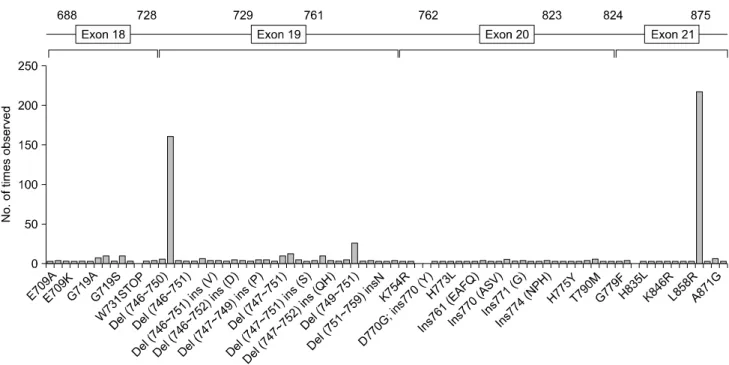
EGFR의 tyrosine kinase를 coding하는 부위인 exon 18에서 exon 21에 걸쳐 돌연변이를 가지고 있는 환자에게서 매우 뛰어난 효과를 보여 주는 것이 확인되었고, 기존 항암제와 효과를 비교한 Iressa Pan-Asia Study (IPASS), European Tarceva (erlotinib) versus Chemotherapy (EURTAC) study 등 을 통해 생존율 향상을 입증함으로써 현재 EGFR 돌연변이 가 있는 폐암환자에게서 1차 요법제로 널리 쓰이고 있다 (1,2). EGFR 돌연변이는 지금까지 30개가 넘는 종류가 보고 되어 왔는데 대부분이 exon 19 deletion과 exon 21 L858R로 서 이 두 가지가 90% 이상을 차지한다(3). 이 외에도 G719A, L861Q와 같이 반응과의 관련성이 잘 알려진 돌연변이도 있 지만 나머지 대부분은 빈도가 낮아 그 의미가 불확실한 상 태이다(Fig. 1).
하지만 EGFR-TKI에 대한 초기 반응이 좋더라도 결국은 약제 내성이 생기는 것이 가장 큰 문제인데 평균반응지속 기간은 1년 정도로 생각되고 있다. 현재까지 가장 널리 알 려진 내성 기전은 T790M 이차돌연변이에 의한 것과 MET
Fig. 1. Epidermal growth factor receptor (EGFR) tyrosine kinase mutations (reprinted from Chan SK, et al. Eur J Cancer 2006;42:
17-23 (3), with permission from Elsevier).
Fig. 2. The frequency of observed drug resistance mechani- sms (reprinted from Sequist LV, et al. Sci Transl Med 2011;
3:75ra26 (6), with permission from American Association for the Advancement of Science). EGFR: epidermal growth factor receptor, PIK3CA: phosphatidylinositol 3 kinase catalytic sub- unit, SCLC: small cell lung cancer.
amplification을 통한 우회 신호전달체계의 활성화가 있다 (Fig. 2) (4-6).
2010년 Jackman 등(7)은 비소세포폐암에서 EGFR-TKI에 대한 획득내성을 다음과 같이 정의하였는데(Table 1) 이는 내성을 일정한 기준에 의해 진단함으로써 내성의 치료 및
내성 연구 결과를 비교하고 평가하는 데 도움이 될 것으로 생각된다.
T790M
내성을 획득한 환자의 약 50%는 T790M 이차돌연변이에 의한 것이다(8). 이는 790번째 아미노산인 threonine이 크기 가 큰 methionine으로 치환되어 약제 결합력을 떨어뜨림으 로써 내성을 가져오는 것으로 이해되고 있지만 T790M에 의해 본래 존재하던 EGFR sensitizing mutation의 ATP에 대 한 결합력이 증가하는 것이 더 중요한 기전이라는 설명도 있다(9). Threonine이 kinase 활성 부위 근처에 위치하기 때 문에 “gatekeeper mutation”이라고 하는데 이런 현상은 이미 가장 먼저 등장한 표적치료제인 imatinib에 대한 내성이 만 성백혈병의 원인인 BCR-ABL에 발생한 T315I 돌연변이 등 과 유사하다고 볼 수 있다. 또한 폐암의 새로운 표적치료제 인 crizotinib도 결국 내성이 발생하는데 L1196M과 같은 이 차돌연변이에 의한 것이 가장 중요한 것으로(30∼40%) 밝 혀지고 있어(10) 모든 표적 치료제에 나타나는 공통된 현상 임을 알 수 있다.
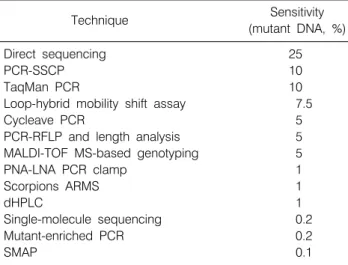
T790M의 경우 내성이 증가함에 따라 유전자 증폭을 통 해 T790M을 포함한 allele이 늘어나기 때문에 내성의 초기 에는 그 양이 많지 않아 민감도가 낮은 검사법을 쓰게 되면 T790M이 없는 allele에 희석이 되면서 발견하지 못하는 경
Table 1. Proposed Definition of Acquired Resistance to EGFR-TKI
Criteria Definition
1 Previously received treatment with single-agent EGFR-TKI (e.g., gefitinib or erlotinib) 2 Either of the following:
(A) A tumor that harbors an EGFR mutation known to be associated with drug sensitivity
(B) Objective clinical benefit from treatment with EGFR-TKI as defined by either documented partial or complete response (RECIST or WHO), or significant and durable (>6 months) clinical benefit (stable disease as defined by RECIST or WHO) after inititation of gefitinib or erlotinib
3 Systemic progression of disease (RECIST or WHO) while on continuous treatment with gefitinib or erlotinib within the last 30 days
4 No intervening systemic therapy between cessation of gefitinib or erlotinib and initiation of new therapy
EGFR-TKI: epidermal growth factor receptor tyrosine kinase inhibitors, RECIST: Response Evaluation Criteria in Solid Tumors, WHO:
World Health Organization.
Fig. 3. Slow, indolent growth of lung cancer cells harboring EGFR T790M (reprinted from Oxnard GR, et al. Clin Cancer Res 2011; 17:5530-5537 (8), with permission from American Association for Cancer Research).
Table 2. Sensitivity of EGFR Mutation Tests
Technique Sensitivity
(mutant DNA, %)
Direct sequencing 25
PCR-SSCP 10
TaqMan PCR 10
Loop-hybrid mobility shift assay 7.5
Cycleave PCR 5
PCR-RFLP and length analysis 5
MALDI-TOF MS-based genotyping 5
PNA-LNA PCR clamp 1
Scorpions ARMS 1
dHPLC 1
Single-molecule sequencing 0.2
Mutant-enriched PCR 0.2
SMAP 0.1
EGFR: epidermal growth factor receptor, PCR-SSCP: poly- merase chain reaction-single-stranded conformation polymor- phism, PCR-RFLP: polymerase chain reaction-restriction frag- ment length polymorphism, MALDI-TOF MS: matrix-assisted laser desorption/ionization-time of flight mass spectrometry, PNA-LNA: peptide nucleic acid-locked nucleic acid, ARMS:
amplified refractory mutation system, dHPLC: denaturing high- performance liquid chromatography, SMAP: smart amplification process.
우가 있다. Arcila 등(11)의 보고에 따르면 처음에 direct sequencing에서 음성으로 나왔던 30명의 환자 중 peptide nucleic acid test를 다시 했더니 11명에서 추가로 T790M을 발견할 수 있었다. 따라서 민감도가 낮은 direct sequencing 이 현재 가장 대표적으로 사용되는 검사법임을 감안할 때 T790M은 지금 알려진 빈도보다 더 많을 것으로 추정된다 (Table 2).
흥미로운 사실 중 하나는 T790M 이차돌연변이가 생긴 환자는 다른 기전에 의해 내성이 발생한 환자에 비해 더 예후가 좋다는 점이다. 이는 T790M을 지닌 세포의 성장이
느리고 전이도 덜 일어나는 성질을 지니는 것에 기인하는 것으로 생각되고 있다(Fig. 3) (12).
T790M 극복 방안 1) Irreversible EGFR-TKIs
Gefitinib, erlotinib과 같이 현재 사용 중인 EGFR-TKI는 re- versible inhibitor이지만 PF-002999804 (dacomitinib), BIBW2992 (afatinib)와 같은 2세대 EGFR-TKI들은 Michael-acceptor group을 함유하고 있어 EGFR ATP 결합 부위에 공유 결합 하는 irreversible inhibitor이고 EGFR, HER2, HER4 등을 같 이 억제하는 pan-HER inhibitor로 작용하기 때문에 효과가 훨씬 뛰어난 것으로 알려졌다(13). 초기 실험 결과에서는 이러한 irreversible inhibior가 T790M 내성을 극복할 수 있다 는 것을 보여 주었지만 PF-002999804의 경우 사용 중 T790M 의 증폭이 더 늘어나면서 효과가 없어지고(14), BIBW2992
Fig. 4. Novel mutant-selective EGFR inhibitors (Zhou W, et al.
Nature 2009;462;1070-1074 (16), with permission from Nature Publishing Group).
역시 가장 약제효과가 높다고 알려져 있음에도 내성 환자 에서 생존율 향상을 입증하는 데 결국 실패하였다(15).
2) Mutant-selective inhibitors
기존의 EGFR inhibitor가 quinazoline 기본 구조를 가지고 있어 정상 EGFR에도 ATP와 경쟁적 결합함으로써 부작용 을 초래하는데 최근 T790M EGFR에 특이적으로 반응하는 pyrimidine EGFR inhibitor가 개발되어 이를 활용하는 연구 가 진행 중이다. 이런 약제는 기존의 EGFR inhibitor에 비해 T790M EGFR에 30∼100배 정도 더 강력한 반면 정상 EGFR에는 오히려 100배 정도 덜 작용함으로써 효과는 더 좋고 부작용이 감소되는 결과를 보여 주고 있어 앞으로의 전망이 밝다(Fig. 4) (16).
3) Heat shock protein 90 (HSP90) inhibitors
HSP90는 단백질의 conformational maturation, stability에 관여하는 chaperone으로 기능을 하고 있는데 정상 단백질 보다 암 단백질의 HSP90에 대한 의존성이 훨씬 높아 HSP90 을 억제하여 암을 치료하려는 시도가 이루어져 왔다(17).
EGFR의 경우에도 T790M을 포함한 mutant EGFR이 정상 EGFR보다 HSP90 억제에 더 민감하게 반응하기 때문에 T790M 내성을 극복하는 데 효과가 있다는 연구 결과들이 보고되었다(18). 하지만 HSP90 inhibitor의 하나인 IPI-504로 시행한 임상시험에서는 과거 EGFR-TKI 치료 후 내성이 생 긴 환자 28명 중 단 1명에서만 반응을 보인 실망스런 결과 를 얻었다(19). 그럼에도 IPI-504와 같은 기존의 geldana- mycin 계열의 약물과는 다른 종류의 HSP90 inhibitor인 AUY922나 STA-9090의 경우에는 현재 진행 중인 임상시험 에서 좋은 반응을 나타내고 있는 것으로 알려지고 있어 그 결과가 기대되고 있다.
4) Dual targeting
T790M transgenic mouse를 이용한 동물실험을 통해 EGFR blocking antibody인 cetuximab과 BIBW2992의 병합이 T790M 내성 극복에 효과적임을 보여 주는 보고가 있었다(20).
HER2+ breast cancer에서도 trastuzumab+lapatinib을 사용 하여 HER2의 extracellular and intracellular domain을 모두 차 단하는 소위 “vertical inhibition”을 통해 치료 효과를 향상시 킨 결과와 유사한 것이다(21). 이 연구 결과를 바탕으로 phase I 연구가 진행되고 있는데 반응 평가가 가능하고 T790M이 확인된 13명의 환자 중 4명에서 partial response를 보여 주었다(22). 이는 실제 내성 환자에서 시행된 연구 중 가장 좋은 성적으로, 앞으로 update 될 결과에 많은 기대가 모아지고 있다.
OTHER SECONDARY MUTATION
Exon 21의 T854A나 exon 19의 L747S, D761Y 등과 같은 이차돌연변이도 내성 환자에서 보고되었지만 매우 드물다.
이들도 나름의 방식으로 약제의 결합부위에 영향을 주게 되고 이로 인해 내성이 발생하는 것으로 설명되고 있다 (23).
MET BYPASS
내성의 다른 중요한 기전 중 하나가 MET 유전자 증폭을 통한 MET receptor 우회 신호전달체계의 활성인데 초기에 약 20%의 내성 환자에서 MET 유전자 증폭이 관찰되었다고 보고되었으나(5) 이후에는 그 보다는 빈도가 좀 낮은 것으 로 알려져 한 조사에 따르면 약 5%를 차지하였다(6). MET 의 ligand인 hepatocyte growth factor가 gefitinib 내성을 유도 하는 실험적 모델이 발표되기도 하였다(24). 현재 MET receptor blocking monoclonal antibody인 MetMAb과 small molecule inhibitor인 ARQ197 (tivantinib) 등의 MET inhibitor 에 대한 임상시험들이 진행 중이지만 아직 내성과 관련된 뚜렷한 효과를 입증한 연구 결과는 나와 있지 않다.
AXL BYPASS
AXL도 세포표면 수용체의 하나로 GIST의 imatinib 내성, 유방암의 lapatinib 내성에 관여하는 것으로 알려져 있다. 최 근 ligand인 GAS6의 upregulation과 함께 AXL의 과발현이 EGFR-TKI 내성의 기전으로 작용한다는 보고가 나오고 다
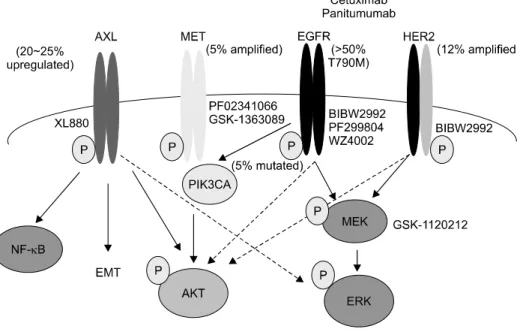
Fig. 5. Schematic of pathways to EGFR inhibitor acquired resistance and pharmacologic approaches (Blakely CM and Bivoma TG. Can- cer Discov 2012;2:872-875 (33), with permission from American Asso- ciation for Cancer Research). EGFR:
epidermal growth factor receptor, EMT: epithelial mesenchymal trans- ition, ERK: extracellular signal-regul- ated kinase, NF-κB: nuclear factor κB, PIK3CA: phosphatidylinositol 3 kinase catalytic subunit.
양한 AXL inhibitor들이 개발되면서 주목을 받고 있다(25).
내성을 획득한 환자 중 약 20% (7/35)에서 AXL의 발현이 증가하였는데 그 중 2명은 T790M을 같이 가지고 있었다.
AXL inhibitor의 병합투여를 통해 내성이 극복될 수 있을 지, 정확한 빈도가 어떻게 되는지 등에 대한 추가적인 연구 가 필요할 것으로 보인다.
EPTHELIAL-TO-MESENCHYMAL TRANSITION (EMT)
EMT는 epithelial polarized phenotype이 mesenchymal fibro- blastoid phenotype으로 변하는 현상으로 전이 및 다양한 항 암제 내성과의 관련성은 이미 알려져 왔는데 2009년 EGFR- TKI 내성과 관련되어 있다는 실험 결과가 나오고 2010년 첫 증례가 발표되었다(26). Sequist 등(6)도 3명의 내성 환자 에서 EMT가 관찰되었다고 보고한 바 있어 빈도가 높지 않 아도 EGFR-TKI 내성의 한 기전임을 알 수 있다.
SMALL CELL TRANSFORMATION
Massachusetts General Hospital 연구자들은 37명의 내성 환자 조직을 분석했을 때 그 중 5명(14%)에서 형태학적인 변화와 함께 synaptophysin, chromogranin, CD56과 같은 소 세포폐암의 마커들의 발현이 증가되었고 소세포폐암에 사 용되는 etoposide+cisplatin 항암제에 반응이 좋았다고 보고 하였다(6). 이전에도 비슷한 증례 보고가 있어 왔고(27,28)
소세포폐암에서도 드물게 EGFR 돌연변이가 발견된다는 (29) 연구 결과들을 종합해 볼 때 이 또한 가능한 내성 기전 의 하나로 생각된다.
PI3KCA MUTATION
빈도는 아주 낮지만 내성 환자의 조직에서 PIK3CA 돌연 변이가 발견되었고(6) EGFR 돌연변이가 있는 폐암 세포주 에 mutant PIK3CA의 발현을 유도할 경우 내성이 발생하였 다는 보고가 있다(30). 현재 BKM120, GDC-0941, MK-2206 등 다양한 inhibitor 들이 개발되어 임상시험이 진행 중인 상 태이다.
ERK/HER2 AMPLIFICATION
다른 내성 기전이 없는 환자에서 ERK (5%), HER2 (12%) amplification이 관찰되었고 이러한 변화가 in vitro model에 서 내성을 유도하는 것을 확인한 연구 결과가 최근 보고된 바 있어(31,32) 내성과의 관련성에 대한 추가 연구가 필요 할 것으로 보인다(Fig. 5) (33).
miRNA
miRNA는 약 19∼25개의 nucleotide로 구성된 RNA로 target mRNA와 결합함으로써 유전자의 발현을 억제하는 역 할을 하는데 인체 유전자의 30% 이상이 영향을 받는 것으
Fig. 6. miRNAs associated with gefitinib resistance and EMT (Garofalo M, et al. Nat Med 2011;18:74-82 (34), with permi- ssion from Nature Publishing Group). APAF-1: apoptosis pro- teinase activating factor-1, EGFR: epidermal growth factor re- ceptor, EMT: epithelial mesenchemal transition, PKC-ε: pro- tein kinase Cε, PTEN: phosphatase and tensin homologue.
로 알려지고 있다. 특히 miR-16, Let-7i 등의 miRNA는 항암 제 반응과 관련이 되어 있고 miR-521, Let-7g 등은 방사선 감수성에 영향을 주는 것으로 보고되었다. Garofalo 등(34) 은 2011년 gefitinib 투여 후 암세포에 apoptosis가 오는 과정 에 관여하고 있는 BIM, APAF-1 등이 miR-30b/c, miR-221/
222에 의해 조절된다는 사실을 증명하여 이를 치료에 응용 할 수 있음을 시사한 바 있다(Fig. 6).
결 론
EGFR-TKI 치료를 받고 있는 환자의 대부분에서 내성이 발생하기 때문에 내성의 기전을 이해하고 그 기전에 따라 극복 방안을 마련하는 것이 EGFR-TKI 치료에 있어 매우 중요한 일이다. 따라서 앞으로는 내성이 생기면 조직 검사 를 다시 시행하고 알려진 내성 기전에 대한 검사를 의뢰하 는 방향으로 변하게 될 것으로 예상된다. MET나 AXL과 같 은 우회신호 전달을 통하는 내성과 small cell transformation 과 같은 경우에는 치료 약제를 찾는 것이 어렵지 않지만 가장 많은 내성을 차지하고 있는 T790M의 경우에는 현재 제시되고 있는 치료 방안들의 효과에 대한 추가적인 연구 가 더 진행되어야 할 것으로 보인다.
REFERENCES
1. Mok TS, Wu YL, Thongprasert S, et al. Gefitinib or carbo-
platin-paclitaxel in pulmonary adenocarcinoma. N Engl J Med 2009;361:947-957.
2. Rosell R, Carcereny E, Gervais R, et al. Erlotinib versus standard chemotherapy as first-line treatment for European patients with advanced EGFR mutation-positive non-small-cell lung cancer (EURTAC): a multicentre, open-label, randomised phase 3 trial. Lancet Oncol 2012;13:239-246.
3. Chan SK, Gullick WJ, Hill ME. Mutations of the epidermal growth factor receptor in non-small cell lung cancer: search and destroy. Eur J Cancer 2006;42:17-23.
4. Pao W, Miller VA, Politi KA, et al. Acquired resistance of lung adenocarcinomas to gefitinib or erlotinib is associated with a second mutation in the EGFR kinase domain. PLoS Med 2005;2:e73.
5. Engelman JA, Zejnullahu K, Mitsudomi T, et al. MET amplifi- cation leads to gefitinib resistance in lung cancer by activating ERBB3 signaling. Science 2007;316:1039-1043.
6. Sequist LV, Waltman BA, Dias-Santagata D, et al. Genotypic and histological evolution of lung cancers acquiring resistance to EGFR inhibitors. Sci Transl Med 2011;3:75ra26.
7. Jackman D, Pao W, Riely GJ, et al. Clinical definition of acquired resistance to epidermal growth factor receptor tyrosine kinase inhibitors in non-small-cell lung cancer. J Clin Oncol 2010;28:357-360.
8. Oxnard GR, Arcila ME, Chmielecki J, Ladanyi M, Miller VA, Pao W. New strategies in overcoming acquired resistance to epidermal growth factor receptor tyrosine kinase inhibitors in lung cancer. Clin Cancer Res 2011;17:5530-5537.
9. Yun CH, Mengwasser KE, Toms AV, et al. The T790M mutation in EGFR kinase causes drug resistance by increasing the affinity for ATP. Proc Natl Acad Sci U S A 2008;105:
2070-2075.
10. Doebele RC, Pilling AB, Aisner DL, et al. Mechanisms of resistance to crizotinib in patients with ALK gene rearranged non-small cell lung cancer. Clin Cancer Res 2012;18:1472- 1482.
11. Arcila ME, Oxnard GR, Nafa K, et al. Rebiopsy of lung cancer patients with acquired resistance to EGFR inhibitors and enhanced detection of the T790M mutation using a locked nucleic acid-based assay. Clin Cancer Res 2011;17:1169-1180.
12. Oxnard GR, Arcila ME, Sima CS, et al. Acquired resistance to EGFR tyrosine kinase inhibitors in EGFR-mutant lung cancer: distinct natural history of patients with tumors harbor- ing the T790M mutation. Clin Cancer Res 2011;17:1616-1622.
13. Kwak EL, Sordella R, Bell DW, et al. Irreversible inhibitors of the EGF receptor may circumvent acquired resistance to gefitinib. Proc Natl Acad Sci U S A 2005;102:7665-7670.
14. Ercan D, Zejnullahu K, Yonesaka K, et al. Amplification of EGFR T790M causes resistance to an irreversible EGFR inhibitor. Oncogene 2010;29:2346-2356.
15. Miller VA, Hirsh V, Cadranel J, et al. Afatinib versus placebo for patients with advanced, metastatic non-small-cell lung cancer after failure of erlotinib, gefitinib, or both, and one or two lines of chemotherapy (LUX-Lung 1): a phase 2b/3 randomised trial. Lancet Oncol 2012;13:528-538.
16. Zhou W, Ercan D, Chen L, et al. Novel mutant-selective EGFR kinase inhibitors against EGFR T790M. Nature 2009;
462:1070-1074.
17. Banerji U. Heat shock protein 90 as a drug target: some like it hot. Clin Cancer Res 2009;15:9-14.
18. Shimamura T, Li D, Ji H, et al. Hsp90 inhibition suppresses mutant EGFR-T790M signaling and overcomes kinase inhi- bitor resistance. Cancer Res 2008;68:5827-5838.
19. Sequist LV, Gettinger S, Senzer NN, et al. Activity of IPI-504, a novel heat-shock protein 90 inhibitor, in patients with mole- cularly defined non-small-cell lung cancer. J Clin Oncol 2010;
28:4953-4960.
20. Regales L, Gong Y, Shen R, et al. Dual targeting of EGFR can overcome a major drug resistance mutation in mouse models of EGFR mutant lung cancer. J Clin Invest 2009;119:
3000-3010.
21. Blackwell KL, Burstein HJ, Storniolo AM, et al. Randomized study of lapatinib alone or in combination with trastuzumab in women with ErbB2-positive, trastuzumab-refractory meta- static breast cancer. J Clin Oncol 2010;28:1124-1130.
22. Janjigian YY, Groen HJ, Horn L, et al. Activity and tolera- bility of afatinib (BIBW 2992) and cetuximab in NSCLC patients with acquired resistance to erlotinib or gefitinib. J Clin Oncol 2011;29(Suppl):7525.
23. Avizienyte E, Ward RA, Garner AP. Comparison of the EGFR resistance mutation profiles generated by EGFR-targeted tyrosine kinase inhibitors and the impact of drug combinations.
Biochem J 2008;415:197-206.
24. Yano S, Wang W, Li Q, et al. Hepatocyte growth factor in- duces gefitinib resistance of lung adenocarcinoma with epider- mal growth factor receptor-activating mutations. Cancer Res 2008;68:9479-9487.
25. Zhang Z, Lee JC, Lin L, et al. Activation of the AXL kinase
causes resistance to EGFR-targeted therapy in lung cancer. Nat Genet 2012;44:852-860.
26. Chung JH, Rho JK, Xu X, et al. Clinical and molecular evidences of epithelial to mesenchymal transition in acquired resistance to EGFR-TKIs. Lung Cancer 2011;73:176-182.
27. Zakowski MF, Ladanyi M, Kris MG, et al. EGFR mutations in small-cell lung cancers in patients who have never smoked.
N Engl J Med 2006;355:213-215.
28. Morinaga R, Okamoto I, Furuta K, et al. Sequential occurrence of non-small cell and small cell lung cancer with the same EGFR mutation. Lung Cancer 2007;58:411-413.
29. Tatematsu A, Shimizu J, Murakami Y, et al. Epidermal growth factor receptor mutations in small cell lung cancer. Clin Cancer Res 2008;14:6092-6096.
30. Engelman JA, Mukohara T, Zejnullahu K, et al. Allelic dilu- tion obscures detection of a biologically significant resistance mutation in EGFR-amplified lung cancer. J Clin Invest 2006;
116:2695-2706.
31. Ercan D, Xu C, Yanagita M, et al. Reactivation of ERK signaling causes resistance to EGFR kinase inhibitors. Cancer Discov 2012;2:934-947.
32. Takezawa K, Pirazzoli V, Arcila ME, et al. HER2 amplifica- tion: a potential mechanism of acquired resistance to EGFR inhibition in EGFR-mutant lung cancers that lack the second- site EGFRT790M mutation. Cancer Discov 2012;2:922-933.
33. Blakely CM, Bivoma TG. Resilency of lung cancers to EGFR inhibitor treatment unveiled, offereing opportunities to divide and conquer EGFR inhibitor resistance. Cancer Discov 2012;
2:872-875.
34. Garofalo M, Romano G, Di Leva G, et al. EGFR and MET receptor tyrosine kinase-altered microRNA expression induces tumorigenesis and gefitinib resistance in lung cancers. Nat Med 2012;18:74-82.