www.jpis.org
pISSN 2093-2278 eISSN 2093-2286 Copyright © 2011 Korean Academy of PeriodontologyThis is an Open Access article distributed under the terms of the Creative Commons Attribution Non-Commercial License (http://creativecommons.org/licenses/by-nc/3.0/).
Identification of mono- or poly-specific monoclonal antibody to Porphyromonas gingivalis heat-shock protein 60
Jeomil Choi 1,*, Sang-Yull Lee2, Koanhoi Kim3, Bong-Kyu Choi4, Myung-Jin Kim1
1Department of Periodontology, Pusan National University School of Dentistry, Yangsan, Korea
2Department of Biochemistry, Pusan National University School of Medicine, Yangsan, Korea
3Department of Pharmacology, Pusan National University School of Medicine, Yangsan, Korea
4Department of Microbiology and Immunology, Seoul National University School of Dentistry, Seoul, Korea
Purpose: The aim of this study was to define the immunoreactive specificity of Porphyromonas gingivalis (P. gingivalis) heat shock protein (HSP) 60 in periodontitis and atherosclerosis.
Methods: In an attempt to define the cross-reactive bacterial heat-shock protein with human self-antigen at molecular level, we have introduced a novel strategy for cloning hybridoma producing anti-P. gingivalis HSP 60 which is polyreactive to bacte- rial HSPs or to the human homolog.
Results: Five cross-reactive clones were obtained which recognized the #19 peptide (TLVVNRLRGSLKICAVKAPG) among 37 synthetic peptides (20-mer, 5 amino acids overlapping) spanning the whole molecule of P. gingivalis HSP 60. We have also es- tablished three anti-P. gingivalis HSP 60 monoclonal antibodies demonstrating mono-specificity. These clones recognized the #29 peptide (TVPGGGTTYIRAIAALEGLK).
Conclusions: Peptide #19 and #29 of P. gingivalis HSP 60 might be important immunoreactive epitopes in the immuno- pathogenic mechanism of bacterial antigen-triggered autoimmune diseases.
Keywords: Antibodies, Periodontitis, Porphyromonas gingivalis.
INTRODUCTION
The crucial role of Porphyromonas gingivalis (P. gingivalis) heat shock protein (HSP)60 in the immunopathogenic mech- anism of both periodontitis and atherosclerosis has been demonstrated in the context of immunodominant T- and/or B-cell epitopes in our previous studies [1-4]. Also we have re- cently reported that vaccines formulated with P. gingivalis
HSP60 can successfully reduce the alveolar bone loss in ex- perimental periodontitis as a polymicrobial infection [5] and that anti-P. gingivalis HSP60 antibody manifested cross-spe- cies recognition to exert an opsonophagocytic function against multiple periodontopathogenic bacteria [6]. However, a concern about potential autoimmune reaction may arise inherent from the high level of sequence homology of bacte- rial HSP with human self-antigen when the whole HSP60
Received: Nov. 15, 2010; Accepted: Feb. 3, 2011
*Correspondence: Jeomil Choi
Department of Periodontology, Pusan National University School of Dentistry, Beomeo-ri, Mulgeum-eup, Yangsan 626-870, Korea E-mail: [email protected], Tel: +82-55-360-5200, Fax: +82-55-360-5194
Nonetheless, identifying a defined cross-reactive bacterial peptide antigen is of critical value in several ways including 1) for identifying the putative peptide antigen responsible for inducing or suppressing autoimmunity in host, 2) for identi- fying a candidate peptide vaccine to provide cross-species immunity, or 3) for use as a tool for mobilizing antigen-specif- ic regulatory T cells to suppress autoimmune diseases. Thus, defining a peptide molecule from bacterial HSP60 that is cross-reactive with human HSP60 at the molecular level would be an exciting idea for stimulating antigen-specific regulatory T cells that might suppress a P. gingivalis HSP- triggered autoimmune response either in periodontitis as an infectious disease [7] or atherosclerosis as an autoimmune disease [8]. In the same way, identifying bacterial HSP60 peptide that exhibits cross-species recognition would facili- tate peptide vaccine development for protection against periodontitis as a polymicrobial disease.
However, simply comparing sequence similarity (homolo- gy) or mapping immunodominant epitopes might provide only limited information on which peptide of P. gingivalis HSP does cross-react with human HSP peptide within the gingival lesion or arterial wall at the molecular level. To cir- cumvent these underlying obstacles, we have adopted an in- novative strategy to incorporate the monoclonal hybridoma technology to screen candidate peptides that may manifest poly-specificities to exogenous bacterial or to indigenous hu- man self-antigens at molecular level. This concept stems from the polyreactive nature of antibodies to pathogen-associated molecular pattern such as HSP, lipopolysaccharide, or phos- phorylcholine [9-11]. Identifying a P. gingivalis HSP peptide sequence recognized by the monoclonal antibody would thus enable us to clarify the exact immunodominant peptide epitope(s) responsible for eliciting in vivo cross-reactivity to its human counterpart.
The primary goal of the present study was to propose an innovative monoclonal hybridoma technology to define an immunodominant epitope of P. gingivalis HSP60 either mono-specific to its cognate antigen or poly-specific to other bacterial HSP’s or with a human homolog,
MATERIALS AND METHODS
Production of monoclonal antibody against P. gingivalis HSP60
Immunization of mice with recombinant P. gingivalis HSP60 Recombinant P. gingivalis HSP60 was purified from the P.
gingivalis GroEL gene (a gift from Dr. Yoji Murayama, Okaya- ma, Japan) as previously reported [2,6]. C57BL/6 mice (Jackson Laboratory, Bar Harbor, ME, USA) were initially immunized
emulsified in complete Freund’s adjuvant followed by two subsequent subcutaneous injections of the HSP60 in incom- plete Freund’s adjuvant. Animals were bred and maintained in a specific-pathogen-free animal breeding facility, the ex- periments were conducted according to Declaration of Hel- sinki principles, and the experimental protocol was approved by the Institutional Review Board of Pusan National Univer- sity Hospital.
Establishment of hybridoma producing anti-P. gingivalis HSP60 IgG antibody
Two weeks after the final immunization, mouse spleen cells were homogenized to a single cell by passing them through 30 μm nylon mesh (Miltenyi Biotech GmbH, Bergisch Glad- bach, Germany) and suspended in serum-free Dulbecco’s modification of eagle’s medium (DMEM). The harvested cells were lysed of contaminating red blood cells and resus- pended to fuse with the same number of mouse myeloma cells (SP2/0-Ag14, American Type Culture Collection #CRL 1581) in the presence of 50% polyethylene glycol. The fused cells were incubated in DMEM containing 20% fetal bovine serum, and then incubated in hypoxanthine-aminopterin- thymidine-containing media for 2 weeks to remove unfused cells. The selection procedure was terminated by adding hy- poxanthine-thymidine-containing media. Wells with single foci of homogeneous cells were identified to collect culture supernatants and were screened for secretion of the anti-P.
gingivalis HSP60 IgG antibody. To ensure the monoclonality of the cells, limiting dilution was performed down to 0.3 cell/
well in 96-well plates until hybridoma producing anti-P. gin- givalis HSP60 IgG antibody was finally identified.
Screening culture supernatants producing IgG antibody to P. gin- givalis HSP60
Microtiter plates coated with P. gingivalis HSP60, diluted in 10 mM phosphate buffer [12-14], were incubated with an ali- quot of cell culture supernatants. After samples were washed, horseradish peroxidase-conjugated goat anti-mouse IgG (γ-chain specific, Jackson ImmunoResearch Laboratories Inc., West Grove, PA, USA) was added. After incubation for 2 hours at room temperature, the plates were washed, and an aliquot of tetramethylbenzidine (Kirkegaard and Perry Laboratories, Gaithersburg, MD, USA) was added for incubation, followed by the addition of 0.18 M H2SO4 to stop the color develop- ment. Optical densities (OD) were plotted as a function of the serum dilution factor. Serum dilution factor correspond- ing to an optical density of 0.5 was assigned an ELISA unit.
The wells producing antibody units higher than a mean OD+
3×s.d. were identified as being positive.
clonal antibody
The established hybridoma cells were expanded and 2×10⁶ cells were injected into the peritoneal cavity of the C57BL/6 mouse that had been immune-suppressed previously by an intraperitoneal injection of immunosuppressant (500 μL/
mouse, Pristane, Sigma-Aldrich Co., St. Louis, MO, USA). As- cites fluid was collected by needle aspiration and anti-P. gin- givalis monoclonal IgG antibody was purified by using an immunoglobulin G purification system (ImmunoPure, Pierce Chemical Co., Rockford, IL, USA).
Screening purified monoclonal antibody for cross-reactivity with other bacterial HSP’s and human HSP60 by Western immunoblot
Five μg of recombinant P. gingivalis HSP60, 100 μg of ly- sate preparations from five bacterial species, and 5 μg of hu- man HSP60 (StressGen Biotechnologies Co., Victoria, Cana- da) were subjected to sodium dodecyl sulfate polyacrylamide gel electrophoresis (SDS-PAGE) and electro-transferred to nitrocellulose membrane. After blocking the membrane, pu- rified anti-P. gingivalis HSP60 monoclonal antibody was ap- plied for incubation. The membrane was washed and orse- radish peroxidase-conjugated mouse anti-mouse IgG was added. After washing the membrane, tetramethylbenzidine was added for visualization of bound antibodies. Bacterial cell lysates was prepared by sonicating five periodontopathic bacterial cells consisting of P. gingivalis, Actinobacillus actino- mycetemcomitans, Prevotella intermedia, Treponema denticola, Streptococcus mutans, and Fusobacterium nucleatum that had been anaerobically grown and then heat-shocked for 1 hour at 44°C. We loaded 100 μg of bacterial cell lysate proteins, be- ing equivalent to approximately 5 μg of HSP’s, for semiquan- titative comparison of blotting intensity. This method was derived from the idea that heat-inducible protein, represent- ing 1 to 2% of total bacterial proteins under normal conditions, increases four- to five-fold under heat shock treatment [15].
Identification of specific peptide epitope recognized by mono-specific or poly-specific anti-P. gingivalis HSP60 monoclonal antibody
Construction of synthetic peptides
A total of 37 overlapping peptides, each consisting of 20 amino acid with 5 amino acids overlapping, spanning whole molecule of P. gingivalis HSP60 were synthesized by Fmoc solid phase peptide synthesis using ASP48S (Peptron Inc., Daejeon, Korea) and purified by the reverse phase HPLC us- ing a Vydac Everest C18 column. Elution was carried out with a water-acetonitrile linear gradient (10 to 75% (v/v) of aceto- nitrile) containing 0.1% (v/v) trifluoroacetic acid.
Briefly, each peptide (1 μg) was spotted onto polyvinyliden fluoride membrane. The membrane was blocked with 5%
skim milk followed by adding the monoclonal antibody in phosphate buffered saline (PBS) buffer for incubation for 2 hours at room temperature. After washing the membrane, horseradish peroxidase-conjugated goat anti-mouse IgG was added for 1 hour. The membrane was then washed with PBS- Tween followed by adding tetramethylbenzidine for color development.
RESULTS
Production of monoclonal antibody against P. gingivalis HSP60
A total of eight anti-P. gingivalis HSP60 IgG monoclonal antibodies were cloned and each was subjected to SDS-PAGE for verification of purity consisting of heavy and light chain molecules of IgG antibody, respectively (Fig. 1).
Screening purified monoclonal antibody for cross-reactivity with other bacterial HSP’s and human HSP60 by western immunoblot
Each purified monoclonal antibody was examined for its reactivity with recombinant P. gingivalis HSP60, bacterial HSP proteins, or human HSP60, respectively, by western im- munoblot. Based on their mono- or poly-reactivity with dif- ferent HSP’s, two different panels of monoclonal antibodies have been categorized: one being mono-specific to cognate P. gingivalis HSP60, the other being poly-specific to different
70 K
50 K 60 K
MW HSP JC2
Heavy chain
Light chain
A B
Figure 1. Sodium dodecyl sulfate polyacrylamide gel electrophore- sis profile of purified recombinant Porphyromonas gingivalis HSP60 (A) and one (clone JC2) of purified anti-P. gingivalis HSP60 mono- clonal IgG antibody demonstrating the heavy and the light chain, respectively (B). MW: molecular weight marker, HSP: heat shock protein.
bacterial HSP’s and human HSP60 (Figs. 2 and 3).
Identification of a specific peptide epitope recognized by mono-specific or poly-specific anti-P. gingivalis HSP60 monoclonal antibody
We were able to obtain eight clones from mouse hybrid- oma producing a panel of monoclonal IgG antibodies to P.
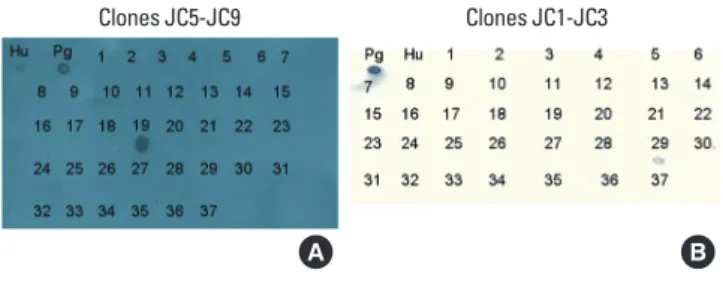
gingivalis HSP60 which was used for the immunogenic anti- gen. Five clones (JC5-JC9) of poly-specific anti-P. gingivalis HSP60 monoclonal antibodies recognized #19 synthetic peptide, while three clones (JC1-JC3) of mono-specific anti-P.
gingivalis HSP60 monoclonal antibodies recognized peptide
#29 of synthetic peptide spanning the whole molecule of P.
gingivalis HSP60, as evidenced by dot immunoblot analyses (Fig. 4). For further characterization of the five poly-reactive monoclonals, we have synthesized #19 peptides based on known sequences of human HSP60, Mycobacterium tubercu- losis (M. tuberculosis), and Chlamydia pneumoniae (C. pneu- moniae) and tested them for inter-species cross-reactivity
with non-oral pathogens. In addition to reactivity with pep- tide #19 from human HSP60, all of the clones have demon- strated inter-species cross-reactivity with peptide #19 from C.
pneumoniae, but not with that of M. tuberculosis as shown by dot immunoblot analysis (Fig. 5). The peptide specificities of cloned monoclonal antibodies are summarized in Table 1.
Table 1. One-letter amino acid sequences of peptide #19 and #29 of Porphyromonas gingivalis HSP60 recognized by five poly-reactive (JC5-JC9) or three mono-reactive clones (JC1-JC3), respectively.
Clones Synthetic peptide # One-letter amino acid sequence
JC5-JC9 #19 TLVVNRLRGSLKICAVKAPG
JC1-JC3 #29 TVPGGGTTYIRAIAALEGLK
JC1
JC2
JC3
HSP60 HSP60
JC5
JC6
JC7
HSP60 HSP60
JC8
JC9 A B
Figure 2. Reactive pattern of cross-reactive (A: clones JC5-JC9) and mono-reactive (B: clones JC1-JC3) or anti-Porphyromonas gingivalis heat shock protein 60 monoclonal antibodies with cognate antigen or with human counterpart demonstrated by immunoblot analysis.
JC5 JC1
JC6 JC2
JC7 JC3
JC8 JC9
HSPPg60
HSPPg60
Aa Pi Fn Sm Td Aa Pi Fn Sm Td
A B
Figure 3. Reactive pattern of poly-reactive (A: clones JC 5-JC9) and mono-reactive (B: clones JC1-JC3) anti-Porphyromonas gingivalis heat shock protein (HSP)60 monoclonal antibodies with cognate HSP antigen or with HSP’s of five periodontopathogenic bacteria as demonstrated by immunoblot analysis. Pg: P. gingivalis HSP60, Aa: Actinobacillus actinomycetemcomitans, Pi: Prevotella intermedia, Fn: Fusobacterium nucleatum, Sm: Streptococcus mutans, Td: Trepone- ma denticola.
A B
Figure 4. Poly-reactive monoclonal antibody (A: clones JC5-JC9) rec- ognized #19 peptide among 37 synthetic peptides spanning a whole molecule of Porphyromonas gingivalis heat shock protein (HSP)60 as well as human HSP60, while mono-reactive monoclonal antibody (B: clones JC1-JC3) recognized #29 peptide among the same syn- thetic peptides without responding to human HSP60, as evidenced by dot immunoblot analyses. Hu: human HSP60, Pg: P. gingivalis HSP60.
JC5
Hu#19 Pg#19 Myco#19 Chia#19
JC6
JC7
JC8
JC9
Figure 5. In addition to reactivity with peptide #19 (Hu#19) from self-antigen (human heat shock protein 60), inter-species cross-re- activity of the five monoclonal antibodies (clones JC5-JC9) with #19 synthetic peptides from Porphyromonas gingivalis (Pg#19), Mycobac- terium tuberculosis (Myco#19) and Chlamydia pneumoniae (Chla#19), respectively, is demonstrated by dot immunoblot analysis. Note that none of them recognized #19 peptide from M. tuberculosis.
Despite the monoclonality of hybridoma cell lines estab- lished in the course of limiting dilution, five of them exhibit- ed an identical pattern of polyreactivity with cognate HSP antigen and other bacterial HSP’s, as well as to human ho- molog, while three of them demonstrated a monoreactivity to cognate HSP60 molecule. Thus, in this study it was possi- ble to validate polyreactive monoclonal antibody, one of the characteristic features of host defense mechanisms against pathogen-associated molecular pattern, such as bacterial heat shock protein [9-11]. In an attempt to identify the specif- ic epitope recognized by these monoclonal antibodies, we have synthesized 37 synthetic peptides (20 mer, 5 amino acids overlapping) spanning the whole molecule of P. gingivalis HSP60. Monoreactive monoclonal antibody to P. gingivalis HSP60 recognized peptide #29 (TVPGGGTTYIRAIAALEGLK), while polyreactive monoclonal antibody recognized peptide
#19 (TLVVNRLRGSLKICAVKAPG). To confirm the cross-re- activity, we have synthesized peptide #19 from known se- quences of human HSP60 molecule as well as lysate prepa- ration from heat-induced whole bacterial cellular protein, which were used for immunoblot analysis. The cross-reactiv- ity of the five monoclonal antibodies with synthetic peptide
#19 from human HSP60 was confirmed by dot immunoblot.
Here, we propose the monoclonal hybridoma technology as a novel strategy for elucidating cross-reactive immunodomi- nant epitope(s) at a molecular level in autoimmune diseases.
Interestingly, based on our series studies and other report, peptide #19 has been immunodominant T-and B-cell epit- ope in both periodontitis and atherosclerosis patients [2,4,16, 17] and common B-cell epitope in atherosclerosis patients [2], while peptide #29 has been B-cell epitope in periodontitis [12]
and T- and B-cell epitope in atherosclerosis patients. Though our previous epitope mapping results may indicate that both peptide #19 and #29 might be involved in the immunopath- ologic process in atherosclerosis as an autoimmune disease, the latter may not be involved in the autoimmune pathologic process of atherosclerosis at the molecular level based on the monoclonal hybridoma technology-based approach intro- duced in our present study. The present study strongly sug- gests that peptide #19 may be an immunodominant epitope that demonstrates a robust cross-reactivity with other bacte- rial and human HSP60. Hence, peptide #19 may be respon- sible for either inducing or suppressing autoimmunity by the host, because cross-reactive peptide to self-antigen is known to mobilize antigen-specific regulatory T cells to suppress autoimmune diseases [18]. Potentially it could also be a can- didate peptide for developing a vaccine to provide cross-spe- cies immunity in periodontitis as a polymicrobial infectious
the T-cell immune response in the periodontitis-atheroscle- rosis link [2,8,19,20]. Hence, the polyclonal anti-P. gingivalis HSP60 antibody could exert either a protective or deteriorat- ing effect on experimental periodontitis induced by multiple bacterial infection. Currently we have launched a series of studies aimed at evaluating the significant role of peptide
#19 in the immunopathogenic mechanism of periodontitis or atherosclerosis.
CONFLICT OF INTEREST
No potential conflict of interest relevant to this article was reported.
ACKNOWLEDGMENTS
The present study was supported by the Korea Healthcare Technology R&D Project, Ministry of Health & Welfare, Re- public of Korea A080391, KOSEF RO1-2008-000-20044-0, and KRF E00130. The authors express our deep appreciation to Professors Eunyup Lee, Chulhoon Chang, and Hyunghoi Kim for their helpful advice and support in collecting blood samples.
REFERENCES
1. Choi JI, Chung SW, Kang HS, Rhim BY, Kim SJ, Kim SJ. Es- tablishment of Porphyromonas gingivalis heat-shock- protein-specific T-cell lines from atherosclerosis patients.
J Dent Res 2002;81:344-8.
2. Choi JI, Chung SW, Kang HS, Rhim BY, Park YM, Kim US, et al. Epitope mapping of Porphyromonas gingivalis heat- shock protein and human heat-shock protein in human atherosclerosis. J Dent Res 2004;83:936-40.
3. Choi J, Chung SW, Kim SJ, Kim SJ. Establishment of Por- phyromonas gingivalis-specific T-cell lines from athero- sclerosis patients. Oral Microbiol Immunol 2001;16:316-8.
4. Choi JI, Kang HS, Park YM, Kim SJ, Kim US. Identification of T-cell epitopes of Porphyromonas gingivalis heat-shock- protein 60 in periodontitis. Oral Microbiol Immunol 2004;
19:1-5.
5. Lee JY, Yi NN, Kim US, Choi JS, Kim SJ, Choi JI. Porphy- romonas gingivalis heat shock protein vaccine reduces the alveolar bone loss induced by multiple periodonto- pathogenic bacteria. J Periodontal Res 2006;41:10-4.
6. Choi JI, Choi KS, Yi NN, Kim US, Choi JS, Kim SJ. Recogni- tion and phagocytosis of multiple periodontopathogenic bacteria by anti-Porphyromonas gingivalis heat-shock protein 60 antisera. Oral Microbiol Immunol 2005;20:51-5.
tious disease. Nat Immunol 2005;6:353-60.
8. Van Eden W, Wick G, Albani S, Cohen I. Stress, heat shock proteins, and autoimmunity: how immune responses to heat shock proteins are to be used for the control of chron- ic inflammatory diseases. Ann N Y Acad Sci 2007;1113:217-37.
9. Lee J, Suh J, Choi J. B-1 cell-derived monoclonal antibod- ies and costimulatory molecules. J Surg Res 2009;154:293-8.
10. Notkins AL. Polyreactive antibodies and polyreactive anti- gen-binding B (PAB) Cells. Curr Top Microbiol Immunol 2000;252:241-9.
11. Zhou ZH, Tzioufas AG, Notkins AL. Properties and func- tion of polyreactive antibodies and polyreactive antigen- binding B cells. J Autoimmun 2007;29:219-28.
12. Choi JI, Borrello MA, Cutler CW, Zauderer M. Prior Im- munization with fusobacterium nucleatum interferes with opsonophagocytosis function of sera against Por- phyromonas gingivalis. J Korean Acad Periodontol 2000;
30:105-10.
13. Choi JI, Borrello MA, Smith ES, Zauderer M. Polarization of Porphyromonas gingivalis-specific helper T-cell sub- sets by prior immunization with Fusobacterium nuclea- tum. Oral Microbiol Immunol 2000;15:181-7.
14. Choi J, Borrello MA, Smith E, Cutler CW, Sojar H, Zauder-
modulates host response to Porphyromonas gingivalis.
Oral Microbiol Immunol 2001;16:338-44.
15. Shinnick TM. Heat shock proteins as antigens of bacterial and parasitic pathogens. Curr Top Microbiol Immunol 1991;167:145-60.
16. Maeda H, Miyamoto M, Kokeguchi S, Kono T, Nishimura F, Takashiba S, et al. Epitope mapping of heat shock pro- tein 60 (GroEL) from Porphyromonas gingivalis. FEMS Immunol Med Microbiol 2000;28:219-24.
17. Bak J, Kim SJ, Choi J. Epitope specificity of Porphyromonas gingivalis heat shock protein for T-cell and/or B-cell in human atherosclerosis. J Korean Acad Periodontol 2003;
33:179-91.
18. van Eden W, van der Zee R, Prakken B. Heat-shock pro- teins induce T-cell regulation of chronic inflammation.
Nat Rev Immunol 2005;5:318-30.
19. Hansson GK, Libby P. The immune response in athero- sclerosis: a double-edged sword. Nat Rev Immunol 2006;
6:508-19.
20. Wick G, Perschinka H, Millonig G. Atherosclerosis as an autoimmune disease: an update. Trends Immunol 2001;
22:665-9.