• 검색 결과가 없습니다.

Endoscopic Septotomy as a Treatment for Chronic Leak after Laparoscopic Sleeve Gastrectomy JMBS

N/A
N/A
Protected

Academic year: 2021

Share "Endoscopic Septotomy as a Treatment for Chronic Leak after Laparoscopic Sleeve Gastrectomy JMBS"

Copied!
4
0
0

로드 중.... (전체 텍스트 보기)

전체 글

(1)

HOW I DO IT

Journal of Metabolic and Bariatric Surgery

J Metab Bariatr Surg 2021;10(1):42-45 https://doi.org/10.17476/jmbs.2021.10.1.42

JMBS

Received: April 30, 2021, Revised: May 31, 2021, Accepted: May 31, 2021

Corresponding author: Kyung Won Seo, 262 Gamcheon-ro, Seo-gu, Busan 49267, Korea Department of Surgery, Kosin University College of Medicine

Tel: +82-51-990-6782, Fax: +82-51-246-6093, E-mail: [email protected] Abstract presented at the 2021 KSMBS Spring Congress, Busan, Korea, March, 2021.

CC
This is an open access article distributed under the terms of the Creative Commons Attribution Non-Commercial License (http://creativecommons.org/licenses/by-nc/4.0) which permits unrestricted non-commercial use, distribution, and reproduction in any medium, provided the original work is properly cited.

Copyright © 2021, The Korean Society for Metabolic and Bariatric Surgery

Endoscopic Septotomy as a Treatment for Chronic Leak after Laparoscopic Sleeve Gastrectomy

Departments of

1

Surgery and

2

Internal Medicine, Kosin University College of Medicine, Busan, Korea

Ki Hyun Kim 1 , Kyoungwon Jung 2 , Yoon Hong Kim 1 , Kyung Won Seo 1

Acute leakage after sleeve gastrectomy progresses into chronic leakage by 10-28.1%, which causes the surgeon to be disturbed. The main treatment for chronic leakage is surgery, but the authors report successful care with endoscopic septotomy. Forty-one year old female patient with a BMI of 42.8 (161.6 cm/111.8 kg) underwent a laparoscopic sleeve gastrectomy. The leakage of the proximal part of the staple resection line was verified in the abdominal CT on the fourth day after the procedure due to pain in the left shoulder that could not be clarified. After appropriate treatment including stent, the patient ended the acute leakage treatment 150 days after surgery. However, the patient was visited for 10 months after removed percutaneous catheter drainage due to fever and pain in the left shoulder. Afterwards, chronic leakage was confirmed from the CT and endoscopy at POD 15 months. We performed endoscopic treatment in the operating room under general anesthesia. At the gastroesophageal junction, we could find chronic leak orifice and bridging fold between stomach lumen and abscess pocket. Endoscopic septotomy was performed with the endoscopic knife and electrosurgical surgical unit, until the stomach lumen and abscess pockets were fully in communication. After the patient was discharged without any complications and is currently under close observation. Endoscopic septotomy as a treatment for chronic leak is feasible and safe. Herein, we report this case with video clip.

Key Words: Sleeve gastrectomy, Acute leak, Complication, Septotomy, Endoscopy

INTRODUCTION

Laparoscopic sleeve gastrectomy is now the most frequently performed primary obesity surgery [1]. Leak after laparoscopic sleeve gastrectomy is considered as a fatal complication and ranges from 1% to 2.9% [2,3].

Depending on the duration of the leak after surgery, acute if within 7 days; early within 1-6 weeks; late within 6-12 weeks; Expressed as chronic if > 12 weeks from surgery [3].

Surgical management should be considered as a treatment

option for chronic leak after laparoscopic sleeve gastrectomy, especially after failure of adequate endoscopic, radiologic and nutritional healing protocols [2]. However, surgical treatment tends to have a high complication rate, thus less invasive and effective endoscopic septotomy was first reported in stable patients by Baretta et al. [4]. After that, several studies for usefulness of endoscopic septotomy for the treatment of recurrent leaks has been reported [5-7].

The main treatment for chronic leakage is surgery, but

the authors report successful care with endoscopic

(2)

Ki Hyun Kim, et al.:

Endoscopic Septotomy for Chronic Leak

Journal of Metabolic and Bariatric Surgery 43

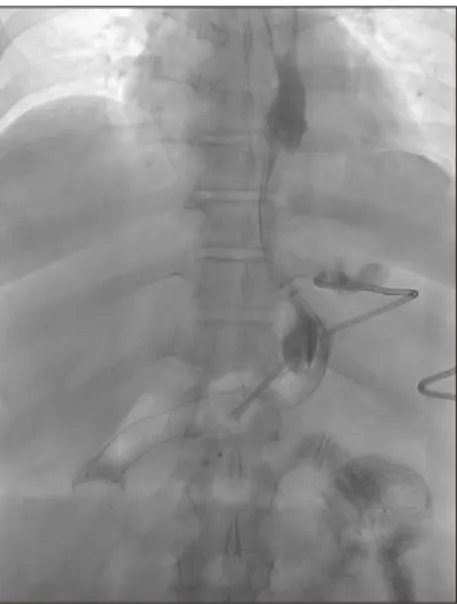
Fig. 1. Abdominal X-ray after endoscopic stent insertion.

septotomy. As far as we know, this is the first case in Korea, and we report the case with a video.

CASE PRESENTATION

Forty-one year old female patient with a BMI of 42.8 (161.6 cm/111.8 kg) underwent a laparoscopic sleeve gastrectomy. On the 4th day after the operation, pain in the left shoulder appeared that could not be explained, and the leakage of the proximal part of the staple resection line was checked in the abdominal CT. Percutaneous catheter drainage and endoscopic stent were treated (Fig.

1), and the stent was removed 6 weeks after insertion and percutaneous catheter drainage was removed 150 days after surgery.

The patient was visited for 10 months after removed percutaneous catheter drainage due to fever and pain in the left shoulder. Afterwards, chronic leakage was confirmed from the CT and endoscopy at POD 15 months. We treated endoscopic septotomy. We performed endoscopic treatment in the operating room under general anesthesia. We used a forward view endoscope with distal cap and intubated to esophagus in the standard method on supine position. At the gastroesophageal junction, we could find chronic leak orifice and bridging fold between stomach lumen and abscess pocket. During further examination with irrigation, inflammatory exudate was

suctioned from abscess orifice. After deciding to perform a septotomy of bridging fold, we once again confirmed the surgically deformed stomach, and confirmed that there was no stenosis or obstruction in the stomach between corpus and antrum. Endoscopic septotomy of bridging fold to divide the stomach lumen and abscess was performed using a L-type Knife (Finemedix co. Daegu, Korea) connected to an electrosurgical unit (VIO 300D;

ERBE, Tübingen, Germany). When the entire abscess communicated with the stomach lumen, the division of the diaphragm was considered complete. Hemostasis was performed with hot biopsy forceps (Radial Jaw 4; Boston Scientific co., Marlborough, MA, USA) on the exposed muscles around the septotomy line to prevent delayed bleeding (Supplementary Video 1). After the patient was discharged without any complications and is currently under close observation.

DISCUSSION

Many factors have been associated with increased risk of leak after laparoscopic sleeve gastrectomy [8]. A significantly higher leakage rate was correlated with male gender, higher BMI, concomitant sleep apnea, conversion to laparotomy, longer operation time, use of both buttresses and oversewing, and the prevalence of intraoperative complications. Most leaks could be treated by percutaneous drainage, stenting, and broad-spectrum antibiotic therapy. However, in the case of repeated chronic leaks, the treatment is unclear and technically demanding.

The therapeutic approach to leakage can be divided into acute phase and chronic phase depending on the timing.

Treatment of the acute phase mainly includes conservative treatment including nutrition, drain, and antibiotics, and endoscopic stent insertion in patients who do not respond to conservative care. Endoscopic stents have been shown to be a successful treatment choice for acute or early leaks, with success rates ranging from 84-94% [9]. Mega stents have also been identified as a successful leak treatment tool, with the added benefit of being able to exclude the whole staple line [10]. However, in this case, Mega stents treatment was unsuccessful.

In the chronic phase, surgical treatment is mainly

(3)

Journal of Metabolic and Bariatric Surgery Vol. 10, No. 1, 2021

Journal of Metabolic and Bariatric Surgery

44

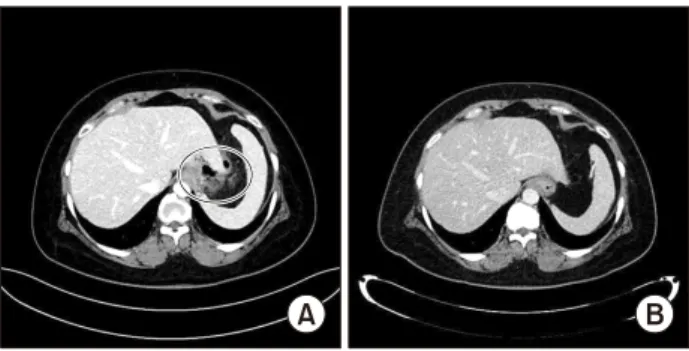
Fig. 2. Radiologic findings before (A) and after (B) endoscopic septotomy.

performed. Revisional surgery with gastric bypass, fistulojejunostomy, proximal gastrectomy, or total gastrectomy with esophagojejunostomy can be needed if endoscopic modalities fail or chronic phase of leak patient [11]. The mechanism of the chronic leak is explained as follows. Intraluminal pressure of the stomach increases after laparoscopic sleeve gastrectomy [12] and can lead to a pressure gradient favoring flow through the fistula or leak into the abscess cavity, thus leading to a vicious cycle further preventing closure. Septum division allows for equalization of stomach and abscess cavity pressures, which, when combined with aggressive sleeve dilatation, allows flow to be transferred to the sleeve’s distal section [13]. The therapeutic utility of endoscopic septotomy using this principle has been reported [4-7,13,14]. We decided to perform endoscopic septotomy before surgery in this case. However, since it was the first attempt, if endoscopic septotomy failed, it was planned to immediately switch to surgical treatment such as fistulojejunostmoy. The endoscopic septotomy was successful and there were no problems with the patient’s radiologic findings after treatment (Fig. 2). So, we suggest if a patient has elevated intraluminal pressure, a matured septum, and a well-contained abscess cavity, it is better to attempt endoscopic septotomy first, which has a non-invasive benefit, rather than performing surgery right away.

In conclusion, as a treatment for repeated leaks after sleeve gastrectomy, in the case of contained abscess with matured septum, endoscopic septotomy is considered to be useful method.

ACKNOWLEDGMENTS

This study was conducted through cooperation and discussion of Kosin Society of Metabolic and Obesity Surgery (KOSMOS) members.

AUTHOR CONTRIBUTION

Study conception and design: Kyung Won Seo.

Acquisition, analysis, and interpretation of data: Ki Hyun Kim, Yoon Hong Kim.

Drafting of manuscript: Ki Hyun Kim, Kyoungwon Jung.

Critical revision: Kyoungwon Jung, Kyung Won Seo.

SUPPLEMENTARY DATA

Supplementary data to this article can be found online at https://youtu.be/IbxhigY94fE

REFERENCES

1. Angrisani L, Santonicola A, Iovino P, et al. IFSO worldwide sur- vey 2016: primary, endoluminal, and revisional procedures.

Obes Surg 2018;28:3783-94.

2. Aurora AR, Khaitan L, Saber AA. Sleeve gastrectomy and the risk of leak: a systematic analysis of 4,888 patients. Surg Endosc 2012;26:1509-15.

3. Rosenthal RJ; International Sleeve Gastrectomy Expert Panel, Diaz AA, Arvidsson D, et al. International Sleeve Gastrectomy Expert Panel Consensus Statement: best practice guidelines based on experience of >12,000 cases. Surg Obes Relat Dis 2012;8:8-19.

4. Baretta G, Campos J, Correia S, et al. Bariatric postoperative fis- tula: a life-saving endoscopic procedure. Surg Endosc 2015;29:

1714-20.

5. Mahadev S, Kumbhari V, Campos JM, et al. Endoscopic septot- omy: an effective approach for internal drainage of sleeve gas- trectomy-associated collections. Endoscopy 2017;49:504-8.

6. Shnell M, Gluck N, Abu-Abeid S, Santo E, Fishman S. Use of endoscopic septotomy for the treatment of late staple-line leaks after laparoscopic sleeve gastrectomy. Endoscopy 2017;49:

59-63.

7. Yu JX, Schulman AR. Management of a refractory leak after sleeve gastrectomy: the endoscopic armamentarium. VideoGIE 2019;4:372-4.

8. Benedix F, Benedix DD, Knoll C, et al. Are there risk factors that

increase the rate of staple line leakage in patients undergoing pri-

mary sleeve gastrectomy for morbid obesity? Obes Surg

(4)

Ki Hyun Kim, et al.:

Endoscopic Septotomy for Chronic Leak

Journal of Metabolic and Bariatric Surgery 45

2014;24:1610-6.

9. Walsh C, Karmali S. Endoscopic management of bariatric com- plications: a review and update. World J Gastrointest Endosc 2015;7:518-23.

10. Klimczak T, Klimczak J, Szewczyk T, Janczak P, Jurałowicz P.

Endoscopic treatment of leaks after laparoscopic sleeve gas- trectomy using MEGA esophageal covered stents. Surg Endosc 2018;32:2038-45.

11. Nedelcu AM, Skalli M, Deneve E, Fabre JM, Nocca D. Surgical management of chronic fistula after sleeve gastrectomy. Surg Obes Relat Dis 2013;9:879-84.

12. Yehoshua RT, Eidelman LA, Stein M, et al. Laparoscopic sleeve gastrectomy–volume and pressure assessment. Obes Surg 2008;18:1083-8.

13. Guerron AD, Ortega CB, Portenier D. Endoscopic abscess sep- totomy for management of sleeve gastrectomy leak. Obes Surg 2017;27:2672-4.

14. Angrisani L, Hasani A, Santonicola A, Vitiello A, Iovino P, Galasso G. Endoscopic septotomy for the treatment of sleeve gastrectomy fistula: timing and indications. Obes Surg 2018;

28:846-7.

수치

Fig.  1.  Abdominal  X-ray  after  endoscopic  stent  insertion.
Fig.  2.  Radiologic  findings  before  (A)  and  after  (B)  endoscopic  septotomy.

참조

관련 문서