熱多寒少湯 관련 기존 연구 분석
오혜원․신승원․장형진*․안광석*․이석근*․이의주†․고병희†․이준희†
경희대학교 한방병원 사상체질과, *경희대학교 한의과대학 기초한의과학과,
†경희대학교 한의과대학 사상체질과
Abstract
Review of Studies on Taeumin Yeoldahanso-tang since 2000
Hye-Won Oh, Seung-Won Shin, Hyeung-Jin Jang*, Kwang-Seok Ahn*, Seok-Geun Lee*, Eui-Ju Lee†, Byung-Hee Koh†, Jun-Hee Lee†
Dept. of Sasang Constitutional Medicine, Kyung Hee Univ, Korean Medical Center
*Dept. of Oriental Medicine, College of Korean Medicine, Kyung Hee Univ
†Dept. of Sasang Constitutional Medicine, College of Korean Medicine, Kyung Hee Univ.
Objectives
This paper was aimed to review experimantal and clinical articles on Yeoldahanso-tang(YDHS), figuring out the recent tendency and suggesting the future prospects of YDHS-related studies.
Methods
The articles published in Korean or English since 2000 were searched, screened, and classified into experimental or clinical studies. And we structured designs, methods and results of the included studies into each table for the experimental studies or the clinical studies. Especially tools to diagnose constitutions and patterns identified in clinical researches were also summarized in the tables.
Results
28 articles are finally included. 14 experimental studies are mostly in vitro designs to show efficacy of YDHS.
There are only 2 studies for the safety. Among 14 clinical studies, 12 case studies target disorders of central nervous system, viral infection, skin ulcer and so on. 2 studies are before and after studies on cerebral infarction and effects on liver function.
Conclusions
Based on the efficacy of YDHS on central nervous system, it acquires higher level of evidence such as randomized controlled trials in the future. In addition other diseases such as skin ulcer and so on, it needs to be done more specific experimental or clinical studies so that we can get statistically significant results.
Key Words: Yeoldahanso-tang, Taeumin, Sasang Constitutional Medicine, Herbal Medicine, Review.
Received March 12, 2014 Revised March 17, 2014 Accepted March 22, 2014 Corresponding Author Jun-Hee Lee
Dept. of Sasang Constitutional Medicine, Kyung Hee Univ. Korean Medical Center, 1 Heogi-dong, Dongdaemun-gu, Seoul, 130-702, Korean
Tel:02-958-9280 Fax: 02-958-9234 E-mail: [email protected]
Ⓒ The Society of Sasang Constitutional Medicine.
All rights reserved. This is an open acess article distributed under the terms of the Creative Commons attribution Non-commercial License (http:// creativecommons.org/licenses/by-nc/3.0/)
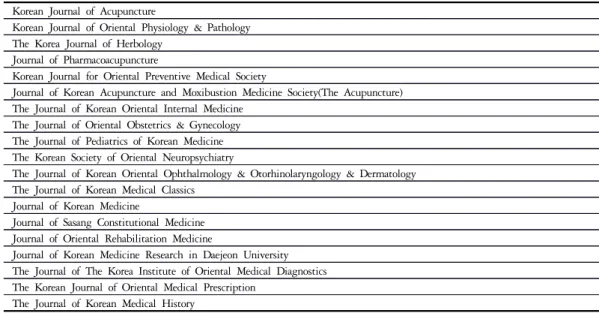
Korean Journal of Acupuncture
Korean Journal of Oriental Physiology & Pathology The Korea Journal of Herbology
Journal of Pharmacoacupuncture
Korean Journal for Oriental Preventive Medical Society
Journal of Korean Acupuncture and Moxibustion Medicine Society(The Acupuncture) The Journal of Korean Oriental Internal Medicine
The Journal of Oriental Obstetrics & Gynecology The Journal of Pediatrics of Korean Medicine The Korean Society of Oriental Neuropsychiatry
The Journal of Korean Oriental Ophthalmology & Otorhinolaryngology & Dermatology The Journal of Korean Medical Classics
Journal of Korean Medicine
Journal of Sasang Constitutional Medicine Journal of Oriental Rehabilitation Medicine
Journal of Korean Medicine Research in Daejeon University The Journal of The Korea Institute of Oriental Medical Diagnostics The Korean Journal of Oriental Medical Prescription
The Journal of Korean Medical History
Table 1. List of Selected Journals in the Review
I. 緖 論
熱多寒少湯은 東醫壽世保元 辛丑本에 나 오는 處方으로 葛根 4돈, 黃芩, 藁本 각 2錢, 蘿葍 子, 桔梗, 升麻, 白芷 각 1錢으로 구성되어 있다.
熱多寒少湯은 太陰人 裏病證 중 燥熱證에 대한 주 處方으로1燥熱證은 內經 燥病機에서의 ‘澁 枯涸皺揭’의 形證과 手指焦黑, 癍瘡, 手足無力, 引飮, 小便多, 大便秘, 虛勞夢泄 및 危亦林의 陰 血耗竭證인 耳聾, 目暗, 脚弱, 腰痛 등이 주 증상 이 된다2. 熱多寒少湯은 肝熱과 肺燥의 病理가 함 께 있을 때 사용하며 裏部의 肝熱을 除하고 潤肺燥 하는 것을 목표로 하는 處方이다1.
기존에 熱多寒少湯 관련 연구를 살펴보면, 실험 연구, 임상연구 및 문헌연구가 있지만 기존 연구에 대한 전반적 분석 논문은 없는 실정이다. 문헌 연구 중에서 熱多寒少湯의 세포활성 물질에 대한 영향을 고찰한 것이 있으나47, 특정 효능에 대한 분석이므로 기존 연구에 대한 분석이라고 보기에는 미흡하다. 이 에 본 연구는 2000년 이후에 熱多寒少湯 관련 연구 에 대한 고찰을 통해 熱多寒少湯의 효능 및 안정성 에 대해 확인하고, 임상에서 활용할 수 있는 근거를
마련하여 향후 연구의 방향을 설정하는 데 도움이 되 고자 하는 바이다.
Ⅱ. 硏究方法
1. 검색방법
한글 또는 영문으로 출판된 논문 중에서 검색하였 다. 한글로 출판된 논문의 경우, 한국 연구 재단에서 승인된 등재학술지 및 등재 후보 학술지 19개를 대상 으로 하였다 (Table 1). 각 학회지의 웹사이트에서 ‘熱 多寒少湯’을 검색어로 하여 제목, 초록, 주제어의 범 위에서 검색하였다. 영문으로 출판된 논문의 경우 Pubmed에서 ‘Yuldahansotang or Yeoldahansotang’ 을 제 목, 초록, 주제어의 범위에서 검색하였다. 기간은 2000 년 1월부터 2013년 12월까지 출판된 논문을 대상으로 하였다.
2. 포함기준 / 제외기준
검색된 논문의 전문을 읽고 선별작업을 시행하였 다. 포함기준은 1) 熱多寒少湯을 중재로 사용한 경
우 2) 동물을 사용한 실험연구(in vivo, in vitro) 또는 사람에게서 유래된 물질을 사용한 실험연구(in vitro) 3) 임상연구 4) 熱多寒少湯 이외의 處方(太陰人 他 處方, 非體質處方, 他體質 處方)과 혼용하였다 하 여도 熱多寒少湯을 사용하였을 때의 효과를 평가할 수 있는 지표가 명확히 제시되어 있으며 熱多寒少湯 이 결과에 의미 있는 영향을 끼친 경우이다.
제외기준은 1) 논문 전문이 없는 경우 2) 四象體質 病證으로 診斷하지 않고 熱多寒少湯을 사용한 경 우 3) 加味하여 사용한 약이 太陰人 약이 아닌 경우 4) 熱多寒少湯을 사용한 후에 효과를 평가할 수 있는 지표가 제시되어 있지 않는 경우 5) 熱多寒少湯 이외 의 處方(太陰人 他處方, 非體質處方, 他體質 處 方)과 혼용하였으며 熱多寒少湯이 결과에 의미 있 는 영향을 끼치지 않은 경우 6) 熱多寒少湯 加減方 을 사용하였으며 加減한 약재에 주된 효능이 있는 것으로 판단되는 경우 7) 문헌연구인 경우이다.
3. 분류
최종적으로 선택된 논문을 형식에 따라 분류하였 다. 우선 실험연구와 임상연구로 분류하였으며 실험 연구는 in vivo, in vitro의 두 종류로 분류하였다. 임상 연구는 증례 및 환자군 연구, 전후 연구, 무작위배정 비교임상시험, 비 무작위배정 비교임상시험, 코호트 연구, 환자-대조군 연구, 단면연구로 분류하고자 하였 다. 분류기준은 2013년 건강보험심사평가원에서 개 발한 임상연구문헌 분류도구인 DAMI 2.0을 기준으로 하였다.
4. 구조화
실험연구는 연구의 목적, 연구 디자인(in vivo, in vitro), 대상 질환 및 효능, 대상 동물 또는 물질, 기간, 처치, 1차 평가도구, 결과에 대해 정리하였다. 임상연 구는 연구 디자인, 대상 질환, 四象體質 診斷기준, 體質病證, 대상자 수, 기간, 處方, 기타 치료, 평가도
구, 결과에 대해 정리하였다.
기간에 대해, 실험연구에서 대상에 따라 熱多寒 少湯을 처리한 시간이 다른 경우에는 시간을 별도로 적었으며, 임상연구에서 다른 處方과 혼용하여 사용 한 경우 熱多寒少湯을 쓴 기간만 계산하여 정리하였 다. 단, 熱多寒少湯의 개념의 확장으로 太陰人 裏 熱病 범주에서 약을 변경하여 사용한 경우에는 熱多 寒少湯이 아닌 處方 (ex. 葛根解肌湯, 淸血降氣 湯, 淸肺瀉肝湯, 加減淸肝湯)을 사용한 기간을 총 합쳐서 기간으로 계산하였다. 임상연구에서 증례 별 로 치료기간이 다른 경우에는 반올림하여 평균시간을 적었으며, 논문에 평균 기간이 기재되어 있는 것3은 기재된 대로 썼다.
Ⅲ. 結果
1. 검색결과
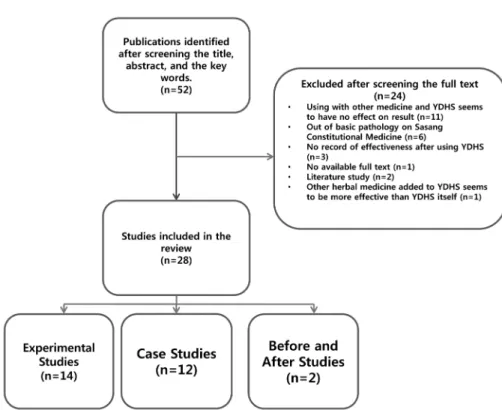
검색 결과 22개의 학회지에서 52개의 논문이 검색 되었다. 52개의 논문 중에서 24개의 논문이 제외되었 다. 다른 處方(太陰人 他處方, 非體質處方, 他體 質 處方)과 혼용하였으며 熱多寒少湯이 결과에 의 미 있는 영향을 끼치지 않은 경우4-14가 11개로 가장 많았다. 그 다음으로 加味하여 사용한 약이 太陰人 약이 아닌 경우15-18가 4개로 많았으며, 熱多寒少湯 을 사용한 후에 효과를 평가할 수 있는 지표가 제시되 어 있지 않는 경우19-21가 3개, 四象體質 病證으로 診斷하지 않고 약을 사용한 경우가 2개였다. 이 경우 八體質22또는 氣虛23로 診斷 하였다. 그 밖에 논문 전문이 없는 경우24가 1개, 熱多寒少湯 加減方을 사용하였으며 加減한 약재에 주된 효능이 있는 것으 로 판단되는 경우25가 1개, 문헌연구인 경우26,47가 2개 였다.
결과적으로 포함된 논문은 총 28개이다. 최27의 연 구는 임상 연구와 인체 유래물을 대상으로 한 in vitro 실험연구가 한 논문에 동시에 포함되어 있었으나 제
Figure 1. Screening and classification of identified publications
목을 고려하여 임상연구에 포함시켜 분석하였다. 배28 의 연구는 in vitro, in vivo 연구가 한 논문에 동시에 포함되어 있었으며, 분류상 실험연구 중 in vitro연구 로 포함 하였다. 결과 실험연구 14개, 임상연구 14개가 포함되었다. 실험연구 중에서 in vitro 연구 12개, in vivo 연구 2개가 포함되었으며, 임상연구 중에서 증례 연구 12개, 전후 연구 2개가 포함되었다(Figure 1).
2. 熱多寒少湯 관련 실험연구 분석
14개의 실험연구 중에서 2개의 연구29,30는 熱多寒 少湯의 안정성에 대한 연구였고 나머지는 효능에 대 한 연구였다. 대부분의 논문은 디자인상 in vitro 연구 였으며 2개의 연구만 in vivo 연구였다29,31 (Table 2).
효능에 대한 연구에서 다수의 연구는 독성을 유발 한 세포에 대한 熱多寒少湯의 세포활성물질 조절 효과에 대한 연구였다. 결과 熱多寒少湯은 항산화 효능, 알츠하이머병의 병인으로 알려진 베타-아밀로
이드가 유발하는 뇌신경 독성에 대한 보호 효능, UPS(ubiquitin-proteasome system)의 기능 부전을 유발 한 신경에 대한 보호 효능, 저산소증에 의해 유발된 신경세포독성에 대한 보호 효능, 항염증 효능, 항 동맥 경화 효능, 항 비만 효능이 있었다.
세포활성 물질 조절 작용과 관련하여 熱多寒少湯 이 독성물질이 유발된 뇌신경세포에 대해 어떠한 작 용을 하는지에 대한 것을 알고, 궁극적으로는 뇌신경 계 질환의 치료 효능을 밝히고자 하는 의도를 가진 실험연구가 가장 많았다32-37. 이외에 in vivo 연구에서 Allergy성 접촉피부염에 대해 면역과민반응 억제효능 과 항 염증 효능, 파킨슨에 대한 신경 보호 효능이 있음을 밝혔다.
안정성과 관련된 연구에서는 熱多寒少湯이 약물 의 대사에 핵심적 역할을 하는 CYP450 활성에 미치는 영향을 평가하였으며, 결과 CYP2D6 및 CYP2E1에 의 해 대사되는 양약과 熱多寒少湯이 상호작용을 할
Author
(Year) Objectives Design Target Disease or Effect Laboratory Animal or Molecules Duration Treatment Choi, JS
(2001)32 Efficacy in vitro Regulating effect on cytokine secretion
LPS‡ and SP¶ stimulated Human
astrocytes(CCF-STTG1 cells) 24 hrs* Preincubated with various concentraions Hong, JA
(2001)33 Efficacy in vitro Protective effect on oxidative
process Spinal sensory neuron of mouse 3hrs Preincubated with various concentraions Lee, JH
(2002)35 Efficacy in vitro Preventive effect on the
damage by hydrogen peroxideHippocampal cell of rat 3hrs Preincubated with various concentraions Kim, MS
(2002)31 Efficacy in vivo Allergic contact dermatitis BALB/c rats 72hours Administered orally Choi, JS
(2002)48 Efficacy in vitro Regulating effect on cytokine production
LPS‡ and SP¶ stimulated Human
astrocytes(CCF-STTG1 cells) 24 hrs Preincubated with various concentraions Park, SJ
(2003)34 Efficacy in vitro Protective effect on cerebral neurons damaged by hypoxia
Cerebral neurons from mouse and
SK-N-MC cells NA NA
Han, BS
(2004)37 Efficacy in vitro Antioxidant capacity,
antiperoxidation effect PC12 cells† NA Preincubated with
various concentraions Bae, NY
(2009)36 Efficacy in vitro Protective effect on β-Amyloid
Induced cytotoxicity PC12 cells 24 hrs Preincubated
Ma, JY (2009)29
Toxicity
and Safety in vivo Acute toxicity ICR mouse 14days Administered orally
Lee, JA
(2010)49 Efficacy in vitro Anti-inflammatory effects LPS‡-stimulated RAW 264.7 cells 18 hrs Preincubated
Bae, N (2011)28 Efficacy
in vitro Neuroprotective effect PC12 cells† 2 hrs Preincubated with various concentraions in vivo Neuroprotective
effect(Parkinson’s disease) C57BL/6 mice 3 days Administered orally Jin, SE
(2012)30 Safety in vitro Interaction potential on
CYP§450 isozymes CYP450 NA NA
Kim, OS
(2012)50 Efficacy in vitro Anti-atherosclerotic effect ABTS¶, DPPH#, LDL**, LDL / LPSstimulatedRAW264.7cells
30min/ 30min/
6hrs/ 24hrs
Preincubated with various concentraions Yoo, SR
(2012)51 Efficacy in vitro Anti-obesity effect 3T3-L1 cells NA Preincubated with various concentraions Abbreviations; *NA: Not Applicable, †PC12 cells: Rat pheochromocytoma cells, ‡LPS: Lipopolysaccharide, ¶SP: Substance P §CYP: Cytochrome
P, ¶ABTS: 3-ethyl-benzothiazoline-6-sulfonic acid, #DPPH: 1-1-diphenyl-2-picrylhydrazyl, **LDL: Low Density Lipoprotein Table 2. Structured Basic Information of Experimental Studies on Yeoldahanso-tang
수 있다고 하였다30. 또 다른 연구에서 熱多寒少湯을 쥐에게 경구 투여한 결과 어떠한 독성 증상도 관찰되 지 않았다29. 평가 방법과 결과는 표에 요약되어 있다 (Table 3).
3. 熱多寒少湯 관련 임상연구 분석
1) 증례보고12개의 증례연구가 포함되었다. 體質診斷 방법으 로 QSCCII, 體形氣像, 容貌詞氣, 性質才幹, 素證, 病證藥理, 전문가의 診斷 등의 방법을 사용한 경우
가 많았다. 病證 診斷으로는 太陰人 燥熱證으로 診斷한 경우가 가장 많았으며 그 중에서도 太陰人 癍瘡病으로 診斷한 경우도 있었다38,39,40.증례연구 에서는 1-2명을 대상으로, 짧게는 10일에서 길게는 397일까지 치료하였다. 대상 질환으로는 뇌경색, 부신 백질이영양증, 뇌경색 후 무도병, 파킨슨병과 같은 중 추신경계 뇌질환과, Ramsay Hunt Syndrome, 대상포진 과 같은 바이러스 감염질환, 망상 청피반, 당뇨병성 족부병변 같은 피부궤양 질환, 기타 안면마비, 만성기 침, 역류성 식도염이 있었다. 기타 치료로 양약병행, 침치료, 뜸치료, 약침, 이침, 부항, 물리치료를 시행한
Author
(Year) Target Disease or Effect Main Method of Evaluation Results
Choi, JS (2001)32
Regulating effect on cytokine
secretion IL*-1, IL-4, IL-6,TNF†-α IFN‡-γ, IL-2
Significantly inhibited IL-1, IL-4, IL-6, TNF-α secretion in- duced by LPS§ and SP¶ concentraion-dependently.
TNF-α secretion was stimulated simultaneously by LPS and SP, mediated by IL-1.
Hong, JA (2001)33
Protective effect on oxidative process
Cell viability, The cell death, neurofila-
ment, LDH#activity Had efficacy of increasing neurofilament, LDH activity.
Lee, JH (2002)35
Preventive effect on the dam-
age by hydrogen peroxide Neurofilament, DNA synthesis Had efficacy of increasing a amount of neurofilament, DNA synthesis.
Kim, MS
(2002)31 Allergic contact dermatitis
Change of cutaneous shape, histo- chemistry, immunohistochemistry, dis- tribution of apoptotic cells
Had less ear swelling, hyperplasia of epidermis, migration of inflammatory cells, damage of epidermis than control group.
Had lower number of mastocyte, apoptotic cells and Bax and Fas than control group.
Had more distribution of Bcl-2 than control group
Choi, JS (2002)48
Regulating effect on cytokine
production IL*-1,IL-4,IL-6,TNF†-α IFN‡-γ, IL-2
Significantly inhibited IL-1, IL-4, IL-6, TNF-α secretion in- duced by LPS§ and SP¶ concentraion-dependently.
TNF-α secretion was stimulated simultaneously by LPS and SP, mediated by IL-1.
Park, SJ (2003)34
Protective effect on cerebral neurons damaged by hypoxia
Cell viability, catalase, SOD**activity,†
‡††TNF-𝛼 and PKC†† activity
Inhibited the decrease of the catalase, SOD activity and apoptosis via caspase activation induced by hypoxia.
Han, BS (2004)37
Antioxidant capacity, anti- peroxidation effect
Antioxidant activity, MDA‡‡ formation rate
Had antioxidant and antiperoxidantion properties for scaveng- ing of ROS.
Bae, NY (2009)36
Protective effect on β-Amyloid Induced cytotoxicity
Cell viability, The cell death, the ex- pression level of LC§§3Ⅰ, LC3Ⅱ proteins
Had protective effect of on PC12 cells cytotoxity induced by Aβ25-35¶¶.
Pharmacologically induced autophagy in PC12 cells.
Induced autophagy on Aβ25-35-induced injury in PC12 cells.
Ma, JY
(2009)29 Acute toxicity Survival rates, general toxicity, change
of body weight and autopsy, LD50## Free from the toxicity and safety problems.
Lee, JA
(2010)49 Anti-inflammatory effects Productions of NO***,PGE2.††† Had effect on NO inhibition, no effect on PGE2 inhibition.
Bae, N (2011)28
Neuroprotective effect Cell viability, induction of autophagy Significantly provided neuroprotection, partially mediated by autophagy enhancement.
Neuroprotective effect (Parkinson’s disease)
TH positive neurons in the substantia nigra pars compacta, reduction of the opti- cal density of TH-IR(tyrosine hydrox- ylase-immunoreact) fibers in the striatum.
Significantly inhibited both the loss of TH-positive neurons in the substantia nigra pars compacta and the reduction of the optical density of TH-IR fibers in the striatum.
Jin, SE (2012)30
Interaction potential on
CYP450 isozymes IC50‡‡‡ values
Had Inhibitory effects on CYP2D6 and CYP2E1-mediated metabolism, week inhibition on CYP3A4 and CYP2C19 relatively.
Kim, OS
(2012)50 Anti-atherosclerotic effect Fragmentation of apolipoprotein B-100 (ApoB), foam cell formation
Showed suppressive effect on LDL§§§ oxidation, significantly inhibited foam cell formation in LDL/LPS¶¶¶ stimulated RAW 264.7 cells.
Yoo, SR
(2012)51 Anti-obesity effect Oil Red O staining, GPDH###activity,tri- glyceridecontents,leptinproduction
Remarkably prevented lipid accumulation with no cytotoxicity in the differentiated 3T3-L1 cells, Decreased contents of trigly- ceride 3T3-L1 adipocytes.
Significantly inhibited GPDH activity and leptin production in a dose-dependent manner.
Abbreviations;*IL:Interleukin†TNF : Tumor Necrosis Factor ‡IFN:Interferon§LPS::Lipopolysaccharide¶SP: Substance P #LDH: Lactate Dehydrogenase Enzyme, **SOD:superoxidedismutase,††PKC: protein kinase C, ‡‡MDA: Malondialdehyde, §§LC: light chain,
¶¶Aβ25-35: β-Amyloid peptide, ##LD50:LethalDose50,***NO:NitricOxide,†††PGE2: Prostaglandin E2, ‡‡‡IC50: Half maximal inhibitory concentration, §§§LDL: Low Density Lipoprotein, ¶¶¶LPS: Lipopolysaccharide, ###GPDH:glycerol-3-phosphatedehydrogenase Table 3. Summaries of Main Outcomes in Experimental Studies on Yeoldahanso-tang
Author
(year) Design Target disease Constitution Diagnosis
Pattern Identified
Mean Number of Patients
Duration Prescription Other
Treatments
Choi, YK (2000)27
B&A* Cerebral infarction
QSCC†II, specialists'
diagnosis NR
8 3 weeks
YDHS# NR
in vitroRegulatory effects on
cytokine production NR‡ LPS§-activa ted PBMC¶
preincubated for 30minutes Kwon, K
(2001)46 CR** Ramsay Hunt
Syndrome NR NR 2 9days YDHS AT※, pharmaco-
AT, Moxa-Tx Yoo, JS
(2001)38 CR Livedo Reticularis NR TE-BCB†
† 1 80 days YDHS Auricular
AT(AAT), AT Go, WS
(2002)39 CR Diabetic foot
QSCCII, special- ists' diagnosis, SMPC‡‡, OS§§
T E
L D H P¶ ¶, TE-BCB
1 71 days YDHS Mx##
Kim, YJ
(2003)40 CR CVA with Diabetic
Foot SMPC, PC*** TE LDHP,
TE-BCB 1 9 days YDHS
AT, Mx, Moxa-Tx, Nega-Tx Kim, HS
(2004)41 CR Facial palsy QSCCII, SMPC,
AMS†††,PC TE LDHP 2 12days YDHS AT, Nega-Tx,
physical-Tx Lee, KR
(2004)52 CR Chronic cough QSCCII, SMPC,
AMS, PC, OS TE LDHP 1 70 days
YDHS
Nokyoungdaejo-tang Galgeunhaegi-tang
NR
Lim, JH
(2004)53 CR Adrenoleukodystrop hy(ALD)
QSCCII, SMPC, AMS, PC, OS, PSTP‡‡‡
TE LDHP 1 397 days
Gagamchungan-tang YDHS
Galgeunhaegi-tang Cheongpaesagan-tang Cheonghyeolgangi-tang
AT
Han, DY
(2005)42 CR Chorea after Cerebral infarction
QSCCII, SMPC, AMS, PC, OS, PSSC-2004
TE LDHP 1 15 days YDHS NR
Kim, TH
(2007)3 B&A Effects on liver func-
tion NR NR 25 36 days YDHS Mx
Lee, JW
(2009)1 CR Hand tremor, heat flash, dysarthria
QSCCII, SMPC,
AMS, PC, OS TE LDHP 1 10 days Cheongsimyeonja-tang YDHS
AT, Moxa-Tx, Mx
Kim, YH
(2011)43 CR Gastro-esophageal re- flux disease(GERD)
QSCCII, SMPC,
AMS, PC, OS TE LDHP 1 11 weeks YDHS AT, Mx
Choi, JS
(2012)44 CR Parkinson`s Disease QSCCII, SMPC,
AMS, PC, OS TE LDHP 1 11 months YDHS AT, Mx
Kim, ST
(2012)45 CR Herpes Zoster QSCCII, SMPC,
AMS, PC, OS TE LDHP 1 15 days YDHS AT
Abbreviations;*B&A: Before-after study †QSCC: Questionnaire for Sasang Constitution Classification, ‡NR: Not Reported, §LPS:
Lipopolysaccharide, ¶PBMC : peripheral blood mononuclear cells #YDHS:Yeoldahanso-tang, **CR: Case Report, ※AT: Acupuncture Therapy, ††BCB: Banchangbyung(癍瘡病), ‡‡,SMPC: Somatic Morphology and Physical Comportment(體形氣像), §§OS: Ordinary Symptoms(素證), ¶¶LDHP: Liver Dryness Heat Pattern(肝燥熱證), ##Mx:Medication, ***PC:Proclivity and Capacity(性質才幹),
†††
AMS:Appearance and Manner of Speech(容貌詞氣), ‡‡‡PSTP:Pathological Symptomatology and Therapeutic Principle(病證藥理) Table 4. Structured Method of Clinical Studies on Yeoldahanso-tang
경우도 있었다 (Table 4).
결과는 대부분 증상의 호전으로 표현하였으며, 평 가 도구로 VAS1,41-45, DITI38,44를 사용하기도 하였으 며, 질환 특이적으로 EGG43, 안면마비 평가 점수41,46 를 사용한 경우가 있었다. 대부분의 경우 증세가 호
전되었다. 평가 방법과 결과는 표에 요약되어 있다 (Table 5).
2) 전후연구
2개의 전후 연구가 포함되었다. 이 중 최27의 연구
Author
(year) Design Target disease Method of
Evaluation Results
Choi, YK (2000)27
B&A* Cerebral infarction
IFN†-γ, IL‡-2, IL-4, IL-6, Ig§E, TNF¶-α
Plasma levels of IFN-γ, IL-2 elevated significantly, IL-4, IL-6 reduced significantly, IgE reduced significantly.
in vitroRegulatory effects on cytokine
production Release of IFN-γ, IL-2, IL-6 decreased.
Kwon, K
(2001)46 CR# Ramsay Hunt Syndrome
House-Brackmann system,
Yanagihara's system Grades considerably improved, Yoo, JS
(2001)38 CR Livedo Reticularis DITI**,symptomsprogress Symptoms improved.
(feet became warm, ulceration has disappeared.) Go, WS
(2002)39 CR Diabetic foot Symptoms progress Symptoms improved
(ulceration had nearly disappeared and could save toes) Kim, YJ
(2003)40 CR CVA with Diabetic Foot Symptoms progress Consciousness and objective symptoms improved.
Kim, HS
(2004)41 CR Facial palsy Symptoms progress(Facial
muscle paralysis, VAS††) Symptoms improved.
Lee, KR
(2004)52 CR Chronic cough Change of sweating coughing,
and other symptoms Sweating condition improved, chronic cough decreased.
Lim, JH
(2004)53 CR Adrenoleukodystrophy(ALD) Change of subjective symptoms
and general conditions. May have an effect on management of ALD.
Han, DY
(2005)42 CR Chorea after Cerebral infarction
Choreiform movement(VAS,
frequency) Symptoms improved.
Kim, TH
(2007)3 B&A Effects on liver function ALP, AST, ALT, γ-GT, total bilirubin
Values of ALP, AST, ALT, γ-GT, total bilirubin were within normal range or decreased for most patients,.
Lee, JW
(2009)1 CR Hand tremor, heat flash,
dysarthria Symptoms progress(VAS) VAS score dropped, general conditions improved.
Kim, YH
(2011)43 CR Gastro-esophageal reflux disease(GERD)
Symptoms progress(VAS), EGG§§
Bradygastria parameters in fed EGG significantly increased of %. Power ratio significantly increased.
Choi, JS
(2012)44 CR Parkinson`s Disease DITI, symptoms
progress(VAS) Chief complaints and symptoms were improved.
Kim, ST
(2012)45 CR Herpes Zoster Symptoms progress(VAS),
pictures of the affected part The vesicles were cleared and symptoms improved Abbreviations;*B&A: Before-after study, ‡IL:Interleukin,¶TNF : Tumor Necrosis Factor, †IFN:Interferon,§Ig: immunoglobulin, #CR: Case
Report, **DITI:Digital Infrared Thermal Imaging, ††VAS: Visual Analogue Scale, §§EGG: Electrogastrography Table 5. Summaries of Main Outcomes in Clinical Studies on Yeoldahanso-tang
내에는 전후 연구와 in vitro 연구가 동시에 있었으나 형식별 분류 기준에서 언급하였듯이 제목에 비중을 두어 전후 연구로 분류하였다. 전후 연구에서 대상 질환은 각각 뇌 경색과 熱多寒少湯의 간 기능에 대 한 영향이었다. 세포활성물질, 간 기능검사로 결과를 평가하였으며, 결과 熱多寒少湯은 급성기 뇌경색증 환자의 세포활성물질의 불균형을 조절하였으나 통계 적으로 유의하지는 않았다. 또 熱多寒少湯 복용 후 대부분의 경우 간 기능 검사 수치가 정상범위 또는 감소하였으나 통계적으로 유의하지는 않았다. 평가 방법과 결과는 표에 요약되어 있다 (Table 5).
Ⅳ. 考 察
熱多寒少湯은 肝熱熱證溫病, 燥熱病, 手指 焦黑癍瘡病, 虛勞夢泄 등을 主治로 한다1. 연구 경향을 보면 실험연구 중에는 in vitro 연구가 대부분 이며, 주로 독성을 유발한 세포에 대해 熱多寒少湯 이 세포활성물질을 조절하는 효능을 확인함으로써, 熱多寒少湯의 뇌신경질환에 대한 치료 효과를 입증 하고자 하는 목적을 가진 경우가 많았다. 임상연구에 서도 뇌신경질환을 대상으로 한 경우가 있었으며, 문 헌에 근거하여 癍瘡病으로 診斷하여 피부궤양에 적
용한 경우도 있었다. 한편 熱多寒少湯의 안정성과 관련한 실험연구에서 熱多寒少湯이 CYP2D6 및 CYP2E1에 의해 대사되는 양약과 상호작용을 할 수 있다는 결과가 있었다. 따라서 이러한 양약과 동시에 熱多寒少湯을 處方 시 주의해야 한다고 하였다. 쥐 에게 熱多寒少湯을 경구 투여한 경우 어떠한 독성도 발견되지 않았다. 임상연구에서 안정성과 관련하여 간 기능에 미치는 영향을 확인한 결과 간 기능 검사 수치는 정상 또는 감소하였으나 통계적으로 유의하지 않았다.
이를 통해 정리해보면, 현재까지 熱多寒少湯과 관련하여 in vivo 연구가 적은 편이며 기존의 안정성 및 효능에 대한 연구에서 통계적으로 유의한 결과를 얻은 경우가 많지 않다. 또한 대조군과의 비교를 통한 무작위배정 비교임상시험과 같은 좀 더 근거 수준이 높은 연구가 진행된 적이 없다. 따라서 현재까지 실험 및 임상연구로 밝혀진 熱多寒少湯의 뇌신경질환에 대한 효과를 근거로 향후 무작위배정 비교임상시험과 같은 근거수준이 높은 연구가 진행되고, 기타 피부질 환을 비롯한 다양한 질환 및 안정성에 대한 실험연구 및 임상연구가 더욱 진행된다면 熱多寒少湯의 효능 및 안정성에 대해 통계적으로 유의한 결과를 얻을 수 있을 것으로 보인다.
Ⅴ. 感謝의 글
이 연구는 2012년도 경희대학교 연구비지원에 의 한 결과임(KHU-20131087).
Ⅵ. 參 考 文 獻
1. Lee JW, Jang HS, Kim YH, Lee JH, Lee EJ, Koh BH. A Case Study of 1 Taeeumin Patient Experiencing Hand Tremor, Heat Flash, and Dysarthria Treated Successfully with Yeoldahansotang. J Sasang Constitut
Med. 2009;21(1):254-262. (Korean)
2. Lee JH, Lee EJ, Koh BH. The Study on the Energy and Fluid Metabolism and the Pathology and Symptomatology of Taeeumin based on The Discourse on Viscera and Bowels of Donguisusebowon. J Sasang Constitut Med. 2012;24(4):1-16. (Korean)
3. Kim TH, Hong SY, Han DN, Lim EC. The Effects of Constant Use of Yeoldahanso-tang on Liver Function.
J Sasang Constitut Med. 2007;19(3):217-226. (Korean) 4. Kim TY, Lee BJ, Jeon JH, Lew JH. A Case of Amyotrophic
Lateral Sclerosis. The Journal of Korean Oriental Internal Medicine. 2000;21(4):661-665. (Korean)
5. Roh GH, Choi DJ, CHo KH, Kim YS. The Clinical Report about Two Stroke Patients who Developed Hiccups after Purgation Therapy. Journal of Korean Medicine. 2000;21(1):109-113. (Korean)
6. Kim CH, Kim HG. The Clinical case study of facial palsy. The Journal of Korean Oriental Ophthalmology
& Otorhinolaryngology & Dermatology. 2001;14(2):
262-270. (Korean)
7. Kim HS, Lee SW, Park HS, Kim KY. A Case Study about Treatment of Taeumin Patient diagnosed as Lateral medullary syndrome(wallenberg syndrome). J Sasang Constitut Med. 2001;13(2):182-189. (Korean) 8. Ko JC, Park JY, Jun CY, Han YH. A Case of paralytic
ileus and Urinary Tract Infection with cerebral infarction. The Journal of Korean Oriental Internal Medicine. 2001;22(3):471-476. (Korean)
9. Lee JH, Kim SB, Park GS, Jeong YJ, Lee SK, Lee EJ, et al. A Case Report on 'fever of unknown origin, abdominal distension and diarrhea' of Taeumin. J Sasang Constitut Med. 2001;13(3):121-125. (Korean) 10. Shin JA, Son DH, Yu KS, Lee JG, Lee YG. 2 Cases
of Lower Limb Monoplegia due to Brain Cortical Infarction. The Journal of Korean Oriental Internal Medicine. 2001;22(2):263-269. (Korean)
11. Yun BH, Lim CW, Kim KH, Park YJ, Park JH.
The Clinical Study on a Abnormal Liver Function
Patients Caused by Obesity. The Journal of Korean Oriental Internal Medicine. 2001;22(4):547-555.
(Korean)
12. CHoi WJ, Kim DW, Shin SH, Lee UJ, Choi JY, Shin HS, et al. Effects of the Renal Function of Complex Herbal Medication in 20 Diabetic Nephropathy Patients. Korean Journal of Oriental Physiology &
Pathology. 2003;17(2):580-584. (Korean)
13. Ock MK, Lim WK, Yoon HS, Sun YJ, Moon JH, Kim CH. Four Cases of Stroke Patients with Defective Vision Treated with Venesection on Palpebral Conjunctiva. The Journal of Korean Oriental Ophthalmology & Otorhinolaryngology & Dermatology.
2004;17(3):107-113. (Korean)
14. Oh KM, Yang DH, Kim BK. A Clinical report of cerebral infarction patient with schizophrenia. The Korean Society of Oriental Neuropsychiatry. 2007;
18(3):209-224. (Korean)
15. Jung HS, Lee JY. A Study on the alteration of general characteristics and therapeutic effect of Gami Yeoldahansotang in patients with Atopic Dermatitis.
The Journal of Pediatrics of Korean Medicine. 2001;
15(3):177-188. (Korean)
16. Cho GI, Han MA, Lee JY, Choi JY, Kim DW, Jung DY, et al. Case Reports about Brainstem Infarction.
Korean Journal of Oriental Physiology & Pathology.
2002;16(6):1291-1296. (Korean)
17. Kim JJ, Kim MG, Choi JR, Park SS. A Clinical Study about Treatment of a Abdominal Distention in Stroke.
J Sasang Constitut Med. 2004;16(1):148-154. (Korean) 18. Cho JS, Yim CH, Kim HS, Kwon SM, Kim S, Kim
IH, et al. The Clinical Study on 2 Case of Patient with Tremor. J Sasang Constitut Med. 2008;20(3):208-217.
(Korean)
19. Son DH, Jang IS, Yu KS, Lee JG, Yun HS, Lee YG, et al. A Clinical Study on the Patients Admitted at the Acute Stage of Stroke. The Journal of Korean Oriental Internal Medicine. 2000;21(2):203-212.
(Korean)
20. Koh KH, Park SY, Choi HG, So KS, Hwang WJ, Lee KM, et al. Clinical Study on treatment of HIVD of lumbar spine using Scolopendrid herbal acupuncture.
Korean Journal of Acupuncture. 2002;19(3):192-206.
(Korean)
21. Kwon EM, Jung YH, Kim EH, Seo YK, Lee SK, Kim DR, et al. A Clinical Case of Liver Injury with Administration of Yeoldahanso-tang plus Rheum rhabarbarum. J Sasang Constitut Med. 2009;23(3):
209-215. (Korean)
22. Cho SH, Jee SY. A Clinical Study on Allergic rhinitis.
Journal of Pharmacoacupuncture. 2001;14(2):173-182.
(Korean)
23. Choi YS, Park SJ, Lee HK, Cho MY, Yu JY, Baek DG, et al. A Case Report of Fever of Unknown Origin Treated with Yeoldahansotang-gamibang. The Journal of Korean Oriental Internal Medicine. 2012;10(4):
316-323. (Korean)
24. Lee YJ, Rhim EK, Hwang SI, Baek DG, Yun JM, Hong SH, et al. A case report of facial palsy and eyeball movement disturbances with Yuldahansotang, Jung- myung and Jium acupuncture point in modified lateral inferior pontine syndrome resulting from pontine infarction. The Journal of Korean Oriental Internal Medicine. 2003;24(3):681-687. (Korean)
25. Kim MG, Choi JR, Bae HS, Park SS. A Case study of multiple myositis. J Sasang Constitut Med. 2003;
15(2):117-123. (Korean)
26. Kim DJ, Kim JR, Kim DR. A Bibliographical Research of the Correlation Among Sasang Constitutional Disease and the Pulse Diagnosis. Journal of Pharmacoacupun- cture. 2003;6(3):23-37. (Korean)
27. Choi YK, Kim KY. Studies on the Regulatory Effect of Cytokine Production in Patients with Cerebral Infarction by Yuldahansotang. J Sasang Constitut Med.
2000;12(1):201-215. (Korean)
28. Bae N, Ahn T, Chung S, Oh MS, Ko H, Oh H,
et al. The neuroprotective effect of modified Yeoldahanso- tang via autophagy enhancement in models of Parkinson's disease. J Ethnopharmacol. 2011;134(2):313-322.
29. Ma JY, Huang DS, Lee SW, Kim JY, Shin HK. Acute Toxicity Study on Yeoldahanso-tang in Mice. J Sasang Constitut Med. 2009;21(1):247-253. (Korean) 30. Jin SE, Ha HK, Shin HK. Effects of Yuldahanso-tang
and Chungsimyonja-tang on Cytochrome P450 Activities. J Sasang Constitut Med. 2012;24(4):84-91.
(Korean)
31. Kim MS, Park SS. Effects of Yuldahansotang on rat skin occured the Allergic Contact Dermatitis. J Sasang Constitut Med. 2002;14(3):97-113. (Korean) 32. Choi JS, Kim KY, Kim HM, Ju JC. Studies on the
Cytokine Production Regulation in Human Astrocytes by Yuldahansotang. J Sasang Constitut Med. 2001;
13(1):61-69.
33. Hong JA, Kim KY, Yu DG, Park HS, Kim HS. Effects of Yuldahansotang water extract on Cultured Spinal Sensory Neurons Damaged by Xanthine Oxidase/
Hypoxanthine. J Sasang Constitut Med. 2001;13(1):
88-96. (Korean)
34. Park SJ, Kim HS, Bae YC, Lee SM, Kim KY, Won KS, et al. Influence of Yeoldahanso-tang on the Hypoxic Damage of Cultured Cerebral Neurons from mouse and SK-N-MC cells. J Sasang Constitut Med. 2003;15(1):
72-89. (Korean)
35. Lee JH, Park HS, Kim KY, Kho KD, Kim IH. Effects of Yuldahansotang water extract on Cultured Primary Hippocampal Cell Culture Damaged by Hydrogen Peroxide. J Sasang Constitut Med. 2002;14(1):79-89.
(Korean)
36. Bae NY, Yang HO, Ahn TW. Protection effect of New-Yeolda-Hanso tang against β-Amyloid Induced Cytotoxicity in NGF-differentiated PC12 Cells. J Sasang Constitut Med. 2009;21(3):138-153. (Korean) 37. Han BS, Bae YC, Song SY, Park HS, Lee JH, Kim
KY. Antioxidant effects and its mechanism of
Cheongsimyeonjatang in Sasang Constitutional Medicine. J Sasang Constitut Med. 2004;16(1):130-147.
38. Yoo JS, Yang SM, Kim SH, Kim DR. A Case Report on the Ban-Chang-Byung of Taeumin. J Sasang Constitut Med. 2001;13(2):190-193. (Korean) 39. Go WS, Kim KS, Lim EC. A Case Report on a patient
diagnosed as Diabetic Foot. J Sasang Constitut Med.
2002;14(2):169-174. (Korean)
40. Kim YJ, Kim BO, Kim HJ, Kwack JJ, Jeon SY, Hong S. A Clinical Report of CVA with Diabetic Foot.
The Journal of Korean Oriental Internal Medicine.
2003;24(3):727-734. (Korean)
41. Kim HS, Kim IH. Clinical Cases about Facial Palsy by Using Yeoldahanso-tang. J Sasang Constitut Med.
2004;16(3):133-138. (Korean)
42. Han DY, Jung WK, Kim EY, Lee SM, Shin MR, Choi JW, et al. A Case of Taeumin Chorea originated after Cerebral infarction. J Sasang Constitut Med.
2005;17(3):128-134. (Korean)
43. Kim YH, Kim SY, Hwang MW. A Case Study of Taeumin Patient with Gastro-esophageal reflux dis- ease(GERD) who Treated Successfully with Yeoldahanso- tang. J Sasang Constitut Med. 2011;23(1):132-138.
(Korean)
44. Choi JS, Jang MH, Ahn TW. A Case Study of Parkinson's Disease Patient Treated with Yuldahanso-tang gagam.
J Sasang Constitut Med. 2012;24(3):104-113. (Korean) 45. Kim ST, Choi AR, Koo DM. A Case Report of Herpes
Zoster in Tae-eumin Improved with Yeoldahanso-tang.
J Sasang Constitut Med. 2012;24(2):71-77. (Korean) 46. Kwon K, Park YH. Two case studies of Ramsay Hunt
syndrome. The Journal of Korean Oriental Ophthalmology
& Otorhinolaryngology & Dermatology. 2001;14(2):
183-193. (Korean)
47. Burns JJ, Zhao L, Taylor EW, Spelman K. The influ- ence of traditional herbal formulas on cytokine activity.
Toxicology. 2010;278(1):140-159. (eng)
48. Choi JS, Jung SW, Ju JC, Lee SW, Kim KY, Kim
HM. Cytokine Production Regulation in human as- trocytes by a herbal combination(Yuldahansotang).
Immunopharmacology and immunotoxicology. 2002;
24(1):55-67.
49. Lee JA, Ha HK, Lee HY, Jung DY, Lee JK, Huang DS, et al. Anti-inflammatory Activities of Herbal Formulas for Sasang Constitutional Medicine. J Sasang Constitut Med. 2010;22(4):56-64. (Korean)
50. Kim OS, Kim YJ, Shin HK. Anti-atherosclerotic Effects of Herbal Formulas for Sasang Constitutional Medicine J Sasang Constitut Med, 2012; 51-61.
51. Yoo SR, Jeong SJ, Shin HK. Effects of Yeoldahanso-
tang, a Sasang Constitutional Herbal Prescription for Taeeumin, on the Adipogenesis in 3T3-L1 Cells. J Sasang Constitut Med. 2012;24(4):75-83. (Korean) 52. Lee KR, Lee SG, Song JM. A Case Study of Chronic
Cough of Taeumin through the Change Process of Sweating. J Sasang Constitut Med. 2004;16(3):
139-142. (Korean)
53. Lim JH, Hwang MW, Ham TI, Lee SK, Koh BH, Song IB. A Case of Treatment of a Taeumin patient diagnosed to Adrenoleukodystrophy. J Sasang Constitut Med. 2004;16(1):155-161. (Korean)