Ionizing Radiation-induced Diseases in Korea
Radiation risk has become well known through epidemiological studies of clinically or occupationally exposed populations, animal experiments, and in vitro studies; however, the study of radiation related or induced disease has been limited in Korea. This study is to find the level of occupational radiation exposure for various kinds of accidents, compensated occupational diseases, related studies, and estimations on future occupational disease risks.
Research data of related institutions were additionally investigated. About 67% of 62,553 radiation workers had no exposure or less than 1.2 mSv per year. The 5 reported cases on radiation accident patients in Korea occurred during nondestructive testing. According to the recent rapid increase in the number of workers exposed to radiation, a higher social recognition of cancer, and an increasing cancer mortality rate, it is expected that
occupational disease compensation will rapidly increase as well. Therefore, it is important to develop scientific and objective decision methods, such as probability of causation and screening dose in the establishment of an exposure and health surveillance system.
Key Words: Radiation; Occupational Exposure; Nuclear Power Plants; Occupational Diseases Young-Woo Jin1, Meeseon Jeong1,
Kieun Moon1, Min-Heui Jo2, and Seong-Kyu Kang2
Division of Radiation Effect Research1, Radiation Health Research Institute, Korea Hydro & Nuclear Power Co., LTD, Seoul; Occupational Safety and Health Research Institute2, Korea Safety and Health Agency, Incheon, Korea
Received: 19 February 2010 Accepted: 8 September 2010 Address for Correspondence:
Young-Woo Jin, M.D.
Radiation Health Research Institute, Korea Hydro & Nuclear Power Co., Ltd., 308 Uicheon-ro, Dobong-gu, Seoul 132-703, Korea
Tel: +82.2-3499-6660, Fax: +82.2-3499-6669 E-mail: [email protected]
This work was supported by Korea Hydro & Nuclear Power Co., Ltd. (grant code: E07NS55).
DOI: 10.3346/jkms.2010.25.S.S70 • J Korean Med Sci 2010; 25: S70-76 Occupation & Environmental Medicine
INTRODUCTION
Ionizing radiation (radiation) is defined as the energy required to remove electrons from a molecule (1) and a radiation worker is defined as one who is exposed or possibly exposed to radia- tion due to work-related activities. As in most countries, radia- tion is a unique toxic agent controlled by the Atomic Energy Act (Atomic Act) and Medical Service Act (Medical Act), and man- aged by the Occupational Safety and Health Act (OSH Act). Ra- diation-induced disease can be divided into radiation injury and cancer. The main cause of radiation injury is accidental overexposure that is usually reported as a skin burn.
In the latter part of the 1990s, claims for compensation of ra- diation-related cancer have increased. In 2000, acute myelocyt- ic leukemia from radiation exposure was formally approved as an occupational disease (2) by the administrative courts. After the radiation-related industry was established in Korea, the first formal case of a radiation accident occurred at the Atomic En- ergy Research Institute in 1961 (3). From 1961 to 1969, 32 acci- dents were reported. Among them was a case of over-exposure up to 1.3 Sv to the entire body due to mismanipulation at a Co- balt-60 gamma irradiation facility.
According to the Korea Institute of Nuclear Safety (KINS), 27 cases of occupational radiation exposure accidents were report- ed from 1984 to 2005 (4), with additional radiation injury reports coming from related academic societies. Anxiety related to ra-
diation exposure have caused many controversies for related industrial nuclear development and are a result of high profile accidents, such as the 1986 Chernobyl accident in the Ukraine and the anencephaly case of an inhabitant in Korea near the Yonggwang Nuclear Power Plant (NPP) in 1989. An epidemio- logical study on the NPP and nearby residents was commenced because of the anencephaly case; in addition, a follow-up study on cancer incidence and mortality is ongoing in the area. Re- cently, a lawsuit regarding occupation-related syndactyly was decided, with the court ruling there was no causal relationship (2008gahap6865); however, this illustrates that radiation anxi- ety is still a current social issue.
To investigate radiation-induced disease in Korea, we first analyzed the level of occupational radiation exposure, searched for various kinds of cases for related accidents and occupational diseases, and then estimated related and future research. It should be noted that the Ministry of Education Science and Technolo- gy (MEST), Korea Food and Drug Administration (KFDA), and the Ministry of Employment and Labor (MOEL) manage Kore- an radiation workers separately; therefore, it is necessary to un- derstand the current system and recommend future changes.
MATERIALS AND METHODS
The search for articles related to Korea were restricted to Eng- lish-language publications published by December 31, 2009,
and was carried out using Medical Subject Heading search terms (Key words: radiation, protection, occupational exposure, nuclear power plant, Korea, Korean) of MEDLINE, a search en- gine of the National Library of Medicine.
In Korea, searches were conducted using the Research Infor- mation Service System, National Digital Science Links (Key words: radiation, accident, disease). Other sources for publica- tions included individual journals such as the Journal of Korean Nuclear Society, Journal of Korean Association of Radiation Pro- tection, Korean Journal of Dermatology, Korean Journal of Oc- cupational and Environmental Medicine, and Journal of Pre- ventive Medicine and Public Health; the references cited in the text of selected papers were also searched. In addition, to inves- tigate the level of exposure and health management, research materials from KINS, MOEL, and the Occupational Safety and
Health Research Institute (OSHRI) were analyzed. The workers’
number of compensation claims on occupational disease pre- dicted using the method of Jeong et al. (5).
RESULTS
There were 62,554 occupational radiation workers in nuclear power plants, medical fields, industry, and miscellaneous posi- tions as of 2006. The occupational categories of these workers were medical 53%, nuclear power plants 21.3%, and industry 17.5% (Table 1).
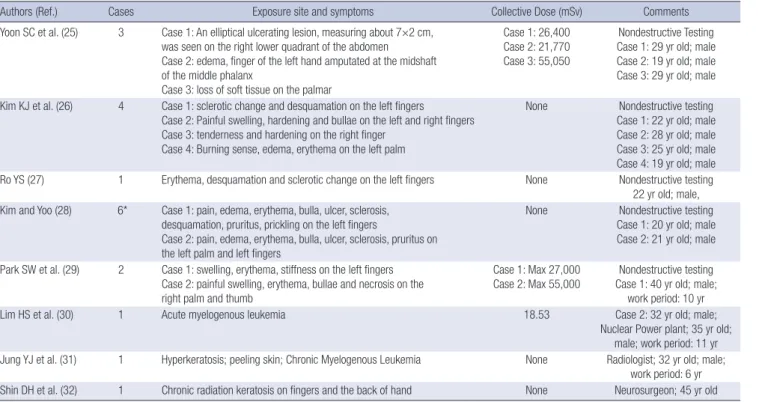
There were 8 reported cases of health disorders due to radia- tion accidents (except for medical fields) in Korea. The total sub- jects to exposure were 15 males that had radiation burns that occurred during non-destructive testing (Table 2).
Table 1. Distribution of radiation workers and personal dose by occupational category in Korea (as of 2006), (7)
Category Male Female Personal mean dose (mSv) Annual personal dose range (mSv) Total
workers Male Female Total 0-1.2 1.2-3 3-5 5-10 10-15 15-20 20-50 >50
Nuclear power plants* 11,116 103 0.88 0.01 0.87 9,147 987 506 452 101 22 1 0 11,219
Medical diagnosis† 19,852 8,086 1.70 0.81 1.44 21,361 3,063 1,123 1,727 378 136 126 23 27,938
Industrial applications 8,825 396 1.65 0.53 1.60 7,223 1,102 371 315 112 54 44 0 9,221
Airplane radiation 3,454 6,363 2.62 2.62 2.62 9,817 9,817
Others‡ 2,756 1,603 0.45 0.37 0.42 4,333 20 5 1 0 0 0 0 4,359
Total (%) 46,003 16,551 1.49 1.45 1.48 42,064
(67.24) 14,992 (23.97)
2,005 (3.21)
2,495 (3.99)
592 (0.95)
212 (0.34)
171 (0.27)
23 (0.04)
62,554 (100)
*Korea currently operates 4 NPPs and 20 commercial nuclear reactors; †Korea administers the Korea Food and Drug Administration in the diagnosis area and the Ministry of Education, Science and Technology in the therapy area; this category is includes in both areas; ‡Others are the public research and education institute.
The data for coal workers was unavailable.
Table 2. Case reports on accident exposure to radiation in Korea
Authors (Ref.) Cases Exposure site and symptoms Collective Dose (mSv) Comments
Yoon SC et al. (25) 3 Case 1: An elliptical ulcerating lesion, measuring about 7×2 cm, was seen on the right lower quadrant of the abdomen
Case 2: edema, finger of the left hand amputated at the midshaft of the middle phalanx
Case 3: loss of soft tissue on the palmar
Case 1: 26,400 Case 2: 21,770 Case 3: 55,050
Nondestructive Testing Case 1: 29 yr old; male Case 2: 19 yr old; male Case 3: 29 yr old; male Kim KJ et al. (26) 4 Case 1: sclerotic change and desquamation on the left fingers
Case 2: Painful swelling, hardening and bullae on the left and right fingers Case 3: tenderness and hardening on the right finger
Case 4: Burning sense, edema, erythema on the left palm
None Nondestructive testing Case 1: 22 yr old; male Case 2: 28 yr old; male Case 3: 25 yr old; male Case 4: 19 yr old; male Ro YS (27) 1 Erythema, desquamation and sclerotic change on the left fingers None Nondestructive testing
22 yr old; male, Kim and Yoo (28) 6* Case 1: pain, edema, erythema, bulla, ulcer, sclerosis,
desquamation, pruritus, prickling on the left fingers
Case 2: pain, edema, erythema, bulla, ulcer, sclerosis, pruritus on the left palm and left fingers
None Nondestructive testing Case 1: 20 yr old; male Case 2: 21 yr old; male Park SW et al. (29) 2 Case 1: swelling, erythema, stiffness on the left fingers
Case 2: painful swelling, erythema, bullae and necrosis on the right palm and thumb
Case 1: Max 27,000
Case 2: Max 55,000 Nondestructive testing Case 1: 40 yr old; male;
work period: 10 yr
Lim HS et al. (30) 1 Acute myelogenous leukemia 18.53 Case 2: 32 yr old; male;
Nuclear Power plant; 35 yr old;
male; work period: 11 yr Jung YJ et al. (31) 1 Hyperkeratosis; peeling skin; Chronic Myelogenous Leukemia None Radiologist; 32 yr old; male;
work period: 6 yr Shin DH et al. (32) 1 Chronic radiation keratosis on fingers and the back of hand None Neurosurgeon; 45 yr old
*Kim KJ and Yoo JH study was duplicated into 4 cases in their previous study.
bers of compensation cases by 2015 also were predicted to be 3-5, 4-6, and 6-10 at the significance levels of 90%, 95%, and 99%, respectively (Table 5).
The radiation management systems are shown in Table 6.
Radiation-related acts consist of the OSH Act, Atomic Act, and Medical Act. Each Act targets different subjects. The Medical Act covers health care workers exposed to radiation. The Atomic Act is applied to all workers in atomic power plants and in non- destructive testing industry. The OSH Act covers all workers ex- posed to radiation, but does not require to keep the record of exposure dose while the Atomic and Medical Acts do.
DISCUSSION
MEST and KFDA established databases on present occupation- al exposure status. Lee (6) reported on established occupational exposure levels and the unmanaged data of air-crews, as they were not yet classified as radiation workers in Korea. Upon this, KINS published a report on the radiation exposure level for the Korean population (7). As nuclear and medical radiation work- ers were legally required to wear a dosimeter and a dosimetry record system was legally enacted, it was possible to acquire dose information. For aircrews, even though exposure manage- ment has not been undertaken, it was possible to use a cumula- tive calculation program to analyze cosmic rays on some flight routes. In this study, coal miners exposed to radon and diag- nostic radiography technicians at animal hospitals were ex- cluded (7).
In 2006, there were 62,554 radiation workers, and 67% of these people were shown to have no exposure or less than 1.2 mSv per year, which was consistent with the general distribution of radiation workers (8). The exposure limit in Korea must not cur- rently exceed 100 mSv per 5 yr and 50 mSv per 1 yr. Workers re- ceiving a dose of more than 20 mSv totaled approximately 0.3%
and showed that the exposure dose has been managed well (7).
However, according to Lee et al. (9) who compiled exposure re- cords of KFDA from 1996 to 2006, the highest exposures (classi- Table 3. Distribution of major radiation accidents in Korea, 1972-2009 (33)
Category -1979 1980-
1989 1990- 1999 2000-
2009 Total
Source loss 3 3 4 7 17
Source theft - 3 5 2 10
Exposure 1 11 7 4 23
Accident - - - 1* 1
Contamination - - - 2 2
Exposure and contamination
1 1
Civil petition 2 2
Source management 3 3
Interpretation unusual 1 1 2
Total 4 17 16 17 61
*The case was caused by an abnormal combustion of a Uranium power chip, but spontaneously it was extinguished and was not exposed.
Table 4. Cases of compensated radiation related occupational diseases in Korea Case
No. Year Birth year Occupation Exposure dose Cancer Approval status
1 1998 1965 NPP worker ≤0.03 mSv AML Rejected
2 1999 1972 X ray analyst - Aplastic anemia Rejected
3 2000 1962 NPP welder 18.5 mSv AML Approved
4 2000 1947 Radiation exposure manager 2.0 mSv Lung Rejected
5 2001 1960 Welder 36.9 mSv ML Approved (Administrative Court)
6 2004 1946 NPP worker 51.8 mSv Pancreas Approved (Administrative Court)
7 2004 1961 Researcher - Thyroid Rejected
8 2005 1958 Nondestructive testing worker 97.3 mSv Colon, MM Approved
9 2005 1977 Researcher 17.1 mSv AML Approved
10 2005 1944 Radioactive waste manager 283.7 mSv Skin Rejected
11 2009 1962 NPP worker 98.3 mSv Stomach, Pancreas Rejected
NPP, Nuclear power plant; AML, Acute myelocytic leukemia; ML, Malignant lymphoma; MM, Multiple Myeloma.
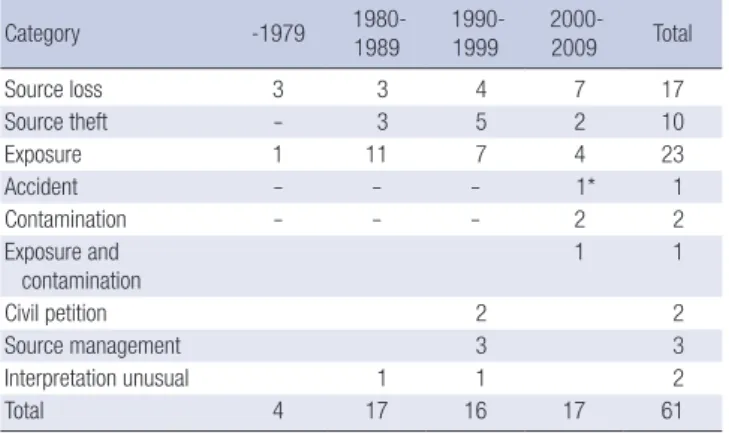
Table 3 shows the distribution of major radiation accidents in Korea. The highest were the 61 radiation accidents that occurred as of 2009 that include radiation exposure and source loss cases.
Table 4 shows results of workers’ compensation claims on occupational diseases. The first claim for occupational disease of a nuclear power plant worker was acute myelocytic leukemia in 1988; however, it was dismissed. In 2000, acute myelocytic leukemia of a nuclear power plant worker who had performed welding operations at the nuclear power plant was the first ap- proved case.
Of the predicted number of compensations for occupational diseases in 2015, the approval possibility for leukemia (except chronic lymphocytic leukemia) was the highest. The numbers of approval possibility for leukemia were predicted to be 0.406, 0.472, and 0.622 at significance levels of 90%, 95%, and 99%, re- spectively. The significance levels for colon cancer were 0.008, 0.025, 0.115, and the respective numbers of 0.04, 0.058, and 0.622 in non-melanoma skin cancer (non-basal cell carcinoma) were predicted to receive approval as occupational diseases. The num- bers of approval possibility for occupational disease in total can- cers except duplicated cancers were 0.473, 0.586, and 1.003 at significance levels of 90%, 95%, and 99%, respectively. The num-
fied by occupation) were for radiation technologists with an av- erage annual effective dose of 1.83 mSv; the average of all occu- pational workers was 0.94 mSv. The level of radiation exposure has decreased every year and suggests that exposure manage- ment has improved.
In 1976, the only reported death by radiation exposure was
caused by a safety failure at the irradiation room of the Korea Atomic Energy Research Institute (10). However, the most com- mon injured parts of the body in radiation accidents were the hands, often due to unrecognized radiation exposure in the non- destructive testing industry (4).
There were 5 reported cases of radiation exposure in Korea that occurred during non-destructive testing, with 12 males ex- periencing radiation burns (Table 2). The current status of pri- mary radiation accident in Korea has been posted on the relat- ed homepage of the KINS (rasis.kins.re.kr/) (Table 3).
Radiation is classified as a confirmed carcinogen by the In- ternational Agency for Research on Cancer (IARC). It is known that (except for mesothelioma and chronic lymphocytic leuke- mia), radiation causes almost all kinds of cancers (1). Due to the increase in number of radiation-related workers and the higher social recognition of occupational disease (particularly cancer), the claim for occupational disease compensation re- lated to radiation exposure has been increasing. In 1998, a male NPP worker made a claim for compensation due to occupation- related radiation exposure causing cancer. However, this case was dismissed because there was no documented radiation ex- Table 5. Predicted cases for compensation in 2005 and 2015 (males) based on the screening dose at significance level in percent
Cancer (ICD-10 code) Predicted cases in 2005 Predicted cases in 2015
α=90 α=95 α=99 α=90 α=95 α=99
Oral cavity and pharynx (C00-14) 0.000 0.000 0.000 0.000 0.001 0.001
Esophagus (C15) 0.000 0.000 0.001 0.001 0.001 0.006
Stomach (C16) 0.001 0.001 0.001 0.003 0.003 0.004
Colon (C18) 0.003 0.008 0.040 0.008 0.025 0.115
Rectum (C19-20) 0.000 0.000 0.000 0.001 0.001 0.001
All digestive (C15-25) 0.003 0.003 0.007 0.009 0.009 0.019
Liver (C22) 0.003 0.004 0.004 0.006 0.008 0.008
Gallbladder (C23-24) 0.000 0.000 0.000 0.000 0.000 0.000
Pancreas (C25) 0.000 0.000 0.000 0.000 0.000 0.001
Trachea, bronchus and lung (C33-34): non-smoker 0.001 0.001 0.010 0.005 0.005 0.041
Trachea, bronchus and lung (C33-34): smoker 0.001 0.001 0.001 0.002 0.004 0.005
Other respiratory (nasal cavity, larynx, and other) (C30-32, C37-38) 0.000 0.000 0.000 0.000 0.000 0.001
Bone (C40-41) 0.000 0.000 0.000 0.000 0.000 0.001
Connective tissue (C47, C49) 0.000 0.000 0.001 0.000 0.000 0.002
Malignant melanoma (C43) 0.001 0.002 0.005 0.003 0.005 0.011
Non-melanoma skin (C44)-basal cell carcinoma 0.016 0.023 0.045 0.040 0.058 0.108
Non-melanoma skin (C44)-non-basal cell carcinoma 0.000 0.000 0.000 0.000 0.000 0.000
Breast-male (C50) 0.000 0.000 0.001 0.000 0.000 0.001
All male genitalia (C60-63) 0.000 0.000 0.001 0.000 0.000 0.008
Bladder (C67) 0.000 0.001 0.006 0.001 0.003 0.018
Kidney and other urinary organs (C64-66, C68) 0.000 0.002 0.009 0.001 0.004 0.022
Eyes (C69) 0.000 0.000 0.001 0.000 0.000 0.002
Brain and nervous system (C70-72) 0.000 0.000 0.000 0.000 0.000 0.000
Thyroid (C73) 0.001 0.003 0.012 0.001 0.005 0.020
Other endocrine glands (C74-75) 0.000 0.000 0.001 0.000 0.000 0.001
Other and ill-defined sites (O&U) 0.000 0.000 0.001 0.001 0.001 0.004
Lymphoma and multiple myeloma (C81-85, C88, C90, C96) 0.000 0.000 0.006 0.001 0.001 0.013
Leukemia, except chronic lymphocytic leukemia (C91-95 except C91.1) 0.266 0.311 0.409 0.406 0.472 0.622
Total* 0.291 0.354 0.55 0.473 0.586 1.003
*Summation of predicted cases for all cancer sites, except the categories expressed in italics.
Table 6. Characteristics of Occupational Safety and Health management according to the Act related to radiation (22)
Category OSH Act Atomic Act Medical Act
Ministry MoEL MEST KFDA
Subject Any radiation
worker
NPP and permitted facilities workers
Radiation diagnosis workers
Permitted/notified* No Yes No
Radiation dose record
system No Yes Yes
Education - Yes Yes
Health examination Yes Yes Yes
Measurement system Yes Yes Yes
*A notified user has not obligation to radiation dose record, health management, and education.
OSH Act, Occupational Safety and Health Act; Atomic Act, Atomic Energy Act; Medical Act, Medical Service Act; MEST, Ministry of Education Science and Technology; MoEL, Ministry of Employment and Labor; KFDA, Korea Food and Drug Administration.
posure information according to a dose record system available.
After that, an NPP welder with acute myelocytic leukemia be- came the first approved case, and it provided an opportunity to study the availability of probability of causation (PoC) for a sci- entific approach to occupational diseases (11). After the adop- tion of a PoC assessment for occupational diseases, the occu- pational disease review committee of the OHSRI has used it to discuss the causal relationship between radiation exposure and diseases. However, some unfavorable cases were later approved by the administrative courts (4).
Decision-making has become more important and the num- ber of radiation workers and the necessity for radiation-induced occupational disease compensation has increased. Though can- cer does not exhibit any special aspects related to radiation, an objective statistical measurement, the PoC, has been defined below to assess the contribution of radiation exposure to the development of cancer in a radiation worker (12).
PoC= RadRisk ×100%
BaseRisk+RadRisk
BaseRisk refers to the baseline cancer risk of the general pop- ulation, while RadRisk is the excess cancer risk due to radiation exposure. Therefore, PoC measures the rate of the cancer risk increased by radiation exposure to the total cancer risk of the population exposed to radiation; when that value exceeds 50%
it was considered that the cancer was due to radiation exposure.
In 1985 (13), the National Institute of Health used PoC to as- sess the radiation causality of cancer in radiation workers, and the National Institute for Occupational Safety and Health (NIOSH) developed the NIOSH-Interactive RadioEpidemiological Pro- gram (www.niosh-irep.com/irep_niosh) as a PoC calculation program based on the National Cancer Institute-Centers for Dis- ease Control model and has operated it until now (14), the US Department of Energy (DOE) is currently judging a request for radiation-induced occupational disease compensation raised by the US DOE or nuclear weapons-related workers on the ba- sis of the 99% upper confidence limit of PoC.
In 1999, the Korea Radiation Risk and Assigned Share (KOR- RAS) first developed a PoC calculation program for radiation workers in Korea (15). KORRAS provided various modes of PoC point estimates, and it was suggested to use the largest estimate of PoC for a person who developed cancer. However, various uncertainties existed in the PoC calculation. Therefore, the PoC should be presented as a distribution or confidence interval that better reflects these uncertainties, rather than a single point es- timate. Currently, the Radiation Health Research Institute-Pro- gram for Estimating the Probability of Causation (RHRI-PEPC) is evaluating the radiation causality of cancer in Korean radiation workers (11) that reflects background mortality, incidence, and the smoking rate in Korea; in addition, the study is based on the
most recent NCI-CDC mode. RHRI-PEPC is also using a com- puter program developed to calculate the distribution of PoC.
It is expected that the number of radiation workers will in- crease continuously, leading to increased cancer incidence and mortality; as a result there is a possibility that claims for occu- pational disease compensation will also increase. Therefore, the social costs of occupational disease will need to be evaluated.
To solve this problem, it is necessary to introduce a screening dose. The US Department of Veterans Affairs used a screening dose that considered the uncertainty of PoC on the basis of a calculation model that judged requests for radiation-induced occupational disease compensation by veterans (16). This screen- ing dose can also be used to estimate the number of persons who may possibly be approved for future occupational disease com- pensation. Jeong et al. (5) proposed a screening dose through the use of exposure data of MEST and estimating the numbers of compensation cases for occupational disease. The numbers of compensation cases that would be approved as occupational disease for the next decade were predicted to be 3-5 workers, 4-6 workers, and 6-10 workers at the significance levels of 90%, 95%, 99%, respectively.
A cohort study of NPP workers and nearby residents was start- ed in 1992 to comprehensively verify the hypothesis of the study:
‘Can the operation of NPP casually increase the incidence risk in nearby residents and workers?’ (17). This study was conduct- ed by Seoul National University and supported by MEST. The cohort was included in the international collaborative study of cancer risks among workers in the nuclear industry (8). The fol- low-up on cancer incidence and mortality for NPP nearby resi- dents (n=10,548) and the control group (n=23,041), and NPP workers (n=8,552), and the control group (n=9,096) will be fin- ished in 2011 (17). In contrast, the epidemiological study for all Korea NPP workers was finished by the Radiation Health Re- search Institute; the results did not show an increase in cancer incidence or mortality according to radiation exposure dose until now (2, 18, 19).
The increase in requests for radiation-induced cancer com- pensation led to a recent health status survey for radiation work- ers conducted by the OHSRI in Korea (4). The study showed that the incidence of thyroid cancer in radiation workers may be higher than other occupations through the use of MEST radia- tion worker exposure data and National Health Insurance Cor- poration admission data (20). However, it cannot exclude the mass screening effects and further study will be needed.
The KFDA manages medical radiation workers and estab- lished a cohort study using exposure records (21). Lee et al. (9) arranged exposure records by using the KFDA database from 1996 to 2006. Radiation technologists were exposed to a relative- ly high radiation dose and the average annual effective dose was 1.83 mSv; the average of whole subjects were 0.94 mSv.
Korean radiation workers are regulated by three acts, the
Atomic Act, the Medical Act, and the OSH Act. However, there were some mismatches or non-organized points for the expo- sure measurement and health management. Recently, Kim (22) made some suggestions following a health management survey of radiation workers: 1) Radiation measurement is regulated by the Atomic Act and Medical Act, so the OSH Act can follow these acts and 2) Health management of radiation workers, that in- cludes health examinations and education, should be organized by the Medical Act.
The OSH Act needs to reestablish health management to the notified user. At present, the OSH Act designates general man- agement, including health education and a special health ex- amination to the notified user. However, the Atomic Act has no special regulation because the exposure level was very low (22).
Therefore, Kim (22) suggested that the Atomic Act would be more applicable. There are currently no regulations for air-crews and veterinary hospital radiation workers and the above criteria should be applied to them. The occurrence of radiation and ac- cidents will most likely decrease if a consistency can be main- tained.
Radiation-induced disease can be divided into radiation in- jury and radiation-induced cancers; it is expected that these in- juries will be reduced in the future. However, the cancer mor- tality for 65 yr-old Korean men was 27.7% in 2008 (23) and is ex- pected to remain the same in the future (24). This situation will lead to a drastic increase in claims for occupational disease com- pensation. Therefore, establishing a scientific and objective judg- ing system using PoC and screening dose would save social costs and better judge the work related occupational disease. In ad- dition, the radiation-related acts that have not been consistent- ly managed need to be rearranged and reestablished, with a re- organization of the exposure assessment, record system, and health surveillance system for all radiation workers.
REFERENCES
1. National Research Council Committee to Assess Health Risks from Ex- posure to Low Level of Ionizing radiation. Health Risks from Exposure to Low Levels of Ionizing Radiation BEIR VII Phase 2. Washington, D.C.:
National Academies Press 2006; 1-10.
2. Jin YW, Jeong M, Sun SH, Jang YK, Kim SH, Lee YS, Lim YK, Kim ES, Kim SG, Kim CS, Lee MC, Yoo KY, Ahn YO. Epidemiological investiga- tion of deaths among radiation workers in nuclear power plants of Ko- rea. J Korean Assoc Radiat Prot 2002; 27: 233-7.
3. Lee HD, Ha JW. A summary of radiation accidents in atomic energy ac- tivities of Korea. J Korean Nucl Soc 1970; 2: 97-106.
4. Koh DH. Health management survey for radiation worker. Incheon, Ko- rea: Occupational Health and Safety Research Institute, Korean Occu- pational Safety and Health Agency; 2006.
5. Jeong M, Jin YW, Lim HS, Kim CS. Use of screening dose to evaluate the work-relatedness for cancers occurred to Korean radiation workers. Ko- rean J Occup Environ Med 2007; 19: 196-203.
6. Lee JG. Design and construction of a radiation dose database for Korean population. Seoul, Korea: Center for Innovative Technology on radia- tion Safety, Hanyang University; 2005.
7. Living & Environmental Radiaoactivity Assessment Dept, Emergency Preparedness & Environment Division. Radiation Environment in Ko- rea, KINS/GR-356. Daejeon: Korea Institute of Nuclear Safety, 2009.
8. Cardis E, Vrijheid M, Blettner M, Gilbert E, Hakama M, Hill C, Howe G, Kaldor J, Muirhead CR, Schubauer-Berigan M, Yoshimura T, Bermann F, Cowper G, Fix J, Hacker C, Heinmiller B, Marshall M, Thierry-Chef I, Utterback D, Ahn YO, Amoros E, Ashmore P, Auvinen A, Bae JM, Sola- no JB, Biau A, Combalot E, Deboodt P, Diez Sacristan A, Eklof M, En- gels H, Engholm G, Gulis G, Habib R, Holan K, Hyvonen H, Kerekes A, Kurtinaitis J, Malker H, Martuzzi M, Mastauskas A, Monnet A, Moser M, Pearce MS, Richardson DB, Rodriguez-Artalejo F, Rogel A, Tardy H, Telle- Lamberton M, Turai I, Usel M, Veress K. Risk of cancer after low doses of ionising radiation: retrospective cohort study in 15 countries. BMJ 2005;
331: 77.
9. Lee WJ, Cha ES, Ha M, Jin YW, Hwang SS, Kong KA, Lee SW, Lee HK, Lee KY, Kim HJ. Occupational radiation doses among diagnostic radia- tion workers in South Korea, 1996-2006. Radiat Prot Dosimetry 2009;
136: 50-5.
10. Lee YS. The lights and shadows in nuclear energy of modern civilization.
Korea Nuclear Energy Foundation, 1996.
11. Jeong M, Jin YW, Kim CS. Program for estimating the probability of cau- sation to Korean radiation workers with cancer. J Korean Assoc Radiat Prot 2004; 29: 221-30.
12. Land C, Gilbert E, Smith JM. Report of the NCI-CDC Working Group to Revise the 1985 NIH Radioepidemiological Tables, NIH Publication No.03-5387. Washington, D.C.: US Department of Health and Human Services; 2003.
13. Department of Health and Human Services. Report of the NIH ad hoc Working Group to Develop Radioepidemiological Tables, NIH publica- tion No.85-2748. Washington, D.C.: National Institute of Health; 1985.
14. Division of Compensation Analysis and Support. NIOSH-Interactive Radio-Epidemiological Program (NIOSH- IREP) Technical Documenta- tion: Final Report. GA: National Institute for Occupational Safety and Health; 2002.
15. Yun KD, Kim HK, Lee JK. Program development and analysis for PC calculation. The Korean Association for Radiation Protection; 1999 Oct 22; Daegu, Korea; 1999
16. Young AL. Use of probability of causation by the Veterans Administra- tion in the adjudication of claims of injury due to exposure to ionizing radiation, CIRRPC Science Panel Report No.6, ORAU 88/F-4. Washing- ton, D.C.: Committee on Interagency Radiation Research and Policy Co- ordination; 1988.
17. Ahn YO. Epidemiological investigation on cancer risk among radiation workers in nuclear power plants and residents nearby nuclear power plants in Korea. Seoul, Korea: Seoul National University College of Med- icine; 2009.
18. Jeong M, Jin YW, Yang KH, Ahn YO, Cha CY. Radiation exposure and cancer incidence in a cohort of nuclear power industry workers in the Republic of Korea, 1992-2005. Radiat Environ Biophys 2009; 49: 47-55.
19. Lim YK, Yoo KY. A cohort study on cancer risk by low-dose radiation ex- posure among radiation workers of nuclear power plants in Korea. J Ko- rean Assoc Radiat Prot 2006; 31: 53-63.
20. Ahn YS, Park RM, Koh DH. Cancer admission and mortality in workers exposed to ionizing radiation in Korea. J Occup Environ Med 2008; 50:
791-803.
21. Ha M. A study of health effect for occupational exposure in radiation work- ers. Cheonan, Korea: Dankook University College of Medicine; 2008.
22. Kim KJ. Study on health management conditions in facilities handling radiations and radioactive isotopes. Incheon, Korea: OSHRI KOSHA;
2008.
23. Korea National Statistical Office. Life Tables for Korea. Available at http:
//kosis.kr/ebook/ [accessed on 20 March 2010].
24. Jung KW, Park S, Kong HJ, Won YJ, Boo YK, Shin HR, Park EC, Lee JS.
Cancer statistics in Korea: incidence, mortality and survival in 2006-2007.
J Korean Med Sci 2010; 25: 1113-21.
25. Yoon SC, Bahk YW, Shinn KS, Kim CY, Cho BK, Wee SS. Radiation der- matitis: report of 3 cases. J Korean Radiol Soc 1986; 22: 167-74.
26. Kim KJ, Lee BK, Kang HJ. Occupational radiodermatitis: report of 4 cas- es. Korean J Dermatol 1989; 27: 686-90.
27. Ro YS. Radiation dermatitis: report of 1 cases. Hanyang J Med 1990; 10:
787-90.
28. Kim KJ, Yoo JH. Radiodermatitis from occupational exposure to 192Ir.
Korean J Occup Environ Med 1998; 10: 128-35.
29. Park SW, Kim JW, Hwang SW, Wang HY. Two cases of occupational ra- diodermatitis. Korean J Dermatol 2000; 38: 1409-10.
30. Lim Y, Cheong HK, KIM SK, Park BC, Lee K. A case of acute myelogenous leukemia occurring in a nuclear power plant worker. Dongguk J Med 2002; 9: 122-38.
31. Jung YJ, Kim J, Park HJ, Lee JY, Cho BK, Kang WH. Chronic radiation dermatitis by occupational radiation exposure: 1 case. Korean J Derma- tol 2003; 41 (Suppl 1): 97.
32. Shin DH, Kim YS, Kim MH, Kim CW, Choi JS, Kim KH. A case of kerato- sis due to chronic exposure to ionizing radiation on hands of medical personnel. Korean J Dermatol 2009; 61 (Suppl 1): 229.
33. Yoon YS, Lee ES, Park C, Lee S, Oh SW. The new definition of metabolic syndrome by the international diabetes federation is less likely to identify metabolically abnormal but non-obese individuals than the definition by the revised national cholesterol education program: the Korea NHANES study. Int J Obes (Lond) 2007; 31: 528-34.