INTRODUCTION
There has been a decreasing trend in complications of dia- betes such as diabetic retinopathy or nephropathy due to better treatment and understanding of the disease. However, the incidence of lower-extremity amputations resulted from dia- betic foot ulceration continues to be high (1). Diabetic foot ulceration is the leading cause of lower-extremity amputa- tions other than trauma, and the overall risk for amputation has increased in diabetes 15-fold beyond that for nondiabet- ic people (2). Foot ulceration results in longer days of hospi- talization and higher mortality rates in diabetic patients due to complication with healing failure. It is well accepted that peripheral neuropathy is a risk factor for developing foot ulcer- ation, thus early detection and meticulous foot care can reduce lower extremity amputation rates by about 50-80% (3-7).
Nerve conduction studies have been used as the gold stan- dard, but can be time-consuming, expensive, and impracti- cal to operate in a primary care clinic. The Semmes-Weinstein (SW) monofilament test is simple and inexpensive to use as a screening tool to identify patients at risk for diabetic foot complication in primary care setting. Light touch sensation was measured using SW nylon filaments, which buckle at a constant known pressure. There are three types of filaments:
4.17, 5.07 and 6.1 (1, 10 and 75-g force, respectively). Birke
et al. (8) examined all three types of the SW monofilaments in a group of 72 patients with Hansen’s disease and 28 patients with diabetes mellitus, and concluded that the 5.07/10-g monofilament was the best indicator of protective sensation.
The rationale of monofilament test is to measure the patient’s ability to sense a point of pressure. Inability to sense the 10-g force pressure is considered as insensate and an independent predictor for higher risk of foot ulceration (4). Unfortunately, there is no consensus on how the monofilament is to be used or the results interpreted, while conceptually simple. Number of testing sites varied from one to ten, and the criteria for deter- mining protective sensation, specificity or sensitivity were dif- ferent in each study (9-14). Thus, we conducted SW monofil- ament tests on ten sites, and then evaluated the impact of each site and combinations of sites for testing.
MATERIALS AND METHODS
We studied 37 type-2 diabetic outpatients at Pusan Nation- al University Hospital. Their sex, age, duration of diabetes, fasting serum glucose, HbA1c, and presence of complications of diabetes were obtained from medical records. Examiner con- ducted SW monofilament test prior to asking whether patients noticed any lower-extremity neuropathy symptom (numbness,
Sangyeoup Lee, Hyeunho Kim, Sanghan Choi, Yongsoon Park*, Yunjin Kim, Byeungman Cho�
Department of Family Medicine, College of Medicine, Pusan National University, Busan, Korea; *Lipid and Diabetes Research Center, Saint Luke’s Hospital, Kansas City, MO, U.S.A.; �Department of Preventive Medicine, College of Medicine, Pusan National University, Busan, Korea
Address for correspondence Yunjin Kim, M.D.
Department of Family Medicine, Pusan National University Hospital, 1-10 Ami-dong, Seo-gu, Busan 602-739, Korea
Tel: +82-51-240-7834, Fax: +82-51-242-8671 E-mail: [email protected], [email protected]
103
Clinical Usefulness of the Two-site Semmes-Weinstein Monofilament Test for Detecting Diabetic Peripheral Neuropathy
The present study was done to validate the two-site Semmes-Weinstein (SW) monofilament test in identifying patients at risk of lower-extremity complications in clinical setting. The SW monofilament test and nerve conduction study were conducted on type 2 diabetic patients (n=37) at Pusan National University Hos- pital in Korea. As the duration of diabetes mellitus was longer, neuropathy iden- tified by nerve conduction study and complications of diabetes were more severe (p<0.01). The number of sites unable to perceive SW monofilament (p<0.001) was larger in patients with lower-extremity neuropathy symptoms than those without symptoms. Sensitivity and specificity at two sites (the third and fifth metatarsal head sites) were 93% and 100%, respectively. In conclusion, the two-site SW monofilament test was a sensitive, specific, simple, and inexpensive screening tool for identifying diabetic peripheral neuropathy in clinical setting.
Key Words : Diabetes Mellitus; Diabetic Neuropathies; Diabetic Foot; Diagnosis
Received : 7 August 2002 Accepted : 15 November 2002
tingling sensation, burning or aching pain) to be blinded from patient’s perception. Nerve conduction study was followed.
While patients were unable to observe their feet, the 10 g- force SW monofilament was used on ten sites of alcohol wiped foot (Fig. 1). We tested the dorsal surface of the foot between the base of the first and second toes, the first, third and fifth toes, the first, third and fifth metatarsal heads, the medial and lateral midfoot, and the heel in random order. Test sites were prearranged to examine not only plantar but also various peri- pheral nerves and dermatomes of the foot.
The SW monofilament was pressed perpendicular to the test site with enough pressure to bend the monofilament for 1 sec.
Patients were asked to answer “Yes or No”, when felt or did not feel the press of the monofilament, respectively. If a patient did not perceive the filament at more than 4 out of 10 sites, that individual was reported as abnormal and the site(s) was recorded.
Counterpoint MK II (Dantec, Copenhagen, Denmark) was used for nerve conduction studies in all patients. Motor con- duction velocities, distal motor latencies and distal compound muscle action potential amplitudes of the peroneal and tib- ial nerves were studied. Additionally, sensory parameters, such as sensory conduction velocities and amplitudes of the sen- sory nerve action potentials of the peroneal and sural nerves were measured according to standard procedures. Room tem- perature was maintained at 20-25℃to avoid any environmen- tal variation.
Data were analyzed by SPSS statistical program. Age of pa- tients with and without symptoms was compared using a two- sample t-test. Duration of diabetes and HbA1c of patients with and without symptoms were compared using Wilcoxon’s rank sum t-test. Sex, the results of SW monofilament test and nerve
conduction study, and complications of diabetes were com- pared using Fisher’s exact test. Nerve conduction study was used as gold standard to calculate sensitivity and specificity of SW monofilament test at each site and then to evaluate the impact of each site and combinations of sites. P value of <0.05 was required for statistical significance.
RESULTS
Duration of diabetes was longer among the patients with lower-extremity neuropathy symptoms than those without
Fig. 1.The sites of Semmes-Weinstein monofilament test.
A B
Number 24 13
Age (yr) (Mean±SD) 57.0± 9.3 62.7±6.8 Sex (%, male) 54.2 53.8 Duration of diabetes mellitus (yr) 14.8± 6.7 8.0±7.1**
(Mean±SD)
HbA1c (%) 9.2± 2.0 9.0±2.0 Semmes-Weinstein monofilament 100.0 (24/24) 53.8 (7/13)�
(%, abnormal)
Nerve conduction study 95.8 (23/24) 46.2 (6/13)� (%, neuropathy)
Problems complicated 83.3 (20/24) 46.2 (6/13)� with diabetes (%)
Diabetic nephropathy 20.8 (5/24) 7.7 (1/13) Diabetic retinopathy 0.0 (0/24) 15.4 (2/13) Diabetic nephropathy and 62.5 (15/24) 23.1 (3/13)
retinopathy
Characteristics With symptom* Without symptom Table 1.Characteristics of study subjects
*Symptoms of peripheral neuropathy, **p=0.005 by Wilcoxon’s rank sum test, �p<0.001 by Fisher’s exact test, �p<0.01 by Fisher’s exact test.
symptoms (Table 1). Abnormal SW monofilament results were observed in 100% of the patients with symptoms, while in 53.8% of patients without symptoms (Table 1). There were more complications of diabetes among patients with symp- toms than those without (p<0.01) (Table 1). Patients with sym- ptoms also had more neuropathy identified by nerve conduc- tion study than those without symptoms (p<0.01) (Table 1).
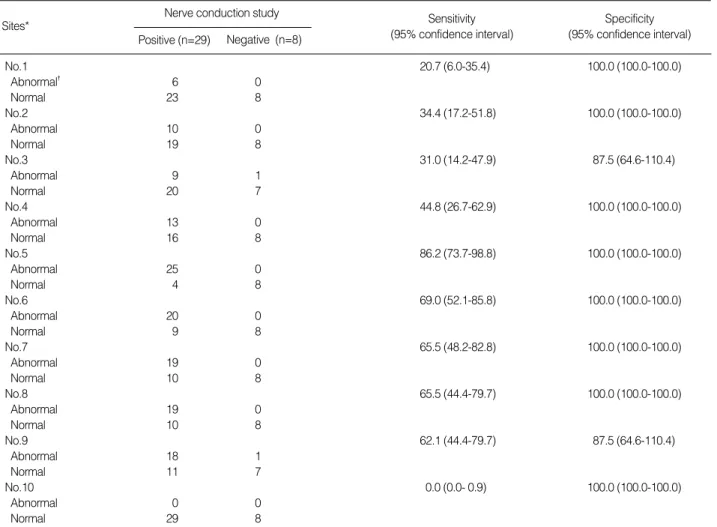
Specificity of SW monofilament test was similar (87.5-100
%) at each site, but the sensitivity was varied (20.7-86.2%) (Table 2). Since 27 out of 29 neuropathy patients identified as “abnormal” by nerve conduction study had abnormal SW monofilament test, sensitivity of the test at 10 sites was 93.1%
(Table 3). Diabetic patients without neuropathy symptoms identified by nerve conduction study also had normal SW monofilament test, thus specificity of the test at 10 sites was 100% (Table 3). Sensitivity and specificity at two sites (the
No.1 20.7 (6.0-35.4) 100.0 (100.0-100.0)
Abnormal� 6 0
Normal 23 8
No.2 34.4 (17.2-51.8) 100.0 (100.0-100.0)
Abnormal 10 0
Normal 19 8
No.3 31.0 (14.2-47.9) 87.5 (64.6-110.4)
Abnormal 9 1
Normal 20 7
No.4 44.8 (26.7-62.9) 100.0 (100.0-100.0)
Abnormal 13 0
Normal 16 8
No.5 86.2 (73.7-98.8) 100.0 (100.0-100.0)
Abnormal 25 0
Normal 4 8
No.6 69.0 (52.1-85.8) 100.0 (100.0-100.0)
Abnormal 20 0
Normal 9 8
No.7 65.5 (48.2-82.8) 100.0 (100.0-100.0)
Abnormal 19 0
Normal 10 8
No.8 65.5 (44.4-79.7) 100.0 (100.0-100.0)
Abnormal 19 0
Normal 10 8
No.9 62.1 (44.4-79.7) 87.5 (64.6-110.4)
Abnormal 18 1
Normal 11 7
No.10 0.0 (0.0- 0.9) 100.0 (100.0-100.0)
Abnormal 0 0
Normal 29 8
Sensitivity (95% confidence interval)
Specificity (95% confidence interval) Table 2.Sensitivity and specificity of using the 10-g monofilament at each site
Nerve conduction study Positive (n=29) Negative (n=8) Sites*
*1. first toe; 2. third toe; 3. fifth toe; 4. first metatarsal head; 5. third metatarsal head; 6. fifth metatarsal head; 7. medial midfoot; 8. lateral midfoot; 9.
Heel; 10. dorsal surface of foot between the base of the first and second toes. �Abnormal if patient was unable to perceive the monofilament at each site (See Fig. 1).
Abnormal* 27 0
Normal 2 8
Table 3. Sensitivity and specificity of using 5.07/10-g monofil- ament at 10 sites
10 Sites*
*Abnormal if patient was unable to perceive the monofilament at more than four of 10 sites. Sensitivity (95% confidence interval): 93.1 (83.9- 102.3). Specificity (95% confidence interval): 100.0 (100.0-100.0).
Nerve conduction study Positive (n=29) Negative (n=8)
Abnormal* 27 0
Normal 2 8
Table 4. Sensitivity and specificity of the 5.07/10 monofilament test at two sites
10 Sites*
*Abnormal if patient was unable to perceive monofilament at any of two (third and fifth metatarsal heads) sites. Sensitivity (95% confidence interval): 93.1 (83.9-102.3). Specificity (95% confidence interval): 100.0 (100.0-100.0).
Nerve conduction study Positive (n=29) Negative (n=8)
third and fifth metatarsal head sites) were 93.1 and 100%, same as at 10 sites (Table 4).
DISCUSSION
The present study was done to validate the SW monofila- ment test in identifying patients with severe neuropathy to be at risk of neuropathic ulceration. Nerve conduction test is used as the gold standard, which is expensive and difficult to operate in a primary care clinic. Thus, the 5.07/10 g SW monofilament is recommended by the International Diabetes Federation and the World Health Organization as a device that can be used to identify patients at risk of diabetic foot ulceration, as feasible by health care professionals at every level. However, there is no guideline on determining test- ing sites and criteria for determining protective sensation.
Mueller (9), McNeely et al. (4) tested 9 sites, Klenerman et al.
(10) used 6, McGill et al. (11) and Pham et al. (12) studied 5 sites. Holleski et al. (13), Olmos et al. (14), Nagai et al.
(15), and Valk et al. (16) used 3 sites. Kumar et al. (17) and Perkins et al. (18) tested only one site, while Duffy et al.
(19), Rith-Najarian et al. (20), and Sosenko et al. (21) suggest- ed 10 sites. Nagai et al. (15) tested on the first toe, and the first and the fifth metatarsal heads using 2, 4, and 10 g monofilaments. They found that the sensitivity and speci- ficity of the 4 g monofilament in the detection of diabetic peripheral neuropathy, 85% and 73%, respectively, were quite close those for the 10 g monofilament (88% and 68%, respectively) (15). In the present study, sensitivity and specificity were 93.1% and 100%, respectively based on the definition of insensate as an inability to sense four or more out of ten sites tested. McGill et al. (11) recommended a combination of the plantar aspects of the first and fifth metatarsal because this combination had a sensitivity of 80% and specificity of 86%. They defined “insensate”
when patients did not feel the monofilament at either of above two sites (11). The sensitivity and specificity were lower than ours. We found that sensitivity and specificity of the third and fifth metatarsal heads were higher (93.1%
and 100%, respectively) than other studies. Holleski et al. (13) reported that specificity was high on the toes and metatarsal heads, and low on the dorsal surface and the heel. McGill et al. (11) reported low sensitivity of the first toe and medial midfoot, while we found that sensitivity of toes and the heel was low.
Diabetes ranks the seventh among ten primary chronic dis- eases in Korea. Every year, 2.2-5.9% of patients with diabetes mellitus in industrialized nations develop a diabetic foot ulcer.
Diabetic foot ulceration is the key factor that may accelerate a cascade of events leading to lower-extremity amputation.
Numerous factors can cause diabetic foot ulceration, but peri- pheral sensory neuropathy is responsible for the most foot ulcerations.
As many as 40 to 50% of diabetic patients have neuropa- thy, which usually occurs in a stocking-glove distribution, with initial symptoms beginning with paresthesia or dysesthesia and progressing to complete loss of sensation (24). About 25%
of patients with diabetes for more than 10 yr developed neuro- pathy and it reached 50% among individuals with more than 20 yr of duration (25). Incidence of diabetic neuropathy is positively related with age, duration, and hyperglycemia. Neu- ropathy can be a fatal problem in diabetic patients and eco- nomic impact of foot ulceration is staggering. Thus, identifi- cation of patient at risk for foot problem at the early stage is necessary in preventive intervention. The SW monofilament test has limitation in quantitative measurement of neuropa- thy, but is simple, cost-effective, and practical for detecting peripheral neuropathy. Only one patient with lower-extrem- ity neuropathy symptoms had normal nerve conduction study and abnormal SW mono-filament test because monofilament is not the perfect tool to detect all patients at risk of devel- oping neuropathic ulcer.
We found that the SW monofilament test was very sensi- tive and highly specific. Sensitivity and specificity at the third and fifth metatarsal head sites were comparable to those of 10 sites together. It is likely that the two-site SW monofil- ament test is useful clinically as a screening device for dia- betic neuropathy as well as 10-site test. However, since this was done on small sample of Korean patients with type 2 dia- betes, larger studies are warranted.
REFERENCES
1. American diabetes association. Consensus development conference on diabetes foot wound care. Diabetes Care 1999; 22: 1354-60.
2. Frykberg RG, Armstrong DG, Giurini J, Edwards A, Kravette M, Kravitz S, Ross C, Stavosky J, Stuck R, Vanore J. Diabetic foot dis- orders: a clinical practice guideline. J Foot Ankle Surg 2000; 39(5 Suppl): S1-60.
3. Rith-Njarian S, Branchaud C, Beaulieu O, Gohdes D, Simonson G, Mazze R. Reducing lower-extremity amputation due to diabetes:
application of the staged diabetes management approach in a pri- mary care setting. J Fam Pract 1998; 47: 127-32.
4. McNeely MJ, Boyko EJ, Ahroni JH, Stensel VL, Reiber GE, Smith DG, Pecoraro RF. The independent contributions of diabetic neu- ropathy and vasculopathy in foot ulceration. How great are the risks?
Diabetes Care 1995; 18: 216-9.
5. Holstein P, Ellitsgaard N, Olsen BB, Ellitsgaard V. Decreasing incidence of major amputations in people with diabetes. Diabetolo- gia 2000; 43: 844-7.
6. Ebskov LB, Schroeder TV, Holstein PE. Epidemiology of leg ampu- tation: the influence of vascular surgery. Br J Surg 1994; 81: 1600-03.
7. Calle-Pascual AL, Garcia-Torre N, Moraga I, Diaz JA, Duran A, Monux G, Serrano FJ, Martin-Alvarez PJ, Charro A, Maranes JP.
Epidemiology of nontraumatic lower-extremity amputation in Area 7, Madrid, between 1989 and 1999: a population-based study. Dia-
betes Care 2001; 24: 1686-9.
8. Birke JA, Sims DS. Plantar sensory threshold in the ulcerative foot.
Lepr Rev 1986; 57: 261-7.
9. Mueller MJ. Identifying patients with diabetes mellitus who are at risk for lower-extremity complications: use of Semmes-Weinstein monofilaments. Phys Ther 1996; 76: 68-71.
10. Klenerman L, McCabe C, Cogley D, Crerand S, Laing P, White M.
Screening for patients at risk of diabetic foot ulceration in a general diabetic outpatient clinic. Diabet Med 1996; 13: 561-3.
11. McGill M, Molyneaux L, Spencer R, Heng LF, Yue DK. Possible sources of discrepancies in the use of the Semmes-Weinstein monofila- ment. Impact on prevalence of insensate foot and workload require- ments. Diabetes Care 1999; 22: 598-602.
12. Pham H, Harkless JB, Armstrong D, Giurini JM, Harvey C, Veves A. Screening techniques to identify people at high risk for diabetic foot ulceration. A prospective multicenter trial. Diabetes Care 2000;
23: 606-11.
13. Holewski JJ, Stess RM, Graf PM, Grunfeld C. Aesthesiometry: quan- tification of cutaneous pressure sensation in diabetic peripheral neuropathy. J Rehabil Res Dev 1988; 25: 1-10.
14. Olmos PR, Cataland S, O’Dorisio TM, Casey CA, Smead WL, Simon SR. The Semmes-Weinstein monofilament as a potential pre- dictor of foot ulceration in patients with noninsulin-dependent dia- betes. Am J Med Sci 1995; 309: 76-82.
15. Nagai Y, Sugiyama Y, Abe T, Nomura G. 4-g monofilament is clini- cally useful for detecting diabetic peripheral neuropathy. Diabetes Care 2001; 24: 183-4.
16. Valk GD, de Sonnaville JJ, van Houtum WH, Heine RJ, van Eijk JT, Bouter LM, Bertelsmann FW. The assessment of diabetic poly-
neuropathy in daily clinical practice: reproducibility and validity of Semmes Weinstein monofilaments examination and clinical neuro- logical examination. Muscle Nerve 1997; 20: 116-8.
17. Kumar S, Fernando DJ, Veves A, Knowles EA, Young MJ, Boul- ton AJ. Semmes-Weinstein monofilaments: a simple, effective and inexpensive screening device for identifying diabetic patients at risk of foot ulceration. Diabetes Res Clin Pract 1991; 13: 63-7.
18. Perkins BA, Zinman B, Olaleye D, Bril V. Simple screening tests for peripheral neuropathy in the diabetic clinic. Diabetes Care 2001;
24: 250-6.
19. Duffy JC, Patout CA. Management of insensitive foot in diabetes:
Lessons learned from Hansen’s disease. Mid Med 1990; 155: 575-9.
20. Rith-Najarian SJ, Stolusky T, Gohdes DM. Identifying diabetic patients at high risk for lower-extremity amputation in primary health care setting. A prospective evaluation of simple screening criteria.
Diabetes Care 1992; 15: 1386-9.
21. Sosenko JM, Sparing YH, Hu D, Welty T, Howard BV, Lee D, Rob- bins DC. Use of the Semmes-Weinstein monofilament in the Strong Heart Study. Diabetes Care 1999; 22: 1715-21.
22. Mandup-Poulsen T. Diabetes. Br Med J 1998; 316: 1221-5.
23. American Diabetes Association. Preventive foot care in people with diabetes. Diabetes Care 1999; 21: 2161-77.
24. Pirart J. Diabetes mellitus and its degenerative complication: a pros- pective study of 4400 patients observed 1947 and 1973. Diabetes Metab 1977; 3: 97-107.
25. Donnelly R, Emslie-Smith AM, Gardener ID, Morris AD. ABC of arterial and venous disease. Vascular complication of diabetes. Br Med J 2000; 320: 1062-6.