Abiotic Degradation of the Herbicide Oxadiazon in Water Md. Mokhlesur Rahman
#, Jong-Woo Park, Man Park, In-Koo Rhee and Jang-Eok Kim*
Department of Agricultural Chemistry, Kyungpook National University, Daegu 702-701, Korea Received August 2, 2006; Accepted November 18, 2006
The performance of abiotic degradation of oxadiazon was investigated by applying zerovalent iron(ZVI), potassium permanganate (KMnO4) and titanium dioxide (TiO2) in the contaminated water.
Experimental conditions allowed the disappearance of oxadiazon in the abiotic system. The degradation of this herbicide was monitored in buffer solutions having pH 3, 5 and 7 in the presence of iron powder in which the maximum degradation rate was achieved at acidic condition (pH 3) by 2% of ZVI treatment. The oxidative degradation of oxadiazon was observed in aqueous solution by KMnO4 at pH 3, 7 and 10 in which the highest disappearance rate was found at neutral pH when treated with 2% of KMnO4. The catalytic degradation of oxadiazon in TiO2 suspension was obtained under dark and UV irradiation conditions. UV irradiation enhanced the degradation of oxadiazon in aquatic system in the presence of TiO2. Conclusively, the remediation strategy using these abiotic reagents could be applied to remove oxadiazon from the contaminated water.
Key words: oxadiazon, degradation, zerovalent iron, potassium permanganate, titanium dioxide.
The ubiquitous use of herbicide in agricultural production has resulted in extensive water contamination. The application of herbicides and their apparent hazard to human health have promoted investigations concerning their impact on water environment. The oxadiazole herbicide oxadiazon [5-tert- butyl-3-(2,4-dichloro-5-isopropoxy-phenyl)-1,3,4-oxadiazol-
= 2(3H)-one, Ronstar®] has routinely applied for the control of weeds in various agricultural crops like rice, cotton, soybean, potato, peanut and onion. The intensive use of this agrochemical combined with its relatively long half-life has a strong impact on the aquatic system1,2). For this reason, innovative methods are needed to remediate herbicide-contaminated water in affected areas. As environmentally benign and economically feasible novel strategy, chemical approaches for the destruction of organic contaminants in water system commonly utilize reduction or oxidation schemes to degrade organic compounds.
The use of zerovalent metals, especially iron, has produced success in the treatment of contaminated water indicating an accepted remediation technology. Zerovalent iron (ZVI) is capable of reductively degrading a wide range of organic contaminants including chlorinated aliphatic and aromatics abiotically3-5). The oxidation of organic contaminants by potassium permanganate (KMnO4) is also a promising alternative chemical approach for the remediation of contaminated water.
Permanganate, as a metal-oxo reagent, usually attacks organic contaminant powerfully due to the inherent nonspecificity of reactive oxygen species6).
Advanced methods are in demand for the effective treatment of pesticide-contaminated water. A lot of researches have been addressed to point out the prominent role of a special class of oxidation techniques defined as advanced oxidation processes (AOPs). Some studies7,8) have concentrated on this goal pointing out that these processes, although making use of different reacting systems, are characterized by the production of • OH radicals. Among the AOPs, titanium dioxide (TiO2) as a heterogeneous photocatalyst is the irradiation of semiconductor slurries by UV irradiation in order to generate highly reactive intermediates, especially • OHradical as a very strong oxidizing agent that initiates a sequence of reactions resulting in partial or total destruction of most the organic contaminants9,10).
Considering the above facts, this study has been designed to detoxify water contaminated with the herbicide oxadiazon using various abiotic reagents. The objectives of the present study were to investigate the potential use of abiotic reagents such as ZVI, KMnO4 and TiO2 for the degradation of the herbicide oxadiazon in water.
Materials and Methods
Agrochemical and chemicals.
The herbicide oxadiazon (99.95% purity) was provided by Rhone-Poulenc, Inc., Agro- Division, France. ZVI powder was purchased from Fisher Scientific, USA. Potassium permanganate (KMnO4) was obtained from Duksan Pharmaceutical Co. Ltd., Korea.Titanium dioxide (TiO2) was purchased from Sigma Chemical Co., USA. All other chemicals were of reagent grade supplied by Sigma Chemical Co., USA, Junsei Chemical Co. and Kanto Chemical Co., Japan.
Zerovalent iron treatment.
Oxadiazon was dissolved in acetone to prepare 1,000 mg/l stock solution, which was#Permanent address: Department of Agricultural Chemistry, Bangladesh Agricultural University, Mymensingh 2202, Bangladesh
*Corresponding author
Phone: +82-53-950-5720; Fax: +82-53-953-7233 E-mail: [email protected]
diluted to obtain the desired concentrations. Oxadiazon (2 mg/
l) was dissolved in 100 ml of citrate-phosphate buffer solution with 5% of acetone and a 10 ml water sample was treated with ZVI at rates of 0.5, 1 and 2% at different pH (3, 5 and 7) conditions. This reaction mixture was incubated in shaking incubator (SW-90F, Sangwoo Scientific Co., Korea) for 1, 4, 8, 12 and 24 h at room temperature. After a specified time, the reaction mixture was partitioned with hexane. After dehydration with anhydrous sodium sulfate, the remaining concentration of oxadiazon was analyzed by gas chromatograph (GC).
Potassium permanganate treatment.
Oxadiazon stock solution was prepared in acetone and the required concentration of this stock solution was mixed with buffer solution. The pure oxadiazon-in-buffer solutions having pH range of 3 to 10 were shaken vigorously and allowed to stand for at least 24 h.The pH values of these solutions were adjusted whenever necessary. The aliquot (10 ml) was treated with KMnO4 at rates of 0.5, 1 and 2% at various pH (3, 7 and 10) conditions separately. This reaction mixture was incubated in shaking incubator (SW-90F, Sangwoo Scientific Co., Korea) for 0.5, 1, 7 and 14 d at room temperature. After a specified time, the samples were partitioned by hexane. After dehydration with anhydrous sodium sulfate, the remaining amount of oxadiazon was analyzed by GC.
Titanium dioxide treatment.
The degradation experiment was performed on 10 ml of aqueous medium containing 2 mg/l of oxadiazon and different amounts of TiO2 (100 and 500 mg/l) at natural pH. The suspensions were allowed to stand in the dark for 60 min under stirring to reach adsorption equilibrium onto semiconductor surface. This reaction mixture was incubated for 0.5, 1, 2, 3 and 5 h under dark and UV irradiation conditions. After a specified time, the reaction mixture was partitioned with hexane. After dehydration with anhydrous sodium sulfate, the concentration of remaining oxadiazon was analyzed by GC.
Analytical technique.
The herbicide oxadiazon of treated water samples was analyzed by gas chromatograph (Varian CP-3800, USA) equipped with an electron capture detector.Analytical conditions for GC were as follows: column, 30 m × 0.25 mm i.d. capillary column DB-1; temperature, column oven 240oC, detector block 300oC; carrier N2 gas flow rate, 1.0 ml/min and injection volume, 1.0µl.
Degradation kinetic parameters.
The reaction rate constant (k) and half-life (t1/2) were calculated by using the first-order rate equation (Eq. 1) as described by Leifer11).Ct = C0 e−kt (1)
Where, Ct represents the concentration at time t C0 represents the initial concentration and k is the rate constant.
When the concentration was reduced to 50% of its initial amount, the half-life (t1/2) was obtained by the following equation (Eq. 2):
t1/2 =0.693/k (2)
Where, k is the degradation constant.
Results and Discussion
Degradation of oxadiazon by zerovalent iron.
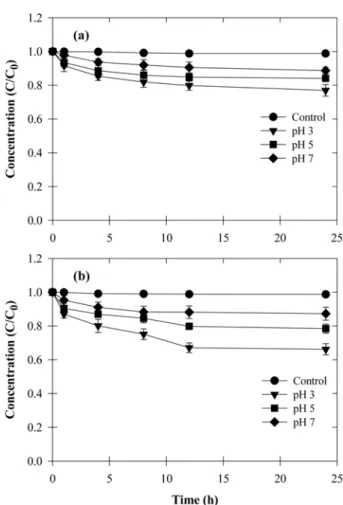
In the aquatic system, the degradation rate of oxadiazon was studied by the addition of 0.5, 1 and 2% of ZVI at different pH (3, 5 and 7) conditions. At acidic condition (pH 3), 23.0 and 33.8% of oxadiazon was degraded within 24 h by treatments of 1 and 2% of ZVI, respectively (Fig. 1). The highest degradation rate of oxadiazon was achieved at a reaction time after 12 h with increasing the amount of ZVI. For the comparative studies of pH, the maximum degradation rate was observed within 24 h at acidic condition (pH 3) as compared to other pH (5 and 7) conditions (Fig. 2). The obtained results suggested that a chemical method of zerovalent iron (Feo) reduction had been explored for the removal of this herbicide from water by the oxidation of ZVI as shown in the following equation12):Feo → Fe2+ + 2e− (3)
Weber13) stated that a two-electron transfer generally occurred directly at the iron surface oxidizing iron (Feo) to ferrous iron (Fe2+) resulting degradation as mentioned in Eq. 4.
Fig. 1. Degradation of oxadiazon by 1% (a) and 2% (b) of ZVI treatments. Error bars indicate standard deviation of mean.
R-Cl + Feo(s) + H+ → Fe2+ + R-H + Cl− (4) It is clear from this finding that pH played a vital role in the degradation rate of oxadiazon via metallic iron. The rate of this process increased as the solution pH decreased. Dombek
et al.14) reported that a low pH of the reaction solution probably allowed more of the iron surface to remain available for reaction with molecule via:
Fe(s) + 2H+ (aq) → Fe2+ (aq) + H2(g) (5) Conversely, the ferrous and hydroxyl ions formed ferrous hydroxide and then precipitated at the elevated pH of solution.
The precipitation of ferrous hydroxide on the surface of ZVI could hinder the transport of the target contaminants and block the reactive sites on ZVI and hence, decreased the overall reaction rate. Monson et al.15), Joo et al.16) and Gibb et al.17)investigated the reductive degradation using ZVI (Fe0) as an electron donor for the remediation of water contaminated with herbicides.
The reaction rate constant (k) and half-life (t1/2) during ZVI treatment have been presented in Table 1. The calculated results revealed that the half-life of oxadiazon decreased by increasing the amount of ZVI but decreasing pH of the
solution. These results were in agreement with experimental findings of Chen et al.5) and Siantar et al.18).
Degradation of oxadiazon by potassium permanganate.
In the aqueous phase, the disappearance rate of oxadiazon was examined by treatments of 0.5, 1 and 2% of KMnO4 at different pH (3, 7 and 10) conditions. At a neutral pH, 34.0 and 58.1% of oxadiazon was degraded within 14 d by treatments of 1 and 2% of KMnO4, respectively (Fig. 3). The maximum degradation rate of oxadiazon was obtained within 14 d with increasing the amount of KMnO4. Considering the pH of solution, the highest degradation rate was obtained at a neutral pH within 14 d as compared to other pH (3 and 10) conditions (Fig. 4).
In oxidation with KMnO4, pH was considered as a primary variable because it influenced the redox potential in a system in which the couples of manganese ions involved in the overall reaction19). At neutral pH condition, the maximum degradation of oxadiazon might be due to mechanistic factors in contrast to the overall free energy change of the oxidant.
Under this condition, the redox reaction with the potentials of various couples of manganese ions has been involved in the following equation20):
MnO4−+ 2H2O + 3e−→ MnO2 + 4OH− (6) Fig. 2. Degradation of oxadiazon by ZVI treatment at vari-
ous pH conditions. Error bars indicate standard deviation of mean.
Table 1. Degradation kinetic parameters (reaction rate con- stant and half-life) during ZVI treatment
pH ZVI (%) k (h−1) t1/2 (h)
3 0.5 4.8 × 10⁻³ 144.4
1.0 6.7 × 10⁻³ 103.4
2.0 0.012 57.8
5 0.5 2.9 × 10⁻³ 239.0
1.0 4.0 × 10⁻³ 173.2
2.0 6.1 × 10⁻³ 113.6
7 0.5 2.8 × 10⁻³ 247.5
1.0 3.2 × 10⁻³ 216.6
2.0 3.7 × 10⁻³ 187.3
Fig. 3. Degradation of oxadiazon by 1% (a) and 2% (b) of KMnO4 treatments. Error bars indicate standard deviation of mean.
The reaction rate constant (k) and half-life (t1/2) during KMnO4 treatment have been reported in Table 2. The obtained results indicated that the half-life of oxadiazon decreased by increasing the amount of KMnO4 but its half-life was lower in neutral pH compared to other pH conditions.
Degradation of oxadiazon by titanium dioxide.
Figure 5 illustrated that the disappearance of oxadiazon was obtained in the presence of TiO2 at rates of 100 and 500 mg/l for 0.5, 1, 2, 3 and 5 h under dark and UV irradiation conditions. As compared to dark condition, 42.6 and 64.0% of oxadiazon was degraded from aqueous solution within 5 h under UV irradiation by treatments of 100 and 500 mg/l TiO2, respectively.The dark reaction produced slight mineralization of oxadiazon.
Konstantinou et al.21) observed a similar trend of catalytic degradation of herbicides using same amounts of TiO2 in aqueous suspension. It is noted that when aqueous TiO2
suspension was irradiated with UV light, the generated electrons reduced organic substrate or reacted with electron acceptors such as the adsorbed molecular O2 on the Ti(III)- surface. The photogenerated holes oxidized either the organic molecule directly, or the OH− ions and the H2O molecules adsorbed at the TiO2 surface to • OH radicals. Accordingly, the relevant reactions at the semiconductor surface have been
cited in Eqs. 7 to 12.
TiO2 + hv → e− + h+ (7)
(O2)ads. + e−→ (•O2−)ads. (8)
Ti(IV)-OH + h+→ •Ti(IV)-OH (9)
Ti(IV)-H2O+ h+→ •Ti(IV)-OH
+
H+ (10)R + h+→ R (oxidized) (11)
R + •OH → Products ··· (12)
The resulting •OHradical, being strongly active and non- selective degrading agent, oxidized this organic xenobiotic in aqueous solution. The detailed above mechanism was described in the literatures of Konstantinouand Albanis10), Heltz et al.22) and Herrmann23).
The kinetics of oxadiazon disappearance in the presence of TiO2 has been shown in Table 3. The reaction rate constant (k) values confirmed the positive influence of the increased number of TiO2 active sites on the kinetics. The recorded half- life indicated that the photocatalytic degradation of this herbicide was occurred prominently in TiO2 suspensions as compared to dark condition.
In conclusion, the enhanced degradation with TiO2 was a feasible and fast treatment for the removal of this herbicide from the contaminated water as compared to ZVI and KMnO4
treatments. It is suggested that the association of enhanced degradation by advanced oxidation process using TiO2 with ZVI was considered to be suitable for the remediation of water environment contaminated with oxadiazon.
Fig. 4. Degradation of oxadiazon by KMnO4 treatment at different pH conditions. Error bars indicate standard devia- tion of mean.
Table 2. Degradation kinetic parameters (reaction rate con- stant and half-life) during KMnO4 treatment
pH KMnO4 (%) k (d−1) t1/2 (d)
3 0.5 3.2 × 10⁻³ 216.6
1.0 6.1 × 10⁻³ 113.6
2.0 8.0 × 10⁻³ 86.6
7 0.5 7.7 × 10⁻³ 90.0
1.0 2.5 × 10⁻² 27.7
2.0 6.1 × 10⁻² 11.4
10 0.5 6.9 × 10⁻³ 100.4
1.0 1.2 × 10⁻² 57.8
2.0 1.5 × 10⁻² 46.2
Fig. 5. Disappearance of oxadiazon by TiO2 treatment. Error bars indicate standard deviation of mean.
Table 3. Degradation kinetic parameters (reaction rate con- stant and half-life) during TiO2 treatment
Reaction TiO2 (mg/l) k (h−1) t1/2 (h)
Dark 100 0.014 49.5
500 0.027 25.7
UV irradiation 100 0.092 7.5
500 0.178 3.9
Acknowledgments
This work was supported by a Grant from the Korea Research Foundation (KRF-2000-005-G00001).
References
1. Yamato, Y. and Suzuki, M. (1980) Occurrence of herbicide oxadiazon in surface waters and tap water, Water Res. 14, 1435-1438.
2. Imanaka, M., Matsunaga, K., Shigeta, A. and Ishida, T.
(1981) Oxadiazon residues in Fish and Shellfish, J. Pestic.
Sci.6, 413-417.
3. Gillham, R. W. and O’Hannesin, S. F. (1994) Enhanced degradation of halogenated aliphatics by zero-valent iron, Ground Water32, 958-967.
4. Chuang, F. W., Larson, R. A. and Wessman, M. S. (1995) Zero-valent iron promoted dechlorination of polychlori- nated biphenyls, Environ. Sci. Technol.29, 2460-2463.
5. Chen, J. L., Al-Abed, S. R., Ryan, J. A. and Li, Z. (2001) Effects of pH on dechlorination of trichloroethylene by zero-valent iron, J. Hazard. Mater. B83, 243-254.
6. Waddell, J. P. and Mayer, G. C. (2003) Effects of Fenton’s reagent and potassium permanganate applications on indige- nous subsurface microbiota: a literature review, Proceed- ings of the 2003 Georgia Water Resources Conference, The University of Georgia, Athens, Georgia.
7. Andreozzi, R., Caprio, V., Insola, A. and Marotta, R. (1999) Advanced oxidation processes (AOP) for water purification and recovery, Catal. Today53, 51-59.
8. Chiron, S., Fernandez-Alba, A., Rodriguez, A. and Garcia- Calvo, E. (2000) Pesticide chemical oxidation: State-of-the art, Water Res.34, 366-377.
9. Malato, S., Blanco, J., Caceres, J., Fernandez-Alba, A. R., Aguera, A. and Rodriguez, A. (2002) Photocatalytic treat- ment of water-soluble pesticides by photo-Fenton and TiO2 using solar energy, Catal. Today76, 209-220.
10. Konstantinou, I. K. and Albanis, T. A. (2003) Photocata- lytic transformation of pesticides in aqueous titanium diox- ide suspensions using artificial and solar light: intermediates and degradation pathways, Appl. Catal. B: Environ. 42, 319-335.
11. Leifer, A. (1988) The Kinetics of Environmental Aquatic Photo-chemistry (1st ed.), American Chemical Society,
Washington, pp. 49.
12. Liao, C. H., Kang, S. F. and Hsu, Y. W. (2003) Zero-valent iron reduction of nitrate in the presence of ultraviolet light, organic matter and hydrogen peroxide, Water Res. 37, 4109-4118.
13. Weber, E. J. (1996) Iron-mediated reductive transforma- tions: investigation of reaction mechanisms, Environ. Sci.
Technol.30, 716-719.
14. Dombek, T., Dolan, E., Scultz, D. and Klarup, D. (2001) Rapid reductive dechlorination of atrazine by zero-valent iron under acidic conditions, Environ. Pollut. 111, 21-27.
15. Monson, S. J., Ma, L., Cassada, D. A. and Spalding, R. F.
(1998) Confirmation and method development for dechlori- nated atrazine from reductive dehalogenation of atrazine with Fe0, Analytica Chimica Acta 373, 153-160.
16. Joo, S. H., Feitz, A. J. and Waite, T. D. (2004) Oxidative degradation of the carbothioate herbicide, molinate, using nanoscale zero-valent iron, Environ. Sci. Technol.38, 2242- 2247.
17. Gibb, C., Satapanajaru, T., Comfort, S. D. and Shea, P. J.
(2004) Remediating dicamba-contaminated water with zero- valent iron, Chemosphere54, 841-848.
18. Siantar, D. P., Schreier, C. G., Chou, C. S. and Reinhard, M.
(1996) Treatment of 1,2-dibro-3-chloropropane and nitrate contaminated water with zero-valent iron or hydrogen/palla- dium catalysts, Water Res.30, 2315-2322.
19. Yan, Y. E. and Schwartz, F. W. (1999) Oxidative degrada- tion and kinetics of chlorinated ethylenes by potassium per- manganate, J. Contam. Hydrol.37, 343-365.
20. Damm, J. H., Hardacre, C., Kalin, R. M. and Walsh, K. P.
(2002) Kinetics of the oxidation of methyl tert-butyl ether (MTBE) by potassium permanganate. Water Res.36, 3638- 3646.
21. Konstantinou, I. K., Sakkas, V. A. and Albanis, T. A.
(2001) Photocatalytic degradation of the herbicides propa- nil and molinate over aqueous TiO2 suspensions: identifica- tion of intermediates and the reaction pathway, Appl. Catal.
B: Environ.34, 227-239.
22. Heltz, G. R., Zepp, R. G. and Crosby, D. G. (1994) In Aquatic and Surface Chemistry, Lewis Publishers, Boca Raton, Florida, USA, pp. 261.
23. Herrmann, J. M. (1999) Heterogeneous photocatalysis: fun- damentals and applications to the removal of various types of aqueous pollutants, Catal. Today53, 115-129.