275 https://doi.org/10.9713/kcer.2018.56.2.275
PISSN 0304-128X, EISSN 2233-9558
Production of Methyl Ester from Coconut Oil using Microwave: Kinetic of Transesterification Reaction using Heterogeneous CaO Catalyst
Mahfud Mahfud, Andi Suryanto*,†, Lailatul Qadariyah, Suprapto Suprapto and Heri Septya Kusuma† Department of Chemical Engineering, Institut Teknologi Sepuluh Nopember, Surabaya, 60111 Indonesia
*Department of Chemical Engineering, University of Muslim Indonesia, Makassar, 90231, Indonesia (Received 4 August 2017; Received in revised form 9 November 2017; accepted 21 November 2017)
Abstract − Methyl ester derived from coconut oil is very interesting to study since it contains free-fatty acid with chemical structure of medium carbon chain (C12-C14), so the methyl ester obtained from its part can be a biodiesel and another partially into biokerosene. The use of heterogeneous catalysts in the production of methyl ester requires severe conditions (high pressure and high temperature), while at low temperature and atmospheric conditions, yield of methyl ester is relatively very low. By using microwave irradiation trans-esterification reaction with heterogeneous catalysts, it is expected to be much faster and can give higher yields. Therefore, we studied the production of methyl ester from coconut oil using CaO catalyst assisted by microwave. Our aim was to find a kinetic model of methyl ester production through a transesterification process from coconut oil assisted by microwave using heterogeneous CaO catalyst. The experimental apparatus consisted of a batch reactor placed in a microwave oven equipped with a condenser, stirrer and temperature controllers. Batch process was conducted at atmospheric pressure with a variation of CaO catalyst concen- tration (0.5; 1.0; 1.5; 2.0, 2.5%) and microwave power (100, 264 and 400 W). In general, the production process of methyl esters by heterogeneous catalyst will obtain three layers, wherein the first layer is the product of methyl ester, the second layer is glycerol and the third layer is the catalyst. The experimental results show that the yield of methyl ester increases along with the increase of microwave power, catalyst concentration and reaction time. Kinetic model of methyl ester production can be represented by the following equation: -rTG= 1.7·106 CTG.
Key words: Methyl ester, Coconut oil, Transesterification, CaO catalyst, Microwave e–---43.86RT
1. Introduction
The utilization of fossil fuel still dominates energy consumption in Indonesia, especially in transportation sector, and has significantly increased in the past twenty years. Indonesia has turned from a net exporter to a net importer of oil in recent years, and faces big chal- lenges since the international price of petroleum continually increases.
An alternative energy like biodiesel which is indispensable as the use of fossil fuel always increases [1]. One alternative renewable energy that is being developed is fatty acid methyl esters (FAME), other- wise known as biodiesel. Biodiesel can be renewed, is non-toxic, has a higher cetane number, contains low sulfur, as well as reduces emis- sions of combustion, making it more environmentally friendly. The utilization of biodiesel does not require engine modifications and has high oxygen content (10-12%) that can be more complete combus- tion [2]. FAME is made from vegetable oils, animal fats or waste oils. In general, vegetable oils are preferred and have advantages over animal fat, because vegetable oil is a natural resource that is very abundant, and can be refurbished. Vegetable oils do not require complex purification for fuel requirements, so do not require much
energy for pre-treatment [3].
Current biodiesel production in Indonesia uses raw materials of palm oil and palm fatty acid distillate (PFAD). Several other types of vegetable oils from Indonesia that can potentially be used to produce biodiesel are coconut oil, jatropha oil, Calophyllum inophyllum oil and cottonseed oil. Particularly, Indonesia is one of the highest coco- nut oil producing countries in the world. In 2000 coconut plantation areas in Indonesia reached 3.76 million hectares with a total produc- tion of about 14 billion and sources of income of around 2.5 million of farming families. Indonesian coconut oil has the second highest productivity when compared with other vegetable oils, reaching 2,689 liters/ha/year. Nowadays, Indonesia is the highest coconut oil producing country that reaches 5,950 liters/ha/year. This becomes the reason to conduct research on the production of methyl ester from coconut oil as raw materials for biodiesel. Besides, coconut oil contains medium chain fatty acids (C12-C14) that is quite high, espe- cially lauric acid (48%) and myristic acid (17%), so the methyl ester of coconut oil obtained from the present research can partially be separated from bio kerosene. Therefore, coconut oil has potential as raw materials for the production of bio kerosene and biodiesel.
Biodiesel can be produced in various ways, such as cracking ther- mal processes (pyrolysis), micro emulsion (micro emulsification) and transesterification process. Transesterification is widely used because it is quite simple and can produce high purity FAME. The transesterification process is a chemical reaction in which triglycer-
†To whom correspondence should be addressed.
E-mail: [email protected], [email protected] This is an Open-Access article distributed under the terms of the Creative Com- mons Attribution Non-Commercial License (http://creativecommons.org/licenses/by- nc/3.0) which permits unrestricted non-commercial use, distribution, and reproduc- tion in any medium, provided the original work is properly cited.
ide reacts with an alcohol in the presence of a catalyst to produce alkyl ester as the main product and glycerol as a byproduct [4]. With- out a catalyst, the transesterification process runs very slowly, but with the addition of a catalyst, the reaction is very fast [5]. Alterna- tive technologies developed in the transesterification process for bio- diesel production currently include the use of microwave irradiation.
Microwave irradiation is very promising compared to conventional methods, which are generally heating using conventional method causing a reaction to be relatively slow and inefficient due to the transfer of energy to the sample depending on flow of convection and thermal conductivity of the reaction mixture [6-11].
Methyl ester from transesterification of coconut oil using conven- tional methods with 0.5~1.0% NaOH catalyst takes 1 h. By using microwave as heater, it is expected to reduce the reaction time as reported by some previous studies [4,12-14]. The use of microwave irradiation can reduce catalyst necessity [15].
The advantages of using heterogeneous catalysts are: catalyst can be regenerated, thereby it can reduce the purchase cost of the cata- lyst and easier to separate, so it can also reduce the production costs and the formation of waste. Therefore, heterogeneous catalysts make them all more environmentally friendly, especially to produce high quality esters and glycerol. The characteristics of heterogeneous cat- alysts that are needed in the present research are catalysts with high activity, stability, strong and large surface area. The use of heteroge- neous catalysts in the production of methyl ester requires severe con- ditions (high pressure and high temperature), while low temperature and atmospheric conditions can make the yield of methyl ester be relatively low. By using microwave irradiation transesterification reaction with heterogeneous catalysts, it is expected to be much faster and can give higher yields. Therefore, we studied the produc- tion of methyl ester from coconut oil using CaO catalyst and assisted by microwave.
2. Materials and Methods
2-1. Materials
We used refinery commercial coconut oil (Barco Co) whose water and free fatty acid (FFA) content was about 0.09 wt% and 0.05 wt%, respectively. The alcohol and catalyst used in the present study were methanol and CaO, respectively. Methanol commercial (purity: 96%) was purchased from Brataco Co. Ltd. (Indonesia). The CaO, p.a MERCK, purity: 99% was obtained from a local chemical supplier (O.V. Chemicals, Co Ltd).
2-2. Apparatus
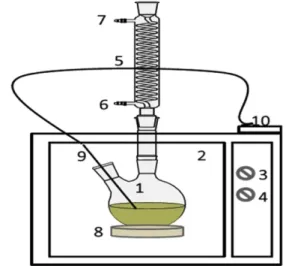
The methyl ester was produced in a batch reactor using micro- wave heating sources. The reaction study was performed by varying catalyst concentration and microwave power. The design of equip- ment used in the present research is shown in Fig. 1. The reactor is a round bottom flask made from Pyrex glass equipped by magnetic stirrer. The microwave oven commercial used in the present research
is Electrolux Microwave EMM2007X with a frequency of 2.45 GHz, power output of 100 to 800 W and time setting of 0 to 35 min.
2-3. Experimental procedures
Transesterification reactions were carried out under microwave heating to see the effects of microwave power on the reaction time and concentration of CaO catalyst. The operating variables are con- centration of CaO catalyst (1.0; 1.5; 2.0; 2.5 and 3.0 wt%) and micro- wave power (100, 264, 400 and 600 W). First, coconut oil was introduced in the reactor and then a mixture of methanol and CaO was added. The reaction was started by turning on the microwave power of 100 W and setting the reaction time of 0.5 min. The pro- cess was repeated for reaction times of 1.0, 1.5, 2.0, 2.5, 3.0 and 3.5 min. After completion of the reaction, the product was kept in a sepa- ratory funnel over night for separating methyl ester and glycerol. The methyl ester was first washed with warm water for three times.
Finally, the product was dried at 110 oC for 1 h.
2-4. Product analysis
The concentration of biodiesel was analyzed by gas chromatogra- phy (Agilent 6890 GC) equipped with a capillary column Agilent 19095N-123 INNOWAX, (30 m × 0.53 mm × 1 µl) and a flame ion- ization detector (FID). Helium was the carrier gas. The yield of bio- diesel was calculated from the content of methyl ester analyzed by GC with the following equation:
Yield (%) = (1)
in which WME is actual weight of methyl ester produced from experiment (g). WTG is weight of coconut oil used in the present
WME–CME WTG
--- 100%×
Fig. 1. Schematic apparatus for transesterification process assisted by microwave.
1. Reactor 6. Cooling water in
2. Microwave 7. Cooling water out 3. Power control 8. Stirrer
4. Temperature control 9. Thermocouple 5. Condenser 10. Temperature indicato
research (g). CME is content of methyl ester measured by GC.
3. Results and Discussion
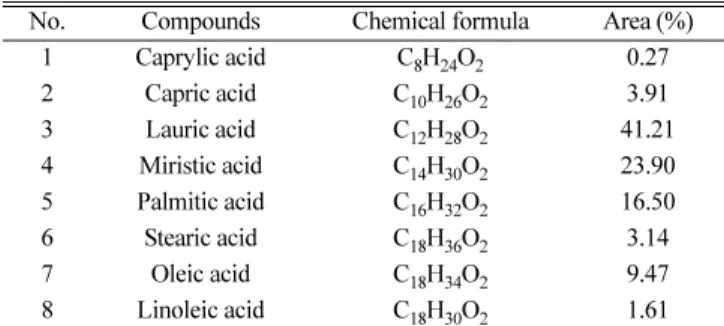
The fatty acid composition of the coconut oil was obtained by gas chromatography (Table 1). The content of fatty acids in coconut oil used in the present research as shown in Table 1: the fatty acid for the chain C8-C14 contained approximately 70%, while for the chain C16- C18 of about 30%, this indicates that coconut oil is rich in saturated fatty acids, saturated fatty acids which are stable at high tempera- tures, so it is best used as a raw material for the production of alterna- tive fuels, especially biodiesel, in addition to having the potential to obtain other fuels such as bio kerosene, etc. In the present research, the biodiesel was prepared by single transesterification process assisted by microwave using CaO catalyst. The results are golden brown bio- diesel on top and brown glycerol on the bottom.
3-1. The effects of microwave power
The microwave energy emitted electromagnetic waves, wherein the amount of wave energy per unit of time is reflected as a power.
Heating with microwaves can take place very quickly because the microwave energy absorption capability of the polar molecule is very high, and in the presence of heat transfer in microwave that quickly toward molecular materials can lead to increased yield of product. With the polarization properties, the homogeneity between the alcohol and the oil may happen quickly due to the movement or rotation of dipole molecules without changing the molecular struc- ture of the material. This is what causes the addition of the supplied power leading to heating at the molecular level which can happen very quickly and positively affects the speed of the reaction rate [5,16,17].
In studying the effect of the amount of catalyst to yield of methyl ester, the experiments were conducted with 100, 264 and 400 W by molar ratio of 1:9 mol of oil to methanol. Fig. 2 shows the effect of microwave power on yield of methyl ester as a function of reaction time. This figure shows that the yield increases significantly along with the increasing of microwave power and reaction time. Padil et al. (2010) [18] conducted a study by the transesterification reaction of vegetable oils using conventional batch methods by CaO catalyst, temperature of 105 °C, and reaction time of 1.5 h obtained methyl ester as product of 73.38%. The use of a heterogeneous catalyst, par-
ticularly CaO to produce methyl ester using conventional methods, requires longer periods of time, while the use of microwave can reduce reaction time. Fig. 2 shows that with the use of microwave, a yield of 33.84% can be obtained only with reaction time of 3 min.
3-2. The effects of catalyst concentration
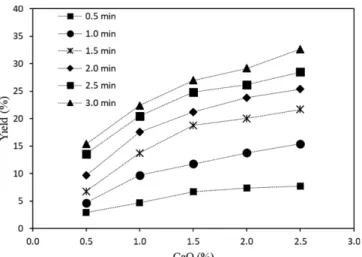
Transesterification reaction with the addition of CaO catalyst was performed by the catalyst amount of 0.5, 1.0, 1.5, 2.0 and 2.5% (w/w).
Fig. 3 shows the effect of catalyst concentration on yield of methyl ester as a function of reaction time. It is clear that the higher concen- tration of catalyst used then causes the yield of methyl esters to be higher, even though the increase is less significant for the catalyst concentration of 0.5 to 2.5% (w/w). CaO catalyst activity is not as high as KOH or NaOH catalysts because the basicity of CaO is lower than homogeneous catalysts. The obtained yield for catalyst concen- tration of 0.5% (w/w) with a reaction time of 1 min is 10.23%, while for catalyst concentration of 2.5% (w/w) with a reaction time of 1 min is 16.3%. A higher yield of methyl esters can be obtained by adding or prolonging the reaction time. So it can be said that the higher cata- lyst concentration used and the longer reaction time causes the yield of methyl esters obtained to be higher.
Table 1. The composition of fatty acids from coconut oil
No. Compounds Chemical formula Area (%)
1 Caprylic acid C8H24O2 0.27
2 Capric acid C10H26O2 3.91
3 Lauric acid C12H28O2 41.21
4 Miristic acid C14H30O2 23.90
5 Palmitic acid C16H32O2 16.50
6 Stearic acid C18H36O2 3.14
7 Oleic acid C18H34O2 9.47
8 Linoleic acid C18H30O2 1.61
Fig. 2. Yield of methyl ester as function of reaction time (CaO cat- alyst of 2.5% (w/w)).
Fig. 3. Yield of methyl ester as function of reaction time (concentra- tion catalyst of 0.5; 1.0; 1.5; 2.0 and 2.5% (w/w); microwave power of 400 W).
Fig. 4 shows that the increase in the concentration of catalyst for the transesterification reaction affects the reaction rate constants, and because of it can directly lower the activation energy. In accordance with the Arrhenius law activation energy decreases lead to increased reaction rate constants. The rise in reaction rate constants has an impact on increasing the speed of reaction because the reaction rate constant is proportional to the speed of reaction. The use of micro- waves reduces the reaction time, for the molecular motion on the reactants tends to adjust or align the molecules and ions, causing fric- tion that causes heating to occur very rapidly.
Generally, the production process of methyl esters using heteroge- neous catalysts will produce three layers, wherein the first layer is the product of methyl ester, the second layer is glycerol and the third layer is the catalyst deposition. But in this experiment there were some samples, especially on the use of catalysts with low concentra- tion was 1% found four layers, namely, the first layer was residue from unconverted methanol, the second layer was a methyl ester product, the third layer was glycerol and the fourth layer was the catalyst. This phenomenon is caused by the use of low microwave power of 100 and 264 W, which can produce an average temperature below 60 °C.
But in general, the increase of microwave power and catalyst con- centration showed an increase in the conversion reactions and yield.
So as to obtain a high reaction conversion and yield, the reaction should be done with a reaction time of 30 min up to 1 h. Kouzu et al.
(2008) [19] conducted an experiment using 12% CaO catalyst, a reaction time of 3 h in the transesterification reaction of soybean oil obtaining conversion of 93%.
3-3. Transesterification reaction kinetics of coconut oil using CaO catalyst
The transesterification reaction is a reaction between triglycerides which becomes the main component of vegetable or animal oils when being reacted with an alcohol, especially methanol, to form methyl esters or known as biodiesel. Transesterification reaction is an equi- librium reaction or a reaction reversible and very slow; then in prac-
tice to make the reaction one way, (irreversible) excess alcohol is used to shift the reaction equilibrium to right. Diasakou et al. (1998) [20] proposed a reaction mechanism that consists of three reaction stages. Triglycerides react with methanol to produce diglycerides, which then react further with methanol to produce monoglycerides.
Finally, monoglycerides further react with methanol to produce glyc- erol. In each reaction stage, one molecule of methyl ester is pro- duced from each molecule of methanol that has been consumed. The mechanism of this reaction can be seen in the following equations, (2), (3) and (4):
(2)
(3)
(4) in which k1, k2 and k3 are the reaction rate constants for the reac- tion of Equations (2), (3) and (4). Each reaction stage is assumed to be the first order for each reactant. However, since the desired end product is a methyl ester, then Jain et al. (2010), Nautiyal et al.
(2014) and Shah et al. (2014) [21-23] proposed a simple mathe- matical model by ignoring intermediate products of diglycerides and monoglycerides, so that the mechanism can be simplified into a single stage of irreversible reaction as follows Nautiyal et al.
(2014) [21].
(5)
Based on Equation (5) the rate of transesterification reaction for triglyceride can be expressed as follows:
(6)
Theoretically, the rate of reaction follows a fourth-order. How- ever, the reaction is practically carried out with a large excess of methanol so that the concentration of methanol is considered unchanged during the reaction runs (CMeOH is constant). The reaction is assumed to follow pseudo first-order [12]. Therefore the rate of reaction can be expressed as follows:
(7) TG concentration can be expressed in the conversion (XTG) with the following equation:
(8)
(9) By rearranging Equation (9), the equation can be expressed as fol- lows:
(10) in which k is a kinetic constant of triglycerides (TG) and k' is k [MeOH]a.
k1·
TG MeOH+ →DG+ME
k2·
DG MeOH+ →MG+ME
k3·
MG MeOH+ →DG+ME
TG 3MeOH+ →k· 3ME+GL
r
–TG –dCTG
---dt k TG[ ] MeOH[ ]3
= =
r
–TG –dCTG
---dt k′ C[ TG]
= =
CTG=CTGo(1 X– TG) dXTG
---dt
– =k′ 1 X( – TG)
1 X– TG
( )
ln
– =k′t
Fig. 4. Yield of methyl ester as function of catalyst concentration (microwave power of 400 W).
Studies conducted on the reaction kinetics of coconut oil transeter- ification assume a pseudo first-order wherein a large excess of meth- anol is used with CaO as catalyst. In addition, the effect of a process that uses microwave as a heater is that the reactants can directly absorb microwaves, which can cause the reaction to occur more quickly. The temperature in the reactor is assumed to run in isthor- mal conditions, because as long as the radiation waves are radiated, the temperature inside the reactor is controlled by reflux to return the evaporated methanol. In this system it is assumed that reaction is controlled by chemical reactions because the catalyst used is powder form with very fine particle size (average 10 μm) with surface area of 16.505 m2/g. These characteristics lead to the value of Thiele modu- lus becoming very small (<0.4), which means that the resistance caused by diffusion is negligible and the reaction is controlled by a chemical reaction.
Study on kinetics in a batch reactor for transesterification reaction of coconut oil was done by CaO catalyst with a concentration of 2.5% (w/w). The analysis was done by varying of reaction time (0.5;
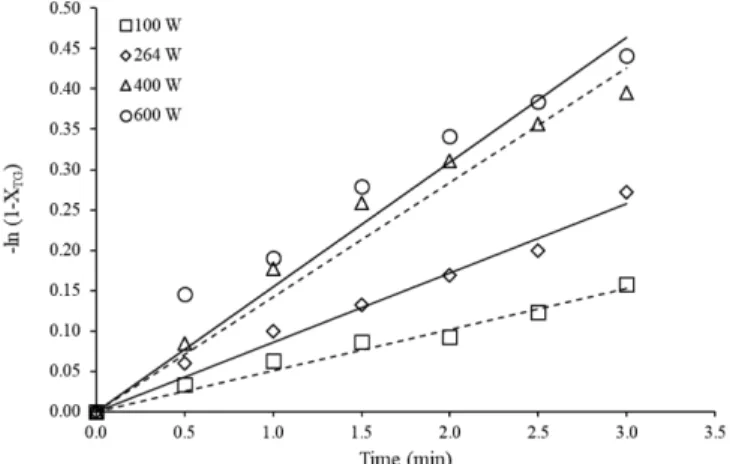
1.0; 1.5; 2.0; 2.5 and 3.0 min) and microwave power (100, 264, 400 and 800 W). In this study the assumptions used to determine the kinetics model of the reaction are pseudo first-order and that the transesterification reaction is irreversible. By using Equation 10 and doing the data plotting between reaction time (t) to -ln (1-XTG) as Fig. 5, the value of k' for transesterification reaction of coconut oil in a batch reactor with a CaO catalyst can be determined.
Based on Fig. 5, the function for all straight lines has a value of R2 is close to 1 (R2> 0.9). In addition it also shows that assumptions of first order are acceptable. To determine the activation energy and fre- quency factor can be done by making a plot between ln k and 1/T as shown in Fig. 6. From Fig. 6 can be obtained the activation energy and frequency factor for the transesterification reaction of coconut oil in a batch process. In addition, it showed that the value of k for CaO catalyst at 324 K is 2.969/min. This shows that the activity of the catalyst greatly affects the rate of reaction, because with catalyst the lower energy barrier allows higher rate of reaction. The addition of the catalyst facilitates the formation of transition compounds, which
means it can decrease the activation energy.
The effect of the microwave is significant against increasing the rate of reaction, even at low temperatures it can still increase the value of k'. This can be seen from the use of microwaves with heteroge- neous CaO catalysts and temperature of 324 K, which can obtain yield of about 15%. This obtained yield is higher when compared to trans- esterification using conventional heating, which takes about 3 to 5 h.
Based on Fig. 6, the values of activation energy and frequency fac- tor obtained from CaO catalyst are 82.08 kJ/mol and 3.54.105/min, which shows that the catalyst can significantly decrease the activa- tion energy. Based on the calculation of activation energy and reac- tion rate constant by a simple model with the assumption that the reaction follow pseudo first-order, then the equation for reaction rate of coconut oil in a batch process with CaO catalyst can generally be expressed as follows: −rTG= 1.7·106 CTG.
4. Conclusion
Microwaves are not only used for heating in production of biofu- els (methyl ester) from raw materials through transesterification reac- tion, but also can speed up the process or shorten the reaction time when compared to the conventional methods. Increased microwave power can cause the temperature of the system to rise very quickly so that the transesterification reaction can run with a shorter time. In addition, increased microwave power can also reduce the amount of catalyst required for transesterification reactions. In this study the highest yield of methyl esters was 33.84% obtained under operating conditions of microwave power of 600 W, concentration of CaO cat- alyst by 2.5%, reaction time of 3 min. Based on this research the reaction kinetics of coconut oil transesterification using microwave with CaO catalyst can be assumed to follow pseudo first-order. So in this research the reaction rate of coconut oil transesterification using microwave with CaO catalyst can be modeled into the following equation: −rTG= 1.7·106 CTG.
e–---43.86RT
e–---43.86RT
Fig. 5. The relation between reaction time and -ln (1-XTG) (CaO catalyst of 2.5% (w/w)).
Fig. 6. The relation between ln k and 1/T (reaction time of 3 min;
CaO catalyst of 2.5% (w/w)).
Acknowledgements
The authors would like to thank the Ministry of Research, Tech- nology and Higher Education Republic of Indonesia for financial support through PUPT research scheme (2015-2016) and crews of Laboratory of Process Technology, Department of Chemical Engi- neering, Institut Teknologi Sepuluh Nopember.
References
1. Hasan, M. H., Mahlia, T. M. I. and Nur, H., “A Review on Energy Scenario and Sustainable Energy in Indonesia,” Renew. Sustain.
Energy Rev., 16(4), 2316-2328(2012).
2. Zabeti, M., Wan Daud, W. M. A. and Aroua, M. K., “Activity of Solid Catalysts for Biodiesel Production: A Review,” Fuel Process.
Technol., 90(6), 770-777(2009).
3. Kapilan, N. and Baykov, B. D., “A Review on New Methods Used for the Production of Biodiesel,” Pet. Coal, 56(1), 62-69(2014).
4. Shahid, E. M. and Jamal, Y., “Production of Biodiesel: A Technical Review,” Renew. Sustain. Energy Rev., 15(9), 4732-4745(2011).
5. Chen, K. S., Lin, Y. C., Hsu, K. H. and Wang, H. K., “Improving Biodiesel Yields from Waste Cooking Oil by Using Sodium Methox- ide and a Microwave Heating System,” Energy, 38(1), 151-156 (2012).
6. Kusuma, H. S. and Mahfud, M., “Microwave-assisted Hydrodis- tillation for Extraction of Essential Oil from Patchouli (Pogoste- mon cablin) Leaves,” Period. Polytech. Chem. Eng., 61(2), 82- 92(2017).
7. Kusuma, H. S. and Mahfud, M., “The Extraction of Essential Oils from Patchouli Leaves (Pogostemon cablin Benth) Using a Microwave Air-hydrodistillation Method as a New Green Tech- nique,” RSC Adv., 7(3), 1336-1347(2017).
8. Kusuma, H. S. and Mahfud, M., “Comparison of Kinetic Mod- els of Oil Extraction from Sandalwood by Microwave-assisted Hydrodistillation,” Int. Food Res. J., 2(4), 1697-1702(2017).
9. Kusuma, H. S. and Mahfud, M., “GC-MS Analysis of Essential Oil of Pogostemon Cablin Growing in Indonesia Extracted by Microwave-assisted Hydrodistillation,” Int. Food Res. J., 24(4), 1525-1528(2017).
10. Kusuma, H. S. and Mahfud, M., “Microwave Hydrodistillation for Extraction of Essential Oil from Pogostemon Cablin Benth:
Analysis and Modelling of Extraction Kinetics,” J. Appl. Res.
Med. Aromat. Plants, 4, 46-54(2017).
11. Kusuma, H. S. and Mahfud, M., “Comparison of Conventional and Microwave-assisted Distillation of Essential Oil from Pogoste-
mon Cablin Leaves: Analysis and Modelling of Heat and Mass Transfer,” J. Appl. Res. Med. Aromat. Plants, 4, 55-65(2017).
12. Azcan, N. and Danisman, A., “Alkali Catalyzed Transesterifica- tion of Cottonseed oil by Microwave Irradiation,” Fuel, 86, 17- 18, 2639-2644(2007).
13. Encinar, J. M., González, J. F., Martínez, G., Sánchez, N. and Pardal, A., “Soybean Oil Transesterification by the Use of a Micro- wave Flow System,” Fuel, 95, 386-393(2012).
14. Sajjadi, B., Abdul Aziz, A. R. and Ibrahim, S., “Investigation, Mod- elling and Reviewing the Effective Parameters in Microwave- assisted Transesterification,” Renew. Sustain. Energy Rev., 37, 762- 777(2014).
15. Suryanto, A., Suprapto, S. and Mahfud, M., “Production Biodiesel from Coconut Oil Using Microwave: Effect of Some Parameters on Transesterification Reaction by NaOH Catalyst,” Bull. Chem.
React. Eng. Catal., 10(2), 162-168(2015).
16. Asakuma, Y., Ogawa, Y., Maeda, K., Fukui, K. and Kuramochi, H., “Effects of Microwave Irradiation on Triglyceride Transes- terification: Experimental and Theoretical Studies,” Biochem. Eng.
J., 58-59, 1, 20-24(2011).
17. Choedkiatsakul, I., Ngaosuwan, K., Assabumrungrat, S., Tabasso, S. and Cravotto, G., “Integrated Flow Reactor That Combines High-shear Mixing and Microwave Irradiation for Biodiesel Pro- duction,” Biomass and Bioenergy, 77, 186-191(2015).
18. Wahyuningsih, P. S. and Awaluddin, A., “Pembuatan Biodiesel Dari Minyak Kelapa Melalui Reaksi Metanolisis Menggunakan Katalis CaCO3 Yang Dipijarkan,” J. Natur Indones., 13, 1, 27-32 (2010).
19. Kouzu, M., Kasuno, T., Tajika, M., Sugimoto, Y., Yamanaka, S. and Hidaka, J., “Calcium Oxide as a Solid Base Catalyst for Transes- terification of Soybean Oil and Its Application to Biodiesel Pro- duction,” Fuel, 87, 12, 2798–2806, 2008.
20. Diasakou, M., Louloudi, A. and Papayannakos, N., “Kinetics of the Non-catalytic Transesterification of Soybean Oil,” Fuel, 77(12), 1297-1302(1998).
21. Nautiyal, P., Subramanian, K. A. and Dastidar, M. G., “Kinetic and Thermodynamic Studies on Biodiesel Production from Spi- rulina Platensis Algae Biomass Using Single Stage Extraction – Transesterification Process,” Fuel, 135, 228-234(2014).
22. Jain, S. and Sharma, M. P., “Kinetics of Acid Base Catalyzed Trans- esterification of Jatropha Curcas Oil,” Bioresour. Technol., 101(20), 7701-7706(2010).
23. Shah, K. A., Parikh, J. K. and Maheria, K. C., “Optimization Stud- ies and Chemical Kinetics of Silica Sulfuric Acid-Catalyzed Biodiesel Synthesis from Waste Cooking Oil,” Bioenergy Res., 7(1), 206-216(2014).