773 https://doi.org/10.9713/kcer.2018.56.5.773
PISSN 0304-128X, EISSN 2233-9558
단 신
Production Biodiesel via In-situ Transesterification from Chlorella sp. using Microwave with Base Catalyst
Ummu Kalsum, Heri Septya Kusuma†, Achmad Roesyadi and Mahfud Mahfud†
Department of Chemical Engineering, Faculty of Industrial Technology, Institut Teknologi Sepuluh Nopember, Surabaya (Received 3 December 2017; Received in revised form 31 July 2018; accepted 14 August 2018)
Abstract − In-situ transesterification of microalgae lipids using microwave irradiation has potential to simplify and accelerate biodiesel production, as it minimizes production cost and reaction time by direct transesterification of microalgae into biodiesel with microwave as a heating source. This study was conducted to research the effect of micro- wave irradiation with in-situ transesterification of microalgae under base catalyst condition. The process variables (reac- tion time, solvent ratio, microwave power) were studied using 2% of catalyst concentration. The maximum yield of FAME was obtained at about 32.18% at the reaction time of 30 min with biomass-methanol ratio 1:12 (w/v) and microwave power of 450 W. The GC MS analysis obtained that the main component of FAME from microalgal oils (or lipids) was palmitic acid, stearic acid and oleic acid. The results show that microwaves can be used as a heating source to synthe- size biodiesel from microalgae in terms of major components resulting.
Key words: Base catalyzed, in-situ transesterification, Microwave, Microalgae, Chlorella sp.
1. Introduction
The increasing of energy consumption in the transportation sector has a big impact on the decreasing of fossil fuel energy stock and the increasing of environmental pollution. The side effect that most con- tributes to global warming and the environmental problems is green house gas (GHG) emission. Global warming is a serious problem that impacts human life and environment and needs huge solutions and ways to solve it.
Biodiesel from microalgae is one of the renewable energy sources known as the third generation of biofuel. It has potential to replace fossil fuel energy, decrease gas house emission and increase protec- tion of the energy supply. If compared with other sources, biodiesel from microalgae has greater potential as the substitution of diesel fuel when viewed from the aspects of environment, security, eco- nomic, raw material and fuel performance [1].
Conventionally, biodiesel production from microalgae involves two steps: extraction and transesterification that requires many sol- vents, much energy and high operational cost. Several researches have been conducted to eliminate the extraction step by in-situ trans- esterification method or direct transesterification. With in-situ trans- esterification, oils saved in material contact directly with alcohol alkalized or alcohol acidified. Therefore, extraction and transesterifi- cation take place simultaneously during the reaction. Several studies have been reported conducting in-situ transesterifications using acid
catalyst. Ehime et al., (2010) [2] studied the effect of reaction vari- ables on Chlorella lipids; Miao et al., (2009) [3] examined acid cata- lyst by direct transesterification; Johnson and Wen (2009) [4] showed in-situ transesterification with different co-solvents, and Xu and Mi (2011) [5] tested in-situ transesterification from Spirulina Sp using a base catalyst with various co-solvents. All previous researchers used conventional or direct heating as a heating method.
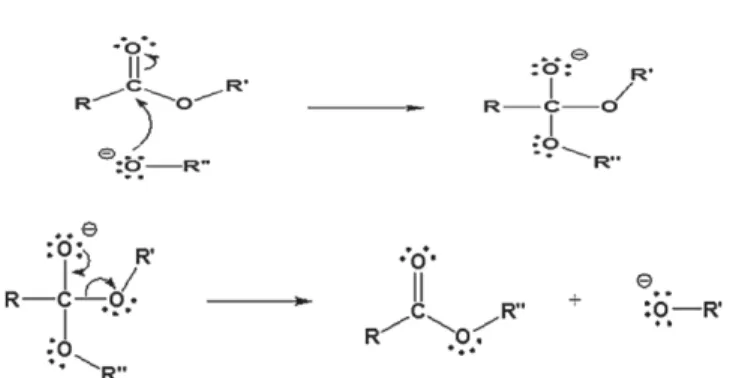
In the in-situ transesterification mechanism, carbonyl group from ester is nucleophilically attacked by alkoxides to produce intermedi- ate tetrahedral, which can be reactant or product. Some species in equilibrium and product distribution depend on relative energy from reactant and product. Base-catalyzed transesterification has been proven as the faster catalyst than acid catalyzed transesterification [6]. The faster reaction rates are due to the strong nucleophilic of alkoxides formed from methanol and catalyst [7]. Base-catalyzed in- situ transesterification can be carried out using base homogeneous catalyst and a heterogeneous catalyst such as KOH, NaOH, and CaO.
Microwave as a heating source can be applied to various things such as the extraction of essential oils [8-14] and in the transesterifi- cation from microalgae or other sources to facilitate cell penetration, energy supply and heating acceleration [15-19]. Microwaves can increase the gradient of temperature and pressure generation, cell wall rupturing and improve mass transfer and reaction rate [20]. The microwave oven works by the exposure of microwave with frequency 2450 MHz and 12.24 cm in length. A microwave will be absorbed by materials through dielectric heating. Some molecules including water are electric dipoles and have positive and negative poles that can cause molecules to rotate and generate heat [21]. The heating system by microwave irradiation is caused by dielectric properties of
†To whom correspondence should be addressed.
E-mail: [email protected], [email protected] This is an Open-Access article distributed under the terms of the Creative Com- mons Attribution Non-Commercial License (http://creativecommons.org/licenses/by- nc/3.0) which permits unrestricted non-commercial use, distribution, and reproduc- tion in any medium, provided the original work is properly cited.
polar mixtures and ionic components of oils that interact molecu- larly to produce an intermolecular mixture.
In this study, we evaluated biodiesel production from Chlorella sp.
by base catalyzed in-situ transesterification at different reaction times, methanol ratio and microwave powers. Methyl ester characteristics were analyzed to investigate its potential as a biofuel.
2. Materials and Methods
2-1. Materials
Chlorella sp. was purchased from Balai Budi Daya Air Payau (BBAP) Jepara, Central Java, Indonesia. Methanol (>99% purity), n-hexane (98%) and KOH were purchased from Brataco Chem.
2-2. Experimental
Process stage involves characterization of microalgae by lipid extraction and in-situ transesterification of microalgae using potas- sium hydroxide and microwave as a heating source.
2-2-1. Lipid extraction of microalgae
Chlorella sp. was placed in a thimble filter paper and then put into 250 ml Soxhlet. N-hexane solvent with 96% of concentration was added into the Soxhlet. An optimization Soxhlet extraction was per- formed to determine the total lipid content of dried microalgae and it was carried out for 3.5 hours with 26 circulations. The mixtures of microalgae lipids and n-hexane were then distilled to remove the residual solvent. Lipid produced was weighted to determine the per- centage of yield lipid. Lipid produced was analyzed by GC MS to determine the fatty acid composition.
2-2-2. In-situ transesterification procedure
In-situ transesterification using KOH 2% was conducted in a microwave reactor equipped with a reflux condenser with design as in Fig. 2. The microwave reactor was a microwave type Electrolux EMM2007X with maximum power 800 W. Reflux condenser func- tion is to provide condensation from evaporation of solvent mixture, and a magnetic stirrer was used to keep uniform mixing during the experiment.
This stage started by solving catalyst into methanol while stirring
with magnetic stirrer. Methanol and catalyst solution was mixed with microalgae powder and heated in the microwave. The process was carried out on all variables of biomass-methanol ratio, catalyst con- centration and microwave powers. When the reaction was finished, the mixed solution was filtered with a vacuum filter to separate fil- trate from residue. The filtrate was then resuspended in methanol for 10 min to take FAME remains. Water was added into the filtrate to ease separation of hydrophilic component, then poured into the fun- nel until forming three layers. FAME in the first layer was extracted for three times with n-hexane and washed with water to remove the remains of catalyst and methanol. After that, FAME product was dis- tilled, weighted and analyzed by GC MS.
3. Results and Discussion
3-1. Extraction and characterization of microalgae lipids In this study, the total lipid of microalgae was obtained by extraction to determine the fatty acid component of microalgae.
Extraction process was conducted by Soxhlet method using n- hexane as a solvent.
The concept of solvent extraction is that non-polar solvents dam- age the hydrophobic component through interaction between non- polar solvents and neutral fatty acid components in microalgae [22].
The extraction relies on the ability of the solution to penetrate the cell structure of microalgae and attract the fatty acid components stored in the microalgae cell matrix. The chemical concept “like dissolving like” is the basic principle of microalgae extraction using solvent. An ideal solvent requires a high specification of lipids, especially acyl- glycerol, and should be volatile to ensure energy and time used for lipid separation of the solvent by distillation is low. Non-polar solvents interfere with the interaction between non-polar lipids and neutral lipids in biomass.
Fig. 1. Mechanism of base trans-esterification reaction.
Fig. 2. Microwave reactor design for in-situ transesterification.
1. Condenser 5. Power setting
2. Stative clamp 6. Time setting 3. Microwave 7. Magnetic stirrer
4. Reactor 8. Stir bar
GC-MS analysis indicated that fatty acid components of Chlo- rella sp. contain saturated fatty acid (SAFA), monounsaturated fatty acid (MUFA) and polyunsaturated fatty acid (PUFA). The lipid components were dominated by unsaturated fatty acid (MUFA) with oleic acid as the prominent component.
3-2. Base-catalyzed in-situ transesterification of microalgae 3-2-1. The effect of methanol volume on the yield of crude biodiesel In the base in-situ transesterification of Chlorella sp., there are several variables that influence the process. The effect of algal bio- mass to methanol ratio is one factor which has a significant impact on in-situ transesterification reaction. Role of methanol is as a sol- vent to extract microalgae lipids or oils [23] and also as a reactant during transesterification process. The stoichiometric ratio indicates that the transesterification of 3 moles of methyl esters and 1 mole of glycerol requires 3 moles of alcohol and 1 mole of triglycerides.
Fig. 3 shows the correlation between alcohol volume to crude bio- diesel which was transesterified using KOH 2%, microwave power 450 W for 30 min. The experiments showed that the yield of crude biodiesel was significantly increased with the increase of methanol volume from 80 ml to 120 ml. It indicates that a large amount of methanol facilitates contact between methanol and microalgae maxi- mally. The use of excess methanol also increases the absorption capacity of material in the microwave, which will improve the mole- cule excitation of materials and induce a rise in temperature. The optimum yield resulted in 120 ml of methanol use with 27.18% of yield.
However, in the use of 150 ml of methanol, the yield of crude bio- diesel decreased immediately to 22.95%. The decrease of yield of crude biodiesel with the process using methanol above of 120 ml reveals that in-situ transesterification with KOH 2% and 1:12 bio- mass to methanol ratio (w/v) under irradiation microwave was inef- fective and was not affected to the increase of yield.
3-2-2. The effect of reaction time on the yield of crude biodiesel In-situ transesterification with 2% of KOH was studied with investigating the effect of reaction time to yield of crude biodiesel.
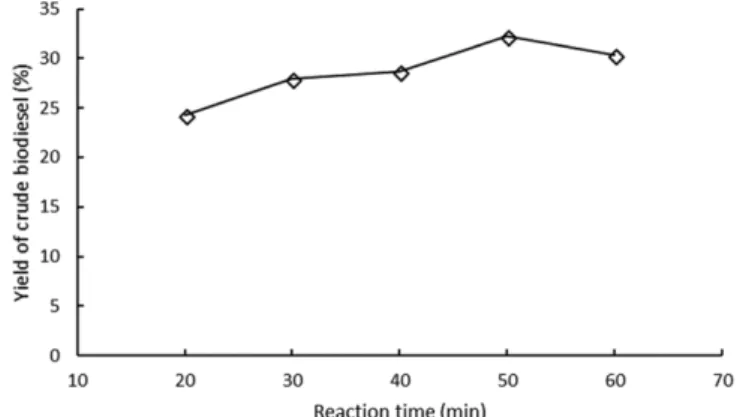
The experiment showed that for 50 min of reaction time the yield of crude biodiesel increased slowly from 24.27% to 32.18% of crude biodiesel. The crude biodiesel resulting in 50 min was the highest yield and after that yield decreased immediately to 30.36% in 60 min.
Reaction time is an important factor that affects during in-situ transesterification under microwave irradiation. The correlation between the reaction time and the yield of crude biodiesel is shown in Fig. 4. The graph shows that yield of crude biodiesel increased with the increasing of time during the reaction. The increasing of contact time between biomass with methanol causes an increase of damaged cell walls and triglycerides which were released into the solvent. The length of contact time facilitates a sufficient contact time for reactant to interact and produce a higher yield of biodiesel [24]. The microwave also accelerates the organic synthe- sis with the increase of the rate of reaction. As stated by Arrhe- nius law, the contact between molecules will be greater with the length of reaction time [25]. However, the length of reaction time can be insufficient and cause overheating, loss of much solvent and energy and by-product formation during the process [24].
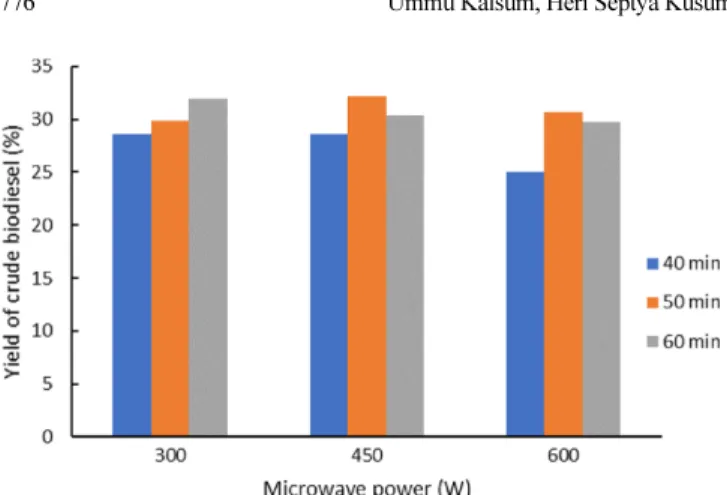
3-2-3. The effect of microwave power on the yield of crude biodiesel The effect of microwave power on the yield of crude bio- diesel was studied with different powers (300, 450 and 600 W) during in-situ transesterification with KOH 2%. Fig. 5 shows correlation crude biodiesel produced from in-situ transesterifi- Table 1. Fatty acid components of Chlorella sp.
No. Fatty acid components Percentage (%) Saturated fatty acid
1 Palmitic acid (C16:0) 9.79
2 Stearic acid (C18:0) 1.32
Monounsaturated fatty acid
3 Oleic acid (C18:1) 9.99
Polyunsaturated acid
4 Linoleic acid (C18:2) 1.43
Fig. 3. Effect of volume of methanol on yield of crude biodiesel with KOH 2%, reaction time 30 min and microwave power 450 W.
Fig. 4. Effect of different reaction time on yield of crude biodiesel from in in-situ transesterification with KOH 2%, biomass to methanol ratio 1:12 (w/v) and microwave power 450 W.
cation using KOH 2% and different microwave power. The graph indicates an increase of yield during reaction for 60 min which was heated in a microwave with 300 W. In contrast, in the operation with higher of microwave power (450 and 600 W), the yield of crude biodiesel increased immediately until 50 min of reaction time and then decreased gradually in 60 min. The high- est yield of crude biodiesel was about 32.18% by using microwave power of 450 W for 50 min, while the lowest yield was found to be 25.09% by using microwave power of 600 W for 40 min.
The application of different power shows a significant effect on the yield of crude biodiesel during in-situ transesterification under microwave irradiation. Energy from microwave is transferred into materials by dipolar polarization, ionic conduction and interfacial polarization, which causes heating localization in materials and acceler- ates the reaction [26]. Microwave power may act as a driving force that produces heating localization. It facilitates breakdown of the cell matrix of microalgae that make solutes easier to diffuse out and dis- solve in the solvent.
It has been found that the use of low microwave power in the experiment significantly increases the yield due to the maximum interaction of the reactant mixture and the lack of evaporated solvent during the reaction. However, the application of high microwave power in the in-situ transesterification stimulates the rise of tempera- ture and that can produce higher yield.
3-3. Characterization of fatty acid methyl esters
The composition of GC MS on fatty acid methyl ester Chlorella sp.
showed that the methyl ester is a medium chain (C12-C20) methyl ester comprising lauric acid methyl ester (C12:0), myristic acid methyl ester (C14:0), palmitic acid methyl ester (C16:0), stearic acid methyl ester (C18:0), oleic acid methyl ester (C18:1), linoleic acid methyl ester (C18:2), arachidonic acid methyl ester (C20:4) and eicosapen- tanoic acid methyl ester (C20:5).
From Table 2 it can be seen that the characteristic of fatty acid methyl ester from Chlorella sp. that was esterified by microwave heating is a medium chain fatty acid (MCFA) consisting of saturated fatty acid (SAFA) and unsaturated fatty acid (unsaturated fatty acid, Fig. 5. The yield of crude biodiesel on several reaction time with vari-
ous microwave power.
Fig. 6. Gas Chromatography-Mass Spectrophotometry Analysis of Chlorella sp. FAME (KOH 2%, reaction time 50 min, microwave power 450 W).
Table 2. The composition of fatty acid methyl ester from Chlorella sp.
by GC-MS analysis
Compound Name Formula Mass (%)
Methyl Lauric C12:0 0.79
Methyl Palmitic C16:0 17.81
Methyl Myristic C14:0 2.06
Methyl Palmitoleic C16:1 4.82
Methyl Oleic C18:1 9.43
Methyl Stearic C18:0 13.22
Methyl Margaric C17:0 4.82
Methyl Eicosapentaenoic C20:5 2.10
Methyl Arachidonic C20:4 0.70
Methyl Linoleic C18:2 1.16
Methyl Ricinoleic C18:1-1OH 0.45
MUFA and PUFA). The highest fatty acid composition is dominated by saturated fatty acids (SAFAs) with a percentage of about 40%
consisting of palmitic acid, stearic acid, myristic acid and lauric acid.
While, monounsaturated fatty acids (MUFAs) consisted of oleic acid with the percentage of about 9.43% and polyunsaturated fatty acids (PUFAs) of about 8.78%. From the PUFAs composition, there is an arachidonic acid methyl ester with a low percentage of about 0.70%.
Arachidonic acid is one of the characteristics of biodiesel produced from microalgae and is not found in fatty acids contained in other vegetable oils. While, the methyl ester profile of FAME generated through transesterification is a medium chain fatty acid which is dominated by saturated fatty acid (SAFA) with 40.22%.
4. Conclusions
We evaluated the process parameters required for base in-situ transesterification to produce biodiesel from microalgae using micro- wave. From the parameters evaluated (methanol volumes, reaction time and microwave powers), the highest yield was obtained at 50 min with biomass to methanol ratio, 1:12 and power of 450 W. It indicated that 32.185% of yield can be obtained using KOH, and from the FAMEs profile was identified that the majority of FAME was pro- duced from palmitic acid, stearic acid and oleic acid.
Acknowledgement
This research work was fully financially supported by The Ministry of Research, Technology and Higher Education of Indonesia for the University Prime Research. We also thank Mr. Rifai for analysis of Algae’s FAME.
References
1. Dinh, L. T. T., Guo, Y. and Mannan, M. S., “Sustainability Eval- uation of Biodiesel Production Using Multicriteria Decision‐mak- ing,” Environ. Prog. Sustain. Energy, 28, 38-46(2009).
2. Ehimen, E. A., Sun, Z. F. and Carrington, C. G., “Variables Affect- ing the in situ Transesterification of Microalgae Lipids Fuel, 89, 677-684(2010).
3. Miao, X., Li, R. and Yao, H., “Effective Acid-catalyzed Trans- esterification for Biodiesel Production,” Energy Convers. Manag., 50, 2680-2684(2009).
4. Johnson, M. B. and Wen, Z., “Production of Biodiesel Fuel from the Microalga Schizochytrium Limacinum by Direct Transester- ification of Algal Biomass,” Energy and Fuels, 23, 5179-5183 (2009).
5. Xu, R. and Mi, Y., “Simplifying the Process of Microalgal Bio- diesel Production Through in situ Transesterification Technol- ogy,” J. Am. Oil Chem. Soc., 88, 91-99(2011).
6. Vyas, A. P., Verma, J. L. and Subrahmanyam, N., “A Review on FAME Production Processes,” Fuel. 89, 1-9(2010).
7. Lotero, E., Liu, Y., Lopez, D. E., Suwannakarn, K., Bruce, D. A.
and Goodwin, J. G., “Synthesis of Biodiesel via Acid Cataly-
sis,” Ind. Eng. Chem. Res., 44, 5353-5363(2005).
8. Kusuma, H. S., Altway, A. and Mahfud, M., “A Preliminary Study of Patchouli Oil Extraction by Microwave Air-hydrodis- tillation Method,” Korean Chem. Eng. Res., 55, 510-513(2017).
9. Kusuma, H. S., Rohadi, T. I., Daniswara, E. F., Altway, A. and Mahfud, M., “Preliminary Study: Comparison of Kinetic Models of Oil Extraction from Vetiver (Vetiveria zizanioides) by Microwave Hydrodistillation,” Korean Chem. Eng. Res., 55, 574-577(2017).
10. Putri, D. K. Y., Kusuma, H. S., Syahputra, M. E., Parasandi, D.
and Mahfud, M., “The Extraction of Essential oil from Patchouli Leaves (Pogostemon cablin Benth) Using Microwave Hydrodis- tillation and Solvent-free Microwave Extraction Methods,” IOP Conf. Ser. Earth Environ. Sci., 101, 1-7(2017).
11. Ismanto, A. W., Kusuma, H. S. and Mahfud, M., “Comparison of Microwave Hydrodistillation and Solvent-free Microwave Extraction of Essential oil from Melaleuca Leucadendra Linn,”
IOP Conf. Ser. Earth Environ. Sci., 101, 1-6(2017).
12. Ismanto, A. W., Kusuma, H. S. and Mahfud, M., Solvent-free Microwave Extraction of Essential oil from Melaleuca Leuca- dendra L. In MATEC Web of Conferences. pp. 1-4. The 24th Regional Symposium on Chemical Engineering (RSCE 2017), Semarang (2018).
13. Kusuma, H. S., Altway, A. and Mahfud, M., “Alternative to Conventional Extraction of Vetiver Oil: Microwave Hydrodistil- lation of Essential oil from Vetiver Roots (Vetiveria zizanioi- des),” IOP Conf. Ser. Earth Environ. Sci., 101, 1-8(2017).
14. Kusuma, H. S., Altway, A. and Mahfud, M., “Solvent-free Micro- wave Extraction of Essential oil from Dried Patchouli (Pogostemon cablin Benth) Leaves,” J. Ind. Eng. Chem., 58, 343-348(2018).
15. Koberg, M., Cohen, M., Ben-Amotz, A. and Gedanken, A.,
“Bio-diesel Production Directly from the Microalgae Biomass of Nannochloropsis by Microwave and Ultrasound Radiation,” Biore- sour. Technol., 102, 4265-4269(2011).
16. Teo, C. L. and Idris, A., “Evaluation of Direct Transesterification of Microalgae Using Microwave Irradiation,” Bioresour. Technol., 174, 281-285(2014).
17. Chee, L. T. and Idris, A., “Rapid Alkali Catalyzed Transesterifi- cation of Microalgae Lipids to Biodiesel Using Simultaneous Cooling and Microwave Heating and its Optimization,” Bioresour.
Technol., 174, 311-315(2014).
18. Wahidin, S., Idris, A. and Shaleh, S. R. M., “Rapid Biodiesel Production Using Wet Microalgae via Microwave Irradiation,”
Energy Convers. Manag., 84, 227-233(2014).
19. Mahfud, M., Suryanto, A., Qadariyah, L., Suprapto, S. and Kusuma, H. S., “Production of Methyl Ester from Coconut oil Using Microwave: Kinetic of Transesterification Reaction Using Het- erogeneous CaO Catalyst,” Korean Chem. Eng. Res., 56, 275-280 (2018).
20. Velasquez-Orta, S. B., Lee, J. G. M. and Harvey, A., “Alkaline in situ Transesterification of Chlorella Vulgaris,” Fuel, 94, 544-550 (2012).
21. Nomanbhay, S. and Ong, M. Y., “A Review of Microwave- assisted Reactions for Biodiesel Production,” Bioengineering, 4, 1-21(2017).
22. Mubarak, M., Shaija, A. and Suchithra, T. V., “A Review on the Extraction of Lipid from Microalgae for Biodiesel Production,”
Algal Res., 7, 117-123(2015).
23. Mulbry, W., Kondrad, S., Buyer, J. and Luthria, D. L., “Optimi- zation of an oil Extraction Process for Algae from the Treatment of Manure Effluent,” J. Am. Oil Chem. Soc., 86, 909-915(2009).
24. Patil, P. D., Gude, V. G., Mannarswamy, A., Deng, S., Cooke, P., Munson-McGee, S., Rhodes, I., Lammers, P. and Nirmalakhandan, N., “Optimization of Direct Conversion of wet Algae to Biodiesel Under Supercritical Methanol Conditions,” Bioresour. Technol.,
102, 118-122(2011).
25. Martinez-Guerra, E., Gude, V.G., Mondala, A., Holmes, W. and Her- nandez, R., “Extractive-transesterification of Algal Lipids Under Microwave Irradiation with Hexane as Solvent,” Bioresour. Tech- nol., 156, 240-247(2014).
26. Caddick, S. and Fitzmaurice, R., “Microwave Enhanced Synthe- sis,” Tetrahedron, 65, 3325-3355(2009).