212 Copyright © 2010 Korean Neurological Association
Print ISSN 1738-6586 / On-line ISSN 2005-5013 10.3988/jcn.2010.6.4.212 CASE REPORT
J Clin Neurol 2010;6:212-215
Introduction
An increase in intrathoracic pressure (ITP) is frequently en- countered during many daily straining activities, such as play- ing wind instruments, coughing, vomiting, lifting heavy loads, and defecation. Its hemodynamic effects have been studied ex- tensively during the Valsalva maneuver.1 Recent studies have suggested that paradoxical embolization through a patent fo- ramen ovale (PFO), caused by elevated ITP, could lead to stro- ke.2-4 However, very little is known about the effects of raised ITP on the incidence of stroke. We report herein the occurrence of cardioembolic strokes in four young individuals during situa- tions that involved an increase in ITP.
Case Report
Case 1
A 35-year-old male visited the emergency room due to dysar- thria and left hemiparesis 30 minutes after the onset of symp- toms. These symptoms developed during repeated coughing wh- ile eating cold noodles. He denied a previous history of hyper- tension, diabetes mellitus, or stroke. However, he had a 15 pack/
year smoking history and a history of atrial fibrillation. A neu-
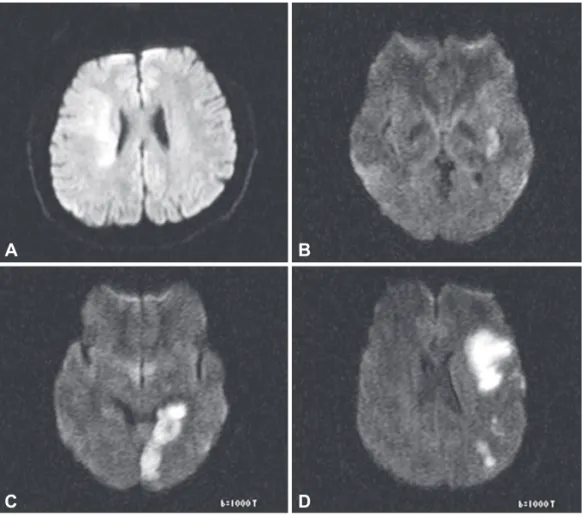
rologic examination revealed forced eyeball deviation to the right side and left hemiparesis. Diffusion-weighted images (DWIs) revealed a large infarction in the distribution of the right middle cerebral artery (Fig. 1A). Intravenous recombinant tissue plasminogen activator (rtPA) was infused within 2 hours of symptom onset. Carotid duplex and transcranial Doppler mea- surements performed 4 hours later were unremarkable. His ini- tial symptoms did not improve, and his overall condition gradu- ally deteriorated. Computed tomography (CT) scans taken 8 hours after the onset of symptoms revealed massive brain swelling with a mass effect and small hemorrhagic transformation. As a result, right-sided hemicraniectomy was performed. The patient regained consciousness 2 weeks later. A neurologic examination at 2 months after symptom onset revealed only mild left-sided hemiparesis.
Case 2
A 24-year-old woman experienced language difficulties and an inability to control her right arm and leg during sexual intercour- se. She was a nonsmoker and had no history of hypertension, diabetes mellitus, or previous stroke. Her last menstrual period had occurred more than 1 month prior to the episode, and a po- sitive result in a urine pregnancy test indicated that she was pre- gnant. The initial neurologic examination revealed left-sided
Transient Increase in Intrathoracic Pressure as a Contributing Factor to Cardioembolic Stroke
Hung Youl Seok, MD; Woo-Keun Seo, MD, PhD; Mi-Yeon Eun, MD;
Do-Young Kwon, MD, PhD; Moon Ho Park, MD, PhD; Kyungmi Oh, MD, PhD
Department of Neurology, Guro Hospital, College of Medicine, Korea University, Seoul, Korea Received July 29, 2010
Revised November 18, 2010 Accepted November 18, 2010 Correspondence Woo-Keun Seo, MD, PhD Department of Neurology, Guro Hospital, College of Medicine, Korea University,
97 Gurodong-gil, Guro-gu, Seoul 152-703, Korea Tel +82-2-2626-3172 Fax +82-2-2626-1257 E-mail [email protected]
BackgroundzzThe hemodynamic effects of increased intrathoracic pressure (ITP) have been the focus of many investigations. However, very little is known about the effects of elevated ITP on the occurrence of stroke.
Case ReportzzFour young patients with a cardioembolic source of stroke were examined. In all cases the stroke was preceded by an increase in ITP that occurred during coughing, vomiting, or sexual intercourse.
ConclusionszzWe suggest that cardioembolic stroke is facilitated by situations in which ITP is el-
evated. J Clin Neurol 2010;6:212-215
Key Wordszz stroke, intrathoracic pressure, embolism.
Seok HY et al.
www.thejcn.com 213 eyeball preponderance, sensory aphasia, and right hemipare- sis. DWIs revealed an infarction in the left insular cortex (Fig.
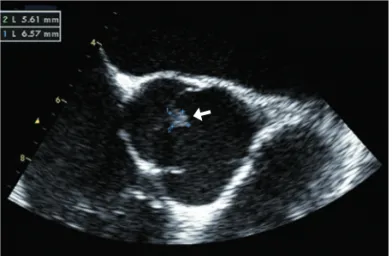
1B). Transthoracic echocardiography revealed an abnormal left-to-right shunt flow through the interatrial septum at rest (Fig.
2). This observation was confirmed to be an atrial septal defect by transesophageal echocardiography. On the following day, the right-sided motor weakness had resolved and sensory aphasia was also partially improved.
Case 3
A 22-year-old woman visited the emergency room due to right- sided paresthesia 30 minutes after onset of the symptoms. The- se symptoms appeared during severe vomiting on the morning following a night of heavy alcohol drinking. The initial neuro- logic examination showed right homonymous upper quadran- tanopsia, right hypesthesia, and right hemiparesis. MRI revealed two distinct acute infarctions in the left thalamus and occipital lobe (Fig. 1C). CT angiography showed no evidence of extra- cranial or intracranial dissection. Intravenous rtPA was infused within 3 hours of symptom onset. Gadolinium-enhanced mag- netic resonance angiography performed on the third day show- ed no evidence of atherosclerotic vascular disease or dissection.
Transesophageal echocardiography showed a PFO with right- to-left shunting during injection of agitated saline at rest. This patient was treated with anticoagulants and discharged on day 12 with only right homonymous upper quadrantanopsia.
Fig. 1. Diffusion-weighted MRI in four pa- tients. A: Case 1 had infarcts in the distri- bution of the right middle cerebral artery.
B: Case 2 had an infarct in the left insular cortex. C: Case 3 had a left posterior ce- rebral artery territory infarct with involve- ment of the occipital lobe. D: Case 4 had infarcts in the distribution of the left mid- dle cerebral artery.
A
C
B
D
Fig. 2. Transthoracic echocardiogram in case 2. Apical four-cham- ber view showing flow acceleration and a left-to-right shunt across the interatrial septum on color Doppler examination (arrow).
Transient Increase in Intrathoracic Pressure and Cardioembolic Stroke
214 J Clin Neurol 2010;6:212-215
Case 4
A 45-year-old male presented with acute onset of incoherent speech that developed after repeated coughing during meals.
He had no known hypertension, diabetes mellitus, or previous stroke. However, he was a current smoker. A neurologic exami- nation showed global aphasia and right-sided facial palsy.
DWIs revealed an acute infarction in the distribution of the left middle cerebral artery (Fig. 1D). CT angiography showed no evidence of atherosclerotic vascular disease or dissection. Tr- ansesophageal echocardiography showed a small movable mass attached to the aortic valve, which was suspected to be a papil- lary fibroelastoma on the aortic valve (Fig. 3). This patient was treated with anticoagulants, which improve his global aphasia.
Discussion
All four young patients constituting the present series of cases were found to have a potential cardiac source of embolism. De- spite a thorough work-up, no other possible cause of stroke was identified. What distinguishes our study from others is that all of our patients developed signs of stroke at a time when ITP was suddenly elevated by coughing, vomiting, or sexual inter- course.
There are a few reports of ischemic strokes occurring during situations that produced an increase in ITP in patients with PFO, as in our cases 2 and 3 (i.e., while playing a wind instru- ment or during sexual intercourse).3,4 These reports suggest that the increase in ITP was the probable pathophysiological step that ultimately led to paradoxical embolism. However, right-to- left shunt occurred at rest in our cases 2 and 3, suggesting that while such an increase in ITP is not required to precipitate par- adoxical embolization, it can increase the likelihood of such an event. Moreover, the patient in case 2 was predisposed to a pro- thrombotic state due to her pregnancy. The potential to shunt
from right to left in combination with the hypercoagulable state of pregnancy may increase the risk of paradoxical embolism, especially with an increase in ITP.5
Interestingly, two of the patients presented here had a cardio- embolic source other than PFO, such as atrial fibrillation and papillary fibroelastoma. In addition, they developed their sym- ptoms during repeated cough. It is possible that the occurrence of the stroke during coughing was a coincidence. However, it is also possible that the stroke was provoked by coughing. In those cases, the pathomechanism is not clear and we can only speculate as to the underlying mechanisms. One possible ex- planation is that the transient hypoperfusion during an increase in ITP plays a role in the induction of stroke. A case of cough- induced transient hemiplegia was previously described in a patient with contralateral internal carotid artery occlusion and a poor collateral blood supply,6 which led to cerebral hypoper- fusion due to increased ITP during repeated cough being pro- posed as a stroke mechanism. The increase in ITP restricts the venous return and is transmitted via the great veins to the intra- cranial compartment, causing transient elevated intracranial pre- ssure.1 The resulting reduction in cerebral perfusion pressure can cause an impairment in the cerebral blood flow.1,7 This de- crease in cerebral blood flow impedes the clearance of emboli.8 Therefore, in our cases 1 and 4, cerebral ischemia may have been precipitated by a combination of elevated ITP-induced cere- bral hypoperfusion and embolization with a reduced washout of emboli.
A change in heart rate during coughing is also a possible ex- planation. When there is an increase in ITP in response to vari- ous situations, including coughing, patients in atrial fibrillation present an increased heart rate. However, unlike normal indi- viduals,1 they do not have the subsequent reflex that normally slows the heart rate as the elevated ITP is relaxed.9 Autonomic modulation of the ventricular rate in patients with atrial fibril- lation is less dependent on vagal tone because the sinoatrial node is not functioning properly.10 There is a relative increase in sym- pathetic tone at the atrioventricular node, which, coupled with a decreased parasympathetic effect on the sinoatrial node,9,10 is thought to be the cause of persistent tachycardia. Therefore, per- sistent tachycardia due to increased ITP in patients with atrial fi- brillation could precipitate embolization, suggesting an addi- tional mechanism of stroke in our case 1.
This study was subject several limitations that should be ad- dressed in order to clarify the putative association between in- creased ITP and the occurrence of embolic stroke. First, the se- lection of patients might have been biased, since the occurrence of stroke depended on the clinical history reported by each pa- tient. Second, it is possible that the elevated ITP in our patients as a fortuitous event rather than a pathophysiological condition related to the occurrence of strokes.
Fig. 3. Transesophageal echocardiogram in case 4. A small mov- able mass can be seen attached to aortic valve (arrow). The lesion exhibited homogeneous hyperechogenicity. The echographic char- acteristics are highly suggestive of papillary fibroelastoma.
Seok HY et al.
www.thejcn.com 215 In summary, increased ITP due to cough, vomiting, or sex-
ual intercourse may precipitate embolization in patients with PFO, atrial fibrillation, or papillary fibroelastoma. We sug- gest that cardioembolic stroke is expedited by elevated ITP.
Conflicts of Interest
The authors have no financial conflicts of interest.
REFERENCES
1. Sharpey-Schafer EP. Effects of Valsalva’s manoeuvre on the normal and failing circulation. Br Med J 1955;1:693-695.
2. Uwatoko T, Toyoda K, Fujimoto S, Yasaka M, Ibayashi S, Iida M, et al.
[Behavioral situation at onset of paradoxical brain embolism due to pat- ent foramen ovale]. Rinsho Shinkeigaku 2004;44:503-507.
3. Evers S, Henningsen H, Ringelstein EB. Transient ischemic attacks caused by trumpet playing. Neurology 1998;51:1709-1710.
4. Becker K, Skalabrin E, Hallam D, Gill E. Ischemic stroke during
sexual intercourse: a report of 4 cases in persons with patent foramen ovale. Arch Neurol 2004;61:1114-1116.
5. Head CE, Thorne SA. Congenital heart disease in pregnancy. Post- grad Med J 2005;81:292-298.
6. Okayasu H, Wakayama Y, Takahashi H, Jimi T. [A case of cough hemi- plegia]. Rinsho Shinkeigaku 1993;33:740-745.
7. Tiecks FP, Lam AM, Matta BF, Strebel S, Douville C, Newell DW. Ef- fects of the valsalva maneuver on cerebral circulation in healthy adults.
A transcranial Doppler Study. Stroke 1995;26:1386-1392.
8. Caplan LR, Hennerici M. Impaired clearance of emboli (washout) is an important link between hypoperfusion, embolism, and ischemic stroke.
Arch Neurol 1998;55:1475-1482.
9. Gray C, Ward JF, Sands JP. Syncope from increased ventricular response in atrial fibrillation during voiding: a new indication for surgical man- agement in benign prostatic hyperplasia. J Urol 1999;161:606-607.
10. Nagayoshi H, Janota T, Hnatkova K, Camm AJ, Malik M. Autonomic modulation of ventricular rate in atrial fibrillation. Am J Physiol 1997;
272:H1643-H1649.