131
우유 및 유제품 중 미생물 동정을 위한 MAL DI - T OFMS활용
김현욱․함준상․설국환․한상하․박범영․오미화* 농촌진흥청 국립축산과학원
MALDI-TOF MS System for the Identification of Microorganisms in Milk and Dairy Products
Hyoun Wook Kim, Jun-Sang Ham, Kuk-Hwan Seol, Sangha Han, Beam Young Park and Mi-Hwa Oh*
National Institute of Animal Science, RDA, Suwon 441-350, Korea
Abstract
Rapid and reliable identification of microorganisms is a key for tracing the relationship between the target bacteria and related infectious diseases. Various identification methods such as classical phenotypic analysis, numerical taxonomic analysis, and DNA sequencing have been widely used to classify microorganisms in milk and dairy products. Matrix-assisted laser desorption ionization time-of-flight (MALDI-TOF) mass spectrometry (MS) identifies targeted bacteria in milk and milk products. Several studies have demonstrated that MALDI-TOF MS identification is an efficient and inexpensive method for the rapid and routine identification of isolated bacteria. MALDI-TOF MS could provide accurate identification of bacteria in milk and milk products at the serotype or strain level and enable antibiotic resistance profiling within minutes.
Keywords: identification, MALDI-TOF MS, dairy product, milk
* Corresponding author: Mi-Hwa Oh, National Institute of Animal Science, RDA, Suwon, 441-350, Korea. Tel.: +82-31-290-1689, Fax: +82-31- 290-1697, E-mail: [email protected]
서 론
생물은 그들의 발생학적 유사성이나 차이점을 통해 원핵 세포생물(procaryote)과 진핵세포생물(eucaryote)로 분류되었 으며, 이는 세분화되어 종, 속, 과, 목, 강, 문, 계 등으로 분 류된다(Jill, 2004; Woo et al., 2008). 인간의 생활환경인 자연 계에는 무수히 많은 종류의 미생물이 서식하고 있으며, 이 들은 물질의 순환에 대단히 중요한 역할을 하고 있다. 자연 계에 다양하게 존재하고 있는 미생물은 계통과 종, 속 등으 로 분류하는데, 전통적인 실험을 통하여 쉽게 확인되는 특 성들을 분류 기준으로 삼는다(민경찬 등, 2005).
동정이란 분류의 응용 면에서 어떤 균이 분리되면 그 성 상을 조사하여 이미 알고 있는 어떤 균과 일치하는 가를 결
정하는 것이다. 미생물은 동․식물과 달리 형태학적 관찰 및 그 차이를 인식하기 쉽지 않기 때문에 이들을 분류하고 동정하기 위하여 여러 가지 방법들이 연구되었다. 미생물의 동정법은 크게 발현형적 방법(phenotypic method)과 계통분 류학적 방법(phylogenetic analysis method)로 나눌 수 있다.
발현형적 방법은 전통적인 표현형 분석(classical phenotypic analysis), 수량분류학적 방법(numerical taxonomic analysis), 세포벽 조성 분석(cell wall component analysis), 균체지방산 조 성 분석(cellular fatty acid analysis), isoprenoid quinone 분석 등이 있다. 미생물의 동정은 일반적으로 그람염색법, 배양 및 성장 특성, 생물학적 패턴, 혈청학적 성상 등 발현형 검사를 이용하여 이루어져 왔다(Carroll과 Weinstein, 2007). 이중 탄소 원의 대사적 특성을 이용한 분류 및 동정기법은 가장 흔하 게 사용되는 기술이며, 이러한 원리를 활용한 동정용 키트들 이 개발되어 미생물 동정에 이용되고 있다. 계통분류학적 방법에 는DNA 염기 서열 조성분석법(DNA base composition analysis),
DNA-DNA hybridization 분석법, rRNA 상동성 분석법(rRNA homology study) 등이 있으며, 이중 16S rRNA 유전자 염기 서열 분석법은 세포 내의 단백질 합성에 관여하는 유전자인 ribodomal RNA(rRNA)의 염기서열을 분석하여 비교하는 방 법으로, 염기서열 분석에 적당한 크기(약 1,500 bp)로 인하 여 가장 활발하게 연구되어 왔다.
최근 고분자 물질의 질량분석법인MALDI-TOF MS(Matric Assisted Laser Desorption Ionization Time of Flight Mass Spectroscopy)에 대한 연구가 활발하게 진행되고 있는데, MALDI-TOF MS는 고분자 물질의 질량분석법으로 1980년 대에 개발되었으며(Anhalt과 Fenselau, 1975; Claydon et al., 1996; Krishnamurthy과 Ross, 1996), 최근 항원-항체반응, DNA- DNA hybridization, 생체 적합성 시험에 의한 단백질 흡착 등 생체물질의 특이성을 분석하는 방법으로 응용되면서 단 백질체학이나 생물정보학 분야에서 각광 받고 있다.
따라서 본고에서는 우유 및 유제품 중의 미생물 동정에 활용하고 있는 미생물 동정법에 대해서 알아보고, 최근 활 발하게 연구되고 있는MALDI-TOF MS를 이용한 새로운 미 생물 동정법을 소개하고, 우유 및 유제품에서의 적용 가능 성을 확인하고자 한다.
본 론
1. 미생물의 분류와 동정
분류학(taxonomy)은 생물을 무리지어 분류군(taxa)으로 나 누는 생물학의 한 분야로서, 생물의 명명(nomenclature)와 분 류(classification), 각 생물체 간의 식별인 동정(identification) 으로 구분할 수 있다(민경찬 등, 2005).
일반적으로 미생물은 종(species)과 속(genus)으로 분류할 수 있는데, 그람염색(gram straining), 형태학적․생리학적 분 류, 생화학적 분류 등 전통적인 실험을 통해 쉽게 확인되는 특성들을 기준으로 삼는데(Carroll과 Weinstein, 2007), 이런
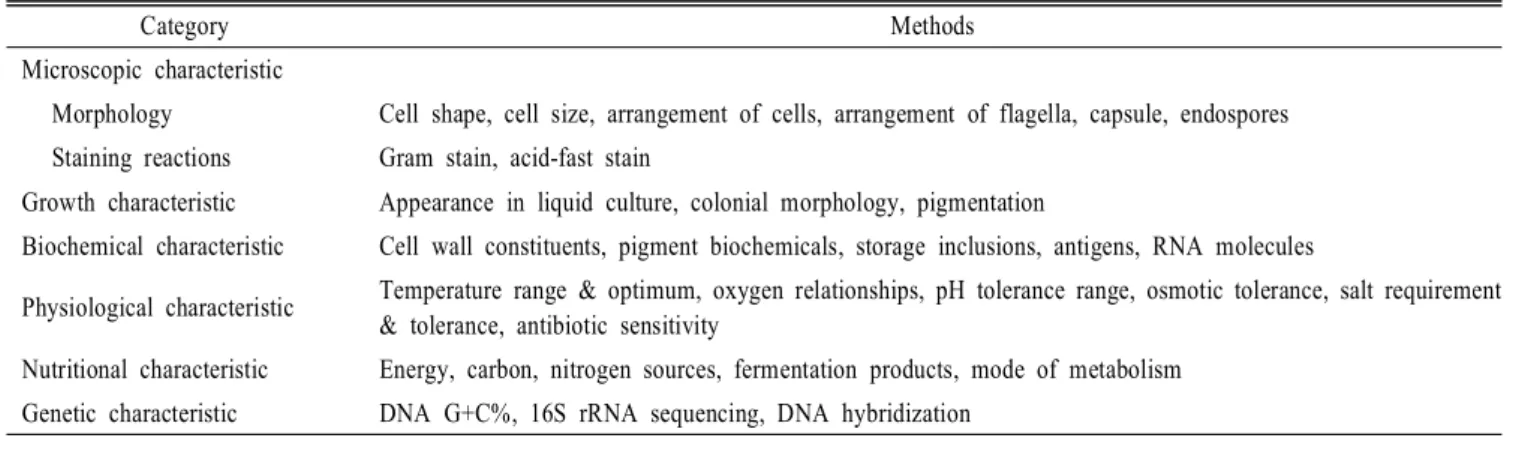
Table 1. Some criteria for classifying bacteria
Category Methods
Microscopic characteristic
Morphology Cell shape, cell size, arrangement of cells, arrangement of flagella, capsule, endospores Staining reactions Gram stain, acid-fast stain
Growth characteristic Appearance in liquid culture, colonial morphology, pigmentation
Biochemical characteristic Cell wall constituents, pigment biochemicals, storage inclusions, antigens, RNA molecules
Physiological characteristic Temperature range & optimum, oxygen relationships, pH tolerance range, osmotic tolerance, salt requirement
& tolerance, antibiotic sensitivity
Nutritional characteristic Energy, carbon, nitrogen sources, fermentation products, mode of metabolism Genetic characteristic DNA G+C%, 16S rRNA sequencing, DNA hybridization
전통적인 방법을 획득되는 특성들은 분류 과정에서 다른 특 성들보다 중요시하게 되며, 미생물의 분류의 첫 단계에 주 로 사용된다. 기초적인 미생물의 분류 후 미생물의 탄소원 이용성, 지방산 조성, DNA의 유전정보(genetic code), 16S rRNA 염기서열 분석 등 통계학적 방법을 이용하여 동정하게 된다 (Table 1).
2. 생화학적 특성 검사
미생물의 동정을 위해서는 생리․생화학적 특성, 형태 및 배양적 특징을 조사하게 되는데, 형태적 및 배양적 특성으 로는 속(genes)만을 동정할 수 있기 때문에, 종(species)까지 동정하기 위해서는 생리․화학적 조사가 필요하다.
미생물의 동정에 사용되는 생화학적 특성 검사법은 단백 질 가수분해능을 조사하는 방법 중 하나인‘Casein hydrolysis test’, 전분 가수분해를 조사하는 ‘Starch hydrolysis test’, urea 분해능리 있는 미생물을 검정하는 방법인‘Urease hydrolysis test’, 아미노산 중 tryptophane 이용 여부를 검증하는 ‘Indole test’, cytochrome을 가지고 있는 미생물을 확인하기 위한
‘Catalse test’, 단백질 분해균을 조사하는 방법인 ‘Gelatin liquefaction test’, 미생물의 산 생성 여부를 확인하는 ‘Methyl Red(MR) test’, 포도당의 발효 시 acetyl-methyl-carbinol(acetoin) 또는2,3-butanidiole을 생성하는 지를 검사하는 ‘Voges-Proskaure (VP) test’, 미생물의 nitrate 환원능을 확인하는 ‘Nitrate reductase test’, 그람음성균 중 호기성 세균과 통성 혐기성 세균을 구 분하는데 사용되는‘Oxidase test’ 등이 있다. 이들 생화학적 특성 검사법들은 미생물의 동정뿐만 아니라, 병원성 미생물 확인시험법으로도 사용되고 있다.
3. 수치적 동정(numerical identification)
미생물 분류학이 발달함에 따라 미생물의 분류는 매우 복잡하게 되었으며, 식중독 등 여러 종류의 원인균에 대한 검사 시 전통적인 방법인 선택배지와 생화학적 방법으로 시
험하여 신속․정확하게 동정하기가 쉽지 않다. 복잡하고 다 양한 미생물의 신속한 동정을 위하여 미생물이 지닌 각각의 특성을 같은 비중으로 다루어 각 특성의 유사성 및 상이성 정도를 비교하여 유사․상이성을 상태적으로 비교할 수 있 는 수치적 동정법에 대한 연구가 이루어졌으며, 수치적 동 정법을 이용한 동정용kit들이 개발되어 상업화됨으로써 다 양한 미생물의 동정을 쉽게 할 수 있게 되었다. 이들 상업용 동정 kit들은 주로 생화학적 특성을 이용한 것들과 균체의 지방산 조성을 분석하는 방법이 있으며, 이외에도 thin layer chromatography(Minnikin et al., 1984), gas chromatography (Sonneson et al., 1988), high performance liquid chromatography 등을 이용하여 지질 또는cell wall을 분석하는 방법 등이 있다.
1) 생화학적 특성 이용 동정법
미생물이 나타내는 생리적 특성인 생육 가능 온도 및pH, 생육에 이용할 수 있는 영양소의 종류, 특정 효소의 생산능 들을 조사하는 방법은 미생물을 분류하고 동정하는 전통적 인 방법이다. 이중 미생물이 이용하는 탄소원의 조사는 미 생물을 동정하는데 있어 기본이 되는 중요한 실험이지만, 많 은 시간과 노력이 필요하기 때문에 보다 쉽고 간편하게 실 험할 수 있는 동정 kit들이 개발되었다.
탄소원 이용성을 활용한 동정kit는 세트화된 시험 종류나 그 수는 다르지만, 시험원리는 동일하며, 시험결과의 패턴을 숫자로 변환시킨 다음 이미 알려진 균주의 데이터베이스와 비교하여 확률계산한 후 결과를 판독하게 된다. 가장 대표적 인 상업화kit로는 Biomerieux社의 API, Microgenbioproducts社의 Microgen Identification kit, Merlin社의 Micronaut plate 등이 있으며, 이러한 생화학적 동정용 kit를 자동화한 동정용 장 비 또한 개발되어 사용되고 있어, 보다 신속하고 정확하게 미생물을 동정할 수 있다.
2) 균체지방산 조성 분석
균체의 지방산은‘carboxylic acid derivatives of long-chain aliphatic molecules’로 정의될 수 있으며, 대부분의 균체지방 산은 polarlipid나 glycolipid의 구성성분으로서 cytiplasmic membrane에서 조로 발견되며, 모든 미생물에 존재하는 것으 로 알려져 있다(reference). 미생물의 균체지방산의 carbon chain 길이는 2~90개 이상까지 매우 다양하지만, 분류학적인 측 면에서는10~24개 정도의 carbon chain으로 이루어진 균체 지방산이 가장 유요한 정보로 이용되는데, 이는 미생물에 따 라carbon chain의 길이, 이중결합의 위치, 치환기 등이 다양 한 형태로 존재하므로 미생물 분류 연구에서 유용한 분류 marker가 될 수 있기 때문이다(Frostegård과 Bååth, 1994). 균 체지방산 분석은 주로gas chromatography를 이용하지만, 시
료의 전처리 과정이 복잡하고 분석시간이 길며, 방법이 표 준화되지 않아 데이터의 상호비교가 어려운 단점을 가지고 있다(Buyer과 Sasser, 2012). 이러한 단점을 보완한 시험법들이 계속적으로 연구되고 있으며, 미국 Microbial ID社에서는 균 체지방산 조성 시험법을 표준화시키고 자동화 시킨Microbial Identification System을 개발하여 쉽고 빠르게 분석할 수 있 도록 하였다.
3) 지질 또는 세포벽 분석
(1) Phospholipid 분석
미생물에 존재하는polarlipid 중 공통적으로 존재하는 phos- pholipid는 세포막의 필수 구성성분이며, 세포막의 투과성 및 조절 기작에 연관되어 있으며(Suzuki et al., 1993), 이들 은 특성상 뚜렷하게 구분되는 분자 내 친수성(hydrophilic) 부 분과 소수성(hydrophobic) 부분의 양쪽 친매성을 나타낸다.
대표적인phospholipid로는 phosphatidyl-ethanolamine(PE), phos- phatidyl-inositol(PI), phosphatidyl-glycerol(PG), diphosphatidyl- glycerol(DPG) 등이 있으며, 이들은 미생물을 분류하는데 있 어서 중요한 key marker로 활용될 수 있다. Phospholipid의 분석은tow-dimensional Thin Layer Chromatography(TLC)를 이 용하는 방법이 잘 알려져 있다(Minnikin et al., 1984).
(2) Diaminopimelic acid(DAP) 분석
Diaminomelic acid(DAP)는 bacterial while cell을 이용하여 가장 용이하게 검출할 수 있는 구성분으로 모든 그람양성균 의 펩티도글리칸에 포함되어 있으며, DAP 이성체의 분석은 방선균을 포함한 그람양성균의 분류․동정에 중요한 위치 를 차지하고 있다. DAP의 분석은 Thin Layer Chromatography, Gas Chromatography, High Performance Liquid Chromatography 등을 이용한 방법이 있으나, 그 중 TLC법이 간편하고 빠른 시 료처리 등의 장점으로 인해 가장 많이 활용되고 있다(Sonneson
et al., 1988).
(3) Pyrolysis Mass Specrtometry
Pyrolysis Mass Spectrometry(PyMS)는 미생물 등의 생체물 질을 진공과 같은 불활성 상태에서 열분해시켜 얻어지는 mass ion의 정보를 분석하는 방법으로 1952년 albumin, pepsin 등 생물의 고분자 물질분석을 위해 처음 사용되었다(reference).
PyMS를 활용한 미생물 분류연구는 종(species) 이하 수준의 미생물을 구별할 수 있는 정확성을 갖고 있으며, 특히 다른 화학분석에 비해 시료의 준비가 간단하고 고속화된 분석속 도, 저렴한 비용 등의 장점을 가지고 있다(신기선 등, 2001;
Kim et al., 2009).
4. 분자생물학적 동정(molecular biological identification) 분자생물학적 동정법은 미생물의 유전물질 사이의 유사 성 또는 상이성에 근거하여 분류하는 방법으로, 주로 핵산 염 기서열을 완전히 구명하여 각기 다른 세포의 유전적 친근성 여부를 비교하게 된다. 분자생물학적 동정법으로는 미생물의 염기구성비율을 이용한 방법, DNA 또는 RNA의 hybridi- zation에 의한 유사성 또는 상이성 비교하는 방법, 16S rRNA 염기서열에 따라 상관성을 분석하는 방법, 미생물의 유전적 교차반응기전을 이용하여 세균 간의 상관성을 분석하는 방 법 등이 있다(Jay, 2000).
현재 세균(prokaryotic microorganism)의 분석은 16S rRNA 유전자 분석을 가장 많이 활용하고 있으며, 진균 동정에는 internal transcribed spacer(ITS) 또는 28S rRNA 유전자의 D1/D2 부위를 이용한 염기서열분석법이 가장 많이 이용되고 있다 (성흥섭과 김미나, 2008). 현재까지 알려진 세균의 종은 약 4,200여 종으로, 이들 중 상당수는 표준균주에 대하여 16S rRNA 유전자의 염기서열이 분석되어 데이터베이스화 되어 있다. 따라서 동정하고자 하는 균주의 16S rRNA 유전자를 분석하면 동정하고자 하는 균주가 전체 세균 중 어느 종에 가까운지를 확인할 수 있다.
5. MALDI-TOF MS
MALDI-TOF MS(Matrix-Assisted Laser Desorption/Ionization Time of Fligh Mass Spectrometry)는 1980년대에 고분자 물질 의 분석을 위하여 개발되었으며, 고분자 물질에 대한 시료 의 분해없이 기화/이온화가 가능한 방법으로 질량이 크고, 열에 불안정한 생체고분자낭 합성고분자에 적합한 분석법 으로 알려져 있다(Anhalt과 Fenselau, 1975; Claydon et al., 1996; Krishnamurthy과 Ross, 1996). MALDI-TOF MS는 휘발 성이 적거나 잘 녹지 않는 시료의 분석이 가능하며, 기존의 질 량분석법과 다르게 열분해 등과 같은 극단적인 조건이 필요하 지 않고column을 사용하지 않기 때문에, 다루기가 상대적으 로 쉽다는 장점을 가진다(Krishnamurthy과 Ross, 1996). MALIDI- TOF MS는 단백질 분석과 검출, 미생물 분석, 표면부착 지 질 분석, 생체 재료 표면의 탄수화물 역할 분석, 항원-항체 반응, DNA-DNA hybridization, 생체 적합성 실험에 의한 단 백질 흡착 등 생체물질의 특이성을 분석하는 방법으로 활용 되고 있다.
1) MALDI-TOF MS의 원리
MALDI-TOF MS는 분석체 자체의 이온을 검출하고 그 질 량을 예측하는 방법으로서, post-source-decay 방법을 사용하 여 탈출관(flight tube)에서 자발적으로 peptide 분해와 이온 화를 진행시켜, 미지의 peptide나 protein의 서열에 대한 직접
적인 정보를 제공함으로써peptide나 protein을 동정할 수 있 다. MALDI-TOF MS의 검출농도는 atto mole/nano gram으로 매우 낮으며, 고분자의 경우 단일 단량체의 해상도 분석을 통해 분자량의 분포를 알 수 있다.
MALDI-TOF MS는 강력한 펄스레이저를 시료에 조사하 여sample-matrix를 붕괴시켜 이온을 방출시키는 레이저 탈 착 이온화(laser desorption ionization) 단계와 이온의 비행시 간을 측정하는 Time of Flight(TOF) 단계로 나눌 수 있다.
(1) 레이저 탈착이온화
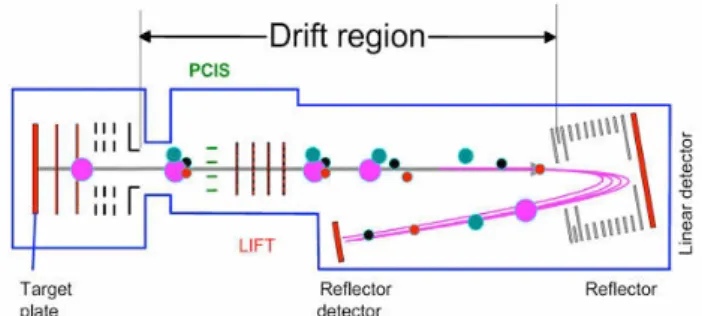
레이저를 이용한 이온화는 강력한 레이저를 고체시료에 조사함으로써 분석체의 온도가 급격하게 상승하게 되고, 이 에 따라 시료가 붕괴되어 이온이 방출된다. 시료는 UV를 잘 흡수하는matrix와 혼합하여 사용하게 되는데, 조사된 레 이저 에너지가 결정화된matrix를 통해 시료로 전달되어 이 온화됨으로matrix의 선정 및 최적 결정화가 실험결과에 매 우 중요한 영향을 미치게 된다(Fig. 1).
(2) Time of Flight (TOF)
Time of Flight는 이온의 무게 또는 이동속도에 따른 검출 기에 도달하는 속도 또는 거리를 통해 물질의 질량을 분석 하는 단계이다. TOF 방식은 가벼운 이온들이 무거운 이온 보다 먼저 검출기에 도달하는 원리를 이용한 liner TOF와 속도가 큰 이온이reflectron 내에서 더 먼 거리를 비행하는 원리를 이용하는reflectron TOF로 분류할 수 있으며(Fig. 3), reflectron TOF는 검출기의 위치에서 time focusing을 통해 질량의 분별능을 증가시킨 것이 특징이다.
2) MALDI-TOF MS를 이용한 미생물 동정
MALDI-TOF MS를 이용한 미생물의 동정법은 비교적 새 로운 동정법으로(Hsieh et al., 2008), MALDI-TOF MS를 이 용하여 미생물의 질량을 측정한 다음 분석프로그램을 이용 하여 동정하게 된다. MALDI-TOF MS를 이용한 미생물 동
Fig. 1. Principle of MALDI-TOF MS (Source: GIGA-Protéomique,
Université de Liège).
정연구는
Burkholderia cepacia(Vanlaere et al., 2008), Clostridium
species(Grosse-Herrenthey et al., 2008), Erwinia species(Saueret al., 2008), Escherichia coli(Parisi et al., 2008), Listeria
species(Barbuddhe et al., 2008), Staphylococcus aureus(Brenardoet al., 2002; Due et al., 2002; Edward-Jones et al., 2000;
Walker et al., 2002; Szabados et al., 2010), Yersinia enterocolitica (Parisi et al., 2009) 등 다양하게 이루어지고 있다.
Hsieh 등(2008)은 병원성 미생물의 분류와 동정에 MALDI- TOF MS의 효율성을 검증하기 위하여 S. aureus, E. coli,
Klebsiella, Salmonella 등을 동정하고, classification model을
검증하였는데, 높은 신뢰도와 빠른 동정이 가능하며, 혼합 시료에서 여러 종류의 세균을 동시에 검출할 수 있으며, 낮은 검출한계를 가지고 있다고 보고하였다. Szabados 등(2010)은S. aureus에 대한 MALDI-TOF MS 동정법의 정확도를 확인
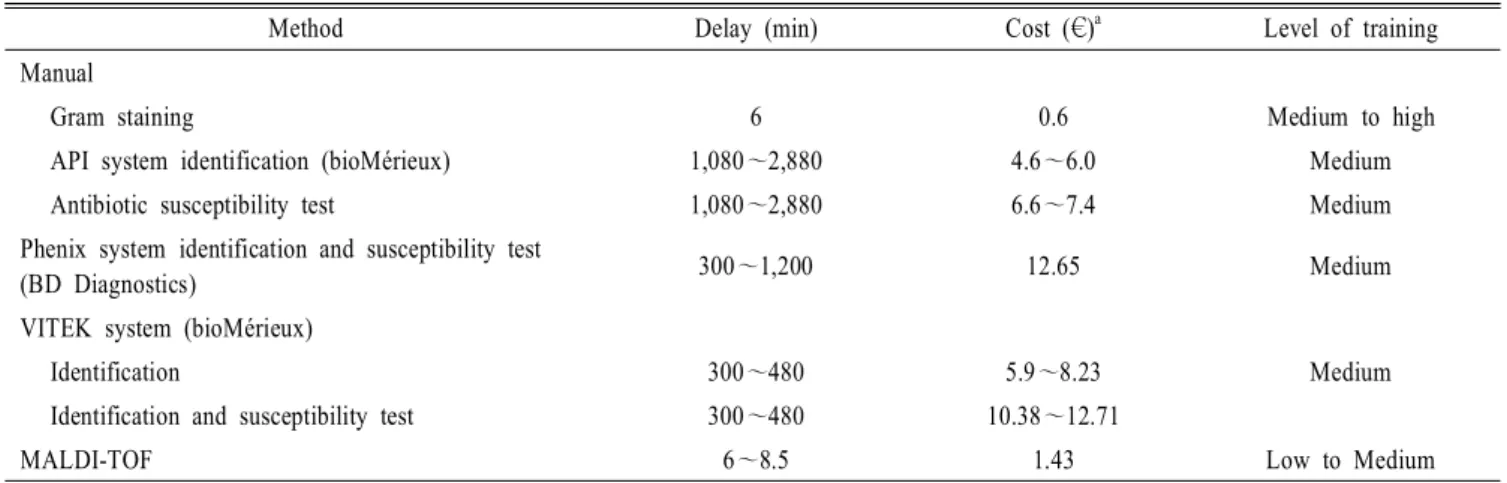
하기 위하여VETEK2, DNA Sequencing와 비교한 결과, 높은 정확도를 나타내었고, 다른 동정법보다 빠른 분석시간을 가 지고 있다고 보고하였다. 또한 Seng 등(2009)은 MALDI-TOF MS를 이용한 미생물 동정법은 다른 상업용 동정시스템에 비하여 낮은 숙련도, 적은 분석 비용, 그리고 신속한 동정이 가능하다고 하였다(Table 2).결 론
산업이 발전하고 수입 자유화에 따른 식품 교역량이 늘 어나면서 식품의 안전성 확보는 중요한 문제로 대두되고 있 다. 또한 소비자들의 건강에 대한 관심의 증가로 안전하고 위생적인 식품의 소비가 증가하고 있으며, 안전한 식품에 대 한 요구가 높아지고 있다. 이러한 소비자의 요구와 식품 관 련 사고의 증가로 인하여 식품의 안전성 확보를 위한HACCP
Table 2. Delays, costs and level of training for isolate identification methods
Method Delay (min) Cost (€)
aLevel of training
Manual
Gram staining 6 0.6 Medium to high
API system identification (bioMérieux) 1,080~2,880 4.6~6.0 Medium
Antibiotic susceptibility test 1,080~2,880 6.6~7.4 Medium
Phenix system identification and susceptibility test
(BD Diagnostics) 300~1,200 12.65 Medium
VITEK system (bioMérieux)
Identification 300~480 5.9~8.23 Medium
Identification and susceptibility test 300~480 10.38~12.71
MALDI-TOF 6~8.5 1.43 Low to Medium
a
Costs have been tabulated based on December 2008 price list of the providers in France.
Source: Flaudrops and Raoult (2009)
과 같은 식품안전관리 프로그램이 실행되고 있으며, 이에 따른 신속하고 정확한 검사법이 요구되고 있다.
우유 및 유제품에는 유산균 등 유용미생물뿐만 아니라 우 유 및 유제품의 안전성을 위협하는 식중독균 등 위해미생물 등 다양한 종류의 미생물이 존재하고 있기 때문에, 신속하고 정확한 미생물 동정법은 우유 및 유제품산업에서 중요하다 고 할 수 있다. 현재 생화학적 특성을 이용한 동정법, API, VITEK, DNA sequencing 등 다양한 동정방법이 사용되고 있 으며, 보다 빠르고 정확한 동정법에 대한 연구가 지속적으로 이루어지고 있다. MALDI-TOF를 이용한 미생물 동정법은 다 른 동정법에 비해 비교적 새로운 동정법으로 짧은 동정시간 과 비교적 저렴한 비용, 그리고 낮은 숙련도 요구 등의 장점 을 가지고 있다. 또한 높은 정확도를 가지고 있으므로 신속․
정확한 동정이 가능하기 때문에, 우유 및 유제품의 미생물 동 정법으로 활용하기 적합하다고 할 수 있다. 하지만 다른 동정 법에 비해 적은 데이터베이스, 정체시간에 따른 검출감도 변 화, 염․당․계면활성제 등 감도에 영향을 미치는 인자 등에 대한 연구 개발이 지속적으로 이루어져야 하며, 이러한 단점 이 보완된다면 보도 우수한 동정법이 될 것으로 판단된다.
감사의 글
본 논문은 농촌진흥청 공동연구사업(과제번호: PJ007586) 과2012년도 농촌진흥청 국립축산과학원 박사후연수과정지 원사업의 지원에 의해 이루어진 것입니다.
참고문헌
1. Anhalt, J. P. and Fenselau, C. 1975. Identification of bacteria
using mass spectrometry. Anal. Chem. 47:219-225.
2. Barbuddhe, S. B., Maier, T., Schwarz, G., Kostrzewa, M., Hof, H., Domann, E., Chakraborty, T. and Hain, T. 2008.
Rapid identification and typing of Listeria species by matrix- assisted laser desorption ionization time of flight mass spectrometry. Appl. Environ. Microbiol. 74:5402-5407.
3. Bernardo, K., Pakulat, N., Macht, M., Krut, O., Seifert, H., Fleer, S., Hunger, F. and Kronke, M. 2002. Identification and discrimination of Staphylococcus aureus strains using matrix- assisted laser desorption/ ionization-time of flight mass spectro- metry. Proteomics. 2:747-753.
4. Carroll, K. C. and Weinstein, M. P. 2007. Manual and auto- mated systems for detection and identification of micro- organisms. In: Manual of clinical microbiology. 9th ed., Murray, P. R., Baron, E. J., Jorgensen, J. H., Landry, M.
L., Pfaller, M. A. (ed). Washington D.C., American Society for Microbiology, 192-217.
5. Claydon, M. A., Davey, S. N., Edwards-Jones, V. and Gordon, D. B. 1996. The rapid identification of intact microorganisms using mass spectrometry. Nat. Biotechnol. 14:1584-1586.
6. Du, Z., Yang, R., Guo, Z., Song, Y. and Wang, J. 2002.
Identification of Staphylococcus aureus and determination of its methicillin resistance by matrix-assisted laser desorption/
ionization time-of-flight mass spectrometry. Anal. Chem.
74:5487-5491.
7. Edwards-Jones, V., Claydon, M. A., Evason, D. J., Walker, J., Fox, A. J. and Gordon, D. B. 2000. Rapid discrimination between methicillin sensitive methicillin sensitive and methicillin- resistant Staphylococcus aureus by intact cell mass spec- trometry. J. Med. Microbiol. 49:295-300.
8. Frostegård, A. and Bååth, E. 1996. The use of phospholipid fatty acid analysis to estimnate bacterial and fugal biomass in soil. Biol. Fertil. Soils. 22:59-65.
9. GIGA-Protéomique. 2005. MALDI-TOF/TOF: Bruker Ultraflex II TOF/TOF. Available from: http://www.giga.ulg.ac.be/jcms/
cdu_15169/maldi-tof/tof-bruker-ultraflex-ii-tof/tof-April-2005.
Accessed Oct. 30. 2012.
10. Grosse-Herrenthey, A., Maier, T., Gessler, F., Schaumann, R., Bohnel, H., Kostrzewa, M. and Kruger, M. 2008. Challenging the problem of clostridial identification with matrix-assisted laser desorption and ionization-time-of-flight mass spectrometry (MALDI-TOF MS). Anaerobe. 14:242-249.
11. Hsieh, S. Y., Tseng, C. L., Lee, Y. S., Kuo, A. J., Sun, C. F., Lin, Y. H. and Chen, J. K. 2008. High efficient
classification and identification of human pathogenic bacteria by MALDI-TOF MS. Mol. Cell. Proteom. 27:448-456.
12. Jay, J. M. 2000. Taxomomy, rolem and significance of microorganisms in foods. In: Modern food microbiology, Jay, J. M. (ed). Aspen Publishers, Inc., Gaithersburg, Maryland.
pp. 13-34.
13. Jill, E. 2004. Clarridge III : Impact of 16S rRNA gene sequence analysis for identification of bacteria on clinical microbiology and infectious diseases. Clin. Microbiol. Rev.
840-862.
14. Kim, S. W., Kim, J. H. and Liu, J. R. 2009. Genetic dis- crimination of Catharanthus roseus cultivars by pyrolysis mass spectrometry. J. Plant. Biol. 52:462-465.
15. Krishnamurthy, T. and Ross, P. L. 1996. Rapid identifi- cation of bacteria by direct matrix-assisted laser desorption/
ionization mass spectrometric analysis of whole cells. Rapid Commun. Mass Spectrom. 10:1992-1996.
16. Parisi, D., Magliulo, M., Nanni, P., Casale, M., Forina, M.
and Roda, A. 2008. Analysis and classification of bacteria by matrix-assisted laser desorption/ionization time-of-flight mass spectrometry and a chemometric approach. Anal. Bioanal.
Chem. 391:2127-2134.
17. Sauer, S., Freiwald, A., Maier, T., Kube, M., Reinhardt, R., Kostrzewa, M. and Geider, K. 2008. Classification and identifi- cation of bacteria by mass spectrometry and computational analysis. PLoS One. 3:e2843.
18. Szabados, F., Woloszyn, J., Richter, C., Kaase, M. and Gatermannm, S. 2010. Identification of molecularly defined
Staphylococcus aureus strains using matrix-assisted laser
desorption/ionization time of flight mass spectrometry and the Biotyper 2.0 database. J. Med. Microbiol. 59:787-790.19. Vanlaere, E., Sergeant, K., Dawyndt, P., Kallow, W., Erhard, M., Sutton, H., Dare, D., Devreese, B., Samyn, B. and Vandamme, P. 2008. Matrix-assisted laser desorption ionisation- time-of-flight mass spectrometry of intact cells allows rapid identification of Burkholderia cepacia complex. J. Microbiol.
Methods 75:279-286.
20. Walker, J., Fox, A. J., Edwards-Jones, V. and Gordon, D. B.
2002. Intact cell mass spectrometry (ICMS) used to type methicillin resistant Staphylococcus aureus: media effects and inter-laboratory reproducibility. J. Microbiol. Methods 48:117-126.
21. Woo, P. C. Y., Lau, S. K. P., Teng, J. L. L., Tse, H. and Yuen, K. Y. 2008. Then and now: use of 16S rDNA gene
sequencing for bacterial identification and discovery of novel bacteria in clinical microbiology laboratories. Clin.
Microbiol. Infect. 14:908-934.
22. 민경찬, 전정일, 박상기, 조남철, 정수현, 유현주. 2005.
필수식품미생물학. 광문각.
23. 성흥석, 김미나. 2008. 염기서열분석을 이용한 미생물 동
정의 신뢰도. 대한감염학회지. 40:355-356.
24. 신기성, 신용국, 권오유, 이상한. 2001. 효모 탐색을 위한 pyrolysis mass spectrometry의 활용. Korean J. Life Sci.
11:19-23.
(Received 2012. 10. 30 / Accepted 2012. 11. 20)