재배 콩나물 저장 중 온도처리가 isoflavone 함량에 미치는 영향
정연신**․이향미*․Krishna Hari Dhakal*․김용훈****․이정동***․신동현*․황영현*
*경북대학교 식물생명과학부․**경북대학교 농업과학기술연구소․
***Univ. of Missouri-Delta Center․****N&B
Effects of storage duration and temperature on the isoflavone content of full grown soy-sprouts
Yeon-Shin Jeong**․Hyang Mi Lee*․Krishna Hari Dhakal*․Yong-Hoon Kim****․Jeong-Dong Lee***․Dong-Hyun Shin* and Young-Hyun Hwang*
*
Division of Plant Biosciences, Kyungpook National University, Daegu 702-701, Korea
**
Institute of Agricultural Science and Technology, Kyungpook National University, Daegu 702-701, Korea
***Univ. of Missouri-Delta Center, P.O. Box 160, Portageville, Mo 63873 U.S.A
****
N&B Co.,Ltd., Techno-Building 406, Kyungpook National University, Daegu 702-701, Korea
Abstract
To obtain food materials of high isoflavone content from soy-sprouts, 8 soy-sprout varieties, Aga 1, Aga 2, Aga 3, Aga 4, Pungsannamulkong, Eunhakong, Jangkikong and Bosugkong, were grown into soy-sprouts for 7 days under light condition and stored for 5 days at 6 different temperatures; 3, 6, 9, 20, 30, and 40 ℃ in the dark.
The isoflavone content of 7 days grown sprout varieties were highest in the order of Aga 3>Aga 1>Aga 2>Aga 4>Jangkikong>Bosugkong>Eunhakong>Pungsannamulkong. The highest isoflavone content of Aga 3 was 4,619
㎍/g. The isoflavone content of soy-sprouts showed much varietal differences depending on the storage temperatures.
Comparative high isoflavone content was obtained at storage temperatures of 6 ℃ and 20 ℃ while most of varieties showed low isoflavone content at 9 ℃ and 30 ℃. No constant trend in isoflavone content for the tested varieties along with the days to storage but most of varieties showed the highest isoflavone content in 3 days of storage.
On the contrary, Aga 4 and Jangkikong showed high isoflavone content even at 5 days of storage. The comparatively high isoflavone content for 4 varieties including of Aga 3 out of 8 varieties was obtained from the treatment of one day storage at 20 ℃. Out of all treatments, the highest isoflavone content was obtained from one day storage at 20 ℃ for Aga 3 and the content was as high as 11,705 ㎍/g. In this experiment, soy-sprouts were believed to be made continuous growth during the storage because the sprouts were being dipped in water during the temperature treatment to protect soy-sprouts from drying. Thus, it is inferred that additional researches should be made to establish better method to increase isoflavone content in soy-sprouts during the storage.
Key words:Soybean, isoflavone, temperature treatment, soy-sprout, storage
Ⅰ. 서 론
세계적으로 콩(
Glycine max(L.) Merrill)의 영양적 우수성뿐만 아니라 기능성 측면에서 콩에 대한 많은 연구가 활발하게 이루어지고 있는 바, 우리나라는 콩 의 원산지로써 아직도 밥밑콩이나 산야에 지천으로 자라고 있는 야생종을 이용한 기능성 물질을 탐색하 고, 이를 이용한 기능성 콩 품종개발과 식품을 생산한 다면 세계적인 wellbeing 시대에 부응할 수 있는 콩 식품의 개발도 가능하리라고 본다(Hwang et al., 2004).
콩나물은 우리나라 고유의 전통식품으로 단백질, 비타민, 무기질의 급원으로 널리 알려져 있다. 가격도 저렴하고 기호성이 높아 많이 이용되고 있으며, 재배 기간이 짧고 사계절 내내 장소의 구분 없이 재배가 가능하여 채소 생산이 불리한 겨울철에 더욱 중요한 식품이다(Chi et al., 2005). 콩나물의 재배조건에 따른 생육특성(Suh et al., 1995; Kim et al., 2000) 및 유통방 법 개선에 관한 연구들(Park et al., 1995)과 가장 적절 한 재배온도 및 수온에 관한 연구(Kim et al., 2000), 콩나물 재배 후 저장 시에는 10℃이하에서 보관하면 60시간까지 이취발생이 되지 않고 선도가 유지되며 (Bae et al., 2004), 저장온도가 높을수록 호흡속도가 증가하여 O
2의 빠른 소모와 높은 농도의 CO
2축적 및 알콜취, 이취의 발생이 촉진된다고 하였다(Cho et al., 2006).
재배기간 중 콩나물의 외관상 특성은 재배종이 야 생종보다 우수하였고, 잔뿌리수와 뿌리의 길이에서 는 야생종이 우수한 것으로 평가되며(Lee et al., 2002), 시판되는 콩나물의 일반적인 외형을 보면 콩나물의 배축의 굵기는 2.4~2.6mm, 배축의 길이는 9~11cm, 뿌리의 길이는 5~7cm의 것이 많았다고 하였다(Park et al., 1995).
Isoflavone은 콩에 존재하는 생리활성 물질 중 중요 한 위치에 있는데, 콩에서 추출한 isoflavone은 유방암 에 효과적이고(Kim et al., 2005), 생식 시스템에 아무 런 영향을 주지 않고 심장혈관질환을 개선시키고 (Anthony et al., 1996), isoflavone이 많이 함유된 콩은 만성질환을 예방하는데도 도움이 되며(Yi et al.,
1997), 적정량의 isoflavone을 섭취하였을 때 뼈의 질 량을 유지시키거나 개선시킬 수 있는 잠재적인 능력 이 있는 것으로(Anderson et al., 1997) 알려져 있다.
특히 isoflavone 추출물만 섭취하는 것 보다 isoflavone 함량이 높은 콩 분말을 함께 섭취하는 것이 더욱 효과 적인 것으로 알려져 있다(Allred et al., 2004).
콩 종실의 isoflavone 함량에 대한 연구는 CO
2농도 와 온도, 토양의 수분함유량에 따라 isoflavone 함량이 다양하며(Caldwell et al., 2005), 같은 지역에서 재배한 콩이라도 해마다 isoflavone 함량이 다르게 나타나고 (Arthur et al., 1983), 종자가 성숙되는 중에는 높은 온도 조건에서 isoflavone 함량이 높게 나타났으며, 대부분의 isoflavone이 배에 존재한다는 연구 (Tsukamoto et al., 1995)가 있다.
콩을 발아시켜 콩나물로 재배하였을 때 높은
isoflavone 함량을 나타낸다고 알려져 있는데, 콩나물
재배 시 isoflavone 함량은 콩보다 1.41배 증가하는
경향을 보였고(Kim et al., 2003), 진품콩은 발아 4일재,
풍산나물콩은 발아 2일째, 신팔달2호는 발아 2일째,
검정콩 1호는 발아 4일째에 각각 총 isoflavone 함량이
높으며 (Jeon et al., 2005), 콩나물 부위별 isoflavone
함량은 부위별로 다른 것으로 조사되었으며, 뿌리,
자엽, 배축 순으로 높게 나타났고, daidzein의 함량은
뿌리에서 가장 높았고 genistein의 함량은 자엽에서
가장 높게 나타났으며 (Kim et al., 2004), 콩나물 재배
6일째부터 발생한 잔뿌리에는 isoflavone 함량이 매우
높았고 (Kim et al., 2006), isoflavone 함량 증가를 위해
콩을 양조식초에 절여 초콩을 제조하기도 하는 등
연구가 계속되고 있었으며(Eom et al., 2006), 그 중
빛을 이용한 연구들이 활발하게 이루어지고 있는데,
콩나물 재배 시 재배상자를 색 셀로판지와 투명 아크
릴 필름을 이용하여 재배한 녹색콩나물은 콩 종실
100g으로 생산한 녹색콩나물이 함유하는 daidzein과
genistein의 함량이 콩 종실에 비해 daidzein은 82.3배,
genistein은 17.5배 증가하였으며, total daidzein의 함
량은 약 26.5배, total genistein의 함량은 약 5.6배가
증가된 것으로 나타났다(Chi et al., 2005). 또한 초록콩
나물이 노란콩나물보다 total isoflavone 함량이 평균
2.5배정도 높게 나타났으며(Kim et al., 2006a),
isoflavone 중 total daidzin은 초록콩나물이 콩에 함유 되어있는 total daidzin 보다 4배나 높게 조사되었다 (Lee et al., 2007b).
본 연구는 콩에 있어서 isoflavone 함량을 증대시키 기 위해 콩나물 재배 시 빛을 쪼여주고, 재배한 후 콩나물의 저장온도를 달리한 조건에서 isoflavone 함 량변이를 조사하여 고 isoflavone 함량 콩 식품원료 제조에 필요한 기초 자료를 얻고자 하였다.
재료 및 방법
본 실험의 공시재료는 경상북도 군위군 효령면 경 북대학교 부속 실험실습장에서 2007년 생산된 아가 1호, 아가 2호, 아가 3호, 아가 4호, 풍산나물콩 및 은하콩과 2007년 경상북도 농업기술연구원에서 재배 된 것을 분양 받은 보석콩, 장기콩을 사용하였다.
콩나물 재배는 Phommalath 등(2008)의 방법을 변형 하여 재배하였는데, 공시재료인 콩를 플라스틱 상자 (6 × 6 × 15 cm)에 20 g씩 담아 4시간 동안 수침시킨 후 본 연구실에서 직접 제작한 콩나물 재배기에 적당 량의 물을 넣고 콩나물이 자라면서 물에 잠기지 않게 물이 잘 빠지는 박스 위에 콩을 넣은 플라스틱 상자를 얹어 관수하였으며, 관수는 하루에 8번씩 타이머와 연결된 펌프로 회당 10분씩 관수하였다. 빛 조건은 먼저 12시간동안 온실등 (40W, FL20 PG, Wooree Lighting co., Korea)을 비춰주고, 다음 12시간은 암 상태로 유지하였다. 온도조건은 명상태일 때 30℃를 유지하고, 암상태일 때 15℃로 유지하여 7일간 콩나물 을 재배하였다.
콩나물을 7일간 재배한 후 재배한 콩나물을 5일간 각각 다른 온도에서 암 상태로 저장하였다. 저온상태 에서는 3℃, 6℃, 9℃의 온도조건에서, 고온상태에서 는 20℃, 30℃, 40℃의 온도조건에서 저장하였다. 저장 시에는 콩나물이 건조되는 것을 피하기 위해 저장하 는 용기의 바닥에 3cm 가량 물을 채워 뿌리만 잠기도 록 하여 저장하였다.
Dry oven (Vision Scientific Co., Ltd)에서 건조한 콩나물 시료를 믹서기(Philips, HR2860)로 분쇄하여
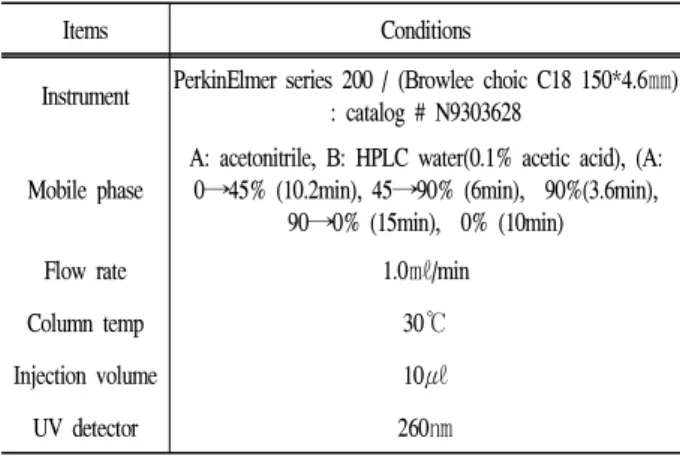
50mesh의 표준망체를 이용하여 거른 다음 0.2g씩 Test tube에 담아 80% ethanol 10㎖을 첨가하여 1시간 동안 50℃로 맞춰진 ultra sonic (KoDo, Korea)으로 추출하 고, 다시 50℃의 incubator에서 150rpm으로 shaking하 면서 20시간동안 추출하여 syringe filter(0.45㎛)를 사 용하여 여과하였다. Isoflavone 함량을 분석을 위한 HPLC 기기의 조건은 표 1과 같았다.
Table 1. Condition of HPLC for analysis isoflavone contents in Soybean sprouts.
Items Conditions
Instrument PerkinElmer series 200 / (Browlee choic C18 150*4.6㎜) : catalog # N9303628
Mobile phase A: acetonitrile, B: HPLC water(0.1% acetic acid), (A:
0→45% (10.2min), 45→90% (6min), 90%(3.6min), 90→0% (15min), 0% (10min)
Flow rate 1.0㎖/min
Column temp 30℃
Injection volume 10㎕
UV detector 260㎚
결과 및 고찰
공시된 8품종의 콩나물의 7일간 생육특성은 표 2와 같다. 전체길이는 아가콩 4품종이 14.0~19.6cm, 나물 콩 4품종이 14.8~22.0cm이었다. 은하콩이 가장 길었 고, 아가 1호, 풍산나물콩, 보석콩이 대체로 짧았다.
하배축길이는 아가콩 4품종이 8.9~11.8cm, 나물콩 4 품종이 7.6~11.2cm이었으며 이 중 아가 3호, 은하콩이 대체로 길었고, 보석콩이 가장 짧았다. 뿌리길이는 아가콩 4품종이 5.1~9.6cm, 나물콩 4품종이 5.4~12.9cm 이었다. 뿌리길이는 장기콩이 가장 길었고 아가 1호, 풍산나물콩이 대체로 짧았다. 콩나물의 굵기는 아가 콩 4품종이 1.42~1.69mm, 나물콩 4품종이 1.98~
2.25mm으로 품종간 차이가 가장 두드러지게 나타났
다. 나물콩 품종이 아가콩 품종보다 유의적으로 굵게
나타났다. 수율이 가장 높게 나온 품종은 770%의 수
율을 보인 아가 3호이었으며, 아가 1호가 430%로 가
장 낮은 수율을 기록하였는데, 품종간 유의적인 차이
가 있었다. 콩나물 10개체의 무게는 은하콩과 장기콩 이 무거웠으며 아가 2호가 가장 가벼웠다.
Table 2. Sprout characteristics of soybean sprout grown for 7 days.
Variety seed100 weight
(g) Whole length (cm)
Hypocotyl length
(cm) lengthRoot
(cm) Diameter
(mm) Yeild
rate(%) sprouts10 weight (g) Aga 1 6.23e 14.0e 8.9cd 5.1d 1.69c 430g 4.8cd Aga 2 6.28e 17.8d 10.0b 7.8c 1.42d 572e 4.1d Aga 3 6.17e 19.6bc 11.8a 7.8c 1.58cd 770a 4.9c Aga 4 5.22f 19.4cd 9.8b 9.6b 1.54cd 627d 5.2c Pungsan-
namulkong 13.08c 14.8e 9.4bc 5.4d 2.25a 620d 8.9b Eunhakong 17.45a 22.0a 11.2a 10.8b 2.25a 550f 10.5a Bosugkong 8.24d 15.6e 7.6e 8.0c 1.98b 670b 4.4cd Jangkikong 13.58b 21.2ab 8.3de 12.9a 2.20a 647c 10.4a
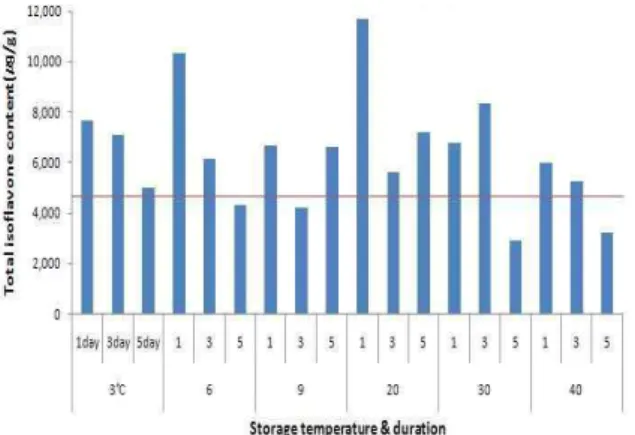
아가 1호를 온도별로 5일간 저장하여 isoflavone을 측정한 결과는 그림 1과 같았다. 1일간 저장하였을 때 isoflavone 함량은 대부분의 온도조건에서 7일간 재배한 후의 isoflavone 함량보다 높았으며, 그 중에서 20℃온도 조건에서 1일간 저장한 콩나물의 isoflavone 함량이 8,209㎍/g으로 가장 높았다. 저온조건에서는 6℃에서 1일간 저장하였을 때 6,188㎍/g이었다. 아가 1호는 20℃와 6℃에서 저장하는 것이 isoflavone 함량 이 증가됨을 알 수 있었다.
Fig. 1. Total isoflavone content of Aga 1 at different storage temperature and duration (horizontal line indicates isoflavone content at 7days cultivation before temperature treatment).
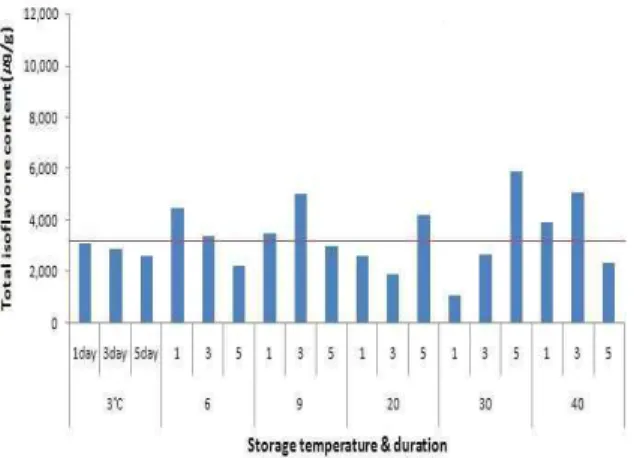
아가 2호를 온도별로 5일간 저장하여 isoflavone을 측정한 결과는 그림 2와 같았다. 저온에서 저장하였을 때 대부분 isoflavone 함량이 7일간 재배한 후의 isoflavone 함량보다 낮게 나타났으나, 6℃에서 1일간 저장했을 때 4,450㎍/g으로 7일간 재배한 isoflavone 함량보다 높게 나타났다. 고온에서는 20℃일 때 isoflavone 함량이 높게 나타나는 경향을 보였다.
Fig. 2. Total isoflavone content of Aga 2 at different storage temperature and duration (horizontal line indicates isoflavone content at 7days cultivation before temperature treatment).
아가 3호를 온도별로 5일간 저장하여 isoflavone을 측정한 결과는 그림 3과 같았다. 아가 3호는 저장기간 동안 다른 콩들에 비해 월등히 높은 isoflavone 함량을
Fig. 3. Total isoflavone content of Aga 3 at different
storage temperature and duration (horizontal line indicates
isoflavone content at 7days cultivation before temperature
treatment).
보였으며, 그 중에서 20℃온도 조건에서 1일간 저장한 콩나물의 isoflavone 함량이 11,705㎍/g으로 가장 높게 나타났다. 저온조건에서는 6℃에서 1일간 저장하였을 때 10,338㎍/g으로 두 번째로 높은 함량을 보였다. 아 가 3호 역시 20℃와 6℃에서 저장하는 것이 isoflavone 함량이 높게 나타남을 알 수 있었다.
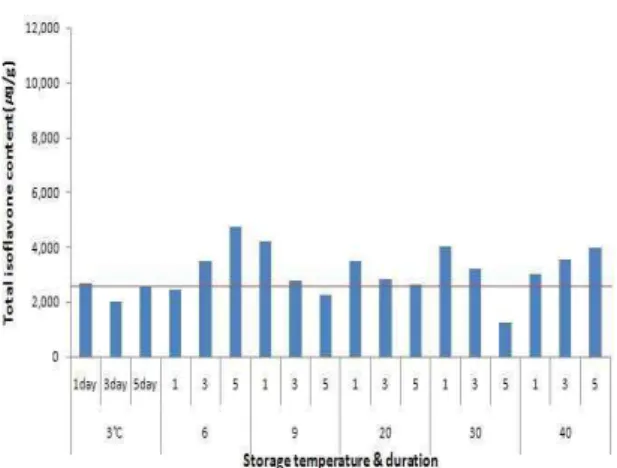
아가 4호를 온도별로 5일간 저장하여 isoflavone을 측정한 결과는 그림 4와 같았다. 저온에서는 6℃에서 4,479㎍/g으로 7일간 재배한 후의 isoflavone 함량보다 높게 나타났으며, 다른 품종에서는 isoflavone 함량이 낮게 나타났던 9℃에서 3일간 저장했을 때 5,015㎍/g
Fig. 4. Total isoflavone content of Aga 4 at different storage temperature and duration (horizontal line indicates isoflavone content at 7days cultivation before temperature treatment).
Fig. 5. Total isoflavone content of Pungsannamulkong at different storage temperature and duration (horizontal line indicates isoflavone content at 7days cultivation before temperature treatment).
으로 저온에서는 가장 높은 isoflavone 함량을 보였다.
고온조건에서는 30℃에서 5,868㎍/g으로 가장 높은 isoflavone 함량을 나타내었다.
풍산나물콩을 온도별로 5일간 저장하여 isoflavone 을 측정한 결과는 그림 5와 같았다. 풍산나물콩은 실 험한 콩들 중에서 가장 낮은 isoflavone 함량을 보였다.
저온에서는 6℃에서 7일간 재배한 후의 isoflavone 함 량보다 높게 나왔다. 고온에서는 20℃온도 조건에서 1일간 저장한 콩나물의 isoflavone 함량이 3,930㎍/g으 로 가장 높게 나왔다.
은하콩을 온도별로 5일간 저장하여 isoflavone을 측 정한 결과는 그림 6과 같았다. 은하콩은 저온에서는 6℃에서만 7일간 재배한 후의 isoflavone 함량보다 높 게 나타났으며 고온에서는 7일간 재배한 후의 isoflavone보다 대부분 높게 나타났다. 20℃와 30℃의 저장온도에서는 isoflavone의 함량이 4,289㎍/g와 4,126㎍/g으로 높은 값을 보였다.
Fig. 6. Total isoflavone content of Eunhakong at different storage temperature and duration (horizontal line indicates isoflavone content at 7days cultivation before temperature treatment).
보석콩을 온도별로 5일간 저장하여 isoflavone을 측 정한 결과는 그림 7과 같았다. 보석콩은 나물콩 품종 중에서 가장 높은 isoflavone 함량을 보였는데, 나물콩 품종들이 고온에서 isoflavone 함량이 높게 나타나는 데 비해 보석콩은 6℃에서 5일간 저장했을 때 4,748㎍
/g으로 가장 높은 isoflavone 함량을 나타내었다. 고온
에서는 거의 비슷한 isoflavone 함량을 보였으며, 특이 하게 40℃에서는 저장일수가 늘어날수록 isoflavone 함량이 증가하였다.
Fig. 7. Total isoflavone content of Bosugkong at different storage temperature and duration (horizontal line indicates isoflavone content at 7days cultivation before temperature treatment).
장기콩을 온도별로 5일간 저장하여 isoflavone을 측 정한 결과는 그림 8과 같았다. 장기콩은 저온에서는 거의 비슷한 isoflavone 함량을 나타내었으며, 고온에 서는 30℃일 때 isoflavone 함량이 낮게 나타났다. 40℃
에서 5일간 저장했을 때 4,582㎍/g으로 가장 높은 isoflavone 함량을 나타내었다.
Fig. 8. Total isoflavone content of Jangkikong at different storage temperature and duration (horizontal line indicates isoflavone content at 7days cultivation before temperature treatment).
적 요
콩나물로부터 고 isoflavone 함량의 콩 식품원료를 얻고자 콩나물 재배 시 빛을 쪼여주고, 재배한 콩나물 의 저장온도를 달리한 조건에서 isoflavone 함량변이 를 조사하였다.
공시 품종들의 7일 재배 후 저장하기 전 isoflavone 함량은 아가 3호>아가 1호>아가 2호>아가 4호>장기 콩>보석콩>은하콩>풍산나물콩 순이었는데 아가 3호 의 isoflavone 함량은 4,619㎍/g이었다.
재배한 콩나물의 isoflavone 함량은 저장온도에 따 라 품종별로 상이한 차이를 보였는데, 저장온도 6℃와 20℃에서 isoflavone 함량이 높은 반면 저장온도 9℃와 30℃에서는 대부분 콩 품종들의 isoflavone 함량은 낮 았다.
저장일수에 따른 isoflavone의 함량은 품종들 간에 일정한 경향이 없었으나 대부분의 품종들은 저장기간 3일 이내에 가장 높은 isoflavone 함량을 보였고, 아가 4호와 장기콩은 저장기간 5일에서도 높은 isoflavone 의 함량을 보였다.
저장기간과 온도처리를 하여 재배한 콩나물의 isoflavone 함량을 높이고자 한 결과 아가 3호를 포함 하여 공시한 8품종 중 4품종에서 20℃에서 하루 동안 저장했을 때 가장 높은 isoflavone의 함량을 나타내었 다. 재배한 콩나물들 중 저장을 통해 가장 높은 isoflavone의 함량을 보인 품종은 아가 3호로써 저장후 의 isoflavone 함량은 11,705㎍/g이었다.
본 연구에서는 콩나물 저장기간 동안 수분공급이 지속적으로 이루어졌기 때문에 콩나물이 계속 성장한 것으로 생각된다. 따라서 저장기간 동안 온도처리를 달리하여 isoflavone의 함량을 증가시키는 보다 확실 한 방법을 확립하기 위해서는 더 많은 연구가 이루어 져야 할 것으로 생각되어진다.
인용문헌
1. Allred Clinton D., Kimberly F. Allred, Young H.
Ju, Tracy S. Goeppinger, Daniel R. Doerge, and
William G. Helferich. 2004. Soy processing influences growth of estrogen-dependent breast cancer tumors. Carcinogenesis. 25(9):1649-1657.
2. Anderson John J. B., and Sanford C. Garner. 1997.
The effects of phytoestrogens on bone. Nutrition Research. 17(10):1617-1632.
3. Anthony Mary S., Thomas B. Clarkson, Claude L.
Hughes, JR., Timothy M. Morgan, and Gregory L.
Burke. 1996. Soybean isoflavones improve cardiovascular risk factors without affecting the reproductive system of peripubertal rhesus monkeys. The Journal of Nutrition. 126(1):43-50.
4. Arthur C. Eldridge, and William F. Kwolek. 1983.
Soybean isoflavones: Effect of environment and variety on composition. J. Agric. Food Chem.
31:394-396.
5. Bae Kyung-Geun, Nam Sung-Woo, Kim Kyung-Nam, and Hwang Young-Hyun. 2004.
Difference in freshness of soybean sprouts as affected by CO
2concentration and postharvest storage temperature. Korean J. Crop Sci.
49(3):172-178.
6. Caldwell Charles R., Steven J. Britz, and Roman M. Mirecki. 2005. Effect of temperature, elevated carbon dioxide, and drought during seed development on the isoflavone content of dwarf soybean [
Glycine max(L.) Merrill] grown in controlled environments. J. Agric. Food Chem.
53:1125-1129.
7. Chi Hee Youn, Roh Jae-Seung, Kim Jung Tae, Lee Sun Joo, Kim Mi Jung, Hahn Sang Joon, and Chung Ill Min. 2005. Light quality on nutritional composition and isoflavones content in soybean sprouts. Korean J. Crop Sci. 50(6): 415~418.
8. Cho Kyoung-Shim, Yong-Ho Kim, Young-Sang Lee. 2006. Characterization of off-flavors from film-packed soybean sprouts. Korean J. Crop Sci.
51(3):220-226
9. Eom Kwon-Yong, Kim Joo-Sook, Choi Hee-Sook,
Cha Bo-Sook and Kim Woo-Jung. 2006. Changes in isoflavone and some characteristics of
Chokongof germinated soybeans during pickling in vinegar.
J Korean Soc Food Sci Nutr. 35(3):359-365.
10. Hwang Young-Hyun, Jeong Yeon-Shin, Lee Jeong-Dong. 2004. Present status and future developmental direction of soy-related industries in Korea. Korea Soybean Digest. 21(1):28-44.
11. Jeon Su-Hyeon, Kyong-Ae Lee, Kwang-Eui Byoun.
2005. Studies on changes of isoflavone and nutrients during germination of soybean varieties. J. of the Korean living science association. 14(3):485-489.
12. Kim E. H., S. H. Kim, J. I. Chung, H. Y. Chi, J. A. Kim, and I. M. Chung. 2006. Analysis of phenolic compounds and isoflavones in soybean seeds (
Glycine max(L.) Merrill) and sprouts grown under different conditions. Eur Food Res Technol.
222:201-208.
13. Kim Eun Mi, Lee Kyung Jin, and Chee Kew-Mahn.
2004. Comparison in isoflavone contents between soybean and soybean sprouts of various soybean cultivars. J. Korean Nutrition Society. 37(1):45-51.
14. Kim Jang Hoon, Hyun Ae Lim, Jeong Soon Lee, Mi-Kyung Sung, Young Kyoon Kim, Rina Yu, and Jong-Sang Kim. 2005. Effect of low doses of genistein and equol on protein expression profile in MCF-7 cells. Food Sci. Biotechnol.
14(6):854-859.
15. Kim Sun-Lim, Hwang Jong-Jin, Son Young-Koo, Song Jin, Park Keum-Yong, and Choi Kwang-Soo.
2000. Effect on growth of soybean sprouts under the temperature control of culture and water supply.
Korea Soybean Digest. 17(1):69-75.
16. Kim Youn-Hee, Hwang Young-Hyun, and Lee Hye-Sung. 2003. Analysis of isoflavones for 66 varieties of sprout beans and bean sprouts. Korean J. Food Sci. Technol. 35(4):568-575.
17. Lee Jeong-Dong, Hwang Young-Hyun, Cho
Ho-Young, Kim Dal-Ung, and Choung Myoung-
Gun. 2002. Comparison of characteristics related with soybean sprouts between
Glycine maxand
G.soja