pISSN 1225-5475/eISSN 2093-7563
1. INTRODUCTION
Crystalline oxide nanowires(NWs) are promising gas sensor materials on account of their high surface area-to- volume ratio, less agglomerated configuration and good crystallinity[1, 2]. When the diameters of n-type oxide semiconductor NWs are comparable or smaller than two times the Debye length, NW gas sensors become highly sensitive due to effective electron depletion[3]. Although a single NW can be fabricated as a gas sensor using sophisticated electrode patterning technology such as e- beam lithography[4], the high cost for processing restricts its potential applications. In comparison, a networked configuration of NWs can be fabricated simply through routes such as slurry coating[5] and direct growth of NWs on catalytic layers[6]. Thus, NW networks are more practical nanoarchietectures for gas sensor applications.
High gas response, fast response speed and high selectivity are three important gas sensing characteristics. It has been known that the chemoresistive contacts between NWs enhance the gas response[5]. From this point of view, NW network sensors have an advantage over single NW sensor. Moreover, in oxide NW networks, the rapid and effective diffusion of the analyte gas over the entire sensor surface via the less agglomerated NW networks facilitates
a high gas response and fast response speed[7]. The gas response and selectivity of oxide NW sensors can be enhanced further by loading noble metal or metal oxide catalysts to promote the gas sensing reaction[8-10]. Note that the less agglomerated network configuration is advantageous for loading catalysts uniformly.
In this work, two different catalysts(Ag and Pd) are loaded onto SnO
2NW network sensors using a solution coating and their gas sensing characteristics are investigated. The main focus of this work is directed at the design of highly sensitive and selective gas sensors and to the understanding of the role of noble metal catalysts in the gas sensing reaction.
2. EXPERIMENTAL 2.1 Preparation of SnO
2NWs
The SnO
2NWs were synthesized by thermal evaporation using Sn metal powder(99.999 %). An Au (30 A)-coated Si substrate was placed downstream of the source material in a quartz tube(inner diameter: 28 mm, length: 800 mm).
The pressure of the processing tube was maintained at about 10
-2Torr by mechanical pumping to ensure a low gas pressure. NWs were grown at 750 °C for 20 min with an O
2flow rate of 0.5 sccm.
Highly Sensitive and Selective Gas Sensors Using Catalyst-Loaded SnO
2Nanowires
In-Sung Hwang and Jong-Heun Lee+
Abstract
Ag- and Pd-loaded SnO2nanowire network sensors were prepared by the growth of SnO2nanowires via thermal evaporation, the coating of slurry containing SnO2nanowires, and dropping of a droplet containing Ag or Pd nanoparticles, and subsequent heat treatment.
All the pristine, Pd-loaded and Ag-loaded SnO2nanowire networks showed the selective detection of C2H5OH with low cross-responses to CO, H2, C3H8, and NH3. However, the relative gas responses and gas selectivity depended closely on the catalyst loading. The loading of Pd enhanced the responses(Ra/Rg: Ra: resistance in air, Rg: resistance in gas) to CO and H2significantly, while it slightly deteriorated the response to C2H5OH. In contrast, a 3.1-fold enhancement was observed in the response to 100 ppm C2H5OH by loading of Ag onto SnO2nanowire networks. The role of Ag catalysts in the highly sensitive and selective detection of C2H5OH is discussed.
Keywords : Gas Sensor, SnO2Nanowires, Catalyst, Selective Detection
Department of Materials Science and Engineering, Korea University +Corresponding author: [email protected]
(Received : Feb. 3, 2012, Accepted : Feb. 15, 2012)
2.2 Sensor fabrication and the loading of Ag or Pd
The SnO
2NWs were separated from the Si substrate by the immersion of the as-synthesized substrate in isopropylalcohol solvent and a subsequent ultrasonic treatment. After removing the solvent and drying, the SnO
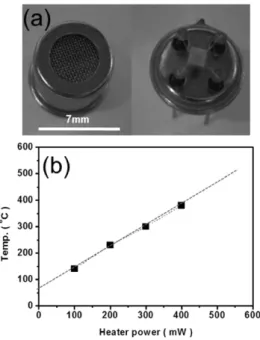
2NWs were mixed with ethyl celluose and α-terpineol and coated on alumina substrates with two Au electrodes(on the top) and micro-heaters(on the bottom)(Fig. 1a). The sensor was heat-treated at a heater power of 500 mW for 2 h in order to remove all organic content. Ag and Pd nanoparticles with an average size of ~ 15 nm were prepared according to the procedure described by Murphy et al[11]. The Ag or Pd catalysts were loaded onto the sensor element by dropping a slurry droplet(10㎕) containing Ag or Pd nanoparticles and subsequent heat treated at the heater power of 500 mW for 2 h.
2.3 Gas sensing characteristics
The sensor temperatures were controlled using the microheater underneath the substrate and were measured using an IR temperature sensor(Rayomatic 14814-2, Euroton IR tec Co.). Heater powers of 100 mW, 200 mW, 300 mW and 400 mW heated the substrates to 140 °C, 230 °C, 300 °C, and 380 °C, respectively (Fig. 1b). The gas responses(S=R
a/R
g, R
a: resistance in air, R
g: resistance in gas) to 200 ppm CO, H
2, C
3H
8, NH
3, and C
2H
5OH were
measured. Gas concentrations were controlled by changing the mixing ratio of the parent gases(100 ppm CO, H
2, C
3H
8, NH
3, and C
2H
5OH, all in an air balance) and dry synthetic air. The DC-2 probe resistances were measured using an electrometer interfaced with a computer.
3. RESULTS AND DISCUSSIONS 3.1 Characterization of sensing materials
The SnO
2NWs grown by thermal evaporation were several tens of micrometer long and 80 nm ~ 150 nm thick (Fig. 2a). From the high resolution lattice image and selected area electron diffraction, each SnO
2NW was identified to be of a single crystalline type(not shown). The SnO
2NWs were confirmed to have a rutile structure by X- ray diffraction measurements(Fig. 2b). The TEM images of Pd- and Ag-loaded SnO
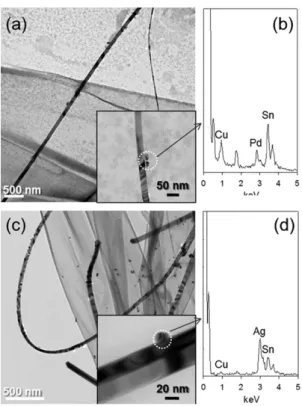
2NWs are shown in Fig. 3. The nanoparticles(size: ~ 15 nm) were uniformly distributed on the SnO
2NWs, seen in Fig. 3a and Fig. 3c, were identified as Pd and Ag, respectively, by energy dispersive spectroscopy analyses(Figs. 3b and 3d). The Cu peaks in the EDS spectra of Figs. 3b and 3d emanate from the Cu grid used for the TEM analysis. The results show that slurry dropping provides a simple, effective route to load Pd or Ag nanoparticles on oxide NWs in a uniform manner.
Fig. 1. (a) Sensor structure and (b) sensor temperature as a function of heater power.
Fig. 2. (a) SEM images and (b) X-ray diffraction pattern of pristine SnO2nanowires.
3.2 Gas sensing characteristics
Gas responses to 100 ppm CO, H
2, C
3H
8, NH
3, and C
2H
5OH of pristine, Pd-loaded and Ag-loaded SnO
2NWs were measured at 380 °C(Fig. 4). In the pristine SnO
2NW sensor, the response to 100 ppm C
2H
5OH(R
a/R
g= 207.6) is significantly higher than the responses to other gases(R
a/R
g= 4.1 – 11.5), indicating the selective detection of C
2H
5OH.
After the loading of Pd, both the response to 100 ppm CO and H
2increased ~2.7 times while the enhancement of the responses to C
3H
8and NH
3is relatively small. On the contrary, the response to 100 ppm C
2H
5OH was slightly decreased by the Pd loading.
In general, the loading of noble metal catalysts are known to improve gas sensing characteristics of oxide semiconductors[8]. However, the role of Pd in terms of gas response seen in various literatures has not always been consistent[12-16]. For example, Pd loading either increased or decreased gas responses according to the loading concentration[12-14] and loading method[12, 15] of the Pd catalysts as well as the optimum sensing temperature[14, 16]. In addition, the gas selectivity was also changed by Pd loading. Although the response to C
2H
5OH sensor is still markedly higher than to other gases after Pd loading, the selectivity to C
2H
5OH slightly deteriorated.
The loading of Ag leads to different sensing behaviors.
The enhancement of response to C
2H
5OH was 3.1-fold, while the responses to CO, H
2, C
3H
8, and NH
3were increased only 1.2 times ~ 1.7 times. That is, Ag loading enhances the selectivity to C
2H
5OH to a great degree. This means that highly sensitive and selectiveC
2H
5OH sensors can be made using Ag-loaded SnO
2NW networks.
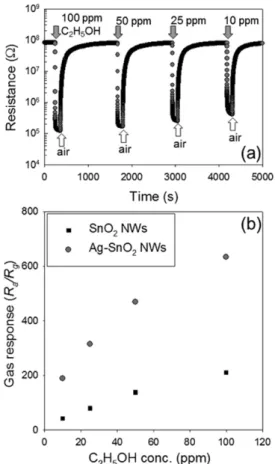
The sensing transients of the Ag-SnO
2NW network sensor to 10 ppm ~ 100 ppm C
2H
5OH are shown in Fig.
5(a). The sensor resistance decreased upon exposure to C
2H
5OH and recovered in a stable manner upon exposure to air. The responses to C
2H
5OH of pristine SnO
2and Pd- SnO
2NW sensors at 380 °C are compared in Fig. 5(b).
The responses to 10 ppm ~ 100 ppm C
2H
5OH ranged from 42.4 to 210 in the SnO
2NW sensor, this is significantly enhanced to 188 to 634 by loading Ag onto the sensor. The C
2H
5OH response of the Ag-SnO
2NW sensors in the present study is higher than the Ag-loaded TiO
2nanobelts[17], the Ag-loaded ZnO nanorods[18], and the Ag-loaded TiO
2spherical heterostructures[19]. In particular, considering the very high response to 10 ppm C
2H
5OH(R
a/R
g= 188), detection of sub-ppm levels of C
2H
5OH seems to be possible using Ag-loaded SnO
2NW networks.
‘Electronic sensitization’ and ‘chemical sensitization’
are the two main sensitization mechanisms of noble metal catalysts in the gas sensing reaction[20]. The former mechanism is explained by the extension of an electron depletion layer beneath the Ag catalyst nanoparticles and a consequent enhancement of gas response. The latter is explained by a ‘spill-over effect’ to promote the dissociation of reducing gases. At this moment, the
Fig. 3. TEM images and EDS results for (a,b) Pd-loaded SnO2 nanowires and (c,d) Ag-loaded SnO2nanowires.
Fig. 4. Gas responses to 100 ppm CO, H2, C3H8, NH3and C2H5OH of pristine SnO2nanowires, Pd-loaded SnO2 nanowires and Ag-loaded SnO2nanowires at 380 °C.
dominant sensitization mechanism is not clear and should be studied further. The gas responses and selectivities as a function of the morphology, size and distribution of Ag catalysts will be an effective way to elucidate the sensing mechanism. Finally, the results in Fig. 4 show the gas response and selectivity can be tuned by the proper use of noble metal catalysts and sensor data with various sensing materials will provide valuable sensing libraries for pattern recognition of multi-component chemicals.
4. CONCLUSIONS
The gas sensing characteristics of SnO
2nanowire network sensors were modified or enhanced by Pd and Ag nanoparticles. Pristine SnO
2nanowire networks showed the selective detection of C
2H
5OH with low cross- responses to CO, H
2, C
3H
8and NH
3. The loading of Pd did not vary the response to C
2H
5OH but significantly increased responses to CO and H
2, which in turn deteriorated the sensor’s selectivity to C
2H
5OH. The
loading of Ag induced a 3.1-fold increase in the C
2H
5OH response, which leaded to highly selective and sensitive detection of C
2H
5OH.
REFERENCES
[1] A. Kolmakov and M. Moskovits, “Chemical sensing and catalysis by one-dimensional metal-oxide nanostructures”, Annu. Rev. Mater. Res. vol. 34, pp.
151-180, 2004.
[2] I.-S. Hwang and J.-H. Lee, “Gas sensors using oxide nanowire networks: An overview”, J. Nanoeng.
Nanomanf., vol. 1, pp. 4-17, 2011.
[3] Z. Fan, D. Wang, P. C. Chang, W. Y. Tseng, and J. G.
Lu, “ZnO NW field-effect transistor and oxygen sensing property”, Appl. Phys. Lett., vol. 85, pp. 5923- 5925, 2004.
[4] X. Duan, Y. Huang, Y. Cui, J. Wang, and C. M. Lieber,
“Indium phosphide nanowires as building blocks for nanoscale electronic and optoelectronic devices”, Nature, vol. 409, pp. 66-69, 2001.
[5] I.-S. Hwang, Y.-S. Kim, S.-J. Kim, B-K. Ju, and J.-H.
Lee, “A facile fabrication of semiconductor nanowires gas sensor using PDMS patterning and solution deposition”, Sens. Actuators B, vol. 136, pp. 224-229, 2009.
[6] Y.-J. Choi, I.-S. Hwang, J.-G. Park, K.J. Choi, J.-H.
Park, and J.-H. Lee, “Novel fabrication of SnO
2nanowire gas sensor with a high sensitivity”, Nanotechnology, vol. 19, p. 095507, 2008.
[7] I.-S. Hwang, E.-B. Lee, S-J. Kim, J.-K. Choi, J.-H. Cha, H.-J. Lee, B.-K. Ju, and J.-H. Lee, “Gas sensing properties of SnO
2nanowires on micro heater”, Sens.
Actuators B, vol. 154, pp. 295-300, 2009.
[8] A. Kolmakov, D. O. Klenov, Y. Lilach, S. Stemmer, and M. Moskovits, “Enhanced gas sensing by individual SnO
2nanowires and nanobelts functionalized with Pd catalyst particles”, Nano Lett., vol. 5, pp. 667- 673, 2005.
[9] Y. Zhang, J. Xu, P. Xu, Y. Zhu, X. Chen, and W. Yu,
“Decoration of ZnO nanowires with Pt nanoparticles and their improved gas sensing and photocatalytic performances”, Nanotechnology, vol. 21, p. 285501, 2010.
[10] I.-S. Hwang, J.-K Choi, S.-J. Kim, K.-Y. Dong, J.-H.
Kwon, B.-K. Ju, and J.-H. Lee, “Enhanced H
2S sensing characteristics of SnO
2nanowires functionalized with CuO”, Sens. Actuators B, vol. 142, pp. 105-110, 2009.
Fig. 5. (a) Gas sensing transients and (b) gas responses to 100 ppm
~ 10 ppm C2H5OH of the Ag-loaded SnO2nanowires at 380 °C.