• 검색 결과가 없습니다.

Changes in Sensory Function After Transcranial Direct Current Stimulation on Primary Motor Cortex Area

N/A
N/A
Protected

Academic year: 2021

Share "Changes in Sensory Function After Transcranial Direct Current Stimulation on Primary Motor Cortex Area"

Copied!
8
0
0

로드 중.... (전체 텍스트 보기)

전체 글

(1)

Changes in Sensory Function After Transcranial Direct Current Stimulation on Primary Motor Cortex Area

Dong-ki Min

1

, PhD, PT

1Dept. of Rehabilitation Medicine, College of Medicine, Keimyung University, Dongsan Medical Center

Abstract 1)

Transcranial direct current stimulation (tDCS) is a neuromodulatory technique that delivers low-intensity direct current to cortical areas, thereby facilitating or inhibiting spontaneous neuronal activity. This study was designed to investigate changes in various sensory functions after tDCS. We conducted a single-center, single-blinded, randomized trial to determine the effect of a single session of tDCS with the current perception threshold (CPT) in 50 healthy volunteers. Nerve conduction studies were performed in relation to the median sensory and motor nerves on the dominant hand to discriminate peripheral nerve lesions. The subjects received anodal tDCS with 1 ㎃ for 15 minutes under two different conditions, with 25 subjects in each groups: the conditions were as follows tDCS on the primary motor cortex (M1) and sham tDCS on M1. We recorded the parameters of the CPT a with Neurometer

at frequencies of 2000, 250, and 5 ㎐ in the dominant index finger to assess the tactile sense, fast pain and slow pain, respectively. In the test to measure CPT values of the M1 in the tDCS group, the values of the distal part of the distal interphalangeal joint of the second finger statistically increased in all of 2000 ㎐ (p=.000), 250 ㎐ (p=.002), and 5 ㎐ (p=.008). However, the values of the sham tDCS group decreased in all of 2000 ㎐ (p=.285), 250 ㎐ (p=.552), and 5 ㎐ (p=.062), and were not statistically significant. These results show that M1 anodal tDCS can modulate sensory perception and pain thresholds in healthy adult volunteers. The study suggests that tDCS may be a useful strategy for treating central neurogenic pain in rehabilitation medicine.

Key Words: Current perception threshold; Primary motor cortex area; Sensory function;

Transcranial direct current stimulation.

Introduction

Non-invasive methods of brain stimulation, includ- ing transcranial direct current stimulation (tDCS) and repetitive transcranial magnetic stimulation (rTMS), are emerging as promising techniques for the man- agement of pain in patients (Fregni et al, 2007).

Among these, tDCS is simple to apply and se- lectively induces and continues functional changes in the cerebral cortex. Its mechanism is one whereby the electrical field passes through the scalp and the skull, and the controls excitability of the cerebral cortex, thereby changing brain functions. This has been used for research in diverse areas (Wagner et

al, 2007). tDCS has contrasting effects according to

polarity: anodal stimulation increases excitability of

the cerebral cortex and cathodal stimulation de-

creases it (Vines et al, 2008). Such an increase or

decrease in excitability may differ according to the

intensity of stimulation, the location of electrodes,

and the direction of the corresponding electrical field

(Nitsche and Paulus, 2001; Priori et al, 1998). The

method currently in general use, when applying

tDCS uses a current intensity of 1 to 2 ㎃, electrode

size of 25 to 35 ㎠, and a stimulation time of 20 to

30 minutes (Iyer et al, 2005; Nitsche and Paulus,

2000; Poreisz et al, 2007). Its side effects may in-

clude slight stinging, headache, fatigue, and nausea

Corresponding author: Dong-ki Min [email protected]

(2)

Stimulation group Sham group p-value

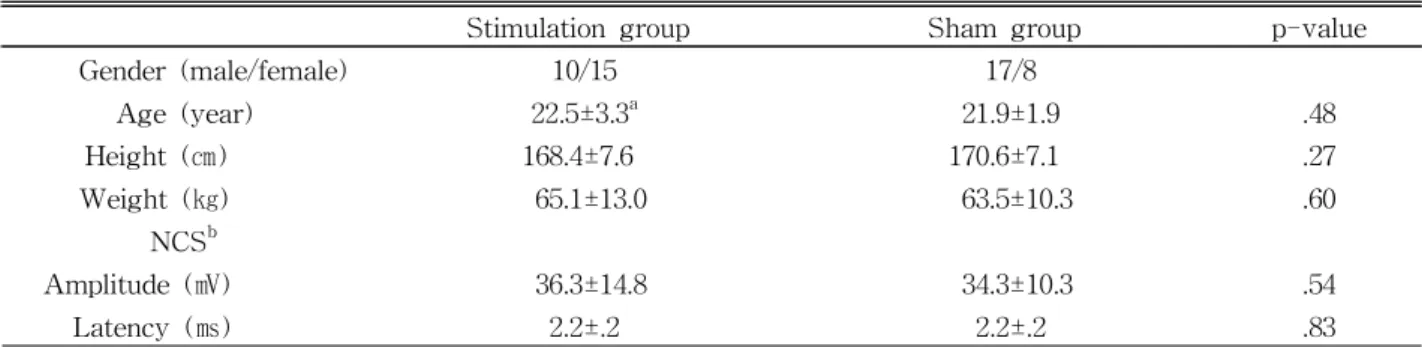
Gender (male/female) 10/15 17/8

Age (year) 22.5±3.3

a

21.9±1.9 .48

Height (㎝) 168.4±7.6 170.6±7.1 .27

Weight (㎏) 65.1±13.0 63.5±10.3 .60

NCS

b

Amplitude (㎷) 36.3±14.8 34.3±10.3 .54

Latency (㎳) 2.2±.2 2.2±.2 .83

a

mean±standard deviation,

b

nerve conduction study.

Table 1. Demographic and general characteristics of the subjects (N=50) but they are relieved soon after stimulation and do

not continue (Antal et al, 2007; Poreisz et al, 2007).

Recent, research into decision making (Fecteau et al, 2007), language (Flöel et al, 2008), memory (Fregni et al, 2005), and pain (Fregni et al, 2007) has inves- tigated the clinical application of tDCS. These re- searchers have reported the effects of cerebral cortex control through diverse neural networks. In partic- ular, tDCS is used as an excellent means for en- hancing mood and anxiety in patients suffering from depression, and also to control chronic pain (Boggio et al, 2008) in patients with traumatic spinal cord in- jury (Fregni et al, 2006b), fibromyalgia (Fregni et al, 2006a), and cancer (Silva et al, 2007). There has been much research, in various fields, into the effects of applying tDCS, but most of the research into sen- sory functions, dealing with pain and its mecha- nisms, has not been verified. Boggio et al (2008) ap- plied anodal tDCS to different cerebral cortex areas of healthy adults, and reported that the perception and pain threshold in the primary motor cortex (M1) and the pain threshold only in the dorsolateral pre- frontal cortex (DLPFC) increased.

The current perception threshold (CPT) test is a quantitative sensory function test and may be applied to patients without discomfort and within a relatively short time compared to other existing tests. This test selectively stimulates the peripheral nervous fi- bers; the large myelinated nerve Aβ, small myeli- nated nerve Aδ, and unmyelinated nerve C in the form of a sine curve at 2000 ㎐, 250 ㎐, and 5 ㎐. It

is possible to quantify the sensory threshold by elec- trical stimulation through the skin with three differ- ent frequencies, and therefore the test is used for di- agnosis of various neuropathies including peripheral neuropathy (Katims et al, 1987). Kodama et al (2009) examined changes in the thresholds of Aβ, Aδ, and C by applying the CPT test to the M1, and the so- matosensory evoked potentials (SEPs) test to the primary sensory cortex (S1), using low frequency rTMS. According to the CPT test of the M1, thresholds of Aβ, Aδ, and C all increased, and excit- ability of the S1 was inhibited in the SEPs. To date, diverse studies have measured sensory changes after the application of tDCS, but there has been no study that investigated changes in each sensory nerve as Kodama et al (2009) did. Therefore, this study ap- plied tDCS to the M1 of the cerebral cortex, and measured changes in the peripheral sensory nerves, thereby clarifying the effects of tDCS on sensory nerves and providing evidential material for its clin- ical application.

Methods

Subjects

The subjects were healthy, right-handed adults

who did not have a history of brain damage or neu-

rological abnormality, and did not exhibit any prob-

lem in electroneurography. The number of subjects

was 50 (male: 27, female: 23) and they were equally

(3)

A B

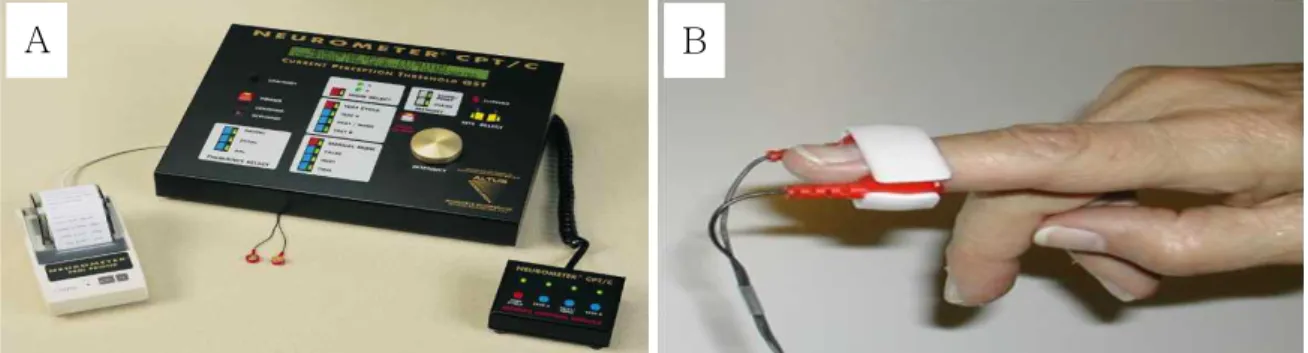
Figure 1. A: Method of current perception threshold test, B: A Neurometer

current perception threshold (CPT)/C was used to measure CPT values at frequencies of 2000, 250, and 5 ㎐ in the right finger to assess the tactile sense, fast pain, and slow pain, respectively.

and randomly assigned to either a tDCS group or a sham tDCS group. Demographic data are shown in Table 1. Sufficient explanation was given to them and a written consent was obtained from them.

Electroneurography

All the subjects received electroneurography (Viking IV, Nicolet Co., Kennewick, USA). electro- neurography was conducted prior to the CPT test in order to verify whether the subjects’ right upper ex- tremity sensory nerves were normal. For the electro- neurography, median nerves among the right upper extremity sensory nerves were measured in an ex- amination room, where the temperature was main- tained at between 26 and 28 ℃ (skin temperature: 30 to 32 ℃), according to the method presented by Liverson and Ma (Nische and Paulus, 2001).

Amplitudes and latencies of the sensory nerves were recorded.

Current perception threshold (CPT) test

CPT values of all subjects were calculated prior to the application of tDCS. The CPT test was con- ducted with a Neurometer

(Neurotron Inc., Baltimore, USA). The subjects sat comfortably on a chair, a thin layer of conductive gel was applied, and then a pair of gold electrodes was attached with an unstretched tape to the distal part of the distal inter- phalangeal joint of the second finger (Figure 1). The

subjects were randomly and equally assigned to a control group or to an experimental group, and then the CPT values were measured in a single blind-method and in manual mode. A current with frequencies of 2000 ㎐, 250 ㎐, 5 ㎐ was applied to the subjects with an intensity of stimulation starting from .001 ㎃, until the subjects felt the electrical current for the first time. The stimulation intensity ranged from .001 ㎃ to 9.99 ㎃. When the subjects felt the electrical current, the stimulation was turned off. The intensity was then lowered to 100 ㎂, an- other stimulation was given, and the threshold values were checked. Stimulation was given again within an error margin of 20 ㎂ to measure the threshold values. CPT values were repetitively measured to obtain a constant result. When the same result oc- curred twice, consecutively, the value was considered as the threshold of the subject. After applying tDCS to all the subjects, CPT values were measured again, using the method described above.

Transcranial direct current stimulation (tDCS)

The tDCS device, Phoresor

Ⅱ Auto (PM850, IOMED

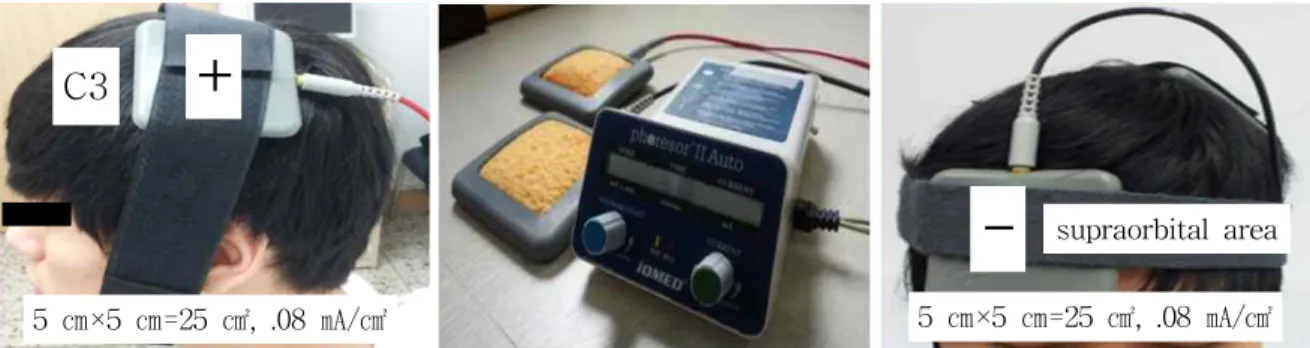
, Utah, USA) was used. The size of the two sponge electrodes attached to the scalp was 25 ㎠ (5 ㎝×5 ㎝) and their current density was .08 ㎃/㎠.

The electrodes were soaked with .9% physiological

saline and attached to the subjects as tightly as

possible, but to an extent at which the subjects did

(4)

C3 +

5 ㎝×5 ㎝=25 ㎠, .08 ㎃/㎠

-

5 ㎝×5 ㎝=25 ㎠, .08 ㎃/㎠

supraorbital area

Figure 2. The equipment for the transcranial direct current stimulation and the stimulation targets (C3: central 3).

Stimulation group Sham group

2000 ㎐ 250 ㎐ 5 ㎐ 2000 ㎐ 250 ㎐ 5 ㎐

Pre 261.20±84.32

a

109.10±51.75 142.60±56.00 315.50±62.38 130.40±65.67 189.40±123.03 Post 310.60±91.96 175.50±78.99 207.50±94.49 299.50±53.59 122.40±65.13 126.70±54.52

p value .000* .002* .008* .285 .552 .062

a
mean±standard deviation, *p<.05.

Table 2. Comparison of pre-test and post-test CPT values in the tDCS and sham tDCS groups (N=50) not feel discomfort. Following the International

10-20 system, the anodal electrode was attached to central 3 of the M1 and the cathodal electrode was attached to the upper part of the opposite orbital region of the M1 (Figure 2). In the anodal tDCS group, current intensity and stimulation time were set at 1 ㎃ and 15 minutes, respectively. In the sham tDCS group, the electrodes were attached to the M1 in the same way as for the tDCS group.

After giving 1 ㎃ stimulation that could be per- ceived for 30 seconds, the stimulation was removed.

The sham group subjects remained in the same position at rest as the tDCS group with the elec- trodes attached for 15 minutes. Such an ex- perimental procedure has been proven in recent re- search to be an efficient blind method. (Gandiga et al, 2006).

Statistical analysis

In this study, statistical analysis was conducted with SPSS ver. 19.0 (SPSS, Inc., Chicago, IL, USA) and as a normality test the Kolmogorov-Smirov /Shapiro-Wilk test was carried out. A paired t-test was performed to compare the M1 between, prior

to, and after the intervention in the tDCS group and the sham tDCS group. A statistical significance level was set at p<.05.

Results

Comparison of CPT values of the M1 between tDCS and sham tDCS groups

In the test to measure CPT values of the M1 in the tDCS group, the values of the distal part of the distal interphalangeal joint of the second finger stat- istically increased in all of 2000 ㎐, 250 ㎐, and 5 ㎐ (p<.05). However, the values of the sham tDCS group decreased in all of 2000 ㎐, 250 ㎐, and 5 ㎐, and were not statistically significant (Table 2).

Discussion

This study applied tDCS to the M1 of the cerebral

cortex of healthy adult males and females, measured

changes in their peripheral sensory nerves, and clari-

fied the effects of tDCS on the sensory nerves,

(5)

thereby providing supportive materials for its clinical application. Regarding the effects of tDCS on the M1, the values increased with statistical significance in all of 2000 ㎐, 250 ㎐, and 5 ㎐, which means that the overall threshold values of nerve fibers such as Aβ, Aδ, and C, in other words, tactile sense, pres- sure sense, fast pain, slow pain, cold sense, and warm sense, all increased. Boggio et al (2008) ap- plied anodal tDCS with 2 ㎃ current to the M1, DLPFC, and occipital cortex, and to sham tDCS for five minutes, and measured peripheral electrical stimulation. The result was a rise in the perception and pain thresholds of the M1, which is the result of controlling the activities of the thalamus and the brainstem nuclei, the most convincing mechanism of pain control, and is explained as stimulation to the M1 area that provides inhibitory control of the de- scending pathway to the spinal cord (Fregni and Pascual-Leone, 2007). Although differing intensities of stimulation were applied to the same area for a different time period in this study, a similar result with an increase in the thresholds of nerve fibers was obtained. This is considered to show the effects of stimulation under the, widely used tDCS applica- tion method, where current intensity is 1 to 2 ㎃, electrode size is 25 to 35 ㎠, and stimulation time is 20 to 30 minutes. Previous research also reported that sensory change in the M1 area was closely re- lated to pain control, and that stimulation to the area led to pain alleviation and improvement in sensory differentiation ability (Drouot et al, 2002). In the present study, changes in such sensory functions were quantitatively analyzed by a neurometer, and CPT values increased after the application of tDCS to the M1 area. In healthy persons, not patients with pain, over-response by the thalamus and the brain- stem nuclei does not occur, and therefore a strength- ened inhibitory connection may result in a rise in CPT values. This was verified in other studies that examined sensory changes by a single transcranial magnetic stimulation, another non-invasive brain stimulation technique (Cohen et al, 1991; McKay et

al, 2003; Morita et al, 1998). Lee (2007) reported that 10 ㎐ rapid TMS to the M1 area significantly raised current perception of 2000 ㎐, 250 ㎐, and 5 ㎐ and the pain tolerance threshold, and Kodama et al (2009) noted that low-frequency rTMS to the M1 area in- creased the sensory threshold. According to the CPT test results from the present study, there was an in- crease in the threshold of Aβ nerve fibers mediating tactile sense, vibration, and pressure, Aδ nerve fibers mediating pain induced by cold perception and cold sense, and C nerve fibers mediating pain induced by warm perception and warm heat. In a study of tem- perature perception and the pain threshold by rTMS, Satow et al (2003) reported that standard somato- sensory-evoked potentials, related to the tactile threshold increased after application of .9 ㎐ rTMS.

Oliviero et al (2005) and Summers et al (2004) ob- served significant changes in the cold pain threshold through a temperature and sensory threshold test.

Tamura et al (2004) observed inhibition of the warm

and heat pain thresholds and aggravation of cold

pain in relation to laser evoked-potentials. The re-

sults of a study by Kodama et al (2009) were con-

sistent with the present study’s results regarding

tactile and pain perception thresholds. Their study

concerned a different non-invasive stimulation tech-

nique, but verified that sensory changes were closely

associated with pain control. A diversity of treatment

choices are considered possible for different types of

chronic pain. This study examined changes in each

sensory nerve fiber through a CPT test that had not

been investigated in previous research, providing

grounds to clarify the function control mechanism of

tDCS stimulation and its effects. This study exam-

ined changes in each sensory nerve fiber through a

CPT test that had not been inquired into in previous

research, providing a ground to clarify sensory the

function control mechanism of tDCS stimulation and

its effects. In the sham tDCS group, the thresholds

of the M1 decreased. In previous studies, the sham

tDCS group did not experience any change with no

excitability of the cerebral cortex or decrease in the

(6)

threshold. In contrast, in the present study, although CPT values did not significantly go down when each area was stimulated, clinically, sensitivity improved.

In a preliminary study, prior to the present study, the sensory threshold test was conducted again, after taking a rest for 15 minutes in a quiet environment without stimulation, and the same finding was observed. this is considered to be due to the effects of stability and retest rather than the effects of a placebo or stimulation. Such a result is a limitation of this study. Therefore, consistency among re- searchers in the environmental conditions of the sham stimulation group is considered necessary. In addition, observation of the carry-over effect in pa- tients with the same sensitivity needs to be achieved by applying both stimulation and sham stimulation to the same patients.

tDCS has been tested in thousands of subjects world wide with no evidence of toxic effects to date.

Poreisz et al (2007) reviewed adverse effects in 77 healthy subjects and 25 patients who underwent a total of 567, 1 ㎃ stimulation sessions. Results show the most common effects were mild tingling sensa- tions (75%), light itching sensation (30%), moderate fatigue (35%), and headache (11.8%); and most of these effects did not differ from those of placebo stimulation.

Much research is being performed on diverse ap- plication areas and effects of tDCS. This study measured changes according to tDCS stimulation and the kinds of peripheral sensory nerve fibers, thereby laying the clinical foundations for application of tDCS to treatment of pain through different mechanisms.

tDCS may be presented as one of the useful treat- ment methods in rehabilitation and pain treatment.

Conclusion

This study applied tDCS to the M1, and measured changes in the peripheral sensory nerves, thereby in- vestigating the effects of tDCS on sensory nerves,

and providing supportive materials for its clinical use. The healthy subjects were divided into an ano- dal tDCS group and a sham tDCS group for applica- tion of tDCS. The CPT values in all Aβ, Aδ, and C nerve fibers of the M1 increased statistically sig- nificantly in the tDCS group. Although CPT values in the sham tDCS group decreased in the M1, such decreases were not statistically significant. These re- sults showed that tDCS had significantly different effects on each nerve fiber, according to the stim- ulation location of the cerebral cortex. For active clinical application of tDCS, a follow-up study into the mechanism of change in the sensory functional system, the effects according to stimulation intensity and time, and temporal indications is considered necessary.

References

Antal A, Terney D, Poreisz C, et al. Towards un- ravelling task-related modulations of neuroplastic changes induced in the human motor cortex.

Eur J Neurosci. 2007;26(9):2687-2691.

Boggio PS, Zaghi S, Lopes M, et al. Modulatory ef- fects of anodal transcranial direct current stim- ulation on perception and pain thresholds in healthy volunteers. Eur J Neurol. 2008;15(10):

1124-1130. http://dx.doi.org/10.1111/j.1468-1331.2008.

02270.x

Cohen LG, Bandinelli S, Sato S, et al. Attenuation in detection of somatosensory stimuli by trans- cranial magnetic stimulation. Electroencephalogr Clin Neurophysiol. 1991;81(5):366-376.

Drouot X, Nguyen JP, Peschanski M, et al. The ant- algic efficacy of chronic motor cortex stim- ulation is related to sensory changes in the painful zone. Brain. 2002;125(Pt 7):1660-1664.

Fecteau S, Pascual-Leone A, Zald DH, et al.

Activation of prefrontal cortex by transcranial

direct current stimulation reduces appetite for

risk during ambiguous decision making. J

(7)

Neurosci. 2007;27(23):6212-6218.

Flöel A, Rösser N, Michka O, et al. Noninvasive brain stimulation improves language learning. J Cogn Neurosci. 2008;20(8):1415-1422. http://dx.

doi.org/10.1162/jocn.2008.20098

Fregni F, Boggio PS, Lima MC, et al. A sham-con- trolled, phase Ⅱ trial of transcranial direct cur- rent stimulation for the treatment of central pain in traumatic spinal cord injury. Pain. 2006a;

122(1-2):197-209.

Fregni F, Boggio PS, Nitsche M, et al. Anodal transcranial direct current stimulation of pre- frontal cortex enhances working memory. Exp Brain Res. 2005;166(1):23-30.

Fregni F, Freedman S, Pascual-Leone A. Recent ad- vances in the treatment of chronic pain with non-invasive brain stimulation techniques.

Lancet Neurol. 2007;6(2):188-191.

Fregni F, Gimenes R, Valle AC, et al. A randomized, sham-controlled, proof of principle study of transcranial direct current stimulation for the treatment of pain in fibromyalgia. Arthritis Rheum. 2006b;54(12):3988-3998.

Fregni F, Pascual-Leone A. Technology insight:

noninvasive brain stimulation in neurol- ogy-perspectives on the therapeutic potential of rTMS and tDCS. Nat Clin Pract Neurol. 2007;

3(7):383-393.

Gandiga PC, Hummel FC, Cohen LG. Transcranial DC stimulation (tDCS): A tool for double-blind sham-controlled clinical studies in brain stimulation. Clin Neurophysiol 2006;117(4):

845-850.

Iyer RB, Silaghi-Dumitrescu R, Kurtz DM Jr, et al.

High-resolution crystal structures of desulfovi- brio vulgaris (hildenborough) nigerythrin: facile, redox-dependent iron movement, domain inter- face variability, and peroxidase activity in the rubrerythrins. J Biol Inorg Chem. 2005;10(4):

407-416.

Katims JJ, Naviasky EH, Rendell MS, et al. Constant current sine wave transcutaneous nerve stim-

ulation for the evaluation of peripheral neuropathy. Arch Phys Med Rehabil. 1987;68(4):

210-213.

Kodama M, Aono K, Masakado Y. Changes in sen- sory functions after low-frequency repetitive transcranial magnetic stimulation over the motor cortex. Tokai J Exp Clin Med. 2009;34(4):

122-129.

Lee TS. Change to current perception threshold and pain tolerance threshold following 10 ㎐ repeti- tive TMS of the primary motor cortex. Daejeon, Chungnam National University, Master Thesis.

2007.

McKay DR, Ridding MC, Miles TS. Magnetic stim- ulation of motor and somatosensory cortices suppresses perception of ulnar nerve stimuli. Int J Psychophysiol. 2003;48(1):25-33.

Morita H, Petersen N, Nielsen J. Gating of somato- sensory evoked potentials during voluntary movement of the lower limb in man. Exp Brain Res. 1998;120(2):143-152.

Nitsche MA, Paulus W. Excitability changes induced in the human motor cortex by weak transcranial direct current stimulation. J Physiol. 2000;527 Pt 3:633-639.

Nitsche MA, Paulus W. Sustained excitability ele- vations induced by transcranial DC motor cortex stimulation in humans. Neurology. 2001;57(10):

1899-1901.

Oliviero A, Esteban MR, de la Cruz FS, et al.

Short-lasting impairment of temperature percep- tion by high frequency rTMS of the sensor- imotor cortex. Clin Neurophysiol. 2005;116(5):

1072-1076.

Poreisz C, Boros K, Antal A, et al. Safety aspects of transcranial direct current stimulation concerning healthy subjects and patients. Brain Res Bull.

2007;72(4-6):208-214.

Priori A, Berardelli A, Rona S, et al. Polarization of the human motor cortex through the scalp.

Neuroreport. 1998;9(10):2257-2260.

Satow T, Mima T, Yamamoto J, et al. Short-lasting

(8)

This article was received September 10, 2014, was reviewed September 10, 2014, and was accepted October 24, 2014.

impairment of tactile perception by 0.9 ㎐-rTMS of the sensorimotor cortex. Neurology. 2003;60 (6):1045-1047.

Silva G, Miksad R, Freedman SD, et al. Treatment of cancer pain with noninvasive brain stimulation. J Pain Symptom Manage. 2007;34 (4):342-345.

Summers J, Johnson S, Pridmore S, et al. Changes to cold detection and pain thresholds following low and high frequency transcranial magnetic stimulation of the motor cortex. Neurosci Lett.

2004;368(2):197-200.

Tamura Y, Hoshiyama M, Inui K, et al. Facilitation of A[delta]-fiber-mediated acute pain by repeti- tive transcranial magnetic stimulation. Neurology.

2004;62(12):2176-2181.

Vines BW, Cerruti C, Schlaug G. Dual-hemisphere tDCS facilitates greater improvements for healthy subjects’ non-dominant hand compared to uni-hemisphere stimulation. BMC Neurosci.

2008;9:103. http://dx.doi.org/10.1186/1471-2202-9-103 Wagner T, Fregni F, Fecteau S, et al. Transcranial direct current stimulation: A computer-based human model study. Neuroimage. 2007;35(3):

1113-1124.

수치

Table  1.  Demographic and general characteristics of the subjects (N=50)but they are relieved soon after stimulation and do
Figure  1.  A: Method of current perception threshold test, B: A Neurometer Ⓡ current perception threshold (CPT)/C was used to measure CPT values at frequencies of 2000, 250, and 5 ㎐ in the right finger to assess the tactile sense, fast pain, and slow pain
Figure  2.  The equipment for the transcranial direct current stimulation and the stimulation targets (C3: central 3).

참조

관련 문서

The purpose of this study is to investigate changes in listening, reading achievement, and learning attitudes of Korean elementary students who enrolled in

In this study, to investigate how applying a critical pathway to stomach cancer patients affects their recovery and treatment, the clinical effect of the critical

The purpose of this study was to evaluate surface changes and abrasion of the implant fixture and TiN coated abutment screw after repeated delivery and

This study the changes in structure and mechanical characteristics by the analysis on mechanical characteristics of the welding part and the post weld

For this, the amount of deformation of welded specimens has been measured and compared, which fabricated under four kinds of welding conditions such as

The purpose of this study is to investigate how participation in 8-week swimming and resistance exercise programs affects changes in health fitness and

The purpose of this study was to provide primary material in discussing methods to activate the treatment effects of diabetes and reduce the rate of

activation(electroencephalolgram: left alpha wave, right alpha wave, left sensory motor rhythm, right sensory motor rhythm, right mid-beta wave, left attention concentration