439 DOI 10.3343/kjlm.2009.29.5.439
439 439 439
메티실린 내성 황색포도알균이 토착화된 중환자실에서 비강보균자 검출을 위한 BD GeneOhm MRSA PCR Assay의 수행능 평가
Performance Evaluation of BD GeneOhm MRSA PCR Assay for Detection of Nasal Colonization of Methicillin-Resistant Staphylococcus aureus at Endemic Intensive Care Units
Sang Hyuk Park, M.D.
1, Yoon Ha Jang, M.D.
1, Heungsup Sung, M.D.
1, Mi-Na Kim, M.D.
1, Jae Suk Kim, M.D.
2, and Yeon Joon Park, M.D.
3Department of Laboratory Medicine1, University of Ulsan College of Medicine and Asan Medical Center, Seoul; Department of Laboratory Medicine2, Hallym University College of Medicine, Seoul; Department of Laboratory Medicine3, College of Medicine, The Catholic University
of Korea, Seoul, Korea
박상혁
1∙장윤하
1∙성흥섭
1∙김미나
1∙김재석
2∙박연준
3울산의대 서울아산병원 진단검사의학과1, 한림의대 진단검사의학과2, 가톨릭의대 진단검사의학과3
Background : The BD GeneOhm MRSA PCR assay (Becton Dickinson, USA) is a qualitative real- time PCR test for rapid detection of nasal colonization of methicillin-resistant Staphylococcus aureus (MRSA). We evaluated the performance of BD GeneOhm MRSA PCR assay versus MRSASelect (Bio-Rad, France) and broth enrichment cultures for detection of MRSA from nasal swabs.
Methods : From August 2008 to January 2009, 295 nasal swabs were taken from patients in inten- sive care units and transported to the laboratory with BD CultureSwab Liquid Stuart Single Swab (Becton Dickinson, USA). The swabs were inoculated onto MRSASelect first and then suspended into GeneOhm sample buffer: 100 μL of the suspension was inoculated into 6.5% NaCl-tryptic soy broth (Becton Dickinson, USA), which was subcultured on MRSASelect after overnight incubation (TSBS). Performances of GeneOhm MRSA and MRSASelect were compared to TSBS.
Results : With GeneOhm MRSA, 125 swabs (44.6%) were positive for MRSA, 13 (4.4%) were unre- solved, and 2 were not determined. With MRSASelect and TSBS 86 (29.4%) and 106 swabs (36.2%), respectively, were positive. The sensitivity, specificity, and positive and negative predictive value of GeneOhm MRSA were 85.8%, 77.5%, and 72.8% and 93.5%, respectively, and corresponding val- ues for MRSASelect were 78.3%, 94.8%, and 96.5% and 88.9%. Of the 33 patients whose 34 speci- mens were found false positive in GeneOhm MRSA, 23 patients were MRSA-positive either previously or subsequently to this study. All of the 10 patients with false-negative specimens in GeneOhm MRSA PCR assay were previously MRSA or methicilln-resistant coagulase negative staphylococci (MRCNS)- positive and were treated for MRSA, but they became MRSA-positive after 1 to 4 negative surveillance
cultures.
Conclusions : GeneOhm MRSA PCR assay showed a relatively high negative predictive value. However, its low specificity and frequent occurrence of unresolved results would be problematic in the endemic areas with a high prevalence of MRSA. (Korean J Lab Med 2009;
29:439-47)
Key Words : BD GeneOhm, MRSA, Nasal colonization, Performance
Received :March 11, 2009 Manuscript No :KJLM09-038 Revision received :July 17, 2009
Accepted :August 7, 2009
Corresponding author :Mi-Na Kim, M.D.
Department of Laboratory Medicine, Asan Medical Center and University of Ulsan College of Medicine, 388-1 Pungnap-2dong, Songpa-gu, Seoul 138-736, Korea
Tel : +82-2-3010-4511, Fax : +82-2-478-0884 E-mail : [email protected]
*본 연구는 식약청 용역연구‘07052 항생제 174’로 식약청으로부터 연구비를 지원받아 수행되었음.
서 론
메티실린 내성 황색포도알균(methicillin-resistant Staphy- lococcus aureus, MRSA)은 병원감염의 중요한 원인균으로 서 최근에는 지역사회에도 확산되어 보건의료계의 큰 문제가 되고 있다[1]. 한국은 과거 10년간 전국적인 임상균주의 자료 수집에서 MRSA 비율이 70% 정도의 수준을 유지하는 토착화 된 단계이며[2, 3], 특히 중환자실에서 분리된 균주들에서는 90%
에 달하여 세계적으로 가장 높은 수준의 MRSA 비율을 보인다 [4]. 세계적으로 MRSA 보균자를 적극적으로 찾아서 탈집락화 시키는‘search-and-destroy policy’전략이 MRSA의 확산 을 막는 중요한 전략으로 등장하면서[5-8] 검사실에서는 MRSA 보균자를 효율적이고 신속하게 검출하는 것이 중요한 과제가 되었다.
전비공 도말 검사는 MRSA 보균자의 검출에 가장 높은 민감 도를 보이는데[9], 배양에 사용하는 선택배지 종류, 배양 조건, 액 체배지 증균 여부에 따라 민감도, 특이도 뿐 아니라 신속성에도 큰 차이가 있다[10-12]. 최근 전비공 도말 검체에서 직접 MRSA 를 검출하는 핵산증폭에 기초한 여러 가지 검사법들이 민감도, 신속성을 향상시키기 위해 개발되었다[13]. 황색포도알균의 메 티실린 내성은 대부분mecA가 부호화한 penicillin-binding protein 2’생성에 기인하기 때문에mecA유전자를 증폭하여 검출하는 방법이 널리 사용된다[12-14]. 하지만mecA는 황색 포도알균과 coagulase-negative staphylococci (CNS)에 모두 존재하기 때문에 직접 검체에 적용하려면 황색포도알균에 특이 적인 유전자도 함께 검출해야 한다[15]. 이들 검사법 중에서 상 품화되어 전비공 도말 검체를 이용한 보균자의 검사에 사용되고 있고 미국 식약청의 승인을 받은 BD GeneOhm MRSA PCR assay (Becton Dickinson, San Diego, CA, USA)는mecA 유전자를 탑재한 카세트 염색체인 Staphylococcal cassette chromosome mec(SCCmec)이 황색포도알균의 종 특이적인 orfX유전자와 근접해 있다는 점에 기초하여 SCCmec에 특이 적인 시발체와orfX특이적인 시발체를 이용하여 실시간 PCR 하는 방법이다[16-18].
이 연구는 MRSA가 토착화된 단일 3차 병원 중환자실 입원환 자들에서 전비공 도말 검체를 대상으로 BD GeneOhm MRSA PCR assay의 MRSA 검출능을 현재 사용중인 MRSASelect (Bio-Rad, Marnes-la-Coquette, France) 선별배지에 기초 한 감시배양법과 비교하여 평가하고자 하였다.
대상 및 방법 1.
대상2008년 8월 12일부터 2009년 1월 2일까지 무작위로 선정한 일자에 서울아산병원 중환자실에서 MRSA 감시배양을 의뢰한 전비공 도말 검체 전부를 대상으로 하여 총 295개에 대해 연구 를 시행하였다. 이 중환자실에서는 모든 입원 환자에 대해 입실 시와 이후 1주 간격을 두고 정기적인 감시배양을 실시하고 있었 다. 전비공 도말 검체는 면봉이 1개 들어있는 BD CultureSwab Liquid Stuart, Single Swab (Becton Dickinson, Sparks, MD, USA)을 이용하여 수집하였다. 감시배양을 의뢰한 환자들을 입 원기간 중 감시배양 양성이 있었던 환자와 감시배양 음성이었던 환자로 나누어 각각의 연령, 성별, 입원기간, 기저 질환, MRSA 감염증, 항 MRSA 항균제 사용 유무를 조사하였다.
2. MRSA Select
선별배지전비공 도말 면봉을 MRSASelect선별배지에 일차로 접종하 여 5% CO2, 35℃ 조건에서 20-24시간 배양하였다. 크기가 작 고 선명한 분홍색 집락이 관찰되면 양성, 집락이 자라지 않거나 무색 혹은 옅은 분홍색 집락이 관찰되면 음성으로 판독하였다.
양성으로 판독된 집락은 그람염색과 Pastorex Staph Plus Kit (BioRad, Marnes-la-Coquette, France)로 검사하여 MRSA 로 확정하였다.
3. BD GeneOhm MRSA PCR assay
MRSASelect 선별배지에 접종하고 난 후의 면봉을 GeneOhm MRSA 검체완충튜브(Becton Dickinson, San Diego, CA, USA) 에 풀었다. 검체완충튜브 현탁액을 100 μL 덜어서 6.5% NaCl을 첨가한 tryptic soy broth (Becton Dickinson, San Diego, CA, USA)에 접종하고 나머지는 제조사의 지침에 따라 검사하였다.
Smart Cycler (Cepheid, Sunnyvale, CA, USA)를 사용하여 실시간 PCR을 하고 장비의 판독에 따라 음성, 양성, 판독불가 (unresolved), 작동오류(not determined, ND) 등의 검사결과 를 얻었다. ‘판독불가’결과를 보이는 검체는 -70℃에서 냉동- 해동을 하여 재검하였고, 재검에서도 계속‘판독불가’면‘판독 불가’로 최종 판정하였다. ‘작동오류’결과를 보이는 검체는 분 석에서 제외하였다.
4. 액체배지 증균 배양
액체배지 증균 배양은 표준 비교 방법으로서 사용하였다.
GeneOhm MRSA의 검체완충액에 전비공 도말 면봉을 풀었던 현탁액 100 μL을 6.5% NaCl을 첨가한 tryptic soy broth 배지 에 접종하여 35℃에서 하룻밤 증균시킨 후 균자람이 관찰되면 MRSASelect배지에 계대배양하여 MRSA를 검출하였다(Tryp- tic Soy Broth enrichment and Subcultured with MRSASe- lect: TSBS). TSBS에서 MRSA가 배양되면서 GeneOhm MRSA 도 양성이면 더 이상의 검사없이 진양성으로 간주하였고, TSBS 에서 양성이고, GeneOhm MRSA 음성이면 그 균을 GeneOhm MRSA 검체완충액에 풀어서 검사하였다. GeneOhm MRSA에 서만 MRSA 양성으로 검출될 때는 TSBS에 사용한 액체배지를 증균하여 GeneOhm MRSA 검사를 시행하고, 혈액한천배지에 계대배양하여 β-용혈을 보이는 집락을 선택하여 동정과 감수성 검사를 시행하였다.
5. 통계 처리
TSBS 양성인 결과를 진양성으로 하였고 TSBS 결과와 비교 하여 GeneOhm MRSA와 MRSASelect배양의 민감도, 특이도, 양성예측도, 음성예측도와 각각의 95% 신뢰구간을 구하였다.
TSBS 결과와 비교는 SPSS 13.0.1 for Windows (SPSS Inc, Chicago, IL, USA)를 이용하여 Pearson chi-square test로 유의성을 검정하였다.
6. GeneOhm MRSA 위양성, 위음성 검체의 분석
GeneOhm MRSA가 위양성, 위음성을 보이는 검체는 검사 전후 7일 이내 시행되었던 직전 감시배양 결과와 직후 감시배양 결과, 이전에 반코마이신을 포함한 항 MRSA 항균제의 사용 유 무를 조사하였다.
결 과
1. MRSA 검출률연구기간 중 190명의 환자가 295개의 전비공 도말 검체를 의 뢰하였다. GeneOhm MRSA에서 2건의‘작동오류’가 발생하 였고, 1차‘판독불가’가 19검체(6.5%)였으며, 냉동-해동시켜 재검했을 때 최종‘판독불가’는 13검체(4.4%)였다. GeneOhm
MRSA에서 음성이었지만 배양에서 MRSA로 판독되는 균이 자 랐을 때 그 균으로 다시 GeneOhm MRSA를 실시한 결과 모두 양성이었다. GeneOhm MRSA에서만 양성인 경우 TSBS 증균 액으로 혈액한천배지에 계대배양하였을 때 4검체에서 메티실린 감수성 황색포도알균이 검출되었고, GeneOhm MRSA 검사하 였을 때 3검체에서 양성이었다. 최종‘판독불가’13검체와‘작 동오류’2검체를 제외한 나머지 280검체 중 125검체(44.6%)가 양성이었고 155검체(55.4%)가 음성이었다. TSBS는 106검체 (36.2%)가 양성, 187검체(63.8%)가 음성이었고, MRSASelect 에서 86검체(29.4%)가 양성, 207검체(70.6%)가 음성이었다.
이들 결과를 종합하면 MRSA 전체 유병률은 106/293 (36.2%) 이고, GeneOhm MRSA, MRSASelect모두 TSBS와 유의한 차이를 보였다(P<0.001).
2. 환자군 분석
감시배양을 의뢰한 환자들의 기저 질환은 폐렴 45명, 미숙아 28명, 소화기 종양 24명, 패혈성 쇽 22명, 선천성 기형 21명, 혈 액 종양 18명, 간질성 폐질환 14명, 폐결핵 7명, 비뇨기계 종양, 췌장염 각 4명, 복막염 3명 순이었다. 연구기간 중 한번이라도 감시배양 양성인 환자는 93명(48.9%)이었고, 감시배양 음성이었 던 환자는 97(51.1%)명이었으며, 이들은 입원기간 중 한번도 임 상 검체에서 MRSA가 검출된 적이 없었다. 감시배양 양성군에 서 평균 연령이 48.1세로 음성군의 35.8세에 비해 많았고(P<
0.001), 평균 입원기간이 138.9일로 음성군의 41.8일에 비해 길 었다(P=0.008). MRSA 감염증은 MRSA 감시배양 양성군에서 만 발생했으며 폐렴이 가장 많았고, 세균혈증, 봉소염, 감염성 심 내막염의 순이었다. 전체 190명의 환자 중 감시배양 시기에 반코 마이신, 리네졸리드, 테이코프라닌 등의 항 MRSA 항균제를 사 용한 환자는 감시배양 음성군에서 45명(46.4%), 감시배양 양성 군에서 72명(77.4%)으로 감시배양 양성군에서 더 많았다(P<
0.001) (Table 1).
3. GeneOhm MRSA, MRSA
Select
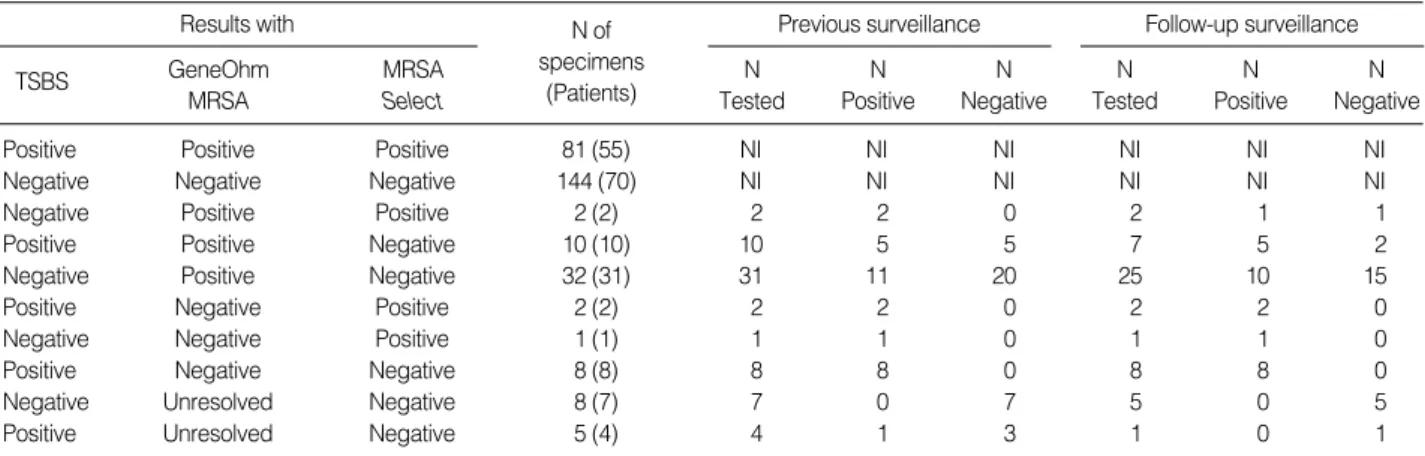
, TSBS 증균 결과의 불일치를 보이는 검체의 분석전체 293검체 중 세 검사 모두에서 양성이 81검체, 모두에서 음성이 144검체로 225검체(76.8%)가 일치된 결과를 보였다.
TSBS와 비교하여 GeneOhm MRSA의 경우 위양성이 34검체, 위음성이 10검체였고, MRSASelect의 경우 위양성이 3검체, 위 음성이 23검체였다. GeneOhm MRSA 위양성인 34검체가 분
리된 33명의 환자들 중 13명은 직전 감시배양 결과가 양성이었 고 반코마이신을 포함한 항 MRSA 항균제를 양성 기간 동안 사 용하고 있었다. 이들은 이후 감시배양은 모두 음성이었다. 10명 은 직전 감시배양이 음성이었으나 1주 이내 실시한 직후 감시배 양이 양성이었다. 또 다른 10명은 직전 감시배양이 모두 음성이 었고 항 MRSA 항균제 사용력이 없었으며 이들 중 4명은 직후 감시배양 음성이었고, 6명은 직후 감시배양을 실시하지 않았다.
GeneOhm MRSA 위음성인 10검체는 10명의 환자에서 채취되 었으며, 이들은 모두 MRSA 또는 메티실린 내성 CNS가 분리되 어 항 MRSA 항균제를 사용하였고, 1-4회의 감시배양에서 음성 이었다가 다시 배양 양성으로 바뀐 경우였다. GeneOhm MRSA 양성이고, TSBS 음성인 34검체 중 4예에서 메티실린 감수성 황
색포도알균이 분리되었고, 이중 3검체에서 분리된 메티실린 감 수성 황색포도알균을 tryptic soy broth로 증균하였을 때 Gene- Ohm MRSA 검사에서 양성이었다. 이들 3검체는 모두 항균제 사용력이 없고 이전, 이후에도 MRSA가 분리되지 않은 환자에 서 얻은 검체들이었다. MRSASelect위양성인 3검체는 3명의 환자에서 채취되었으며, 이들은 모두 직전 감시배양이 양성이었 으며 모두 항 MRSA 항균제를 사용하였고 2명에서 직후 감시배 양이 양성이었다(Table 2).
4. MRSASelect와GeneOhm MRSA검사의 민감도와 특이도
TSBS 증균 결과와 비교하여 MRSASelect와 GeneOhm MR- SA의 민감도, 특이도, 양성예측도, 음성예측도를 조사하였다.
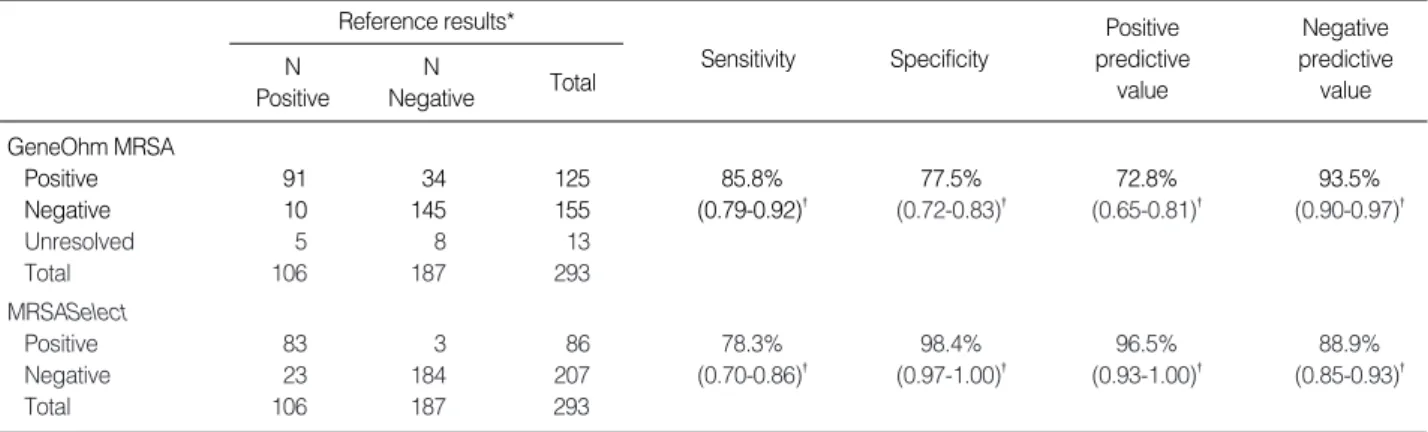
GeneOhm MRSA는 위양성이 34검체, 위음성이 10검체로 민감 도 85.8%, 특이도 77.5%, 양성예측도 72.8%, 음성예측도 93.5%
이었고, MRSASelect는 위양성이 3검체, 위음성이 23검체로 민감도 78.3%, 특이도 98.4%, 양성예측도 96.5%, 음성예측도 88.9%이었다. 두 검사 간의 민감도, 음성예측도는 95% 신뢰수 준으로 볼 때 통계적인 유의한 차이는 없었고 특이도, 양성예측 도는 MRSASelect가 통계적으로 유의하게 높았다. 두 검사의 일치도는 80.2%이었다(Table 3).
고 찰
GeneOhm MRSA 검사와 MRSASelect선별배양의 민감도는 각각 85.8%, 78.3%이었고, 음성예측도 또한 93.5%, 88.9%로
Abbreviation: NI, not investigated.
Results with
TSBS GeneOhm
MRSA
MRSA Select
N of specimens
(Patients)
Previous surveillance N
Tested
N Positive
N Negative
Follow-up surveillance N
Tested N Positive
N Negative
Positive Positive Positive 81 (55) NI NI NI NI NI NI
Negative Negative Negative 144 (70) NI NI NI NI NI NI
Negative Positive Positive 2 (2) 2 2 0 2 1 1
Positive Positive Negative 10 (10) 10 5 5 7 5 2
Negative Positive Negative 32 (31) 31 11 20 25 10 15
Positive Negative Positive 2 (2) 2 2 0 2 2 0
Negative Negative Positive 1 (1) 1 1 0 1 1 0
Positive Negative Negative 8 (8) 8 8 0 8 8 0
Negative Unresolved Negative 8 (7) 7 0 7 5 0 5
Positive Unresolved Negative 5 (4) 4 1 3 1 0 1
Table 2. Results of three different MRSA surveillance tests with the results of previous and follow-up surveillance cultures for the speci- mens showing a discrepancy between the three tests
Surveillance- negative
Surveillance-
positive P value Number of patients 97 (51.1%) 93 (48.9%)
Age (yr, mean±SD) 35.8±3.4 48.1±3.1 <0.001
Sex (male:female) 55:42 67:26 0.027
Hospital stay (days) 41.8±3.7 138.9±51.6 0.008 MRSA infections
Pneumonia 0 (0.0%) 20 (21.5%) <0.001
Bacteremia 0 (0.0%) 7 (7.5%) 0.006
Wound infection 0 (0.0%) 3 (3.2%) 0.075
Infective endocarditis 0 (0.0%) 2 (2.2%) 0.147
Total 0(0.0%) 32(34.4%) <0.001
Antimicrobial treatments
Vancomycin 45 (46.4%) 72 (77.4%) <0.001
Linezolid 0 (0.0%) 2 (2.2%) 0.147
Teicoplanin 4 (4.1%) 16 (17.2%) 0.003
Total 45 (46.4%) 72 (77.4%) <0.001
Table 1. Clinical characteristics of 190 study patients
GeneOhm MRSA가 더 높은 민감도와 음성예측도를 보였다. 이 와 같은 민감도는 GeneOhm MRSA와 MRSA 선별배지의 일종 인 BBL CHROMagar MRSA를 액체증균배지와 비교했던 연구 에서[19] GeneOhm MRSA가 89.0%의 민감도를 보인 것과 유 사하다. 본 연구에서 10예의 위음성 검체는 모두 과거에 MRSA 감시배양이 양성이었던 환자에서 의뢰되었고, 이들은 항 MRSA 항균제를 사용해서 감시배양이 음성으로 되었다가 다시 양성으 로 전환된 환자들이었다. GeneOhm MRSA의 검출 한계는 면 봉 당 325 CFU라고 하는데[20] 검출 한계에 대한 연구에서 직접 배양검사와 유사하고, 액체증균배양 보다는 1 log10정도 떨어진 다[21]. 10개 중 8개가 TSBS에서만 검출된 점으로 보아 항균제 를 사용하는 환자에서 균수가 GeneOhm MRSA의 검출한계 이 하로 줄어서 음성이 되었을 가능성을 시사한다. 본 연구는 Gene- Ohm MRSA 제조사가 권하는 Stuart 배지를 사용했고[21], 원 내 중환자실 환자를 대상으로 비교적 동일한 조건에서 검체가 채 취되고, 신속하게 운송되었기 때문에 운송조건이나 과정이 민감 도에 영향을 주었을 가능성은 낮다. GeneOhm MRSA의 민감도 가 떨어지는 다른 원인으로 특정한 SCCmec 형별을 검출하지 못하는 점을 생각해 볼 수 있다. GeneOhm MRSA는 SCCmec I, II, III, IV형을 가진 MRSA는 100% 검출하지만, SCCmec V 형은 검출하지 못하고 IVA형은 60% 정도만 검출한다고 알려져 있다[21-26]. 덴마크에서는 GeneOhm MRSA 위음성의 95%가 SCCmec IVA형의 MRSA가 원인이었음을 보여주었는데[22]
국내에서도 SCCmec IVA형이 40.6%였다는 보고가 있는 만큼 [28] 본 연구에서 GeneOhm MRSA 위음성의 원인이 되었을 수 있다.
본 연구에서 MRSASelect의 경우 전비공 도말 검체에서 92.1- 99.0%의 민감도를 보인 연구들에 비해 민감도가 떨어지지만[27, 29, 30], 80.0% [11]로 비슷하게 보고한 논문이 있고, 본 연구진
이 이전에 발표한 배양 1일째 민감도인 78.1%와 비슷한 결과이 다[31]. 또한 GeneOhm MRSA의 민감도가 MRSASelect에 비해 높다고 해도 통계적으로 유의하지는 않았고, GeneOhm MRSA 와 MRSASelect둘 다 전비공 MRSA 보균자 감시에 TSBS보다 는 민감도가 유의하게 떨어졌다. 본 연구에서 MRSASelect와 GeneOhm MRSA 둘 다 이전 보고들에 비해 민감도가 낮은 경 향은 균주의 특성보다는 대상군의 특성상 전비공의 MRSA 집 락 밀도가 두 검사의 검출한계 이하여서, TSBS에서만 검출되었 음을 시사한다. 즉, 본 연구에서 대상군이 심각한 기저질환을 가 진 중환자실의 입원환자들이고, MRSA 감염률이 높아서 대상 환자의 61.6%가 검사 당시 항 MRSA 항균제를 사용했거나 사용 중인 환자들이었기 때문에 전비공의 MRSA 집락밀도에 영향을 주었을 것이다. 이러한 해석에 따르면 MRSA 치료가 빈번한 중 환자실의 보균자 감시는 액체증균배양과 같은 민감도가 높은 방 법이 더 필요함을 알 수 있다. 민감도가 89%로 본 연구와 유사 했던 연구에서 대상군이 지역사회획득 MRSA의 고위험군으로 MRSA 유병률이 15%, 음성예측도는 97.9%에 달하는데 비해[19], 본 연구에서는 MRSA 유병률이 36.2%라서 GeneOhm MRSA 의 음성예측도가 떨어진다. 지금까지 여러 연구들에서 Gene- Ohm MRSA는 높은 음성예측도 때문에 음성일 때 배양검사를 하지 않아도 되는 선별검사로서의 효용성을 갖는다고 하였지만 [16-19], MRSA가 토착화된 국내의 3차 병원에서 특히 보균율 이 가장 높고, MRSA용 항균제를 많이 사용하는 중환자실을 대 상으로 감시배양을 실시할 때 그와 같은 용도로 사용할 수 있을 지 신중한 판단이 필요하다.
GeneOhm MRSA 검사와 MRSASelect 선별배양의 특이도 는 각각 77.5%, 98.4%로 GeneOhm MRSA의 특이도가 훨씬 낮고, 양성예측도 또한 72.8%로 양성결과가 나올 시 확인검사 가 필요하다. 특히“판독불가”결과까지 더하면 확인을 요하는 Sensitivity Specificity
Positive predictive
value
Negative predictive value Reference results*
N Positive
N
Negative Total GeneOhm MRSA
Positive 91 34 125 85.8% 77.5% 72.8% 93.5%
Negative 10 145 155 (0.79-0.92)� (0.72-0.83)� (0.65-0.81)� (0.90-0.97)�
Unresolved 5 8 13
Total 106 187 293
MRSASelect
Positive 83 3 86 78.3% 98.4% 96.5% 88.9%
Negative 23 184 207 (0.70-0.86)� (0.97-1.00)� (0.93-1.00)� (0.85-0.93)�
Total 106 187 293
Table 3. Comparison of BD GeneOhm MRSA PCR assay and MRSASelect to the reference results
*Results from 6.5% NaCl-tryptic soy broth enrichment followed by a subculture with MRSASelect (TSBS); �CI: 95% confidence interval.
검사는 37.6%까지 늘어난다. 이들 위양성 검체가 발견된 33명 의 환자들 중 1주 전의 직전 감시배양에서 MRSA가 검출된 경우 는 13명이었는데 이들은 이후 검사에서 음성이었고 항균제 치료 를 받았던 병력이 있었다. 또한 10명은 1주 후의 추적 감시배양 에서 MRSA가 검출되었는데 이는 MRSA 감염력이 있었던 환 자에서 GeneOhm MRSA 양성, 배양 음성 결과가 MRSA의 완 전한 제거를 의미하지는 않음을 시사한다. 이와 같은 소견은 항 균제치료로 전비공의 살아있는 MRSA의 밀집도가 떨어진 상태 에서 생존능이 없는 MRSA만 면봉에 묻어서 GeneOhm MRSA 가 유전자를 검출한 데 기인할 수 있다[17, 32, 33]. 나머지 10명 은 항균제 사용력이 없고 이전, 이후에도 MRSA가 검출되지 않 아서 이와 같은 가설로는 설명되지 않는 위양성이었다. Gene- Ohm MRSA의 특이도가 91.7-95.4%로 더 높은 연구가 있지 만[8, 11], 이들 연구에서도 양성예측도는 65.9-75.0%에 불과 하다. GeneOhm MRSA가 위양성을 초래하는 원인으로 초기에 는 MRCNS 중orfX를 가진 특정한 종의 유병률에 의해 결정된 다는 연구가 있었지만[34], 최근 SCCmec카세트에서mecA유 전자가 빠져나간 메티실린 감수성 황색포도알균이 더 중요한 역할을 하는 것이 알려졌다[17, 19]. 상당수의 메티실린 감수성 황색포도알균, 특히 다제내성 메티실린 감수성 황색포도알균은 68.0%까지도 GeneOhm MRSA에서 양성결과를 보인다[17, 33].
본 연구에서도 항균제 사용력이 없고 이전, 이후에도 MRSA가 분리되지 않았던 10검체 중 3검체는 tryptic soy broth 증균액 이 GeneOhm MRSA 검사에서 양성이었고, 여기서 분리된 메 티실린 감수성 황색포도알균 3주도 양성반응을 보여 이와 같은 기전에 의한 위양성이 있음을 알 수 있다. GeneOhm MRSA 위 양성의 원인은 지역 및 환자들의 임상적 특성에 따라 차이가 있 을 것으로 사료된다.
GeneOhm MRSA법은 직접검체를 사용함으로써 PCR 반응 억제효과에 취약하여‘판독불가’결과가 가끔 발생한다. 본 연 구에서 최초‘판독불가’가 19검체(6.5%)이고, 냉동-해동 후 재 검하였을 때도 13검체(4.4%)는 계속‘판독불가’였다. 통상적인 실시간 PCR법은 반응곡선을 보고 반응에 영향을 주는 인자들을 파악할 수 있는데 비해 GeneOhm MRSA는 반응곡선을 보여주 지 않기 때문에 이와 같은‘판독불가’의 원인을 규명하기가 어렵 다. 그 원인으로 검사자의 숙련도가 높아지면‘판독불가’결과가 4.5%에서 1.7%로 감소되었다는 연구가 있고[16], 냉동-해동시 키면‘판독불가’를 해결할 수 있었다는 보고[19]나 기존의 시약 을 이용한 용해법 대신 achromopeptidase 용해법을 도입하였 을 때‘판독불가’결과 비율이 1% 미만으로 낮았다는 보고[16]는 검체의 용해 과정에 문제점이 있음을 시사한다. 본 연구에서도
GeneOhm MRSA를 처음 실시할 때 더 많은‘판독불가’를 경 험하였고, 후반기에 갈수록 이 문제는 훨씬 감소하였다(자료는 제시하지 않음).
전문가들은 감염관리를 위해서 MRSA 감시배양검사가 신속 해야 한다고 권장한다[35]. MRSASelect를 이용한 배양법은 익 일 보고인 반면 GeneOhm MRSA는 당일 보고를 할 수 있다.
국내 중환자실의 높은 MRSA 보균율 때문에 GeneOhm MRSA 의 음성예측도가 낮을 때 음성 선별검사로 사용할 수 있을지, 본 병원과 같이 이미 MRSASelect선별배지를 사용하여 검사 익일 결과를 보고하는 시스템을 갖추었을 때 GeneOhm MRSA가 당 일 음성결과를 내는 것이 중환자실 MRSA 관리에 더 효과가 있 을지는 평가가 필요하다. 최근 내과계 중환자실에서 PCR법을 이용하여 MRSA를 하루만에 선별하였을 때 배양법을 사용할 때 에 비해 새로운 MRSA 획득률을 유의하게 감소시켰다는 연구가 있지만[36, 37], 그 연구는 보고시간이 4일인 통상적인 배양법과 비교한 것이기 때문에 본 연구에 적용하기는 어렵다. 반코마이 신 내성 장구균의 대규모 원내 유행에서 PCR법으로 반코마이신 내성 장구균을 신속하게 검출하는 것이 감염관리의 성공을 결정 짓는 요인이라고 보고되어 신속검사의 효과를 증명한 바 있지 만[38, 39] 유행이 아닌 상태에서 일상적인 감시에 GeneOhm MRSA과 같은 신속검사가 MRSA 관리에 미치는 효과는 평가 할 필요가 있다.
결론적으로 GeneOhm MRSA는 MRSA 보균율과 항균제 사 용률이 높은 국내 중환자실 환경에서는 감시배양을 대치할 만큼 음성예측도가 충분하지 않고, 특이도가 낮아서 MRSA 감시에 단독으로 사용하기는 어렵다. 위양성과 위음성의 원인을 규명하 고, 민감도를 높이기 위한 연구가 더 필요하다.
요 약
배경 : BD GeneOhmTMMRSA PCR assay (Becton Dick- inson, USA)은 메티실린 내성 황색포도알균 비강보균자의 신 속한 검출을 위한 정성적 실시간 PCR 검사이다. 저자들은 전비 공 도말 검체에서의 MRSA 선별에 GeneOhm MRSA의 수행능 을 MRSASelect(Bio-Rad, France) 선별배지와 액체증균배지 에 비교하여 평가하였다.
방법 : 2008년 8월에서 2009년 1월 사이에 중환자실에서 의 뢰한 295개의 전비공 도말 검체를 대상으로 하였고, 이들은 BD CultureSwab Liquid Stuart Single Swab (Becton Dickinson, USA)으로 채취, 수송되었다. 전비공 도말 검체는 먼저 MRSA- Select에 접종 후 GeneOhm 검체완충튜브에 풀었고 현탁액
100 μL을 6.5% NaCl을 첨가한 tryptic soy broth (Becton Dickinson, USA)에 접종하고 하룻밤 배양 후 MRSASelect선 별배지에 계대배양하였다(TSBS). GeneOhm MRSA와 MRSASelect의 수행능을 TSBS에 비교하여 평가하였다.
결과 : GeneOhm MRSA는 125검체(44.6%)가 양성이었고 13검체(4.4%)가‘판독불가’, 2검체가‘작동오류’였다. MRSA- Select와 TSBS는 각각 86검체(29.4%), 106검체(36.2%)가 양 성이었다. GeneOhm MRSA와 MRSASelect의 민감도/특이/
양성예측도/음성예측도는 각각 85.8%/77.5%/72.8%/93.5%, 78.3%/98.4%/96.5%/88.9%이었다. 34개의 GeneOhm MRSA 위양성 검체는 33명의 환자에서 얻어졌고, 23명은 직전 또는 직 후 감시배양에서 MRSA 양성이었다. 10개의 GeneOhm MRSA 위음성 검체는 모두 이전에 MRSA 또는 메티실린 내성 coag- ulase negative staphylococci 양성이었으며 항 MRSA 항균 제 치료를 받았고 1-4회의 감시배양이 음성이다가 양성으로 전 환된 경우였다.
결론 : GeneOhm MRSA는 상대적으로 높은 음성예측도를 보이나 특이도가 낮고‘판독불가’결과가 존재하여 MRSA 유병 률이 높은 토착화된 장소에서 감시배양을 대치하는데 문제가 될 수 있다.
감사의 글
이 연구는 식약청 용역연구‘07052 항생제 174’로 식약청으로 부터 연구비를 지원받은 연구입니다. 이 연구에 사용한 BD GeneOhm MRSA PCR assay 검사시약은 BD Korea에서 지원 을 받았습니다.
참고문헌
1. Chambers HF. The changing epidemiology of Staphylococcus aureus?
Emerg Infect Dis 2001;7:178-82.
2. Chong YS and Lee K. Present situation of antimicrobial resistance in Korea. J Infect Chemother 2000;6:189-95.
3. Lee K, Park KH, Jeong SH, Lim HS, Shin JH, Yong D, et al. Further increase of vancomycin-resistant Enterococcus faecium, amikacin- and fluoroquinolone-resistant Klebsiella pneumoniae, and imipenem-resis- tant Acinetobacter spp. in Korea: 2003 KONSAR surveillance. Yon- sei Med J 2006;47:43-54.
4. Kim KM, Yoo JH, Choi JH, Park ES, Kim KS, Kim KS, et al. The nation- wide surveillance results of nosocomial infections along with antimi-
crobial resistance in intensive care units of sixteen university hospi- tals in Korea, 2004. Korean J Nosocomial Infect Control 2006;11:79- 86. (김경미, 유진홍, 최정현, 박은숙, 김경숙, 김광숙 등. 2004년도 전국 16개 대학병원 중환자실 병원감염 감시 결과. 대한병원감염관리학회지 2006;11:79-86.)
5. Wertheim HF, Vos MC, Boelens HA, Voss A, Vandenbroucke-Grauls CM, Meester MH, et al. Low prevalence of methicillin-resistant Sta- phylococcus aureus (MRSA) at hospital admission in the Netherlands:
the value of search and destroy and restrictive antibiotic use. J Hosp Infect 2004;56:321-5.
6. Siegel JD, Rhinehart E, Jackson M, Chiarello L. Management of mul- tidrug-resistant organisms in health care settings, 2006. Am J Infect Control 2007;35(S):S165-93.
7. Smith PW, Bennett G, Bradley S, Drinka P, Lautenbach E, Marx J, et al. SHEA/APIC Guideline: Infection prevention and control in the long-term care facility. Am J Infect Control 2008;36:504-35.
8. Weber SG, Huang SS, Oriola S, Huskins WC, Noskin GA, Harriman K, et al. Legislative mandates for use of active surveillance cultures to screen for methicillin-resistant Staphylococcus aureus and vanco- mycin-resistant enterococci: position statement from the Joint SHEA and APIC Task Force. Infect Control Hosp Epidemiol 2007;28:249-60.
9. Sewell DL, Potter SA, Jacobson CM, Strausbaugh LJ, Ward TT. Sen- sitivity of surveillance cultures for the detection of methicillin-resis- tant Staphylococcus aureus in a nursing-home-care unit. Diagn Micro- biol Infect Dis 1993;17:53-6.
10. Nonhoff C, Denis O, Brenner A, Buidin P, Legros N, Thiroux C, et al. Comparison of three chromogenic media and enrichment broth media for the detection of methicillin-resistant Staphylococcus aureus from mucocutaneous screening specimens: Comparison of MRSA chromogenic media. Eur J Clin Microbiol Infect Dis 2009;28:363-9.
11. Nahimana I, Francioli P, Blanc DS. Evaluation of three chromogenic media (MRSA-ID, MRSA-Select, CHROMagar MRSA) and ORSAB for surveillance cultures of methicillin-resistant Staphylococcus aureus.
Clin Microbiol Infect 2006;12:1168-74.
12. Murray PR, Baron EJ, et al. eds. Manuals of clinical mircobiology.
9th ed. Washington DC: American society of microbiology press, 2007:122-3.
13. Jaffe RI, Lane JD, Albury SV, Niemeyer DM. Rapid extraction from and direct identification in clinical samples of methicillin-resistant staphylococci using the PCR. J Clin Microbiol 2000;38:3407-12.
14. Pai CH, Kim MN, et al. eds. Clinical Microbiology for Infection Con-
trol. 1st ed. Seoul: Hanmi medical publishing, 2007:90-1. (배직현, 김 미나 등. 감염관리를 위한 임상미생물학. 1st. ed. 서울: 한미의학, 2007;
90-1.)
15. Cuny C and Witte W. PCR for the identification of methicillin-resis- tant Staphylococcus aureus (MRSA) strains using a single primer pair specific for SCCmec elements and the neighbouring chromosome- borne orfX. Clin Microbiol Infect 2005;11:834-7.
16. Paule SM, Hacek DM, Kufner B, Truchon K, Thomson RB Jr, Kaul KL, et al. Performance of the BD GeneOhm methicillin-resistant Sta- phylococcus aureus test before and during high-volume clinical use. J Clin Microbiol 2007;45:2993-8.
17. Huletsky A, Giroux R, Rossbach V, Gagnon M, Vaillancourt M, Ber- nier M, et al. New real-time PCR assay for rapid detection of methi- cillin-resistant Staphylococcus aureus directly from specimens contain- ing a mixture of staphylococci. J Clin Microbiol 2004;42:1875-84.
18. Hiramatsu K, Cui L, Kuroda M, Ito T. The emergence and evolution of methicillin-resistant Staphylococcus aureus. Trends Microbiol 2001;
9:486-93.
19. Farley JE, Stamper PD, Ross T, Cai M, Speser S, Carroll KC. Com- parison of the BD GeneOhm methicillin-resistant Staphylococcus aureus (MRSA) PCR assay to culture by use of BBL CHROMagar MRSA for detection of MRSA in nasal surveillance cultures from an at-risk community population. J Clin Microbiol 2008;46:743-6.
20. BD GeneOhmTMMRSA PCR assay package insert. http://www.bd.
com/geneohm/english/products/idi_mrsa.asp(Cited May 2008).
21. Rossney AS, Herra CM, Fitzgibbon MM, Morgan PM, Lawrence MJ, O’Connell B. Evaluation of the IDI-MRSA assay on the SmartCycler real-time PCR platform for rapid detection of MRSA from screen- ing specimens. Eur J Clin Microbiol Infect Dis 2007;26:459-66.
22. Bartels MD, Boye K, Rohde SM, Larsen AR, Torfs H, Bouchy P, et al.
A common variant of staphylococcal cassette chromosome mec type IVa in isolates from Copenhagen, Denmark, is not detected by the BD GeneOhm methicillin-resistant Staphylococcus aureus assay. J Clin Microbiol 2009;47:1524-7.
23. Chung HJ, Jeon HS, Sung H, Kim MN, Hong SJ. Epidemiological characteristics of methicillin-resistant Staphylococcus aureus isolates from children with eczematous atopic dermatitis lesions. J Clin Micro- biol 2008;46:991-5.
24. Ko KS, Lee JY, Suh JY, Oh WS, Peck KR, Lee NY, et al. Distribution of major genotypes among methicillin-resistant Staphylococcus aureus clones in Asian countries. J Clin Microbiol 2005;43:421-6.
25. Chongtrakool P, Ito T, Ma XX, Kondo Y, Trakulsomboon S, Tiensa- sitorn C, et al. Staphylococcal cassette chromosome mec (SCCmec) typing of methicillin-resistant Staphylococcus aureus strains isolated in 11 Asian countries: a proposal for a new nomenclature for SCCmec elements. Antimicrob Agents Chemother 2006;50:1001-12.
26. Kim JS, Song W, Kim HS, Cho HC, Lee KM, Choi MS, et al. Associa- tion between the methicillin resistance of clinical isolates of Staphylo- coccus aureus, their staphylococcal cassette chromosome mec (SCCmec) subtype classification, and their toxin gene profiles. Diagn Microbi- ol Infect Dis 2006;56:289-95.
27. Nsira SB, Dupuis M, Leclercq R. Evaluation of MRSASelect, a new chromogenic medium for the detection of nasal carriage of methi- cillin-resistant Staphylococcus aureus. Int J Antimicrob Agents 2006;
27:561-4.
28. Park C, Lee DG, Kim SW, Choi SM, Park SH, Chun HS, et al. Pre- dominance of community-associated methicillin-resistant Staphylo- coccus aureus strains carrying staphylococcal chromosome cassette mec type IVA in South Korea. J Clin Microbiol 2007;45:4021-6.
29. Louie L, Soares D, Meaney H, Vearncombe M, Simor AE. Evaluation of a new chromogenic medium, MRSA select, for detection of methi- cillin-resistant Staphylococcus aureus. J Clin Microbiol 2006;44:4561-3.
30. Krishna BV, Smith M, McIndeor A, Gibb AP, Dave J. Evaluation of chromogenic MRSA medium, MRSA select and Oxacillin Resistance Screening Agar for the detection of methicillin-resistant Staphylococcus aureus. J Clin Pathol 2008;61:841-3.
31. An DH, Jeon HS, Park SJ, Sung H, Kim MN. Evaluation of MRSASelect for detecting methicillin-resistant Staphylococcus aureus from surveil- lance specimens. Korean J Nosocomial Infect Control 2007;12:28-35.
(안동희, 전홍선, 박숙자, 성흥섭, 김미나. Methicillin 내성 황색포도알 균의검출을위한 MRSASelect 선별배지의수행능평가. 대한병원감염관 리학회지 2007;12:28-35.)
32. Daskalaki M, Otero JR, Sanz F, Chaves F. Bacteremia due to clonal- ly derived methicillin-resistant, gentamicin-susceptible isolates and methicillin-susceptible, gentamicin-resistant isolates of Staphylococ- cus aureus. J Clin Microbiol 2007;45:3446-8.
33. Donnio PY, Fevrier F, Bifani P, Dehem M, Kervegant C, Wilhelm N, et al. Molecular and epidemiological evidence for spread of multire- sistant methicillin-susceptible Staphylococcus aureus strains in hospi- tals. Antimicrob Agents Chemother 2007;51:4342-50.
34. Francois P, Bento M, Renzi G, Harbarth S, Pittet D, Schrenzel J. Eval- uation of three molecular assays for rapid identification of methicillin-
resistant Staphylococcus aureus. J Clin Microbiol 2007;45:2011-3.
35. Brown DF, Edwards DI, Hawkey PM, Morrison D, Ridgway GL, Towner KJ, et al. Guidelines for the laboratory diagnosis and sus- ceptibility testing of methicillin-resistant Staphylococcus aureus (MRSA).
J Antimicrob Chemother 2005;56:1000-18.
36. Harbarth S, Masuet-Aumatell C, Schrenzel J, Francois P, Akakpo C, Renzi G, et al. Evaluation of rapid screening and pre-emptive con- tact isolation for detecting and controlling methicillin-resistant Staphy- lococcus aureus in critical care: an interventional cohort study. Crit Care 2006;10:R25.
37. Harbarth S, Fankhauser C, Schrenzel J, Christenson J, Gervaz P, Ban-
diera-Clerc C, et al. Universal screening for methicillin-resistant Sta- phylococcus aureus at hospital admission and nosocomial infection in surgical patients. JAMA 2008;299:1149-57.
38. Pearman JW. 2004 Lowbury Lecture: the Western Australian expe- rience with vancomycin-resistant enterococci-from disaster to ongo- ing control. J Hosp Infect 2006;63:14-26.
39. Christiansen KJ, Tibbett PA, Beresford W, Pearman JW, Lee RC, Coombs GW, et al. Eradication of a large outbreak of a single strain of vanB vancomycin-resistant Enterococcus faecium at a major Aus- tralian teaching hospital. Infect Control Hosp Epidemiol 2004;25:
384-90.