Purpose: We tested the hypothesis that cesarean section might increase the risk for allergic diseases compared to vaginal delivery, by depriving the newborn of exposure to maternal microflora. Methods: We evaluated the prevalence of allergic diseases, allergic inflammation, and allergic sensitization according to mode of delivery for 279 Korean children aged ≤16 years. Data were extracted from medical records and a questionnaire filled out by parents. Logistic regression was used to determine the association between cesarean section and the outcomes of interest. Results:
Of the 279 children, 179 (62.6%) were delivered vaginally and 100 (37.4%) by cesarean section. There were no differences in the prevalence of al- lergic diseases, allergic inflammation, or allergic sensitization according to mode of delivery. Children born by cesarean section had no higher risk of allergic disease than those delivered vaginally, regardless of a parental history for allergic disease. Adjusted odds ratios (95% confidence intervals) for cesarean section compared to vaginal delivery were not statistically significant for any outcome considered: asthma, 0.76 (0.37-1.57), allergic rhi- nitis, 1.14 (0.61-2.10), atopic dermatitis, 1.01 (0.59-1.71). Conclusions: Delivery by cesarean section may not be associated with the subsequent development of asthma, allergic rhinitis, or atopic dermatitis in Korean children.
Key Words: Hypersensitivity; cesarean section; obstetric delivery, child
INTRODUCTION
The prevalence of allergic diseases is increasing due to rapid industrialization, changes in lifestyle, air pollution, and the oc- currence of new allergens. The 2002-2003 phase 3 study per- formed by the International Study of Asthma and Allergies in Childhood (ISAAC) reported that the prevalence of bronchial asthma, allergic rhinitis, and atopic dermatitis tended to in- crease in most institutions compared to data from 5 years earli- er (provided in a report by the ISAAC phase 1 study).1 The rela- tionship between the prevalence of allergic diseases and mode of delivery in childbirth has been actively investigated as the proportion of cesarean sections has increased.2 In the United States, the frequency of cesarean sections increased from 23.0%
in 1990 to 28.0% in 2003 and to 31.1% in 2006.3,4 According to the Korean Health Insurance Review and Assessment Service, the rate of cesarean sections continuously increased from 13.3% in 1990 to 40.5% in 2001, but decreased to 36.0% in 2006, although this rate was considerably higher than that proposed by the World Health Organization (WHO, 5-15%). Cesarean section babies have a different gut flora, which has been suggested to prolong immunological immaturity and thereby increase the
Relationship between mode of delivery in childbirth and prevalence of allergic diseases in Korean children
Yeo Hoon Park, Kyung Won Kim, Bong Seok Choi, Hye Mi Jee, Myung Hyun Sohn,* Kyu-Earn Kim
Department of Pediatrics and Institute of Allergy, BK 21 Project for Medical Sciences, Yonsei University College of Medicine, Seoul, Korea
risk for the development of allergic disease.5-7 The hygiene hy- pothesis states that decreased exposure to microorganisms ear- ly in life leads to insufficient stimulation of Th1 lymphocytes and, therefore, a predominance of the Th2 allergic response.8 However, the association between mode of delivery and the prevalence of allergic diseases has not been completely eluci- dated. Some investigators have reported increased risk for de- veloping asthma among children born by cesarean section compared to those born by vaginal delivery,9-12 whereas others have found no such relationship.13-15 Although the relationship between mode of delivery and the prevalence of allergic diseas- es has been investigated continuously in many countries, there has been no report on this relationship in Korea. Therefore, we investigated the effects of mode of delivery on the prevalence of allergic diseases in Korean children.
Allergy Asthma Immunol Res. 2010 January;2(1):28-33.
doi: 10.4168/aair.2010.2.1.28 pISSN 2092-7355 • eISSN 2092-7363
This is an Open Access article distributed under the terms of the Creative Commons Attribution Non-Commercial License (http://creativecommons.org/licenses/by-nc/3.0/) which permits unrestricted non-commercial use, distribution, and reproduction in any medium, provided the original work is properly cited.
Correspondence to: Myung Hyun Sohn, MD, PhD, Department of Pediatrics, Yonsei University College of Medicine, Severance Hospital, 250 Seongsanno, Seodaemun-gu, Seoul 120-752, Korea.
Tel: +82-2-2228-2062; Fax: +82-2-393-9118; E-mail: [email protected] Received: July 21, 2009; Accepted: December 1, 2009
•There are no financial or other issues that might lead to conflict of interest.
MATERIALS AND METHODS Study subjects
A total of 279 children aged ≤16 years who visited Severance Children’s Hospital, Yonsei University College of Medicine be- tween January and December 2008.
Methods
The following data were identified through a questionnaire:
gender, age, mode of delivery, gestational age, birth weight, his- tory of admission to neonatal intensive care unit (NICU), dura- tion of breast feeding, maternal age at delivery, exposure to household pets or smoking, and physician-diagnosed allergic diseases in children and their parents. Data on the diagnosis of allergic diseases, allergic inflammation, and allergic sensitiza- tion were collected from medical records and analyzed retro- spectively. We evaluated the relationship between mode of de- livery and prevalence of three common childhood allergic dis- eases: asthma, allergic rhinitis, and atopic dermatitis.
Definition of allergic disease
Bronchial asthma was defined as recurrent wheezing or coughing episodes in the absence of the common cold in the preceding 12 months. In addition, a physician’s diagnosis of bronchial hyperresponsiveness upon methacholine challenge (PC20 ≤16 mg/mL) and at least a 12% reversibility of forced ex- piratory volume in 1 second (FEV1) after inhaling a b2 agonist, as per the American Thoracic Society (ATS) criteria,16 were re- quired. A diagnosis of allergic rhinitis was made according to the Allergic Rhinitis and its Impact on Asthma (ARIA) guide- lines,17 and a diagnosis of atopic dermatitis was made based on the diagnostic criteria proposed by Hanifin and Rajka in 1980.18
Measurement of blood eosinophils, serum total IgE, and serum specific IgE levels
Serum specific IgE against Dermatophagoides farinae (Df) and Dermatophagoides pteronyssinus (Dp) and serum total IgE were measured using the CAP radioallergosorbent technique (UniCAP; Phadia, Uppsala, Sweden). The NE-8000 system (Sys- mex, Kobe, Japan) was used to count eosinophils automatically in peripheral blood. Allergic sensitization was identified in 177 (63.4%) of the 279 subjects.
Skin-prick tests
Skin-prick tests, using 65 inhalant and food allergens, were performed on 41 subjects who had not taken antihistamines before the test. Normal saline was used as a negative control, and a 0.1% histamine solution was used as a positive control.
Test results were considered positive if the following criteria were met: (1) there was no erythema or wheal in response to the negative control and (2) the allergen/histamine wheal size ratio was ≥1 or (3) the wheal measured ≥3 mm. Atopy was de-
fined as a positive reaction to one or more allergens, a specific IgE level of ≥0.35 kU/L, or a serum total IgE level of ≥100 kU/L.
Statistical analysis
The clinical characteristics between the cesarean and vaginal delivery groups were compared using the Student’s t-test, the Chi-square test, and the Fisher’s exact test. The effects of con- founding variables were removed by logistic regression analy- sis. Statistical analyses were performed using SPSS version 13.0 (SPSS Inc, Chicago, IL, USA). A P value <0.05 was considered statistically significant.
RESULTS
Clinical characteristics of the study subjects
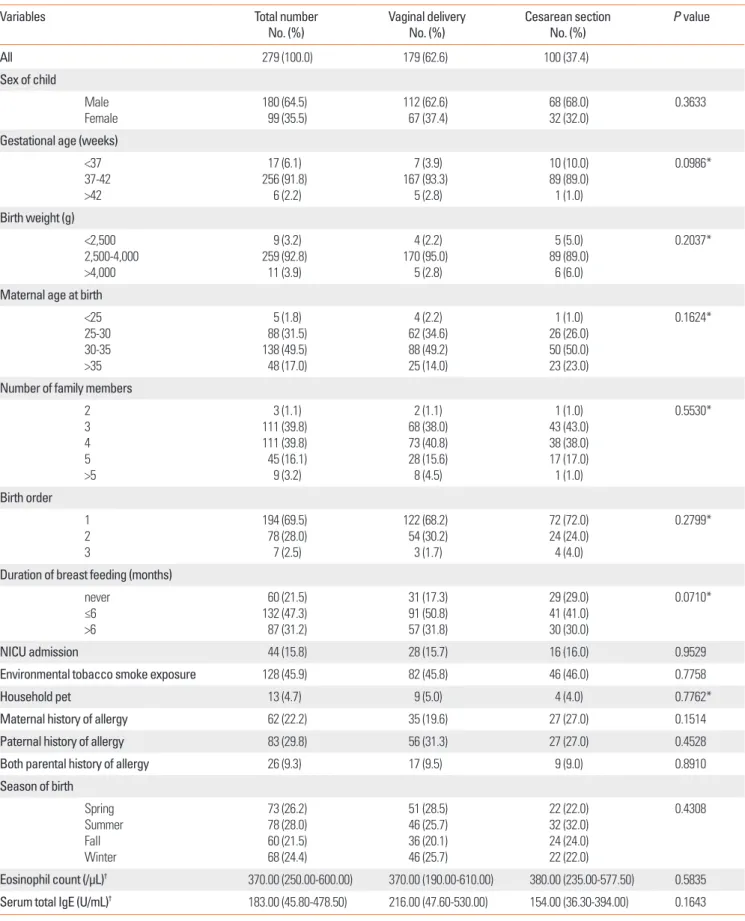
Of the 279 subjects, 179 (62.6%) were born by vaginal delivery, and 100 (37.4%) were born by cesarean section. The mean (±SD) age of the subjects was 4.6 (±3.8) years. Atopy was assessed in 197 subjects (70.6%). There were no significant differences be- tween the two groups for gender, gestational age, birth weight, season of birth, maternal age at birth, the number of family mem- bers, birth order, duration of breast feeding, admission to NICU, exposure to household pets or smoking, and a parental history of allergic diseases. Furthermore, there were no significant dif- ferences in blood eosinophil counts or serum total IgE levels be- tween the two groups (Table 1).
Prevalence of allergic diseases
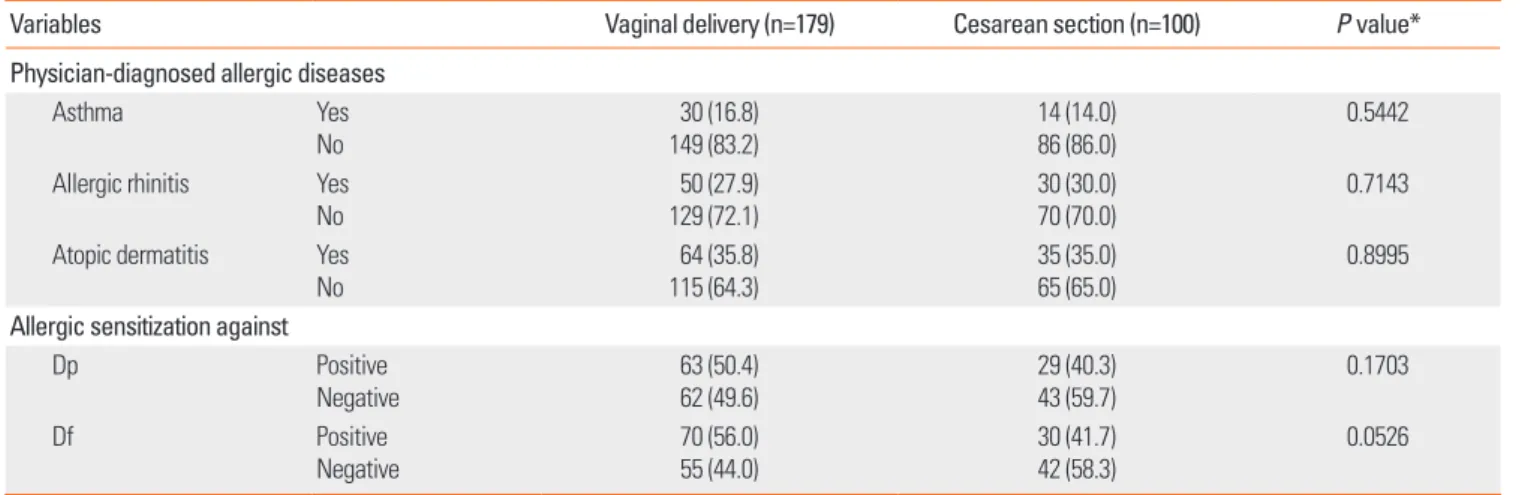
The prevalence of bronchial asthma, allergic rhinitis, and atopic dermatitis did not differ significantly between the two groups, nor did sensitization to Dp or Df (Table 2). There were also no significant differences in the odds ratios for the preva- lence of allergic diseases, sensitization to Dp or Df, or after ad- justing for confounding variables including age, gender, gesta- tional age, birth weight, duration of breast feeding, and a paren- tal history of allergic diseases (Table 3).
Prevalence of allergic diseases according to parental history of allergic disease
The subjects were divided into three subgroups: those with both parents, one parent, and no parent with a history of allergic disease. The prevalence of allergic diseases according to mode of delivery was not significantly different among the three sub- groups. In addition, there were no significant differences among the odds ratios of each group after adjusting for confounding variables including age, gender, gestational age, birth weight, and breast feeding (Table 4).
DISCUSSION
Mode of delivery in childbirth has been implicated in the de- velopment of allergic disorders during childhood.19 According
Table 1. Characteristics of study subjects (n=279) by the mode of delivery
Variables Total number
No. (%) Vaginal delivery
No. (%) Cesarean section
No. (%) P value
All 279 (100.0) 179 (62.6) 100 (37.4)
Sex of child
Male
Female 180 (64.5)
99 (35.5) 112 (62.6)
67 (37.4) 68 (68.0)
32 (32.0) 0.3633
Gestational age (weeks)
<37 37-42
>42
17 (6.1) 256 (91.8)
6 (2.2)
7 (3.9) 167 (93.3)
5 (2.8)
10 (10.0) 89 (89.0) 1 (1.0)
0.0986*
Birth weight (g)
<2,500 2,500-4,000
>4,000
9 (3.2) 259 (92.8)
11 (3.9)
4 (2.2) 170 (95.0)
5 (2.8)
5 (5.0) 89 (89.0)
6 (6.0)
0.2037*
Maternal age at birth
<25 25-30 30-35
>35
5 (1.8) 88 (31.5) 138 (49.5) 48 (17.0)
4 (2.2) 62 (34.6) 88 (49.2) 25 (14.0)
1 (1.0) 26 (26.0) 50 (50.0) 23 (23.0)
0.1624*
Number of family members 2 3 4 5
>5
3 (1.1) 111 (39.8) 111 (39.8) 45 (16.1) 9 (3.2)
2 (1.1) 68 (38.0) 73 (40.8) 28 (15.6) 8 (4.5)
1 (1.0) 43 (43.0) 38 (38.0) 17 (17.0) 1 (1.0)
0.5530*
Birth order 1 2 3
194 (69.5) 78 (28.0) 7 (2.5)
122 (68.2) 54 (30.2) 3 (1.7)
72 (72.0) 24 (24.0) 4 (4.0)
0.2799*
Duration of breast feeding (months) never
≤6
>6
60 (21.5) 132 (47.3) 87 (31.2)
31 (17.3) 91 (50.8) 57 (31.8)
29 (29.0) 41 (41.0) 30 (30.0)
0.0710*
NICU admission 44 (15.8) 28 (15.7) 16 (16.0) 0.9529
Environmental tobacco smoke exposure 128 (45.9) 82 (45.8) 46 (46.0) 0.7758
Household pet 13 (4.7) 9 (5.0) 4 (4.0) 0.7762*
Maternal history of allergy 62 (22.2) 35 (19.6) 27 (27.0) 0.1514
Paternal history of allergy 83 (29.8) 56 (31.3) 27 (27.0) 0.4528
Both parental history of allergy 26 (9.3) 17 (9.5) 9 (9.0) 0.8910
Season of birth Spring Summer Fall Winter
73 (26.2) 78 (28.0) 60 (21.5) 68 (24.4)
51 (28.5) 46 (25.7) 36 (20.1) 46 (25.7)
22 (22.0) 32 (32.0) 24 (24.0) 22 (22.0)
0.4308
Eosinophil count (/µL)† 370.00 (250.00-600.00) 370.00 (190.00-610.00) 380.00 (235.00-577.50) 0.5835
Serum total IgE (U/mL)† 183.00 (45.80-478.50) 216.00 (47.60-530.00) 154.00 (36.30-394.00) 0.1643
*Fisher’s exact test.
†Median (interquartile range).
to the Nationwide Study of Asthma and Allergies in Korean Children, the prevalence of the three allergic diseases studied herein increased from 1995 to 2000 as follows: for asthma, from 7.7% to 9.1% in elementary school students, and from 2.7% to 5.3% in middle school students; for allergic rhinitis, from 15.5%
to 20.4%, and from 7.7% to 13.6%, respectively; and for atopic
dermatitis, from 16.6% to 24.9%, and from 7.3% to 12.8%, re- spectively.20 Because the rate of cesarean sections in Korea is relatively high compared to other countries,21 investigating the association between mode of delivery and the prevalence of al- lergic diseases is warranted. However, no study has considered this association in Korea. We found no significant differences Table 2. Prevalence of allergic diseases and allergic sensitization according to the mode of delivery
Variables Vaginal delivery (n=179) Cesarean section (n=100) P value*
Physician-diagnosed allergic diseases
Asthma Yes
No 30 (16.8)
149 (83.2) 14 (14.0)
86 (86.0) 0.5442
Allergic rhinitis Yes
No 50 (27.9)
129 (72.1) 30 (30.0)
70 (70.0) 0.7143
Atopic dermatitis Yes
No 64 (35.8)
115 (64.3) 35 (35.0)
65 (65.0) 0.8995
Allergic sensitization against
Dp Positive
Negative 63 (50.4)
62 (49.6) 29 (40.3)
43 (59.7) 0.1703
Df Positive
Negative
70 (56.0) 55 (44.0)
30 (41.7) 42 (58.3)
0.0526
*Chi-square test.
Dp, Dermatophagoides pteronyssinus; Df, Dermatophagoides farinae.
Table 3. Proportion of children with outcome variable according to the mode of delivery Vaginal delivery
(n=179) Cesarean section
(n=100) Crude OR
[95% CI] P value Adjusted OR*
[95% CI] P value
Physician-diagnosed allergic diseases Asthma
Allergic rhinitis Atopic dermatitis
30/179 (16.8) 50/179 (27.9) 64/179 (35.8)
14/100 (14.0) 30/100 (30.0) 35/100 (35.0)
0.81 [0.41,1.61]
1.11 [0.65,1.89]
0.97 [0.58,1.62]
0.5447 0.7143 0.8997
0.76 [0.37,1.57]
1.14 [0.61,2.10]
1.01 [0.59,1.71]
0.4596 0.6873 0.9818 Allergic sensitization against
Dp
Df 63/125 (50.4)
70/125 (56.0) 29/72 (40.3)
30/72 (41.7) 0.66 [0.37,1.19]
0.56 [0.31,1.01] 0.1712
0.0537 0.62 [0.30,1.27]
0.48 [0.23,1.01] 0.1918 0.0501
*Adjusted for gender, age, gestational age, birth weight, breast feeding, and parental allergy.
Dp, Dermatophagoides pteronyssinus; Df, Dermatophagoides farinae.
Table 4. Associations between the mode of delivery and allergic diseases according to parental allergic diseases
Total population (n=279) Non-allergic parents (n=160) Only one allergic parent (n=93) Two allergic parents (n=26)
N (%) OR* [95% CI] N (%) OR* [95% CI] N (%) OR* [95% CI] N (%) OR* [95% CI]
Asthma Vaginal delivery
Cesarean section 30/179 (16.8)
14/100 (14.0) 1.00
0.76 [0.37, 3.07] 11/105 (10.5)
7/55 (12.7) 1.00
2.48 [0.82, 7.57] 12/57 (21.1)
6/36 (16.7) 1.00
0.91 [0.23, 3.57] 7/17 (41.1)
1/9 (11.1) 1.00
0.08 [0.00, 1.68]
Allergic rhinitis Vaginal delivery Cesarean section
50/179 (27.9) 30/100 (30.0)
1.00 1.14 [0.61, 2.10]
17/105 (16.2) 13/55 (23.6)
1.00 1.45 [0.57, 3.68]
22/57 (38.6) 12/36 (33.3)
1.00 1.11 [0.39, 3.16]
11/17 (64.7) 5/9 (55.6)
1.00
<0.001 [<0.001, 305.77]
Atopic dermatitis Vaginal delivery
Cesarean section 64/179 (35.8)
35/100 (35.0) 1.00
1.01 [0.59, 1.71] 36/105 (34.3)
19/55 (34.5) 1.00
1.12 [0.54, 2.30] 21/57 (36.8)
11/36 (30.6) 1.00
0.78 [0.30, 2.04] 7/17 (41.1)
5/9 (55.6) 1.00
1.53 [0.20, 11.79]
*Adjusted for gender, age, gestational age, birth weight, and breast feeding.
between the cesarean section and vaginal delivery groups for the prevalence of allergic diseases, blood eosinophil counts, se- rum total IgE levels, or allergic sensitization to Dp and Df. The prevalence of allergic diseases according to mode of delivery was not significantly different between the three subgroups classified by a parental history of allergic diseases.
Although we analyzed confounding variables including age, gender, mode of delivery, gestational age, birth weight, admis- sion to NICU, duration of breast feeding, maternal age at birth, exposure to household pets or smoking, physician-diagnosed allergic diseases, and a parental history of allergic diseases, we were unable to collect data on other variables, including paren- tal educational level, residence, the time infants spent in a nurs- ery, antibiotic administration at NICU admission, or peripar- tum complications.
This study has some limitations. It was a retrospective study with a small sample size, and it included subjects from a single institution and a wide range of age groups. Furthermore, it is possible that bias could have been introduced in the data that were collected through a questionnaire, and the insignificant differences in blood eosinophil counts, serum total IgE levels, and allergic sensitization to allergens may be explained by the fact that we did not perform these tests on all subjects.
Cesarean section is associated with delayed intestinal coloni- zation,6 which could deprive newborns of immunostimulatory impulses at a very critical period in life when the immune sys- tem and the gut barrier maturate.7 Cesarean section may also be associated with a lack of IL-10 or TGF-b production, which may redirect the constitutive Th2-phenotype of the newborn to normal.22,23 A recent meta-analysis reported that cesarean sec- tion increases the subsequent risk of asthma in children by 20%.24 It has been demonstrated that cesarean section leads to an increased risk for allergic rhinitis and atopy among children with a parental history of asthma or allergies.25 Koplin et al.26 in- dicated that cesarean section increases the risk for sensitization to food allergens. In contrast, some investigators have proposed that mode of delivery is not related to allergic diseases such as asthma in children.19,27 Therefore, although cesarean section is considered a risk factor for allergic diseases, a definite associa- tion has not yet been determined. Moreover, such studies have shown different results according to the duration of follow-up, investigated variables, and the definition of allergic diseases.
In conclusion, this is the first study to investigate whether there is an association between mode of delivery in childbirth and the prevalence of allergic diseases in Korea, and we did not find a significant correlation. Further cohort studies with a larg- er sample size are needed to confirm our findings.
REFERENCES
1. Asher MI, Montefort S, Björkstén B, Lai CK, Strachan DP, Weiland SK, Williams H; ISAAC Phase Three Study Group. Worldwide time
trends in the prevalence of symptoms of asthma, allergic rhinocon- junctivitis, and eczema in childhood: ISAAC Phases One and Three repeat multicountry cross-sectional surveys. Lancet 2006;368:733- 43.
2. Bager P, Wohlfahrt J, Westergaard T. Caesarean delivery and risk of atopy and allergic disease: meta-analyses. Clin Exp Allergy 2008;38:
634-42.
3. Menacker F. Trends in cesarean rates for first births and repeat ce- sarean rates for low-risk women: United States, 1990-2003. Natl Vi- tal Stat Rep 2005;54:1-8.
4. Hamilton BE, Martin JA, Ventura SJ. Births: preliminary data for 2006. National vital statstics reports. Hyattsville (MD): National Center for Health Statistics; 2007.
5. Bennet R, Nord CE. Development of the faecal anaerobic microflo- ra after caesarean section and treatment with antibiotics in new- born infants. Infection 1987;15:332-6.
6. Gronlund MM, Lehtonen OP, Eerola E, Kero P. Fecal microflora in healthy infants born by different methods of delivery: permanent changes in intestinal flora after cesarean delivery. J Pediatr Gastro- enterol Nutr 1999;28:19-25.
7. Grönlund MM, Arvilommi H, Kero P, Lehtonen OP, Isolauri E. Im- portance of intestinal colonisation in the maturation of humoral immunity in early infancy: a prospective follow up study of healthy infants aged 0-6 months. Arch Dis Child Fetal Neonatal Ed 2000;83:
F186-92.
8. Strachan DP. Hay fever, hygiene, and household size. BMJ 1989;
299:1259-60.
9. Xu B, Pekkanen J, Jarvelin MR. Obstetric complications and asth- ma in childhood. J Asthma 2000;37:589-94.
10. Kero J, Gissler M, Grönlund MM, Kero P, Koskinen P, Hemminki E, Isolauri E. Mode of delivery and asthma - is there a connection?
Pediatr Res 2002;52:6-11.
11. Renz-Polster H, David MR, Buist AS, Vollmer WM, O’Connor EA, Frazier EA, Wall MA. Caesarean section delivery and the risk of al- lergic disorders in childhood. Clin Exp Allergy 2005;35:1466-72.
12. Bager P, Melbye M, Rostgaard K, Benn CS, Westergaard T. Mode of delivery and risk of allergic rhinitis and asthma. J Allergy Clin Im- munol 2003;111:51-6.
13. Bernsen RM, de Jongste JC, Koes BW, Aardoom HA, van der Wouden JC. Perinatal characteristics and obstetric complications as risk factors for asthma, allergy and eczema at the age of 6 years.
Clin Exp Allergy 2005;35:1135-40.
14. Juhn YJ, Weaver A, Katusic S, Yunginger J. Mode of delivery at birth and development of asthma: a population-based cohort study. J Allergy Clin Immunol 2005;116:510-6.
15. Nafstad P, Magnus P, Jaakkola JJ. Risk of childhood asthma and al- lergic rhinitis in relation to pregnancy complications. J Allergy Clin Immunol 2000;106:867-73.
16. Crapo RO, Casaburi R, Coates AL, Enright PL, Hankinson JL, Irvin CG, MacIntyre NR, McKay RT, Wanger JS, Anderson SD, Cockcroft DW, Fish JE, Sterk PJ. Guidelines for methacholine and exercise challenge testing-1999. This official statement of the American Thoracic Society was adopted by the ATS Board of Directors, July 1999. Am J Respir Crit Care Med 2000;161:309-29.
17. Bousquet J, Khaltaev N, Cruz AA, Denburg J, Fokkens WJ, Togias A, Zuberbier T, Baena-Cagnani CE, Canonica GW, van Weel C, Agache I, Aït-Khaled N, Bachert C, Blaiss MS, Bonini S, Boulet LP, Bousquet PJ, Camargos P, Carlsen KH, Chen Y, Custovic A, Dahl R, Demoly P, Douagui H, Durham SR, van Wijk RG, Kalayci O, Kaliner
MA, Kim YY, Kowalski ML, Kuna P, Le LT, Lemiere C, Li J, Lockey RF, Mavale-Manuel S, Meltzer EO, Mohammad Y, Mullol J, Nacle- rio R, O’Hehir RE, Ohta K, Ouedraogo S, Palkonen S, Papadopou- los N, Passalacqua G, Pawankar R, Popov TA, Rabe KF, Rosado- Pinto J, Scadding GK, Simons FE, Toskala E, Valovirta E, van Cau- wenberge P, Wang DY, Wickman M, Yawn BP, Yorgancioglu A, Yu- suf OM, Zar H, Annesi-Maesano I, Bateman ED, Ben Kheder A, Boakye DA, Bouchard J, Burney P, Busse WW, Chan-Yeung M, Cha- vannes NH, Chuchalin A, Dolen WK, Emuzyte R, Grouse L, Hum- bert M, Jackson C, Johnston SL, Keith PK, Kemp JP, Klossek JM, Larenas-Linnemann D, Lipworth B, Malo JL, Marshall GD, Naspitz C, Nekam K, Niggemann B, Nizankowska-Mogilnicka E, Okamoto Y, Orru MP, Potter P, Price D, Stoloff SW, Vandenplas O, Viegi G, Williams D; World Health Organization; GA(2)LEN; AllerGen. Al- lergic Rhinitis and its Impact on Asthma (ARIA) 2008 update (in collaboration with the World Health Organization, GA(2)LEN and AllerGen). Allergy 2008;63 Suppl 86:8-160.
18. Hanifin JM, Rajka G. Diagnostic features of atopic dermatitis. Acta Derm Venereol 1980;92:44-7.
19. Maitra A, Sherriff A, Strachan D, Henderson J. Mode of delivery is not associated with asthma or atopy in childhood. Clin Exp Allergy 2004;34:1349-55.
20. Hong SJ, Ahn KM, Lee SY, Kim KE. The Prevalences of Asthma and Allergic Diseases in Korean Children. Pediatr Allergy Repir Dis
(Korea) 2008;18:15-25.
21. Wylie BJ, Mirza FG. Cesarean delivery in the developing world. Clin Perinatol 2008;35:571-82, xii.
22. Hansen G, McIntire JJ, Yeung VP, Berry G, Thorbecke GJ, Chen L, DeKruyff RH, Umetsu DT. CD4(+) T helper cells engineered to pro- duce latent TGF-beta1 reverse allergen-induced airway hyperreac- tivity and inflammation. J Clin Invest 2000;105:61-70.
23. Pessi T, Sutas Y, Hurme M, Isolauri E. Interleukin-10 generation in atopic children following oral Lactobacillus rhamnosus GG. Clin Exp Allergy 2000;30:1804-8.
24. Thavagnanam S, Fleming J, Bromley A, Shields MD, Cardwell CR.
A meta-analysis of the association between Caesarean section and childhood asthma. Clin Exp Allergy 2008;38:629-33.
25. Pistiner M, Gold DR, Abdulkerim H, Hoffman E, Celedon JC. Birth by cesarean section, allergic rhinitis, and allergic sensitization among children with a parental history of atopy. J Allergy Clin Im- munol 2008;122:274-9.
26. Koplin J, Allen K, Gurrin L, Osborne N, Tang ML, Dharmage S. Is caesarean delivery associated with sensitization to food allergens and IgE-mediated food allergy: a systematic review. Pediatr Allergy Immunol 2008;19:682-7.
27. McKeever TM, Lewis SA, Smith C, Hubbard R. Mode of delivery and risk of developing allergic disease. J Allergy Clin Immunol 2002;109:800-2.