INTRODUCTION
Peroxisome proliferator-activated receptor-γ (PPAR-γ) is a member of the nuclear hormone receptor superfamily regulat- ing gene expression.1 There are thiazolidinedione (TZD) PPAR γ and non-TZD PPAR-γ ligands. TZD PPAR-γ ligands, such as rosiglitazone and pioglitazone, have been studied in terms of not only antidiabetic activity but also anti-inflammatory func- tion. Recently, the effects of pioglitazone, a TZD PPAR-γ ligand, on increased expression of forkhead box P3 (Foxp3) and the population of regulatory T cells have been reported.2 This re- port suggests that PPAR-γ may affect allergic inflammation as well. However, due to adverse effects of TZD PPAR- γ ligands, such as cardiac hypertrophy, weight gain, edema, and hepato- toxicity, some of the non-TZD PPAR-γ ligands have been intro- duced and elucidated as having antidiabetic effects and less ad-
ipogenic activity.3,4
KR62980 (1-(transmethylimino-N-oxy)-6-(2-morpholinoethy- oxy)-3-phenyl-1H-indene-2-carboxylic acid ethyl ester), a non- TZD PPAR-γ ligand, has been proved to have therapeutic effects in an animal model of allergic airway inflammation in vivo by re- ducing eotaxin-induced eosinophil infiltration and Th2-cell de- velopment and by attenuating goblet cell hyperplasia and colla-
Antiallergic Function of KR62980, a Peroxisome Proliferator- Activated Receptor-γ Agonist, in a Mouse Allergic Rhinitis Model
Ji-Eun Lee,
1Yu-Lian Zhang,
2Doo Hee Han,
2Dong-Young Kim,
2,3Chae-Seo Rhee
3,4,5,6*
1Department of Otorhinolaryngology-Head and Neck Surgery, Chosun University College of Medicine, Gwangju, Korea
2Department of Otorhinolaryngology-Head and Neck Surgery, Seoul National University Hospital, Seoul, Korea
3Sensory Organ Research Center and 4Institute of Allergy and Clinical Immunology, Seoul National University Biomedical Research Institute, Seoul, Korea
5Graduate School of Immunology, Seoul National University, Seoul, Korea
6 Department of Otorhinolaryngology-Head and Neck Surgery, Seoul National University Bundang Hospital, Seoul National University College of Medicine, Seongnam, Korea
This is an Open Access article distributed under the terms of the Creative Commons Attribution Non-Commercial License (http://creativecommons.org/licenses/by-nc/3.0/) which permits unrestricted non-commercial use, distribution, and reproduction in any medium, provided the original work is properly cited.
Purpose: Peroxisome proliferator-activated receptor γ (PPAR-γ) has been shown to play an important role in the control of inflammatory responses acting on macrophages, mast cells, T cells and eosinophils. A novel PPAR-γ ligand, KR62980 have been recently focused on due to the lower unde- sirable effects than other PPAR-γ ligands such as rosiglitazone and pioglitazone. The present study was aimed to investigate the effects of KR62980 on nasal symptoms and immunopathological profiles in allergic nasal mucosa in murine allergic rhinitis model. Methods: BALB/c mice were sensi- tized and challenged intranasally with ovalbumin (OVA). KR62980 was administered intraperitoneally or orally 3 hours before each intranasal OVA challenge. Results: Administration of KR62980 significantly decreased the number of nasal rubbing, nasal sneezing, ova-specific IgE and total IgE in serum, secretion of Interleukin (IL)-4, IL-5, and IL-17 from the spleen and eosinophilic infiltration in the nasal mucosa. KR62980 decreased the ex- pression of IL-4, IL-5, and IL-10 mRNAs in the nasal mucosal tissue, while, it elevated the level of IL-10 and IFN-γ in splenocyte culture. KR62980 seemed to decrease IL-17 level in local and systemic level even though it did not reach to statistical significance. The anti-inflammatory effect was more definite when the KR62980 was administered intraorally than intraperitoneally. Conclusions: A novel PPAR-γ ligand, KR62980 can attenuate OVA- induced allergic inflammation in mice mainly through modulation of Th2 cytokines. This finding suggests that PPAR-γ might have a role in the treatment of allergic rhinitis.
Key Words: Allergic rhinitis; PPAR gamma; T-Lymphocytes; regulatory; Interleukin-10; Interleukin-17
Correspondence to: Chae-Seo Rhee, MD, PhD, Department of Otorhinolaryngology-Head and Neck Surgery, Seoul National University Bundang Hospital, 82 Gumi-ro 173beongil, Bundang-gu, Seongnam 463-707, Korea.
Tel: +82-31-787-7401; Fax: +82-31-787-7409; E-mail: [email protected] Received: January 20, 2014; Revised: June 20, 2014; Accepted: July 21, 2014
• This study was supported by grant 04-2010-1100 from the SNUH Research Fund.
•There are no financial or other issues that might lead to conflict of interest.
Allergy Asthma Immunol Res. 2015 May;7(3):256-264.
http://dx.doi.org/10.4168/aair.2015.7.3.256 pISSN 2092-7355 • eISSN 2092-7363
gen deposition in the airways.5 This article suggests that KR62980 may have anti-inflammatory effects in allergic rhinitis (AR).
It is well documented that the imbalance between Th1-cyto- kine (interferon-γ) and Th2-cytokine (IL-4, 13, and IL-5) levels plays a triggering role in the activation of IgE antibody-producing B cells, mast cells, and eosinophils. Accumulating data from mice and humans have identified Th2 cytokine as major contrib- utors to allergy. IL-4, IL-13, and IL-5 are associated with total se- rum IgE, asthma, and airway sensitivity. Moreover, interferon-γ produced by Th1 cells and IL-4 produced by Th2 cells counter- regulate each other.6,7
IL-17 has been implicated in such situations as a proinflam- matory regulator by inducing the expressions of many inflam- matory mediators. Also, IL-17 mRNA expression has been shown to be increased in lung cells, bronchoalveolar lavage flu- id, and peripheral blood from asthmatics.8-10 Moreover, IL-17A- deficient AR mice show a significant decrease in allergic symp- toms, serum IgE levels, and eosinophil infiltration into the na- sal mucosa compared to wild-type mice.11 IL-10 is also a regu- latory cytokine produced by several cell types and exhibits anti- allergic inflammatory properties.11
Few studies have been thoroughly conducted on anti-inflam- matory effects of KR62980 associated with Th1, Th2, IL-17, and regulatory cytokines. In this study, we investigated effects of KR62980 on nasal symptoms and immunopathological profiles in allergic nasal mucosa of a murine AR model.
MATERIALS AND METHODS Animals and OVA sensitization
Four-week-old female BALB/c mice were used in all experi- ments. Each mouse weighed 20 to 30 g. This study followed the principles for laboratory animal research, as outlined in the An-
imal Welfare Act and Department of Health, Education, and Welfare (National Institutes of Health) guidelines for the exper- imental use of animals, and the experimental protocol was ap- proved by the Institutional Animal Care Committee of the Clin- ical Research Institute of Seoul National University Hospital.
Sensitization, KR62980 agent delivery, and allergen challenge Twenty mice were divided into 4 groups: (1) the negative con- trol group (group A) that was challenged with phosphate-buff- ered saline (PBS), (2) the AR group (group B) that was chal- lenged with ovalbumin (OVA; Grade V, Sigma, St Louis, MO, USA), (3) the KR62980 intraperitoneal treatment group (group C) that was treated with KR62980 dissolved in dimethyl sulfox- ide (DMSO; Sigma) via intraperitoneal injection 3 hours before intranasal OVA challenge, and (4) the KR62980 oral treatment group (group D) that was treated with KR62980 dissolved in DMSO via intragastric administration 3 hours before intranasal OVA challenge. The procedure for allergen sensitization and challenge is summarized in Fig. 1. Briefly, on days 0, 7, and 14, mice were systemically sensitized by intraperitoneal adminis- tration of 25 μg of OVA mixed with 1 mg of aluminum hydroxide (Sigma) in 300 μL of phosphate-buffered saline (PBS) or PBS only (group A). From day 22, 2% OVA droplet was administered via the nasal cavity on 7 consecutive days. The treatment groups received intraperitoneal injection (100 mg/kg) (group C) or in- tragastric administration (100 mg/kg) (group D) of KR62980 (Korea Research Institute of Chemical Technology, Daejeon, Korea) dissolved in DMSO 3 hours before each OVA nasal chal- lenge on days 22, 24, 26, and 28. Twenty-four hours after the fi- nal OVA challenge, the mice were sacrificed for analysis. The dosage of KR62980 in this study was referred to reference 6.
Evaluation of allergic responses Nasal symptom scores
After the final intranasal allergen challenge with 200 μg of OVA, the frequencies of sneezing and nose scratching were counted for 10 minutes to evaluate early allergic responses.
Measurement of OVA-Specific IgE and total IgE
Serum levels of total IgE and OVA-specific IgE were measured by solid-phase enzyme-linked immunosorbent assay (ELISA).
Serum samples were harvested 24 hours after the last nasal OVA challenges and plated on 10 μg/mL of OVA-coated mi- crotiter plates. Bound immunoglobulin isotypes were detected with specific secondary antibody (biotin-conjugated rat anti- mouse IgE Ab was purchased from BD Pharmingen, San Jose, CA, USA). Total serum IgE was measured by standard ELISA using anti-mouse IgE capture mAb (BD Pharmingen).
Mesurement of Cytokines in splenocyte culture
The spleen was removed aseptically 24 hours after the last in- tranasal challenge. A single cell was plated on a 24-well plate at Fig. 1. Protocol for allergen sensitization and challenge. Mice were sensitized
on days 0, 7, and 14 by IP injection of OVA emulsified in alum hydroxide (OVA 25 μg + alum 2 mg)/300 μL/mouse. On days 22 through 29 after the initial sensiti- zation, the mice were challenged with OVA (100 μg/20 μL/mouse) intranasally.
KR62980 was administered intraperitoneally 4 times at 2-day intervals on days 22, 24, 26, and 28 in group C or by oral gavage on the same days in group D 3 hours before nasal challenge. D, day; PBS, phosphate-buffered saline; OVA, ov- albumin; IP, intraperitoneal administration; PO, per oral administration.
Fig. 3. Effects of KR62980 in the mouse nasal tissue. (A) Representative sections of the nasal tissue are seen at a magnification of ×400 after hematoxylin and eo- sin staining. A marked reduction in the infiltration of inflammatory cells was observed in the KR62980-treated groups (groups C and D), similar to group A. (B) The number of eosinophils in the nasal septal mucosa. The number of eosinophils was significantly decreased in the KR62980-treated groups (groups C and D) (P=0.01).
*P<0.05. ns, not significant; OVA, ovalbumin; IP, intraperitoneal administration; PO, per oral administration.
B 35
30 25 20 15 10 5
0 Control 0.20
21.95
8.70 6.65
ns
* *
OVA KR62980 IP Number of eosinophil (/×400 HPF)
KR62980 PO
×400
×400 OVA
OVA/KR62980 PO Control
OVA/KR62980 IP
×400
×400
A a final concentration of 5×10⁶ cells/well in RPMI-1640 contain- ing 10% fetal bovine serum (FBS) with penicillin-streptomycin.
The cell was stimulated with OVA for 72 hours. The supernatant was collected and stored at -70°C until needed.
The levels of IL-4, 5, 10, 17, and IFN-γ in the splenocyte super- natant were measured using commercially available ELISA kits (R&D Systems, Inc., Minneapolis, MN, USA). After measuring optical density at 450 nm, the concentrations of IL-4, 5, 10, 17, and IFN-γ were determined by interpolation from a standard curve and expressed as pg/mL.
Histological assessment
Experimental mice were sacrificed 24 hours after the final OVA challenge, and nasal tissues were obtained for analysis. Two sec-
tions of the nasal septum, 4 μm apart, were made 5 mm posteri- or to the nasal vestibule and used in histological assessment.
Eosinophil counts
Nose sections were stained with hematoxylin and eosin to as- sess inflammatory cell infiltration. Eosinophils were defined morphologically by the presence of 2-lobed nucleus and eosin- ophilic granules in the cytoplasm. Eosinophils were counted under a microscope at ×400 magnification. Four randomly chosen high power fields (HPFs) of each section were exam- ined to yield the mean number of eosinophils per HPF of sub- epithelial connective tissue. Eosinophils in each section were counted, and the average number of eosinophils per HPF was also calculated. All slides were read by a single pathologist who
12 10 8 6 4 2 0
Control 2.2
7.8 6
3.8 ns ns
*
Frequency of rubbing
OVA KR62980 IP KR62980 PO A 12 10 8 6 4 2 0
Control 1.8
7.2
5.8 4.8
ns ns
*
Frequency of sneezing
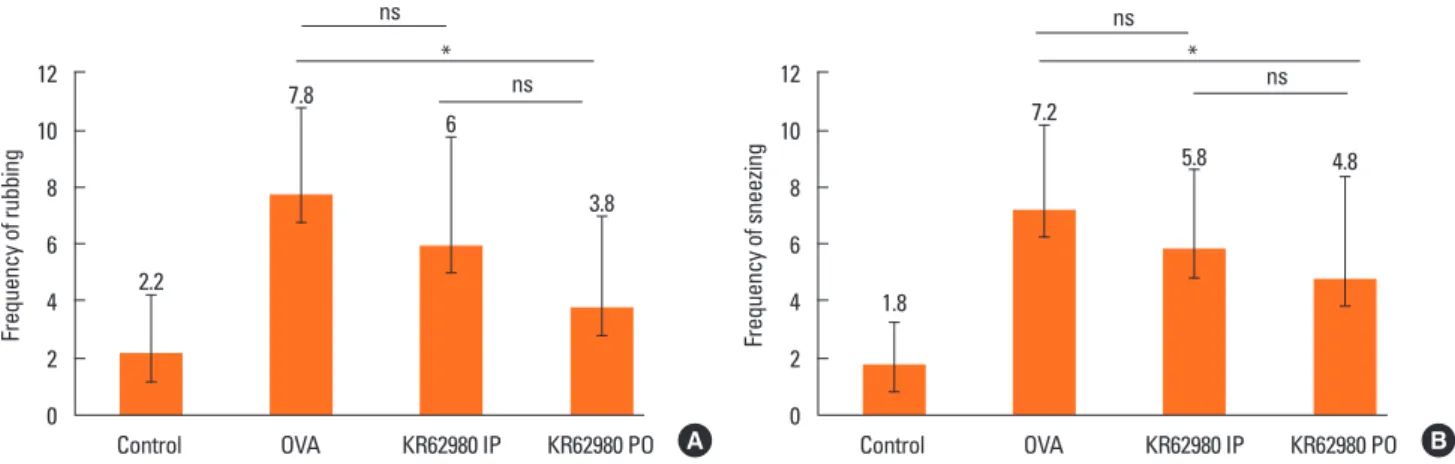
OVA KR62980 IP KR62980 PO B Fig. 2. Frequency of rubbing (A) and sneezing (B) for 10 minutes after the last ovalbumin (OVA) sensitization. The number of sneezing or nasal rubbing was signifi- cantly decreased in the KR62980-treated groups. *P<0.05. ns, not significant; OVA, ovalbumin; IP, intraperitoneal administration; PO, per oral administration.
was blinded to the experimental conditions.
Real-time polymerase chain reaction (PCR)
Total RNA was prepared from the nasal mucosa with TriZolre- agent (Invitrogen, Carlsbad, CA, USA). Complementary DNA (cDNA) was synthesized using superscript reverse
transcriptase (Invitrogen) and oligo (dT) primers (Fermentas, Burlington, ON, Canada). For the analysis of IL-4 (Mm00445258_
g1), IL-5 (Mm00439646_m1), IL-10 (Mm00439616_m1), IFN-γ (Mm99999071_m1), GAPDH (Mm03302249_g1), PDAR (Pre- Developed AssayReagent) kits of primers, and probes were pur-
chased from Applied Biosystems (Foster City, CA, USA). Amplifi- cation of IL-4, IL-5, IL-10, IFN-γ, and GAPDH cDNA was carried out on MicroAmp optical 96-well reaction plates (Applied Bio- systems). The reaction was performed using an ABI prism 7000 Sequence Detection System (Applied Biosystems). The average transcript levels of genes were then normalized to GAPDH.
Flow cytometric analysis
For cell-surface staining, splenic mononuclear cells were in- cubated with fluorescein isothiocyanate-conjugated anti- mouse CD4 antibody (eBioscience, San Diego, CA). For intra-
160 140 120 100 80 60 40 20
0 Control 10.03
133.92
108.65 108.64 ns
ns *
IL-4 (pg/mL)
OVA KR62980 IP KR62980 PO
3,000 2,500 2,000 1,500 1,000 500
0 Control 13.36
2,465.18
1,319.53
1,140.24
* *
*
IL-5 (pg/mL)
OVA KR62980 IP KR62980 PO
1,800 1,600 1,400 1,200 1,000 800 600 400 200 0
Control 236.5
948.7
1,548.4 1,498.0 ns
* *
IL-10 (pg/mL)
OVA KR62980 IP KR62980 PO
3,500 3,000 2,500 2,000 1,500 1,000 500 0
Control 465.32
990.94
2,933.82
1,914.22
*
* *
IFN-γ (pg/mL)
OVA KR62980 IP KR62980 PO C 100
80 60 40 20 0
Control 0
77.3
60.5
33.5 ns
* *
Total IgE (ng/mL)
OVA KR62980 IP KR62980 PO A 10
8 6 4 2 0
Control 0
7.37
6.60 5.80
ns ns
*
OVA-Specific IgE (ng/mL)
OVA KR62980 IP KR62980 PO B
Fig. 4. Effects of KR62980 on levels of total IgE (A) and OVA-specific IgE (B) in the serum, and Th1/Th2 cytokines (C) in the spleen supernatant. KR62980 treatment reduced total IgE/OVA-specific IgE (serum) and IL-4/IL-5 (splenocyte) production significantly, while there were significant increments in IL-10 levels in the splenocyte culture supernatant. *P<0.05. ns, not significant; OVA, ovalbumin; IP, intraperitoneal administration; PO, per oral administration.
cellular staining, cells stained with CD4 were incubated with fixation/permeabilization working solution, and Fc receptors were blocked with excess mouse Fc block. Cells were then stained with phycoerythrin (PE)-Cy5- conjugated anti-mouse Foxp3 and allophycocyanin (APC)-CD25 antibody (eBiosci- ence). CD4+CD25+Foxp3+ T cells were analyzed by flow cy- tometry (FACSCalibur; Becton Dickinson, San Jose, CA).12 Statistical analysis
Data are expressed as mean±SD. All statistical analyses were performed using SPSS 17.0 (SPSS Inc., Chicago, IL, USA), and the Mann-Whitney U test was used for mean analysis.
RESULTS
Effect of KR62980 on nasal symptoms
The number of nasal rubbing was more significantly more in- creased in group B than in group A (7.8±1.3 vs 2.2±1.0). The number of sneezing was also significantly more increased in group B than in group A (7.2±1.3 vs 1.8±1.0). Moreover, nasal rubbing/sneezing scores were significantly more decreased in KR62980-treated groups (groups C and D) than in group B (P=
0.018 and P=0.029, respectively) (Fig. 2).
Effects of KR62980 on eosinophilic inflammation
Histological analysis of the nasal mucosa obtained from the OVA group revealed grossly typical pathologic features of AR in the submucosa which was infiltrated with numerous inflam- matory cells. There were significant differences in the gross ap- pearance of cross sections between group C/D (KR62980-treat- ed mice) and group B (Fig. 3A).
Eosinophil counts in the nasal mucosa are shown in Fig. 3B.
Significant differences in eosinophil counts were found be- tween individual groups (group B vs group C, P=0.023; group B vs group D, P=0.028). The mean eosinophil count in groups B, C, and D were 21.9±11.7, 8.7±3.1, and 6.65±3.8, respectively.
The mean eosinophil count was more decreased in group D than in group C, without statistical significance.
Effecst of KR62980 on the production of OVA-specific IgE and inflammatory cytokines
The OVA-treated groups showed significantly higher total IgE and OVA-specific IgE levels than group A. Significant differenc- es were observed in total IgE levels between groups B, C, and D (group B vs group D, P=0.049; group C vs group D, P=0.034) (Fig. 4A). Also, OVA-specific IgE levels between groups B and D were significantly different (group B vs group D, P=0.049) (Fig.
120 100 80 60 40 20
0 Control 1.00
85.57
31.46 30.34
ns
*
*
IL-4 mRNA
OVA KR62980 IP KR62980 PO
7 6 5 4 3 2 1
0 Control 1.00
5.34 4.35
4.54 ns ns ns
IL-5 mRNA
OVA KR62980 IP KR62980 PO
12 10 8 6 4 2 0
Control 1.00
8.88 8.03
6.53
ns ns
*
IL-10 mRNA
OVA KR62980 IP KR62980 PO
1.30
1.10
0.90
0.70
0.50
Control 1.00
1.12
1.02 0.94
ns ns ns
IFN-γ mRNA
OVA KR62980 IP KR62980 PO Fig. 5. Effects of KR62980 on the expressions of IL-4, IL-5, IL-10, and IFN-r mRNAs in the nasal mucosa. Oral or intraperitoneal administration of KR62980 (groups C and D) reduced the expressions of these mRNAs compared to group B. *P<0.05. ns, not significant; OVA, ovalbumin; IP, intraperitoneal administration; PO, per oral administration.
4B). Similarly, the levels of IL-4 and IL-5 in the splenocyte cul- ture were significantly more elevated in the OVA-treated groups (groups B, C, and D) than in group A. KR62980 treatment signif- icantly decreased the levels of IL-4 and IL-5 (P=0.10 for groups B and D, and P=0.01 for group D). In addition, there were sig-
nificant increments in IL-10 levels in the splenocyte culture su- pernatant by OVA treatment (P<0.001 for each). KR62980 treat- ment induced further increments in IL-10 levels in groups C and D (Fig. 4C).
Fig. 6. Effects of KR62980 on the expression of IL-17 mRNA in the nasal tissue (A) and IL-17 in the splenocyte culture supernatant (B).The expression of IL-17 mRNA in the nasal tissue was reduced by administration of KR62980, while IL-17 expression in the splenocyte culture supernatant was not significantly reduced. ns, not significant; OVA, ovalbumin; IP, intraperitoneal administration; PO, per oral administration.
1,400 1,200 1,000 800 600 400 200 0
Control 194.14
1,182.16 1,118.98 1,105.53 ns ns ns
IL-17 (pg/mL)
OVA KR62980 IP KR62980 PO B Control OVA KR62980 IP A
IL-17 mRNA
GAPDH
KR62980 PO
104
103
102
101
100
104
103
102
101
100
104
103
102
101
100
104
103
102
101
100 100 101 102 103 104
100 101 102 103 104
100 101 102 103 104
100 101 102 103 104 Control
CD25
KR62980 IP
OVA
KR62980 PO 15.51%
17.87%
17.46%
18.29%
Foxp3
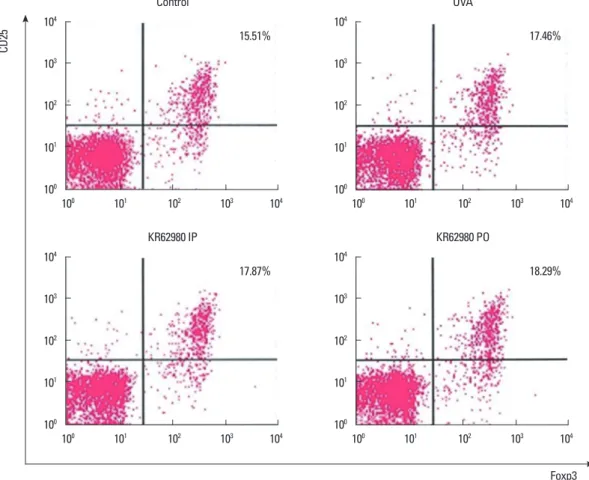
Fig. 7. Effects of KR62980 on the induction of the regulatory T-cell subgroups. After sensitization and challenge with OVA, a slight increase in CD4+CD25+FoxP3+
was observed, and the percentage of regulatory T cells seemed to further increase in the KR62980-treated group D. ns, not significant; OVA, ovalbumin; IP, intraperi- toneal administration; PO, per oral administration.
Effects of KR62980 on the Expressions of IL-4, 5, 10, and IFN-γ mRNAs
There were increases in the expressions of IL-4, IL-5, IL-10, and IFN-γ mRNAs in the allergic nasal mucosa compared to those in the control group (Fig. 5). However, the expressions of these mRNAs were more reduced in the KR62980-treated groups than in group B.
Effects of KR62980 on the Expressions of IL-17 and IL-17 mRNA
RT- PCR analysis showed that IL-17 mRNA expression in al- lergic nasal mucosa (group B) was increased, while it was re- duced by administration of KR62980 (groups C and D) (Fig.
6A). In addition, the cytokine IL-17 level in the splenocyte cul- ture supernatant seemed to be more decreased in groups C and D compared to group B, though it did not reach statistical sig- nificance (Fig. 6B).
Effects of KR62980 on CD4+CD25+Foxp3 Tregs
We examined the proportion of CD4+ T cells and regulatory T cells from the whole spleen class by flow cytometry. In the AR group, the percentage of regulatory T cells seemed to be in- creased in the KR62980-treated group D (Fig. 7).
DISCUSSION
PPAR-γ was originally known to regulate adipocyte differentia- tion and lipid metabolism.13 Since then PPAR-γ has been sug- gested to be an important immune regulator. PPAR-γ ligands have been proved to have anti-inflammatory activity in the mu- rine models of inflammatory diseases, such as arthritis, inflam- matory bowel disease, and asthma.13-17 Recent studies have re- ported that PPAR-γ activation by administration of PPAR-γ ago- nists or adenovirus carrying PPAR-γ cDNA decreases allergen-in- duced airway inflammation, subepithelial fibrosis, eosinophil in- filtration, and airway hyperresponsiveness.18 KR62980 has been developed to redeem the limitation of TZD PPAR-γ ligands.19-22
In this study, we evaluated the effect of KR62980, a novel non- TZD PPAR-γ ligand, on nasal allergic inflammation and exam- ined the role of PPAR-γ in an animal AR model. We found that activation of PPAR-γ by administration of KR62980 also sub- stantially inhibits the expressions of cytokines (IL-4 and IL-5) and eosinophillic inflammation. Suppression of Th2 cytokines has been found in local (nasal mucosa) and systemic (spleno- cyte culture supernatant) levels, which can explain the reduc- tion in allergic symptoms by KR62980. In case of Th1 cytokines, administration of KR62980 seemed to elevate INF-γ; however, to draw such a conclusion further studies would be needed be- cause there are discrepancies regarding IFN-γ levels between the local nasal tissue and the spleen supernatant. Based on these results, we conclude that, in terms of Th1/Th2 balance, KR62980 can suppress allergic inflammation by regulating Th2
cytokines.
IL-10 is an anti-inflammatory cytokine that down-regulates cellular immunity and allergic inflammation. IL-10 has been shown to modulate allergen-induced airway inflammation, in- hibit eosinophil survival and IgE synthesis, and down-regulate the expressions of IL-4 and IL-5 through T-helper type 2 lym- phocytes.23 In a previous study regarding IL-10 and PPAR-γ, the IL-10 level was increased in the lung tissue of a murine asthma model after ovalbumin inhalation and was further increased by administration of rosiglitazone and piglitazone.18 However, the definite role of IL-10 has not yet been clearly elucidated in AR.
Recently reported data regarding the nasal release of IL-10 and other cytokines or chemokines in AR demonstrated a significant increase in IL-10 at 5 hours after nasal allergen challenge; how- ever, it was significantly lower in AR subjects than in nonallergic subjects during natural pollen exposure, concluding that IL-10 may be related to the alleviation of nasal mucosal allergy.24
Our study with an ovalbumin-induced murine AR model re- vealed that activation of PPAR-γ by administration of KR62980 reduced eosinophilic inflammation in the nasal mucosal tissue.
The elevated IL-10 cytokine levels in the spleen supernatant af- ter ovalbumin challenge were further increased by administra- tion of KR62980. These findings suggest that an anti-inflamma- tory role of PPAR-γ in the pathogenesis of AR could be partially mediated through an IL-10-dependent mechanism. The elevat- ed IL-10 levels in splenocyte culture may have been attributed to the increased number of T reg cells by administration of KR62980, which was proven by FACS analysis. However, we could not identify further increments in IL-10 by KR62890 in the nasal mucosa. Although it is not clear why the reaction patterns are different in local nasal mucosa versus systemic one, the dif- ference may be due to the different main target of action besides the dissimilarity in protein and mRNA levels as we usually have been noticed. This difference may also be partially due to the sites of interest in the samples and measuring parameters (cyto- kine levels in the cell supernatant versus mRNA expression in the nasal mucosal tissue).
IL-17 was initially known to be associated with neutrophil- dominant inflammation as a promoter of granulopoiesis, neu- trophil accumulation, and neutrophil activation in the lung tis- sue. Increasing evidence has been published that IL-17 is relat- ed to allergic eosinophillic inflammation as well as neutrophillic inflammation. Also, IL-17 is increased in the sera of seasonal AR patients and AR modelmice.10,11 Another study elucidating the relationship between PPAR-γ and IL-17 indicated that adminis- tration of PPAR-γ agonists substantially reduced increases IL-17 protein levels and mRNA expression via NF-kB inhibition after ovalbumin inhalation in an animal asthma model.25 Moreover, it has been demonstrated that treatment with rosiglitazone sig- nificantly decreases IL-17 expression in an animal model of in- flammatory bowel disease. As expected, in our study the expres- sions of IL-17 cytokine and mRNA were up-regulated in an ani-
mal model of OVA-induced AR. Thereafter, our results demon- strated that KR62980 seems to suppress the IL-17 cytokine level in the spleen supernatant and IL-17 mRNA expression in the nasal mucosal tissue. This result is in agreement with that of a previous study conducted with KR62980, in which allergic cyto- kines in the bronchoalveolar lavage fluid, as assessed by ELISA, were decreased in the KR62980-treated group. Taken together, KR62980, a non-TZD PPAR-γ agonist, like other TZD PPAR-γ ag- onists, may also play a role in the amelioration of inflammation in a murine AR model.
It has been reported that PPAR-γ enhances regulatory T cells through PPAR-γ-dependent or PPAR-γ-independent mecha- nisms by increasing retinoic acid synthesis from murine splenic dendtric cells.26-28 Recently, the therapeutic effect of pioglitazone on the induction of regulartory T cells in a PPAR-γ-dependent fashion was reported in a murine AR model.29 In this mecha- nism, pioglitazone can reduce GATA-3 and T bet expression and induce Foxp3+ expression in CD4+ T cells after challenge with OVA. Moreover, it has been reported that regulatory T cells can skew a reduction in Th1 and Th2 subpopulations. In a human study, it has also been demonstrated that the ability of regulato- ry T cells to suppress Th17 cytokine production is significantly decreased in the AR group.30 In our study, the proportion of CD4+CD25+Foxp3+ T cells in the spleen was slightly increased in the KR62980-treated groups (groups C and D) (Fig. 7). Foxp3+
is an intracellular marker of regulatory T cells. Based on the in- creasing tendency of IL-10 along with the proportion of CD4+
CD25+Foxp3+ T cells, it is conceivable that the expression of Foxp3+ induced by KR62980 results in an increase in the IL-10 level and, in turn, affects the levels of Th2, Th1, and Th17 cyto- kines. These findings indicate that KR62980, like other PPAR-γ agonists, may have the potential to regulate induction of specific T-cell subgroups.
Additionally, the anti-inflammatory effect of KR62980 seemed to be more remarkable via oral administration than via intraper- itoneal administration in terms of some parameters. The bio- availability after oral administration is reported to be approxi- mately 60.9%, and the metabolic half-life of 0.1-10 μM KR-62980 is reported to be 11.5-15.2 minutes in rat liver microsomes.31 It is reasonable to assume that oral administration of KR62980 would reach a valid concentration more easily. However, fur- ther studies are needed to draw a definite conclusion.
In conclusion, our results demonstrate that administration of non-TZD PPAR-γ agonists may modulate allergic symptoms and immunologic features via not only suppression of Th2 cy- tokines but also regulation of IL-10/IL-17 expression. Hence, non-TZD PPAR-γ agonists may have a therapeutic potential to treat allergic nasal inflammation.
ACKNOWLEDGMENTS
The authors would like to gratefully and sincerely thank Dr. Jin
Hee Ahn, a principle researcher of the Division of Drug Discov- ery Research, Korea Research Institute of Chemical Technolo- gy, for his generous donation of KR62980.
ORCID
Ji-Eun Lee http://orcid.org/0000-0001-9043-140X
REFERENCES
1. Evans RM. The steroid and thyroid hormone receptor superfamily.
Science 1988;240:889-95.
2. Moore KW, de Waal Malefyt R, Coffman RL, O’Garra A. Interleu- kin-10 and the interleukin-10 receptor. Annu Rev Immunol 2001;
19:683-765.
3. Oberfield JL, Collins JL, Holmes CP, Goreham DM, Cooper JP, Cobb JE, et al. A peroxisome proliferator-activated receptor gamma ligand inhibits adipocyte differentiation. Proc Natl Acad Sci U S A 1999;96:6102-6.
4. Rocchi S, Picard F, Vamecq J, Gelman L, Potier N, Zeyer D, et al. A unique PPARgamma ligand with potent insulin-sensitizing yet weak adipogenic activity. Mol Cell 2001;8:737-47.
5. Won HY, Min HJ, Ahn JH, Yoo SE, Bae MA, Hong JH, et al. Anti-aller- gic function and regulatory mechanisms of KR62980 in allergen-in- duced airway inflammation. Biochem Pharmacol 2010;79:888-96.
6. Maggi E. The TH1/TH2 paradigm in allergy. Immunotechnology 1998;3:233-44.
7. Ngoc PL, Gold DR, Tzianabos AO, Weiss ST, Celedón JC. Cytokines, allergy, and asthma. Curr Opin Allergy Clin Immunol 2005;5:161-6.
8. Molet S, Hamid Q, Davoine F, Nutku E, Taha R, Pagé N, et al. IL-17 is increased in asthmatic airways and induces human bronchial fi- broblasts to produce cytokines. J Allergy Clin Immunol 2001;108:
430-8.
9. Chakir J, Shannon J, Molet S, Fukakusa M, Elias J, Laviolette M, et al.
Airway remodeling-associated mediators in moderate to severe asthma: effect of steroids on TGF-beta, IL-11, IL-17, and type I and type III collagen expression. J Allergy Clin Immunol 2003;111:1293-8.
10. Wong CK, Ho CY, Ko FW, Chan CH, Ho AS, Hui DS, et al. Proin- flammatory cytokines (IL-17, IL-6, IL-18 and IL-12) and Th cyto- kines (IFN-γ, IL-4, IL-10 and IL-13) in patients with allergic asth- ma. Clin Exp Immunol 2001;125:177-83.
11. Quan SH, Zhang YL, Han DH, Iwakura Y, Rhee CS. Contribution of interleukin 17A to the development and regulation of allergic in- flammation in a murine allergic rhinitis model. Ann Allergy Asth- ma Immunol 2012;108:342-50.
12. Fields, ML, Hondowicz BD, Metzgar MH, Nish SA, Wharton GN, Picca CC, et al. CD4+ CD25+ regulatory T cells inhibit the matura- tion but not the initiation of an autoantibody response. J Immunol 2005;175:4255–64.
13. Ueki S, Matsuwaki Y, Kayaba H, Oyamada H, Kanda A, Usami A, et al. Peroxisome proliferator-activated receptor gamma regulates eosinophil functions: a new therapeutic target for allergic airway inflammation. Int Arch Allergy Immunol 2004;134 Suppl 1:30-6.
14. Serhan CN, Devchand PR. Novel antiinflammatory targets for asthma.
A role for PPARgamma? Am J Respir Cell Mol Biol 2001;24:658-61.
15. Scher JU, Pillinger MH. 15d-PGJ2: the anti-inflammatory prosta- glandin? Clin Immunol 2005;114:100-9.
16. Park SJ, Lee YC. Peroxisome proliferator-activated receptor gamma
as a novel therapeutic target in asthma. J Asthma 2008;45:1-8.
17. Lee KS, Park SJ, Kim SR, Min KH, Jin SM, Lee HK, et al. Modulation of airway remodeling and airway inflammation by peroxisome proliferator-activated receptor gamma in a murine model of tolu- ene diisocyanate-induced asthma. J Immunol 2006;177:5248-57.
18. Kim SR, Lee KS, Park HS, Park SJ, Min KH, Jin SM, et al. Involve- ment of IL-10 in peroxisome proliferator-activated receptor gam- ma-mediated anti-inflammatory response in asthma. Mol Phar- macol 2005;68:1568-75.
19. Kim KR, Lee JH, Kim SJ, Rhee SD, Jung WH, Yang SD, et al. KR- 62980: a novel peroxisome proliferator-activated receptor gamma agonist with weak adipogenic effects. Biochem Pharmacol 2006;
72:446-54.
20. Scheen AJ. Combined thiazolidinedione-insulin therapy: should we be concerned about safety? Drug Saf 2004;27:841-56.
21. Martens FM, Visseren FL, Lemay J, de Koning EJ, Rabelink TJ. Met- abolic and additional vascular effects of thiazolidinediones. Drugs 2002;62:1463-80.
22. Chui PC, Guan HP, Lehrke M, Lazar MA. PPARgamma regulates adipocyte cholesterol metabolism via oxidized LDL receptor 1. J Clin Invest 2005;115:2244-56.
23. Takanaski S, Nonaka R, Xing Z, O’Byrne P, Dolovich J, Jordana M.
Interleukin 10 inhibits lipopolysaccharide-induced survival and cytokine production by human peripheral blood eosinophils. J Exp Med 1994;180:711-5.
24. Baumann R, Rabaszowski M, Stenin I, Tilgner L, Scheckenbach K, Wiltfang J, et al. Comparison of the nasal release of IL-4, IL-10, IL- 17, CCL13/MCP-4, and CCL26/eotaxin-3 in allergic rhinitis during
season and after allergen challenge. Am J Rhinol Allergy 2013;27:
266-72.
25. Park SJ, Lee KS, Kim SR, Min KH, Choe YH, Moon H, et al. Peroxi- some proliferator-activated receptor gamma agonist down-regu- lates IL-17 expression in a murine model of allergic airway inflam- mation. J Immunol 2009;183:3259-67.
26. Housley WJ, O’Conor CA, Nichols F, Puddington L, Lingenheld EG, Zhu L, et al. PPARgamma regulates retinoic acid-mediated DC in- duction of Tregs. J Leukoc Biol 2009;86:293-301.
27. Wohlfert EA, Nichols FC, Nevius E, Clark RB. Peroxisome prolifera- tor-activated receptor gamma (PPARgamma) and immunoregula- tion: enhancement of regulatory T cells through PPARgamma-de- pendent and -independent mechanisms. J Immunol 2007;178:
4129-35.
28. Klotz L, Dani I, Edenhofer F, Nolden L, Evert B, Paul B, et al. Peroxi- some proliferator-activated receptor gamma control of dendritic cell function contributes to development of CD4+ T cell anergy. J Immunol 2007;178:2122-31.
29. Wang W, Zhu Z, Zhu B, Ma Z. Peroxisome proliferator-activated re- ceptor-gamma agonist induces regulatory T cells in a murine mod- el of allergic rhinitis. Otolaryngol Head Neck Surg 2011;144:506-13.
30. Cheng X, Lou W, Wang C, Zhang W, Han D, Zhang L. FOXP3- marked IL-17a-producing regulatory T cells are increased in pa- tients with allergic rhinitis. Acta Otolaryngol 2012;132:1311-7.
31. Park JS, Kim MS, Song JS, Choi SH, Lee BH, Woo J, et al. Dose-inde- pendent pharmacokinetics of a new peroxisome proliferator-acti- vated receptor-γ agonist, KR-62980, in Sprague-Dawley rats and ICR mice. Arch Pharm Res 2011;34:2051-8.