5. Reactors in Series XI
Feb/28 2011 Spring 1
o Example 3
- Reactors in Series: CSTR-PFR-CSTR
• Using either the data in Table 1, calculate the reactor volumes V1, V2, and V3 for the CSTR/PFR/CSTR
reactors in series sequence shown in Figure 1 along with the corresponding conversion.
5. Reactors in Series XII
o Example 3
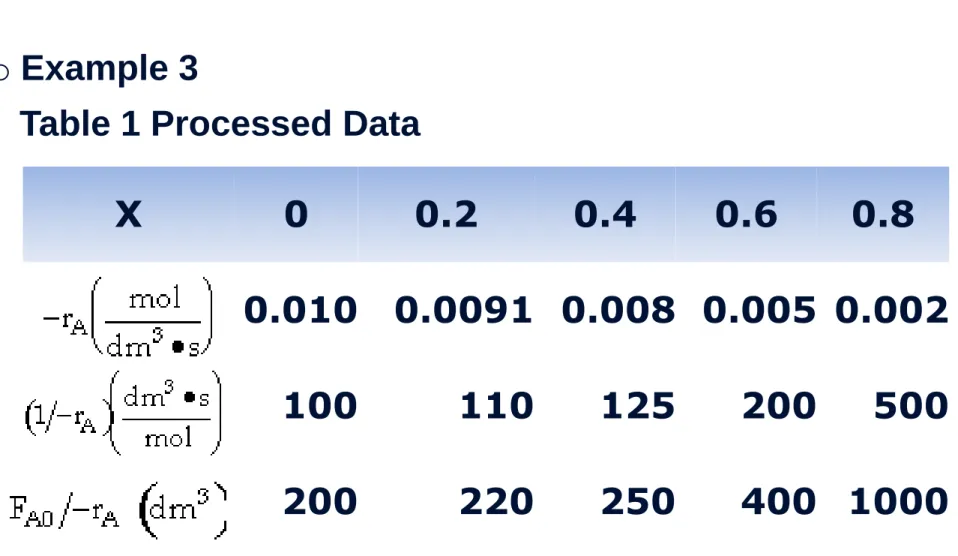
Table 1 Processed Data
X 0 0.2 0.4 0.6 0.8
0.010 0.0091 0.008 0.005 0.002
100 110 125 200 500
200 220 250 400 1000
5. Reactors in Series XIII
Feb/28 2011 Spring 3
o Example 4
- The adiabatic exothermic irreversible gas phase reaction is to be carried out in a flow reactor for a stoichiometric feed of A and B
5. Reactors in Series XIV
o Example 4
a) What PFR volume is necessary to achieve 50%
conversion?
V1 =
b) What CSTR volume is necessary to achieve 50%
conversion?
V1 =
c) What CSTR volume must be added to raise the conversion in Part (b) to 80%?
V2 =
d) What PFR volume must be added to raise the conversion in Part (b) to 80%?
5. Reactors in Series XV
Feb/28 2011 Spring 5
o Example 5
a) Which system is most efficient for a intermediate conversion of (0.3)?
b) Which system is most efficient for a intermediate conversion of (0.65)?
c) Which system makes the best use of the reactor volume (i.e., least wasted volume)?
5. Reactors in Series XVI
o Example 5
5. Reactors in Series XV
Feb/28 2011 Spring 7
o Example 6
- An adiabatic liquid phase exothermic reaction is to be carried out in a 25 dm3 CSTR. The entering molar flow rate of A times the reciprocal of the rate of
reaction is shown below as a function of
conversion. What is the conversion exiting the CSTR?
5. Reactors in Series XVI
o Total volumes and reactor sequencing 1
- The maximum conversion (minimum volume) in the sequencing reactor
⇒ it depends
• not only on the shape of the (FA0/-rA) vs X plot
• but also the reactor size
- Calculating the reactor volume necessary to achieve a specified conversion
• rxn rate depends on conversion, initial conc. of the reactants, T, and P
- To get the right size of the flow reactor, only -r = f(X) is needed
6. Some Further Definitions (p. 57)
Feb/28 2011 Spring 9
o Space time(τ)
- Dividing the reactor volume by the volumetric flow rate entering the reactor
- The time necessary to process one volume of reactor fluid at the entrance conditions
• the time it takes for the amount of fluid that takes up the entire volume of the reactor to either
completely enter or completely exit the reactor
☞ holding time or mean residence time v0
V
6. Some Further Definitions II
Feb/28 2011 Spring 11
o Space velocity(SV)
- Reciprocal of the space time
- LHSV, liquid-hourly SV
• the entering volumetric flow rate is frequently
measured as that of liquid feed rate at 60◦F or 75 ◦F, even though vapor or some higher T
- GHSV, gas-hourly SV
• measured at STP
SV 1 SV
0
V v
V v V
v0 liquid 0 STP
GHSV
SHSV