Received December 9, 2019 Revised March 10, 2020 Accepted March 11, 2020 Corresponding author: Yi Yi Htun Department of Pharmacology, University of Medicine, 30 st, Between 73x74 , Chanayetharsan Township, Mandalay 100102, Myanmar
Tel: +95-9798881698 Fax: +95-9798881698 E-mail: [email protected]
Effect of cytochrome P450 3A5 polymorphism on the pharmacokinetics of tacrolimus in
renal transplant recipients
Yi Yi Htun
1, Nwe Nwe Than
1, Htar Kyi Swe
21Department of Pharmacology, University of Medicine, Mandalay, Myanmar
2Department of Nephrology, University of Medicine, Mandalay, Myanmar
Background: Renal transplant is an effective treatment option for end-stage kidney dis- ease and tacrolimus is one of the most commonly used immunosuppressant drugs in renal transplant patients. Tacrolimus is a substrate of cytochrome P450 3A5 (CYP3A5), and a narrow therapeutic index and large inter-individual variability. The objective of this study was to determine the frequency of CYP3A5*3 polymorphism and its effect on the pharmacokinetics of tacrolimus in post-renal transplant patients at Mandalay Gen- eral Hospital.
Methods: Three different genotypes of CYP3A5 were determined by polymerase chain reaction-restriction fragment length polymorphism in 54 post-renal transplant recipi- ents. Tacrolimus trough concentrations (C
trough) were measured by enzyme multiplied immunoassay technique following method validation. The apparent clearance (CL/F) was calculated from measured C
trough.
Results: The frequency of CYP3A5*1 allele was 0.24 and that of CYP3A5*3 allele was 0.76 in the study sample. There were a total of 33 CYP3A5 non-expressors (patients with CYP3A5*3/*3 genotype) and 21 CYP3A5 expressors (patients with CYP3A5*1/*1 or CYP3A5*1/*3 genotype), respectively. CL/F was significantly lower in the non-expressor group than in the expressor group (mean±standard deviation, 12.53±5.28 vs. 21.22±5.95 L/hr; P<0.001). The mean C
troughand concentration dose ratio (C/D) for tacrolimus in CYP3A5 non-expressors were significantly higher than those in CYP3A5 expressors (C
trough, 7.14±2.56 vs. 5.92±1.76 ng/mL; C/D, 6.92±4.11 vs. 2.89±1.85 ng/mL/mg), respec- tively (P<0.05).
Conclusions: In this study, 76% of the Myanmar renal transplant recipients carried the CYP3A5*3 allele that was associated with lower functional activity of the CYP3A5 en- zyme a lower CL/F of tacrolimus in these Thus, CYP3A5 polymorphism influences the pharmacokinetics of tacrolimus, which may affect the pharmacological response to tacrolimus.
Keywords: Tacrolimus; Pharmacokinetics; CYP3A5*3 polymorphism; Renal transplant recipients
© The Korean Society for Transplantation This is an Open Access article distributed under the terms of the Creative Commons Attribution Non-Commercial License (http://creativecommons.org/licenses/
by-nc/4.0/) which permits unrestricted non-commercial use, distribution, and reproduction in any medium, provided the original work is properly cited.
pISSN 2671-8790
eISSN 2671-8804
INTRODUCTION
For patients with end-stage kidney disease, kidney trans- plantation is a successful means of improving their qual- ity of life. Immunosuppressive agents are usually taken lifelong by kidney transplant patients since it is critical to prevent episodes of both, early and late acute rejection, as well as chronic allograft nephropathy in transplant patients [1]. Tacrolimus is one of the most commonly used immu- nosuppressant drugs in renal transplant patients. A suc- cessful transplantation outcome depends on an optimal balance between under-immunosuppression and over-im- munosuppression [2]. Tacrolimus is used as the backbone of immunosuppressant therapy for more than 90% of all renal transplant recipients in the United States [3]. In Thai- land, 83% of all renal transplant recipients used tacrolimus as part of their immunosuppressant regimen [4].
As a substrate of cytochrome P450 3A5 (CYP3A5), tacrolimus is characterized by a narrow therapeutic index and a large inter-individual pharmacokinetic variability.
Several factors influence the pharmacokinetics of tac- rolimus, including hematocrit, serum albumin, ethnicity, drug interactions, as well as genetic polymorphisms [5].
CYP3A5 genetic polymorphisms may be associated with variation in the pharmacokinetics of tacrolimus in Asian populations. It is one of the main enzymes that metab- olizes tacrolimus, and its genetic polymorphism is com- mon among Asian populations. CYP3A4 is also involved in the metabolism of tacrolimus, however, CYP3A4 poly- morphisms are probably rare in Asians populations [6-11].
CYP3A5 * 3 is the most common non-functional variant of CYP3A5, while CYP3A5 * 1 is the functional CYP3A5 variant [10]. Individuals with the CYP3A5 * 3/ * 3 genotype are termed as CYP3A5 non-expressors while those with the CYP3A5 * 1/ * 1 and CYP3A5 * 1/ * 3 genotypes are termed
as CYP3A5 expressors [12]. The allele frequency of CY- P3A5 * 3 among South Asian and East Asian populations is 66.8% and 71.3% [13].
In a previous study in 173 post-renal transplant pa- tients, CYP3A5 expressors exhibited a higher apparent oral tacrolimus clearance than CYP3A5 non-expressors [14]. However, Boudia et al. [15] reported that the CYP3A5 polymorphisms did not influence tacrolimus pharmaco ki- netics in an Algerian population (n=62). Further, tacrolimus clearance was not related to the CYP3A5 genotype in sta- ble renal transplant recipients (n=118) [16].
Thus immunosuppression with tacrolimus is still un- successful in some patients, while causing toxicity in oth- ers. CYP3A5 polymorphism is associated with variation in tacrolimus pharmacokinetics in many ethnic groups.
However, limited data is available in Myanmar renal trans- plant recipients about the effects of CYP3A5 polymor- phism on the pharmacokinetics of tacrolimus. Therefore, this study aimed to determine the frequency of the CY- P3A5 * 3 genetic polymorphism and its effect on the phar- macokinetics of tacrolimus in renal transplant recipients.
METHODS Ethical Approval and Study Design
Descriptive study was conducted for genotype frequen- cy of CYP3A5 * 3/ * 3, CYP3A5 * 1/ * 1, and CYP3A5 * 1/ * 3 and hospital based cross-sectional comparative study was conducted for pharmacokinetic study of tacrolimus in those genotype groups. This study was conducted after ethical approval by the Research Ethics Committee of the University of Medicine, Mandalay (ID No. 23 [pharmaco]
UMM/2016). Written informed consent was obtained from all patients. Fifty-four stable renal transplant recipients (Myanmar Ethnic) who underwent renal transplantation at Mandalay General Hospital were included this study.
The study was conducted at the Common Research Laboratory and Department of Pharmacology at the Uni- versity of Medicine Mandalay. There were total 76 num- bers of post renal transplant patients. All renal transplant recipients (1 to 12 months posttransplant) from Mandalay General Hospital that were receiving tacrolimus Pangraf (Panacea Biotec, New Delhi, India), prednisolone, and my- cophenolate mofetil as immunosuppressant agents, were invited to participate in this research. Patients who were prescribed cyclosporine were excluded from this study.
HIGHLIGHTS
• The apparent clearance of tacrolimus was significantly lower in CYP3A5 non-expressor than that of CYP3A5 expressor in renal transplant recipients at Mandalay General Hospital.
• Seventy-six percent of Myanmar renal transplant recip- ients have CYP3A5*3 allele.
• CYP3A5 polymorphism may influence the pharmacoki-
netics of tacrolimus in Myanmar population.
The objective and procedures of the study were explained in detail to each patient, and thereafter their decision to participate in the study was entirely voluntary. Tacroli- mus doses were administered twice daily and adjusted to trough concentrations (C
trough) between 5 and 12 ng/
mL using aminimization dosing protocol, posttransplant duration, and clinical response. A whole blood sample (5 mL) was collected (15–30 minutes) prior to administra- tion of the immunosuppressive drug and stored at –20°C until analysis.
Genotyping
All patient samples were analyzed in the Common Re- search Laboratory (University of Medicine Mandalay) us- ing polymerase chain reaction (PCR)-restriction fragment length polymorphism analysis. Purified genomic DNA was extracted by Geneaid DNA extraction kit (Geneaid Biotech Ltd; Shijr City, New Taipei City, Taiwan) from 200 µL of the whole blood samples (collected in ethylenedi- aminetetraacetic acid tubes) following manufacturer in- structions. The extracted DNA was stored at –20°C until analysis. PCR amplification and digestion with specific restriction enzyme DdeI (New England Biolabs, Ipswich, MA, USA) were performed as per, previously described methods [17].
Analysis of Tacrolimus C
troughTacrolimus whole blood C
troughwere measured using En- zyme Multiplied Immunoassay Technique (EMIT; Siemens Healthcare Diagnostics, Newark, DE, USA) after method validation. Assay validation was conducted with a cali- bration standard curve ranging from 0 to 30 ng/mL. The linearity of the assay method was evaluated using six different concentrations of tacrolimus (0, 2.5, 5, 10, 20, and 30 ng/mL). Three quality control (QC) samples were prepared at 4.6, 11.0, and 22.0 ng/mL (Siemens) and were coanalyzed with all samples and standards. The inter-day and intra-day coefficient of variation for each QC sample was <4%, and <8%, respectively.
Calculation of Concentration Dose Ratio and Apparent Clearance
The apparent clearance (CL/F) was calculated from measured tacrolimus C
troughby JPKD version 3.0 soft- ware (Pharmdatatech, Taiwan). The software is the CL/
F program based on Bayesian pharmacokinetic estima- tion models using published population pharmacokinetic parameters and is easy to use. The parameters, including
tacrolimus C
trough, tacrolimus concentration dose ratio (C/
D) and CL/F were compared between CYP3A5 non-ex- pressor and expressor groups.
Statistical Analysis
The data were collected with proforma. After checking for completeness, the data were analyzed by Stata ver. 13 (Stata Corp., College Station, TX, USA). The frequency of the different genotypes (CYP3A5 * 3/ * 3, CYP3A5 * 1/ * 1, and CYP3A5 * 1/ * 3) were estimated by counting and expressed as a percentage. Allelic (CYP3A5 * 1 and CYP3A5 * 3) fre- quencies were calculated using a Hardy-Weinberg equi- librium calculator [18]. Mann-Whitney U-tests were used for comparison of tacrolimus C
trough, C/D, and CL/F be- tween the non-expressors (CYP3A5 * 3/ * 3) and expressor (CYP3A5 * 1/ * 1 and CYP3A5 * 1/ * 3) groups. A P-value <0.05 was considered as statistically significant.
RESULTS
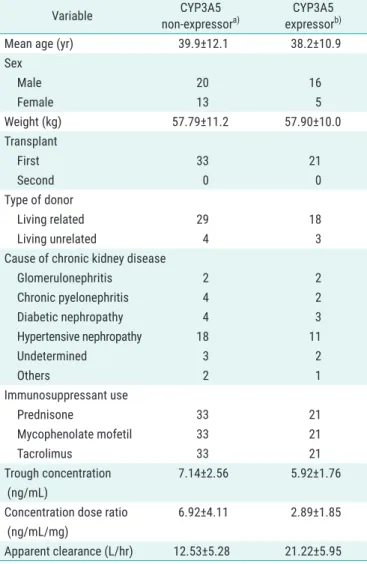
The allelic frequency for CYP3A5 was calculated using the Hardy-Weinberg equilibrium calculator. The observed frequencies of CYP3A5 * 1 and CYP3A5 * 3 were 0.24 and 0.76, respectively (Fig. 1), which were not different from their expected frequencies. The characteristics of the renal transplant patients (Myanmar ethnics, n=54) are de- scribed in Table 1.
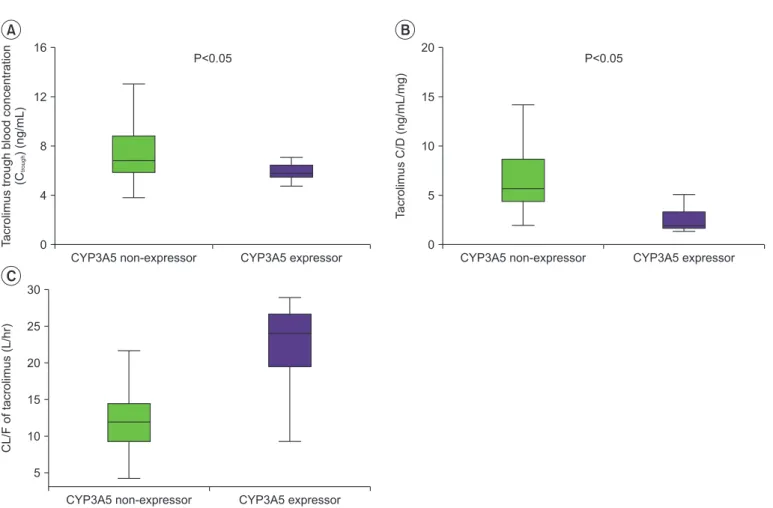
The means and standard deviations (SDs) of the mea- sured whole blood trough C/D and CL/F of tacrolimus in CYP3A5 non-expressor and CYP3A5 expressor groups are shown in Fig. 2. The CL/F of tacrolimus in CYP3A5 non-expressors was significantly lower than that in CY- P3A5 expressors (P<0.05).
DISCUSSION
In this study, the frequency of the CYP3A5 * 3 polymor-
phism was identified in 54 post-renal transplant patients
(Myanmar ethnics) with post-renal transplant duration of
1 to 12 months were recruited in order to include patients
in a stable posttransplant condition. The pharmacokinet-
ics of tacrolimus were compared between the CYP3A5
non-expressor (CYP3A5 * 3/ * 3) and CYP3A5 expressor
(CYP3A5 * 1/ * 1 and CYP3A5 * 1/ * 3) genotype groups.
The mean±SD whole blood C
troughof tacrolimus in the CYP3A5 non-expressor and expressor groups were 7.14±2.56 and 5.92±1.76 ng/mL, respectively. These were within the target therapeutic range of 5 to 20 ng/mL. The mean C
troughof the CYP3A5 non-expressor group was significantly higher than that of the CYP3A5 expressor group (P<0.001). Tacrolimus is primarily metabolized by the highly polymorphic CYP3A5 enzyme in the liver.
The CYP3A5 * 3 non-expressor group had higher trough tacrolimus concentrations than the CYP3A5 * 3 expressor group, suggesting that tacrolimus metabolism in patients with the CYP3A5 * 3/ * 3 genotype is higher than that in patients with CYP3A5 * 1/ * 3 and CYP3A5 * 1/ * 1 genotypes.
These results are similar to those found in a study con- ducted in 165 renal transplant patients, where the tac- rolimus C
troughin the CYP3A5 non-expressor group were significantly higher than those of the CYP3A5 expressor group (P<0.05), suggesting that CYP3A5 * 3 is a major ge- netic factor affecting tacrolimus concentrations in renal transplant recipients [19]. Additionally, in studies evalu- ating Korean patients carrying the CYP3A5 * 3 allele, ho- mozygotes showed significantly higher tacrolimus con- centrations than patients carrying at least one CYP3A5 * 1 allele (n=12), and CYP3A5 polymorphism significantly af- fected the achievement of target tacrolimus trough levels (n=62) [20,21].
The mean C/D of tacrolimus for the CYP3A5 non-ex- pressor group (6.92±4.11 ng/mL/mg) was significant- ly higher than that for the CYP3A5 expressor group (2.89±1.85 ng/mL/mg, P<0.001). This finding was also reported in other studies [22-26], suggesting that the CYP3A5 6986A>G polymorphism in renal transplant re- cipients influences the tacrolimus C/D. The mean CL/F in the CYP3A5 non-expressor group (12.53±5.28 L/hr) was significantly lower than that in the CYP3A5 expressor group (21.22±5.95 L/hr, P<0.001). In a previous study the pharmacokinetics of tacrolimus, CL/F was lower in the CYP3A5 non-expressor group than in the CYP3A5 expres- sor group [12,27].
Tacrolimus is considered as a backbone agent in immunosuppression protocols for the management of renal transplant patients, and the drug dose is adjusted according to routine monitoring of its blood levels in or- der to maintain adequate immunosuppression to avoid acute rejection and to minimize adverse effects. Other variables that may contribute to the pharmacokinetic dif- ferences between groups were investigated by comparing demographic factors including age, sex, and body weight
0.24%
0.76%
CYP3A5*1 CYP3A5*3
Fig. 1. Frequency (%) of CYP3A5*1 and CYP3A5*3 allele in renal trans-
plant recipients (Myanmar ethnics, n=54).
Table 1. Characteristics of CYP3A5 non-expressor and expressor
Variable CYP3A5
non-expressor
a)CYP3A5 expressor
b)Mean age (yr) 39.9±12.1 38.2±10.9
Sex
Male 20 16
Female 13 5
Weight (kg) 57.79±11.2 57.90±10.0
Transplant
First 33 21
Second 0 0
Type of donor
Living related 29 18
Living unrelated 4 3
Cause of chronic kidney disease
Glomerulonephritis 2 2
Chronic pyelonephritis 4 2
Diabetic nephropathy 4 3
Hypertensive nephropathy 18 11
Undetermined 3 2
Others 2 1
Immunosuppressant use
Prednisone 33 21
Mycophenolate mofetil 33 21
Tacrolimus 33 21
Trough concentration (ng/mL)
7.14±2.56 5.92±1.76
Concentration dose ratio (ng/mL/mg)
6.92±4.11 2.89±1.85
Apparent clearance (L/hr) 12.53±5.28 21.22±5.95 Values are presented as mean±standard deviation.
a)
CYP3A5*3/*3, n=33;
b)CYP3A5*3/*1 and CYP3A%*1/*1, n=21.
between the and non-expressor groups. No demographic factor showed a significant difference between the two groups other than sex. However, Fitzsimmons et al. [28]
observed no sex-specific effects on the pharmacokinetic profile of tacrolimus. Therefore, variations in whole blood tacrolimus concentration in this study are likely to be re- lated to the genetic polymorphism of CYP3A5 * 3.
Factors other than CYP3A5 polymorphism that can affect the CL/F of tacrolimus include age, race, post- transplant duration, albumin levels, hematocrit levels, and corticosteroid dose. A lower hematocrit and a lower plasma albumin concentration may result in a higher un- bound fraction of tacrolimus and a consequent increase in clearance. Conversely, a higher hematocrit and a higher plasma albumin concentration would result in a low- er clearance of tacrolimus [29]. However, in the current study, posttransplant duration and plasma albumin levels in all patients were comparable and not different between
the CYP3A5 expressor and non-expressor groups. Cor- ticosteroid dose in all patients were also comparable and not different between these two groups. The assay used in this study, the EMIT 2000 tacrolimus assay, was reported to be free from hematocrit interference in the range of 25%–60%, and all the patients in this study had hematocrit levels in the range of 25%–55%. Therefore, the possibility of a bias for low or high hematocrit values to tacrolimus clearance can be ruled out.
In this study, there were significant differences in tac- rolimus C
trough, C/D, and CL/F between CYP3A5 non-ex- pressor and expressor groups. Clearance is one of the most important parameters in clinical pharmacokinetics.
Clearance may be large, if enzymes have a high capaci- ty to metabolize a drug, and fit may be small if enzymes have a limited capacity to metabolize the drug [30]. Thus, a significantly lower CL/F of tacrolimus in the non-ex- pressor group may signify that individuals with two al-
CYP3A5 non-expressor 16
12
8
4
CYP3A5 expressor Tacrolimustroughbloodconcentration (C)(ng/mL)
P<0.05
0
A B
C
20
15
10
5
TacrolimusC/D(ng/mL/mg)
P<0.05
0
CYP3A5 non-expressor CYP3A5 expressor 30
25
20 15
10
5
CL/Foftacrolimus(L/hr)
CYP3A5 non-expressor CYP3A5 expressor
trough
Fig. 2. (A) Comparison of mean trough concentration of tacrolimus between CYP3A5 non-expressor and expressor. (B) Comparison of mean tacrolimus