https://doi.org/10.5468/ogs.2016.59.6.498 pISSN 2287-8572 · eISSN 2287-8580
Introduction
Polycystic ovary syndrome (PCOS) is one of the most com- mon endocrine disorders, occurring in 5% to 10% of women of reproductive age [1]. Currently, the diagnosis of PCOS [2]
is based on the following three criteria: hyperandrogenism, oligo-anovulation, and detection of polycystic ovaries (PCO) on ultrasound. In addition to complications related to the chronic ovulatory dysfunction, metabolic disturbances such as dyslipidemia, impaired glucose tolerance, and type 2 diabetes mellitus (T2DM) can concomitantly occur with PCOS [3].
The characteristic hormonal features in addition to hy-
Association between serum gonadotropin level
and insulin resistance-related parameters in Korean women with polycystic ovary syndrome
Chan-Hong Park 1 , Sungwook Chun 2
1
Health Care Division, The Provincial Office of Jeollanamdo, Muan;
2Department of Obstetrics and Gynecology, Haeundae Paik Hospital, Inje University College of Medicine, Busan, Korea
Objective
To evaluate the relationship between serum gonadotropin level and parameters related to insulin resistance in Korean women with polycystic ovary syndrome (PCOS).
Methods
This retrospective study included 138 women aged 18 to 35 years who were newly diagnosed with PCOS according to the Rotterdam consensus. Participants were divided into three groups based on the serum luteinizing hormone to follicle- stimulating hormone (LH/FSH) ratio in the early follicular phase: group 1 (LH/FSH <1), group 2 (1.0≤ LH/FSH <2.0), and group 3 (LH/FSH ≥2.0). The correlations between the LH/FSH ratio and various metabolic parameters were evaluated using Pearson correlation coefficients.
Results
Patients with higher LH/FSH ratios showed higher total antral follicle counts and higher total ovarian volume. In the comparison of anthropometric and biochemical parameters among the three groups, the waist to hip ratio was the only parameter that differed significantly among the groups (P=0.003). Correlation analysis revealed no significant correlations between serum LH/FSH ratios and biochemical parameters related to insulin resistance. However, after adjustments for age and body mass index, a significant correlation between total cholesterol level and serum LH/FSH ratio was observed (r=0.221, P=0.018).
Conclusion
Most parameters related to insulin resistance, with the exception of total cholesterol level, are unrelated to the inappropriate pattern of serum gonadotropin secretion in Korean women with PCOS.
Keywords: Follicle stimulating hormone; Gonadotropins; Insulin resistance; Luteinizing hormone; Polycystic ovary syndrome
Articles published in Obstet Gynecol Sci are open-access, distributed under the terms of the Creative Commons Attribution Non-Commercial License (http://creativecommons.
org/licenses/by-nc/3.0/) which permits unrestricted non-commercial use, distribution, and reproduction in any medium, provided the original work is properly cited.
Copyright © 2016 Korean Society of Obstetrics and Gynecology Received: 2016.5.11. Revised: 2016.6.22. Accepted: 2016.7.21.
Corresponding author: Sungwook Chun
Department of Obstetrics and Gynecology, Inje University Haeundae Paik Hospital, 875 Haeun-daero, Haeundae-gu, Busan 48108, Korea Tel: +82-51-797-2020 Fax: +82-51-797-2030
E-mail: [email protected]
http://orcid.org/0000-0002-9948-0360
perandrogenism in PCOS include inappropriate pituitary gonadotropic hormone secretions, resulting in an increase in the luteinizing hormone (LH) level and subsequent increase in the serum LH to follicle-stimulating hormone (FSH) ratio, and reversal of the peripheral serum estradiol to estrone ratio [4].
Recently, increased serum anti-Müllerian hormone level has been recognized as a useful parameter for the diagnosis and evaluation of PCOS [5].
Inappropriate increases in LH and the LH/FSH ratio are recognized as important factors related to the persistent an- ovulatory state in PCOS. An inappropriate increase in LH is an important diagnostic marker for estimation of oligo- or anovulation [6], and it is partially included in the diagnostic criteria for PCOS in Japan [7], although it is not involved in the Rotterdam diagnostic criteria [2].
Common metabolic abnormalities related to PCOS are cen- tral obesity, dyslipidemia, and impaired glucose tolerance, and all of these are known to be highly associated with insulin resistance [4]. Insulin resistance is one of the most important factors involved in the pathophysiology of PCOS [8]; this is based on correlation with not only the metabolic abnormali- ties of PCOS but also hyperandrogenism, either directly or in- directly via induction of inappropriate ovarian steroidogenesis [1,4,8]. The manifestation of insulin resistance is one of the important features observed in obese women with PCOS and its incidence in non-obese women with PCOS is higher than that in normal women [1,4]. The prevalence of insulin resis- tance in women with PCOS differs by race and ethnicity [9-11].
The parameters used to evaluate insulin resistance include fasting glucose level, fasting insulin level, and the oral glucose tolerance test results, as well as the results obtained via the hyperinsulinemic-euglycemic clamp technique, the fasting glucose to insulin ratio (GIR), the results from homeostatic model assessment of insulin resistance (HOMA-IR), and the quantitative insulin sensitivity check index (QUICKI) [4].
A number of studies have investigated the association between serum anti-Müllerian hormone level and insulin resistance-related parameters [12-15]; however, to date, few studies have evaluated the association between serum LH level and insulin resistance with respect to PCOS [16,17].
Moreover, to the best of our knowledge no studies have as- sessed the relationship between serum gonadotropin level and postprandial glucose level at 1 hour (PPG1).
The aim of the present study was to conduct an in-depth analysis of the associations between early follicular phase
serum pituitary gonadotropin levels and clinical and biochemi- cal parameters related to insulin resistance in Korean women with PCOS.
Materials and methods
1. Subjects
This retrospective, observational study was approved by the institutional review board of Inje University Haeundae Paik Hospital. The study participants were Korean women aged 18 to 35 years who were diagnosed with PCOS during their first visit to Inje University Haeundae Paik Hospital between June 2010 and April 2013. All patients with PCOS were diagnosed according to the Rotterdam consensus, which required the presence of at least two out of the following three criteria: 1) oligo-anovulation; 2) clinical and/or biochemical signs of hy- perandrogenism; and 3) PCO identified via ultrasonography, after exclusion of other etiologies including congenital adre- nal hyperplasia, androgen-secreting tumors, Cushing’s syn- drome, thyroid disease, and hyperprolactinemia [2]. Oligo or anovulation was defined as a menstrual cycle longer than 35 days. Clinical hyperandrogenism was defined by the presence of hirsutism (modified Ferriman-Gallwey score >6 [18]), and biochemical hyperandrogenism was defined as an elevated serum androgen concentration beyond the 95% confidence limits (total testosterone >0.68 ng/mL, and/or free testoster- one >1.72 pg/mL) [11]. PCO detection via ultrasonography was defined using the following criteria: 1) the presence of 12 or more follicles measuring 2 to 9 mm in diameter in each ovary; and/or 2) increased ovarian volume (>10 mm
3) as ob- served using the transrectal or transvaginal equipment [2].
Any patient with at least one follicle with a diameter of ≥10 mm on ultrasonography was excluded from the current study.
Furthermore, patients who had a history of previous ovarian surgery or a suspicious ovarian malignancy and those who had been taking medications known to affect the hypotha- lamic-pituitary-ovarian axis within 6 months of enrollment (oral contraceptives, ovulation induction agents, glucocorticoids, or anti-androgens) were also excluded from this study. Ultimate- ly, a total of 138 patients were enrolled in the present study.
2. Measurement of anthropometric parameters
Clinical variables such as body weight, height, body mass in-
dex (BMI), waist circumference, hip circumference, and waist
to hip ratio (WHR) were assessed for all patients during the first visit to our outpatient department. BMI was calculated by divid- ing the body weight (kg) by the square of the body height (m
2).
3. Measurement of antral follicle count and total ovarian volume
Transvaginal or transrectal sonographic examination was per- formed in the early follicular phase between days 2 and 4 of the menstrual cycle after spontaneous bleeding or withdrawal bleeding induced by medroxyprogesterone acetate Provera (Pfizer Inc., New York, NY, USA; 10 mg/day for 7 days) by us- ing a Voluson S7 (GE Ultrasound Korea, Seongnam, Korea) equipped with a 7-MHz transvaginal transducer. For each ovary, the total number of visible antral follicles measuring 2 to 9 mm in diameter was counted using the continuous scan- ning method for both ovaries from the inner to outer mar- gins in a longitudinal cross-section. The ovarian volume was calculated using the simplified formula for a prolate ellipsoid (0.5×length×width×thickness) [2]. The total ovarian volume was defined as the sum of both ovarian volumes, and the to- tal antral follicle count was defined as the sum of both antral follicle counts.
4. Biochemical measurement
Blood samples were collected from all participants in tubes
without anticoagulants on the same day as the ultrasound ex- amination during the early follicular phase. Serum FSH levels were measured using an Elecsys FSH assay (Roche Diagnostics Corp., Indianapolis, IN, USA) and serum LH levels were mea- sured using an Elecsys LH assay (Roche Diagnostics Corp.).
Insulin levels were measured using an Elecsys Insulin assay (Roche Diagnostics Corp.), and fasting glucose levels and lev- els during a standard 2-hour 75-gram oral glucose tolerance test were measured using L-Type GluI (Wako Pure Chemical Industries, Osaka, Japan). The total cholesterol and triglycer- ide levels were measured using a Pureauto S (Sekisui Medical, Tokyo, Japan), and high density lipoprotein and low density li- poprotein were measured using a Cholestest (Sekisui Medical, Tokyo, Japan). Both the intraassay and interassay coefficients of variation for all measurements were less than 5%.
5. Assessment of insulin sensitivity
HOMA-IR, QUICKI, and GIR were used for assessment of insu- lin sensitivity. HOMA-IR was calculated by fasting glucose (mg/
dL)×fasting insulin (μU/mL)/405; QUICKI was calculated as 1/[log fasting insulin+log fasting glucose]; and GIR was calculated by dividing the fasting glucose value by the fasting insulin value.
6. Statistical analysis
All data are expressed as mean±standard deviation. All statis-
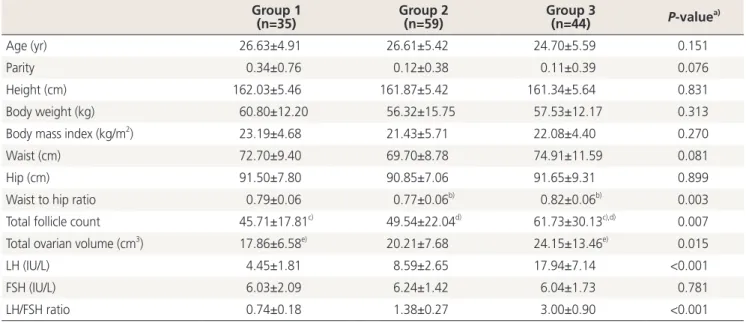
Table 1. Comparison of baseline clinical and hormonal characteristics among the three groups Group 1
(n=35) Group 2
(n=59) Group 3
(n=44) P-value
a)Age (yr) 26.63±4.91 26.61±5.42 24.70±5.59 0.151
Parity 0.34±0.76 0.12±0.38 0.11±0.39 0.076
Height (cm) 162.03±5.46 161.87±5.42 161.34±5.64 0.831
Body weight (kg) 60.80±12.20 56.32±15.75 57.53±12.17 0.313
Body mass index (kg/m
2) 23.19±4.68 21.43±5.71 22.08±4.40 0.270
Waist (cm) 72.70±9.40 69.70±8.78 74.91±11.59 0.081
Hip (cm) 91.50±7.80 90.85±7.06 91.65±9.31 0.899
Waist to hip ratio 0.79±0.06 0.77±0.06
b)0.82±0.06
b)0.003
Total follicle count 45.71±17.81
c)49.54±22.04
d)61.73±30.13
c),d)0.007
Total ovarian volume (cm
3) 17.86±6.58
e)20.21±7.68 24.15±13.46
e)0.015
LH (IU/L) 4.45±1.81 8.59±2.65 17.94±7.14 <0.001
FSH (IU/L) 6.03±2.09 6.24±1.42 6.04±1.73 0.781
LH/FSH ratio 0.74±0.18 1.38±0.27 3.00±0.90 <0.001
Values are mean±standard deviation; Group 1, LH/FSH <1.0; Group 2, 1.0≤ LH/FSH <2.0; Group 3, LH/FSH ≥2.0.
FSH, follicle-stimulating hormone; LH, luteinizing hormone.
a)
ANOVA;
b),c),d),e)P<0.05 by Tukey’s multiple comparison test.
tical analyses were performed using SPSS ver. 18.0 (SPSS Inc., Chicago, IL, USA). For comparisons of anthropometric and biochemical parameters among the three groups, one-way analysis of variance (ANOVA) was performed, followed by Tukey multiple comparison test for post hoc analysis. The cor- relations between serum gonadotropin levels and biochemical parameters related to insulin resistance were evaluated by the Pearson correlation coefficient, and partial correlation coef- ficients were used after adjusting for confounding factors of age and BMI. Two-tailed P-values less than 0.05 were consid- ered significant for all analyses.
Results
All recruited participants were divided into three groups ac- cording to the serum LH/FSH ratio: group 1 (LH/FSH ratio
<1.0, n=35), group 2 (1.0≤ LH/FSH ratio <2.0, n=59), and group 3 (LH/FSH ratio ≥2.0, n=44). The comparison of the baseline clinical and hormonal characteristics of the three groups is shown in Table 1. Among the anthropometric pa- rameters, only WHR was significantly different among the three groups. In the post hoc analysis, the mean value of the WHR of group 3 (0.82±0.06) differed significantly from that of group 2 (0.77±0.06). Patients with higher serum LH levels were more likely to show larger numbers of total antral fol-
licles and larger total ovarian volume. Serum LH levels were significantly different among the three groups, while, serum FSH levels were not.
As shown in Table 2, no significant differences were ob- served in the biochemical metabolic parameters among the three groups. Similarly, as displayed in Table 3, no significant correlations were found between the serum LH/FSH ratio and biochemical parameters related to insulin resistance. However, after adjustments for age and BMI, blood total cholesterol level was significantly correlated with LH/FSH ratio (r=0.221, P=0.018).
Discussion
Inappropriate gonadotropin secretion is one of the most characteristic hormonal features and is associated with the continuation of the anovulatory state in women with PCOS [15]. The abnormal gonadotropin secretion pattern in PCOS is characterized by increased serum LH levels and an increased LH/FSH ratio [4], and this pattern is related to increases in both the amplitude and frequency of LH secretion secondary to increased pulse frequency of hypothalamic gonadotropin- releasing hormone [8,19]. Increased frequency of gonadotro- pin-releasing hormone secretion favors transcription of the β-subunit of LH over the β-subunit of FSH [8], which causes Table 2. Comparison of baseline biochemical metabolic parameters among the three groups
Group1
(n=35) Group2
(n=59) Group 3
(n=44) P-value
a)Fasting insulin (μIU/mL) 10.85±16.69 7.63±4.97 10.00±9.15 0.320
Fasting glucose (mg/dL) 92.66±14.93 89.10±9.90 92.20±12.31 0.229
PPG1 (mg/dL) 135.51±51.55 127.03±40.25 133.52±47.40 0.633
PPG2 (mg/dL) 116.17±41.04 107.12±25.84 113.91±45.79 0.461
HOMA-IR (fasting) 2.19±3.69 1.69±1.11 2.43±2.63 0.332
GIR (fasting) 19.25±11.78 16.22±9.13 15.06±9.52 0.210
QUICKI (fasting) 0.37±0.05 0.37±0.04 0.36±0.04 0.303
Cholesterol (mg/dL) 165.06±25.16 172.43±28.44 172.54±24.92 0.405
Triglyceride (mg/dL) 89.74±89.70 95.11±98.67 96.41±90.41 0.952
HDL (mg/dL) 58.03±15.07 58.45±12.43 59.20±14.46 0.935
LDL (mg/dL) 89.57±22.10 92.79±27.85 96.00±20.83 0.544
Values are mean±standard deviation; Group 1, LH/FSH <1.0; Group 2, 1.0≤ LH/FSH <2.0; Group 3, LH/FSH ≥2.0.
PPG1, postprandial glucose at 1 hour; PPG2: postprandial glucose at 2 hour; HOMA-IR, homeostasis model assessment of insulin resistance;
GIR, glucose to insulin ratio; QUICKI, quantitative insulin sensitivity check index; HDL, high-density lipoprotein; LDL, low-density lipoprotein.
a)