Reversed intestinal rotation is one of the least com- mon intestinal developmental anomalies, and accounts for 4% of all malrotation cases (1). In 1923, Dott et al. (2) proposed that in reversed rotation, the normal 270 counterclockwise rotation is replaced by a 90 counter- clockwise rotation followed by a 180 clockwise rota- tion, resulting in a net 90 clockwise rotation. Intestinal malrotation is usually diagnosed during infancy and childhood as a result of acute symptoms induced by complications including intestinal obstruction or volvu- lus. Adults with rotational anomalies are asymptomatic and are usually founded incidentally during an imaging evaluation or laparotomy for coincidental disease (3).
Only a few cases of reversed intestinal rotation have been reported in surgical and internal medicine litera- tures. To the best of our knowledge, there are no reports of MDCT findings concerning reversed intestinal rota-
tion (4-6). We report a case of reversed rotation in a 38- year-old man, focusing on the first MDCT findings alongside a literature review.
Case Report
A 38-year-old man visited the outpatient department of our hospital with complaints of nausea, intermittent vomiting, recurrent dyspepsia, and abdominal discom- fort. Upon physical examination, his abdomen was not distended, and he had normal bowel sounds. After un- dergoing endoscopy, he was initially diagnosed with gastritis and gastroesophageal reflux and had been treat- ed. However, his recurrent dyspepsia and abdominal discomfort had not been completely relieved.
Using a 128-row detector MDCT scanner (definition AS+, Siemens Medical Solutions, Forchheim, Germany), CT scans of the abdomen and pelvis were obtained in the arterial and portal venous phases after the intravenous injection of contrast agent (Ultravist 300, Bayer Schering Pharma, Berlin, Germany) and op- timal colon distension. Colon distension with carbon dioxide was achieved using an automated insufflator and a small rectal catheter with a retention balloon
J Korean Soc Radiol 2011;64:365-368
─ 365 ─
Multidetector CT Findings of Retroarterial Reversed Intestinal Rotation in an Adult: A Case Report1
Jin-kyeong Sung, M.D., Young Mi Ku, M.D., Hiun-Suk Chae, M.D.
2, In Yong Whang, M.D., Su Lim Lee, M.D.
Departments of
1Radiology and
2Internal Medicine, Uijeongbu St. Mary’s Hospital, College of Medicine, The Catholic University of Korea Received December 15, 2010 ; Accepted January 18, 2011
Address reprint requests to : Su Lim Lee, M.D., Department of Radiology, Uijeongbu St. Mary’s Hospital, College of Medicine, The Catholic University of Korea, 65-1 Geumo-dong, Uijeongbu-si, Gyeonggi-do 480- 717, Korea.
Tel. 82-31-820-3148 Fax. 82-31-846-3080 E-mail: [email protected]
Intestinal malrotation is an uncommon cause of abdominal pain in adults. More so, reversed intestinal rotation is one of the least common malrotation anomalies. A few cases of reversed intestinal rotation have been reported only in surgical and internal medicine literatures. To the best of our knowledge, MDCT findings concerning re- versed intestinal rotation had never been reported. We present a 38-year-old man with retroarterial reversed intestinal rotation with MDCT findings.
Index words : Rotation Colon
Tomography, X-Ray Computed
(PROTOCO
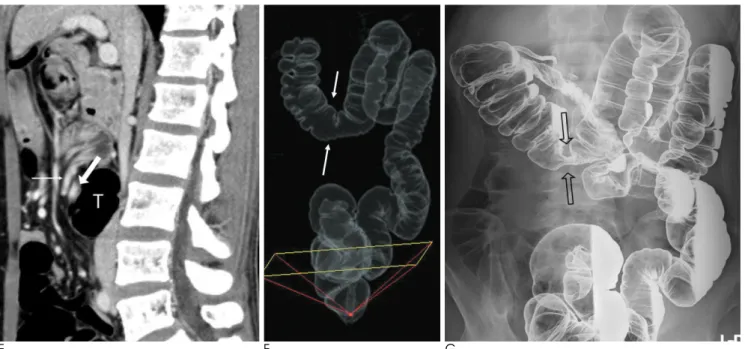
2L; E-Z-Em, Westbury, NY, USA). We ob- tained 4-mm-thick axial, coronal, and sagittal reformat- ted images. The findings of axial image revealed that the superior mesenteric vein (SMV) was located to the left of the superior mesenteric artery (SMA) and wrapped clockwise around the SMA (Figs. 1A-D). The abnormal position of the bowel loops related to the SMA and SMV were depicted. The mid-portion of the transverse colon was interpositioned between the superior mesenteric vessels and the aorta, which resulted in focal luminal narrowing. The duodenum crossed from right to left an- terior to the SMA and SMV. Additional reformatted im- age (Fig. 1E) and tissue transition projection from CT colonoscopy (Fig. 1F) more clearly demonstrated the re-
lationship between the superior mesenteric vessels and transverse colon, as well as the focal narrowing in the mid-portion of the transverse colon. A double contrast barium enema (Fig. 1G) showed focal luminal narrow- ing at the mid-portion of the transverse colon and the ce- cum located in the right upper quadrant of the ab- domen. All of these findings were consistent with retroarterial reversed rotation of the intestine with an extrinsic compression of the transverse colon by the su- perior mesenteric vessels.
Discussion
A fetal midgut loop is divided into two segments;
Jin-kyeong Sung, et al : Multidetector CT Findings of Retroarterial Reversed Intestinal Rotation in an Adult
─ 366 ─
A B
C D
Fig. 1. A-D. Serial axial images of a contrast-enhanced CT of a 38-year-old man with reversed rotation. SMV (thick arrow) lies to the
left of SMA (thin arrow) in the first image (A), and SMV wraps around SMA clockwise on consecutive images (B-D). It is noted that
the duodenum (dotted lines in A and B) cross from the right to left anterior to SMA and SMV. Images at the level of lower pole of
the kidneys (C and D) demonstrate that the distended transverse colon (T) is sandwiched between the superior mesenteric vessels
and the aorta.
prearterial and postarterial. These two segments are sep- arated by the superior mesenteric vessels. The midgut loop is herniated out of the abdominal cavity and re- duced. In this stage, the prearterial segment first returns to the abdomen, followed by the postarterial segment (4). Anomalies during this stage are related to the abnor- mal rotation of midgut and classified as non-rotation, malrotation, or reversed rotation (5).
Reversed rotation is the rarest developmental intesti- nal rotation anomaly. As described earlier, reversed ro- tation is defined as net 90 clockwise rotation of midgut.
Estrada et al further classified reversed rotation into two subtypes; retroarterial and prearterial (6). The more common retroarterial subtype was thought to occur when the postarterial bowel segment first reduced into the abdomen. As a result, the transverse colon was lo- cated behind both the duodenum and the SMA. In the less common prearterial subtype, the prearterial seg- ment is reduced first into the abdomen and is located in the left abdominal region anterior to the SMA. The postarterial segment ends up in the right abdomen (6, 7).
In our case, the transverse colon was located behind the superior mesenteric vessels and the cecum and duode- num were positioned in the right supramesocolic com- partment of the abdominal cavity. The intraperitoneal
location of bowel loops and the relationship between the bowel loops and adjacent mesenteric vessels are clearly delineated on reformatted and 3D rendered images of MDCT, with the findings consistent with retroarterial reversed midgut rotation.
On axial CT images of our patients, there is a clock- wise whirling of the SMV around the SMA. It has been demonstrated that a clockwise wrapping of the SMV and the mesentery around the SMA, is suggestive of a midgut volvulus (8). On the other hand, a counterclock- wise whirling pattern is usually the result of normal em- bryologic rotation and is not associated with the volvu- lus or malrotation (9). As our patient had both the midgut and the hindgut rotated in the opposite direc- tion, the clockwise whirling of the SMV around the SMA is presumed a normal finding of reversed rotation, a counterpart of clockwise rotation in the normal midgut rotation.
During infancy and childhood, the most common clin- ical manifestation of midgut malrotation is vomiting and abdominal distension, which results from the intestinal obstruction or volvulus. Occasionally, malabsorption and chronic diarrhea are present due to intermittent volvulus (3). On the contrary, rotational anomalies con- stitute less than 1% of blower obstructions in adults (3).
J Korean Soc Radiol 2011;64:365-368
─ 367 ─
E F G
Fig. 1. E-G. The sagittal (F) reformatted image more clearly depicted the relationship between the superior mesenteric vessels (thin
and thick arrows) and the transverse colon (T). A tissue transition projection (F) from CT colonoscopy discloses focal narrowing of
transverse colon (open arrows) and the abnormal location of the cecum. The overhead image after double-contrast barium enema
(G) is exactly coincidental with the image of CT colonoscopy, which shows focal extrinsic compression of the transverse colon and
resultant narrowing of the involved segment (open arrows). The cecum, appendix, and ileocecal valve are located in the right up-
per quadrant of the abdomen.
Most adults with midgut rotational anomalies in adult patients are asymptomatic and are incidentally revealed during imaging evaluation or laparotomy for coinciden- tal diseases. Vague symptoms of malrotation in adult pa- tients may delay the exact diagnosis, as occurred in our patient. MDCT is suitable for further evaluation of these enigmatic patients with ambiguous symptoms. MDCT can make an accurate diagnosis of the reversed rotation since it discloses the position of the small and large bow- els and the relationship between the bowel loops and adjacent structures such as mesenteric vessels. Also, ad- ditional coronal or sagittal reformatted images and 3D- rendered images provide even more detailed depiction, as in our case.
Although reversed rotation is the rarest type of malro- tation, it emphasizes the importance of considering rota- tional abnormalities in adolescents and adults who pre- sent with chronic abdominal pain or recurrent obstruc- tive symptoms. Based on this study, MDCT is a more useful diagnostic tool for depicting reversed rotation than conventional diagnostic methods such as a barium enema and conventional CT.
References
1. Aldridge RT. Intestinal malrotation in the adult. N Z Med J 1996;60:420-423
2. O’Connell P, Lynch G. Reversed intestinal rotation associated with anomalous mesenteric venous drainage. Dis Colon Rectum 1990;33:883-885
3. Berardi RS. Anomalies of midgut rotation in the adult. Surg Gynecol Obstet 1980;151:113-124
4. Lilleyman A, Levy RD, Sillar R. Reversed intestinal rotation: re- port of two cases and review of the published reports. ANZ J Surg 2006;76:947-949
5. Cunningham T, Hartman G, Bulas DI. CT findings in prearterial reversed midgut rotation. Pediatr Radiol 1994;24:537-538 6. Estrada RL, Gurd FN. Surgical correction of reversed rotation of
the midgut loop. Surg Gynecol Obstet 1962;114:707-711
7. Nehra D, Zeineh M, Rodriguez F, Dutta S. Double reverse intesti- nal malrotation: a novel rotational anomaly and its surgical correc- tion. J Pediatr Surg 2007;42:578-581
8. Shimanuki Y, Aihara T, Takano H, Moritani T, Oguma E, Kuroki H, et al. Clockwise whirlpool sign at color Doppler US: an objec- tive and definite sign of midgut volvulus. Radiology 1996;199:261- 264
9. Clark P, Ruess L. Counterclockwise barber-pole sign on CT:
SMA/SMV variance without midgut malrotation. Pediatr Radiol 2005;35:1125-1127
Jin-kyeong Sung, et al : Multidetector CT Findings of Retroarterial Reversed Intestinal Rotation in an Adult
─ 368 ─
대한영상의학회지 2011;64:365-368
성인에서 발견한 후동맥역회전이상의 MDCT 소견:
증례 보고11
가톨릭대학교 의정부성모병원 영상의학과
2