• 검색 결과가 없습니다.

The Number of Endothelial Progenitor Cells is Decreased in Patients With Non-Dipper Hypertension

N/A
N/A
Protected

Academic year: 2022

Share "The Number of Endothelial Progenitor Cells is Decreased in Patients With Non-Dipper Hypertension"

Copied!
6
0
0

로드 중.... (전체 텍스트 보기)

전체 글

(1)

Korean Circulation Journal

Introduction

Hypertension is associated with alterations in the endothelial function of arterial resistance and is often accompanied by severe complications, e.g., stroke, ischemic heart disease and nephroscler-

Print ISSN 1738-5520 • On-line ISSN 1738-5555

The Number of Endothelial Progenitor Cells is Decreased in Patients With Non-Dipper Hypertension

Seunghwan Kim, MD 1 , Nam-Ho Kim, MD 1,2 , Yong Kwon Kim, MD 1 , Jong Hyun Yoo, MD 1 , Seong Nam Shin, MD 1 , Jum Suk Ko, MD 1,2 , Yun Kyeong Kim, MD 1,2 , Sang Jae Rhee, MD 1,2 , Kyeong Ho Yun, MD 1,2 ,

Eun Mi Lee, MD 1,2 , Nam Jin Yoo, MD 1,2 , Seok Kyu Oh, MD 1,2 , and Jin-Won Jeong, MD 1,2

1

Department of Cardiovascular Center, Regional Cardiocerebrovascular Disease Center, Wonkwang University Hospital,

2

Institute of Wonkwang Medical Science, Iksan, Korea

Background and Objectives: Circulating endothelial progenitor cells (EPCs) play a key role in the maintenance of endothelial homeosta- sis and promote vascular repair. A reduced number of EPCs and the functional activity have been associated with several cardiovascular risk factors. However, the relationship between the number of EPCs and circadian rhythm of the blood pressure (BP) remains unclear. The purpose of the present study was to evaluate the relationship between the circadian rhythm of the BP and EPCs in patients with essential hypertension.

Subjects and Methods: A total of 45 patients with essential hypertension who were newly identified by outpatient BP measurements, underwent 24-hour ambulatory BP monitoring. Among the 45 patients with essential hypertension, 20 were classified as dippers (12 men and 8 women; mean age 48±14 years) and 25 as non-dippers (14 men and 11 women; mean age 52±18 years). The EPC count was isolated from the peripheral bloodstream and quantified by flow cytometry.

Results: The baseline clinical characteristics were similar between the dipper and non-dipper hypertensive patients. The circulating EPCs were statistically reduced in the non-dipper patients as compared to the dippers (104±60 vs. 66±47 EPCs per 106 mononuclear cells, p=0.027). The circulating EPC level correlated positively with the circadian changes in the systolic and diastolic BP (r=0.435, p=0.003, and r=0.310, p=0.038, respectively).

Conclusion: The present study demonstrated that the EPC count was reduced in the peripheral bloodstream in non-dipper hypertensive patients. (Korean Circ J 2012;42:329-334)

KEY WORDS: Hypertension; Circadian rhythm; Stem cells.

Received: August 2, 2011

Revision Received: October 1, 2011 Accepted: November 16, 2011

Correspondence: Nam-Ho Kim, MD, Department of Internal Medicine, Wonkwang University Hospital, Institute of Wonkwang Medical Science, 895 Muwang-ro, Iksan 570-711, Korea

Tel: 82-63-859-2523, Fax: 82-63-852-8480 E-mail: [email protected]

• The authors have no financial conflicts of interest.

This is an Open Access article distributed under the terms of the Creative Commons Attribution Non-Commercial License (http://creativecommons.

org/licenses/by-nc/3.0) which permits unrestricted non-commercial use, distribution, and reproduction in any medium, provided the original work is properly cited.

osis, which are associated with vascular damage. The dysfunctional endothelium and resulting structural changes may be responsible for the adverse outcomes of hypertension.

1)

Blood pressure (BP) tends to be higher in the early morning hours than at other times of the day, and the nighttime BP is generally 10- 20% lower than the daytime BP. A non-dipper rhythm refers to a circadian change in BP in which a nocturnal decrease in the BP is attenuated or absent. Patients with a non-dipper circadian rhythm of the BP have a greater risk of cerebrovascular and cardiovascular complications than those with a dipper circadian rhythm.

2)

Endothelial progenitor cells (EPCs) derived from the bone mar-

row circulate in the peripheral bloodstream and have been impli-

cated in neoangiogenesis after tissue ischemia has occurred, and

are candidates for vascular regeneration.

3)

Thus, circulating EPCs

play a key role in the maintenance of endothelial homeostasis and

promote vascular repair. They may also have a predictive value for

cardiovascular events. A reduced EPC count and associated func-

(2)

tional activity have been associated with several cardiovascular risk factors, but their relationship to non-dipper hypertension remains unclear.

4-6)

Therefore, we conducted the present study to investigate whether the circulating EPC level was altered in patients with non-dipper hy- pertension who were at high risk for cardiovascular disease and to evaluate the relationship between the circadian rhythm of the BP and circulating EPC level in patients with essential hypertension.

Subjects and Methods

Subjects

Between December 2007 and May 2008, 47 patients with essen- tial hypertension who were recently identified by outpatient BP mea- surements and had not previously received antihypertensive ther- apy were included in this study. After 5 minutes of rest in the sitting position, BP was measured by a calibrated mercury sphygmomano- meter, and defined as the average of at least 2 measurements re- corded 3 minutes apart. Two patients were excluded because of their refusal, and blood samples were obtained from the remaining 45 patients. Patients with recent cardiovascular events, concomi- tant malignant diseases or active inflammation were excluded from this study. All individuals were on an unrestricted diet and gave their informed consent according to the protocol approved by the Ethical Committee of our Hospital.

Ambulatory blood pressure monitoring

All patients underwent 24-hour ambulatory BP monitoring (TO- NOPORT V, GE Marquette, Milwaukee, WI, USA). The patients were divided into two groups, dippers and non-dippers, according to their nocturnal decrease in BP. Patients whose nocturnal decrease in sys-

tolic BP was ≥10% of the daytime systolic BP were classified as dip- pers, and those whose nocturnal decrease in systolic BP was <10%

of the daytime systolic BP were classified as non-dippers.

7)

Isolation of circulating endothelial progenitor cells

In all participants, the total EPC count was assessed by using an in vitro assay, as described previously.

8)

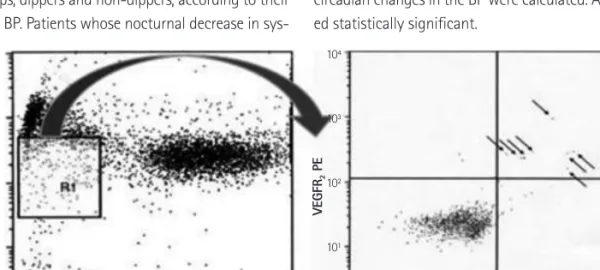
In brief, mononuclear cells (MNCs) were obtained from peripheral blood samples (100 μL), and the EPCs were identified by flow cytometry (BD Biosciences, San Jose, CA, USA). Their phenotype was determined by immunohisto- chemistry after staining with 20 μL fluorescein PE-Cy5-conjugated anti-CD45 monoclonal antibody (Dynona, Korea), 20 μL of fluores- cein isothiocyanate (FITC)-conjugated anti-CD34 monoclonal anti- body (Dynona, Korea) and 10 μL of PE-conjugated anti-vascular endothelial growth factor receptor 2 (VEGFR2) monoclonal antibody (R&D, Minneapolis, MN, USA), and further incubated in a dark room for 1 hour. After appropriate gating with low cytoplasmic granularity and a low expression of CD45, the number of CD34

+

VEGFR2

+

cells was quantified and expressed as the absolute number of cells per 1×10

6

peripheral MNCs. The total number of CD45

low

CD34

+

VEG- FR2

+

cells was then counted (Fig. 1).

Statistical analysis

All statistical analysis was performed using the Statistical Pack- age for the Social Sciences (SPSS Inc., Chicago, IL, USA) for Win- dows 12.0. All data are expressed as means±standard deviations.

The Student’s t-test was used for comparisons of the measured values between the dipper and non-dipper hypertensive patients.

A Pearson’s correlation coefficient between the number of EPSs and circadian changes in the BP were calculated. A p<0.05 was consider- ed statistically significant.

Fig. 1. Quantification of EPCs by flow cytometry. Circulating EPCs were identified by flow cytometry with low cytoplasmic granularity (R1) and with ex- pression of cell surface antigens such as CD45

low

CD34

+

VEGFR2

+

. Arrows indicate CD45

low

CD34

+

VEGFR2

+

cells. EPCs: endothelial progenitor cells, VEGFR2:

vascular endothelial growth factor receptor 2, SSC: side scather, FITC: fluorescein isothiocyanate.

10

4

10

3

10

2

10

1

10

0

10

4

10

3

10

2

10

1

10

0

SSC-Height CD34 FITC

CD 45 P E cy 5 VE GF R

2

P E

0 200 400 600 800 1000 10

0

10

1

10

2

10

3

10

4

(3)

Results

Subject characteristics

Among the 45 patients with essential hypertension, 20 were clas- sified as dippers (12 men and 8 women; mean age 48±14 years) and

25 as non-dippers (14 men and 11 women; mean age 52±18 years).

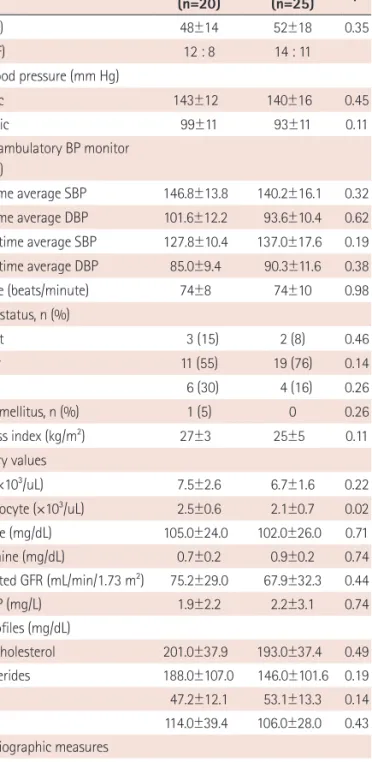
The baseline characteristics of the dipper and non-dipper hyper- tensive patients are shown in Table 1. The clinical characteristics and laboratory parameters were similar between the dipper and non- dippers except for the number of lymphocytes (2.5±0.6 vs. 2.1±

0.7×10

3

/uL; p=0.02) and left ventricular ejection fraction (70.8±6.0%

vs. 64.8±11.1%; p=0.04).

Comparison of differences in the endothelial progenitor cell count between the dippers and non-dippers

The difference in the circulating number of EPCs between the dippers and non-dippers is presented in Fig. 2. The absolute num- ber of circulating EPCs was significantly reduced in the non-dipper hypertensive patients as compared to the dippers (104±60 vs.

66±47 EPCs per 10

6

MNCs, p=0.027) (Fig. 2).

Relationship between the endothelial progenitor cell count and parameters

The correlation between the EPC count and parameters is shown in Table 2. The EPC count correlated positively with the number of lymphocytes and the glucose level (r=0.625, p<0.001, and r=0.318, p=0.035, respectively).

Relationship between the endothelial progenitor cell count and circadian changes in the blood pressure

The correlation between the EPC count and the circadian changes in the BP is presented in Fig. 3. The number of circulating EPCs cor- related positively with the circadian changes in the systolic blood pressure and diastolic blood pressure (r=0.435, p=0.003, and r=

0.310, p=0.038, respectively) (Fig. 3).

Table 1. Baseline characteristics of the patients evaluated in this study Dipper

(n=20)

Non-dipper

(n=25) p

Age (year) 48±14 52±18 0.35

Sex (M : F) 12 : 8 14 : 11

Office blood pressure (mm Hg)

Systolic 143±12 140±16 0.45

Diastolic 99±11 93±11 0.11

24-hour ambulatory BP monitor (mm Hg)

Day-time average SBP 146.8±13.8 140.2±16.1 0.32 Day-time average DBP 101.6±12.2 93.6±10.4 0.62 Night-time average SBP 127.8±10.4 137.0±17.6 0.19 Night-time average DBP 85.0±9.4 90.3±11.6 0.38

Heart rate (beats/minute) 74±8 74±10 0.98

Smoking status, n (%)

Current 3 (15) 2 (8) 0.46

Former 11 (55) 19 (76) 0.14

Never 6 (30) 4 (16) 0.26

Diabetes mellitus, n (%) 1 (5) 0 0.26

Body mass index (kg/m

2

) 27±3 25±5 0.11

Laboratory values

WBC (×10

3

/uL) 7.5±2.6 6.7±1.6 0.22

Lymphocyte (×10

3

/uL) 2.5±0.6 2.1±0.7 0.02

Glucose (mg/dL) 105.0±24.0 102.0±26.0 0.71

Creatinine (mg/dL) 0.7±0.2 0.9±0.2 0.74

Estimated GFR (mL/min/1.73 m

2

) 75.2±29.0 67.9±32.3 0.44

hs-CRP (mg/L) 1.9±2.2 2.2±3.1 0.74

Lipids profiles (mg/dL)

Total-cholesterol 201.0±37.9 193.0±37.4 0.49

Triglycerides 188.0±107.0 146.0±101.6 0.19

HDL-C 47.2±12.1 53.1±13.3 0.14

LDL-C 114.0±39.4 106.0±28.0 0.43

Echocardiographic measures

LV ejection fraction (%) 70.8±6.0 64.8±11.1 0.04 Medication, n (%)

Statin 0 0

Data are expressed as mean±SD or number (%). SBP: systolic blood pres- sure, DBP: diastolic blood pressure, WBC: white blood cell, GFR: glomerular filtration rate, hs-CRP: high sensitivity C-reactive protein, HDL-C: high density lipoprotein-cholesterol, LDL-C: low density lipoprotein-cholesterol, LV: left ventricular, ACE: angiotensin-converting enzyme, ARB: angiotensin receptor blocker, CCB: calcium channel blocker

Fig. 2. Comparison of the difference in the EPC count between the dippers and non-dippers. The absolute number of circulating EPCs was significantly reduced in the non-dipper hypertensive patients as compared to the dippers (104±60 vs. 66±47 EPCs per 10

6

mononuclear cells, p=0.027). EPC: endo- thelial progenitor cell, VEGFR2: vascular endothelial growth factor receptor 2, MNCs: mononuclear cells.

150

100

50

low++6
CD 45 CD 34 VE GF R2 c el ls (/1 0 M N Cs ) 0

Dipper Non-dipper

104±60 66 ±47

p=0.027

(4)

Discussion

The present study showed that the concentration of the circul- ating EPCs was significantly reduced in the non-dipper hypertensive patients as compared to the dipper hypertensive patients. More- over, the circulating EPC count correlated positively with the circa- dian changes in the systolic and diastolic BPs. To the best of our kn- owledge, this is the first report to show such a relationship between

the EPCs and circadian changes in the BP.

Experimental and clinical studies have suggested that there is an evolving role of the EPCs in neoangiogenesis and rejuvenation of the endothelial monolayer.

9)10)

Several studies have confirmed that EPCs are derived from the bone marrow, circulate in the peripheral blood- stream and may contribute to new vessel formation by homing in to sites such as ischemic tissues and tumor microenvironments in vi- tro.

11)12)

Thus, EPCs would appear to play a key role in the mainte- nance of endothelial homoeostasis. Recent studies have shown that the EPC count and function can predict the occurrence of car- diovascular events and, most importantly, their imbalance may lead to the development of atherosclerosis.

13)

In healthy men, the EPC level may be a surrogate biologic marker for vascular function and cumulative cardiovascular risk. These find- ings suggest that endothelial injury in the absence of sufficient cir- culating EPCs may affect the progression of cardiovascular disease.

6)

Regarding the relationship between EPCs and cardiovascular events, Schmidt-Lucke et al.

14)

demonstrated that patients with car- diovascular events have fewer circulating EPCs and that a low num- ber of EPCs independently predicts a higher occurrence of cardio- vascular events. Similar results were obtained by Werner et al.

5)

who found coronary artery disease (CAD) a significant inverse relation- ship in patients with CAD between the EPC levels and rate of car- diovascular death, revascularization and hospitalization.

Hypertension is one of the most well-known cardiovascular risk factors for target organ damage and cardiovascular events. There is no doubt that the effect of hypertension on the vascular wall is one of the most important determinants of this enhanced risk. With re- gard to hypertension, it has been shown that patients with CAD have a reduced level and migratory capacity of EPCs, and the latter is mainly influenced by hypertension.

Imanishi et al.

15)

reported that EPC senescence is accelerated in essential hypertensive patients and positively correlates with the se- verity of hypertension. Oliveras et al.

16)

demonstrated that the EPC concentration in the peripheral bloodstream and after in vitro cul- Table 2. Correlation between EPC count and the different parameters

Parameters R p

Age (year) 0.005 0.975

Blood pressure (mm Hg)

Systolic 0.068 0.655

Diastolic -0.009 0.952

Heart rate (beats/minute) -0.105 0.494

Smoking status, n (%) -0.105 0.491

Body mass index (kg/m

2

) 0.098 0.523

Laboratory values

WBC (×10

3

/uL) 0.136 0.371

Lymphocyte (×10

3

/uL) 0.625 <0.001

Glucose (mg/dL) 0.318 0.035

Creatinine (mg/dL) -0.001 0.996

Estimated GFR (mL/min/1.73 m

2

) -0.096 0.537

hs-CRP (mg/L) 0.049 0.760

Lipid profiles (mg/dL)

Total cholesterol 0.227 0.139

Triglycerides 0.094 0.544

HDL-C 0.082 0.598

LDL-C 0.154 0.317

Echocardiographic measures

LV ejection fraction (%) 0.087 0.581

EPC: endothelial progenitor cell, WBC: white blood cell, GFR: glomerular fil- tration rate, hs-CRP: high sensitivity C-reactive protein, HDL-C: high density lipoprotein-cholesterol, LDL-C: low density lipoprotein-cholesterol, LV: left ventricular

Fig. 3. Relationship between the EPC count and circadian changes in the BP. A: the number of circulating EPCs correlated positively with the circadian changes in the systolic blood pressure (r=0.435, p=0.003). B: the number of circulating EPCs also correlated positively with circadian changes in the dia- stolic blood pressure (r=0.310, p=0.038).

300 250 200 150 100 50 0

300 250 200 150 100 50 0

Ci rc ul at in g EP C (C D3 4

+

V EG FR 2

+

) Ci rc ul at in g EP C (C D3 4

+

V EG FR 2

+

)

Circadian change of systolic blood pressure (%) Circadian change of diastolic blood pressure (%) -10 0 10 20 30

R=0.435 p=0.003

R=0.310 p=0.038

-10 0 10 20 30

(5)

tures was reduced in patients with refractory hypertension. This decrease was independent of the other risk factors and known de- terminants of EPCs. This reinforced a likely role of EPCs in athero- sclerosis development.

It has been reported that the average lifespan of EPCs is short- ened by oxidative stress and regulated by anti-oxidative mecha- nisms. Angiotensin II receptor antagonists improve EPC dysfunc- tion and increase cardiac c-kit expression through an anti-oxidative mechanism during hypertension. The local renin-angiotensin system induces oxidative stress and regulates EPC function.

17-19)

In addition, we previously reported that the number of circulating EPCs and flow-mediated vasodilatation (FMD) reduced in vasospastic angina, and statin treatment increased EPC count and FMD.

20)

In the present study we showed that the concentration of circul- ating EPCs is significantly reduced in non-dipper hypertensive pa- tients as compared to dipper hypertensive patients. The reduction in non-dippers may account for the known high cardiovascular risk in these patients. It would be interesting to know the pharmacolo- gical and non-pharmacological measures that upregulate EPCs in the early stages of potentially high cardiovascular risk patients to prevent them from developing atherosclerosis and minimize the risk of adverse outcomes.

Our study had several limitations. First, the sample size was small.

Second, we could not perform a functional study of the EPCs. Thus, we could not learn the correlation between the EPC functional pro- perties and hypertensive patients. Finally, the specific phenotype of EPCs has not yet been elucidated and there is no defined universal agreement on the characterization of EPCs. Thus, the surface cell markers that we used in our study were not sufficiently precise.

However, even considering that all these cells were not true EPCs, they possessed a proven angiogenic potential and may therefore be considered endothelial progenitors in a wide sense.

In conclusion, the present study demonstrated that EPC concentr- ation in the peripheral bloodstream reduced in non-dipper hyper- tensive patients and circulating EPCs statistically correlated posi- tively with the circadian changes in the BP. However, the clinical sig- nificance of the reduced circulating EPCs in non-dippers was unclear.

Therefore, these findings need to be confirmed in follow-up studies.

Acknowledgments

This paper was supported by grants from the Wonkwang Univer- sity in 2011.

References

1. Juonala M, Viikari JS, Rönnemaa T, Helenius H, Taittonen L, Raitakari OT. Elevated blood pressure in adolescent boys predicts endothelial

dysfunction: the Cardiovascular Risk in Young Finns Study. Hyperten- sion 2006;48:424-30.

2. Verdecchia P, Porcellati C, Schillaci G, et al. Ambulatory blood pres- sure: an independent predictor of prognosis in essential hypertension.

Hypertension 1994;24:793-801.

3. Gehling UM, Ergün S, Schumacher U, et al. In vitro differentiation of endothelial cells from AC133-positive progenitor cells. Blood 2000;

95:3106-12.

4. Vasa M, Fichtlscherer S, Aicher A, et al. Number and migratory activity of circulating endothelial progenitor cells inversely correlate with risk factors for coronary artery disease. Circ Res 2001;89:E1-7.

5. Werner N, Kosiol S, Schiegl T, et al. Circulating endothelial progenitor cells and cardiovascular outcomes. N Engl J Med 2005;353:999-1007.

6. Hill JM, Zalos G, Halcox JP, et al. Circulating endothelial progenitor cells, vascular function, and cardiovascular risk. N Engl J Med 2003;

348:593-600.

7. Kohara K, Nishida W, Maguchi M, Hiwada K. Autonomic nervous func- tion in non-dipper essential hypertensive subjects: evaluation by power spectral analysis of heart rate variability. Hypertension 1995;26:808-14.

8. Choi JH, Oh SK, Yun KH, et al. Effect of early statin therapy on circu- lating endothelial progenitor cells during the acute phase in patients with acute myocardial infarction. Korean Circ J 2008;38:411-8.

9. Asahara T, Murohara T, Sullivan A, et al. Isolation of putative progeni- tor endothelial cells for angiogenesis. Science 1997;275:964-7.

10. Kong D, Melo LG, Gnecchi M, et al. Cytokine-induced mobilization of circulating endothelial progenitor cells enhances repair of injured ar- teries. Circulation 2004;110:2039-46.

11. Urbich C, Dimmeler S. Endothelial progenitor cells: characterization and role in vascular biology. Circ Res 2004;95:343-53.

12. Hristov M, Weber C. Endothelial progenitor cells: characterization, pa- thophysiology, and possible clinical relevance. J Cell Mol Med 2004;8:

498-508.

13. Chironi G, Walch L, Pernollet MG, et al. Decreased number of circulating CD34+KDR+ cells in asymptomatic subjects with preclinical atheroscle- rosis. Atherosclerosis 2007;191:115-20.

14. Schmidt-Lucke C, Rössig L, Fichtlscherer S, et al. Reduced number of circulating endothelial progenitor cells predicts future cardiovascular events: proof of concept for the clinical importance of endogenous vascular repair. Circulation 2005;111:2981-7.

15. Imanishi T, Moriwaki C, Hano T, Nishio I. Endothelial progenitor cell se- nescence is accelerated in both experimental hypertensive rats and pa- tients with essential hypertension. J Hypertens 2005;23:1831-7.

16. Oliveras A, Soler MJ, Martínez-Estrada OM, et al. Endothelial progeni- tor cells are reduced in refractory hypertension. J Hum Hypertens 2008;

22:183-90.

17. Bahlmann FH, de Groot K, Mueller O, Hertel B, Haller H, Fliser D. Stim- ulation of endothelial progenitor cells: a new putative therapeutic ef- fect of angiotensin II receptor antagonists. Hypertension 2005;45:

526-9.

18. Yu Y, Fukuda N, Yao EH, et al. Effects of an ARB on endothelial pro- genitor cell function and cardiovascular oxidation in hypertension.

Am J Hypertens 2008;21:72-7.

19. Dernbach E, Urbich C, Brandes RP, Hofmann WK, Zeiher AM, Dimmeler

(6)

S. Antioxidative stress-associated genes in circulating progenitor cells:

evidence for enhanced resistance against oxidative stress. Blood 2004;104:3591-7.

20. Yun KH, Shin IS, Park EM, et al. Effect of additional statin therapy on

endothelial function and prognosis in patients with vasospastic angi-

na. Korean Circ J 2008;38:638-43.

수치

Fig. 1. Quantification of EPCs by flow cytometry. Circulating EPCs were identified by flow cytometry with low cytoplasmic granularity (R1) and with ex- ex-pression of cell surface antigens such as CD45 low CD34 +  VEGFR2 +
Table 1. Baseline characteristics of the patients evaluated in this study Dipper (n=20) Non-dipper(n=25) p Age (year) 48±14 52±18 0.35 Sex (M : F) 12 : 8 14 : 11
Fig. 3. Relationship between the EPC count and circadian changes in the BP. A: the number of circulating EPCs correlated positively with the circadian  changes in the systolic blood pressure (r=0.435, p=0.003)

참조

관련 문서

Objective :::: The neovascularization is an essential a factor for the growth of solid organ cancer, and especially vascular endothelial growth factor (VEGF)

In this study, platelet-derived growth factors-BB (PDGF-BB), vascular endothelial growth factor (VEGF), and insulin-like growth factor-1 (IGF-1) were quantified in the PRF

In the tissue culture using leaf tissue of Orostachys japonicus , callus were induced most efficiently in 5-week-after culture in the MS medium supplemented with 10 μ BAP and 4

Ross: As my lawfully wedded wife, in sickness and in health, until

다양한 번역 작품과 번역에 관한 책을 읽는 것은 단순히 다른 시대와 언어, 문화의 교류를 넘어 지구촌이 서로 이해하고 하나가

The index is calculated with the latest 5-year auction data of 400 selected Classic, Modern, and Contemporary Chinese painting artists from major auction houses..

1 John Owen, Justification by Faith Alone, in The Works of John Owen, ed. John Bolt, trans. Scott Clark, &#34;Do This and Live: Christ's Active Obedience as the

Convection dominant in flow channels Diffusion dominant in electrode...