Anxiety and Mood Vol 7, No 1
Received : February 8, 2011 / Revised : March 7, 2011 Accepted : March 7, 2011
Address for correspondence
Jin Pyo Hong, M.D., Ph.D., Department of Psychiatry, University of Ulsan College of Medicine, Asan Medical Center, 388-1 Poongnap-dong, Songpa- gu, Seoul 138-736, Korea
Tel : +82-2-3010-3421, Fax : +82-2-485-8381 E-mail : [email protected]
한국판 우울과 신체 증상 평가 척도(Depression and Somatic Symptom Scale, DSSS)의 신뢰도와 타당도
울산대학교 의과대학 울산대학교병원 정신과학교실,
1울산대학교 의과대학 서울아산병원 정신과학교실
2김건우1 .홍진표2 .박승진2 .최지혜2 .최혜라2
Reliability and Validity of Korean Version of Depression and Somatic Symptom Scale(DSSS)
Kunwoo Kim, MD
1, Jin Pyo Hong, MD, PhD
2, Seung-Jin Park, MA
2, Ji-Hye Choi, MA
2and Hye-Ra Choi, MA
2Department of Psychiatry,
1College of Medicine University of Ulsan, Ulsan University Hospital, Ulsan,
Department of Psychiatry,
2College of Medicine University of Ulsan, Asan Medical Center, Seoul, Korea
ABSTRACT
Objectives : We examined the reliability and validity of the Korean version of the Depression and So- matic Symptom Scale (DSSS) in Korean patients with depressive symptoms.
Methods : Participants were 55 outpatients diagnosed with major depressive disorder, a depressive episode of bipolar I disorder, somatoform disorder, panic disorder, generalized anxiety disorder, or post-traumatic stress disorder according to the DSM-IV criteria. We assessed them using the Korean versions of the DSSS, Hamilton Depression Rating Scale (HDRS), and Quick Inventory of Depressive Symptomatology Self Re- port (QIDS-SR).
Results : The Korean version DSSS had a Cronbach’s alpha of 0.90. Moreover, each item’s correlation with the total score was statistically significant (r=0.24-0.71, p<0.01). The test-retest correlation coefficient (r=0.83, p<0.01) was relatively high, and the DSSS correlations with the HDRS and QIDS-SR were 0.77 and 0.74, respectively.
Conclusion : These results demonstrate that the Korean version of the DSSS could be a reliable and valid tool for screening and assessing depressive patients. The Korean version of the DSSS will be a useful tool for screening both depressive and somatic symptoms in Korea. (Anxiety and Mood 2011;7(1):9-15)
KEY WORDS : Korean version of Depression and Somatic Symptom Scale·Reliability·Validity.
ORIGINAL ARTICLE
서 론
신체증상은 우울장애 환자가 호소하는 주요 증상 가운데 하나이다.
1,21차 의료기관을 방문한 주요우울장애 환자의 69%가 병원을 방문한 주된 이유가 신체증상 때문이라고 보 고하였다.
31차 의료기관, 정신과 외래, 정신과 입원 등 다양 한 형태의 의료를이용한 우울증 환자의 65%에서 신체 통증
을 호소하였다.
4또한, 우울장애 환자의 신체증상 호소는 문 화권의 영향을 받는데 서양에 비해서 동양 문화권의 환자 들은 심리적인 증상을 부정하고 신체 증상을 더 호소하는 것으로 보고된다.
3,5-7우울장애 환자가 흔히 호소하는 신체증상은 몇 가지 중
요한 의미를 가진다. 첫째, 신체증상은 우울장애의 진단에
영향을 준다. 신체증상으로 인하여 우울장애의 심리사회적
증상이 가려지고 우울장애의 진단을 어렵게 만든다.
8둘째,
신체증상은 우울장애의 치료에 영향을 준다. 신체증상은
우울장애의 치료 반응에 악영향을 미치고,
9-13신체증상은
우울장애의 감정적인 증상보다 치료 반응이 나쁘다.
14셋째,
신체증상은 우울장애의 예후에 영향을 준다. 치료에 반응
하지 않고 남아있는 신체증상이 우울장애의 재발 위험성을
높이고,
15-19반면에 신체증상의 호전은 우울증의 호전과 상관 관계가 있다.
20,21또한, 신체증상은 우울장애의 경제적인 부 담을 높이는 것으로 보고된다.
22우울장애의 증상을 측정하는 도구가 다수 개발되어 있지 만, 국내외 일차의료영역에서 널리 사용되고 있는 해밀톤 우 울증상 평가척도(Hamilton Depression Rating Scale, HDRS), 몽고메리-아스버그 우울증상 평가척도(Montgom- ery-Asberg Depression Rating Scale, MADRS) 등 대 부분의 척도는 우울장애의 신체증상을 적절히 반영하고 있 지 못하다.
17항목 HDRS은 신체증상을 평가하는 8개 항목 을 포함하고 있지만, 그 중 6개 항목은 불면, 식욕감소, 체 중감소, 그리고 성욕감소와 관련되어 있다. 가슴 답답함, 두근거림, 두통, 근육통 등과 같은 다른 신체증상은 단지 2 개 항목으로만 평가된다.
23MADRS의 경우 10개 항목 중 식 욕감소, 불면에 대한 2개 항목이 있고, 다른 신체증상에 대 한 항목은 없다.
24기존 우울증상 평가척도의 신체증상 평가의 미비점을 보 완하기 위해서 우울증상과 신체증상을 함께 평가할 수 있 는 우울과 신체 증상 평가 척도(Depression and Somatic Symptom Scale, DSSS)가 2006년에 Hung 등에 의해서 개발되었다.
25DSSS는 자기보고식 설문지로 우울증상에 대 한 12개 항목(우울증상 소척도, Depression subscale;
DSSS-D)과 신체증상에 대한 10개 항목(신체증상 소척도, Somatic subscale, DSSS-S) 총 22개 항목으로 구성된다.
신체증상 소척도는 통증증상 소척도(Pain subscale, DSSS- P)로 구분되는 5개 통증증상(두통, 요통, 가슴의 통증, 목이 나 어깨의 통증, 근육통)을 포함한다. 최근 1주일 동안 경험 한 증상의 심각한 정도를 각 항목당 0점에서 3점까지 평가 하도록 되어있다. 기존 연구에서 DSSS와 각 소척도의 검사- 재검사 신뢰도, 내적 일관성 신뢰도는 검증되었고, DSSS 총 점과 각 소척도가 HARS 총점과 유의한 상관관계가 있고, 1개월 약물치료 후 DSSS, HARS 백분율 점수의 호전이 상관관계가 있다고 보고되었다.
25한국의 경우, 번역된 DSSS가 없고 DSSS의 신뢰도와 타당 도에 대한 연구가 없다. 이에 저자들은 한글로 번역한 DSSS 를 개발하여 신뢰도와 타당도를 살펴보았다.
연 구 방 법
연구대상
본 연구는 2009년 12월부터 2010년 1월까지 서울에 소재 한 일개 대학병원 정신과 외래방문객을 대상으로 2개월간 실시되었다. 정신과 전문의의 면담과 의무기록지 내용을 토
대로 DSM-IV에 근거하여 주요우울장애, 양극성 장애, 신 체형 장애, 공황 장애, 범불안장애, 외상 후 스트레스 장애 로 진단된 환자 55명을 연구대상으로 하였다. 명백한 신체질 환을 가지고 있는 환자들은 제외하였고, 한글을 읽고 쓸 수 있는 정도의 인지 수준을 가지고 있는 사람으로 국한하였다.
연구도구
한국판 우울과 신체 증상 평가 척도(Depression and Somatic Symptom Scale, DSSS)의 제작
2006년 Hung 등
25이 발표한 논문의 부록에 수록된 DSSS 를 번역하였다. 원저자에게 e-mail을 통해 원문의 사용에 대한 허락을 얻었다. 우리나라의 사회문화적인 특성을 감안 하되, 가능하다면 변형을 최소화하여 원척도의 체제와 의미 를 그대로 전달한다는 원칙을 세우고, 번역위원회(2명의 정신 과 전문의, 1명의 임상심리사)에서 함께 검토하고 수정하면 서 번역본을 만들었다. 이렇게 만들어진 번역본을 전문 번역 기관에서 역번역하였고, 이를 다시 번역위원회에서 원본과 비 교 감수하였다.
비교 측정도구
해밀톤 우울증상 평가척도(Hamilton Depression Rating Scale, HDRS)
HDRS는 현재 우울증에 대한 임상적 평가 및 치료 효과 검증을 위하여 가장 널리 이용되고 있는 평가도구로, 처음에 는 21개의 문항으로 만들어졌으나, 현재는 17개 문항의 척 도가 많이 쓰이고 있다.
23각 항목의 총점으로 증상의 정도 를 평가하며, 총점의 범위는 0점에서 52점까지이고 점수가 높 을수록 우울증의 심각도가 높아짐을 나타낸다. 본 연구에서 는 2005년 이중서 등이 표준화한 HDRS를 사용하였다.
26Quick Inventory of Depressive Symptomatology-Self Report(QIDS-SR)
QIDS-SR은 IDS(Inventory of Depressive Symptom - atology)의 단축형으로, 자기보고식 질문지이다. 16개 문항 으로 이루어져 있고, 16개 문항의 반응을 DSM-Ⅳ의 9가지 우울 증상의 기준에 맞춰 채점하게 된다. 각각의 항목은 0점 에서 3점까지 채점되고, 총점의 범위는 0점에서 27점까지 이다. 본 연구에서는 홍진표 등이 번역한 QIDS-SR을 사용 하였다.
27DSSS 및 비교측정도구의 평가 실시
먼저 의무기록지를 검토하고, 주치의 또는 보호자를 통
해 환자에 대한 정보를 수집한 후, 경험 많은 임상가가 환자 와 면담을 해서 HDRS 평가치를 기록하였다. 이후 평가자가 동석한 자리에서 환자로 하여금 DSSS, QIDS-SR을 완성 하도록 하였다.이후, 전체 환자 중 30명을 대상으로 5~6일 간격으로 다시 외래를 방문하였을 때, DSSS를 다시 실시하 도록 해, 검사-재검사 신뢰도를 구하였다.
자료분석
인구학적, 임상적 특징
대상군의 남, 녀 집단간의 연령, DSSS 점수 비교를 위해 독립표본 T-검정을 시행하였고, 교육수준, 정신과적 진단을 비교하기 위해 Fisher의 직접확률법을 시행하였다.
신뢰도 검증
DSSS의 내적 일관성 신뢰도 검증에는 Cronbach’s alpha 와 교정된 총점-항목간 상관계수를, 검사-재검사 신뢰도 검 증에는 Pearson 상관계수를 각각 이용하였다.
타당도 검증
DSSS와 HDRS, QIDS-SR간의 상관관계를 Pearson 상 관계수로 조사하여 공존타당도를 검증하였다. 모든 자료는 SPSS(version 15.0)로 분석하였다.
결 과
연구대상의 인구학적 특징
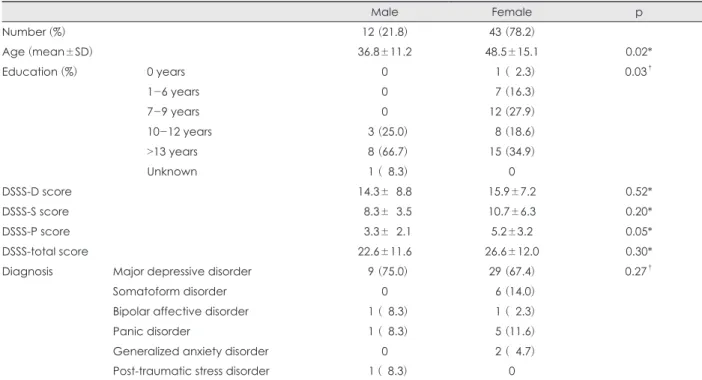
대상군은 남자가 12명으로 전체의 21.8%를, 여자가 43명 으로 전체의 88.2%를 차지하였다. 평균 연령은 46±15.1세 (19~78세)였고, 남자가 여자에 비하여 유의하게 나이가 많았 다(t=-2.49, df=53, p=0.02). 교육수준은 무학이 1명(1.8%), 초등학교 중퇴 혹은 졸업이 7명(12.7%), 중학교 중퇴 혹은 졸 업이 12명(21.8%), 고등학교 중퇴 혹은 졸업이 11명(20.0%), 대학교 중퇴 이상이 23명(41.8%)으로, 남녀에 따른 차이를 보였다(χ
2=10.893, p=0.03, Fisher’s exact test). 평균 교 육연수는 남자가 14.9±1.9년, 여자가 11.3±4.1년으로 남자 가 여자에 비하여 유의하게 많았다(t=4.26, df=37.1, p<
0.001).
DSSS 총점은 25.8±11.94의 분포를 보였다. DSSS-P 소척도 점수는 여자가 남자에 비하여 유의하게 높았고(t=
-2.01, df=53, p=0.05), DSSS 총점, DSSS-D, DSSS-S 소척도 점수는 남녀에 따른 차이를 보이지 않았다. 대상군 의 진단은 주요우울장애가 38명(69.1%), 신체형장애가 6명 (10.9%), 양극성장애가 2명(3.6%), 공황장애가 6명(10.9%), 범불안장애가 2명(3.6%), 외상 후 스트레스장애는 1명(1.8%) 이었다(Table 1).
Table 1. Sociodemographic and clinical characteristics of study subjects
Male Female p
Number (%) 12 (21.8) 43 (78.2)
Age (mean±SD) 36.8±11.2 48.5±15.1 0.02*
Education (%) 0 years 0
01 (02.3)0.03
†1-6 years 0
07 (16.3)7-9 years 0 12 (27.9)
10-12 years
03 (25.0) 08 (18.6)˃13 years
08 (66.7)15 (34.9)
Unknown
01 (08.3)0
DSSS-D score 14.3±08.8 15.9±7.2 0.52*
DSSS-S score
08.3±03.510.7±6.3 0.20*
DSSS-P score
03.3±02.15.2±3.2 0.05*
DSSS-total score 22.6±11.6 26.6±12.0 0.30*
Diagnosis Major depressive disorder
09 (75.0)29 (67.4) 0.27
†Somatoform disorder 0
06 (14.0)Bipolar affective disorder
01 (08.3) 01 (02.3)Panic disorder
01 (08.3) 05 (11.6)Generalized anxiety disorder 0
02 (04.7)Post-traumatic stress disorder
01 (08.3)0
* : Independent t-test, † : Fisher’s exact test. DSSS : Depression and Somatic Symptom Scale, DSSS-D : DSSS Depression subscale,
DSSS-S : DSSS Somatic subscale, DSSS-P : DSSS Pain subscale
신뢰도
내적 일관성 신뢰도
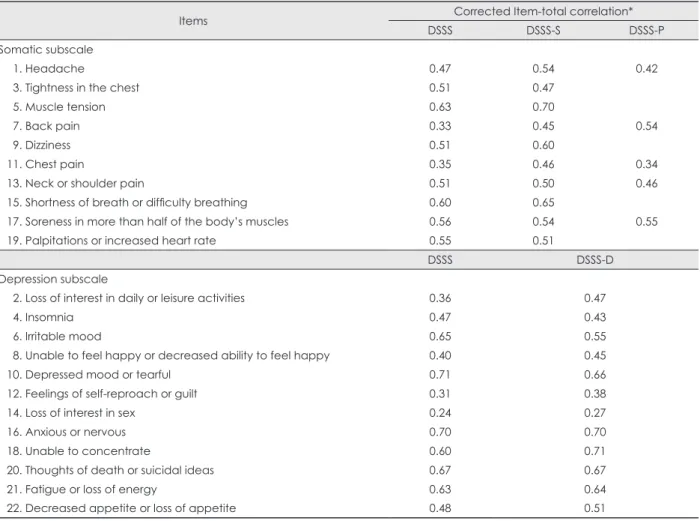
Cronbach’s alpha로 살펴본 DSSS 총점의 내적 일관성 신뢰도는 0.90이였고, 각 항목을 차례로 제거시켰을 경우에 도 0.888~0.901범위의 값을 보여 그 값은 크게 변하지 않았 다. 각 소척도 점수의 내적 일관성 신뢰도는 DSSS-D, 0.86 ; DSSS-S, 0.84 ; DSSS-P, 0.70이였다. DSSS의 교정된 항 목-총점간 상관관계(corrected item-total correction) 는 대부분 0.50을 넘었으나(0.24~0.71), 요통 항목, 가슴 의 통증 항목, 흥미가 없음 항목, 자기 비하나 죄책감 항목, 그리고 성에 대한 관심의 상실 항목에서 다소 낮은 상관성 을 보였다. DSSS의 각 소척도 점수의 항목간 상관관계도 대부분 0.50을 넘었으며(0.27~0.71), DSSS-P는 가슴의 통증 항목에서, DSSS-D는 자기 비하나 죄책감 항목과 성 에 대한 관심의 상실 항목에서 다소 낮은 상관성을 보였다 (Table 2).
검사-재검사 신뢰도
전체 환자를 대상으로 5~6일 간격으로 DSSS를 다시 실 시하도록 했을 때 검사-재검사 신뢰도는 0.83이었고, 각 소 척도의 검사-재검사 신뢰도는 DSSS-D, 0.73 ; DSSS-S, 0.87 ; DSSS-P, 0.83이였다(Table 3).
타당도
DSSS의 공존 타당도
DSSS 총점과 DSSS-D, DSSS-S, DSSS-P, HDRS,
Table 2. Correlations of each item score with the total score of the DSSS
Items Corrected Item-total correlation*
DSSS DSSS-S DSSS-P
Somatic subscale
01. Headache
0.47 0.54 0.42
03. Tightness in the chest
0.51 0.47
05. Muscle tension
0.63 0.70
07. Back pain
0.33 0.45 0.54
09. Dizziness
0.51 0.60
11. Chest pain 0.35 0.46 0.34
13. Neck or shoulder pain 0.51 0.50 0.46
15. Shortness of breath or difficulty breathing 0.60 0.65
17. Soreness in more than half of the body’s muscles 0.56 0.54 0.55
19. Palpitations or increased heart rate 0.55 0.51
DSSS DSSS-D
Depression subscale
02. Loss of interest in daily or leisure activities
0.36 0.47
04. Insomnia
0.47 0.43
06. Irritable mood
0.65 0.55
08. Unable to feel happy or decreased ability to feel happy
0.40 0.45
10. Depressed mood or tearful 0.71 0.66
12. Feelings of self-reproach or guilt 0.31 0.38
14. Loss of interest in sex 0.24 0.27
16. Anxious or nervous 0.70 0.70
18. Unable to concentrate 0.60 0.71
20. Thoughts of death or suicidal ideas 0.67 0.67
21. Fatigue or loss of energy 0.63 0.64
22. Decreased appetite or loss of appetite 0.48 0.51
* : Correlation coefficient. DSSS : Depression and Somatic Symptom Scale, DSSS-D : DSSS Depression subscale, DSSS-S : DSSS So- matic subscale, DSSS-P : DSSS Pain subscale
Table 3. Test-retest reliability of the DSSS
Items Pearson correlation coefficient (r)
DSSS 0.83*
DSSS-D 0.73*
DSSS-S 0.87*
DSSS-P 0.83*
* : p-value < 0.01. DSSS : Depression and Somatic Symptom
Scale, DSSS-D : DSSS Depression subscale, DSSS-S : DSSS Somat-
ic subscale, DSSS-P : DSSS Pain subscale
QIDS-SR 총점과의 상관관계를 조사하였을 때, 각 척도들과 DSSS 총점 사이에 모두 유의미한 상관성이 관찰되었다. DS - SS-D 소척도 점수는 HDRS, QIDS-SR 총점과 유의미한 상관성을 보였으나, DSSS-S, DSSS-P는 HDRS, QIDS- SR 총점과 상관성을 보이지 않았다(Table 4).
고 찰
본 연구에서는 우울장애의 흔한 증상이면서도 간과되고 있는 신체증상을 적절한 평가하여 우울장애의 진단에 도움 을 주기 위해 개발된 자기 보고식 질문지인 DSSS의 한국 판을 개발하고 그 신뢰도와 타당도를 측정하고자 하였다.
DSSS의 내적 일관성 신뢰도(Cronbach’s alpha=0.90) 는 높게 나타났는데, 이는 Hung 등
25의 연구에서 관찰된 것(0.87~0.88)과 비슷한 수치이다. DSSS 각 소척도의 내적 일관성 신뢰도는 DSSS-D, 0.86 ; DSSS-S, 0.84 ; DS- SS-P, 0.70로 기존 연구25에서 관찰된 것(DSSS-D, 0.73~
0.79 ; DSSS-S, 0.88 ; DSSS-P, 0.77~0.82)과 비슷한 수치이다. 본 연구에서는 DSSS 총점의 Cronbach’s α값은 0.90, 각 소척도 Cronbach’s α값은 0.70~0.86으로 모두 신뢰할만한 수준의 높은 신뢰도를 보여주었다.
개개 항목과 DSSS 총점과의 상관계수 역시 전 항목에 걸 쳐 통계적으로 유의미한 상관성을 보여, 구성항목의 동질성 (homogeneity)을 확인할 수 있었다. 각각의 항목에 대해서 좀 더 자세히 보면, 다른 항목에 비해 요통 항목, 가슴의 통 증 항목, 흥미가 없음 항목, 자기 비하나 죄책감 항목, 그리고 성에 대한 관심의 상실 항목에서 다소 낮은 상관성을 보였다.
DSSS의 전체 점수에 대한 검사-재검사 신뢰도는 0.83, 각 소척도 점수는 DSSS-D, 0.73 ; DSSS-S, 0.87 ; DS- SS-P, 0.83로 높았으며, 각 문항들도 모두 의미 있는 상관 관계를 나타내어서, DSSS의 구성문항들이 시간이 지나더 라도 개인의 우울, 신체 증상을 매우 안정되게 측정하는 것 으로 나타났다. 따라서 DSSS는 우울, 신체 증상의 변화 정도를 측정하는 도구로도 유용하게 쓰일 수 있을 것으로
보인다.
DSSS의 공존타당도를 보면, 관찰자 평가척도인 HDRS 와는 0.77, 자기보고형 척도인 QIDS-SR와는 0.74의 높은 상관성을 보였다. 일반적으로 관찰자 평가척도와 자기보고 형 척도는 상관관계가 높지 않다고 알려져 있는데,
28DSSS 의 경우는 기존의 다른 자기보고형 우울척도에 비해서 관찰 자 평가척도와 더 높은 상관관계를 보였다.
29DSSS의 각 소 척도 항목의 공존타당도를 보면, DSSS-D가 다른 소척도에 비해서 HDRS, QIDS-SR와 각각 0.72, 0.81의 높은 상관 성을 보였다. 이는 HDRS와 QIDS-SR의 항목이 신체증상보 다는 우울증상을 주로 반영하고 있는 것과 관련되어 있다.
본 연구 대상자의 80% 정도가 여성이고 연구 대상 인원이 다소 적었다는 점과, 본 연구에 참여한 인구의 대다수가 40 대로 다소 연령이 높은 편이며, 학력이 비교적 높은 층이 많 이 포함된 점 등이 본 연구의 제한점으로 고려할 수 있다.
물론 이러한 제한점이 한국판 DSSS의 신뢰도와 타당도를 근본적으로 변화시키지는 않을 것이나, 추후 다양한 연령 및 공존질환이 있는 집단에서 한국판 DSSS의 유용성을 입증할 필요가 있을 것으로 생각된다.
결 론
한국판 DSSS와 각 소척도인 DSSS-D, DSSS-S, DS- SS-P는 만족할 만한 내적 일관성 신뢰도와 높은 검사-재 검사 신뢰도를 보였다. 또한 HDRS, QIDS-SR 등 다른 우 울증 평가척도와 유의한 공존타당도를 나타내어 우울증을 평가하고 선별하는 척도로서의 신뢰도와 타당도가 입증되 었다. 한국판 DSSS는 우울장애의 우울증상과 신체증상 모두를 평가하여, 신체증상의 평가가 부족하였던 기존 우 울증 평가척도와 차별된 도구이다. 따라서, DSSS는 우울 증상과 신체증상을 선별하고 변화 정도를 평가하는 데 유 용한 도구로 사용될 수 있을 것으로 보인다.
중심 단어 : 한국판 우울과 신체 증상 평가 척도·신뢰도·타 당도.
Table 4. Correlations of total scores of each scale with the DSSS
Scales DSSS DSSS-D DSSS-S DSSS-P HDRS
DSSS-D 0.92*
DSSS-S 0.86* 0.60*
DSSS-P 0.75* 0.49* 0.90*
HDRS 0.77* 0.72* 0.65 0.52
QIDS-SR 0.74* 0.81* 0.47* 0.30* 0.71*
* : p-value<0.01. DSSS : Depression and Somatic Symptom Scale, DSSS-D : DSSS Depression subscale, DSSS-S : DSSS Somatic sub-
scale, DSSS-P : DSSS Pain subscale, HDRS : Hamilton Depression Rating Scale, QIDS-SR : Quick Inventory of Depressive Symptom-
atology-Self Report
REFERENCES
1. The ICD-10 classification of mental and behavioral disorders: clini- cal descriptions and diagnostic guidelines. Geneva: World Health Organization;1992.
2. Diagnostic and statistical manual of mental disorders. 4th ed.
Washington, D.C.: American Psychiatric Association;1995.
3. Simon GE, VonKorff M, Piccinelli M, Fullerton C, Ormel J. An in- ternational study of the relation between somatic symptoms and depression. N Engl J Med 1999;341:1329-1335.
4. Bair MJ, Robinson RL, Katon W, Kroenke K. Depression and pain comorbidity: a literature review. Arch Intern Med 2003;163:2433- 2445.
5. Mezzich JE, Raab ES. Depressive symptomatology across the Amer- icas. Arch Gen Psychiatry 1980;37:818-823.
6. Kleinman A. Neurasthenia and depression: a study of somatization and culture in China. Cult Med Psychiatry 1982;6:117-190.
7. Bhatt A, Tomenson B, Benjamin S. Transcultural patterns of soma- tization in primary care: a preliminary report. J Psychosom Res 1989;33:671-680.
8. Greden JF. Physical symptoms of depression: unmet needs. J Clin Psychiatry 2003;64 Suppl 7:5-11.
9. Bair MJ, Robinson RL, Eckert GJ, Stang PE, Croghan TW, Kroenke K. Impact of pain on depression treatment response in primary care.
Psychosom Med 2004;66:17-22.
10. Papakostas GI, Petersen TJ, Iosifescu DV, Summergrad P, Sklarsky KG, Alpert JE, et al. Somatic symptoms as predictors of time to on- set of response to fluoxetine in major depressive disorder. J Clin Psychiatry 2004;65:543-546.
11. Karp JF, Scott J, Houck P, Reynolds CF 3rd, Kupfer DJ, Frank E.
Pain predicts longer time to remission during treatment of recur- rent depression. J Clin Psychiatry 2005;66:591-597.
12. Katona C, Peveler R, Dowrick C, Wessely S, Feinmann C, Gask L, et al. Pain symptoms in depression: definition and clinical signifi- cance. Clin Med 2005;5:390-395.
13. Leuchter AF, Husain MM, Cook IA, Trivedi MH, Wisniewski SR, Gilmer WS, et al. Painful physical symptoms and treatment out- come in major depressive disorder: a STAR*D (Sequenced Treat- ment Alternatives to Relieve Depression) report. Psychol Med 2010;40:239-251.
14. Greco T, Eckert G, Kroenke K. The outcome of physical symptoms with treatment of depression. J Gen Intern Med 2004;19:813-818.
15. Paykel ES, Ramana R, Cooper Z, Hayhurst H, Kerr J, Barocka A.
Residual symptoms after partial remission: an important outcome in depression. Psychol Med 1995;25:1171-1180.
16. Judd LL, Akiskal HS, Maser JD, Zeller PJ, Endicott J, Coryell W, et al. Major depressive disorder: a prospective study of residual sub- threshold depressive symptoms as predictor of rapid relapse. J Affect Disord 1998;50:97-108.
17. Bakish D. New standard of depression treatment: remission and full recovery. J Clin Psychiatry 2001;62 Suppl 26:5-9.
18. Fava M. Depression with physical symptoms: treating to remission.
J Clin Psychiatry 2003;64 Suppl 7:24-28.
19. Vieta E, Sanchez-Moreno J, Lahuerta J, Zaragoza S. Subsyndromal depressive symptoms in patients with bipolar and unipolar disorder during clinical remission. J Affect Disord 2008;107:169-174.
20. Denninger JW, Papakostas GI, Mahal Y, Merens W, Alpert JE, Nie- renberg AA, et al. Somatic symptoms in outpatients with major de- pressive disorder treated with fluoxetine. Psychosomatics 2006;47:
348-352.
21. McIntyre RS, Konarski JZ, Mancini DA, Zurowski M, Giacobbe P, Soczynska JK, et al. Improving outcomes in depression: a focus on somatic symptoms. J Psychosom Res 2006;60:279-282.
22. Greenberg PE, Leong SA, Birnbaum HG, Robinson RL. The eco- nomic burden of depression with painful symptoms. J Clin Psychi- atry 2003;64 Suppl 7:17-23.
23. Hamilton M. Development of a rating scale for primary depressive illness. Br J Soc Clin Psychol 1967;6:278-296.
24. Montgomery SA, Asberg M. A new depression scale designed to be sensitive to change. Br J Psychiatry 1979;134:382-389.
25. Hung CI, Weng LJ, Su YJ, Liu CY. Depression and somatic symp- toms scale: a new scale with both depression and somatic symp- toms emphasized. Psychiatry Clin Neurosci 2006;60:700-708.
26. Yi JS, Bae SO, Ahn YM, Park DB, Noh KS, Kim YS. Validity and Reliability of the Korean Version of the Hamilton Depression Rating Scale (K-HDRS). J Korean Neuropsychiatr Assoc 2005;44:456-465.
27. Hong JP, Park SJ, Choi JW, Kim KW, Choi JH. Reliability and Va- lidity of the Korean Version of the Quick Inventory of Depressive Symptomatology-Self Report (QIDS-SR). A Anxiety and Mood 2011 (unpublished observation).
28. Kaplan HI, Friedman AM, Sadock BJ. Comprehensive Textbook of Psychiatry: Williams & Wilkins;1989.
29. Park SJ, Choi HR, Choi JH, Kim K, Hong JP. Reliability and Valid-
ity of the Korean Version of the Patient Health Questionnaire-9
(PHQ-9). Anxiety and Mood 2010;6:1-6.
부 록