Short-term treatment effects produced by rapid maxillary expansion evaluated with computed
tomography: A systematic review with meta-analysis
Objective: To identify the available evidence on the effects of rapid maxillary expansion (RME) with three-dimensional imaging and provide meta-analytic data from studies assessing the outcomes using computed tomography.
Methods: Eleven electronic databases were searched, and prospective case series were selected. Two authors screened all titles and abstracts and assessed full texts of the remaining articles. Seventeen case series were included in the quantitative synthesis. Seven outcomes were investigated: nasal cavity width, maxillary basal bone width, alveolar buccal crest width, alveolar palatal crest width, inter-molar crown width, inter-molar root apex width, and buccopalatal molar inclination. The outcomes were investigated at two-time points: post- expansion (2–6 weeks) and post-retention (4–8 months). Mean differences and 95% confidence intervals were used to summarize and combine the data.
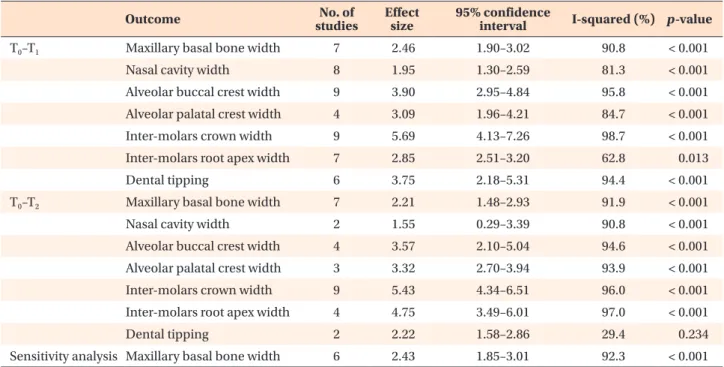
Results: All the investigated outcomes showed significant differences post- expansion (maxillary basal bone width, +2.46 mm; nasal cavity width, +1.95 mm; alveolar buccal crest width, +3.90 mm; alveolar palatal crest width, +3.09 mm; intermolar crown width, +5.69 mm; inter-molar root apex width, +2.85 mm; and dental tipping, +3.75°) and post-retention (maxillary basal bone width, +2.21 mm; nasal cavity width, +1.55 mm; alveolar buccal crest width, +3.57 mm; alveolar palatal crest width, +3.32 mm; inter-molar crown width, +5.43 mm; inter-molar root apex width, +4.75 mm; and dental tipping, 2.22°) compared to pre-expansion. Conclusions: After RME, skeletal expansion of the nasomaxillary complex was greater in most caudal structures. Maxillary basal bone showed 10% post-retention relapse. During retention period, uprighting of maxillary molars occurred.
[Korean J Orthod 2020;50(5):314-323]
Key words: Rapid maxillary expansion, Computed tomography, Systematic review, Meta-analysis
Antonino Lo Giudice
aPaola Spinuzza
bLorenzo Rustico
bGabriele Messina
bRiccardo Nucera
ba
Department of Medical-Surgical Specialties, Section of Orthodontics, School of Dentistry, University of Catania, Policlinico Universitario V. Emanuele, Catania, Italy
b
Department of Biomedical and Dental Sciences and Morphofunctional Imaging, Section of Orthodontics, School of Dentistry, University of Messina, Policlinico Universitario G. Martino, Messina, Italy
Received March 20, 2020; Revised June 7, 2020; Accepted June 8, 2020.
Corresponding author: Antonino Lo Giudice.
Adjunct Professor, Department of Medical-Surgical Specialties, Section of Orthodontics, School of Dentistry, University of Catania, Policlinico Universitario V. Emanuele, Via Santa Sofia 78, Catania 95123, Italy.
Tel +39-0953782475 e-mail [email protected]
How to cite this article: Lo Giudice A, Spinuzza P, Rustico L, Messina G, Nucera R.
Short-term treatment effects produced by rapid maxillary expansion evaluated with computed tomography: A systematic review with meta-analysis. Korean J Orthod 2020;50:314-323.
© 2020 The Korean Association of Orthodontists.
This is an Open Access article distributed under the terms of the Creative Commons Attribution Non-Commercial License (http://creativecommons.org/licenses/by-nc/4.0) which permits unrestricted non-commercial use, distribution, and reproduction in any medium, provided the original work is properly cited.
pISSN 2234-7518 • eISSN 2005-372X
https://doi.org/10.4041/kjod.2020.50.5.314
INTRODUCTION
Orthopedic palatal expansion treatment has been used for more than a century and a half to correct transverse maxillary deficiency.
1Orthopedic palatal expansion is usually prescribed when a transverse skeletal discrepancy is diagnosed; it promotes a combination of orthopedic, dental, and dentoalveolar treatment effects.
2The ef- fects of orthopedic palatal expansion treatment are not limited to the maxilla; they extend to the surrounding maxillary structures.
3,4Different authors have investi- gated the effects of palatal expansion through two- dimensional (2D) radiographic examinations.
5However, the superimposition of different anatomical structures on the radiographic film was found to potentially affect landmark identification in 2D imaging studies.
6In 1982, the use of computed tomography (CT) was proposed for three-dimensional (3D) evaluation of the basal bone changes induced by maxillary expansion.
7Literature showed that CT is a valid approach to evaluate, with greater accuracy, the modifications induced by orthope- dic palatal expansion.
8In order to provide clinicians with useful information related to treatment effects and the potential side effects of this technique, numerous CT studies were performed to evaluate the effects of maxil- lary orthopedic expansion.
9-26Some systematic reviews with meta-analyses have been performed to evaluate the dentoskeletal effects induced by palatal expansion.
27-29However, these reviews were performed including only studies conducted with 2D radiographic techniques.
The aim of this systematic review with meta-analysis was to select the available evidence evaluating the ef- fects of orthopedic palatal expansion with 3D imaging (cone-beam CT or low-dose CT) in order to provide meta-analytic data derived from studies assessing the 3D characteristics with the accuracy afforded by CT.
MATERIALS AND METHODS
Protocol and registration
This systematic review and meta-analysis was reported according to the guidelines provided by the Preferred Reporting Items for Systematic Reviews and Meta-Anal- yses (PRISMA) statement.
30Unfortunately, the Cochrane Handbook for Systematic Reviews of Interventions does not provide guidelines for conducting systematic reviews when only case series are available.
The protocol of this review was registered on PROS- PERO international prospective register of system- atic reviews (PROSPERO 2017: CRD42017067362).
http://www.crd.york.ac.uk/PROSPERO/display_record.
asp?ID=CRD42017067362.
Information sources and search
A survey of articles published up to June 2019 about the dentoskeletal effects of rapid maxillary expansion (RME) evaluated with 3D radiographic imaging tech- niques was performed. Grey literature in electronic data- bases for conference abstracts, thesis dissertations, and unpublished literature was searched. No limitations con- cerning language, publication year, or publication status were applied. The following 12 electronic databases were searched: PubMed, OvidSP, ScienceDirect, Cochrane Da- tabase, Google Scholar, Web of Science, Scopus, LILACS, Evidence-Based Medicine, Conference Proceedings Cita- tion Index, ClinicalTrials.gov, and International Clinical Trials Registry Platform.
Eligibility criteria and selection of studies
Studies were considered eligible if the study sample was prospectively enrolled or if it was a retrospective sample derived from a previous prospective trial. The studies were also included when they exhibited the following characteristics reported according the PICO format: studies conducted in growing human subjects (Participants); studies evaluating RME treatment effects (Intervention), assessing the status before and after pal- atal expansion with follow-up periods up to 8 months (Comparison), and studies assessing 3D cephalometric outcomes (Outcomes) obtained from CT exams (cone- beam CT and low-dose multi-slice CT) and reporting both dental and skeletal outcomes.
Articles were excluded if they did not meet the inclu- sion criteria, did not relate to this topic, or were related but had a different aim. Furthermore, studies including subjects with the following characteristics were exclud- ed: congenital syndromes, periodontal diseases, or oro- facial inflammatory conditions; studies assessing only skeletal or only dental values; studies involving bone- borne palatal expander; and studies evaluating surgically assisted palatal expansion.
Two authors (P.S. and G.M.) deleted the duplicate re- ports, screened all titles and abstracts, and assessed the full texts of the remaining articles. The eligibility of the trials was evaluated independently, and any disagree- ment was resolved after consulting another author (R.N.).
The level of agreement between the two reviewers was assessed by Cohen kappa statistics.
Data collection process and extraction
Two authors (A.L.G. and L.R.) independently extracted
study characteristics (study design, type of appliance,
sample size, age, sex, setting, observation period, time
of daily activation) and outcomes from the selected
studies by using predefined data extraction forms. Any
disagreements were resolved by discussion with another
author (R.N.). Cohen kappa statistics were used to assess
the agreement between the two authors.
Summary measures and data analysis
This review was conducted by including case series in the final study selection. For ethical reasons, the major- ity of studies evaluating palatal expansion by means of CT used a case series design without a control group.
This study design is considered appropriate to evalu- ate the effects of palatal expansion procedures because the maxillary growth in the considered time interval (up to 8 months) can be considered negligible.
31Literature showed that when clinical trials with untreated control groups are not available, case series without control groups can be used to perform meta-analyses.
32-34The mean differences (MDs) and their corresponding 95% confidence intervals (95% Cls) were used to sum- marize and combine data for each continuous outcome under investigation. Random-effects models were ap- plied to estimate all pooled data. Meta-analyses were performed with Stata software (StataCorp, 2016 Stata statistical software, release 14.1, College Station, TX, USA) using the “metan” command.
Assessment of risk of bias and sensitivity analysis Two authors (P.S. and G.M.) independently investi- gated any potential sources of bias and the quality of reporting by using a tool for risk of bias assessment developed by Guo et al.
35that uses a modified Delphi technique. The Moga's tool for quality appraisal check- list is the gold standard for evaluation of bias in case se- ries; it consists of 19 questions evaluating eight primary domains from case series, i.e., study objective, study design, population, intervention and co-intervention(s), outcome measures, statistical analysis, results and con- clusions, and competing interests and sources of finan- cial support. We used Moga’s tool, scoring each answer and assigning two points in case the answer reflected a low risk of bias or 0 points if the answer reflected a high risk of bias. Application of this methodology to each evaluated study could yield a score between zero and 40, and the total rating score for each individual study was reported. Any disagreement on the risk of bias as- sessment was resolved after consulting a third author (R.N.). The level of agreement between the two review authors was assessed with Cohen kappa statistics.
A sensitivity analysis was planned for the main out- come by excluding the clinical trial with the higher risk of bias.
Assessment of heterogeneity
For all analyses, statistical heterogeneity was assessed by the I
2index. A value of 0% indicates no observed heterogeneity, and greater values indicate increasing heterogeneity, with 25% indicating low, 50% moderate,
and 75% high heterogeneity.
Assessment of the quality of evidence
The quality of evidence was evaluated using the Grades of Recommendation, Assessment, Development and Evaluation Pro software (GRADEPro; http://www.
gradepro.org/).
36This assessment consists of five aspects for overall risk of bias: directness of the evidence, con- sistency of the results, precision of the estimates, risk of publication bias, and magnitude of the effect. The qual- ity of evidence was classified as high, moderate, low, or very low.
Strength of Recommendation Taxonomy (SORT)
37grading system was used to evaluate the strength of recommendation for each outcome analyzed. This tool addresses the issue of patient-oriented (effectiveness) versus disease-oriented evidence (efficacy) and is based on the quality of the individual studies and the con- sistency of evidence across the studies included in the meta-analyses. The strength of recommendation was graded as A (good-quality patient-oriented evidence), B (limited-quality patient-oriented), and C (disease-orient- ed evidence).
Selection of studies
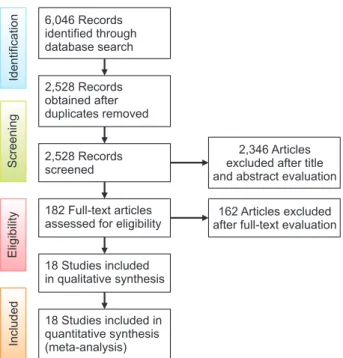
Keyword strategy and electronic search results for all searched databases are reported in Supplementary Table 1. The following information has been provided for each search: electronic database, date of search, search strate- gy, and number of retrieved items. Among the 6,046 ini- tial identified articles, 2,528 remained after the removal of duplicates. A total of 2,346 articles were excluded on the basis of the title and abstract; of the remaining 182 articles, 162 were excluded after evaluation of their full texts. Of the remaining potentially appropriate trials, 18 articles were identified as eligible to be included in qual- itative and quantitative final synthesis.
9-26The compete flow diagram of included studies designed according to the PRISMA guideline is provided in Figure 1.
RESULTS
Study characteristics
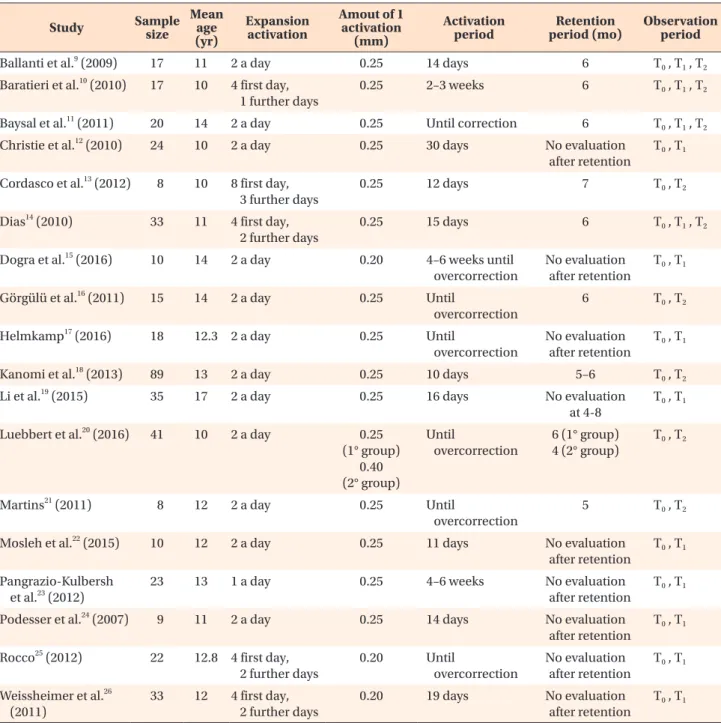
The characteristics of the 18 case series clinical trials included in the meta-analysis are summarized in Table 1. All selected studies evaluated expansion treatment in growing patients with a maxillary discrepancy. The in- cluded clinical trials were mainly conducted in a univer- sity setting. All studies included both male and female subjects.
Outcome selection and data points
In total, six main outcomes were investigated for
assessment of the dentoskeletal changes induced by
orthopedic maxillary expansion: nasal cavity width, maxillary basal bone width, alveolar buccal crest width, alveolar palatal crest width, inter-molar crown width, inter-molar root apex width, and buccopalatal molar inclination. All the outcomes were evaluated in coronal scans positioned anteroposteriorly at the level of the first molar and were defined as follows: maxillary basal bone width outcome included measurements assessing the horizontal distance between two symmetric points (right/
left) vertically located in the area of the maxillary basal bone and nasal floor (since we considered the increment at specific time points for data synthesis, we were able to group different measurements performed by using reference points that were not necessarily homologous among the selected studies); alveolar buccal crest width included measurements assessing the distance between the most coronal right and left maxillary vestibular alve- olar crest; alveolar palatal crest width included measure- ments assessing the distance between the most coronal right and left maxillary palatal alveolar crest; interdental width included measurements assessing the inter-molar distance (right-left) measured both in the dental crown (cusps, occlusal groove, pulp chamber) and in the ra- dicular portion (radicular apex, middle third root area);
buccopalatal molar inclination included measurements assessing the variation of the angle obtained by the in- tersection of tooth axis and reference lines; and nasal cavity width included measurements assessing the hori- zontal distance between the right- and left-most lateral points of the nasal cavity.
All considered trials performed a pre-expansion evalu- ation of considered outcomes (T
0). Twelve trials per- formed a second outcome evaluation at the end of the active expansion period (T
1), in a time interval between 2 and 6 weeks. Nine trials performed an outcome evalu- ation at the end of the retention period (T
2), in a time interval between 4 and 8 months. Four trials performed both T
1and T
2outcome evaluations. After pooling data extracted from all considered trials, the total number of patients considered for the time interval T
1–T
0were as follows: 160 subjects for nasal cavity width; 135 sub- jects for basal bone molars; 182 subjects for alveolar buccal crest; 63 subjects for alveolar palatal crest; 179 subjects for molar crown interdental width; 152 subjects for molar root interdental width; and 122 subjects for dental tipping. The total number of patients considered for the time interval T
2–T
0were as follows: 25 subjects for nasal cavity width; 126 subjects for basal bone mo- lars; 62 treated subjects for alveolar buccal crest; 117 subjects for alveolar palatal crest; 232 subjects for molar interdental width crown; 93 subjects for molar root in- terdental width; and 37 treated subjects for dental tip- ping.
Assessment of risk of bias
Supplementary Table 2 reports the risk of bias evalu- ation performed with a tool specifically designed for case series uncontrolled trials (i.e., Moga’s tool). The tool provides no cut-off scores to classify high or low risk of bias. However, evaluation of the results of this tool could help readers to understand the methodologi- cal quality of the included studies. The trials exhibited comprehensive risk of bias values ranging from 24 to 32, with a mean value and standard deviation of 28.7 and
± 2.8, respectively. For some questions, the majority of trials obtained a low score. For example, the majority of trials did not report side effects, patients lost to follow- up, blinding of outcome assessors, and consecutive re- cruitment. These limitations primarily affected the final scores.
Considering the intrinsic bias of case series, the risk of bias evaluation showed an overall good methodology among the selected studies. The inter-reviewer agree- ments for study selection, data extraction, and risk of bias assessment were acceptable, with kappa values of 0.92, 0.94, and 0.89, respectively.
Quantitative data analysis
Supplementary Figures 1 to 7 report the forest plots obtained by performing quantitative synthesis of max- illary expansion treatment effects from comparing T
0(pre-expansion) and T
1(post-expansion) data for all the considered outcomes. Each forest plot reports the in- cluded trials, the weights of every considered trial, the
IncludedEligibilityScreeningIdentification
6,046 Records identified through database search
2,528 Records obtained after duplicates removed
2,528 Records screened
182 Full-text articles assessed for eligibility
18 Studies included in qualitative synthesis
18 Studies included in quantitative synthesis (meta-analysis)
2,346 Articles excluded after title and abstract evaluation
162 Articles excluded after full-text evaluation