Comparison of shear bond strength of orthodontic brackets using various zirconia primers
Objective: The aim of this study was to compare the shear bond strength (SBS) of orthodontic brackets bonded to zirconia surfaces using three different zirconia primers and one silane primer, and subjected to thermocycling.
Methods: We designed 10 experimental groups following the surface treatment and thermocycling. The surface was treated with one of the following method:
no-primer (NP), Porcelain Conditioner (PC), Z-PRIME Plus (ZP), Monobond Plus (MP) and Zirconia Liner Premium (ZL) (n=20). Then each group was subdivided to non-thermocycled and thermocycled groups (NPT, PC, ZPT, MPT, ZLT) (n=10).
Orthodontic brackets were bonded to the specimens using Transbond
TMXT Paste and light cured for 15 s at 1,100 mW/cm
2. The SBS was measured at a 1 mm/
min crosshead speed. The failure mode was assessed by examination with a stereomicroscope and the amount of bonding resin remaining on the zirconia surface was scored using the modified adhesive remnant index (ARI). Results:
The SBS of all experimental groups decreased after thermocycling. Before ther- mocycling, the SBS was ZL, ZP ≥ MP ≥ PC > NP but after thermocycling, the SBS was ZLT ≥ MPT ≥ ZPT > PCT = NPT (p > 0.05). For the ARI score, both of the groups lacking primer (NP and NPT) displayed adhesive failure modes, but the groups with zirconia primers (ZP, ZPT, MP, MPT, ZL, and ZLT) were associated with mixed failure modes. Conclusions: Surface treatment with a zirconia primer increases the SBS relative to no-primer or silane primer appli- cation between orthodontic brackets and zirconia prostheses.
[Korean J Orthod 2015;45(4):164-170]
Key words: Orthodontic brackets, Shear bond strength, Zirconia, Zirconia primer Ji-Yeon Lee
aJin-Seok Kim
aChung-Ju Hwang
ba
Department of Orthodontics, National Health Insurance Corporation Ilsan Hospital, Goyang, Korea
b
Department of Orthodontics, The Institute of Craniofacial Deformity, College of Dentistry, Yonsei University, Seoul, Korea
Received November 21, 2014; Revised January 7, 2015; Accepted February 12, 2015.
Corresponding author: Chung-Ju Hwang.
Professor, Department of Orthodontics, The Institute of Craniofacial Deformity, College of Dentistry, Yonsei University, 50-1 Yonsei-ro, Seodaemun-gu, Seoul 120-752, Korea Tel +82-1-2228-3106 e-mail [email protected]
© 2015 The Korean Association of Orthodontists.
The authors report no commercial, proprietary, or financial interest in the products or companies described in this article.
This is an Open Access article distributed under the terms of the Creative Commons Attribution Non-Commercial License (http://creativecommons.org/licenses/by-nc/4.0) which permits unrestricted non-commercial use, distribution, and reproduction in any medium, provided the original work is properly cited.
http://dx.doi.org/10.4041/kjod.2015.45.4.164
INTRODUCTION
Increased interest in an esthetic facial appearance has led to an increase in the number of adult orthodontic patients. Many patients underwent previous dental restorations to treat wear, attrition, missing teeth, and malformed teeth.
1Distinct surface treatments are required to increase the bond strength between ortho- dontic brackets and the restorations because the bond between bracket and previous restorations is weaker than the bond to natural teeth.
2Esthetic demands and the development of ceramic systems have increased the use of all-ceramic crowns.
Zirconia is a widely used core for all-ceramic crowns due to its high strength and superior esthetic appearance.
To construct an esthetic prosthesis, a veneer is layered with ceramic powder onto the zirconia core. However, fracturing of the veneer is frequently reported in the posterior teeth, which apply strong masticatory forces,
3,4prompting increased use of monolithic zirconia crowns without veneers.
5,6In orthodontic patients with monolithic zirconia crowns, the orthodontic bracket should be bonded directly onto the zirconia surface.
Currently, an additional zirconia surface treatment is required to obtain proper bond strength.
7In prosthodontics, various mechanical and chemical surface treatments have been studied to improve the bond strength between zirconia and resin cement. One such technique sandblasting was reported to increases mechanical retention,
8,9and as a chemical method, many recently developed zirconia primers have been introduced.
10-13However, few studies have examined the bond strength between orthodontic brackets and zirconia prostheses, and the effects of surface treatment with zirconia primers on bonding. Thus, the aim of this study was to compare the shear bond strength (SBS) of orthodontic brackets using three different zir- conia primers and one silane primer, and subjected to thermocycling.
MATERIALS AND METHODS
A total 100 blocks of yttrium oxide-stabilized zirconia (NaturaZ a-series; DMAX International, Seoul, Korea) were embedded in acrylic resin (Ortho-Jet
TM; Lang Dental Manufacturing Co., Inc., Wheeling, IL, USA) polished with 1000-grit silicon carbide paper, and ultrasonically cleaned. All specimens underwent airborne-particle abrasion with 50-mm Al
2O
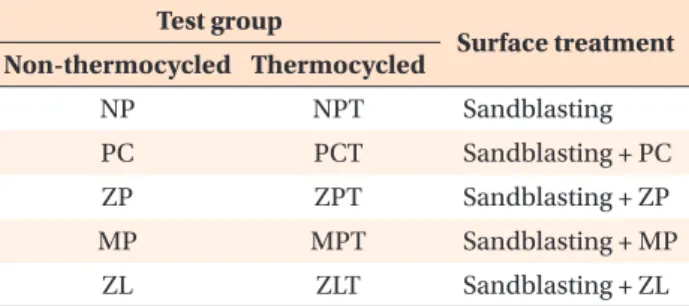
3particles at 40 psi for 10 s at a 10-mm distance perpendicular to the surface. The specimens were randomly divided into five primer groups (n = 20 per group), and each primer was divided into two subgroups (n = 10 each) to examine by thermocycling protocols (Table 1). The composition of the primers used in this study is presented in Table 2.
Before bonding the orthodontic metal brackets (Gemini series
TM; 3M Unitek Corporation, Monrovia, CA, USA), all specimens were steam-cleaned and air-dried. In the control no-primer (NP) group, Transbond
TMXT Primer (3M Unitek Corporation) was applied to the zirconia surface and bracket base. The remaining specimen groups were treated with either Porcelain Conditioner (PC), Z-PRIME Plus (ZP), Monobond Plus (MP), or Zir- conia Liner Premium (ZL) primer according to each
Table 2. Composition of primers applied to zirconia specimens
Trade name Functional monomer Manufacturer
Porcelain Conditioner Silane Reliance Orthodontic Products, Inc.,
Itasca, IL, USA Z-PRIME Plus Organophosphate and carboxylic acid, biphenyl
dimethacrylate and hydroxyethyl methacrylate
Bisco, Inc., Schaumburg, IL, USA
Monobond Plus 10-Methacryloyloxydecyl dihydrogen phosphate, silane methacrylate, ethanol, sulfide methacrylate
Ivoclar Vivadent AG, Schaan, Liechtenstein
Zirconia Liner Premium Methyl methacrylate, phosphate ester monomer, 4-methoxyphenol
Sun Medical Co., Ltd., Shiga, Japan Table 1. Characteristics of experimental groups
Test group
Surface treatment Non-thermocycled Thermocycled
NP NPT Sandblasting
PC PCT Sandblasting + PC
ZP ZPT Sandblasting + ZP
MP MPT Sandblasting + MP
ZL ZLT Sandblasting + ZL
NP, No-primer; NPT, no-primer with thermocycling; PC,
Porcelain Conditioner; PCT, Porcelain Conditioner with
thermocycling; ZP, Z-PRIME Plus; ZPT, Z-PRIME Plus with
thermocycling; MP, Monobond Plus; MPT, Monobond
Plus with thermocycling; ZL, Zirconia Liner Premium; ZLT,
Zirconia Liner Premium with thermocycling.
manufacturer’s instructions. All orthodontic brackets were bonded to the specimens using Transbond
TMXT Paste and light polymerized for 15 s at 1,100 mW/cm
2(Mr. Light LED curing light; Dent Zar, Tarzana, CA, USA).
After bonding the orthodontic brackets, all specimens
were stored at 37
oC in distilled water for 24 hours.
The five primer groups were then split into a total 10 subgroups, with one subgroup of specimens from each primer treatment subjected to thermocycling (KD-TCS30;
Kwang-duk F.A., Gwangju, Korea) in 5
oC and 55
oC water for 2,000 cycles, yielding groups NPT, PCT, ZPT, MPT, and ZLT. The remaining five subgroups (NP, PC, ZP, MP, and ZL) did not undergo thermocycling.
The SBS was measured in all 10 groups using a universal testing machine (Model 3366; Instron® Co., Norwood, MA, USA) at a 1 mm/min crosshead speed.
The failure mode was assessed by examination with a stereomicroscope (SZ61; Olympus, Tokyo, Japan), and the amount of bonding resin remaining on the zirconia surface was scored using the modified adhesive remnant index (ARI)
14(Table 3). One representative specimen from each group was flecked with gold using an ion coater (IB-3; Eiko Co., Tokyo, Japan) and examined via scanning electron microscopy (S-800; Hitachi, Tokyo, Japan) to further evaluate the failure mode.
Statistical analysis
Statistical analysis was performed with IBM SPSS Statistics version 20.0 (IBM Co., Armonk, NY, USA). Two- way analysis of variance (ANOVA) was applied to detect significant differences in the SBS between the groups.
The significance for all statistical tests was set at p <
0.05, and Tukey’s honest significant difference post-hoc test was used to detect pairwise differences between the groups (Table 4).
Table 3. Modified adhesive remnant index (ARI) score ARI
score Criteria
1 All composite remained on tooth.
2 More than 90% of the composite remained on tooth.
3 More than 10% but less than 90% of the composite remained on tooth.
4 Less than 10% of the composite remained on tooth.
5 No composite remained on tooth.
Table 5. Comparison of shear bond strengths between primer and thermocycling groups
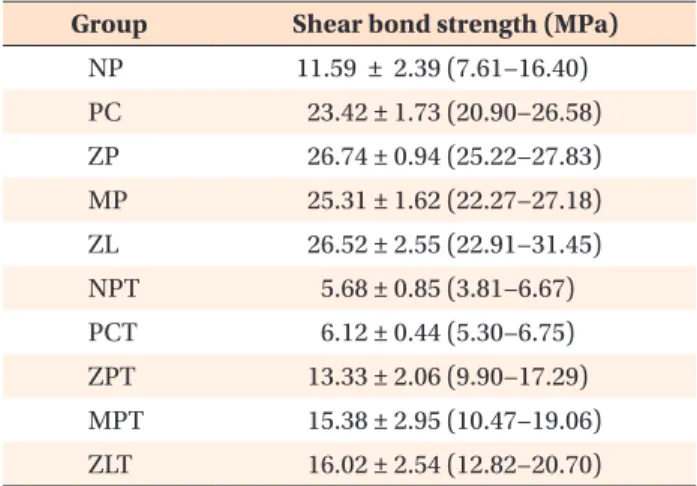
Group Shear bond strength (MPa) NP 11.59 ± 2.39 (7.61−16.40) PC 23.42 ± 1.73 (20.90−26.58) ZP 26.74 ± 0.94 (25.22−27.83) MP 25.31 ± 1.62 (22.27−27.18) ZL 26.52 ± 2.55 (22.91−31.45) NPT 5.68 ± 0.85 (3.81−6.67) PCT 6.12 ± 0.44 (5.30−6.75) ZPT 13.33 ± 2.06 (9.90−17.29) MPT 15.38 ± 2.95 (10.47−19.06) ZLT 16.02 ± 2.54 (12.82−20.70)
Values are presented as mean ± standard deviation (range).
NP, No-primer; NPT, no-primer with thermocycling; PC, Porcelain Conditioner; PCT, Porcelain Conditioner with thermocycling; ZP, Z-PRIME Plus; ZPT, Z-PRIME Plus with thermocycling; MP, Monobond Plus; MPT, Monobond Plus with thermocycling; ZL, Zirconia Liner Premium; ZLT, Zirconia Liner Premium with thermocycling.
Table 4. Post-hoc test of pair differences comparing mean bond strengths between groups
Group Difference of average bond strength (MPa)
Lower limit (MPa)
Upper limit (MPa)
Adjusted p-value
PC-NP 11.82 9.37 14.29 < 0.01
ZP-NP 15.16 12.70 17.62 < 0.01
MP-NP 13.72 11.26 16.18 < 0.01
ZL-NP 14.93 12.47 17.39 < 0.01
ZP-PC 3.33 0.87 5.79 < 0.01
MP-PC 1.89 −0.57 4.35 0.2
ZL-PC 3.10 0.64 5.56 < 0.01
MP-ZP −1.44 −3.90 1.02 0.47
ZL-ZP −0.23 −2.69 2.23 1.00
ZL-MP 1.21 −1.25 3.67 0.63
PCT-NPT 0.45 −2.12 3.01 0.99
ZPT-NPT 7.66 5.10 10.22 < 0.01
MPT-NPT 9.71 7.15 12.27 < 0.01
ZLT-NPT 10.35 7.78 12.91 < 0.01
ZPT-PCT 7.21 4.65 9.77 < 0.01
MPT-PCT 9.26 6.70 11.82 < 0.01
ZLT-PCT 9.90 7.34 12.46 < 0.01
MPT-ZPT 2.05 −0.51 4.61 0.17
ZLT-ZPT 2.69 0.13 5.25 < 0.05
ZLT-MPT 0.64 −1.92 3.20 0.95
NP, No-primer; NPT, no-primer with thermocycling; PC,
Porcelain Conditioner; PCT, Porcelain Conditioner with
thermocycling; ZP, Z-PRIME Plus; ZPT, Z-PRIME Plus with
thermocycling; MP, Monobond Plus; MPT, Monobond
Plus with thermocycling; ZL, Zirconia Liner Premium; ZLT,
Zirconia Liner Premium with thermocycling.
RESULTS
The SBS values for all groups are presented in Table 5.
The variables and the interactions between the variables exerted significant effects on the SBS (p < 0.05; Table 6).
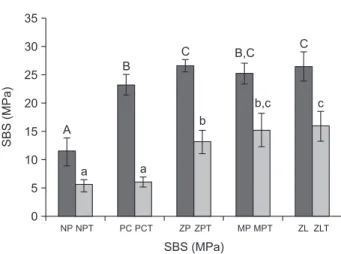
In all five surface treatment groups, the SBS decreased after thermocycling (Figure 1). Among the groups that did not undergo thermocycling, group NP exhibited a significantly lower SBS than the other groups (PC, ZP, MP, and ZL; p < 0.05). Group PC, which was treated with a silane primer, showed significantly lower SBS than groups ZP and ZL (p < 0.05). However, groups PC and MP did not significantly differ between each other (p > 0.05), and no significant differences were detected among the groups treated with zirconia primers (p >
0.05; Figure 1).
In the thermocycling groups, there was no significant difference between groups NPT and PCT (p > 0.05).
Groups ZPT, MPT, and ZLT, which used zirconia primers, were associated with a significantly higher SBS than the groups NPT and PCT (p < 0.05; Figure 1). There were no significant differences between groups ZPT and MPT or between groups MPT and ZLT (p > 0.05); however, groups ZPT and ZLT differed significantly between each other ( p < 0.05; Figure 1).
For the ARI score, both of the groups lacking primer
SBS(MPa)
NP
SBS (MPa) 0
35 30 25 20 15 10 5
NPT PC PCT ZP ZPT MP MPT ZL ZLT
A
a B
a
b
C B,C C
b,c c
Figure 1. Comparison of shear bond strength (SBS) between non-thermocycled and thermocycled groups.
Identical letters (A, B, C, a, b, c) indicate the lack of a significant difference between mean (p > 0.05). NP, No-primer; NPT, no-primer with thermocycling; PC, Porcelain Conditioner; PCT, Porcelain Conditioner with thermocycling; ZP, Z-PRIME Plus; ZPT, Z-PRIME Plus with thermocycling; MP, Monobond Plus; MPT, Monobond Plus with thermocycling; ZL, Zirconia Liner Premium; ZLT, Zirconia Liner Premium with thermocycling.
Table 7. Frequency distribution of failure modes Modified
ARI scores
Thermocycled group Non-thermocycled group
NP PC ZP MP ZL NPT PCT ZPT MPT ZLT
1 - - - - - - - - - -
2 - - 7 5 6 - - 6 7 8
3 - 4 3 5 4 - 5 4 3 2
4 - 3 - - - - 3 - - -
5 10 3 - - - 10 2 - - -
Median 5 4 2 2.5 2 5 3.5 2 2 2
Mean 5 3.9 2.3 2.5 2.4 5 3.7 2.4 2.3 2.2
SD 0 0.83 0.46 0.5 0.49 0 0.78 0.48 0.45 0.4
ARI, Adhesive remnant index score; NP, no-primer; NPT, no-primer with thermocycling; PC, Porcelain Conditioner; PCT, Porcelain Conditioner with thermocycling; ZP, Z-PRIME Plus; ZPT, Z-PRIME Plus with thermocycling; MP, Monobond Plus;
MPT, Monobond Plus with thermocycling; ZL, Zirconia Liner Premium; ZLT, Zirconia Liner Premium with thermocycling; SD, standard deviation.
Table 6. Two-way ANOVA for experimental groups
Source of variation df Sum of squares Mean square F-value p-value
Thermocycling 1 3,253.11 3,253.11 833.09 < 0.05
Primer 4 2,272.88 568.22 145.52 < 0.05
Thermocycling × Primer 4 359.60 89.90 23.02 < 0.05
ANOVA, Analysis of variance; df, degree of freedom.
(NP and NPT) displayed adhesive failure modes, but the groups with zirconia primers (ZP, ZPT, MP, MPT, ZL, and ZLT) were associated with mixed failure modes (Table 7).
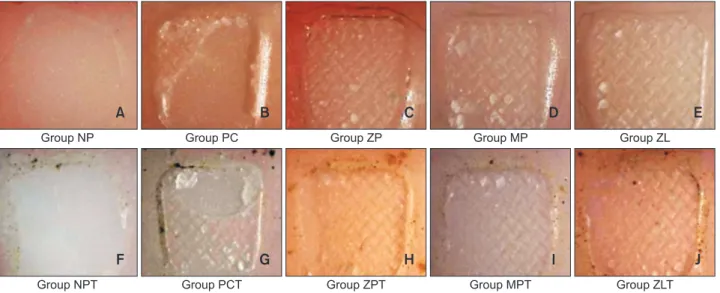
Micrographs of representative failure modes are shown in Figures 2 and 3.
DISCUSSION
In this study, the effect of zirconia primers on the SBS
of orthodontic metal brackets was determined. Kern and Wegner
15reported that sandblasting treatment increased the roughness of the zirconia surface, but compared to other alloys, it also decreased the number of undercuts and failed to maintain bond stability after water in- vasion. Similarly, the SBS of group NPT was 49% of the bond strength for group NP.
The control groups that lacked primer showed the lowest SBS both with and without thermocycling (Table
A B C D E
F G H I J
Group NP Group PC Group ZP Group MP Group ZL
Group NPT Group PCT Group ZPT Group MPT Group ZLT
Figure 2. Representative stereoscopic micrographs (16×) of the adhesive failure mode (A, F) and the mixed failure mode (B − E, G − J). NP, No-primer; NPT, no-primer with thermocycling; PC, Porcelain Conditioner; PCT, Porcelain Conditioner with thermocycling; ZP, Z-PRIME Plus; ZPT, Z-PRIME Plus with thermocycling; MP, Monobond Plus; MPT, Monobond Plus with thermocycling; ZL, Zirconia Liner Premium; ZLT, Zirconia Liner Premium with thermocycling.
A B C D E
F G H I J
Group NP Group PC Group ZP Group MP Group ZL
Group NPT Group PCT Group ZPT Group MPT Group ZLT