INTRODUCTION
Attention deficit hyperactivity disorder (ADHD) is one of the most prevalent disorders in child and adolescent psychiatry.1,2
Symptoms include difficulty staying focused and paying at- tention, difficulty controlling behavior, and hyperactivity. With treatment, the symptoms of ADHD can be improved, leading to more productive lives for affected children. Methylpheni- date is one of the most commonly used medications for ADHD treatment.
Mental effort has been described as energy mobilization for cognitive goals.3 The concept of mental effort can be defined as follows: 1) A response to high mental effort, which is not necessarily physically demanding, but which is nonetheless experienced as exhausting and stressful. 2) Compensation for a decrement in performance owing to the detrimental effects of stressors such as fatigue and sleep deprivation. Subjects need to exert extra effort in order to maintain optimal performance.
This additional exertion is also referred to as mental effort. In
Changes of Heart Rate Variability during
Methylphenidate Treatment in Attention-Deficit Hyperactivity Disorder Children:
A 12-Week Prospective Study
Hayeon Jennifer Kim, Jaewon Yang, and Moon-Soo Lee
Department of Psychiatry, Korea University, College of Medicine, Seoul, Korea.
Purpose: The aim of this study was to clarify the relationship between the autonomic nervous system and attention deficit hyper- activity disorder (ADHD) rating scales and to evaluate the usefulness of heart rate variability (HRV) as a psychophysiological bio- marker for ADHD.
Materials and Methods: Subjects were recruited from outpatients in the Department of Child and Adolescent Psychiatry at the Korea University Medical Center from August 2007 to December 2010. Subjects received methylphenidate. Time- and frequency- domain analyses of HRV, the Korean ADHD rating scale (K-ARS), and computerized ADHD diagnostic system were evaluated be- fore treatment. After a 12-week period of medication administration, we repeated the HRV measurements and K-ARS rating.
Results: Eighty-six subjects were initially enrolled and 37 participants completed the 12-week treatment and HRV measurements subsequent to the treatment. Significant correlations were found between the K-ARS inattention score and some HRV parame- ters. All of the HRV parameters, except the standard deviations of the normal-to-normal interval, very low frequency, and low fre- quency to high frequency, showed a significant positive correlation between baseline and endpoint measures in completers. High frequency (HF) and the square root of the mean squared differences of successive normal-to-normal intervals (RMSSD), which are related to parasympathetic vagal tone, showed significant decreases from baseline to endpoint.
Conclusion: The HRV test was shown to be reproducible. The decrease in HF and RMSSD suggests that parasympathetic domi- nance in ADHD can be altered by methylphenidate treatment. It also shows the possibility that HRV parameters can be used as psychophysiological markers in the treatment of ADHD.
Key Words: Attention deficit hyperactivity disorder, heart rate variability, methylphenidate, autonomic nervous system Yonsei Med J 2015 Sep;56(5):1365-1371
http://dx.doi.org/10.3349/ymj.2015.56.5.1365 pISSN: 0513-5796 · eISSN: 1976-2437
Received: June 23, 2014 Revised: October 8, 2014 Accepted: November 5, 2014
Corresponding author: Dr. Moon-Soo Lee, Department of Psychiatry, Korea Univer- sity, College of Medicine, Korea University Guro Hospital, 148 Gurodong-ro, Guro-gu, Seoul 152-703, Korea.
Tel: 82-2-459-1579, Fax: 82-2-852-1937, E-mail: [email protected]
•The authors have no financial conflicts of interest.
© Copyright: Yonsei University College of Medicine 2015
This is an Open Access article distributed under the terms of the Creative Com- mons Attribution Non-Commercial License (http://creativecommons.org/ licenses/
by-nc/3.0) which permits unrestricted non-commercial use, distribution, and repro- duction in any medium, provided the original work is properly cited.
other words, mental effort is the exertion necessary to regulate the subject’s current state.4
Mental effort has been operationalized by the use of various indices of psychophysiological state, particularly cardiovascu- lar measures, and previous studies have used cardiovascular activity to index mental effort.5,6
When the efficiency of cognitive inhibition is compared be- tween children with ADHD and healthy age-matched con- trols, children with ADHD were found to be capable of mental inhibition, but required more effort to do so.7 This also means that children with ADHD exert greater mental effort to main- tain a particular performance level than healthy children do.
Children diagnosed with ADHD show an appropriate capaci- ty for cognitive inhibition; however, the regulation of response processes requires greater attention in children with ADHD than in healthy control children.8
Heart rate variability (HRV) is a simple and non-invasive method for evaluating autonomic nervous system. The heart rate of a healthy person changes continually via interactions be- tween sympathetic and parasympathetic nerves, thereby main- taining somatic homeostasis.9 Measurement of HRV can be ap- plied in adult medicine as a predictor of acute myocardial infarction risk and as an early indicator of diabetic neuropathy.10 HRV has also been used as a neuropsychological biomarker for the assessment of mental effort. Particularly, HRV indices of parasympathetic nervous system activity are known to be sensi- tive indicators of mental effort during computational tasks.11
Therefore, if mental effort is indeed associated with changes in HRV, it may be possible that using HRV as a biomarker can help physicians predict and evaluate the outcomes and status of children with ADHD. A number of previous studies have in- vestigated the relationship between HRV parameters for auto- nomic function and ADHD measurements. A previous study indicated that there was decreased vagal tone with diminished HRV and higher heart rates in unmedicated children with ADHD. These parameters of autonomic activation seemed to be ameliorated by methylphenidate treatment.12 Another cross- sectional comparison of 19 children who were diagnosed as ADHD with 18 control subjects suggested that unmedicated, stimulant-free children with ADHD exhibit parasympathetic dominance of autonomic balance relative to control subjects.13 Nevertheless, there were no consistent findings on HRV param- eters in children with ADHD in these previous studies.
Abnormal catecholaminergic functioning has been thought to be a major pathophysiological mechanism in ADHD. Un- derarousal of the sympathetic system has been proposed in children with ADHD. Psychostimulants that increase dopa- mine concentrations and the selective noradrenaline trans- porter inhibitor atomoxetine which increases noradrenaline levels, have been used in the treatment of ADHD by targeting the central nervous system.14-16 Small increases in mean heart rate and mean blood pressure have been reported for psycho- stimulants.17 Atomoxetine also could increase blood pressure
by elevating noradrenaline concentrations in peripheral sym- pathetic neurons.18 However, the activity of the parasympa- thetic nervous system and the autonomic balance in ADHD have not been studied as extensively as the activity of sympa- thetic nervous system.
To the best of our knowledge, there have also been no pro- spective studies to systematically evaluate the changes of HRV parameters before and after methylphenidate treatments in children with ADHD. Thus, the aim of this study was to clarify the relationship between the autonomic nervous system and ADHD measurements and to evaluate the utility of HRV as a biomarker for therapeutic changes in ADHD.
MATERIALS AND METHODS
Participants
Subjects were recruited from amongst outpatients who had been diagnosed by two experienced child psychiatrists in the Department of Child and Adolescent Psychiatry at the Korea University Medical Center from August 2007 to December 2010. All participants showed signs and symptoms of either in- attention or hyperactivity-impulsivity or both according to the Diagnostic and Statistical Manual-IV-Text Revision (DSM-IV- TR) criteria for ADHD. All the participants underwent physical examination, electrocardiogram, and laboratory analysis before entering the study. Information regarding medical and psychi- atric comorbid disorders was also taken from medical charts, neuropsychological evaluation, and interview with partici- pants’ parents. Exclusion criteria included medical problems requiring special attention, such as cardiovascular disorders, as were learning disabilities or mental retardation. Subjects show- ing other psychiatric comorbidities were also excluded in order to focus on ADHD, although other psychiatric comorbidities are commonly diagnosed with this disorder. No psychotropic medications were permitted before the start of the study, and none of the participants had received any medication for at least two months prior to the initiation of the study. Subjects ranged in age from 6 to 12 years. A parent or legal guardian of the subjects provided informed consent. Methylphenidate medications were used in either immediate- or extended-re- lease form. The equivalent dose was calculated from published literature.19,20 The study was approved by the Institutional Re- view Board of Guro Hospital, Korea University Medical Center.
Clinical assessments ADHD symptoms
We assessed the symptoms of ADHD using the Korean ADHD rating scale (K-ARS) and the computerized ADHD diagnostic system (ADS). The K-ARS was originally developed from the ADHD Rating Scale-IV21 and the reliability and validity of Ko- rean version have been established. It was administered to par-
ents or caregivers by the investigators.22 The K-ARS is composed of two subscales (inattention and hyperactivity-impulsivity), each of which is scored independently and rated on the fol- lowing 4-point rating scale: 0=not present, 1=sometimes pres- ent, 2=often present, and 3=very often present. The maximum possible score for each subscale is 27, with the total maximum score being 54.9,23 We investigated the correlation between ADHD symptoms expressed by K-ARS and HRV parameters, because we wished to investigate the relationship between the change of ADHD symptoms and HRV parameters.
The ADS is a standardized continuous performance test that is commonly used as a supplement for ADHD diagnosis and comprises both visual and auditory tasks. Participants performed visual tasks, with the major outcome variables be- ing omission errors, commission errors, response times, and response variability. The omission and commission errors measure inattention and impulsivity, respectively. Patients with ADHD also tend to exhibit longer response times to a target and increased response variability. ADS test results are commonly expressed as t-scores relative to predetermined average scores.24 We also examined the correlation between ADS results and HRV parameters showing psychophysiologi- cal states at the baseline, as ADS assessments are widely used in clinics not only for categorical diagnosis of ADHD but also for assessing the continuous performance and the ADHD symptom profile.
Heart rate variability
Standard methods to measure HRV have been developed and have demonstrated pathophysiological correlation.10 The data collection and HRV analysis were performed with SA-2000E (Medicore Company, Seoul, Korea). The parameters measured in the evaluation of HRV were grouped into the time and fre- quency domains. In the time domain, the standard deviation of the normal-to-normal interval (SDNN) was used to esti- mate the long-term components of the HRV, and the square root of the mean squared differences of successive normal-to- normal intervals (RMSSD) was calculated by statistical time do- main measurements. In the frequency domain, short-term re- cordings of 5 minutes were binned into the following frequency bands, as recommended by the Task Force of the European Society of Cardiology and the North American So- ciety of Pacing and Electrophysiology:10 very low frequency (VLF) (0.00–0.04 Hz), low frequency (LF) (0.05–0.15 Hz), and high frequency (HF) (0.16–0.40 Hz) components.11 Initially in this study, VLF, LF, and HF power were recorded as absolute values. The total power (TP) and ratio of low frequency to high frequency (LF/HF) were calculated from the absolute values of LF and HF power as single number estimates9 that are con- sidered to reflect simultaneous modulating effects on both the sympathetic and vagal systems.25 Since the absolute values of TP, VLF, LF, and HF power were skewed, power densities were transformed by taking their natural logarithms to allow
parametric statistical comparisons that assume normal distri- butions.26
Short-term recording (5 min) of electrocardiograms and HRV parameters from a stationary position were used in this study.
Procedures
This study’s subjects were all outpatients at Guro Hospital, Korea University Medical Center. None had received any medication for at least two months prior to beginning treat- ment in this study. Subjects were instructed to visit the outpa- tient clinic at Korea University Guro Hospital on a regular ba- sis and received methylphenidate as part of their medical treatment. All subjects were evaluated for adverse events dur- ing each visit, and an interview with their care providers was conducted. At baseline, time- and frequency-domain analy- ses of HRV, K-ARS, and ADS were evaluated before starting medication. After a 12-week period of receiving the medica- tion, endpoint HRV and ARS measurements were taken.
Statistical analysis
Clinical variables, such as K-ARS and HRV parameters, were compared between the baseline and endpoints using a paired samples t-test. Correlations between baseline and endpoint HRV parameters were investigated. Pearson’s correlations were also used to determine the correlations between ADHD clini- cal variables and HRV parameters. All data analyses were per- formed using SPSS version 21.0 (SPSS Inc., Chicago, IL, USA), and p≤0.05 was considered significant.
RESULTS
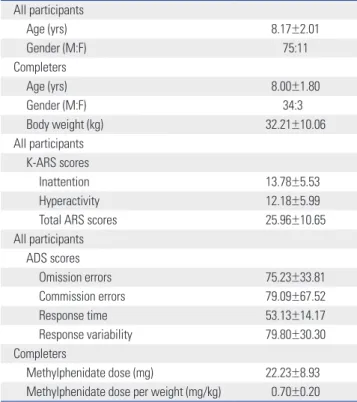
Eighty-six subjects were initially enrolled and 37 participants completed the 12-week treatment regimen. The mean age of all 86 participants [75 male (87.2%) and 11 female (12.8%)]
was 8.17±2.06. Baseline demographic and psychometric vari- ables from all participants and completers are presented in Table 1. The mean score of the K-ARS was 25.96±10.65 for all participants. Among the completers, the mean methylpheni- date dose at the endpoint was 22.23±8.93 mg and the mean methylphenidate dose per unit weight was 0.70±0.20 mg/kg.
We investigated the correlations between the K-ARS vari- ables and each HRV parameter at baseline in all participants (Table 2). Significant correlations were found between the K- ARS inattention score and some HRV parameters (mean heart rate: r=-0.277, HF: r=0.229, LF/HF: r=-0.250).
When we examined the correlations between ADS variables and each HRV parameter, the only significant result was a nega- tive correlation between commission errors and VLF (r=-0.235).
Next, we investigated the correlations between HRV param- eters at baseline and at the endpoint of the 12-week treatment in completers. In the analysis of completers, all of the HRV parameters, except SDNN, VLF, and LF/HF, showed a signifi-
cant positive correlation between baseline and endpoint mea- sures (mean heart rate: r=0.394, RMSSD: r=0.546, TP: r=0.350, LF: r=0.324, HF: r=0.330).
For the completers, we also assessed the changes in K-ARS and HRV between the baseline and endpoint (Table 3). After treatment, all the K-ARS scores (inattention, hyperactivity-im- pulsivity, and total) decreased significantly from the baseline.
This indicated that the participants showed a clinical im-
provement in ADHD symptoms. In addition, there was a sig- nificant increase in the mean heart rate from 86.38±11.15 to 93.54±15.60.
HF also showed a significant decrease from baseline (6.14±
0.97) to endpoint (5.70±1.22). The HF component is known to be a quantitative marker of parasympathetic vagal tone.27 The RMSSD significantly decreased from baseline (47.65±25.12) to endpoint (38.88±17.94). The RMSSD is sensitive to high- frequency heart period fluctuations in the respiratory fre- quency range and has also been used as an index of vagal car- diac control.28
DISCUSSION
Several studies have investigated laboratory analyses to assess Table 2. Correlations between K-ARS Variables and HRV Parameters in All Participants (n=86)
HRV parameters K-ARS variables
Inattention Hyperactivity Total scores
Mean heart rate -0.277* -0.204 -0.259*
SDNN 0.116 0.014 0.068
RMSSD 0.198 0.077 0.146
TP 0.081 0.022 0.055
VLF 0.023 0.047 -0.038
LF 0.002 -0.065 -0.035
HF 0.229* 0.086 0.167
LF/HF -0.250* -0.124 -0.200
K-ARS, Korean-ADHD rating scale; HRV, heart rate variability; SDNN, stan- dard deviation of the NN interval; RMSSD, square root of mean squared dif- ferences of successive NN intervals; TP, total power; VLF, very low frequency;
LF, low frequency; HF, high frequency; LF/HF, ratio of low frequency to high frequency; ADHD, attention deficit hyperactivity disorder.
Numbers are presented as means.
*p≤0.05.
Table 3. Changes in K-ARS and HRV between the Baseline and Endpoint (12th Treatment Week) in Completers (n=37)
Variables Baseline Endpoint p value
K-ARS subscale score changes
Inattention score 14.25±5.21 10.53±5.33 0.001
Hyperactivity-impulsivity score 12.47±6.11 9.39±5.57 0.001
Total score 26.72±10.65 19.92±10.46 0.001
HRV changes
Mean heart rate 86.38±11.15 93.54±15.60 0.007
SDNN 51.78±21.28 47.66±17.12 NS
RMSSD 47.65±25.12 38.88±17.94 0.018
TP 7.42±0.80 7.24±0.84 NS
VLF 6.10±1.03 6.10±0.97 NS
LF 6.30±1.05 6.13±1.09 NS
HF 6.14±0.97 5.70±1.22 0.043
LF/HF 1.68±1.70 2.20±2.62 NS
K-ARS, Korean-ADHD rating scale; HRV, heart rate variability; SDNN, standard deviation of the NN interval; RMSSD, square root of mean squared differences of suc- cessive NN intervals; TP, total power; VLF, very low frequency; LF, low frequency; HF, high frequency; LF/HF, ratio of low frequency to high frequency; NS, not significant.
Numbers are presented as mean±standard deviation.
Table 1. Baseline Demographic/Clinical Characteristics of ADHD Par- ticipants and Completers
All participants
Age (yrs) 8.17±2.01
Gender (M:F) 75:11
Completers
Age (yrs) 8.00±1.80
Gender (M:F) 34:30
Body weight (kg) 32.21±10.06
All participants K-ARS scores
Inattention 13.78±5.53
Hyperactivity 12.18±5.99
Total ARS scores 25.96±10.65
All participants ADS scores
Omission errors 75.23±33.81
Commission errors 79.09±67.52
Response time 53.13±14.17
Response variability 79.80±30.30
Completers
Methylphenidate dose (mg) 22.23±8.93
Methylphenidate dose per weight (mg/kg) 0.70±0.20 K-ARS, Korean ADHD rating scale; ADS, the computerized ADHD diagnostic system; ADHD, attention deficit hyperactivity disorder.
Numbers are presented as mean±standard deviation.
the potential differences between typically developing healthy children and ADHD groups. There are no characterized spe- cific and definitive cognitive, metabolic, neurological, or bio- logical markers for ADHD, although many diagnostic tools such as continuous performance test are applied for the diag- nosis of ADHD. Accordingly, uncertainty exists for assessing symptoms changes in the disorder.29 The development of lab- oratory and psychophysiological measures for the assessment of symptom changes in ADHD would be helpful for both the understanding and the treatment of the essential underlying pathophysiological processes.
The central nervous system modulates the changes in auto- nomic nervous system activity in ADHD.30 Psychological state and processes are known to influence the autonomic nervous control of the cardiovascular system in patients with mental disorders. In mental disorders such as ADHD, psychological state also can influence HRV because the central nervous sys- tem modulates the autonomic nervous system, and cardiac function is sensitive to autonomic influences.31 Accordingly, a change in the mental disorder can also affect the autonomic nervous system and can thus affect HRV parameters, whether it is caused by treatment or not. Consequently, the HRV can be used as an index of central-peripheral neural feedback and CNS-ANS integration,32 and HRV analysis can show the possi- ble links between mental processes and cardiac autonomic regulation.30 Accordingly, many studies have sought to identi- fy specific electro-cortical and HRV indices of arousal, activa- tion, and effort.4 In addition, these parameters related to state regulation can be measured reliably using cardiac measures as these are less sensitive to characteristic behaviors of chil- dren with ADHD (eye and body movement) rather than elec- tro-cortical measures.33
The polyvagal theory proposed by Porges conceptualizes the vagal brake (i.e., the myelinated vagus, originating in the nucle- us ambiguous) as an adaptive and dynamic neural physiologi- cal mechanism to foster interaction with the environment,30 and parasympathetic nervous system-linked cardiac activity can be associated with emotion,34 and also state regulation.35
We measured HRV in subjects completing our study two times (at baseline and after 12-weeks of treatment). The HRV parameters showed significant correlations with each other, except for SDNN, VLF, and LF/HF, although there was a 12- week interval between the administrations of each test. This shows that the HRV test is reproducible, despite the parame- ters being subject to change according to the participants’
clinical status and various clinical conditions.
Spectral power in the HF band, has been reported to pri- marily reflect respiration-driven vagal modulation of sinus ar- rhythmia.36 Traditionally, HF indexes have been accepted measures of cardiac vagal tone. However, some recent studies have demonstrated that changes in this index do not neces- sarily show proportional changes in vagal tone. Recent studies also show that the HF component is related to both vagal tone
and the magnitude of fluctuation in vagal traffic, although these relationships are non-linear.37
In a previous cross-sectional study, vagal reactivity was com- pared between 18 children with ADHD and 18 age-matched healthy subjects. The vagal reactivity, measured as percent change in the high frequency band in response to orthosis, was significantly higher in the ADHD group compared to controls.30
Negrao, et al.13 reported that stimulant-free children with ADHD have sympathetic underarousal and parasympathetic overarousal of the sympathovagal balance (i.e., a parasympa- thetic dominance of the autonomic balance) relative to healthy control subjects. They also showed that methylphenidate shift- ed the autonomic balance in children with ADHD towards nor- mal levels, although methylphenidate was administered for a shorter period of only, but at least, 10 days and the duration of the trial was not controlled.
The HF component shows significant positive correlations with K-ARS inattention subscale scores, which decreased sig- nificantly after our 12-week treatment. The significant clinical improvements included decreases in all K-ARS scale scores:
inattention, hyperactivity-impulsivity, and total scores. There was also a statistically significant decrease in the mean HF value, because there were significant clinical improvements.
In addition, RMSSD, which is also known to be a measure of vagus-mediated control of the heart, decreased significantly after 12 weeks of treatment, compared with baseline.38 This study alone does not show whether changes in HRV parame- ters are related with clinical response, apart from the well- characterized methylphenidate effects on cardiovascular pa- rameters. If we could compare the endpoint HRV parameters between children who responded to methylphenidate and those who did not, it would help answer to this question.
However, we could not evaluate the endpoint HRV parame- ters in patients who dropped out of the study. Instead, we need to consider the results of Negrao’s study on the compari- son of baseline HRV parameters between stimulant-free chil- dren with ADHD and normal typically developing control subjects. There were significant differences between those two groups and stimulant-free children with ADHD showed greater values in HF and RMSSD parameters.13 This indicates that children with ADHD differ from normal controls in their preexisting HRV parameters irrespective of methylphenidate treatment, and HRV parameter differences might be related to the pathophysiologic mechanisms of ADHD itself. We suggest that the changes in HRV parameters after treatment in our study may have originated from the clinical response caused by the pathophysiologic mechanisms of ADHD rather than simply methylphenidate effects on cardiovascular parameters when considering the previous study result.13
This is in line with previous research suggesting that chil- dren with ADHD show parasympathetic dominance and that methylphenidate treatment changes this parasympathetic dominance into autonomic balance. The association between
altered autonomic functioning and ADHD is established, but the role of the autonomic regulatory responses in ADHD is less well understood, and the mechanisms for these changes in parasympathetic dominance in ADHD remain unclear. The HRV parameters seem to act as a proxy for more central regu- latory processes that cannot be measured non-invasively.39 Heart rate was increased after treatment in this study. This is likely due to the use of methylphenidate. Methylphenidate is known to raise heart rate, but it is not significantly associated with an increase in the short-term or mid-term risk of severe cardiac events when used to treat children.40
This study had some limitations. Among its most major is the lack of a control group and non-blinded study design.
Without the ability to compare the findings to such a control group, we cannot draw conclusions about whether the change in parasympathetic dominance completely returns to the lev- els in healthy controls with methylphenidate treatment. Sec- ond, there were high dropout rates during this study and fe- male participants were underrepresented in the completers group (male 34:female 3). This was because this study was strictly limited to patients who were medicated exclusively with methylphenidate, and all the patients who took other psychotropic medications were excluded. To avoid confusion in the interpretation, we limited to patients who took only the stimulant medication. Clinical decision-making was made on the basis of clinician’s appraisal of the child’s clinical status, response to the methylphenidate, and the experience of ad- verse events. When the child needed to receive an alternative psychotropic medication, the patient was excluded from the study. This contributed to the high dropout rate in this study.
Third, the use of non-medicinal products including energy drinks that can affect the cardiovascular parameters were not screened in this study. However, when considering the age of participants (from 6 to 12 years), it is not common for children to consume energy drinks and the sale of energy drinks that contain high concentrations of caffeine is regulated in Korea.
Nonetheless, to our knowledge, this is the first study to exam- ine the relationship between HRV parameters and ADHD clinical variables prospectively in a controlled clinical trial.
In conclusion, the HRV test was shown to have repeatabili- ty, and decreases in HF and RMSSD suggested that parasym- pathetic dominance in ADHD can be changed by methylphe- nidate treatment. This study also revealed the possibility that HRV parameters can be used as a psychophysiological marker in the treatment of ADHD.
ACKNOWLEDGEMENTS
This research was financially supported by a Jun Sang-Bae Child and Adolescent Psychiatry Research grant from the Ko- rean Foundation of Neuropsychiatric Research.
REFERENCES
1. Polanczyk G, de Lima MS, Horta BL, Biederman J, Rohde LA. The worldwide prevalence of ADHD: a systematic review and metare- gression analysis. Am J Psychiatry 2007;164:942-8.
2. Costello EJ, Mustillo S, Erkanli A, Keeler G, Angold A. Prevalence and development of psychiatric disorders in childhood and ado- lescence. Arch Gen Psychiatry 2003;60:837-44.
3. Gaillard AW. Comparing the concepts of mental load and stress.
Ergonomics 1993;36:991-1005.
4. Mulder G. The concept and measurement of mental effort. In:
Hockey RJ, Gaillard AWK, Coles MGH, editors. Energetics and human information processing; 1986. p.175-98.
5. Fairclough SH, Houston K. A metabolic measure of mental effort.
Biol Psychol 2004;66:177-90.
6. Kline KP, Ginsburg GP, Johnston JR. T-wave amplitude: relation- ships to phasic RSA and heart period changes. Int J Psychophysiol 1998;29:291-301.
7. Gaultney JF, Kipp K, Weinstein J, McNeill J. Inhibition and Mental Effort in Attention Deficit Hyperactivity Disorder. J Dev Phys Dis- abil 1999;11:105-14.
8. Jennings JR, van der Molen MW, Pelham W, Debski KB, Hoza B.
Inhibition in boys with attention deficit hyperactivity disorder as indexed by heart rate change. Dev Psychol 1997;33:308-18.
9. Kristal-Boneh E, Raifel M, Froom P, Ribak J. Heart rate variability in health and disease. Scand J Work Environ Health 1995;21:85-95.
10. Heart rate variability. Standards of measurement, physiological interpretation, and clinical use. Task Force of the European Soci- ety of Cardiology and the North American Society of Pacing and Electrophysiology. Eur Heart J 1996;17:354-81.
11. Hjortskov N, Rissén D, Blangsted AK, Fallentin N, Lundberg U, Søgaard K. The effect of mental stress on heart rate variability and blood pressure during computer work. Eur J Appl Physiol 2004;92:
84-9.
12. Buchhorn R, Conzelmann A, Willaschek C, Störk D, Taurines R, Renner TJ. Heart rate variability and methylphenidate in children with ADHD. Atten Defic Hyperact Disord 2012;4:85-91.
13. Negrao BL, Bipath P, van der Westhuizen D, Viljoen M. Autonom- ic correlates at rest and during evoked attention in children with attention-deficit/hyperactivity disorder and effects of methylphe- nidate. Neuropsychobiology 2011;63:82-91.
14. Wilens TE. Mechanism of action of agents used in attention-defi- cit/hyperactivity disorder. J Clin Psychiatry 2006;67 Suppl 8:32-8.
15. Berridge CW, Devilbiss DM, Andrzejewski ME, Arnsten AF, Kelley AE, Schmeichel B, et al. Methylphenidate preferentially increases catecholamine neurotransmission within the prefrontal cortex at low doses that enhance cognitive function. Biol Psychiatry 2006;
60:1111-20.
16. Swanson CJ, Perry KW, Koch-Krueger S, Katner J, Svensson KA, Bymaster FP. Effect of the attention deficit/hyperactivity disorder drug atomoxetine on extracellular concentrations of norepineph- rine and dopamine in several brain regions of the rat. Neurophar- macology 2006;50:755-60.
17. Awudu GA, Besag FM. Cardiovascular effects of methylpheni- date, amphetamines and atomoxetine in the treatment of atten- tion-deficit hyperactivity disorder: an update. Drug Saf 2014;37:
661-76.
18. Shibao C, Raj SR, Gamboa A, Diedrich A, Choi L, Black BK, et al.
Norepinephrine transporter blockade with atomoxetine induces hypertension in patients with impaired autonomic function. Hy- pertension 2007;50:47-53.
19. Connor D. Once a day Concerta methylphenidate was equivalent
to 3 times daily methylphenidate in children with ADHD. Evid Based Ment Health 2002;5:20.
20. Coghill D, Banaschewski T, Zuddas A, Pelaz A, Gagliano A, Doep- fner M. Long-acting methylphenidate formulations in the treat- ment of attention-deficit/hyperactivity disorder: a systematic re- view of head-to-head studies. BMC Psychiatry 2013;13:237.
21. DuPaul GJ, Power TJ, Anastopoulos AD, Reid R. ADHD Rating Scale-IV: Checklists, Norms, and Clinical Interpretation. New York: Guilford Press; 1998.
22. So YK, Noh JS, Kim YS, Ko SG, Koh YJ. The reliability and validity of Korean parent and teacher ADHD Rating Scale. J Korean Neu- ropsychiatr Assoc 2002;41:283-9.
23. DuPaul GJ. Parent and Teacher Ratings of Adhd Symptoms: Psy- chometric Properties in a Community-Based Sample. J Clin Child Psychol 1991;20:245-53.
24. Shin MS, Cho S, Chun SY, Hong KE. A study of the development and standardization of ADHD diagnostic system. Korean J Child Adol Psychiatr 2000;11:91-9.
25. Malliani A, Lombardi F, Pagani M. Power spectrum analysis of heart rate variability: a tool to explore neural regulatory mecha- nisms. Br Heart J 1994;71:1-2.
26. Sandercock G. Normative values, reliability and sample size esti- mates in heart rate variability. Clin Sci (Lond) 2007;113:129-30.
27. Thayer JF, Yamamoto SS, Brosschot JF. The relationship of auto- nomic imbalance, heart rate variability and cardiovascular dis- ease risk factors. Int J Cardiol 2010;141:122-31.
28. Berntson GG, Lozano DL, Chen YJ. Filter properties of root mean square successive difference (RMSSD) for heart rate. Psycho- physiology 2005;42:246-52.
29. Timimi S, Taylor E. ADHD is best understood as a cultural con- struct. Br J Psychiatry 2004;184:8-9.
30. Tonhajzerova I, Ondrejka I, Adamik P, Hruby R, Javorka M, Trunk- valterova Z, et al. Changes in the cardiac autonomic regulation in children with attention deficit hyperactivity disorder (ADHD). In-
dian J Med Res 2009;130:44-50.
31. Yeragani VK. Heart rate and blood pressure variability: implications for psychiatric research. Neuropsychobiology 1995;32:182-91.
32. Thayer JF, Lane RD. The role of vagal function in the risk for car- diovascular disease and mortality. Biol Psychol 2007;74:224-42.
33. Börger N, van der Meere J. Motor control and state regulation in children with ADHD: a cardiac response study. Biol Psychol 2000;51:247-67.
34. Porges SW. Orienting in a defensive world: mammalian modifica- tions of our evolutionary heritage. A Polyvagal Theory. Psycho- physiology 1995;32:301-18.
35. Porges SW, Doussard-Roosevelt JA, Stifter CA, McClenny BD, Riniolo TC. Sleep state and vagal regulation of heart period pat- terns in the human newborn: an extension of the polyvagal theo- ry. Psychophysiology 1999;36:14-21.
36. Heart rate variability: standards of measurement, physiological interpretation and clinical use. Task Force of the European Soci- ety of Cardiology and the North American Society of Pacing and Electrophysiology. Circulation 1996;93:1043-65.
37. Pyetan E, Akselrod S. Do the high-frequency indexes of HRV pro- vide a faithful assessment of cardiac vagal tone? A critical theoret- ical evaluation. IEEE Trans Biomed Eng 2003;50:777-83.
38. DeGiorgio CM, Miller P, Meymandi S, Chin A, Epps J, Gordon S, et al. RMSSD, a measure of vagus-mediated heart rate variability, is associated with risk factors for SUDEP: the SUDEP-7 Inventory.
Epilepsy Behav 2010;19:78-81.
39. Beauchaine T. Vagal tone, development, and Gray’s motivational theory: toward an integrated model of autonomic nervous system functioning in psychopathology. Dev Psychopathol 2001;13:183- 214.
40. Bange F, Le Heuzey MF, Acquaviva E, Delorme R, Mouren MC.
[Cardiovascular risks and management during Attention Deficit Hyperactivity Disorder treatment with methylphenidate]. Arch Pediatr 2014;21:108-12.