• 검색 결과가 없습니다.

Modulation of Presynaptic GABA Release by Oxidative Stress in Mechanically-isolated Rat Cerebral Cortical Neurons

N/A
N/A
Protected

Academic year: 2022

Share "Modulation of Presynaptic GABA Release by Oxidative Stress in Mechanically-isolated Rat Cerebral Cortical Neurons"

Copied!
6
0
0

로드 중.... (전체 텍스트 보기)

전체 글

(1)

127 DOI: 10.4196/kjpp.2010.14.3.127

ABBREVIATIONS: ROS, reactive oxygen species; NAC, N-acety- lcystein; H-89, N-(2-[p-bromocinnamylamino]ethyl)-5-isoquino- linesulfonamide hydrochloride.

Received March 25, 2010, Revised May 9, 2010, Accepted May 26, 2010

Corresponding to: Young-Wuk Cho, Department of Physiology, Kyung Hee University School of Medicine, 1, Hoegi-dong, Dongdaemun-gu, Seoul 130-701, Korea. (Tel) 82-2-961-0534, (Fax) 82-2-967-0534, (E-mail) [email protected]

*Eu-Teum Hahm and Jung-Woo Seo contributed equally to the present work.

Modulation of Presynaptic GABA Release by Oxidative Stress in Mechanically-isolated Rat Cerebral Cortical Neurons

Eu-Teum Hahm*, Jung-Woo Seo*, Jinyoung Hur, and Young-Wuk Cho

Department of Physiology, Biomedical Science Institute and Medical Research Center for Reactive Oxygen Species, Kyung Hee University School of Medicine, Seoul 130-701, Korea

Reactive oxygen species (ROS), which include hydrogen peroxide (H

2

O

2

), the superoxide anion (O

2

․), and the hydroxyl radical (OH․), are generated as by-products of oxidative metabolism in cells. The cerebral cortex has been found to be particularly vulnerable to production of ROS associated with conditions such as ischemia-reperfusion, Parkinson's disease, and aging. To investigate the effect of ROS on inhibitory GABAergic synaptic transmission, we examined the electrophysiological mechanisms of the modulatory effect of H

2

O

2

on GABAergic miniature inhibitory postsynaptic current (mIPSCs) in mechanically isolated rat cerebral cortical neurons retaining intact synaptic boutons. The membrane potential was voltage-clamped at − 60 mV and mIPSCs were recorded and analyzed. Superfusion of 1-mM H

2

O

2

gradually potentiated mIPSCs. This potentiating effect of H

2

O

2

was blocked by the pretreat- ment with either 10,000-unit/mL catalase or 300-μM N-acetyl-cysteine. The potentiating effect of H

2

O

2

was occluded by an adenylate cyclase activator, forskolin, and was blocked by a protein kinase A inhibitor, N-(2-[p-bromocinnamylamino] ethyl)-5-isoquinolinesulfonamide hydrochloride. This study indicates that oxidative stress may potentiate presynaptic GABA release through the mechanism of cAMP-dependent protein kinase A (PKA)-dependent pathways, which may result in the inhibition of the cerebral cortex neuronal activity.

Key Words: Gamma-aminobutyric acid, Hydrogen peroxide, Oxidative stress, Inhibitory postsynaptic potentials

INTRODUCTION

Reactive oxygen species (ROS), which include hydrogen peroxide (H

2

O

2

), the superoxide anion (O

2−

․), and the hy- droxyl radical (OH․), are generated as by-products of oxida- tive metabolism in cells. Increased intracellular production of ROS results in oxidative stress and damage to the central nervous system [1,2]. ROS-induced oxidative stress to the brain has been implicated in normal aging and in various neurodegenerative disorders, including Parkinson’s dis- ease, amyotrophic lateral sclerosis, Alzheimer’s disease, and ischemia-reperfusion injury [3-8]. The cerebral cortex is the one of the brain areas most susceptible to ROS and is particularly vulnerable to generation of ROS associated with ischemia-reperfusion.

Numerous neurotransmitter systems are sensitive to ROS, including adrenergic [9], dopaminergic [10], serotonergic [11] and GABAergic [12,13] systems. The effects of ROS on neurotransmission can occur via various mechanisms [14]. For example, ROS may interact with neurotransmitter

receptors and ion transport proteins such as channels, pumps, and transporters, leading to changes in receptor activity and ionic homeostasis. In addition, ROS can alter ligand-re- ceptor interactions or ion transport indirectly via actions within the lipid environment of cell membranes. ROS, par- ticularly H

2

O

2

, might also play a role in cellular signaling [15]. Among the most important signaling pathways modu- lated by H

2

O

2

are those involving kinase and phosphatase enzymes, which are sensitive to ROS [16-19]. For GABAer- gic neurotransmission, ROS have been shown to increase release and decrease uptake of GABA in a variety of neuro- nal preparations [12,20,21]. A recent study indicated that H

2

O

2

increased GABAergic mIPSCs through presynaptic in- ositol-1,4,5-trisphosphate receptor (IP3R)- sensitive Ca

2+

release mechanism [22]. However, it is not clear whether cAMP-dependent protein kinase A is involved in the effect of ROS on GABAergic mIPSCs in central neurons. Thus, we examined the role of PKA in the modulatory effect of H

2

O

2

on GABAergic miniature inhibitory postsynaptic cur- rents (mIPSCs) in mechanically-isolated cerebral cortical neurons of the rat. As a result, we have found that H

2

O

2

potentiates the presynaptic GABA release through the

mechanism of cAMP-dependent protein kinase A (PKA)-

dependent pathways, which may result in the inhibition of

the cerebral cortical neuronal activity.

(2)

METHODS

Isolation of single cerebral cortical neurons with intact synaptic boutons

All experimental protocols were approved by the Institu- tional Animal Care and Use Committee of the Kyung Hee University and all efforts were made to minimize the num- ber of animals utilized, as well as animal suffering.

Single cerebral cortical neurons with presynaptic boutons were isolated using techniques described previously [23,24].

In brief, 10- to 15-day-old Sprague-Dawley rats of both sexes were decapitated under Zoletil 50

anesthesia (50 mg kg

−1

, i.p.). Brains were quickly removed and transversely sliced at a thickness of 400 μm using a vibratome (Series 1500, Vibratome, St. Louis, MO, USA). Before mechanical dis- section, slices were preincubated for at least 1 h at room temperature (22∼25

o

C) in a solution well saturated with 95% O

2

and 5% CO

2

. For mechanical dissociation, slices were transferred to a 35-mm plastic culture dish (Falcon Primaria 3801, Becton Dickinson, Rutherford, NJ, USA), and the cerebral cortex was identified under a binocular microscope (SZ-ST, Olympus, Tokyo, Japan). Mechanical dissociation was accomplished using a custom-built vi- bration device and a fire-polished glass pipette oscillating at approximately 50∼60 Hz. The tip of the pipette was lightly placed on the surface of the cerebral cortex and vi- brated horizontally (0.1∼0.2 mm displacement) for approx- imately 2 min. Slices were removed, and the mechanically dissociated neurons were allowed to settle and adhere to the bottom of the dish for at least 15 min before commence- ment of recording. The neurons undergoing dissociation re- tained short portions of their proximal dendrites.

Electrical measurements

Electrophysiological recordings were performed in the conventional whole-cell patch-clamp recording mode [25]

under voltage-clamp conditions. Patch pipettes were pre- pared from glass capillaries (1B150F-4, World Precision Instruments Inc., Sarasota, FL, USA) on a vertical pipette puller (PP-830, Narishige, Tokyo, Japan) in 2 stages. The patch pipette was positioned on the neuron using a water- driven micromanipulator (WR-60, Narishige, Tokyo, Japan).

The resistance between the recording electrode filled with the internal pipette solution and the reference electrode was 5∼7 MΩ. The neurons were visualized with phase-con- trast equipment on an inverted microscope (IX-70, Olympus, Tokyo, Japan). Electrical stimulation, current recordings, and current filtration (at 1 kHz) were obtained with an EPC-10 patch-clamp amplifier (HEKA Electronik, Lambrecht, Germany) linked to an IBM-compatible PC controlled by HEKA software. Data were digitized with a LIH 1600 board (HEKA Electronik, Lambrecht, Germany) and stored on a hard disk. The currents were monitored on a thermal line- arcorder (WR3320-3CL, Graphtec Co., Yokohama, Japan).

All experiments were performed at room temperature (22∼

25

o

C).

Solutions

The ionic composition of the incubation solution was (in mM): NaCl 124, KCl 5, KH

2

PO

4

1.2, MgSO

4

1.3, CaCl

2

2.4, glucose 10, and NaHCO

3

24. The pH was adjusted to 7.4 by continuous bubbling with 95% O

2

and 5% CO

2

. The

standard external solution was (in mM): NaCl 150, KCl 5, MgCl

2

1, CaCl

2

2, glucose 10, and N-2-hydroxyethylpiper- azine-N'-2-ethanesulphonic acid (HEPES) 10. The pH was adjusted to 7.4 with tris-hydroxymethyl aminomethane (Tris-base). The composition of the internal pipette solution for mIPSC recording was (in mM): CsCl 110, TEA-Cl 30, EGTA 5, adenosine 5'-triphosphate magnesium salt (Mg-ATP) 5, guanosine 5'-triphosphate trisodium salt (Na3-GTP) 0.4, and HEPES 10. The pH was adjusted to 7.2 with Tris base.

For mIPSC recording, external solutions contained 300 nM TTX, 3 μM 6-cyano-7-nitroquinoxaline-2,3-dione (CNQX), and 10 μM DL-2-amino-5-phosphonovaleric acid (AP5) to block voltage-dependent Na

channels and glutamatergic excitatory synaptic currents.

Data analysis

Spontaneous miniature inhibitory postsynaptic currents (mIPSCs) were counted and analyzed using the Mini-Analysis program (Synaptosoft Inc., Leonia, NJ, USA). Kaleida Graph software (Synergy Software, Reading, PA, USA) was used for curve fitting. To set the adequate threshold for mIPSCs, we analyzed mIPSCs at the threshold of 1 pA, and then manually accepted or rejected each event according to the characteristics of rise time and decay time kinetics. Then, we plotted the histogram of amplitude distribution of mIPSCs.

Almost all events of mIPSCs were larger than 10∼20 pA.

Thus, we set the threshold for event detection at 10∼20 pA for mIPSC. Spontaneous events were initially detected automatically using an amplitude threshold of 10∼20 pA for the recording of mIPSCs at the holding voltage (V

H

) of

−60 mV. After automatic detection, all events were man- ually accepted or rejected on the basis of the rise and decay times. Events with brief rise times (0.5∼1.5 ms) that were well-fitted by a single-exponential function were selected for analysis. The amplitude and frequency of large numbers of mIPSCs obtained from a single neuron were examined by constructing all-point cumulative probability distribu- tions and compared using the Kolmogorov-Smirnov (K-S) test with Stat View software (SAS Institute Inc., Cary, NC, USA). Mean amplitudes and frequencies of mIPSCs were normalized to the control conditions and were reported as means±SEM. Differences in mean amplitude and frequency of mIPSCs were tested with Student's paired two-tailed t-test using absolute rather than normalized values. Values of p<0.05 were considered significant.

Drugs

Zoletil 50

(tiletamine HCl 125 mg/5 mL+zolazepam HCl 125 mg/5 mL) was purchased from Virbac laboratory (06516 Carros, France). Tetrodotoxin, (-)-bicuculline metho- chloride, CNQX, AP5, ethylene glycol-bis (β-aminoethyl ether)-N,N,N'N'-tetraacetic acid (EGTA), Mg-ATP, Na

3

GTP, methanesulfonic acid, HEPES, dimethyl sulfoxide, N-methyl-

D

-glucamine, BaCl

2

, CsCl, CdCl

2

, cesium methanesulfonate,

4-aminopyridine (4-AP), forskolin, N-(2-[p-bromocinnamy-

lamino]ethyl)-5-isoquinolinesulfonamide hydrochloride (H-89),

tetraethyl ammonium chloride (TEA-Cl), BaCl

2

, catalase,

N-acetyl-

L

-cysteine, and clotrimazole were purchased from

Sigma (St. Louis, Missouri). CNQX, bicuculline, and for-

skolin were dissolved in dimethyl sulfoxide at 10 mM as

a stock solution. Drugs were added to external solutions

at the final concentrations shown in the text and the vehicle

concentrations never exceeded 0.01%. Drugs were applied

(3)

Fig. 1. GABAergic mIPSCs recorded from mechanically dissociated cerebral cortical neurons. In the presence of 300 nM TTX, 3 μM CNQX, and 10 μM AP5, superfusion of 50 μM bicuculline com- pletely and reversibly blocked mIPSCs in isolated cerebral cortical neurons. Holding voltage was −60 mV. Intracellular and extra- cellular Cl

concentrations were 140 mM and 161 mM, respectively.

Asterisks represent a statistically significant difference (**p<0.01).

Fig. 2. Effect of H

2

O

2

on GABAergic mIPSCs. Each recording trace is the representative current trace of GABAergic mIPSCs recorded before (control), during and after the superfusion of 1 mM H

2

O

2

. The bar histograms show the mean±S.E.M. of the relative frequency and amplitude of mIPSCs. All frequencies and amplitudes are normalized to those of control mIPSCs. **p<0.01.

using a rapid application system termed the ‘‘Y-tube method’’

as described elsewhere [26].

RESULTS

GABAergic mIPSCs in isolated cerebral cortical neurons with presynaptic boutons

Mechanically isolated cerebral cortical neurons retained short portions of their proximal dendrites. When the neu- rons were voltage-clamped at V

H

−60 mV in the presence of 300 nM TTX, 3 μM CNQX, and 10 μM AP5, spontaneous mIPSCs were observed. After rupture of the patch mem- brane, it took 10∼20 min for synaptic currents to stabilize.

Upon stabilization, recording of mIPSCs were started and the amplitudes of almost all mIPSC in the present study were larger than 10∼20 pA. In most neurons, mIPSCs were stable for approximately 60 min. These results indicate that presynaptic nerve terminals attached to the dissociated neurons were functional and their spontaneous activity sta- ble within 60 min. Superfusion of 50 μM bicuculline com- pletely blocked spontaneous mIPSCs frequency (8.9±4.3%

of the control, p<0.01, n=3, Fig. 1). After washing out bicu- culline, the frequency of mIPSC was restored to the control level (103.1±5.7% of the control, p=0.644). These results in- dicate that the spontaneous mIPSCs are mediated by GABAA receptors.

Effect of H

2

O

2

on GABAergic mIPSCs in isolated cerebral cortical neurons

Superfusion of 1 mM H

2

O

2

potentiated the frequency and amplitude of GABAergic synaptic events in all cerebral cortical neurons (Fig. 2). H

2

O

2

increased the mean mIPSC frequency to 267.3±37.8% of the control (p<0.01, n=9) and the mean amplitude to 131.0±8.9% of the control (p<0.01, n=9). Washing out H

2

O

2

for at least 10 min could not com- pletely restore the frequency and amplitude of mIPSC to the control level (182.8±52.2% of the control, p=0.151 for the frequency; 117.2±11.4% of the control, p=0.169 for the amplitude). Superfusion of H

2

O

2

did not significantly change the rise time and the decay time of the mIPSC (96.9±3.2%

of the control, p=0.565 for the rise time; 115.5±6.2% of the control, p=0.302 for the decay time). The results indicate that superfusion of H

2

O

2

presynaptically potentiates the re- lease probability of GABA at the presynaptic terminals and postsynaptically potentiates the GABA-activated Cl

cur- rents without any alteration of kinetics. These results sug- gest that inhibitory GABAergic synaptic transmission in the cerebral cortical neurons is increased by an increase in presynaptic ROS concentration.

Effect of N-acetylcystein and catalase on the potenti- ating effect of H

2

O

2

on mIPSCs

To elucidate whether the effect of H

2

O

2

on the presynaptic GABA release is due to the oxidative stress induced by in- creased intracellular ROS, we examined the blocking effects of N-acetylcystein (NAC) and catalase on the H

2

O

2

potenti- ating of mIPSCs. Changes in the frequency and amplitude of mIPSCs were recorded before and after the superfusion of 1 mM H

2

O

2

with the pretreatment of 300 μM NAC (Fig. 3) or 1,000-unit/ml catalase (Fig. 4). NAC is well known as a ROS scavenger, whereas catalase activates the decom- position of H

2

O

2

into water and oxygen. Superfusion of NAC for 10 min did not alter the mIPSCs frequency (108.7±

30.1% of the control, n=5, p=0.787) and the mIPSC ampli- tude (113.3±6.8% of the control, n=5, p=0.106). However, pretreatment with NAC suppressed the potentiating effect of 1 mM H

2

O

2

on the mIPSC frequency (125.9±23.5% of the control, n=5, p=0.666) and the mIPSC amplitude (128.2±

11.3% of the control, n=5, p=0.291). In addition, pretreat- ment with catalase, an enzyme catalyzing H

2

O

2

to H

2

O and O

2

, for 10 min did not alter the mIPSCs frequency (87.1±

8.3% of the control, n=11, p=0.152) and the mIPSC ampli- tude (106.1±3.8% of the control, n=11, p=0.141). However, pretreatment with catalase significantly blocked the poten- tiating effect of 1 mM H

2

O

2

on the mIPSC frequency (96.1±

14.1% of the control, n=11, p=0.592) and the mIPSC ampli-

tude (105.8±5.1% of the control, n=11, p=0.973). The result

indicates that the potentiating effect of H

2

O

2

on the mIPSCs

frequency and amplitude is blocked by NAC and catalase.

(4)

Fig. 5. Effect of forskolin on the potentiating of H

2

O

2

on GABAergic mIPSCs. Each recording trace shows the control current trace, the current trace recorded during the superfusion of 10 μM forskolin, and the current trace recorded during the superfusion of 1 mM H

2

O

2

in the presence of forskolin. Bar histograms show the mean±

S.E.M. of the relative frequency and amplitude of mIPSCs recorded in the above conditions. Forskolin significantly potentiated the frequency of mIPSCs without any alteration of amplitude. In the presence of forskolin, H

2

O

2

did not significantly alter the frequency and amplitude of mIPSCs. *p<0.05.

Fig. 3. Effect of NAC on the potentiating of H

2

O

2

on GABAergic mIPSCs. Each recording trace shows the control current trace, the current trace recorded during the pretreatment with 300 μM NAC, and the current trace recorded during the superfusion of 1 mM H

2

O

2

in the presence of NAC. Bar histograms show the mean±

S.E.M. of the relative frequency and amplitude of mIPSCs recorded in the above conditions. The pretreatment with NAC suppressed the potentiating effect of H

2

O

2

on the frequency and amplitude of mIPSCs.

Fig. 4. Effect of catalase on the potentiating of H

2

O

2

on GABAergic mIPSCs. Each recording trace shows the control current trace, the current trace recorded during the pretreatment with 1,000-unit catalase, and the current trace recorded during the superfusion of 1 mM H

2

O

2

in the presence of catalase. Bar histograms show the mean±S.E.M. of the relative frequency and amplitude of mIPSCs recorded in the above conditions. The pretreatment with catalase suppressed the potentiating effect of H

2

O

2

on the frequency and amplitude of mIPSCs.

Effect of adenylate cyclase activation on the potenti- ating effect of H

2

O

2

on mIPSCs

Activation of adenylate cyclase can increase cAMP for- mation and then potentiates presynaptic neurotransmitter release. Thus, we examined the effect of forskolin, an ad- enylyl cyclase activator, on the potentiating effect of H

2

O

2

on GABAergic mIPSCs. Forskolin (10 μM) significantly in- creased the mIPSC frequency to 147.8±15.6% of the control (p<0.05, n=6), without affecting the mIPSC amplitude

(106.0±6.3% of the control, p=0.386, n=6, Fig. 5). In the presence of forskolin, superfusion of H

2

O

2

slightly increased the mIPSC frequency while statistically not significant (136.9±17.0% of the forskolin condition, p=0.232, n=6). In addition, in the presence of forskolin, superfusion of H

2

O

2

did not potentiate the mIPSC amplitude (96.0±6.7% of the forskolin control, p=0.780, n=6). The results indicate that activation of adenylate cyclase might inhibit the potentiat- ing effect of H

2

O

2

on the frequency of presynaptic GABA release and on the amplitude of postsynaptic GABA-acti- vated Cl

current.

Effect of PKA inhibition on the potentiating effect of H

2

O

2

on mIPSCs

It is well known that in the CNS a change in intracellular cAMP concentration affects a variety of cellular signaling via PKA. To address the possible involvement of PKA in the potentiating effect of H

2

O

2

on presynaptic GABA re- lease, we examined the effects of H-89, a cAMP-dependent PKA inhibitor, on the H

2

O

2

potentiation of GABAergic mIPSCs. Superfusion of H-89 (100 nM) did not alter the frequency and amplitude of GABAergic mIPSC (108.9±

20.8% of the control, p=0.692, n=5 for the frequency; 110.6±

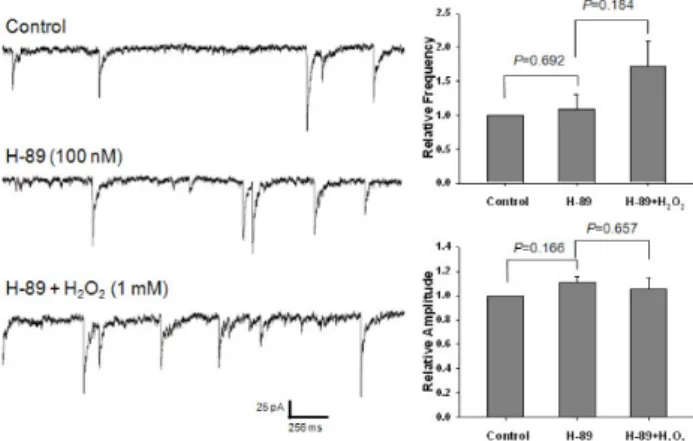
5.3% of the control, p=0.166, n=5 for the amplitude; Fig. 6).

In the presence of H-89, superfusion of H

2

O

2

slightly in- crease the mIPSC frequency while statistically not significant (167.2±34.3% of the H-89 control frequency, p=0.184, n=5).

In addition, in the presence of H-89, superfusion of H

2

O

2

did not potentiate the mIPSC amplitude (95.1±3.7% of the

H-89 control, p=0.657, n=5). The results indicate that in-

hibition of PKA pathway might inhibit the potentiating ef-

fect of H

2

O

2

on the frequency of presynaptic GABA release

and on the amplitude of postsynaptic GABA-activated Cl

current.

(5)

Fig. 6. Effect of H-89 on the potentiating of H

2

O

2

on GABAergic mIPSCs. Each recording trace shows the control current trace, the current trace recorded during the superfusion of 100 nM H-89, and the current trace recorded during the superfusion of 1 mM H

2

O

2

in the presence of H-89. Bar histograms show the mean±S.E.M.

of the relative frequency and amplitude of mIPSCs recorded in the above conditions. H-89 did not significantly alter the frequency and amplitude of mIPSCs. In the presence of H-89, H

2

O

2

did not significantly alter the frequency and amplitude of mIPSCs.

DISCUSSION

The present study demonstrates that oxidative stress caused by H

2

O

2

potentiates the frequency and amplitude of GABAergic mIPSCs in mechanically isolated single neu- rons retaining intact synaptic boutons of the rat cerebral cortex. This potentiating effect of H

2

O

2

on GABAergic syn- aptic transmission might be mediated by activation of cAMP-dependent PKA pathway. The results suggest that some conditions resulting in oxidative stress result in the inhibition of the cerebral cortex neuronal activity.

The potentiating effect of H

2

O

2

on the activity of rat sym- pathetic preganglionic neurons was blocked by the pretreat- ment with catalase [27], which breaks down H

2

O

2

into wa- ter and molecular oxygen [1] and by the pretreatment with N-acetyl-cysteine, which increases cellular pools of free rad- ical scavengers [27]. In the present study, the potentiating effect of H

2

O

2

on GABAergic mIPSC frequency was also completely blocked by catalase and NAC. This finding in- dicates that oxygen free radicals might directly mediate the potentiating effect of H

2

O

2

on the presynaptic GABA re- lease in the rat cerebral cortical neurons.

Oxidative stress induced by ROS might induce the alter- ation of the neuronal activity through the modulation of inhibitory or excitatory synaptic input strength. H

2

O

2

and O

2−

inhibited the uptake of glutamate and enhanced the release of glutamate, resulting in NMDA receptor over- stimulation [28,29]. In addition, H

2

O

2

stimulated glutamate release, elevation of [Ca

2+

]

c

and ROS generation, which in turn led to neuronal cell death in cultured cortical cells [30].

A recent report demonstrated that H

2

O

2

increased GABAergic mIPSCs through presynaptic release of Ca

2+

from inositol-1,4,5-trisphosphate receptor-sensitive Ca

2+

stores in the spinal cord substantia gelatinosa neurons [22].

In addition, several reports have demonstrated that cAMP-dependent PKA has an important role in certain con- ditions showing an increase in presynaptic GABA release

in many neuronal preparations [31-33]. However, it is not clear whether cAMP-dependent PKA is involved in the ef- fect of H

2

O

2

on presynaptic GABA release. In the present study, activation of PKA with forskolin increased pre- synaptic GABA release and occluded the potentiating effect of H

2

O

2

on the frequency of GABAergic mIPSCs (Fig. 5).

Inhibition of PKA with H-89 occluded the potentiating ef- fect of H

2

O

2

on the frequency of GABAergic mIPSCs (Fig. 6).

These results indicate that the frequency of presynaptic GABA release might be potentiated by H

2

O

2

through acti- vation of PKA. On the other hand, forskolin did not alter the amplitude of GABAergic mIPSCs, while the potentiat- ing effect of H

2

O

2

on the amplitude of GABAergic mIPSCs was blocked by the pretreatment with forskolin. H-89 also blocked the potentiating effect of H

2

O

2

on the amplitude of GABAergic mIPSCs. The results indicate that the amount of GABA released from presynaptic terminals might be in- creased by H

2

O

2

, not through activation or inhibition of PKA, but through other mechanisms. From the results of a recent report [22], it can be suggested that the potentiat- ing effect of H

2

O

2

on the amount of GABA released from presynaptic terminals might be through IP3-induced pre- synaptic Ca

2+

increase.

From the present study, it can be suggested that in- creased intracellular ROS of the neuronal nerve terminals of cerebral cortical neurons may increase the frequency and amount of GABA release from the presynaptic terminals and then inhibits the postsynaptic neuronal activity via in- creased GABAergic inhibitory synaptic transmission. This result is consistent with the previous result that H

2

O

2

in- hibits the neuronal excitability via hyperpolarization of the membrane potential (unpublished data). The sensitivity of GABA

A

receptor function to ROS may be an important fac- tor in the development of neuronal damage associated with cerebral ischemia and other neurodegenerative conditions.

These findings provide a rationale for testing the efficacy of combined antioxidant pharmacotherapy with drugs that enhance GABAergic neurotransmission [34].

ACKNOWLEDGEMENTS

This study was supported by the Kyung Hee University Research Fund in 2008 (KHU-20080386).

REFERENCES

1. Fridovich I. The biology of oxygen radicals. Science. 1978;201:

875-880.

2. Halliwell B. Reactive oxygen species and the central nervous system. J Neurochem. 1992;59:1609-1623.

3. Beckman JS, Beckman TW, Chen J, Marshall PA, Freeman BA.

Apparent hydroxyl radical production by peroxynitrite: impli- cations for endothelial injury from nitric oxide and superoxide.

Proc Natl Acad Sci USA. 1990;87:1620-1624.

4. Dreher D, Junod AF. Differential effects of superoxide, hydrogen peroxide, and hydroxyl radical on intracellular calcium in human endothelial cells. J Cell Physiol. 1995;162:147-153.

5. Lewen A, Matz P, Chan PH. Free radical pathways in CNS injury. J Neurotrauma. 2000;17:871-890.

6. Ames BN, Shigenaga MK. Oxidants are a major contributor to aging. Ann N Y Acad Sci. 1992;663:85-96.

7. Chandra J, Samali A, Orrenius S. Triggering and modulation of apoptosis by oxidative stress. Free Radic Biol Med.

2000;29:323-333.

(6)

8. Golino P, Ragni M, Cirillo P, Avvedimento VE, Feliciello A, Esposito N, Scognamiglio A, Trimarco B, Iaccarino G, Condorelli M, Chiariello M, Ambrosio G. Effects of tissue factor induced by oxygen free radicals on coronary flow during reperfusion. Nat Med. 1996;2:35-40.

9. Kvaltinova Z, Lukovic L, Stolc S. Effect of incomplete ischemia and reperfusion of the rat brain on the density and affinity of alpha-adrenergic binding sites in the cerebral cortex. Prevention of changes by stobadine and vitamin E. Neuropharmacology.

1993;32:785-791.

10. Joseph JA, Erat S, Denisova N, Villalobos-Molina R. Receptor- and age-selective effects of dopamine oxidation on receptor-G protein interactions in the striatum. Free Radic Biol Med.

1998;24:827-834.

11. Muakkassah-Kelly SF, Andresen JW, Shih JC, Hochstein P.

Decreased [3H]serotonin and [3H]spiperone binding consequent to lipid peroxidation in rat cortical membranes. Biochem Biophys Res Commun. 1982;104:1003-1010.

12. Sah R, Schwartz-Bloom RD. Optical imaging reveals elevated intracellular chloride in hippocampal pyramidal neurons after oxidative stress. J Neurosci. 1999;19:9209-9217.

13. Schwartz RD. The GABAA receptor-gated ion channel: bio- chemical and pharmacological studies of structure and function.

Biochem Pharmacol. 1988;37:3369-3375.

14. van der Want JJ, Nunes Cardozo JJ, van der TC. GABAergic neurons and circuits in the pretectal nuclei and the accessory optic system of mammals. Prog Brain Res. 1992;90:283-305.

15. Finkel T. Oxygen radicals and signaling. Curr Opin Cell Biol.

1998;10:248-253.

16. Denu JM, Tanner KG. Specific and reversible inactivation of protein tyrosine phosphatases by hydrogen peroxide: evidence for a sulfenic acid intermediate and implications for redox regulation. Biochemistry. 1998;37:5633-5642.

17. Nakamura K, Hori T, Sato N, Sugie K, Kawakami T, Yodoi J. Redox regulation of a src family protein tyrosine kinase p56lck in T cells. Oncogene. 1993;8:3133-3139.

18. Klann E, Roberson ED, Knapp LT, Sweatt JD. A role for superoxide in protein kinase C activation and induction of long-term potentiation. J Biol Chem. 1998;273:4516-4522.

19. Whisler RL, Goyette MA, Grants IS, Newhouse YG. Sublethal levels of oxidant stress stimulate multiple serine/threonine kinases and suppress protein phosphatases in Jurkat T cells.

Arch Biochem Biophys. 1995;319:23-35.

20. Rego AC, Santos MS, Oliveira CR. Oxidative stress, hypoxia, and ischemia-like conditions increase the release of endogenous amino acids by distinct mechanisms in cultured retinal cells.

J Neurochem. 1996;66:2506-2516.

21. Saransaari P, Oja SS. Release of endogenous glutamate, aspartate, GABA, and taurine from hippocampal slices from

adult and developing mice under cell-damaging conditions.

Neurochem Res. 1998;23:563-570.

22. Takahashi A, Mikami M, Yang J. Hydrogen peroxide increases GABAergic mIPSC through presynaptic release of calcium from IP3 receptor-sensitive stores in spinal cord substantia gelatinosa neurons. Eur J Neurosci. 2007;25:705-716.

23. Akaike N, Moorhouse AJ. Techniques: applications of the nerve-bouton preparation in neuropharmacology. Trends Pharmacol Sci. 2003;24:44-47.

24. Hahm ET, Lee JJ, Min BI, Cho YW. Opioid inhibition of GABAergic neurotransmission in mechanically isolated rat periaqueductal gray neurons. Neurosci Res. 2004;50:343-354.

25. Hamill OP, Marty A, Neher E, Sakmann B, Sigworth FJ.

Improved patch-clamp techniques for high-resolution current recording from cells and cell-free membrane patches. Pflugers Arch. 1981;391:85-100.

26. Min BI, Kim CJ, Rhee JS, Akaike N. Modulation of glycine- induced chloride current in acutely dissociated rat peria- queductal gray neurons by μ-opioid agonist DAGO. Brain Res.

1996;734:72-78.

27. Lin HH, Chen CH, Hsieh WK, Chiu TH, Lai CC. Hydrogen peroxide increases the activity of rat sympathetic preganglionic neurons in vivo and in vitro. Neuroscience. 2003;121:641-647.

28. Volterra A, Trotti D, Racagni G. Glutamate uptake is inhibited by arachidonic acid and oxygen radicals via two distinct and additive mechanisms. Mol Pharmacol. 1994;46:986-992.

29. Mailly F, Marin P, Israel M, Glowinski J, Premont J. Increase in external glutamate and NMDA receptor activation contribute to H

2

O

2

-induced neuronal apoptosis. J Neurochem. 1999;73:

1181-1188.

30. Lee MK, Yeo H, Kim J, Markelonis GJ, Oh TH, Kim YC.

Cynandione A from Cynanchum wilfordii protects cultured cortical neurons from toxicity induced by H

2

O

2

, L-glutamate, and kainate. J Neurosci Res. 2000;59:259-264.

31. Yum DS, Cho JH, Choi IS, Nakamura M, Lee JJ, Lee MG, Choi BJ, Choi JK, Jang IS. Adenosine A1 receptors inhibit GABA- ergic transmission in rat tuberomammillary nucleus neurons.

J Neurochem. 2008;106:361-371.

32. Lee JJ, Hahm ET, Lee CH, Cho YW. Serotonergic modulation of GABAergic and glutamatergic synaptic transmission in mechanically isolated rat medial preoptic area neurons. Neuro- psychopharmacology. 2008;33:340-352.

33. Jeong HJ, Jang IS, Nabekura J, Akaike N. Adenosine A1 receptor-mediated presynaptic inhibition of GABAergic trans- mission in immature rat hippocampal CA1 neurons. J Neuro- physiol. 2003;89:1214-1222.

34. Schwartz-Bloom RD, Sah R. gamma-Aminobutyric acid(A) neurotransmission and cerebral ischemia. J Neurochem. 2001;

77:353-371.

수치

Fig. 1. GABAergic mIPSCs recorded from mechanically dissociated  cerebral cortical neurons
Fig. 4. Effect of catalase on the potentiating of H 2 O 2  on GABAergic  mIPSCs. Each recording trace shows the control current trace, the  current trace recorded during the pretreatment with 1,000-unit  catalase, and the current trace recorded during the
Fig. 6. Effect of H-89 on the potentiating of H 2 O 2  on GABAergic  mIPSCs. Each recording trace shows the control current trace, the  current trace recorded during the superfusion of 100 nM H-89, and  the current trace recorded during the superfusion of

참조

관련 문서

A frame size error in a frame that could alter the state of the entire connection MUST be treated as a connection error (Section 5.4.1); this includes any frame carrying a

After first field tests, we expect electric passenger drones or eVTOL aircraft (short for electric vertical take-off and landing) to start providing commercial mobility

1 John Owen, Justification by Faith Alone, in The Works of John Owen, ed. John Bolt, trans. Scott Clark, "Do This and Live: Christ's Active Obedience as the

For the study of inhibitory synapse development, we analyzed the intensity, area, and density of Gephyrin or VGAT clusters in primary hippocamapal

In this study, it can be interpreted that the combined increase of the trust and the alternative attraction makes the intention of conversion higher rather

– In order to investigate the interaction between neurons in the network, patterning the small number of neurons is necessary.. – The electrical connectivity

As a result, the number of vasopressin and oxytocin-containing neurons was decreased in the paraventricular and supraoptic nucleus in chronic alcohol group..

In this study, it is shows that the stream of CO 2 is more effective in the reduction of unreacted TEGDMA and the increase of surface microhardness than that of N 2