Effect of Pertussis Toxin and Herbimycin A on Proteinase- Activated Receptor 2-Mediated Cyclooxygenase 2 Expression
in Helicobacter pylori-Infected Gastric Epithelial AGS Cells
Ji Hye Seo,
1Jeong Yeon Seo,
2Hae-Yun Chung,
3and Hyeyoung Kim
41Department of Pharmacology, Brain Korea 21 Project for Medical Science, Yonsei University College of Medicine, Seoul;
2Department of Physiology, Tissue Injury Defense Research Center, College of Medicine, Ewha Womans University, Seoul;
3Institute of Food and Nutritional Science, College of Human Ecology, Yonsei University, Seoul;
4Department of Food and Nutrition, Brain Korea 21 Project, College of Human Ecology, Yonsei University, Seoul, Korea.
Received: August 17, 2009 Revised: October 9, 2009 Accepted: October 15, 2009
Corresponding author: Dr. Hyeyoung Kim, Department of Food and Nutrition, College of Human Ecology, Yonsei University, 50 Yeonse-ro, Seodaemun-gu,
Seoul 120-749, Korea.
Tel: 82-2-2123-3125, Fax: 82-2-364-5781 E-mail: [email protected]
∙ The authors have no financial conflicts of interest.
© Copyright:
Yonsei University College of Medicine 2011 This is an Open Access article distributed under the terms of the Creative Commons Attribution Non- Commercial License (http://creativecommons.org/
licenses/by-nc/3.0) which permits unrestricted non- commercial use, distribution, and reproduction in any medium, provided the original work is properly cited.
Helicobacter pylori (H. pylori) is an important risk factor for chronic gastritis, pep- tic ulcer, and gastric cancer. Proteinase-activated receptor 2 (PAR2), subgroup of G-protein coupled receptor family, is highly expressed in gastric cancer, and chronic expression of cyclooxygenase-2 (COX-2) plays an important role in H.
pylori-associated gastric carcinogenesis and inflammation. We previously demon- strated that H. pylori induced the expression of PAR2 and COX-2 in gastric epi- thelial cells. Present study aims to investigate whether COX-2 expression induced by H. pylori in Korean isolates is mediated by PAR2 via activation of Gi protein and Src kinase in gastric epithelial AGS cells. Results showed that H. pylori-in- duced COX-2 expression was inhibited in the cells transfected with antisense oli- gonucleotide for PAR2 or treated with Gi protein blocker pertussis toxin, Src ki- nase inhibitor herbimycin A and soybean trypsin inbitor, indicating that COX-2 expression is mediated by PAR2 through activation of Gi protein and Src kinase in gastric epithelial cells infected with H. pylori in Korean isolates. Thus, targeting the activation of PAR2 may be beneficial for prevention or treatment of gastric in- flammation and carcinogenesis associated with H. pylori infection.
Key Words: Helicobacter pylori, cyclooxygenase-2, proteinase-activated receptor 2, AGS cells
H. pylori-associated acute and chronic antral inflammation has been associated with the expression of cyclooxygenase-2 (COX-2) in gastric epithelial cells,1 which is strongly correlated with the extent of chronic inflammatory cell infiltrate.2 Chronic expression of COX-2 is related to H. pylori-associated gastric carcinogen- esis in addition to propagation of gastric inflammation since prostaglandins pro- duced via COX-2 are reported to contribute to inflammation3 and carcinogenesis.4 Our previous study demonstrated that oxidant-sensitive transcription factor NF-κB mediates COX-2 expression, which may be related to cell proliferation in gastric epithelial cells.5 H. pylori-induced activation of NF-κB mediates the expression of
In the present study, we investigated whether H. pylori- induced COX-2 expression is mediated by PAR2 via activa- tion of Gi protein and Src kinase in gastric epithelial AGS cells. Thus, the cells were transfected with sense oligonu- cleotide (S ODN) and antisense oligonucleotide (AS ODN) for PAR2 and cultured in the presence of H. pylori. In other sets of experiments, the cells were treated with Gi protein blocker pertussis toxin, Src kinase inhibitor herbimycin A or soybean trypsin inhibitor for 1 hour and cultured in the presence of H. pylori. Subsequently, mRNA and protein ex- pression of COX-2 were determined by RT-PCR analysis and Western blot analysis, respectively. Pertussis toxin in- hibits Gi protein by coupling the inhibitory receptors to the adenylate cyclase system.21 Herbimycin A is known to be an irreversible inhibitor of Src kinase.22
We used HP99 which was isolated from gastric antral mu- cosa of Korean patients with gastric and duodenal ulcer, and identified it as cagA+, vacA s1b, m2, iceA1 H. pylori strain.23 H. pylori was added to human gastric epithelial AGS cells (ATCC CRL 1739, American Type Culture Collection, Manassas, Virginia, USA) at a bacterium/cell ratio of 100 : 1 in a 3 mL volume. The cells were transfected with S ODN and AS ODN for PAR2 for 16 hours and cultured in the pres- ence of H. pylori. In other sets of experiments, the cells were treated with Gi protein blocker pertussis toxin (400 ng/mL), Src kinase inhibitor herbimycin A (10 µM), or soybean tryp- sin inhibitor (1, 2, 5 nM) for 1 hours and cultured in the pres- ence of H. pylori. mRNA and protein expression of COX-2 were determined by reverse transcription-polymerase chain reaction (RT-PCR) analysis (at 12 hours) and Western blot analysis (at 24 hours), respectively. For ODN preparation, single-stranded ODNs were prepared commercially (GIB- CO-BRL, New York, USA). ODNs were phosphorothioate- modified to reduce intracellular nuclease digestion. AS ODN and S ODN target the ATG start codon of the PAR2 mRNA.
The sequence of PAR-2 AS ODN was 5’-TCCG- CATCCTCCTGGAA-3’, and that of PAR2 S ODN was 5’-TTCCAGGAGGATGC GGA-3’. For RT-PCR analysis, the primers used were: PAR2, forward 5’-GATGGCA- CATCCCACGTC-3’, reverse 5’-GGCATGTATGTGATAG- GC-3’, giving a 288 bp PCR product; COX-2, forward 5’-TTCAAATGAGATTGTGGGAAAATTGCT-3’, reverse 5’-AGATCATCTCTGCCTGAGTATCTT- 3’, giving a 296 bp PCR produc; β-actin, forward 5’-ACCAACTGGGAC- GACATGGAG-3’, reverse 5’-GTGAGGATCTTCATGAG- GTAGTC-3’, giving a 354 bp PCR product. The PCR prod- ucts were amplified and visualized by UV transilumination.23 several genes involved in inflammation, such as IL-86 and
adhesion molecules intergrin α5, in gastric epithelial AGS cells.7 Proteinase-activated receptor 2 (PAR2) regulates cell proliferation and enhances COX-2 expression in human pancreatic cancer cells8 and integrin expression in H. pylo- ri-infected gastric epithelial cells.9
Proteinase-activated receptors (PARs) are G protein-cou- pled receptors that are activated by the cleavage of their N- terminal domains by proteases.10,11 Proteinase-activated re- ceptor 2 (PAR2) activation induces G protein-mediated signal transduction, generation of inositol triphosphate, mo- bilization of intracellular calcium, the activation of mito- gen-activated protein kinase, cell growth, and the release of cytokines (IL-6, IL-8) and prostaglandins.12,13 PAR2 is acti- vated by multiple trypsin-like serine proteases including trypsin and tryptase.13 Inflammatory cytokines (interleukin- 1α, tumor necrosis factor-α) increase mRNA expression of PAR2.14 Invasive breast and pancreatic cancer cells express high levels of PAR2 compared with normal cells.15 These studies show the positive relationship between PAR2 ex- pression and carcinogenesis. Previously, we demonstrated that H. pylori induced the expression and activation of PAR2 by stimulating the expression of trypsinogens and trypsin in gastric epithelial AGS cells.9 In addition, inhibition of PAR2 activation by a soyben trypsin inhibitor (SBTI) suppressed H.
pylori-induced expression of integrins in gastric epithelial cells.9 Therefore, PAR2 seems to play an important role in H.
pylori-associated gastric inflammation and/or carcinogenesis by mediating the induction of inflammatory and carcinogenic genes, including COX-2, in gastric epithelial cells.
In addition, the genetic differences of H. pylori isolates play a role in the clinical outcome of the infection, particu- larly H. pylori-virulence associated genes such as vacA, cagA, and iceA genes.16 Infection by cagA strain is more likely to result in peptic ulceration, atrophic gastritis, and gastric carcinoma.17,18 Presence of cagA or vacA in H. pylo- ri strain showed different expression of genes as compared to cagA negative or vacA negative H. pylori in gastric epi- thelial AGS cells.19 The studies suggest that the presence of virulence factors (vacA, cagA, and iceA) and isotypes of each virulence factor (vacA s1b m2, vacA s1c m1, iceA1, iceA2 etc.) in H. pylori strain are important to determine disease incidence related to H. pylori infection. Since the predomi- nant genotype of H. pylori in Korea has been reported to be cagA positive and vacA positive genotype,20 H. pylori in Korean isolates may be used to determine the pathogenic mechanism of H. pylori-induced gastric diseases in Korea.
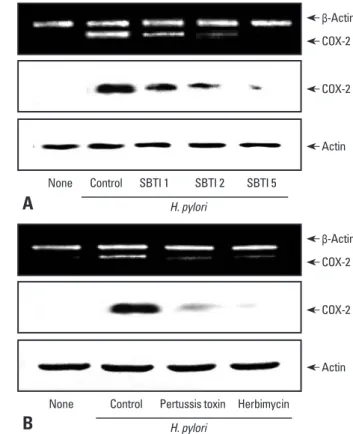
fection efficiency of ODN was determined by observing mRNA and protein levels of PAR2 in the cells transfected (Fig. 1A). H. pylori-induced PAR2 expression was inhibit- ed in the cells transfected with AS ODN, but not changed in those transfected with S ODN. H. pylori-induced expres- sion of COX-2 was similarly inhibited in the cells transfect- ed with AS ODN compared to those in the cells transfected with S ODN (Fig. 1B). Since protein level and the activity of trypsin increased in H. pylori-infected AGS cells,9 trypsin may activate PAR2 in AGS cells. Previously, we showed the increase of intracellular Ca mobilization by PAR2 activa- tion in H. pylori-infected AGS cells,25 which was inhibited by SBTI (data not shown), demonstrating that SBTI in AGS cells suppresses PAR activation induced by H. pylori. Using SBTI, we determined whether SBTI suppresses H. pylori- induced expression of COX-2 in AGS cells. As seen in Fig.
2A, H. pylori-induced expression of COX-2 was inhibited dose-dependently by SBTI. G protein coupled receptor (GPRC) signalings have been shown to be inhibited by per- tussis toxin, which inactivates ADP-ribosylation of α sub- For Western blot analysis, the proteins were detected with
polyclonal antibodies for PAR2 (Catalog # SC-13504) and COX-2 (Catalog # SC-19999), perchased from Santa Cruz Biotechnology (Santa Cruz, CA, USA), at 1 : 1000 dilation and the immunoreactive proteins were visualized by en- hanced chemiluminescence.24
Since mRNA and protein expressions of COX-2 were evi- dent at 12 hours and 24 hours in our previous study,24 in the following experiments using transfection with S ODN and AS ODN for PAR2 or treatment with Gi protein blocker per- tussis toxin, Src kinase inhibitor herbimycin A and SBTI, re- spectively, the time points of 12 hours and 24 hours for mRNA and protein expressions of COX-2, respectively, were used. β-Actin (for mRNA) and actin (for protein) were constitutively expressed in the cells and not changed with culture period.
To determine direct involvement of PAR2 in the expres- sion of COX-2, the cells were transfected with PAR2 AS ODN or S ODN and cultured in the presence of H. pylori for 12 hours (mRNA) or 24 hours (protein) (Fig. 1). Trans-
Fig. 2. H. pylori-induced expression of COX-2 is inhibited in AGS cells treat- ed with soybean trypsin inhibitor (SBTI), pertussis toxin and herbimycin A.
AGS cells in 6-well culture plates were treated with SBTI (1, 2, 5 nM) (A), or pertussis toxin (400 ng/mL) or herbimycin A (10 µM) (B) for 1 h and cultured in the presence of H. pylori at a bacterium/cell ratio of 100 : 1 for 12 h (for mRNA) or 24 h (for protein). COX-2 mRNA expression levels were deter- mined by RT-PCR and at protein level by Western blotting. COX-2, cycloox- ygenase-2.
None
None Control
Control
H. pylori
H. pylori SBTI 1
Pertussis toxin SBTI 2
Herbimycin
β-Actin
β-Actin COX-2
COX-2 COX-2
COX-2 Actin
Actin SBTI 5
Fig. 1. H. pylori-induced expressions of PAR2 and COX-2 are inhibited in AGS cells transfected with PAR2 AS ODN. AGS cells were seeded in 6-well culture plates at 5×10⁵ cells per well transfected with S or AS ODNs for PAR-2 for 16 h. The bacterial cells were added to the cultured cells at a bacterium/cell ratio of 100 : 1 for 12 h (for mRNA) or 24 h (for protein). The expressions of mRNA and protein for PAR2 (A) and COX-2 (B) were deter- mined by RT-PCR and Western blotting, respectively. PAR2, proteinase-ac- tivated receptor 2; COX-2, cyclooxygenase-2.
None
None
Control
Control
H. pylori
H. pylori PAR2 S
PAR2 S
PAR2 AS
PAR2 AS
β-Actin
β-Actin PAR2
COX-2 PAR2
COX-2 Actin
Actin
A
B
A
B
gram through the National Research Foundation of Korea (NRF) funded by the Ministry of Education, Science and Technology (2010-0001669) (to H Kim) and the Korea Re- search Foundation Grant funded by Korea Government (MOEHRD) (KRF-2006-353-F00019) (to H-Y Chung). H Kim is grateful to Brain Korea 21 Project, College of Hu- man Ecology, Yonsei University.
REFERENCES
1. Tatsuguchi A, Sakamoto C, Wada K, Akamatsu T, Tsukui T, Mi- yake K, et al. Localisation of cyclooxygenase 1 and cyclooxygen- ase 2 in Helicobacter pylori related gastritis and gastric ulcer tis- sues in humans. Gut 2000;46:782-9.
2. McCarthy CJ, Crofford LJ, Greenson J, Scheiman JM. Cyclooxy- genase-2 expression in gastric antral mucosa before and after eradication of Helicobacter pylori infection. Am J Gastroenterol 1999;94:1218-23.
3. Seibert K, Zhang Y, Leahy K, Hauser S, Masferrer J, Perkins W, et al. Pharmacological and biochemical demonstration of the role of cyclooxygenase 2 in inflammation and pain. Proc Natl Acad Sci U S A 1994;91:12013-7.
4. Boolbol SK, Dannenberg AJ, Chadburn A, Martucci C, Guo XJ, Ramonetti JT, et al. Cyclooxygenase-2 overexpression and tumor formation are blocked by sulindac in a murine model of familial adenomatous polyposis. Cancer Res 1996;56:2556-60.
5. Lim JW, Kim H, Kim KH. Nuclear factor-kappaB regulates cy- clooxygenase-2 expression and cell proliferation in human gastric cancer cells. Lab Invest 2001;81:349-60.
6. Kim H, Lim JW, Kim KH. Helicobacter pylori-induced expres- sion of interleukin-8 and cyclooxygenase-2 in AGS gastric epithe- lial cells: mediation by nuclear factor-kappaB. Scand J Gastroen- terol 2001;36:706-16.
7. Lim JW, Kim H, Kim KH. Cell adhesion-related gene expression by Helicobacter pylori in gastric epithelial AGS cells. Int J Bio- chem Cell Biol 2003;35:1284-96.
8. Yada K, Shibata K, Matsumoto T, Ohta M, Yokoyama S, Kitano S.
Protease-activated receptor-2 regulates cell proliferation and en- hances cyclooxygenase-2 mRNA expression in human pancreatic cancer cells. J Surg Oncol 2005;89:79-85.
9. Seo JH, Lim JW, Yoon JH, Kim H. Proteinase-activated receptor- 2 mediates the expression of integrin alpha5 and beta1 in helicobacter pylori-infected gastric epithelial AGS cells. Digestion 2009;80:40-9.
10. Nystedt S, Emilsson K, Wahlestedt C, Sundelin J. Molecular clon- ing of a potential proteinase activated receptor. Proc Natl Acad Sci U S A 1994;91:9208-12.
11. Xu WF, Andersen H, Whitmore TE, Presnell SR, Yee DP, Ching A, et al. Cloning and characterization of human protease-activated receptor 4. Proc Natl Acad Sci U S A 1998;95:6642-6.
12. Hou L, Kapas S, Cruchley AT, Macey MG, Harriott P, Chinni C, et al. Immunolocalization of protease-activated receptor-2 in skin:
receptor activation stimulates interleukin-8 secretion by keratino- cytes in vitro. Immunology 1998;94:356-62.
13. Coughlin SR, Camerer E. PARticipation in inflammation. J Clin Invest 2003;111:25-7.
14. Hamilton JR, Frauman AG, Cocks TM. Increased expression of
units of the Gi class in various cells,21,26 and Src family non- receptor tyrosine kinases play important roles in PAR- dependent GPCR signalings.27,28 Therefore, using Gi protein blocker pertussis toxin and Src kinase inhibitor herbimycin A, we examined the involvement of Gi protein and Src ki- nase in H. pylori-induced COX-2 expression in AGS cells.
Fig. 2B shows that pertussis toxin and herbimycin A inhib- ited the expression of COX-2 in HP99-infected AGS cells.
These results demonstrated that Gi protein and Src kinase are involved in PAR2-mediated COX-2 expression in H.
pylori-infected gastric epithelial cells. Gi protein is known to mediate the activation of NF-κB in lung cancer cells29 and keratonocytes,30 and the connection of Src kinase to NF-κB has been reported in toll-like receptor-activated sig- naling31 and epidermal growth factor-induced cell prolifera- tion.32 Since H. pylori induces the activation of NF-κB whose binding site is located in the promoter region of COX-2 gene, both Gi protein and Src kinase may be related to COX-2 expression via NF-κB pathway in addition to PAR2 pathway in H. pylori-infected gastric epithelial cells.
Recent studies demonstrate that COX-2 prevents fas-in- duced liver injury through up-regulation of epidermal growth factor receptor.33 COX-2 expression is not associated with the risk of cervical cancer in Korean population.34 Therefore, gastric carcinogenesis or inflammation may not be fully de- pendent on COX-2 expression in gastric epithelial cells or gastric mucosal tissues. Further study should be performed to determine the role of COX-2 in gastric carcinogenesis or in- flammation at molecular and cellular levels. Recent study showed that advanced oxidation protein products were in- creased in serum of gastric cancer patients.35 However, the activities of antioxidant enzyme catalase in serums were not different between H. pylori-positive and negative patients.
Since oxygen radicals are important in transcription of COX- 2, the relation between oxidative stress and PAR2-mediated signaling should be investigated. The novel finding of the present study is that H. pylori in Korean isolates induced COX-2 expression, which is mediated by PAR2 through acti- vation of Gi protein and Src kinase in gastric epithelial cells.
Specific targeting of the activation of PAR2 may be benefi- cial for prevention or treatment of H. pylori-associated gas- tric inflammation and carcinogenesis in Korea.
ACKNOWLEDGEMENTS
This study was supported by Basic Science Research Pro-
25. Seo JH, Kim KH, Kim H. Role of proteinase-activated receptor-2 on cyclooxygenase-2 expression in H. pylori-infected gastric epi- thelial cells. Ann N Y Acad Sci 2007;1096:29-36.
26. LaMorte VJ, Harootunian AT, Spiegel AM, Tsien RY, Feramisco JR. Mediation of growth factor induced DNA synthesis and calci- um mobilization by Gq and Gi2. J Cell Biol 1993;121:91-9.
27. Della Rocca GJ, Maudsley S, Daaka Y, Lefkowitz RJ, Luttrell LM. Pleiotropic coupling of G protein-coupled receptors to the mitogen-activated protein kinase cascade. Role of focal adhesions and receptor tyrosine kinases. J Biol Chem 1999;274:13978-84.
28. Luttrell LM, Daaka Y, Lefkowitz RJ. Regulation of tyrosine ki- nase cascades by G-protein-coupled receptors. Curr Opin Cell Biol 1999;11:177-83.
29. Seo M, Nam HJ, Kim SY, Juhnn YS. Inhibitory heterotrimeric GTP-binding proteins inhibit hydrogen peroxide-induced apoptosis by up-regulation of Bcl-2 via NF-kappaB in H1299 human lung cancer cells. Biochem Biophys Res Commun 2009;381:153-8.
30. Goon Goh F, Sloss CM, Cunningham MR, Nilsson M, Cadalbert L, Plevin R. G-protein-dependent and -independent pathways reg- ulate proteinase-activated receptor-2 mediated p65 NFkappaB ser- ine 536 phosphorylation in human keratinocytes. Cell Signal 2008;20:1267-74.
31. Manukyan M, Nalbant P, Luxen S, Hahn KM, Knaus UG. RhoA GTPase activation by TLR2 and TLR3 ligands: connecting via Src to NF-kappa B. J Immunol 2009;182:3522-9.
32. Hsieh HL, Tung WH, Wu CY, Wang HH, Lin CC, Wang TS, et al.
Thrombin induces EGF receptor expression and cell proliferation via a PKC(delta)/c-Src-dependent pathway in vascular smooth muscle cells. Arterioscler Thromb Vasc Biol 2009;29:1594-601.
33. Li G, Han C, Xu L, Lim K, Isse K, Wu T. Cyclooxygenase-2 pre- vents fas-induced liver injury through up-regulation of epidermal growth factor receptor. Hepatology 2009;50:834-43.
34. Lee TS, Jeon YT, Kim JW, Park NH, Kang SB, Lee HP, et al.
Lack of association of the cyclooxygenase-2 and inducible nitric oxide synthase gene polymorphism with risk of cervical cancer in Korean population. Ann N Y Acad Sci 2007;1095:134-42.
35. Noyan T, Guducuoglu H, Ilhan M. A study of oxidative stress pa- rameters in anti-helicobacter pylorus immunoglobulin G positive and negative gastric cancer patients. Yonsei Med J 2009;50:677-82.
protease-activated receptor-2 (PAR2) and PAR4 in human coro- nary artery by inflammatory stimuli unveils endothelium-depen- dent relaxations to PAR2 and PAR4 agonists. Circ Res 2001;
89:92-8.
15. Kamath L, Meydani A, Foss F, Kuliopulos A. Signaling from pro- tease-activated receptor-1 inhibits migration and invasion of breast cancer cells. Cancer Res 2001;61:5933-40.
16. Labigne A, de Reuse H. Determinants of Helicobacter pylori pathogenicity. Infect Agents Dis 1996;5:191-202.
17. Blaser MJ, Perez-Perez GI, Kleanthous H, Cover TL, Peek RM, Chyou PH, et al. Infection with Helicobacter pylori strains pos- sessing cagA is associated with an increased risk of developing adenocarcinoma of the stomach. Cancer Res 1995;55:2111-5.
18. Kuipers EJ, Pérez-Pérez GI, Meuwissen SG, Blaser MJ. Helico- bacter pylori and atrophic gastritis: importance of the cagA status.
J Natl Cancer Inst 1995;87:1777-80.
19. Bach S, Makristathis A, Rotter AM, Hirschl M. Gene expression profiling in AGS cells stimulated with Helicobacter pylori isogen- ic strains (cagA positive or cagA negative). Infect Immun 2002;
70:988-92.
20. Yamaoka Y, Kodama T, Gutierrez O, Kim JG, Kashima K, Gra- ham DY. Relationship between Helicobacter pylori iceA, cagA, and vacA status and clinical outcome: studies in four different countries. J Clin Microbiol 1999;37:2274-9.
21. Moss J, Bruni P, Hsia JA, Tsai SC, Watkins PA, Halpern JL, et al.
Pertussis toxin-catalyzed ADP-ribosylation: effects on the cou- pling of inhibitory receptors to the adenylate cyclase system. J Re- cept Res 1984;4:459-74.
22. Uehara Y, Fukazawa H, Murakami Y, Mizuno S. Irreversible inhi- bition of v-src tyrosine kinase activity by herbimycin A and its ab- rogation by sulfhydryl compounds. Biochem Biophys Res Com- mun 1989;163:803-9.
23. Seo JH, Lim JW, Kim H, Kim KH. Helicobacter pylori in a Kore- an isolate activates mitogen-activated protein kinases, AP-1, and NF-kappaB and induces chemokine expression in gastric epitheli- al AGS cells. Lab Invest 2004;84:49-62.
24. Cho SO, Lim JW, Kim KH, Kim H. Involvement of Ras and AP-1 in Helicobacter pylori-induced expression of COX-2 and iNOS in gastric epithelial AGS cells. Dig Dis Sci 2010;55:988-96.