· Received : October 5, 2020 · Revised : October 13, 2020 · Accepted : October 20, 2020
§
Corresponding Author : Man Seung Lee (E-mail : [email protected])
Department of Advanced Materials Science & Engineering, Mokpo National University, 1666 Yeongsan-ro, Cheonggye-myeon, Muan-gun, Chonnam 58554, Korea
ⓒThe Korean Institute of Resources Recycling. All rights reserved. This is an open-access article distributed under the terms of the Creative Commons Attribution Non-Commercial License (http://creativecommons.org/licenses/by-nc/3.0/), which permits unrestricted non-commercial use, distribution and reproduction in any medium, provided the original work is properly cited.
Vol. 29, No. 5, 2020, 73-80 pISSN : 1225-8326 eISSN : 2287-4380
≫ 연구논문 ≪
Li(I), Mn(II) 및 Ni(II)를 함유한 폐리튬 이온 배터리의 염산침출용액에서 Co(II) 및 Cu(II)의 용매 추출
르민난 · §이만승
목포대학교 공과대학 신소재공학과
Solvent Extraction of Co(II) and Cu(II) from Hydrochloric Acid Solution of Spent Lithium-ion Batteries Containing Li(I), Mn(II), and Ni(II)
Minh Nhan Le and
§Man Seung Lee
Department of Advanced Materials Science & Engineering, Institute of Rare Metal, Mokpo National University, Chonnam 534-729, Republic of Korea
요 약
폐리튬이온전지에 함유된 유가금속을 회수하기 위한 공정을 개발하기 위해 리튬 (I), 망간(II), 니켈(II)을 함유한 합성 염산용액에서 구 리 (II)와 코발트(II)의 분리를 위한 용매추출실험을 수행했다. 본 연구에서는 Alamine 336과 Aliquat 336을 추출제로 사용했으며 염산과 추출제의 농도에 따른 금속의 추출거동을 조사했다. 염산농도가 금속의 추출거동에 큰 영향을 미치는 것이 확인되었다. 염산농도가 1 M 인 조건에서는 구리(II)만 추출되었으나, 염산농도 5 M 이상의 조건에서는 구리(II)와 코발트(II)가 선택적으로 추출되고 리튬(I), 망간 (II), 니켈(II)은 추출여액에 남았다. 염산농도를 조절하면 구리(II)와 코발트(II)를 선택적으로 추출하는 것이 가능하다.
주제어 : 폐리튬이온전지, 염산, 용매추출, 아민
Abstract
In order to develop a process for the recovery of valuable metals from spent LiBs, solvent extraction experiments were performed to separate Cu(II) and/or Co(II) from synthetic hydrochloric acid solutions containing Li(I), Mn(II), and Ni(II).
Commercial amines (Alamine 336 and Aliquat 336) were employed and the extraction behavior of the metals was investigated as a function of the concentration of HCl and extractants. The results indicate that HCl concentration affected remarkably the extraction efficiency of the metals. Only Cu(II) was selectively at 1 M HCl concentration, while both Co(II) and Cu(II) was extracted by the amines when HCl concentration was higher than 5 M, leaving the other metal ions in the raffinate. Therefore, it was possible to selectively extract either Cu(II) or Co(II)/Cu(II) by adjusting the HCl concentration.
Key words : spent lithium-ion batteries, hydrochloric acid, solvent extraction, amines
1. Introduction
The development of lithium-ion batteries (LiBs) is currently one of the hot topics and has received the 2019 Nobel Prize in Chemistry1). LiBs are rechargeable power storage devices and have been widely employed in many applications such as mobile phones, electric vehicles and laptop computers2). In addition, lithium metal is also an important component in the alloy of advanced materials3,4). A large number of spent LiBs have been generated with the rapid expansion of electrical products5). The spent LiBs can be hazardous to the environment and are considered as secondary resources6). The main composition of spent LiBs is lithium (5-7 wt.%), aluminum (1-3 wt%), cobalt (5-20 wt%), copper (3-12 wt%), manganese (10-15 wt%), and nickel (5-10 wt%)7,8). Since the ores containing cobalt and nickel are depleting, the recovery of metals from spent LiBs is very important in terms of environmental protection and resource conservation.
Several hydrometallurgical processes such as acid leaching, bioleaching, precipitation, solvent extraction, and ion exchange have been applied for the recovery of valuable metals from spent LiBs9-12). There are two common routes for metal recovery from leach liquor of spent LiBs. The first way is to selectively separate the primary metals (Co, Li, Ni), leaving the undesirable metals (Fe, Mg, Mn) in the raffinate8). The other route is to remove the impurities (Al, Mn, Fe) from the leach liquor by precipitation or solvent extraction, leaving Co, Li, and Ni in the solution13). Although many research papers on spent LiBs are available in previous literature, very few studies have investigated the solvent extraction of Co(II) and Cu(II) from hydrochloric acid solution of spent LiBs. Among these methods, solvent extraction is often preferred by researchers due to its high metal recovery efficiency, simple equipment, and environmen- tally friendly.
Generally, spent LiBs are pretreated by discharging, dismantling, drying, calcination, and grinding to remove nonmetallic ingredients as well as to obtain materials in
powder form. Then, either leaching or bioleaching is employed to dissolve the target metals (cobalt, lithium, nickel) from the resulting powders. Finally, the separation and purification of metals from the leaching solution could be obtained by either solvent extraction or ion exchange.
Many works have been done on the recovery of metals from acidic sulfate solutions of spent LiBs using solvent extraction10,14). Since most of the divalent metal ions exist as cationic form in the acidic sulfate leaching solution of spent LiBs, cation extractants are usually used for the separation of valuable metals15,16). Compared to sulfuric acid leaching solutions of spent LiBs, few works have been reported on the separation of metals from the hydrochloric acid leaching solutions of spent LiBs. In strong hydrochloric acid solutions, Co(II), Cu(II), Mn(II) can form anionic complexes, while Li(I), Ni(II) and Al(III) exist as cationic form. The difference in the predominant species of metal ions in the hydrochloric acid leaching solutions of LiBs can be utilized in separation by using amine extractants. Therefore, in the present work, separation of the metal ions in the hydro- chloric acid leaching solutions of spent LiBs was in- vestigated by amine extractants (Alamine 336 and Aliquat 336). The extraction behavior of the metals was investigated as a function of the concentration of hydro- chloric acid and extractants. The obtained results can provide some information on the leaching condition of spent LiBs by employing HCl solution as well as the ability to selectively extract Cu(II) or Co(II)/Cu(II) by controlling the acid concentration.
2. Experimental
Cobalt(II) chloride hexahydrate (CoCl2∙6H2O, 97%) and lithium(I) chloride anhydrous (LiCl, 98%) were purchased from Junsei Chemical Co., Japan. Copper(II) chloride dihydrate (CuCl2∙2H2O, 97%) and manganese (II) chloride tetrahydrate (MnCl2∙4H2O, 98%) was supplied by Daejung Chemicals & Metals Co., Korea. Nickel(II)
chloride hexahydrate (NiCl2·6H2O, 96%) was obtained from Yakuri Pure Chemicals Co., Japan. A synthetic leach solution of spent lithium-ion batteries was prepared by dissolving the required amount of these chemicals in distilled water. Generally, the main components of LiBs are composed of LiCoO2, LiNiO2, and LiMnO217-19). In this work, the composition of hydrochloric acid leaching solution of spent LiBs was obtained from the literature20). The composition of the synthetic solution is shown in Table 1. The acidity of the synthetic solution was con- trolled by adding HCl (Daejung Co., 35%) or NaOH (Duksan Co., 93%) solution. The commercial extractants like Alamine 336 (tri-octyl/dodecyl amine) and Aliquat 336 (N-Methyl-N,N,N-trioctylammonium chloride) were purchased from BASF Co. They were used without any further purification. Kerosene (Samchun Pure Chemical Co.) was used as a diluent and all the other chemicals used were of analytical grade.
In solvent extraction experiments, the aqueous and organic phases were mixed in 50 mL screwed cap bottle with a wrist action shaker (Burrell model 75, USA) for 30 mins. All of the experiments were carried out at ambient temperature and the O/A ratio was fixed at unity. After equilibrium, the two phases were separated from a separation funnel. The concentration of metal ions in the raffinate and feed solution was measured by ICP-OES (Spectro Arcos, Germany). Metal ion concent- rations in the organic phase were determined by mass balance. The extraction percentage (E%) of metals was calculated as the ratio of the mass of metal extracted into the organic to that of metal in the aqueous before extraction.
3. Results and Discussion
In hydrochloric acid solution, Co(II), Cu(II) and Mn(II) have a strong tendency to form complexes with chloride ion. In extraction with amines, the existence of anionic complexes and their valence state is very impor- tant. The nature of the complexes of these three metal ions depends on the concentration of chloride ion.
Therefore, the effect of HCl concentration on the sepa- ration of the metals from the synthetic leaching solution was investigated by employing Alamine 336 and Aliquat 336.
3.1. Effect of HCl concentration
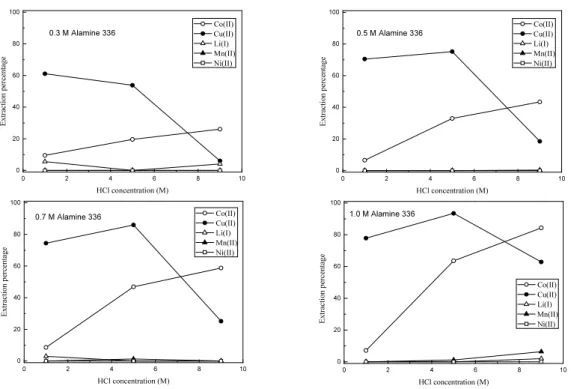
The concentration of HCl in the synthetic solution was varied from 1 to 9 M. The volume ratio of the two phases during extraction was kept at unity. Figs. 1 and 2 show the extraction results of the metals by Alamine 336 and Aliquat 336, respectively. As expected, Co(II) and Cu(II) were selectively extracted over the other metal ions by both extractants. This might be due to the for- mation of anionic complexes (CoCl3–, CoCl42–, CuCl42–) in HCl solution which can be extracted into the organic phase, while Li(I), Ni(II) and Mn(II) remained in the raffinate21-24). Mn(II) can form anionic species MnCl3-
with chloride ion25). Since the concentration of Mn(II) in the solution was only 15 mg/L, its extraction percentage was low. The results also indicated that the extraction percentage of Co(II) increased as HCl concentration increased from 1 to 9 M by both extractants. Generally, Alamine 336 should be protonated in an acidic solution to act as an anion exchanger26). The protonation reaction of Alamine 336 is represented as Eq. (1). The extraction reaction of Co(II) by Alamine 336 and Aliquat 336 can be represented as Eqs. (2) and (3), respectively. The extraction efficiency of Co(II) by Aliquat 336 is always higher than Alamine 336 in our experimental ranges.
The highest extraction percentage of Co(II) was 84% by 1 M Alamine 336 at 9 M HCl, while that by Aliquat 336 was 90%.
Table 1. Chemical composition of synthetic leach solution of spent LiBs
Element Co(II) Cu(II) Li(I) Mn(II) Ni(II)
Concentration, mg/L 24000 780 3000 15 35
0 2 4 6 8 10 0
20 40 60 80 100
Extraction percentage
HCl concentration (M)
Co(II) Cu(II) Li(I) Mn(II) Ni(II) 0.3 M Alamine 336
0 2 4 6 8 10
0 20 40 60 80 100
Extraction percentage
HCl concentration (M)
Co(II) Cu(II) Li(I) Mn(II) Ni(II) 0.5 M Alamine 336
0 2 4 6 8 10
0 20 40 60 80 100
Extraction percentage
HCl concentration (M)
Co(II) Cu(II) Li(I) Mn(II) Ni(II) 0.7 M Alamine 336
0 2 4 6 8 10
0 20 40 60 80 100
Extraction percentage
HCl concentration (M)
Co(II) Cu(II) Li(I) Mn(II) Ni(II) 1.0 M Alamine 336
Fig. 1. Effect of HCl concentration on the extraction of metals by Alamine 336. Conditions: HCl concentration: 1-9 mol/L;
Alamine 336 concentration: 0.3-1.0 mol/L; O/A ratio: 1; diluent: kerosene.
0 2 4 6 8 10
0 20 40 60 80 100
Extraction percentage
HCl concentration (M)
Co(II) Cu(II) Li(I) Mn(II) Ni(II) 0.3 M Aliquat 336
0 2 4 6 8 10
0 20 40 60 80 100
Extraction percentage
HCl concentration (M)
Co(II) Cu(II) Li(I) Mn(II) Ni(II) 0.5 M Aliquat 336
0 2 4 6 8 10
0 20 40 60 80 100
Extraction percentage
HCl concentration (M)
Co(II) Cu(II) Li(I) Mn(II) Ni(II) 0.7 M Aliquat 336
0 2 4 6 8 10
0 20 40 60 80 100
Extraction percentage
HCl concentration (M) Co(II)
Cu(II) Li(I) Mn(II) Ni(II) 1.0 M Aliquat 336
Fig. 2. Effect of HCl concentration on the extraction of metals by Aliquat 336. Conditions: HCl concentration: 1-9 mol/L;
Aliquat 336 concentration: 0.3-1.0 mol/L; O/A ratio: 1; diluent: kerosene.
R3Norg + HCl = R3NHClorg (1) CoCl3– + R3NHClorg = CoCl3R3NHorg + Cl– (2) CoCl3– + R4NClorg = CoCl3R4Norg + Cl– (3)
Unlike Co(II), the extraction of Cu(II) decreased with the increase in HCl concentration at low extractant concentrations (0.3-0.5 M). This may be ascribed to an insufficient concentration of extractants according to the molar ratio in the following reactions:
MeCl42– + 2R3NHClorg = MeCl4(R3NH)2 org + 2Cl– (4) MeCl42– + 2R4NClorg = MeCl4(R4N)2 org + 2Cl– (5)
where Me denotes both Co(II) and Cu(II).
At 9 M HCl concentration, the competition between Co(II) and Cu(II) led to much reduced extraction per- centage of Cu(II) by the two extractants (see Eqs. (2-5)).
Our results are in good agreement with previous data27).
3.2. Effect of extractant concentration
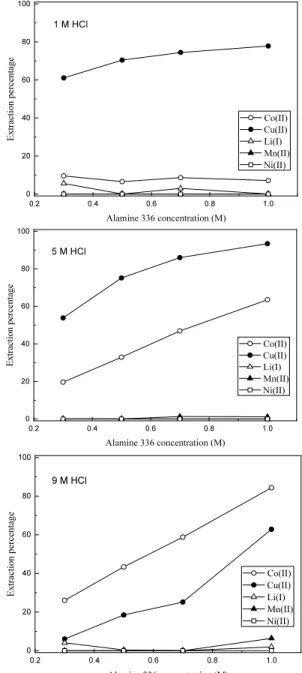
The effect of extractant concentration on the extraction of metals was investigated by varying Alamine 336 and Aliquat 336 concentration from 0.3 to 1.0 M at 1, 5, and 9 M HCl solution. The obtained results on the influence of Alamine 336 and Aliquat 336 concentration are shown in Figs. 3 and 4, respectively. It can be observed in Fig.
3 that the extraction percentage of Cu(II) increased with increasing Alamine 336 concentration from 0.3 to 1.0 M at all HCl solution. Cu(II) was selectively extracted over Co(II), Li(I), Mn(II), and Ni(II) by Alamine 336 at 1 M HCl concentration. At 1 M HCl solution, Co(II) cannot form anionic species with chloride ion and thus it would not be extracted into amines, which are in good agree- ment with the results. At 5 and 9 M HCl solution, the co-extraction of Cu(II) and Co(II) was observed, while the extraction percentage of Li(I), Mn(II) and Ni(II) was very low in the extractant concentration range. Owing to
the existence of Li(I) and Ni(II) as cationic form in strong hydrochloric acid solution, these metal ions are not extracted by amine extractants in our experiments.
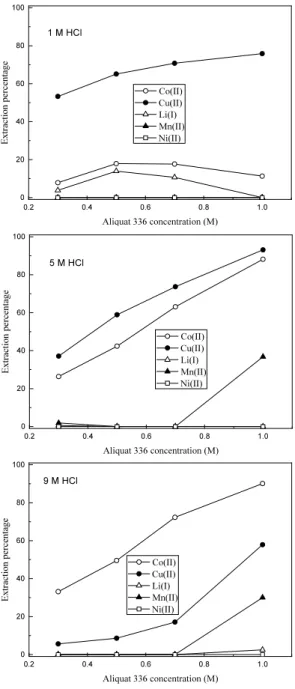
In the case of Aliquat 336, the extraction behavior of
0.2 0.4 0.6 0.8 1.0
0 20 40 60 80 100
Extraction percentage
Alamine 336 concentration (M)
Co(II) Cu(II) Li(I) Mn(II) Ni(II) 1 M HCl
0.2 0.4 0.6 0.8 1.0
0 20 40 60 80 100
Extraction percentage
Alamine 336 concentration (M)
Co(II) Cu(II) Li(I) Mn(II) Ni(II) 5 M HCl
0.2 0.4 0.6 0.8 1.0
0 20 40 60 80 100
Extraction percentage
Alamine 336 concentration (M)
Co(II) Cu(II) Li(I) Mn(II) Ni(II) 9 M HCl
Fig. 3. Effect of Alamine 336 concentration on the extrac-
tion of metals in HCl solution. Conditions: HCl
csoncentration: 1-9 mol/L; Alamine 336 concentra-
tion: 0.3-1.0 mol/L; O/A ratio: 1; diluent: kerosene.
metals is almost similar to that of Alamine 336 (see Fig.
4). The difference occurred when 1 M Aliquat 336 was employed to the solution with 5 and 9 M HCl concent- ration. Namely, about 30-36% of Mn(II) was extracted
into the Aliquat 336. Since anionic complexes of Mn(II) like MnCl3- can form in strong HCl solution, the anionic complex of Mn(II) can be extracted by amine extractants.
However, our results showed that Mn(II) was not extracted by Alamine 336, while some of Mn(II) was extracted by Alamine 336 at 5 and 9 M HCl solution.
The difference between Alamine 336 and Aliquat 336 as an anion exchanger lies in the fact that Alamine 336 needs to be protonated before extraction. At least 1 mole of HCl is needed to protonate 1 mole of Alamine 336.
Therefore, the real concentration of HCl in the aqueous phase might be reduced after being contacted to the Alamine 336. However, this decrease in HCl concent- ration cannot explain the negligible extraction of Mn(II) by Alamine 336. Considering the low concentration of Mn(II) in the solution, there might be some difference in the chemical reactivity for Mn(II) between Alamine 336 and Aliquat 336.
3.3. Comparison of extraction performance between Alamine 336 and Aliquat 336 Comparison of Figs. 3 and 4 indicates that the separation of the metals by extraction with Alamine 336 and Aliquat 336 was almost similar to each other due to the amine group in their structure. However, Alamine 336 was better than Aliquat 336 in terms of metal separation efficiency. Cu(II) as well as Co(II) can be selectively extracted by Alamine 336 from 5 and 9 M HCl solution. Moreover, only Cu(II) can be extracted by Alamine 336 from 1 M HCl solution, while Co(II) is co-extracted with Cu(II) by Aliquat 336. Besides, Mn(II) was extracted by Aliquat 336 when the concentration of HCl in the solution was 5 and 9 M. Compared to the results by Alamine 336, the coexistence of Co(II), Cu(II), and Mn(II) in Aliquat 336 results in some diffi- culties in separating the 3 metals by stripping. Therefore, Alamine 336 is considered to be an appropriate extractant for the extraction of metals from the hydrochloric acid leaching solutions of spent Li-ion batteries. In addition, control of the acidity of the solution can lead to selective
0.2 0.4 0.6 0.8 1.0
0 20 40 60 80 100
Extraction percentage
Aliquat 336 concentration (M) Co(II) Cu(II) Li(I) Mn(II) Ni(II) 1 M HCl
0.2 0.4 0.6 0.8 1.0
0 20 40 60 80 100
Extraction percentage
Aliquat 336 concentration (M) Co(II) Cu(II) Li(I) Mn(II) Ni(II) 5 M HCl
0.2 0.4 0.6 0.8 1.0
0 20 40 60 80 100
Extraction percentage
Aliquat 336 concentration (M) Co(II) Cu(II) Li(I) Mn(II) Ni(II) 9 M HCl
Fig. 4. Effect of Aliquat 336 concentration on the extraction of metals in HCl solution. Conditions: HCl con- centration: 1-9 mol/L; Aliquat 336 concentration:
0.3-1.0 mol/L; O/A ratio: 1; diluent: kerosene.
separation of the desired metal. The purification of Cu(II) at low acid media as well as the separation of Co(II) and Cu(II) in high acid concentration by Alamine 336 should be investigated in further works.
Our results confirmed that employment of Alamine 336 at strong HCl solution could result in selective extraction of Co(II) and Cu(II) from the HCl leaching solution of LiBs. Then, Li(I), Mn(II) and Ni(II) would remain in the raffinate. Therefore, the separation possi- bility of these three metal ions should be investigated from dilute HCl solution.
4. Conclusions
The spent LiBs contain some valuable metals which deserve to be recovered. The present study focused on the separation of cobalt(II) and copper(II) from the hydro- chloric acid leaching solution of spent LiBs containing Li(I), Mn(II) and Ni(II). In this work, synthetic leaching solutions of spent LiBs were employed for aqueous phase, while commercial amines like Alamine 336 and Aliquat 336 were used as organic phase. The effect of hydrochloric acid and amine concentrations on the extraction and separation was investigated. The results showed that Cu(II) was selectively extracted by the two amines at 1 M HCl solution, while both Cu(II) and Co(II) were extracted as the HCl concentration increased from 5 to 9 M. The highest extraction percentage of metals was attained as follows: 90% for Co(II) at 9 M HCl by 1 M Aliquat 336; 93% for Cu(II) at 5 M HCl by 1 M Aliquat 336. The competition for the extraction bet- ween Co(II) and Cu(II) from concentrated HCl solution led to the difference in the extraction efficiency of both metals. Alamine 336 was better than Aliquat 336 in separating Co(II) and Cu(II) from the solution.
Acknowledgment
This work was supported by the Technology Inno- vation Program (Development of Material Component
Technology) (Project number: 2011183) funded by the Ministry of Trade, Industry & Energy (MOTIE, Korea).
References
1. Kamat, P. V., 2019 : Lithium-ion batteries and beyond:
Celebrating the 2019 Nobel prize in chemistry - a virtual issue, ACS Energy Lett., 4(11), pp.2757-2759.
2. Wang, Y., Liu, B., Li, Q., et al., 2015 : Lithium and lithium ion batteries for applications in microelectronic devices: A review, J. Power Sources, 286, pp.330-345.
3. Dutkiewicz, J., Kalita, D., Maziarz, W., et al., 2020 : Effect of KOBO extrusion and following cyclic forging on grain refinement of Mg–9Li–2Al–0.5Sc alloy, Met. Mater. Int., 26, pp.1004-1014.
4. Nouri, S., Sahmani, S., Hadavi, M., et al., 2020 : Mecha- nical properties improvement of al–li 8090 alloy by using the new proposed method of directional quenching, Met.
Mater. Int., 26, pp.1134-1143.
5. Zheng, X., Gao, W., Zhang, X., et al., 2017 : Spent lithium- ion battery recycling – reductive ammonia leaching of metals from cathode scrap by sodium sulphite, Waste Manag., 60, pp.680-688.
6. Wu, C., Li, B., Yuan, C., et al., 2019 : Recycling valuable metals from spent lithium-ion batteries by ammonium sulfite-reduction ammonia leaching, Waste Manag., 93, pp.153-161.
7. Badawy, S. M., Nayl, A. A., El Khashab, R. A., et al., 2014 : Cobalt separation from waste mobile phone batteries using selective precipitation and chelating resin, J. Mater.
Cycles Waste Manag., 16(4), pp.739-746.
8. Wang, H., Huang, K., Zhang, Y., et al., 2017 : Recovery of lithium, nickel, and cobalt from spent lithium-ion battery powders by selective ammonia leaching and an adsorption separation system, ACS Sustain. Chem. Eng., 5(12), pp.
11489-11495.
9. Chiu, K. L. and Chen, W. S., 2017 : Recovery and separation of valuable metals from cathode materials of spent lithium- ion batteries (Libs) by ion exchange, Sci. Adv. Mater., 9(12), pp.2155-2160.
10. Vasilyev, F., Virolainen, S., and Sainio, T., 2019 : Numerical simulation of counter-current liquid–liquid extraction for recovering Co, Ni and Li from lithium-ion battery lea- chates of varying composition, Sep. Purif. Technol., 210, pp.530-540.
11. Xin, Y., Guo, X., Chen, S., et al., 2016 : Bioleaching of valuable metals li, co, ni and mn from spent electric vehicle li-ion batteries for the purpose of recovery, J.
Clean. Prod., 116, pp.249-258.
12. Lee, J., So, H., Cho, Y., et al., 2019 : A study on the separation and concentration of li from li-containing waste solutions by electrodialysis, Korean J. Met. Mater., 57(10), pp.656-662.
13. Nayl, A. A., Hamed, M. M., and Rizk, S. E., 2015 : Selective extraction and separation of metal values from leach liquor of mixed spent li-ion batteries, J. Taiwan Inst. Chem. Eng., 55, pp.119-125.
14. Chen, X., Chen, Y., Zhou, T., et al., 2015 : Hydrometal- lurgical recovery of metal values from sulfuric acid lea- ching liquor of spent lithium-ion batteries, Waste Manag., 38(1), pp.349-356.
15. Chagnes, A. and Pospiech, B., 2013 : A brief review on hydrometallurgical technologies for recycling spent lithium- ion batteries, J. Chem. Technol. Biotechnol., 88(7), pp.1191- 1199.
16. Liu, C., Lin, J., Cao, H., et al., 2019 : Recycling of spent lithium-ion batteries in view of lithium recovery: A critical review, J. Clean. Prod., 228(1), pp.801-813.
17. Wang, R. C., Lin, Y. C., and Wu, S. H., 2009 : A novel recovery process of metal values from the cathode active materials of the lithium-ion secondary batteries, Hydro- metallurgy, 99(3), pp.194-201.
18. Chen, X., Xu, B., Zhou, T., et al., 2015 : Separation and recovery of metal values from leaching liquor of mixed- type of spent lithium-ion batteries, Sep. Purif. Technol., 144, pp.197-205.
19. Han, D., Park, I., Kim, M., et al., 2019 : Study on the optimum conditions for synthesizing a cathode active material precursor in li-ion batteries using a Taylor reactor, Korean J. Met. Mater., 57(6), pp.360-365.
20. Kang, J., Senanayake, G., Sohn, J., et al., 2010 : Recovery of cobalt sulfate from spent lithium ion batteries by re- ductive leaching and solvent extraction with cyanex 272, Hydrometallurgy, 100(3), pp.168-171.
21. Mishra, S. and Devi, N., 2011 : Extraction of copper(II) from hydrochloric acid solution by cyanex 921, Hydro- metallurgy, 107(1-2), pp.29-33.
22. Kagaya, S., Cattrall, R. W., and Kolev, S. D., 2011 : Solid- phase extraction of cobalt(II) from lithium chloride solu- tions using a poly(vinyl chloride)-based polymer inclusion membrane with aliquat 336 as the carrier, Anal. Sci., 27(6), pp.653-657.
23. Gammons, C. H. and Seward, T. M., 1996 : Stability of manganese (II) chloride complexes from 25 to 300°C, Geochim. Cosmochim. Acta, 60(22), pp.4295-4311.
24. Ji, J. and Cooper, W. C., 1996 : Nickel speciation in aqueous chloride solutions, Electrochim. Acta, 41(9), pp.1549-1560.
25. Morris, D. F. C. and Short, E. L., 1961 : 1018. Manganese (II) chloride complexes. Part I. Stability constants, J.
Chem. Soc., pp.5148-5153. DOI:10.1039/JR9610005148.
26. Liu, Y., Jeon, H. S., and Lee, M. S., 2015 : Extraction of hydrochloric acid with binary mixtures of tertiary amine and organophosphorus acid and analysis of the interaction between the constituents of these mixtures, Hydrometal- lurgy, 155, pp.44-50.
27. Sato, T., Shimomura, T., Murakami, S., et al., 1984 : Liquid- liquid extraction of divalent manganese, cobalt, copper, zinc and cadmium from aqueous chloride solutions by Tricaprylmethylammonium chloride, Hydrometallurgy, 12(2), pp.245-254.
Minh Nhan Le
• 목포대학교 신소재공학과 학사
• 현재 목포대학교 신소재공학과 공학박사
이 만 승